News you may have missed #866

Blackwater/Academi headquartersBy IAN ALLEN | intelNews.org

►►Academic study into the behavioral traits of contract killers. Using off-the-record interviews with informants, interviews with offenders and former offenders, court transcripts and newspaper archives, academics from Britain’s Birmingham City University identified patterns of ‘hitman’ behavior in an attempt to demystify their secret world. The criminologists, who examined 27 cases of contract killing between 1974 and 2013 committed by 36 men and one woman, found that the killers typically murder their targets on a street close to the victim’s home, although a significant proportion get cold feet or bungle the job.
►►Interview with Blackwater founder Erik Prince. The founder of private security group Blackwater is now based in Hong Kong and chairs Frontier Services Group, an Africa-focused security and logistics company with intimate ties to China’s largest state-owned conglomerate, Citic Group. In an interview with The Wall Street Journal, Prince says he would “rather deal with the vagaries of investing in Africa than in figuring out what the hell else Washington is going to do to the entrepreneur next”. The controversial businessman calls the US State Department “fickle” and the US “federal bureaucracy” a “bunch of rabid dogs”.
►►New book accuses Edward Snowden of ‘treason’. Economist columnist Edward Lucas says his new book, The Snowden Operation: Inside the West’s Greatest Intelligence Disaster, does not argue that Snowden is a Russian agent. But he says that the damage caused by the former NSA technical expert’s revelations “neatly and suspiciously fits the interests of one country: Russia”. Moreover, argues Lucas, “Snowden’s published revelations include material that has nothing to do with his purported worries about personal privacy”.

South Korean ex-spy chief jailed for accepting bribes

Won Sei-hoonBy IAN ALLEN | intelNews.org

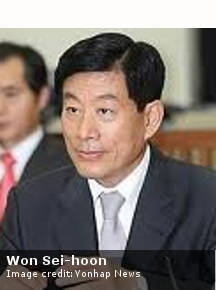
One of the most powerful figures in South Korea’s intelligence establishment has been sentenced to prison for accepting bribes in return for helping a private company acquire government contracts. Won Sei-hoon headed South Korea’s National Intelligence Service (NIS) from 2008 to 2013, during the administration of President Lee Myung-bak. The once supremely powerful organization, founded in 1961 as the Korean Central Intelligence Agency, was intimately involved in the murky South Korean politics of the Cold War era, during which the country’s political life was dominated by bloody military coups and political repression. In the late 1980s, a process of democratization began in the NIS, and in recent years many intelligence observers believed that the agency had managed to shed its controversial reputation. On Wednesday, however, a court in South Korean capital Seoul sentenced Won to two years in prison for receiving kickbacks from the private sector while heading the NIS. Won was accused of having taken over $150,000 from Hwang Bo-yeon, former director of Hwangbo Construction, in exchange for lobbying the government to award construction contracts to the company. Regular readers of this blog will recall that Won is also standing accused of having meddled in the 2012 Presidential Election. According to the official indictment in the case, Won is said to have ordered a group of NIS officers to “flood the Internet” with messages accusing liberal political candidates of being “North Korean sympathizers”. Prosecutors allege that Won initiated the Internet-based psychological operation because he was convinced that “leftist adherents of North Korea” were on their way to “regaining power” in the South. Read more of this post

News you may have missed #865

Emad ShahinBy IAN ALLEN | intelNews.org
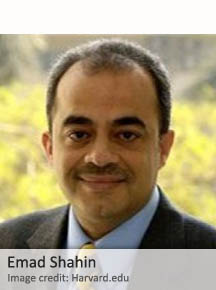
►►Renowned Egyptian scholar charged with espionage. Emad Shahin, a scholar of political Islam who has taught at Harvard, Notre Dame and the American University in Cairo and edited the Oxford Encyclopedia of Islam and Politics, has been charged along with several senior leaders of the Muslim Brotherhood with conspiring with foreign organizations to undermine Egypt’s national security. He is listed as ‘Defendant 33’ in a lengthy criminal complaint that also names former President Mohamed Morsi, who was deposed in last summer’s military takeover.
►►Al-Qaeda training Western Islamists in Syria to set up cells abroad. British newspaper The Telegraph reports that, according to security sources, Westerners fighting for the Islamist opposition in Syria are being trained and then encouraged to return to the UK to launch attacks on home soil. The paper quotes an “al-Qaeda defector” from the Islamic State of Iraq and al-Sham (ISIS), who says that “recruits from Britain, Europe and the US were being indoctrinated in extremist anti-Western ideology, trained in how to make and detonate car bombs and suicide vests and sent home to start new terror cells”.
►►Snowden has “no plans” to return to the United States. Former National Security Agency (NSA) contractor Edward Snowden has said he has “no chance” of a fair trial in the US and has no plans to return there. “There’s no no way I can come home and make my case to a jury”, he told the Free Snowden website. “Returning to the US, I think, is the best resolution for the government, the public, and myself, but it’s unfortunately not possible in the face of current whistleblower protection laws, which, through a failure in law, did not cover national security contractors like myself”, he said.

Coroner’s report sees Russian state behind ex-KGB spy’s death

Alexander LitvinenkoBy JOSEPH FITSANAKIS | intelNews.org
A previously classified report by the British government official who certified the 2006 death of former KGB officer Alexander Litvinenko states that the Russian state was directly implicated in the murder. Litvinenko was an employee of the Soviet KGB and one of its successor organizations, the FSB, until 2000, when he defected with his family to the UK. He soon became known as a vocal critic of the administration of Russian President Vladimir Putin. In 2006, Litvinenko came down with radioactive poisoning soon after meeting former KGB/FSB colleague Andrey Lugovoy at a London restaurant. Many suspect that the Russian government is behind Litvinenko’s murder. In February of last year, Litvinenko’s family accused the British government of trying to block a probe into the murder case, after British Foreign Secretary William Hague limited the scope of a public inquest in to the matter on national security grounds. Supporters of Litvinenko have argued that White Hall has played down the Litvinenko murder case in order to preserve its trade ties with Russia’s government-owned energy companies. Members of the murdered spy’s family are now pushing for a full public inquiry into the incident, and are currently making the case before a specially appointed panel of judges at the High Court. In the course of this appeal, a previously classified document has emerged, which contains the report of Sir Robert Owen, the coroner who first examined the available evidence immediately after Litvinenko’s death. According to the document, which has been seen by the BBC, the coroner concluded that, based on “documents held by the UK government”, the “culpability of the Russian state in the death of Alexander Litvinenko” could be established “prima facie”. Read more of this post

Announcement: Conference on social media and intelligence

Social networkingBy JOSEPH FITSANAKIS | intelNews.org
During the past four years, this blog has reported several incidents pointing to the increasing frequency with which spy agencies of various countries are utilizing social networking media as sources of tactical intelligence. But are we at a point where we can speak of a trend? In other words, is the rapid rise of social networking creating the conditions for the emergence of a new domain in tactical intelligence collection? Some experts now contend that the growth of social networking has given rise to a new form of intelligence-gathering: social media intelligence (SOCMINT). There are even some who believe SOCMINT should become a separate entity altogether in the intelligence process. On March 7, 2014, the Netherlands Intelligence Studies Association (NISA) will be holding a one-day conference in Amsterdam, to discuss this new phenomenon and consider some of the practical, ethical and political dilemmas involved in SOCMINT. The conference will open with a keynote speech by Sir David Omand, former director of Britain’s’ signals intelligence agency, the GCHQ, who currently teaches at the War Studies Department at King’s College, London. Other speakers come from intelligence and security services in Holland and Belgium, as well as from a variety of academic centers and non-governmental organizations in Europe and the United States. Longtime readers of this website will be familiar with NISA. The group was founded in 1991 with a mission to help focus and streamline academic work on intelligence, security and law enforcement. Read more of this post

News you may have missed #864

Otis G. PikeBy IAN ALLEN | intelNews.org
►►Germany says Obama’s NSA promise fails to address concerns. German Chancellor Angela Merkel’s government said yesterday that President Barack Obama’s pledge for new restrictions on mass surveillance by US spy agencies so far offered “no answer” to Germany’s concerns over spying. Merkel’s chief spokesman, Steffen Seibert, told reporters that Berlin would “look very closely at what practical consequences the announcements of the US president carry”, but added that key German concerns had not yet been addressed.
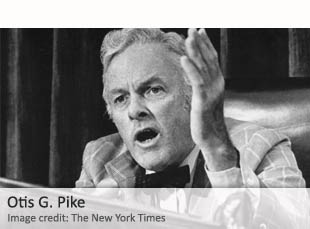
►►Longtime US Congressman who took on CIA dies. Otis G. Pike, a longtime Democratic Congressman from New York, who took on the CIA following the Watergate revelations, has died, aged 92. In 1975, he became chairman of the House Select Committee on Intelligence, which began examining suspicions that the CIA had had its hand in coups in Chile and other countries and was spying on American citizens. The inquiry paralleled one in the Senate, chaired by Frank Church. These committees marked the first time that Congress looked into allegations of abuse by the CIA and other US intelligence agencies.
►►East Timor slams Australia at The Hague over alleged spying.  The International Court of Justice in The Hague, Netherlands, is hearing a case brought against Australia by the government of East Timor. The small island nation accuses Australia of bugging the offices of key Timorese officials in an attempt to acquire inside information on a crucial energy deal. It alleges that a group of Australian Secret Intelligence Service (ASIS) officers disguised themselves as a refurbishing crew and planted numerous electronic surveillance devices in an East Timorese government office. The information collected from the listening devices allegedly allowed Australia to gain an upper hand during negotiations that led to the Certain Maritime Arrangements in the Timor Sea (CMATS) treaty.

US lawmakers say Snowden was coached by foreign spy agency

Edward SnowdenBy IAN ALLEN | intelNews.org
Two American lawmakers with senior positions in Congressional intelligence committees have expressed strong views that American defector Edward Snowden was probably coached by Russian intelligence prior to his defection. Speaking separately on Sunday, the two lawmakers —both Republican— said they suspected that Snowden had “acted in concert” with Russian intelligence in order expose Washington’s worldwide surveillance programs and steal military secrets. Snowden, a former technical expert for the Central Intelligence Agency (CIA) and the National Security Agency (NSA), is currently in Russia, where he has been granted political asylum. On Sunday, Mike Rogers, who chairs the Permanent Select Committee on Intelligence at the United States House or Representatives, said he was convinced Moscow had “at least in some part something to do” with Snowden’s defection. During separate interviews at NBC’s Meet The Press and CBS’ Face the Nation, Rogers said he thought it highly unlikely that Snowden’s defection was “a gee-whiz luck event”. He added that the former intelligence technician’s arrival in Russia had been likely pre-arranged by the FSB —the Russian Federal Security Service (though he likely meant the SVR, Russia’s Foreign Intelligence Service, which is responsible for intelligence activities outside the borders of the Russian Federation). The Republican lawmaker said that Snowden’s defection plan, ranging “from how he prepared to leave [to] his route of departure and how quickly [he] ended up in Moscow”, points to involvement by Russian intelligence. Also on Sunday, Republican Congressman Michael McCaul told ABC’s This Week that he did not think “Snowden woke up one day and had the wherewithal to do this all by himself”. The lawmaker, who chairs the US House of Representatives Committee on Homeland Security, cautioned that he could not prove definitively that Russia had a role in Snowden’s defection. Read more of this post

Confirmed: Secret talks between Assad officials and Western spies

Faisal MekdadBy JOSEPH FITSANAKIS | intelNews.org
The BBC says it has confirmed that secret meetings have been held between Western intelligence officials and senior members of the Syrian government, aimed at “combating radical Islamist groups” in Syria. In a report aired on Wednesday, the British news agency cited “informed sources” in confirming that Western intelligence officials had visited Syrian capital Damascus. While there, said the report, the officials held meetings with security agents loyal to the government of President Bashar al-Assad. The confirmation came a day after Syria’s Deputy Foreign Minister, Faisal Mekdad, told BBC’s flagship Newsnight program that the Syrian government was cooperating with Western intelligence services against radical Islamist groups that have taken up arms against President Assad. The Syrian official told Newsnight that Western governments were “finally understanding” that there was “no alternative except al-Qaeda” to Assad’s rule in Syria, and that Western security officials were in secret contact with Damascus. Asked whether he was referring to officials from Western intelligence agencies, Mekdad said he would “not specify, but many of them have visited Damascus, yes”. He added that the al-Assad government was receiving regular requests from Western countries to have their diplomats —most of whom were withdrawn following the outbreak of the civil war— return to the Syrian capital. Read more of this post

US regular troops enter Somalia for the first time in 20 years

By JOSEPH FITSANAKIS | intelNews.orgAl-Shabaab militants in Somalia
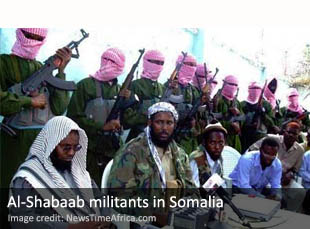
For the first time since 1993, when American troops left Somalia following the infamous ‘Black Hawk down’ incident, the US army has secretly stationed a group of regular troops in the troubled African country. The last time United States troops were in Somalia, in support of a wider United Nations stabilization operation, the administration of US President Bill Clinton decided to abandon the operation. The decision has been largely attributed to an incident known as “The Battle of Mogadishu”, in which nearly 20 American soldiers were killed. Images of their bodies being dragged by Somali militiamen through the streets of the capital resulted in major policy shift in Washington, with successive US administrations avoiding prolonged military engagements in Somalia ever since. In the post-9/11 era, American military and intelligence planners have deployed Predator drones against Somali targets from a US base in neighboring Djibouti, while rare cases have involved US Special Forces entering the country for a few hours at a time. Washington has also spent hundreds of millions of dollars to fund the nascent Somali military. But American Presidents have avoided any long-term military or civilian presence on the ground; Washington does not even maintain an embassy in Mogadishu —though most observers agree that the Central Intelligence Agency has operated a base there for years. On January 12, however, The Washington Post published a statement by US Africa Command (AFRICOM) spokesman Army Colonel Thomas Davis, in which he confirmed that the Pentagon recently established a “military coordination cell” in Somalia that “is now fully operational”. Read more of this post

News you may have missed #863

Carmi GillonBy IAN ALLEN | intelNews.org
►►Al-Qaeda controls more Arab territory than ever before. Al-Qaeda currently controls territory that stretches more than 400 miles across the heart of the Middle East. Indeed, the group appears to control more territory in the Arab world than it has done at any time in its history. Its affiliates now control much of northern and northwestern Syria as well as some parts of eastern Syria, as well as much of Anbar province, which is around a third of Iraqi territory.
►►German diplomats survive shooting in Saudi Arabia. Two German diplomats survived a shooting attack on their car while on a visit to eastern Saudi Arabia on Monday, the state news agency SPA reported, but their vehicle was burned. In Berlin, a Foreign Ministry spokeswoman said: “I can confirm that there was an incident during a drive out in the country. The car was shot at and it caught fire. There were no injuries. The embassy in Riyadh has launched an investigation”.
►►Israel’s ex-security chief flees Denmark to avoid arrest. Carmi Gillon, former director of Israel’s Shin Bet internal security agency, who is also Israel’s former ambassador to Denmark, has left the Scandinavian country following a formal complaint accusing him of committing crimes of torture and brutality against Palestinian detainees. Gillon is reported to have left the country hastily to avoid being detained.

Croatian court authorizes extradition of ex-spy official to Germany

Josip PerkovićBy JOSEPH FITSANAKIS | intelNews.org
A court in the Croatian capital Zagreb has ruled in favor of the extradition of the country’s former spy chief to Germany, where he is wanted for the communist-era murder of a Yugoslav dissident. Josip Perković was a senior official in the Yugoslav State Security Service (known by its Serbo-Croatian acronym, UDBA) during the closing stages of the Cold War. He is a prime suspect in the murder of Stjepan Đureković, a Yugoslav defector who was killed by UDBA agents in 1983. Đureković, who was of Croatian nationality, defected from Yugoslavia to Germany in 1982, while he was director of the state-owned INA oil company. Upon his arrival in Germany, he was granted political asylum and began associating with Croatian nationalist émigré groups that were active in the country. He was killed on July 28, 1983, in Wolfratshausen, Bavaria, in a UDBA operation codenamed DUNAV. In 2009, following testimonies by several former UDBA agents, who were arrested in connection with the crime, the Office of the German Federal Prosecutor issued a European Arrest Warrant for Perković, who is believed to have authorized Đureković’s assassination. However, Croatia consistently refused to honor the warrant and allowed Perković to live in Zagreb. The reason, according to observers, was that the former spy official was instrumental in helping set up Croatia’s first post-independence intelligence agency, which he directed for the first few years of its existence. His contribution to the establishment of Croatia’s intelligence apparatus has contributed to his political legacy in the country, which effectively shielded him from extradition to Germany. Read more of this post

Analysis: How al-Qaeda changed the Syrian Civil War

Regional map of SyriaBy IAN ALLEN | intelNews.org
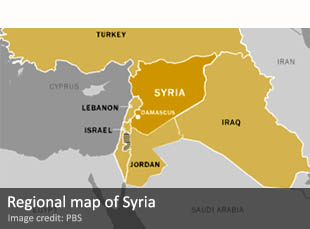
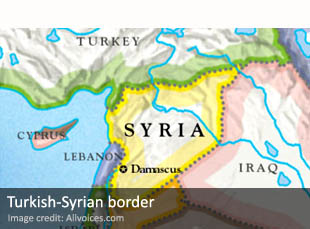
Until relatively recently, few observers believed that the government of Bashar al-Assad had a future in war-torn Syria. But the situation in the world’s most active battle zone has changed drastically in recent months, and now many suggest that the Assad forces are dominating the conflict. In a recent article in The New York Review of Books, Sarah Birke, a Middle East correspondent for The Economist, argues that it was the presence of al-Qaeda that changed the balance of power between the warring sides. She points the finger at the Islamic State of Iraq and Greater Syria, or ISIS, an al-Qaeda-linked group that made its appearance in Syria in April of last year. Since that time, ISIS has turned into “one of the most powerful forces on the ground”, with 7,000 well-armed fighters, many of whom are battle-hardened foreign Islamists. The origins of ISIS are in Iraq, where it was founded in 2003 as a Sunni armed paramilitary force, in response to the invasion by the United States. In 2004, the group pledged allegiance to al-Qaeda and Osama bin Laden, and changed its name to Al-Qaeda in Iraq (AQI). The United States government has pledged $10 million in return for information leading to the capture of the group’s leader, Abu Bakr al-Baghdadi, but with no success so far. In the spring of 2003, the Iraqi-born al-Baghdadi announced the merger of AQI with the Al-Nusra Front, AQI’s branch in Syria. Since that time, the two unified groups have been commonly referred to as the Islamic State of Iraq and al-Sham —al-Sham being a reference to ‘greater Syria’, known also as ‘the Levant’. Birke reports that ISIS now dominates Syria’s northwest, having established outposts in a series of “strategic towns” in the region, which are referred to by its leaders as “mini emirates”. Through these outposts, ISIS fighters are able to monitor border traffic between Syria and Turkey, and effectively control most border passages. This has crippled the Free Syrian Army, which used to dominate the Syrian opposition with the help of generous donations of money and war material coming in from Turkey. Read more of this post

Leftist group behind 1971 burglary of FBI office comes forward

FBI field office in Media, PaBy JOSEPH FITSANAKIS | intelNews.org
Members of an American leftwing group, who in 1971 burgled a regional branch of the Federal Bureau of Investigation (FBI), stealing documents that revealed illegal government activities, have come forward. The mysterious group, which called itself The Citizens’ Commission to Investigate the FBI, is credited by historians as having unearthed the initial revelations that eventually led to the exposure of COINTELPRO. The acronym stood for COunter INTELligence PROgram; it incorporated a host of questionable and often illegal activities by the FBI, which were aimed at discrediting domestic political organizations considered ‘radical’ by longtime FBI Director J. Edgar Hoover. The program targeted mostly nonviolent antiwar groups and black civil rights organizations and leaders, including Dr. Martin Luther King, Jr., who was regarded by Hoover as a communist agent. In association with the Watergate scandal, the COINTELPRO revelations led to the creation of the Church and Pike committees in Congress, which radically restructured the oversight of the United States Intelligence Community. The burglary took place on the evening of March 8, 1971, in the town of Media, Pennsylvania. It resulted in the theft of over 1,000 documents, which were then reproduced and mailed anonymously to several national newspapers, including The New York Times and The Washington Post. Nearly half of the stolen documents concerned surveillance and disruption operations —mainly blackmail, intimidation and sabotage— against liberal groups. They also included a controversial directive by Director Hoover to place “an FBI agent behind every mailbox” in America. A furious Hoover placed as many as 200 agents on the burglary case; but the investigation got nowhere, and the Bureau was forced to close the case in March 1976, having failed to conclusively identify the burglars. But now a new book written by Betty Medsger, who at the time of the burglary was working for The Washington Post, has revealed for the first time the identities of four of the eight-member team that carried out the burglary. Read more of this post

Discovery of spy parts leaves French-UAE satellite deal in doubt

Jean-Yves Le Drian and Crown Prince Sheikh Mohammed bin ZayedBy IAN ALLEN | intelNews.org
The planned acquisition of two French-built spy satellites by the United Arab Emirates appeared to be in doubt last night, after news that technicians discovered “security-compromising components” in the satellites’ software. The agreed purchase, which is to be completed in 2018, concerns two Falcon Eye military observation satellites worth nearly €700 million (US $930 million). The deal, signed last July by French Defense Minister Jean-Yves Le Drian and Crown Prince Sheikh Mohammed bin Zayed of Abu Dhabi, includes the provision of a ground station, as well as the training of up to 20 UAE engineers who will staff it. Two companies, Thales Alenia Space and Airbus Defence and Space, were contracted for the project. The French bid was chosen from an original shortlist of 11 bidders, along with a similar one from the United States. Ultimately, the American bid was rejected by Abu Dhabi, due to the operational restrictions placed by the American makers of the proposed satellites. At the time, the French-UAE deal raised eyebrows in defense circles worldwide, as it was the first time that France had agreed to sell military-grade high-resolution satellites to a foreign buyer. But an article in US-based defense industry publication Defense News, said software engineers in the UAE had discovered a number of components in the satellites that seem designed to “provide a back door to the highly secure data transmitted to the ground station”. Interestingly, the back-door components appeared to have come from US suppliers. Read more of this post

Exiled Rwandan ex-spymaster found murdered in South Africa

Patrick KaregeyaBy JOSEPH FITSANAKIS | intelNews.org
The former head of Rwanda’s external intelligence agency, who had been branded an ‘enemy of the state’ by the Rwandan government, was murdered last week in South Africa. Police in Johannesburg said the body of Patrick Karegeya, 53, was found in a room at the luxury Michelangelo Towers Hotel, where he had gone to meet a fellow Rwandan. His neck was abnormally swollen and showed signs of strangulation; a rope and a bloodied towel were found tucked inside the hotel room’s safe. Karegeya was a leading member of the Rwandan Patriotic Army (RPA), the armed wing of the Rwandan Patriotic Front (RPF), which was founded in 1987 in Uganda by Rwandan Tutsi refugees. In 1994, the RPA, led by Paul Kagame, took control of Rwanda, thus ending the genocide of up to a million Tutsis and moderate Hutus, which had taken place earlier that year. Soon afterwards, Karegeya was named Director General of External Intelligence in the RPA, which was renamed to Rwandan Defense Forces. In 2004 however, after falling out with Kagame, who had become President of Rwanda in 2000, Karegeya was arrested, stripped of his rank of colonel, and served 18 months in prison for “insubordination and desertion”. He fled the country in 2007 and received political asylum in South Africa. The Rwandan government later claimed that Karegeya had been a double spy for South Africa. In 2010, Karegeya teamed up with General Faustin Kayumba Nyamwasa, who used to head the Rwandan Army, and had also escaped to South Africa after falling out with President Kagame. The two formed a new Rwandan opposition party in-exile, called the Rwanda National Congress. The response from the government in Kigali was to try Karegeya and Nyamwasa in absentia in a military court. They were both sentenced to lengthy prison terms for “promoting ethnic divisions” in the country. In 2011, the Rwandan government issued international arrest warrants for the two former military men, but South Africa refused to extradite them. Since then, General Nyamwasa has survived two assassination attempts against him in South Africa. The BBC notes that other former allies of President Kagame, who have received political asylum in the West, have been warned by Western intelligence agencies that their lives may be in danger. Read more of this post