Is Texas Army base home to secret CIA weapons facility?
May 5, 2014 2 Comments
 By JOSEPH FITSANAKIS | intelNews.org
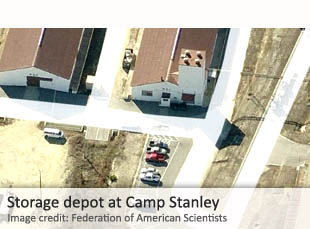
Observers of the Central Intelligence Agency know that the Agency maintains two widely acknowledged facilities inside the United States —both in the state of Virginia. One is its headquarters in Langley. The other is inside the Armed Forces Experimental Training Activity, known more commonly as Camp Peary, located near Williamsburg, where officers of the CIA’s National Clandestine Service are allegedly trained. However, for many decades researchers have speculated that the Agency maintains a third facility, which it uses to stockpile and distribute weapons around the world. The facility has been referred to in declassified documents as the “Midwest Depot”. It is said that billions of dollars of untraceable weapons have been dispatched from the “Midwest Depot” to CIA-supported groups such as Brigade 2506, which conducted the 1961 Bay of Pigs invasion. Other paramilitary groups said to have received weapons from the CIA’s “Midwest Depot” include the Honduras-based Contras, who fought the Sandinistas government in 1980s’ Nicaragua, Angola’s UNITA anti-communist group, as well as the Sunni mujahedeen who fought the Soviet Red Army in Afghanistan. Now the location of this mysterious depot may have been unearthed thanks to Allen Thomson, a retired CIA analyst. In a 73-page research paper, Thomson concludes that the location of the “Midwest Depot” is actually in Texas. The paper has been published (.pdf) on the website of the Federation of American Scientists’ Intelligence Resource Program, which maintains an extensive archive on topics of current interest to intelligence researchers. Based on what The New York Times calls “a mosaic of documentation”, Thomson claims that the CIA’s “Midwest Depot” is located inside Camp Stanley, located north of San Antonio, Texas. The latter is officially indexed as a US Army weapons depot. But Thomson says the depot is in fact commanded by the CIA. His paper highlights an explicit reference made to Texas in a memo drafted in 1986 by Colonel Oliver North, who was eventually convicted in connection with the Iran-Contra scandal. In it, North states that the CIA would transport missiles headed for Iran from a military facility to its “Midwest Depot, Texas”. Read more of this post






















Germans kidnapped in Ukraine had ‘intelligence connections’
May 6, 2014 by Ian Allen Leave a comment
Four German military observers, who were kidnapped in Ukraine by pro-Russian separatists, are members of a military agency that has intelligence contacts, but are not themselves spies, according to a leading German newspaper. The German observers were abducted along with several other Western military officials on April 25, in the eastern Ukrainian city of Sloviansk. They were participating in a military verification mission organized by the Organization for Security and Cooperation in Europe (OSCE). At the time of the abduction, one pro-Russian separatist leader, Vyacheslav Ponomarev, said his group had decided to detain the OSCE monitors due to “credible information” that they were spies for the North Atlantic Treaty Organization (NATO). The OSCE strongly denied the accusation that its monitors were intelligence operatives, saying that the kidnappers’ claims were aimed at damaging the reputation of the organization. With nearly 60 signatories to its charter, the OSCE has operated since 1975 with the aim of securing peace across the European continent. It regularly supplies military observers to investigate what it terms “uncommon military operations” in nations that formally invite their presence, as Ukraine did last month. On Monday, German newspaper Süddeutsche Zeitung said that, although the four German OSCE observers are not employees of German intelligence agencies, they do maintain “certain connections” with Germany’s Federal Intelligence Service, known as Bundesnachrichtendienst, or BND. The Munich-based broadsheet claimed that the inspectors, who had been given diplomatic status during their deployment in Ukraine, are not members of staff at the BND or MAD, Germany’s Military Counterintelligence Service. However, they are employed at the Verification Center of the Bundeswehr —Germany’s federal armed forces. The mission of the Center, which is based in the town of Geilenkirchen, in Germany’s North Rhine-Westphalia, is to verify compliance with weapons control agreements signed between Germany and other countries. Read more of this post
Filed under Expert news and commentary on intelligence, espionage, spies and spying Tagged with BND, Bundeswehr, Bundeswehr Verification Center, Geilenkirchen, Germany, MAD (Germany), News, OSCE, Ukraine, Vyacheslav Ponomarev