Belgian university shuts down Chinese-funded institute due to espionage claims
December 12, 2019 Leave a comment
 One of Belgium’s leading universities has decided to shut down a research institute funded by the Chinese government, after the Belgian intelligence service accused its director of spying on behalf of Beijing. The news was announced on Wednesday by the Vrije Universiteit Brussel (VUB), one of Belgium’s leading higher-education institutions. The Confucius Institute has been operated at VUB since 2006. But the university’s board of directors now says that it will not be renewing its contact with the Institute in 2020.
The Confucius Institute at VUB is one of more than 500 such research bodies that the government of China has funded around the world since 2004. Their mission is to promote the language and culture of China to the world. However, numerous academic institutions in Japan, Canada, and a number of European countries, have recently shut down Confucius Institute branches, following allegations that their staff members carried out espionage tasks, or tried to stifle academic research critical of China. In Europe alone, the University of Lyon in France, Stockholm University in Sweden, and Holland’s University of Leiden have all recently terminated their cooperation with the Confucius Institute.
In October of this year, Belgium’s State Security Service (VSSE) concluded that the VUB Confucius Institute director, Dr. Song Xinning, carried out espionage tasks on behalf of the Chinese government. As a result, the Belgian government refused to renew the work visa of Dr. Song, who had lived in Belgium for over a decade. Additionally, the Chinese academic was barred from entering the European Union’s Schengen Area —which comprises 26 European countries— for eight years.
Dr. Song alleges that his work visa was revoked after he refused to cooperate with an American diplomat stationed in Brussels. He also denies that he was ever in the service of Chinese intelligence or the Chinese state. But the VUB appears to have sided with the Belgian government in this dispute. The university annulled its contract with Dr. Song and, as of January, will be terminating its relationship with the Confucius Institute. In a press statement published online, VUB Rector Caroline Pauwels said that the work of the Confucius Institute did not meet the “current policy objectives” of the university.
► Author: Ian Allen | Date: 12 December 2019 | Permalink
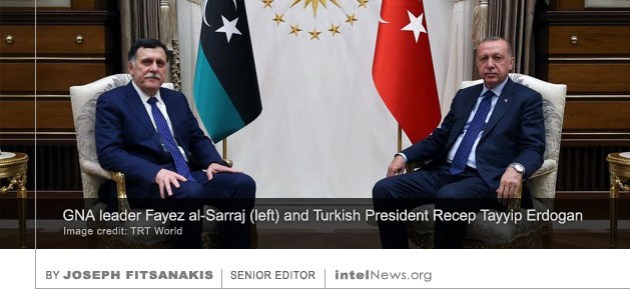 Turkish President Recep Tayyip Erdoğan has said his country is prepared to deploy troops to Libya, just days after Ankara surprised analysts by announcing an agreement with the embattled Libyan government in Tripoli. The Turkish-Libyan agreement has spurred angry reactions from Israel, Greece and Egypt, all of which are
  Victor Ivanovich Sheymov, who is often referred to as one of the most important intelligence defectors of the Cold War, has reportedly died in the American state of Virginia. He was one of the most senior officials in the Soviet Union’s Committee for State Security (KGB) to ever defect to the West, and revealed important KGB secrets to the United States.
 An unprecedented closed-door trial of a man identified only as “Witness J”, who was convicted earlier this year of a crime that cannot be revealed, has raised questions about the relationship between security and the law in Australia. The man, who is also known as “Prisoner 123458”, was sentenced to a jail sentence in February of this year. His sentencing came following a closed-door hearing, which was
 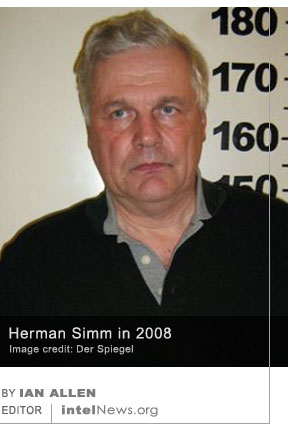 A court in Estonia has ordered the release of a former senior defense official who spied on the North Atlantic Treaty Organization for Russia, causing what experts
  An elite group Russian military intelligence officers, who have participated in assassinations across Europe, have been using resorts in the French Alps as logistical and supply bases, according to a new report. The report concerns Unit 29155 of the Main Directorate of the General Staff of the Russian Armed Forces, commonly known as GRU.
 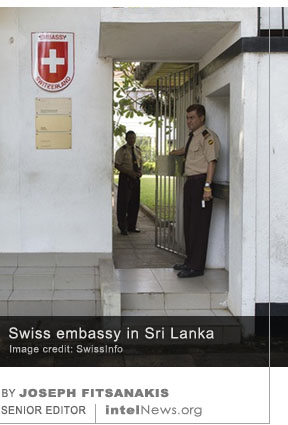 Switzerland has filed a formal complaint after an employee of the Swiss embassy in Sri Lanka was allegedly abducted by men who forced her to divulge sensitive information about the embassy and its activities. The Swiss Ministry of Foreign Affairs
 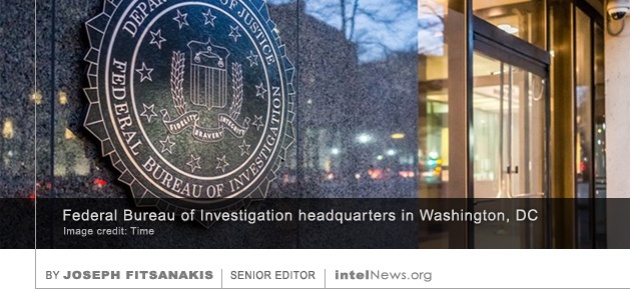 The United States Federal Bureau of Investigation says it is examining possible counterintelligence threats in connection with the popular online application FaceApp, which is headquartered in Russia. The application first made its appearance in January of 2017 and quickly became popular among smartphone users around the world. It allows users to upload a photograph of their face and then edit it with the help of artificial-intelligence software. The software can change the user’s photograph to make it look younger or older, or make it look as if it is from the opposite gender. The result can be impressively realistic and life-like.
 The European multinational aerospace corporation Airbus has fired 16 of its employees for illegally possessing classified documents belonging to the German military. The Netherlands-registered aviation company, one of the world’s largest, has been cooperating with an investigation into the incident. The probe has been led by German authorities since September of 2018.
 An intense fight between the United States and Russia over the extradition of a Russian cryptocurrency tycoon being held in Greece, is raising questions about the possible use of cryptocurrencies by spies. The tycoon in question is Aleksandr Vinnik, 39, who in 2011 co-founded BTC-e, an international cryptocurrency-trading platform. BTC-e allowed users to buy or sell several popular cryptocurrencies, including bitcoin and litecoin, using Russian rubles, United States dollars, or European Union euro currencies. Although headquartered in Russia, BTC-e’s servers were located in Bulgaria, while its operations were conducted through its offshore components in Cyprus and the Seychelles.
 As the Australian government has launched an official investigation into the claims made by a self-styled Chinese intelligence defector, some skeptics have begun to cast doubts about his revelations. The claims of Wang “William” Liqiang have dominated news headlines in Australia for over a week. The 26-year-old from China’s eastern Fujian province reportedly defected to Australia in October, while visiting his wife and newborn son in Sydney. He is currently reported to be in a safe house belonging to the Australian Security Intelligence Organization (ASIO).
 The law enforcement agency of the European Union, in cooperation with the popular online messaging service Telegram, has culled thousands of Islamic State online accounts in what it described as “a day of action”. The operation was coordinated by the European Union Agency for Law Enforcement Cooperation, better known as Europol. The agency coordinated its activities with the popular instant-messaging service Telegram, which the Islamic State has used as its main platform of mass communication since 2014.
 A Chinese intelligence defector has reportedly given the Australian government information about entire networks of Chinese undercover spies in Hong Kong, Taiwan and Australia, according to reports. The story of Wang “William” Liqiang, made headlines all over Australia during the weekend, culminating in an entire
  South Korea appears determined to reject calls from the United States to maintain an intelligence-sharing agreement with Japan, as relations between Seoul, Tokyo and Washington continue to experience tensions. The South Korean government has been issuing warnings since August that it will






 intelNews.org
Germany convicts married couple of spying for Indian intelligence service
December 13, 2019 by Joseph Fitsanakis Leave a comment
According to the prosecution, Manmohan S. was recruited by India’s Research and Analysis Wing (RAW) in January of 2015. His wife joined his intelligence-collection activities in July 2017. Following their arrest, the couple told German authorities that they held regular meetings with a RAW case officer who was serving as a diplomat in the Indian consulate in Frankfurt. They also said they were paid nearly $8,000 for their services.
The two convicted spies said at their trial that they were tasked to spy on adherents of the Sikh religion and members of the Kashmiri expatriate community in Germany. The central European country is believed to host as many as 20,000 Indian Sikhs, many of whom openly proclaim secessionist aspirations. Many Sikhs in India and abroad campaign for the creation of a Sikh state in parts of northwestern India and Pakistan, which they call Khalistan. India is also concerned about the secessionist aspirations of Kashmiris, a predominantly Muslim population of 10 million that lives in the region of Jammu and Kashmir. Delhi has long claimed that expatriate groups living in Europe and the United States provide funding for secessionist groups that operate in the region.
On Thursday, Frankfurt’s Higher Regional Court found the couple guilty of conducting illegal espionage activities on German soil. It handed Manmohan S. a one-and-a-half-year suspended jail sentence, while Kanwal Jit K. was given a fine that equates to 180 days of income.
► Author: Joseph Fitsanakis | Date: 13 December 2019 | Permalink
Filed under Expert news and commentary on intelligence, espionage, spies and spying Tagged with espionage, Germany, India, Indian consulate in Frankfurt, Jammu (India), Kanwal Jit K., Kashmir (India), lawsuits, Manmohan S., News, non-official-cover, Sikhism