Israeli officials announce arrest of alleged deep-cover spy for Iran

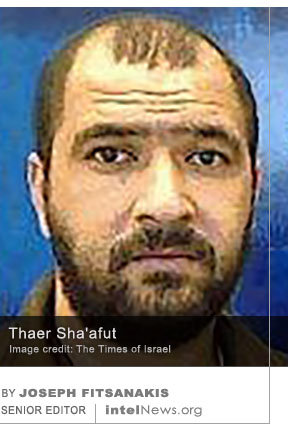
Thaer Sha'afutIsraeli authorities announced on Thursday the arrest of a deep-cover intelligence operative who allegedly attempted to establish a base for Iranian intelligence in Israel and the West Bank, according to news reports from Israel. Shin Bet, Israel’s domestic security and counterintelligence agency, said it arrested Thaer Sha’afut (pictured), a Jordanian national, on espionage charges. The arrest reportedly occurred in April, but was only announced this week. According to Shin Bet officials, Sha’afut was an accredited deep-cover intelligence operative for the Iranian spy services. He was allegedly was commissioned “to carry out missions that were meant to establish a network in Israel and the West Bank, which would be used for covert operations by the Iranians”.
Israeli officials said Sha’afut received instructions from his Iranian handlers to enter Israeli territory between July and August of 2018. After entering Israel, his goal was “to form business ties” in the West Bank and in Israel proper. He planned to do that, said the Shin Bet, by hiring Shiite Muslims to staff a new factory in Jordan and then use the new venture “as an anchor for future Iranian activities in Israel and the West Bank”. These activities included the eventual recruitment of “spies who would help collect intelligence for Iranian interests”, according to court documents. The Shin Bet said that Sha’afut’s handlers were two Arabic-speaking Iranian intelligence officers based in Lebanon and Syria, who went by the names Abu Sadek and Abu Jaffar. They allegedly provided Shafut with “an encrypted communication device”, which he used to arrange clandestine meetings with them throughout 2018 and 2019.

Sha’afut’s Iranian handlers allegedly planned to use him as a conduit for transferring funds to spies in the West Bank and Israel. They had told Sha’afut that Iranian intelligence would make an initial investment of $500,000 in his factory venture in Jordan and to an import-export business, in order to sustain his base of operations, with more funds to follow. Once the factory was set up, Sha’afut was expected to travel clandestinely to Iran in order to complete his training as a deep-cover case officer. Israeli daily Haaretz said on Thursday that Sha’afut was indicted earlier this month by military prosecutors in Jerusalem for “contact with an enemy country, contact with a hostile organization, and conspiracy to funnel money from an enemy entity”.

Author: Joseph Fitsanakis | Date: 21 June 2019 | Permalink

Indian officials admit for first time Islamic State militants are present in Kashmir

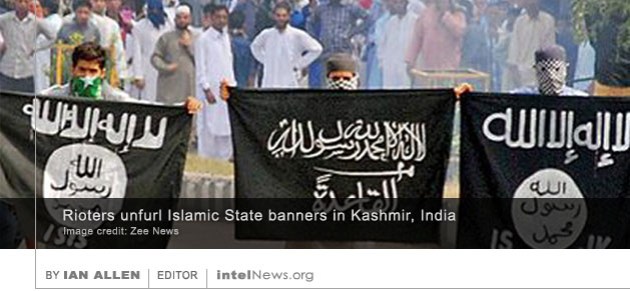
Islamic State India KashmirIndian counterterrorism officials have alleged in court that four members of the Islamic State in Indian-administered Kashmir were guided by a handler from Pakistan. The court case involves four young men from Jammu and Kashmir who were arrested last November on terrorism charges. Court documents filed recently identify the four as members of the Islamic State. This development is significant because Indian officials have until recently dismissed as overstated claims that the Islamic State is present in Kashmir. The unfurling of Islamic State banners by anti-government rioters is a regular phenomenon in Indian Kashmir. But government officials dismiss those who wave such banners as impressionable youth who have no access to weaponry or logistical support from the Islamic State. Last November’s arrests, however, highlighted the fact that the Islamic State does in fact have an armed presence on the ground in India.

The four young men have been named as Haris Mushtaq Khan, Tahir Ahmad Khan, Asif Suhail Nadaf and Asif Majid. They were apprehended in Srinagar, Jammu and Kashmir’s largest city, following the arrest in September of 2018 of two other men who were allegedly affiliated with a group calling itself the Islamic State in Jammu and Kashmir (ISJK). The group has since renamed itself to Islamic State – Khorasan Province, while recently it proclaimed an overseas province in the region, which it calls “wilayah al-Hind” (province of Hind). Three of the four men have been charged with attacking a tourist visitor center in the area with hand grenades. In their official indictment against the four men, officers of India’s National Investigation Agency accuse them of being “confirmed terrorists of the Islamic State”, which amounts to the first confirmation in Indian government documents of the presence of Islamic State militants in India. The 28-page indictment states that the four men were among several locals who “acted as ground workers and […] provided logistics to the ISJK cadres”.

Additionally, two of the men, Haris and Tahir, are accused of having been in contact online with a man identified as Abu Huzefa, an Islamic State recruiter based in Afghanistan. According to the court documents Huzefa is a Pakistani national and “an active cadre of the Islamic State based in Afghanistan”. He was allegedly in regular contact with the two Indian men and provided them with Islamic State literature and other propaganda material. In their indictment the NIA officers also admit that the arrests of the four men point to “a larger conspiracy of these terrorist elements propagating pan-Islamic ideology of IS by recruiting and radicalizing Kashmiri youth towards jihad and targeting security forces”.

Author: Ian Allen | Date: 20 June 2019 | Permalink

Iran says it dismantled a ‘complicated’ CIA cyber operation in several countries

Ali ShamkhaniA senior Iranian security official said on Monday that Tehran had dismantled “one of the most complicated” espionage operations by the United States Central Intelligence Agency, leading to “arrests and confessions” of suspects in several countries. The announcement was made by Ali Shamkhani (pictured), secretary of the Supreme National Security Council of Iran, the Islamic Republic’s highest security decision-making body, which is chaired by the country’s president.
Speaking in Tehran to reporters from pro-government news agencies, including IRIB and Fars News, Shamkhani said that Iran had “exposed” what he described as a CIA-run cyber espionage network, which carried out “operations in different countries”. He said the alleged espionage network had been detected by Iranian counterintelligence agencies “some time ago and was dismantled”. Iran’s counterintelligence actions had led to the “identification and arrest of CIA intelligence agents”, said Shamkhani, many of whom had been arrested “in different countries”. The arrests occurred after Iran “shared the information about the exposed network with our allies”, said Shamkhani, which led to the “disclosure and dismantling of a network of CIA officers” as well as the “detention and punishment of several spies”. Shamkhani did not specify the number of people arrested, or in which countries, but appeared to refer to both CIA personnel and local assets. He concluded his remarks by saying that Iran was building a regional alliance “to counter American espionage”. He also urged Iran’s Ministry of Intelligence to release “videos and confessions” relating to the arrests.

Meanwhile, Iranian anti-government groups based abroad alleged on Monday that a senior official in the Islamic Revolutionary Guard Corps was arrested in Tehran for allegedly working for Israel. The unidentified individual is believed to have helped Israel’s Mossad intelligence agency gain access to the archive of the Iranian nuclear program in 2018, and steal an unspecified number of classified documents. It is not known whether this alleged arrest is connected with Shamkhani’s announcement on Monday.

Author: Joseph Fitsanakis | Date: 18 June 2019 | Permalink

Pakistan dismisses head of powerful spy agency after only eight months on the job

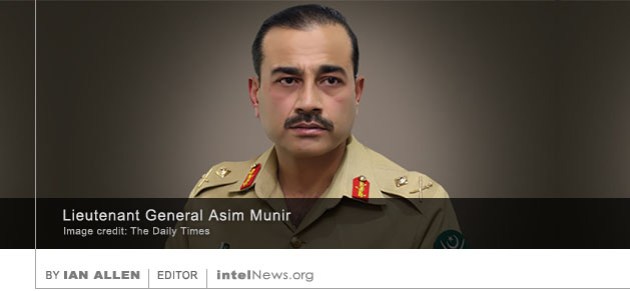
Lieutenant General Asim MunirIn a surprising move the Pakistani military has dismissed the head of the powerful Inter-Services Intelligence (ISI) spy agency just eight months after appointing him to that position. The decision was announced on Sunday in a brief statement by the Inter-Services Public Relations, the public-relations wing of the Pakistan Armed Forces. The statement said that Lieutenant General Asim Munir had stepped down from his post as director of ISI and would take over as commander of the Gujranwala Corps in Punjab, Pakistan’s second-largest province. The statement did not explain the reasons for the reshuffle; the latter came as a surprise, as ISI directors typically serve for at least three years in that post. General Munir’s tenure began in October of this year.
General Munir has been replaced by Lieutenant General Faiz Hameed, who until this latest appointment was head of the ISI’s counterintelligence directorate. Last October, when General Munir was promoted to ISI director, Hameed was promoted to the rank of three-star general. In April he was promoted again, this time from major general to lieutenant general, and was appointed Adjutant General at the General Headquarters of the Pakistan Armed Forces. His meteoric rise in the ISI has won him several devotees and he is seen as an influential intelligence planner in the ranks of the powerful spy agency. He rose to prominence outside of the ISI in late 2017, when he personally mediated to broker a deal between the government of then-Prime Minister Nawaz Sharif and leaders of the so-called Ahmadiyya community. Followers of the Ahmadiyya movement, a messianic Muslim sect with a substantial following in the Punjab, had taken to the streets to complain of discrimination and harassment by the authorities. According to media reports at the time, Hameed threatened to use the Pakistani Army against the Ahmadiyya protesters if they did not scale down their public protests. Such reports cause some in Pakistan to view Hameed as a military hardliner and a firm believer in the view of the military as the guarantor of political normalcy in Pakistan.

Meanwhile in an unrelated development Indian officials said on Sunday that Islamabad had alerted Delhi of a possible attack by al-Qaeda in a region of Indian-administered Kashmir. Media reports said that Indian officials had been warned by the ISI that al-Qaeda forces planned to carry out “a major terror strike” in the Pulwama region of southern Kashmir. Security observers noted the move as a rare instance of intelligence cooperation between the two rival nuclear-armed nations. As a result, India said it had deployed nearly 500 additional companies of police officers in the southern Kashmir region.

Author: Ian Allen | Date: 17 June 2019 | Permalink

Trump says US will not use spies on North Korea, then appears to retract statement

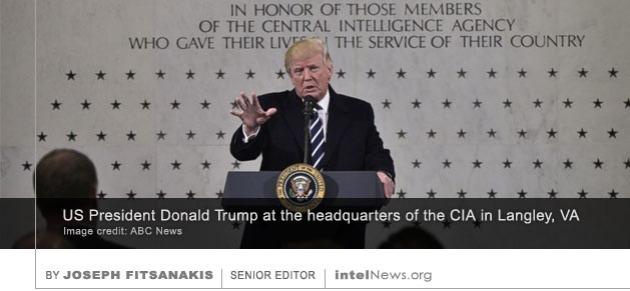
Trump CIA - JFUnited States President Donald Trump said on Tuesday that he would not allow American intelligence agencies to use spies against North Korea, raising eyebrows in Washington, before appearing to backtrack a day later. The American president was speaking to reporters at the White House on Tuesday, when he was asked about a report that appeared in The Wall Street Journal that day. According to the report, Kim Jong-nam, the half-brother of North Korean leader Kim Jong-un, held regular meetings with officers of the US Central Intelligence Agency before he was assassinated with VX nerve gas at a busy airport terminal in Malaysia in February 2017. The Wall Street Journal’s claim was echoed by a book written by Washington Post correspondent Anna Fifield, which also came out on Tuesday. In the book, entitled The Great Successor, Fifield claims that Kim had traveled to Malaysia to meet his CIA handler when he was killed.

On Tuesday, President Trump said he had seen “the information about the CIA, with respect to [North Korean Supreme Leader Kim Jong-un’s] half-brother. And I would tell [Kim] that would not happen under my auspices, that’s for sure”, said the US president, before repeating, “I wouldn’t let that happen under my auspices”. Reporters interpreted Trump’s comments to mean that he would not use human assets or any other kinds of informants to collect intelligence on the regime of the North Korean leader. As can be expected, the US president’s remarks raised eyebrows among lawmakers and national security experts in Washington. It was suggested that Trump appeared to voluntarily eliminate a potentially invaluable tool of intelligence collection from America’s arsenal. The president’s comments were even more peculiar given the hermetically sealed nature of the North Korean regime, which Western spy agencies would argue necessitates the use of human assets for intelligence collection. Moreover, President Trump’s comments appeared to once again place him at odds with his own Intelligence Community, as previously in the cases of Iran’s nuclear program, the current status of the Islamic State, or Russia’s meddling in American political life.

On Wednesday, however, the US president appeared to backtrack on his comments. When asked at a joint press conference with Polish President Andrzej Duda about his earlier remarks, Trump denied that he had implied the US would not use spies to collect information on North Korea. “No, it’s not what I meant”, the president responded to the reporter who asked him the question. “It’s what I said and I think it’s different, maybe, than your interpretation”, said President Trump, but refused to elaborate on what he actually meant with his statement on Tuesday. The Reuters news agency contacted the CIA seeking an official statement on the US president’s remarks, but the agency said it had no immediate comment on the issue.

Author: Joseph Fitsanakis | Date: 13 June 2019 | Permalink

North Korean leader’s half-brother worked with CIA before his death, paper claims

Kim Jong-nam murderKim Jong-nam, the half-brother of North Korean leader Kim Jong-un, held regular meetings with American intelligence officers before he was assassinated with VX nerve gas at a busy airport terminal in Malaysia. Two women approached Kim Jong-nam as he was waiting to board a plane at the Kuala Lumpur International Airport on February 13, 2017. The estranged half-brother of the North Korean leader was about to travel to the semi-autonomous Chinese territory of Macau, where he had been living in self-exile since 2007. Soon after his encounter with the two women, Kim collapsed and eventually died from symptoms associated with VX nerve agent inhalation.

But a new book published on Tuesday by a Washington Post reporter, and an article that came out in The Wall Street Journal on the same day, allege that Kim Jong-nam was working with the United States Central Intelligence Agency and was in fact in Malaysia to meet with his American spy hander when he was killed. The Wall Street Journal article said that many details of Kim Jong-nam’s precise relationship with the CIA remain “unclear”. It is doubtful that the late half-brother of the North Korean leader had much of a powerbase in the land of his birth, where few people even knew who he was. So his usefulness in providing the CIA with crucial details about the inner workings of the North Korean regime would have been limited. However, the paper quoted “a person knowledgeable about the matter” as saying that “there was a nexus” between the CIA and Kim. The article also alleges that Kim met with CIA case officers “on multiple occasions”, including during his fateful trip to Malaysia in February of 2017.

In her just-published book The Great Successor, Anna Fifield, a correspondent with The Washington Post, claims that Kim spent a number of days on the island of Langkawi, a well-known resort destination in Malaysia. Security footage at his hotel showed him meeting with “an Asian-looking man [Korean-American, according to The Wall Street Journal] who was reported to be an American intelligence [officer]”. It was one of regular trips Kim took to places like Singapore and Malaysia to meet his spy handlers, according to Fifield, who cites “someone with knowledge of the intelligence”. She adds that, although meeting with this CIA handler may not have necessarily been the sole purpose of Kim’s fateful trip to Malaysia, it was certainly a major reason. Fifield alleges that the backpack Kim was carrying when he was killed at the Kuala Lumpur International Airport was found to contain $120,000 in cash. The Wall Street Journal claims that, in addition to meeting with the CIA, Kim held regular meetings with spy agencies of other countries, including China.

Meanwhile, two South Korean government agencies, the National Intelligence Service and the Ministry of Reunification, said on Tuesday that they were unable to confirm that Kim was indeed an asset of the CIA or any other intelligence agency. They also said that they could not confirm whether Kim had traveled to Malaysia to meet with a CIA case officer at the time of his assassination.

Author: Joseph Fitsanakis | Date: 12 June 2019 | Permalink

ISIS in Afghanistan is now more dangerous than the Taliban, say experts

ISIS Islamic State AfghanistanThe Islamic State group in Afghanistan is now more threatening than the Taliban to both Afghan and Western interests, according to some experts, who warn that many of its fighters are moving there from the Middle East. It was in late 2014 when the Islamic State, known formerly as the Islamic State of Iraq and Syria (ISIS), made its initial appearance in Afghanistan. Soon an official Islamic State affiliate emerged in Afghanistan, calling itself Islamic State – Khorasan Province. Security observers estimated the group’s strength to below 150 armed fighters, most of them Pakistani Taliban who had sought refuge in Afghanistan, or small cadres of Afghan Taliban who pursued a more globalized Salafist agenda. Aided by the growing worldwide notoriety of its parent organization in Iraq and Syria, the Islamic State – Khorasan Province grew in size in 2015 and 2016. Its armed cadres were joined by Salafist-jihadists from Central Asia and the Indian subcontinent, as well as by radical Muslims from China’s northwestern Xinjiang Province. In 2016, as the Islamic State began retreating in the Middle East, fighters from there gradually began to make their way to Afghanistan, adding to the numerical strength of the organization’s Khorasan Province branch.

Today, the strength of the Islamic State in Afghanistan is concentrated in four northeastern Afghan provinces, Nuristan, Nangarhar, Kunar and Laghman. Nearly all of these provinces border Pakistan and none are far from the Afghan capital Kabul. According to the Associated Press’ Kathy Gannon, who wrote an extensive article about the current state of the Islamic State in Afghanistan, the primary military goal of the group’s Khorasan Province branch is to expand its territory. Some believe that the Islamic State aspires to one day conquer Jalalabad, a city of nearly 400,000 residents that serves as the administrative center of Nangarhar Province. This aspiration is not delusional; Gannon cites an unnamed US intelligence official who insists that the Islamic State is now a more deadly threat than the Taliban to Afghan and Western security. Islamic State fighters are acquiring increasingly sophisticated military hardware, which enables them to broaden their tactical capabilities. Additionally, unlike the Taliban, who largely follow a policy of limiting their attacks on government and military targets, the Islamic State appears to be deliberately targeting civilians. What is more, security experts see these attacks as “practice runs for even bigger attacks in Europe and the US”. In other words, the Islamic State – Khorasan Province is actively using its Afghan base to plan “external attacks in the US and Europe [and] it’s just a matter of time” before these occur, says a US intelligence official.

According to Gannon, the growth of the Islamic State in Afghanistan is so alarming that some security experts are beginning to see the Taliban as a potential partner of the West in containing the danger. One expert says that the Taliban remain bigger and stronger than the Islamic State, and their fighters “know the terrain [and] territory” of northeastern Afghanistan. Furthermore, the Islamic State has declared war on the Taliban and the two groups are active adversaries in the region. Gannon claims that Russia would not be opposed to the idea of utilizing the Taliban to fight off the Islamic State. As intelNews reported last month, Russia’s Federal Security Service warned that thousands of Islamic State fighters were operating in Afghanistan’s northern border regions and were attempting to destabilize former Soviet Republics with substantial Muslim populations.

Author: Joseph Fitsanakis | Date: 11 June 2019 | Permalink

Turkish spy agency develops phone app to help ex-pats inform on dissidents

BfV GermanyTurkey’s spy agency has developed a smart phone application to enable pro-government Turks living in Germany inform on their compatriots who speak out against the ruling Justice and Development Party (AKP). The existence of the phone application was revealed in the annual report of the Federal Office for the Protection of the Constitution (BfV), Germany’s primary counterintelligence agency. The report covers terrorist and foreign intelligence activity that took place in 2018 in Baden-Württemberg, a state in southwest Germany that borders Switzerland and France. Deutsche Welle, Germany’s state broadcaster, which cited the BfV report, said that 2018 saw a significant increase in intelligence activities by several countries, including China, Russia, Iran and Turkey. Much of the intelligence activity by Turkish spy agencies concentrated on the Turkish expatriate community in Baden-Württemberg. The federal state is home to approximately 15 percent of Germany’s 3-million-strong Turkish population.

According to the BfV report, Turkish intelligence operations in Baden-Württemberg have focused primarily on two groups since 2015. One group consists of supporters of the Kurdistan Workers’ Party (PKK), an armed separatist group that fights for the independence of Turkey’s Kurdish population. A ceasefire between the PKK and the Turkish government collapsed in 2015, leading to the outbreak of a low-intensity war in Turkey’s southeastern regions, which is ongoing. The other group consists of sympathizers of Fethullah Gülen, a Turkish Islamic scholar who is seen by the government of Turkey as the primary instigator of a coup that unsuccessfully tried to unseat the AKP in July 2016. The BfV report also states that pro-government Turks living in Germany are known to use a smart phone application developed by Turkey’s police force, the General Directorate of Security (EGM). The application allegedly enables supporters of the AKP to inform on suspected members of the PKK or followers of Gülen who live in Germany. These individuals are then questioned or even apprehended when they travel to Turkey to visit family members and friends.

The report also names several Turkish pro-AKP organizations that allegedly operate as intelligence collectors for a host of Turkish spy agencies. Among them are civic groups like the Union of International Democrats, or religious organizations like the Turkish-Islamic Union for Religious Affairs. Known as DİTİB, the organization administers the activities of several hundred Turkish Muslim organizations and mosques throughout Germany and is believed to be closely associated with the AKP and Turkish President Recep Tayyip Erdoğan. Several German intelligence officials and reports have claimed in recent years that the DİTİB operates as an intelligence collection arm of the Turkish state in Germany.

Author: Joseph Fitsanakis | Date: 10 June 2019 | Permalink

Despite spying allegations, African Union deepens ties with Chinese telecoms firm

African UnionDespite allegations in the French press that China has been spying for years on the internal communications of the African Union, the organization appears to be deepening its ties with a leading Chinese telecommunications firm. The allegations surfaced in January of last year in the Paris-based Le Monde Afrique newspaper. The paper claimed in a leading article that African Union technical staff found that the computer servers housed in the organization’s headquarters in Addis Ababa, Ethiopia, were secretly communicating with a server facility in Shanghai, China. The secret communications reportedly took place at the same time every night, namely between midnight and 2 in the morning. According to Le Monde Afrique, the African Union servers forwarded data to the servers in Shanghai from 2012, when the building opened its doors, until early 2017.

Beijing donated $200 million toward the project and hired the state-owned China State Construction Engineering Corporation to build the tower, which was completed in 2012. Since then, the impressive 330 feet, 19-storey skyscraper, with its reflective glass and brown stone exterior, has become the most recognizable feature of Addis Ababa’s skyline. The majority of the building material used to construct the tower was brought to Ethiopia from China. Beijing even paid for the cost of the furniture used in the impressive-looking building. The paper noted that, even though the organization was allegedly notified about the breach by its technical staff in January of 2017, there was no public reaction on record. However, according to Le Monde Afrique, African Union officials took immediate steps to terminate the breach. These included replacing the Chinese-made servers with new servers purchased with African Union funds, without Beijing’s mediation. Additionally, new encryption was installed on the servers, and a service contract with Ethio Telecom, Ethiopia’s state-owned telecommunications service provider, which uses Chinese hardware, has been terminated.

Last week, however, the African Union deepened its ties with Huawei Technologies, the Chinese telecommunications firm that provided all the hardware, as well as much of the software, used in the organization’s headquarters. Last week, at a meeting in the Ethiopian capital, Thomas Kwesi Quartey, deputy chair of the African Union’s Commission signed a memorandum of understanding with Philippe Wang, Huawei’s vice president for North Africa. According to the memorandum, Huawei will increase its provision of hardware and services to the African Union “on a range of technologies”. These range from broadband telecommunications to cloud computing, as well as 5G telecommunications capabilities and artificial intelligence systems. The Chinese firm will also continue to train African Union information technology and telecommunications technicians. Both the African Union and the government of China have denied the Le Monde Afrique allegations.

Author: Joseph Fitsanakis | Date: 07 June 2019 | Permalink

In a surprise move, Iran releases Washington resident accused of espionage

Nizar ZakkaIran has announced that it will release a Lebanese national and United States permanent resident, who has served nearly half of his 10-year prison sentence for allegedly spying for Washington. Nizar Zakka, 52, was born in Lebanon but was schooled in the US, where he lived permanently until 2015. In September of that year, Zakka traveled to the Iranian capital Tehran at the invitation of the government of Iran, where he spoke at a conference on Internet-based entrepreneurship. He attended the event as an information technology expert who worked for companies like Cisco and Microsoft before setting up his own company called IJMA3. Based in Washington, DC, IJMA3 lobbies investors to help build online networks in the Middle East in order to develop the region economically, socially and politically.

But on September 18, 2015, as Zakka was traveling to the Imam Khomeini International Airport in Tehran for his return flight, he was detained by Iranian security officers and never made it out of the country. A year later, he was convicted of spying for the US and sentenced to 10 years in prison. The court also handed him a $4.2 million fine, allegedly for “collaborating with a government that was hostile to Iran”. Iran’s state-run media said Zakka was a “treasure trove” of intelligence on the American military. But the Lebanese IT expert denied all charges leveled against him. He said he was tortured during his interrogation and he went on frequent hunger strikes to protest his innocence and the conditions of his detention. Throughout his imprisonment, the Lebanese government pressured Iran for his release. The US also raised the issue through Congress and the Department of State. But Washington’s ability to influence Iran was limited, as it does not have diplomatic relations with Tehran.

On Tuesday, however, Lebanon’s Ministry of Foreign Affairs said it had received word from Iran’s ambassador to Lebanon that Zakka would be released soon. The Iranians reportedly said they decided to release Zakka following personal interventions by Lebanon’s Prime Minister Saad Hariri and the country’s President Michel Aoun. Additionally, said the Iranian ambassador, Zakka would be released as “a goodwill gesture” during Eid al-Fitr, a Muslim holiday that marks the end of Ramadan, the Islamic holy month of fasting. The statement added that Iran’s President Hassan Rouhani was “ready to receive a Lebanese delegation at any time for the extradition of the Lebanese prisoner Nizar Zakka”.

Author: Ian Allen | Date: 05 June 2019 | Permalink

Leaked documents show Cuban spies targeted Miami International Airport

Miami International AirportDocuments that were allegedly leaked by a Cuban intelligence insider show that Cuban spies targeted the Miami International Airport (MIA) and may have acquired MIA internal files, passwords and other sensitive information. The documents were published on Monday by CiberCuba, an online news portal that was founded in 2014 by Cuban exiles in Spain. The website said that it was given access to several batches of classified Cuban intelligence files by an “anonymous source”. The files allegedly contain copies of internal emails and email attachments, personnel contracts, financial information, as well as intelligence collected on “persons of interest” to the Cuban government.

The Spain-based website said on Monday that the leaked documents, which it dubbed “CiberCubaleaks”, constitute one of history’s largest and most significant disclosures of internal files of the Cuban Ministry of Interior. In a lading article on Monday, CiberCuba published six documents from the Ministry’s Directorate of Counterintelligence, which are dated between mid-2015 and late 2017. The documents contain information provided by two spies in the United States, codenamed CHARLES and EL GORDO. They contain internal passcodes that can be used to access secure areas at MIA, sensitive records relating to the commercial airlines that use the airport, and descriptions of restricted areas at MIA.

But in a statement made to The Miami Herald, the Director of Aviation for Miami-Dade County, Lester Sola, dismissed the information in the leaked documents as “not credible”. Sola said that the description of MIA documents in the leaded files did not seem accurate and missed some basic clues, such as a correct description of the colors of MIAs security protocols. Consequently, said Sola, “nothing in the [CiberCuba] report poses a credible security threat”. However, his office did not ignore the information and shared it with government agencies; consequently, the Federal Bureau of Investigation was “looking into” the CiberCuba report as of Monday morning, he said.

Author: Joseph Fitsanakis | Date: 04 June 2019 | Permalink

North Korea said to have executed senior nuclear negotiators as ‘spies’

Kim Song-hye Kim Hyok-cholNorth Korea has executed at least five of its senior nuclear negotiators and imprisoned several others, according to a report in a leading South Korean newspaper. Rumors of executions of North Korean nuclear negotiators have circulated in international diplomatic circles since February, but specific allegations have not surfaced in the news media. That changed on Friday, when Chosun Ilbo, South Korea’s highest-circulation newspaper, said that at least five executions of nuclear negotiators took place in Pyongyang in March.

According to the paper, the most senior North Korean official to be executed was Kim Hyok-chol (pictured), who led the nuclear negotiations with Washington until February, when the North Korean Supreme Leader Kim Jong-un met US President Donald Trump in Vietnam. Citing an “anonymous source” Chosun Ilbo said on Friday that Kim was executed by a firing squad at the Pyongyang East Airfield in Mirim, a suburb of the North Korean capital. Four other Ministry of Foreign Affairs officials were executed at the same time, allegedly for having been “swayed by American imperialists to betray the Supreme Leader”, said the newspaper. Two more senior North Korean nuclear negotiators, Kim Yong-chol and Kim Song-hye (also pictured), have been stripped of their government posts and sent to labor camps, according to the report. Until recently, Kim Song-hye headed the Bureau of the Committee for the Peaceful Reunification of the Fatherland, Pyongyahg’s main agency for negotiations with South Korea. Kim Yong-chol was one of several vice-chairs of the ruling Workers’ Party of Korea. He visited Washington with Kim Song-hye for negotiations prior to last February’s high-level summit in Vietnam.

There have been no reports in North Korean media about purges of senior officials or executions of alleged spies. However, the three officials named in the Chosun Ilbo report have not been seen in public in nearly a month. Additionally, last week the official Workers’ Party of Korea newspaper, Rodong Sinmun, published an editorial that condemned “counter-party and counter-revolutionary actions” of government officials who “claim to labor for the Supreme Leader […] but clandestinely harbor other machinations behind the back of the Supreme Leader”. The New York Times reached out to the South Korean and American governments about the Chosun Ilbo report, but no-one would comment on record. If the Chosun Ilbo report is accurate, it would support the view that there is exasperation in Pyongyang about the breakdown of its nuclear negotiations with Washington. It would also signify that Kim has radically reshuffled his team of negotiators, but this does not necessarily denote a change in his negotiating stance.

Author: Joseph Fitsanakis | Date: 03 June 2019 | Permalink

Pakistan sentences two, including senior military officer, to death for espionage

Inter-Services Public Relations PakistanA military court in Pakistan has sentenced two men to death and one to 14 years in prison for espionage. The alleged spies, who have been named, include a lieutenant general and civilian employee of a security agency. In February, several Pakistani news outlets reported that “an international spying network” had been dismantled in the country following the arrests of at least five intelligence and security officials who were working for foreign interests. Soon afterwards, the online reports were taken down and nothing more was said about the arrests. But on Thursday, Pakistan’s Inter-Services Public Relations (ISPR), the media wing of the country’s Armed Forces, said in a statement that three men had been sentenced for “espionage/leakage of sensitive information to foreign agencies” which “prejudiced national security”.

The three men were identified as Lieutenant General Javed Iqbal, Brigadier (ret.) Raja Rizwan, and Dr. Wasim Akram, who was reportedly “employed at [an unidentified] sensitive organization”. Iqbal and Akram were sentenced to death, while Rizwan was sentenced to 14 years of “vigorous imprisonment”, according to ISPR. Reports in local media said that General Qamar Javed Bajwa, the Pakistani Army’s Chief of Staff, had approved the sentences handed to the men by the military judges. This means that the sentences will be carried out unless Pakistan’s President, Arif Alvi, pardons them. Interestingly, the ISPR statement noted that the three men were tried in separate military courts for separate cases. No further information was provided. As intelNews reported in February, Pakistani media claimed at the time that those arrested included a Pakistani official with diplomatic credentials who was serving in a Pakistani embassy “in a European capital”.

No information has emerged about the country or countries to which the alleged spies gave sensitive information. Back in February, Pakistan’s leading conservative daily, The News International, claimed that the spies’ handlers belonged to an intelligence agency of one of “the world’s most powerful countries”. The paper also hinted that the alleged spy network may have been working for the United States Central Intelligence Agency, but provided no information to support this claim. It added that the network had been “completely dismantled” following a counterintelligence operation that an unnamed source described to the paper as “remarkable”.

Author: Joseph Fitsanakis | Date: 31 May | Permalink

Analysis: Yemen conflict shows small-drone warfare ‘is here to stay’, say experts

DroneThe current wars in the Middle East, especially the ongoing conflict in Yemen, are proof that the use of small drones in insurgencies is now a permanent phenomenon of irregular warfare, according to experts. Drones have been used in warfare in the Middle East for almost 20 years —including by outside powers like the United States. But National Public Radio’s Geoff Brumfiel reports that the wars in Iraq and Syria, and especially the war between the Yemeni government and Houthi rebels, clearly demonstrate that we have entered “a new era of drone warfare”.

The use of off-the-shelf small drones has been increasing since 2010, with the Syrian Civil War having served as a testing ground for military uses of drones by all sides involved in the conflict. Belligerents quickly realized that the use of drones —whether remotely operated from the ground, or guided by GPS coordinates— could provide useful air power “for a fraction of the cost of fighter jets” employed by national militaries, according to Brumfiel. He quotes numerous drone warfare expects who agree that the ongoing Yemeni Civil War provides the clearest sign yet of the proliferation of drones for military and paramilitary purposes. The Houthi rebels have employed drones to attack government targets and targets such as air fields, oil installations and military bases in neighboring Saudi Arabia. Most of these drones, and the knowledge of how to modify them for military use, are given to the Houthis by Iran, according to RAND Corporation expert Ariane Tabatabai, who is quoted in Brumfiel’s article.

Iran has been developing military drone technology since the 1980s, but did not begin to employ drones outside of its airspace until 2015. The change was prompted by the emergence of the Islamic State emerged as a major Sunni threat to Shiite populations in the region. Iranian drones are now everywhere, from Iraq and Syria to Yemen. These drones, including drones used by the Houthis, are major sources of concern for conventional armies, because they are difficult to detect and destroy, according to Center for a New American Security researcher Nicholas Heras. He told Brumfiel that small drones are difficult to locate by radar, and their flight paths are far more flexible than those of airplanes. Additionally, those drones controllers can use GPS systems to “navigate through holes” in air defenses, said Heras.

Author: Ian Allen | Date: 30 May 2019 | Permalink

Venezuelan paramilitary groups in Colombia prepare to launch cross-border raids

Venezuelan defectorsGroups of Venezuelan expatriates are reportedly forming armed militias in Colombia and say they are preparing to launch cross-border attacks to topple the government of President Nicolás Maduro in Caracas. It is believed that over a million Venezuelans have crossed the border into Colombia since 2016, when the ongoing economic crisis in Venezuela began to deepen. Among them are at least 1,400 members of various branches of Venezuela’s Armed Forces. Many of these defectors have declared their support for Juan Guaidó, the United States-supported President of the Venezuelan National Assembly, who has publicly called on the country’s Armed Forces to remove Maduro from power. According to a May 28 report by the Reuters news agency, some of these defectors are forming militias in Colombia and say they are preparing to launch cross-border attacks into Venezuela.

Reuters reporters spoke recently to eight Venezuelan defectors at an undisclosed location near the border between Colombia and Venezuela. The defectors said they represented a militia of 150 men, all of whom were had defected from the Venezuelan police force, army and intelligence services. One of the men identified himself as Eddier Rodriguez, 37, and said he now works as a private security guard in the Colombian city of Bogotá. He told Reuters that all 150 members of his militia were “willing to give our lives if necessary” to topple President Maduro. He added that his militia members had managed to arm themselves with handguns and were raising money to purchase more weapons and explosives. Rodriguez also claimed that his militia had been in contact with several Venezuelan “resistance groups” in Colombia, implying that his militia was not the only group of its kind. According to Rodriguez, his militia plans to coordinate with other similar groups to launch “Operation Venezuela”, an all-out cross-border attack against Venezuela, with the participation of “garrisons in Venezuela [which were] ready to fight once the operation began”.

Reuters said it was unable to independently verify the eight men’s claims about their militia group and other such groups in Colombia. However, reporters said they spoke with Victor Bautista, the Colombian Foreign Ministry’s director for border security, who assured them that the Colombian government “totally rejected” any attempts by armed groups to attack Venezuela. These groups would be considered “paramilitary organizations and would be detained by authorities If they were found”, Bautista told Reuters. The news agency also cited an anonymous Colombian intelligence official, who said that Colombia’s intelligence services had verified the existence of a number of Venezuelan paramilitary groups in the country. However, they “could not act against them because they had not yet committed any crimes”, he said.

Author: Joseph Fitsanakis | Date: 29 May 2019 | Permalink