Israel leaked video that brought down Austrian government, says German ex-spy chief

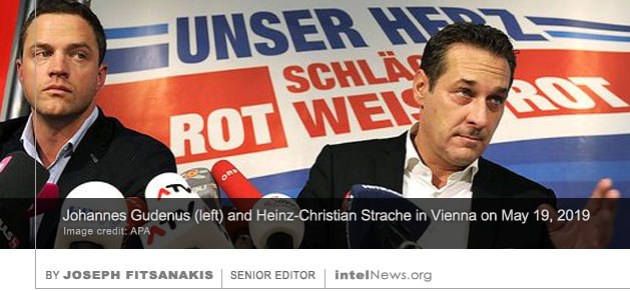
Strache GudenusIsraeli intelligence was likely behind the leaked video that brought down the far-right governing coalition in Austria on Monday, according to the former deputy director of Germany’s spy agency. The surreptitiously recorded video was leaked to two German media outlets on May 17, days before Austrian voters participated in the continent-wide elections for the European Union. In the video, two senior members of Austria’s governing far-right Freedom Party are seen conversing with an unnamed woman posing as a Russian investor. The two men in the video were Heinz-Christian Strache, the the Freedom Party’s leader and until recently Austria’s Vice Chancellor, and Johannes Gudenus, the party’s deputy leader and a member of parliament. In the video, Gudenus and Strache promise to award the woman’s firm state contracts if her uncle —a Russian oligarch— purchases an Austrian newspaper and uses it to support the Freedom Party. The video threw Austria’s political system into disarray and prompted the resignations of both Strache and Gudenus. On Monday, Austria’s Chancellor, Sebastian Kurz, was removed from power during a special parliamentary session in Vienna.

But the question is who leaked the video, and why? In an article in the Cicero, a monthly political magazine based in Berlin, a former senior official in Germany’s Federal Intelligence Service (BND) argues that Israeli intelligence was probably behind the leak. The article’s author is Rudolf Adam, who served as deputy director of the BND from 2001 to 2004, before serving as president of the Federal Academy for Security Policy of the German Ministry of Defense. Adam argues that the actions of Strache and Gudenus, as shown in the leaked video, seem “half mafia-like and half-treasonable”, and that the two should face legal consequences. But he goes on to ask “a far more interesting question”, namely “who is behind this intrigue [and] what were the intentions of its initiators?”. Adam points out that nothing is known about the woman in the video; she reportedly met Gudenus several months before the video was filmed. She posed as the Latvian niece of a Russian oligarch with ties to Russia’s President Vladimir Putin. In exchanges that lasted for several months, the woman told Gudenus that she planned to move with her daughter to Vienna and was interested in investment opportunities. She eventually invited him and Strache to a meeting in a villa in the Spanish resort island of Ibiza. It was there where the video was recorded. Read more of this post

Jonathan Pollard, US spy for Israel, complains of neglect by Israeli state

Jonathan PollardJonathan Pollard, an American who spied on his country for Israel in the 1980s, and is now free after spending 30 years in prison, has spoken of his frustration with the Israeli government, which it claims has forgotten about him. Pollard, a former intelligence analyst for the United States Navy, was released from an American prison in 2015, after serving a lengthy sentence for selling US government secrets to Israel. Throughout Pollard’s time in prison, the government of Israel lobbied for his release, claiming that the convicted spy did not harm American interests, but was simply trying to help Israel. But the US Intelligence Community and successive American presidents consistently rejected Israel’s claims, arguing that Pollard’s activities were severely detrimental to US interests. Pollard was eventually released after serving the entirety of his sentence. Ever since his release, Pollard has been required to wear an ankle monitor at all times. His Internet browsing is strictly regulated by the US government and he is not permitted to leave his New York home after sunset. He is also not permitted to leave the US, and Washington has refused to allow him to move to Israel.
Last week, Israel’s Channel 12 television station aired a rare interview with Pollard, in which the former spy claimed he had been “forgotten” by the Israeli government. Speaking from a restaurant in New York with his wife Esther by his side, Pollard told Channel 12 that no officials from the Israeli government had made contact with him since his release. He added that he felt “there is always something more urgent than me” for the government of Israel, whether it is “the [nuclear] deal with Iran or the [US] embassy’s move to Jerusalem, or the sovereignty of the Golan Heights”. When the Channel 12 reporter asked him whether he was disappointed by Israel’s perceived lack of efforts to bring him to Israel, Pollard replied that he would be “very depressed” if his “faith in God and [his] love for Israel and its people [was not] so strong”. At another point in the interview, Pollard appeared to criticize the Israeli government of Prime Minister Benjamin Netanyahu. “I am very concerned about what this entails for the [government’s] commitment and for [Israel’s] security”, he said. “If you do not care about someone like me, who spent 30 years in prison for the land of Israel and its citizens, how much concern is there for others in the country, [whether they are] soldiers or civilians?”.

In November of 2017, Israel’s Channel 2 television reported that Israeli Prime Minister Netanyahu had asked the United States President Donald Trump to allow Jonathan Pollard to move to Israel. However, despite the popular perception of the Trump administration as strongly pro-Israel, there are no indications that such a move may be taking place any time soon.

Author: Joseph Fitsanakis | Date: 27 May 2019 | Permalink

French spy agency summons reporters, prompting press-freedom concerns

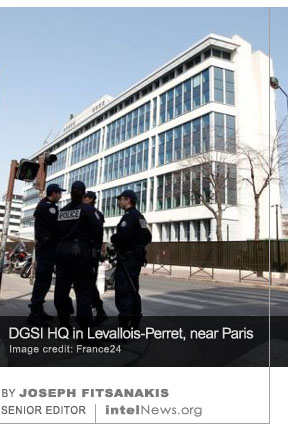
DGSI FranceFrance’s domestic intelligence agency has summoned eight journalists for questioning in relation to two separate investigative reports, prompting concerns about press freedom, according to reports from Paris. Last month, France’s domestic security and counter- intelligence agency, the General Directorate for Internal Security (DGSI), summoned three journalists for questioning. The summonses related to a leaked document that detailed the use of French-made weapons in the Yemeni Civil War. The 15-page document was prepared by France’s main military intelligence agency, the Directorate of Military Intelligence (DRM). It was reportedly meant to be read only by France’s President, Emmanuel Macron, and senior members of his security cabinet, including ministers. However, the report was leaked to the media and published in full. The leaked report revealed that a significant amount of French-made weapons are being used by the United Arab Emirates and Saudi Arabia in the Yemeni Civil War. The weapons allegedly include laser-guided missile systems and armored vehicles, as well as tanks, which the Saudi-led coalition is deploying against Iranian-supported Houthi rebels in Yemen.
On Wednesday, new summonses were issued for five more reporters, including two senior members of staff of Le Monde, which, along with Libération, and Le Figaro, is one of France’s newspapers of record. One of the reporters who have been summoned by DGSI is senior Le Monde reporter Ariane Chemin, who in 2018 broke a story about Alexandre Benalla, a senior security aide to President Macron. Benalla is believed to have illegally participated in a scuffle with ‘yellow vest’ protesters while wearing police riot gear in 2018. Subsequent reports in Libération linked Benalla with a questionable state contract handed out to a security company owned by a Russian oligarch. The reports centered on a former officer in the French Air Force named Chokri Wakrim, who some say facilitated Benalla’s contacts with the Russian’s company. An official anti-corruption investigation was sparked by these revelations. But in April of this year, Wakrim filed a complaint against the press, claiming that his identification in the media broke legal statutes that forbid the “revelation of the identity of a member of the [French] special forces”. This counter-complaint, according to reports from Paris, is what prompted Wednesday’s five new summonses by the DGSI.

On Thursday, nearly 40 French media outlets issued a joint statement in support of those journalists who were summoned by DGSI. The statement condemns the summonses an attack on press freedom and as “a new attempt by authorities to circumvent” France’s laws on freedom of the press and the protection of sources, which date back to 1881. In reference to the Wakrim case, the statement goes on to say that “military secrecy cannot restrict the right to information, which is essential for informed public debate, nor can it be [used] to deter [journalists] from investigating and publishing”.

Author: Joseph Fitsanakis | Date: 24 May 2019 | Permalink

Islamic State says it killed 20 Nigerian soldiers in shootout, executed 9 more

NigeriaThe West Africa province of the Islamic State has claimed responsibility for the killing 20 Nigerian soldiers and the execution of nine more soldiers that were captured in various operations, according to Reuters. The group behind the attacks emerged in 2002 under the name Boko Haram (“Western education is forbidden”), as part of a growing wave of anti-government sentiment in Nigeria’s Muslim-majority northern regions. In 2014, the group pledged allegiance to Abu Bakr al-Baghdadi, leader of the Islamic State of Iraq and Syria —otherwise known as Islamic State. Since that time, Boko Haram has rebranded itself as Islamic State – West Africa Province, while a smaller faction of the group has refused to align itself with the ISIS and continues to operate under the name Boko Haram.
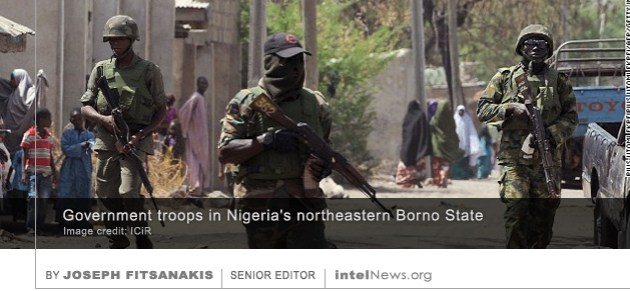
In an English-language statement posted online on Wednesday, the ISIS-affiliated faction of Boko Haram said that its fighters were responsible for the deaths of 20 Nigerian Army soldiers, who were killed on Monday in Gubio, a town located in Nigeria’s extreme northeastern Borno State. Reuters cited an unnamed “security source and a humanitarian worker”, who said that the insurgents attacked a military barracks on the outskirts of Gubio late on Monday evening. According to the report, the attackers used motorcycles and non-standard technical vehicles, or ‘technicals’ —open-backed pickup trucks mounting heavy weapons. The attack was followed by an hour-long shootout between the Nigerian Army forces and the insurgents, which resulted in the soldiers retreating, leaving behind the bodies of at least 15 troops, said Reuters. On Wednesday, the Islamic State released a separate video that claims to show the execution of nine captured Nigerian soldiers. According to Reuters, the soldiers in the video disclose their names, rank and unit, before they are executed by masked militants. At the end of the video, a group of Islamic State fighters is shown pledging allegiance to al-Baghdadi. The video concludes with footage of artillery, armored vehicles and tanks, and even boats, which the Islamic State claims to have captured from the Nigerian military.

This development is bound to increase skepticism about the Nigerian government’s repeated claims that it has been able to quell the Islamist insurgency that plagued the country’s northern regions for the past 15 years. In late 2015, the Nigerian government proclaimed the end of the Islamist insurgency after its troops destroyed all of Boko Haram’s camps in Borno State. However, the group appears to have reinvented itself and to have been able to use its new affiliation with the Islamic State to attract more funding and fighters during the past two years.

Author: Joseph Fitsanakis | Date: 23 May 2019 | Permalink

ISIS threatens stability of former Soviet Republics, says Russian spy chief

ISIS Afghanistan

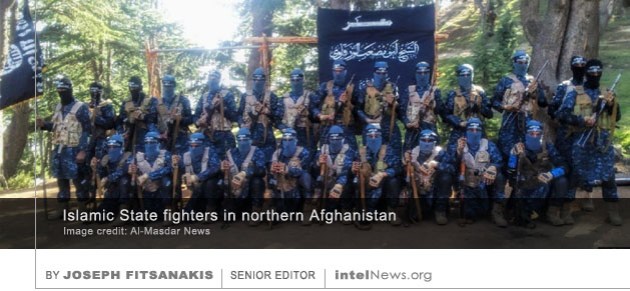
Thousands of Islamic State fighters are operating in Afghanistan’s northern border regions and are attempting to destabilize former Soviet Republics with substantial Muslim populations, according to Russia’s domestic spy chief. This warning was issued by Alexander Bortnikov, director of Russia’s Federal Security Service (FSB), which functions as Russia’s primary counter-terrorism agency. Bortnikov made these remarks during a visit to the capital of Tajikistan, Dushanbe, for a meeting of the heads of intelligence agencies of the Commonwealth of Independent States (CIS), an intergovernmental organization comprised of former Soviet Republics in the Eurasian region. The meeting was reportedly held behind closed doors, but Russia’s government-owned news agency TASS carried a summary of Bortnikov’s remarks.

The Russian intelligence chief said that, with the aid of the intelligence services of CIS states like Uzbekistan, Azerbaijan, Tajikistan, Kyrgyzstan, and others, the FSB was able to uncover and suppress eight Islamic State cells in the past year, which operated in the Central Asian region. However, the reach of the CIS countries does not extend to Afghanistan, said Bortnikov, where as many as 5,000 Islamic State fighters are congregating along the country’s border with three CIS states, namely Turkmenistan, Uzbekistan and Tajikistan. Many of these fighters are Turkmens, Uzbeks, Tajiks, Russians, and other citizens of CIS states, who previously fought with the Islamic State in Syria and elsewhere, and now form integral components of the Islamic State’s fighting force in Afghanistan and Pakistan. It appears that the Islamic State is now attempting to exploit the mountainous and porous borders of northern Afghanistan in order to destabilize neighboring countries, he said. These fighters intend to exploit “migrant and refugee flows [in Central Asia] in order to operate covertly from the Afghan battle zones to neighboring countries” and from there possibly to Russia, according to Bortnikov.

These covert activities of Islamic State fighters have already caused an escalation of tensions in the region and can be expected to continue to do so, as these groups radicalize and co-opt Muslim communities in CIS countries, noted Bortnikov. He added that popular responses to Islamist radicalization are prompting increasing incidents of “anti-Islamic terrorism”, which further-fuel religious and ethnic tensions in the region. As a reminder, last week the Islamic State announced that its so-called Khorasan Province fighters would be amalgamated into a new armed group calling itself Islamic State – Pakistan Province. Earlier this month, the group also proclaimed the establishment of a new overseas province in India’s Jammu and Kashmir state, called “wilayah al-Hind” (province of Hind). In addition to these two forces, there are currently an estimated 3,000 to 4,000 Islamic State fighters in Afghanistan’s Pashtun regions.

Author: Joseph Fitsanakis | Date: 22 May 2019 | Permalink

Star on CIA’s memorial wall honors employee who took her own life

CIA memorial wallA new star that was recently added to the United States Central Intelligence Agency’s memorial wall is seen by some as a way to draw attention to the mental pressures that come with the job, while others view it as disrespectful to the Agency’s mission. The specially designated wall is located at the main entrance lobby of the CIA’s headquarters in Langley, Virginia. It was created in 1974 and displays a star for each of the CIA’s personnel who have perished in the line of duty while working for the Agency. Today it displays nearly 130 stars, which span the CIA’s 72-year history.


The CIA holds an annual ceremony in recognition of its fallen members, at which time new stars are usually added to the memorial wall. Among them there is a star for Ranya Abdelsayed, who died on August 28, 2013, while employed by the CIA in Kandahar, Afghanistan. However, unlike the other 19 known deaths of CIA personnel in Afghanistan since 2001, Abdelsayed reportedly died by suicide. Her lifeless body was found by a colleague after she shot herself to death at Firebase Gecko, an International Security Assistance Force base in Afghanistan, which is commanded by the North Atlantic Treaty Organization. It is believed that Abdelsayed’s star is the only star on the CIA’s memorial wall that recognizes a CIA employee who took her own life.

In an article published on Sunday, The Washington Post’s Ian Shapira reports that not everyone at CIA agrees that Abdelsayed deserves to have a star on the Agency’s memorial wall. Shapira spoke to Nicholas Dujmovic, a recently retired CIA historian, who claims that Abdelsayed’s star “must absolutely come off the wall” because it violates the CIA’s own criteria for this highest of honors. Dujmovic opines that the memorial wall is reserved for deaths of CIA personnel that are “of an inspirational or heroic character”, typically deaths that are caused by hazardous conditions or violent actions by adversaries. The CIA historian tells The Washington Post that he has researched past deaths of CIA personnel and fears that “there has been an erosion of understanding in CIA leadership for at least two decades about what the wall is for and who is it that we’re commemorating”.

The paper reports that Dujmovic made his views known to CIA officials when the Agency’s Merit Awards Board decided to include a star in honor of Abdelsayed. But the Board upheld its decision, and so did the CIA’s director at the time, John Brennan. He told The Post that he stands by that decision today, arguing that Abdelsayed’s death was “something the Agency needed to recognize as being one of those unfortunate consequences of the global challenges the CIA addresses”.

Author: Joseph Fitsanakis | Date: 21 May 2019 | Permalink

German spy agency concerned about Russian penetration of Austrian government

Sebastian Kurz Vladimir PutinA day after Austria’s political system was thrown into a disarray by a covert video featuring the country’s vice chancellor and a woman posing as a Russian investor, German intelligence sources have raised fears that Russia may have penetrated the Austrian government with informants. Heinz-Christian Strache, who heads Austria’s far-right Freedom Party, stepped down from the post of vice chancellor on Saturday. His resignation came a day after two German media outlets aired a covert video in which Strache appears to be promising to award state contracts in the construction sector to a woman posing as a Russian investor. In return for the state contracts, the unnamed woman said that she would have the firm of her uncle —a Russian oligarch— purchase an Austrian newspaper and use it to support Strache’s political party.

According to the German newspaper Süddeutsche Zeitung, the video was filmed in Spain in 2017, two months before the Freedom Party won a record 26 percent in Austria’s national election. This gave the party 51 seats in the Austrian parliament and propelled Strache to the post of vice chancellor. In his resignation statement, Strache said he was filmed while drunk and was engaged in “macho talk” in an atttempt to “impress the attractive hostess”. He also dismissed the airing of the covertly filmed video as “a targeted political assassination”, but added that he was resigning from the government as a matter of principle. Shortly afterwards, the Austrian Chancellor Sebastian Kurz, Chairman of the rightwing Austrian People’s Party, announced that new national elections would be held “as soon as possible”.

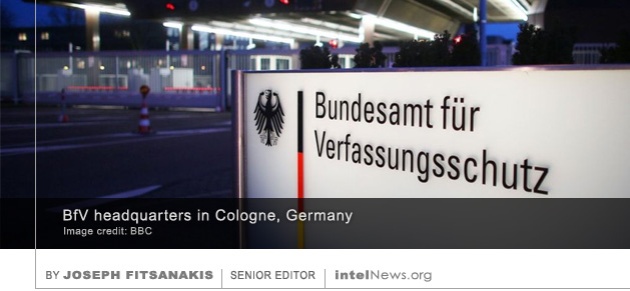
Meanwhile, German newspaper Die Welt am Sonntag reported on Saturday that the director of Germany’s Federal Office for the Protection of the Constitution (BfV), warned that sharing intelligence with Austria was “risky”. The Berlin-based newspaper said that BfV director Thomas Haldenwang was speaking at a closed-door meeting with German parliamentarians. He reportedly told his parliamentary audience that, due to the close relationship between the Freedom Party and Moscow, members of the Austrian government could potentially “misuse” and in some cases “forward to Russia” intelligence that they receive from other European Union member-states. This is not the first time that such warnings have come out of Germany. Last year August Hanning, who served as director of Germany’s Federal Intelligence Service (BND) openly warned Western officials to stop sharing intelligence with the government of Austria, because of its alleged proximity to the Kremlin.

Author: Joseph Fitsanakis | Date: 20 May 2019 | Permalink

US-Iran tensions may have been sparked by ‘misread intelligence’, claims report

Trump BoltonThe escalating tension between the United States and Iran, and the ensuing military buildup in the Persian Gulf, may have resulted from a misreading of intelligence by both sides, according to a new report in The Wall Street Journal. Reports from the Middle East continue to describe the situation there as tense, while the political rhetoric by both Washington and Tehran remains heightened. Last week, the White House ordered the USS Abraham Lincoln carrier strike group to sail to Middle Eastern waters, following intelligence showing that “Iran or its proxies were planning attacks against US forces in Iraq, Syria and at sea”. Washington also evacuated all non-essential personnel from its embassy in Iraq. Meanwhile Iranian officials stated on Thursday that they were “prepared for war”, while the head of Iran’s Revolutionary Guard Corps, Major Genreal Hossein Salami, described the escalating crisis as “the most decisive moment in the [40-year history] of the Islamic Revolution”.

But a new report in The Wall Street Journal claimed on Thursday that the crisis between the two countries may have been caused by a misinterpretation of intelligence on each other’s moves. The paper said that new intelligence collected by American spy agencies appears to show that Tehran was under the impression that the US was about to launch attacks against it. There is no information about what precisely led the Iranians to draw that conclusion. But it is believed that Iran responded to the perceived threat from Washington by abruptly bolstering its military posture and placing its allies in the region —including Hezbollah in Lebanon and numerous Shiite militias in Iraq and Syria, on high alert. Those actions were interpreted by Washington as evidence that Iran was planning to launch an attack against American interests in the region, thus prompting the White House to send the USS Abraham Lincoln strike group to sail to the area, and to partially evacuate its embassy in Iraq. Citing “people familiar with the matter”, the Journal said that new intelligence that has been collected “in recent days” points to the initial actions taken by Tehran as “defensive in nature”.

However, said that paper, there continue to be “sharply differing views” about the situation among officials in the administration of US President Donald Trump. Specifically, some administration officials continue to argue that the available intelligence indicates that Iran “was planning to strike first”, and some even believe that Tehran is still “planning imminent attacks” on the US and its interests in the region. The paper also noted that President Trump is believed to have told senior officials in his administration —including the Secretary of Defense Patrick Shanahan— that he does not want to see a military confrontation with Iran.

Author: Joseph Fitsanakis | Date: 17 May 2019 | Permalink

After India province, Islamic State proclaims a new province in Pakistan

ISIS PakistanThe group calling itself the Islamic State has announced the establishment of a new overseas province in Pakistan, just days after proclaiming another new overseas province in northern India. Until recently, the Islamic State’s operations in Asia were conducted under the banner of the Islamic State – Khorasan Province, or IS-KP. The shadowy group was founded in early 2015 and was led by former Taliban warlords who pledged allegiance to Abu Bakr al-Baghdadi, the spiritual leader and self-proclaimed emir of the Islamic State. Since that time, at least two of IS-KP’s leaders have been killed by United States forces, while the group has been engaged in a war against rival militant groups in Afghanistan and Pakistan, notably the Taliban.

Last week, the Islamic State announced the establishment of a new overseas province in India’s Jammu and Kashmir state. The announcement was made by Amaq, which serves as the news agency of the Islamic State. According to the news release, the Islamic State named the new province “wilayah al-Hind” (province of Hind). It is based in the Muslim-majority Kashmir Valley, which is located in one of the three administrative divisions of the Indian administered state of Jammu and Kashmir. On Wednesday a new press release by Amaq proclaimed the establishment of the Islamic State – Pakistan Province. In the same press release, the Islamic State said that the new overseas province’s first action was the killing of a Pakistani police officer in Mastung, a mountainous town located in Pakistan’s Baluchistan Province. In addition to killing the police officer, the Islamic State claimed responsibility for an armed attack at a gathering of the Tehrik-i-Taliban Pakistan, the Pashtun-dominant Taliban group that operates on Pakistani soil. The attack took place last week in Quetta, the largest urban center and provincial capital of Baluchistan.

Last month, the Islamic State said it was behind a suicide attack at a Quetta outdoor marketplace, which killed 20 and injured over 50 people. The attack was targeted Pakistani Hazara Muslims, who are seen as heretical by several militant Islamist groups that operate in the region. The latest announcement of a new Islamic State overseas province may be seen as evidence that the Islamic State is gradually moving its center of operations to the eastern regions of Asia. In April the militant group said it was behind a barrage of synchronized suicide attacks in Sri Lanka, which killed over 250 people.

Author: Joseph Fitsanakis | Date: 16 May 2019 | Permalink

British commander in Iraq contradicts US assessment of increased Iranian threat

Christopher GhikaThe most senior British military officer in the war against the Islamic State contradicted American assessments of a heightened threat from Iran, prompting an unusually strong rebuke from Washington. Last week, the White House ordered the USS Abraham Lincoln carrier strike group to sail to Middle Eastern waters, following intelligence showing that “Iran or its proxies were planning attacks against US forces in Iraq, Syria and at sea”.

On Tuesday, however, this view appeared to be challenged by Major General Christopher Ghika, Britain’s most senior military official in the Middle East, who is deputy commander of Operation Inherent Resolve (OIR). The OIR umbrella brings together all pro-Western forces that are fighting the Islamic State in Iraq and Syria. General Ghika spoke to American reporters at the US Department of Defense via a live video-link from Baghdad, where he is currently stationed as OIR deputy commander. In responding to questions by reporters about alleged threats to Western forces from Iran or its proxies, General Ghika said that the OIR forces were “aware of that presence [or Iranian-led Shia militia groups in Iraq and Syria], clearly. And we monitor them along with a whole range of others because that’s the environment we are in”. However, added the general, “no, there has been no increased threat from Iranian-backed forces in Iraq and Syria”.

British newspaper The Guardian, which published General Ghika’s comments on Tuesday, noted that his statements appeared to directly contradict Washington’s claims of a heightened Iranian threat in the region. But in a statement released on Tuesday night local time, the US Central Command CENTCOM, whose responsibilities include the Middle East and Central Asia theaters, rejected General Ghika’s comments. “Recent comments from OIR’s Deputy Commander run counter to the identified credible threats available to intelligence from U.S. and allies regarding Iranian backed forces in the region”, said the statement. The Guardian described CENTCOM’s statement as “particularly striking” and “an extraordinary rebuke of an allied senior [military] officer”. The British Ministry of Defense had not responded to CENTCOM’s statement by Wednesday morning.

Author: Joseph Fitsanakis | Date: 15 May 2019 | Permalink

Islamic State announces new overseas province in India for the first time

ISIS IndiaThe group calling itself the Islamic State has announced the establishment of a new overseas province in India’s Jammu and Kashmir state. The announcement was made over the weekend by Amaq, which serves as the news agency of the Islamic State. According to the news release, the Islamic State (known also as the Islamic State of Iraq and Syria) has named the new province “wilayah al-Hind” (province of Hind), and said it is based in the Muslim-majority Kashmir Valley, which is located in one of the three administrative divisions of the Indian administered state of Jammu and Kashmir.

The Amaq report surfaced following an armed clash between a group of Islamist militants and Indian security forces in Amshipora, a village in the district of Shopian, which is in the foothills of the northern Himalayan Mountains. At least one Islamist militant was killed in the armed confrontation, which reportedly lasted two hours. Indian authorities identified the dead militant as Ishfaq Ahmad Sofi, and said he had pledged allegiance to the Islamic State. The Amaq statement alleged that the militants in Amshipora had “inflicted casualties” on the security forces, but the claim was denied by the Indian government. The Reuters news agency spoke with Rita Katz, an Israeli analyst who directs the SITE Intelligence Group in the United States. She said that the announcement of a new Islamic State province “should not be written off”, but added that “the establishment of a province in a region where [the Islamic State] has nothing resembling actual governance is absurd”.

Writing in the Hong-Kong-based Asia Times, Prakash Katoch, a retired lieutenant general in the Indian Army’s Special Forces, said that the announcement of a wilayah in India was a first for the Islamic State. He warned that after announcing a province in Indian Kashmir, the Islamic State “may also attempt to increase its presence in other Indian states” with a significant Muslim presence, such as Kerala or West Bengal. Katoch noted that “a number of young men and women from Kerala” had been identified as having joined the Islamic State in 2016 and 2017. Several of them even traveled to Syria to fight for the Sunni Islamist group, he added.

Author: Ian Allen | Date: 14 May 2019 | Permalink

Emirates authorities confirm four ships targeted by ‘sabotage operations’

Fujairah UAE EmiratesAuthorities in the United Arab Emirates said on Sunday that four commercial ships were targeted by “sabotage operations”, but did not point to possible culprits. The announcement came hours after false reports circulated in Iranian and Lebanese media stating that explosions had been witnessed at the port of Fujairah, a major Emirati commercial shipping facility that borders the Sultanate of Oman and is visible from the coast of Iran. The alleged explosions were first reported by Al-Mayadeen, a Shiite-Lebanese satellite television station, and were then picked up by a host of Iranian news outlets.

The reports caused alarm in international energy market circles, as observers feared that the explosions may have resulted from deliberate attacks by Iranian forces. Located less than 100 miles from the Strait of Hormuz, through which over 30 percent of the world’s sea-transported oil is trafficked, the Port of Fujairah is the world’s second largest shipping fueling hub. Even a partial destruction of the port would cause major disruptions in the international energy transportation system. Several hours later, however, the Associated Press dismissed the reports as false, saying it had spoken to “Emirati officials and local witnesses” and had found the earlier reports of explosions at Fujairah to be “unsubstantiated”.

Later on Sunday, state-owned Emirates News Agency published a statement by the Ministry of Foreign Affairs, which said that four ships had indeed “suffered acts of sabotage” while sailing off the Emirati coast. The Foreign Ministry’s statement said that the ships were “civilian trading vessels of various nationalities” and that they had been “subjected to […] acts of sabotage”. It added that “subjecting commercial vessels to sabotage operations and threatening the lives of their crew is considered a dangerous development”. However, Emirati officials refused to elaborate on the nature of the sabotage that the ships allegedly suffered, or discuss the possible culprit or culprits of the alleged attacks. On Friday, the United States Maritime Administration (MARAD) warned that Iranian military forces could target “US commercial ships, including oil tankers”. There was also an “increased possibility” of “Iran or its regional proxies taking action against US and partner interests”, said MARAD.

Author: Joseph Fitsanakis | Date: 13 May 2019 | Permalink

‘Unusual’ high-level meeting held at CIA headquarters to discuss Iran, say sources

CIA headquartersAn untypical high-level meeting was convened at the headquarters of the United States Central Intelligence Agency last week to discuss Iran, according to NBC News. The meeting, which NBC described as “highly unusual” was convened by President Donald Trump’s National Security Adviser John Bolton. Participants allegedly included Secretary of State Mike Pompeo, Acting Secretary of Defense Patrick Shanahan, Director of National Intelligence Dan Coats, CIA Director Gina Haspel, and Chairman of the Joint Chiefs of Staff General Joe Dunford. Citing “six current US officials”, NBC said the meeting was held at 7 a.m. on Monday, April 29, in Langley, Virginia.

The list of participants refers to a high-level national security meeting. These are almost always held at the White House —typically in the Situation Room— says NBC. In general, it is extremely rare for senior White House officials, like Bolton, or members of the Cabinet, like Pompeo, to participate in meetings at CIA headquarters. It is also worth noting that, according to NBC’s sources, the meeting was not related to Washington’s recent decision send the USS Abraham Lincoln carrier strike group to the Middle East. This leaves two options, according to the NBC report: first, that the meeting concerned a “highly sensitive covert action” involving Iran or an Iranian proxy, such as the Lebanese Hezbollah. It could have been an update on an existing CIA operation, or a description of options for an impending operation. Alternatively the meeting could have been called due to a disagreement between the CIA and the White House about the results of an intelligence assessment or estimate about Iran.

NBC said it contacted the National Security Council to inquire about the April 29 meeting, but a spokesperson refused to comment. Meanwhile, Pompeo abruptly canceled the final leg of a four-nation tour of Europe on Thursday and returned to Washington, reportedly in light of heightening tensions between Washington and Tehran. Also on Thursday, the Iranian government described the Trump administration’s decision to deploy the USS Abraham Lincoln carrier strike group to the Middle East as “an action of psychological warfare” against the Iranian people. Late on Thursday, President Trump urged Iran to reach out to him: “What I would like to see with Iran, I’d like to see them call me”, said the US leader during a press conference at the White House. Iranian officials did not immediately respond to his comments.

Author: Ian Allen | Date: 10 May 2019 | Permalink

Intel that prompted US to deploy aircraft carrier to Middle East ‘came from Israel’

USS Abraham LincolnThe sudden decision by the United States to deploy significant firepower to the Middle East was partly in response to intelligence that was given to Washington by Israeli officials, according to a report. On Wednesday, the US announced that the USS Abraham Lincoln carrier strike group had received instructions to sail to the Middle East. The aircraft carrier is reportedly sailing alongside a cruiser and four destroyers, while an unspecified number of B-52 heavy long-range bombers have been ordered to fly to a US military base in Qatar.

Commenting on this last-minute development, US National Security Adviser John Bolton warned Iran that it would face “unrelenting force” if it threatened American interests in the Middle East and beyond. The Chairman of the Joint Chiefs of Staff, General Joseph Dunford, said that the move aimed to “deter Iran […] so that there would be no ambiguity about our preparedness to respond to any threat against our people or partners in the region”. Speaking in Congress, the US Acting Secretary of Defense Patrick Shanahan said that the decision to move a significant amount of firepower to the Middle East came in response to intelligence showing that Iran had “made plans to target US forces in Iraq and elsewhere in the Middle East”. According to ABC News, the intelligence suggested that “Iran or its proxies were planning attacks against US forces in Iraq, Syria and at sea”. But there was no further information reported about the precise nature of the alleged warnings.

Meanwhile, the American news and information website Axios said on Monday that the intelligence that caused Washington’s response was given to the US by Israeli officials. Citing “senior Israeli officials”, the website said that the intelligence given to the US had been gathered “primarily by the Mossad”, Israel’s main external intelligence agency. It added that the information about possible Iranian attacks against the US or its allies in the Middle East was “raised two weeks ago” during closed-door talks at the White House between a US team led by Bolton and an Israeli delegation headed by his Israeli counterpart, Meir Ben Shabbat. The intelligence, said Axios, showed that the US or its allies, including the United Arab Emirates or Saudi Arabia, would be targeted by Iran. The information is “understood to be part of the reason for Bolton’s announcement” this week, said Axios.

Author: Joseph Fitsanakis | Date: 09 May 2019 | Permalink

US lifts sanctions on Venezuelan ex-spy chief, calls on others to defect

SEBIN VenezuelaIn an effort to persuade senior members of the Venezuelan government to defect, the United States has lifted punitive financial sanctions on the country’s intelligence director, who left his post on April 30. General Christopher Figuera became director of the Bolivarian National Intelligence Service (SEBIN) in October 2018. SEBIN is Venezuela’s primary intelligence agency and has a dual domestic and international role. Much of its domestic mission is to protect and defend the Bolivarian Revolution, which forms the ideological framework of the government headed by President Nicolás Maduro. It follows that SEBIN’s employees are all trusted supporters of Venezuela’s embattled President.

On February 15 of this year, the United States government included General Figuera on a financial sanctions list of Venezuelan government officials who held senior posts in the Maduro government. But on April 30, General Figuera appeared to be one of relatively few senior Venezuelan officials to respond favorably to an open call by Juan Guaidó, the United States-supported President of the Venezuelan National Assembly, to remove Maduro from power. Figuera was reportedly denounced by Venezuelan government officials and summarily replaced by Gustavo Gonzalez Lopez, who was director of SEBIN until he was replaced by Figuera in 2018.

On Tuesday, the United States government said that it had removed General Figuera from its financial sanctions list. Speaking before reporters in Washington, US Vice President Mike Pence said that Figuera was “an example to follow” for other senior Venezuelan government officials and urged more of them to follow Figuera’s example. Pence added that the US government wanted to reward Figuera for abandoning his post and denouncing Maduro. In a subsequent statement given to the media, the US Department of the Treasury said that removal of sanctions “may be available” for all senior Venezuelan officials “who take concrete and meaningful actions to restore democratic order” in the Latin American country. The statement did not elaborate on the meaning of taking “concrete and meaningful actions”.

In a potentially related development, the Venezuelan government said on Tuesday that it had taken control of three private airfields in the vicinity of the capital city of Caracas, in order “to prevent illicit acts which would compromise the safety of civil aviation”. It is believed that General Figuera left the country with his family using a private airfield, and that the Maduro government is trying to stop others from following his example.

Author: Joseph Fitsanakis | Date: 08 May 2019 | Permalink