Analysis: Israel underestimated Hamas while overestimating its own capabilities
January 10, 2024 10 Comments
 THE OCTOBER 7 ATTACK on Israel was a total surprise. There was no warning. There were very few signs of a possible attack. Israeli intelligence evaluated these signs as elements of a routine military exercise by Hamas, and even assessed them as parts of an imaginary scenario. It therefore gave no warning to those Israeli Defense Forces (IDF) units that were stationed on the border with Gaza. Meanwhile, what we know about the intelligence failure of October 7 will likely pale before what the commission of inquiry will reveal once it is established. That was precisely what happened in the case of the Agranat Commission of Inquiry, which made significant revelations while investigating the intelligence failings of the IDF in the run up to the 1973 Yom Kippur War.
In the eyes of the Israeli generation of the Yom Kippur War, the possibility of such a failure happening again was unthinkable. Yet there is a significant difference between the events of 1973 and the events of last October 7. In 1973 the intelligence failed, but the IDF reacted quickly and acted efficiently. This  time, in the first two days of the conflict the IDF was confused and acted without direction, in the apparent absence of relevant action plans for what to do in the event of a massive invasion. The IDF was clearly not ready for such a scenario.
Recently, another important piece of information about the intelligence failure of October 7 was revealed. It was reported that, two months before the surprise attack by Hamas, information was received from an agent handled by the Israel Security Agency (ISA) in Gaza, with a “very high” reliability level. The agent allegedly reported that Hamas was planning “a major move in the week after Yom Kippur”. Yet that warning was not marked as significant; the assumption was that, if the warning materialized, it would be corroborated with additional intelligence. It was thus kept from higher levels of command and from Israeli Military Intelligence (IMI). The ISA did not deny the report, saying instead in a statement: “Focusing on one specific piece of news or another does not reflect the intelligence picture at the time”.
Given the high number of casualties and the horrendous destruction that resulted from the October 7 attack, many Israelis, including some in the security establishment, feel that it is far too long to wait until a commission of inquiry is established and publishes its conclusions. It will likely take at least two years  for those conclusions to become public. What is to be done in the meantime? There is public pressure to launch the inquiry soon.
Recently the State Comptroller of Israel, Matanyahu Engelman, announced that he has begun to investigate the intelligence failure. This is an appropriate move. However, with all due respect to the state comptroller’s inquiries, we know from previous experience that his findings have no teeth. For instance, in the context of Hamas, the state comptroller’s review of Operation TZUK EITAN (the 2014 Gaza War) was published in early 2017. It revealed serious instances of misconduct in the intelligence community dating several years prior to the operation. Yet this severe criticism passed below the public’s radar and was practically ignored, while no actions were taken against IDF and ISA security personnel that were shown to have acted irresponsibly.
I would like to point to a number of stronger factors that led to the tragic complacency of October 7, drawn from the field of psychology. It relates to how a country (mainly through its intelligence analysts) perceives its enemies and how this affects the evaluations of said enemies. We know that there was a conception on the Israeli side that Hamas had no interest in attacking Israel at this stage. It seems that the State of Israel underestimated Hamas and its leader, Yahya Sinwar, based on the available evidence of Hamas and Sinwar. Read more of this post
 IN AN UNPRECEDENTED AND potentially highly consequential decision, a judge has barred a Chinese PhD student from entering Canada over concerns he might be pressured to spy by the government of China. The case could have “ripple effects” on universities across Canada and possibly even all of North America,
  MIDDLE EAST OBSERVERS WERE hardly surprised by yesterday’s news of the apparent assassination of Hamas leader Saleh al-Arouri in Lebanon. Not only was al-Arouri a
  Yesterday’s assassination at the very heart of Hezbollah’s lair was nothing short of a demonstration of the Mossad’s competency in special operations.
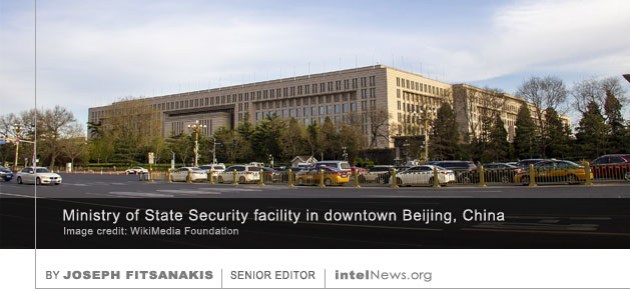
 THE UNITED STATES CENTRAL Intelligence Agency (CIA) has sharply stepped up its activities on China, but Chinese espionage operations remain formidable and continue to pose challenges for American decision-makers, a new report claims. Citing “interviews with more than two dozen current and former American officials and a review of internal Chinese corporate documents and public [Chinese government] documents”, the New York Times
  A LONGTIME BELGIAN POLITICIAN worked as a spy for Chinese intelligence for at least three years, according to a joint investigation by a consortium of European news media. Until last week, the politician, Frank Creyelman, 62, was a leading member of Vlaams Belang, a far-right separatist party that draws nearly the entirety of its support from northern Belgium’s Dutch-speaking Flemish regions. In addition to seeking to separate Flanders from Belgium, Vlaams Belang opposes immigration and multiculturalism, with much of its criticism directed at Islam.
 LAST WEEK THE UNITED States Department of Justice announced the arrest of Victor Manuel Rocha, 73, a former senior American diplomat, whose career included stints as ambassador and advisor to the National Security Council and the United States Southern Command. Cuban intelligence allegedly recruited Rocha when he was a student in the 1970s and inspired him to spend his entire professional life in search of opportunities to supply intelligence to Cuba —and possibly Russia and China. United States Attorney General Merrick Garland
  principal officer in the United States Interests Section in Cuba —effectively the second-in-command in Washington’s de facto embassy in Havana.
 IT HAS BECOME CLEAR that Hamas had up-to-date intelligence on Israeli targets prior to the attack on October 7, 2023, the largest and most devastating terrorist attack in Israel’s history. Hamas did not have access to clandestine information sources but rather relied on open-source intelligence (OSINT) to understand the structure and weaknesses of Israel’s defense system along the border fence. In addition to publicly available maps, Hamas meticulously gathered online intelligence about specific sites within the Israeli communities near the Gaza Strip.
 interests of national security, the public’s ‘right to know’ purview is substantial. Thus, significant amounts of information are available online.
 the Israeli Military Intelligence was dissolved, for reasons that remain to be investigated. CNN was among many news outlets that have
 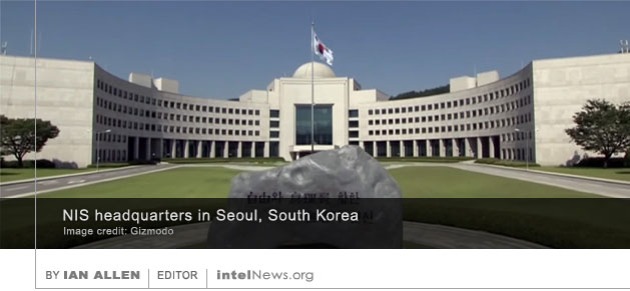 IN A SURPRISING MOVE that has stirred curiosity across Asia, South Korean President Yoon Suk Yeol has abruptly ousted the entire senior leadership of the National Intelligence Service (NIS), a powerful entity in the country. The
  AUTHORITIES IN ITALY ARE investigating a series of suspicious cash withdrawals that were made from accounts belonging to the Russian embassy in Rome, according to reports in the Italian press. On November 14, the Rome-based daily La Repubblica
  THE FRENCH GOVERNMENT HAS accused Russia of carrying out a disinformation campaign using stenciled images of Stars of David that mysteriously appeared in the streets of Paris late last month. The stars, between 60 and 80 in number, were found in the 14th arrondissement of the French capital, as well as in several Parisian suburbs in the early hours of October 31. The stars (see accompanying picture) are all blue and all have the same size. They appear to have been hurriedly stenciled and have no accompanying text.
 SINCE OCTOBER 7, WHEN Hamas launched its surprise attack on Israel, many more details about the intelligence failure have emerged. It appears that Israeli intelligence officials have warned for years about military exercises held by Hamas in the Gaza Strip, which have included practice raids on cities deep inside Israel. However, the Israel Military Intelligence (IMI) did not heed to the warnings, because it considered Hamas operationally incapable of carrying out such raids. Instead, the IMI estimated that the Hamas leadership aimed to arrive at a settlement with Israel. That seems like the result of a highly successful disinformation operation, which added significantly to the effectiveness of the sudden attack on Israel on October 7.
 large number of settlements simultaneously. It also believed that such an operation would go against the spirit of Hamas leadership’s spirit intention to settle with Israel.
 Indeed, a preventive course of action should have been in place even in the absence of specific intelligence warnings —if only to enable the IDF to repel a surprise attack by Hamas. There was no need to estimate what Hamas would do in order to prepare for a surprise attack.
 BEIJING HAS ACCUSED “FOREIGN governments” of collecting data on China through hundreds of fake meteorological stations that have been illegally installed throughout Chinese territory. The announcement appears to form part of a broader “people’s anti-espionage war” that the Communist Party of China






 intelNews.org
North Korean radio station known for sending coded messages to spies goes silent
January 15, 2024 by Joseph Fitsanakis 2 Comments
Throughout the Cold War, Radio Pyongyang aired hundreds of hours of news and cultural content every week. The broadcasts were in various languages and were exclusively aimed at international listeners. However, most of the station’s output was targeted at South Koreans. In 2002, the station was renamed Voice of Korea. Around that time, possibly owing to a temporary rapprochement between North and South Korea, the station curtailed much of its political programming. However, broadcasts featuring political content were resumed in 2016, as relations between the two warring sides began to deteriorate once again.
For much of its existence, the Voice of Korea has also been known to operate as a so-called numbers station. The term denotes shortwave radio stations, usually sponsored by a government entity, that regularly air broadcasts consisting of formatted number sequences. These sequences are widely believed to be encrypted communications addressed to intelligence officers operating abroad. They contain operational instructions and other directives that are typically undecipherable without the use of an encryption protocol. These stations also broadcast certain types of music, which function as codewords and are believed to signal specific directives to spies.
But the Voice of Korea unexpectedly fell silent last week. Its website, which features content in several languages, also appears to have been taken down. The sudden changes occurred days after North Korea’s Supreme Leader, Kim Jong-un, delivered a key address during the year-end plenum of the ruling Workers’ Party of Korea (WPK) in Pyongyang, on December 31. In his speech, which became public on January 6, the North Korean leader declared that the reunification of Korea under communist principles —a longstanding goal of the WPK—had been rendered “impossible” due to widening differences in approach between the two Koreas.
The North Korean strongman also called for “a fundamental change” in the WPK’s policy on inter-Korean affairs. Finally, he discussed a series of steps for the “reorganization of entities” that govern North Korea’s relations with South Korea. Several North Korean government websites focusing on the reunification of Korea, including the Voice of Korea website, have since been taken down. North Korea observers suggest that the daily radio broadcasts of the Voice of Korea appear to be part of the reorganization declared by Kim Jong-UN on December 31.
► Author: Joseph Fitsanakis | Date: 15 January 2024 | Permalink
Filed under Expert news and commentary on intelligence, espionage, spies and spying Tagged with News, North Korea, numbers stations, South Korea, Voice of Korea