News you may have missed #817 (assassinations edition)

Patrick FinucaneBy IAN ALLEN | intelNews.org |
►►British PM apologizes in killing of IRA lawyer. The Prime Minister of the United Kingdom, David Cameron, has apologized after a government report found that British intelligence officials had colluded with loyalist paramilitaries in the 1989 killing of lawyer Patrick Finucane in Belfast, Northern Ireland. Finucane, who had represented members of the Irish Republic Army in court, was shot dead by two gunmen from a Protestant paramilitary group while having a Sunday dinner at his home with his wife and three children.
►►Behind the plot to kill Afghanistan’s spy chief. On December 11, we reported that the Afghan government accused Pakistani intelligence of having played a role in the assassination of Assadullah Khaled, who heads Afghanistan’s National Directorate for Security. But how was the attempt on Khaled’s life carried out, and how did the aspiring assassins get so close to the controversial intelligence chief? Time magazine reports that it was Khaled’s self-confidence “bordering on recklessness” that almost got him killed. Sources say that, even after taking over the NDS, Khalid frequently drove around without bodyguards.
►►How Mossad bid to kill Hamas leader ended in fiasco. Khaled Mashal’s recent presence in the Gaza Strip will have rudely reminded Benjamin Netanyahu, the Israeli Prime Minister, of one of the greatest fiascos in the history of special operations, writes The Daily Telegraph‘s David Blair. Fifteen years ago, Netanyahu authorized a risky attempt to assassinate Mashal in the Jordanian capital, Amman. Everything went wrong. The Jordanian security forces responded to this brazen daylight attack, arresting two of the Israeli operatives and forcing three to hide in their country’s embassy, which was promptly surrounded by troops.

News you may have missed #816

Kim Jong-namBy IAN ALLEN | intelNews.org |
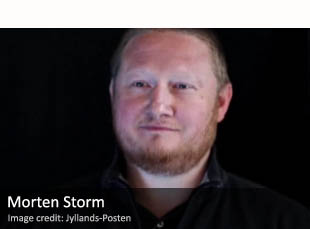
►►Danish minister vows more control over spy agency. Following the uproar created by the revelations from former Danish secret service (PET) agent Morten Storm, Denmark’s Minister of Justice, Morten Bødskov, is now calling for parliament to have more control over the domestic intelligence agency. In an interview with Berlingske newspaper, Bødskov said that he is seeking increased powers for parliament’s Kontroludvalg, a committee established in 1964 to oversee PET. The move comes in response to the many questions that have arisen about PET’s actions following Storm’s decision to contribute to a series of articles in Jyllands-Posten newspaper that chronicled his time as a PET double-agent.
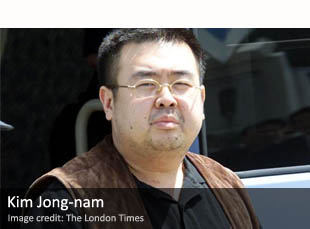
►►South Korea jails alleged North Korean assassin. A South Korean court has jailed an unidentified North Korean spy reportedly ordered to attack Kim Jong-nam, the eldest son of late North Korean leader Kim Jong-il. Kim Jong-nam, who is believed to have fallen out of favor with Kim Jong-il in 2001, was thought to have been living in Macau, but media reports indicate he may have moved to Singapore. South Korean media said the alleged assassin had spent a decade in China tracking down North Korean defectors before coming to the South, and that he had admitted trying to organize “a hit-and-run accident” targeting Kim Jong-nam.
►►US Pentagon to double the size of its worldwide spy network. The Defense Intelligence Agency (DIA), the US Pentagon’s military intelligence unit, is aiming to recruit 1,600 intelligence collectors —up from the several hundred overseas agents it has employed in recent years. The DIA’s new recruits would include military attachés and others who do not work undercover. But US officials say that the growth will be driven a new generation of spies who will take their orders from the Department of Defense. The project is reportedly aimed at transforming the DIA into a spy service more closely aligned with the CIA and elite military commando units.
Afghan government blames Pakistan for attempt on spy chief’s life

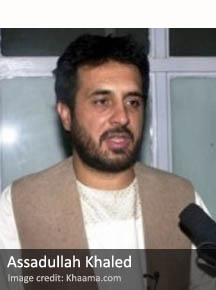
Assadullah KhaledBy JOSEPH FITSANAKIS | intelNews.org |
The Afghan President and senior cabinet officials have described the recent assassination attempt against the country’s spy chief as the work of “a professional intelligence service” and said they would be asking Pakistan “for clarification”. Assadullah Khaled, who heads Afghanistan’s National Directorate for Security (NDS), survived a suicide attack last Thursday in Kabul. According to Afghan officials, Khaled was attacked by a member of the Taliban posing as a “peace emissary”, who blew himself up as he was meeting Khaled to discuss a possible peace deal with the government. Media reports suggest that the bomber had concealed explosives in his undergarments and that he was not searched out of “respect for [Afghan] traditions and hospitality”. Shortly after the attack, the Afghan Taliban claimed responsibility and said they would try to kill Khaled again. But speaking to reporters last week, Afghan President Hamid Karzai said that “more professional hands” were behind the attack on Khaled. The Afghan leader described the suicide attack as a “very sophisticated and complicated act by a professional intelligence service” and said the Afghan security services “know [for] a fact” that the suicide bomber had entered the country from Pakistan. President Karzai stopped short of directly implicating the Inter-Services Intelligence Directorate (ISI) of directly planning the attack; but he said his government would be “seeking a lot of clarifications from Pakistan” about the bombing. Last Sunday Afghan Ministry of Foreign Affairs spokesperson Janan Musazai told reporters that Afghan officials were “100 percent sure” the suicide bomber had come to Afghanistan from the Pakistani city of Quetta. Read more of this post

Saudi diplomat shot dead in Yemen by gunmen disguised as soldiers

By IAN ALLEN | intelNews.org |
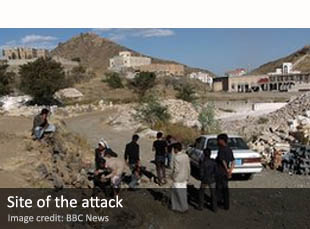
An official at the Saudi Arabian embassy in Yemen has been shot dead along with this Yemeni bodyguard by a group of gunmen disguised as government security forces. According to television station al-Arabiya, which is owned by the Saudi government, the diplomat and his bodyguard were killed on Wednesday when their car was “raked with gunfire” in the heart of Yemeni capital Sana’a. Later in the day, the incident was confirmed by the Kingdom’s Ministry of Foreign Affairs, which identified the assassinated diplomat as Sergeant Khaled Shobeikan al-Anzi. IntelNews understands that al-Anzi worked as an aide to the Military Attaché at the Saudi Arabian embassy in Sana’a. There are rumors, however, that his diplomatic credentials may have been a cover for his intelligence work for Al-Mukhabarat Al-A’amah, Saudi Arabia’s military intelligence agency. Sources in Yemen report that the attack took place in Haddah, one of Sana’a’s more exclusive districts, which houses the majority of foreign embassies and diplomatic compounds in the capital. It is also worth noting that the assailants were reportedly “dressed in the uniforms of [Yemen’s] Central Security Organization”, a 50,000-strong National Guard-type force that operates under the direction of the Ministry of the Interior. Wednesday’s assassination of the Saudi diplomat is the latest incident in a series of attacks against diplomatic targets in Sana’a, which have included employees in the British and American embassies there. In late March of this year, Islamist militants kidnapped Saudi Arabia’s Deputy Consul in Yemen’s southern port city of Aden, who remains in captivity. Read more of this post

Mossad ‘tried to kill’ Saddam Hussein using ‘exploding book’

Saddam HusseinBy JOSEPH FITSANAKIS | intelNews.org |
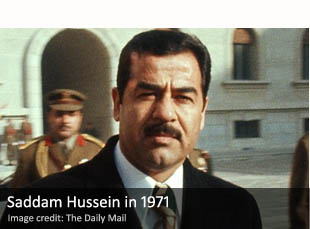
Israeli intelligence tried unsuccessfully to kill Iraqi leader Saddam Hussein in the 1970s using a bomb disguised as a book. This revelation is included in a new documentary film, which was aired on Monday evening on Israel’s Channel 1 television. The documentary, entitled Sealed Lips, focuses on the life and intelligence exploits of Yitzhak Hofi. Known informally as “Khaka”, Hofi was the fifth Director of the Mossad, Israel’s foremost covert-action intelligence agency, which he led form 1974 to 1982.  Aside from Hofi, who is still living in Israel, aged 85, the film includes interviews with five other former Directors of the Mossad, as well as with some of the agency’s best-known covert-action operatives. One of them is Brigadier General (ret.) Tzuri Sagi, said to have been the mastermind behind the plan to kill Hussein, who had assumed power in Iraq following a coup in 1968. According to the documentary, as soon as the Mossad tasked Sagi with assassinating Hussein, he employed the best-known bomb-maker in the Israeli intelligence and security services, known by his operational name, “Natan”. “Natan” put together a carefully constructed explosive device, which was hidden inside an Arabic-language book. The device was wired to detonate once the front cover of the book was opened. The film suggests that the Mossad did manage to find a way for the book to reach the Iraqi leader. However, Hussein appeared suspicious about the book and had one of his close aides, an unnamed senior Iraqi government official, open it. Read more of this post

Israel admits assassinating Palestinian commander in Tunisia

Abu JihadBy JOSEPH FITSANAKIS | intelNews.org |
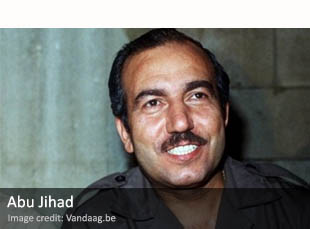
Authorities in Israel have authorized the publication of an interview acknowledging Israel’s role in the assassination of a senior Palestinian military commander in Tunisia in 1988. The target of the assassination was Khalil al-Wazir, better known as Abu Jihad, one of the co-founders of Fatah, the secular wing of the Palestinian Liberation Organization chaired by Yasser Arafat. In the 1960s and 1970s, Abu Jihad rose within the ranks of Fatah and eventually became commander of its armed wing, known as al-Assifa. However, he was killed on April 16, 1988, when a group of unidentified gunmen stormed his villa in Tunisian capital Tunis, before managing to slip away. In the past 23 years, the Israeli intelligence services have been repeatedly singled out as prime suspects in Abu Jihad’s assassination. Nearly 15 years ago, Israeli newspaper Yedioth Ahronot announced that it had secured an interview with an Israeli commando who had a leading role in the operation and had been the one who fired the shots that killed the Fatah commander. But the interview was blocked from publication by the Israeli military censors, who, under Israeli law, have the power to prevent the airing of information that might harm national security. In 2000, however, the commando, Nahum Lev, died in a motorcycle accident, which prompted the Israeli newspaper to renew its application for the ban on the interview to be lifted. This week, Israeli authorities officially lifted the ban, which allowed Yedioth Ahronot to run the interview with Lev. The airing of the interview was coupled by a more substantial account of the operation, which appeared in the specialist Israel Defense magazine. According to the article, the operation was planned over several months by the Israeli covert action agency Mossad and the Sayaret Matkal, a special forces unit of the Israel Defense Forces. It involved 26 commandos who allegedly reached the Tunisian shore on rubber boats. Several of them walked the streets of Tunis disguised as women tourists. Read more of this post

ExxonMobil executive shot dead ‘assassination-style’ in Brussels

Nicholas MockfordBy IAN ALLEN | intelNews.org |
A senior British executive of American multinational oil and gas corporation ExxonMobil has been killed in an alleged “assassination-style” shooting in Belgium. Nicholas Mockford, 60, was a technical support manager for ExxonMobil Chemicals, Europe, specializing in intermediate technology, also known as alternative energy generation. He was shot dead at 10:00 in the evening as he was leaving an Italian restaurant on Rue de Beyseghem, in Neder-over-Heembeek, a leafy suburb of Belgian capital Brussels, where he lived with his Belgian wife and three children from a previous marriage. British newspaper The Daily Telegraph, which published news of the incident last week, said that Mr. Mockford was killed on October 14. But the paper said a “judicial instruction” had been imposed on the case by the investigating judge, which amounted to a news blackout. According to reports, Mr. Mockford was with his wife Mary when he was shot in the attack, which witnesses said happened “very quickly”. The couple was allegedly seen walking across the street from the restaurant to their car, when all of a sudden several shots were fired. The Telegraph said that Mr. Mockford’s wife was left at the scene of the crime “covered in blood” and crying for help. Two men were apparently seen running away from the area where the shooting took place, carrying motorcycle crash helmets. Soon afterwards Mr. Mockford died on his way to the hospital, said the paper. Read more of this post

Comment: The Significance of the Killing of Lebanon’s Security Chief

The bombing that killed Wissam al-HassanBy JOSEPH FITSANAKIS*| intelNews.org |
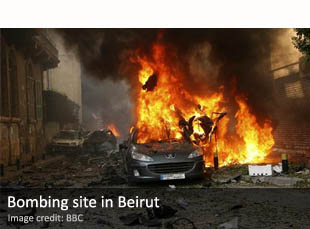
Perhaps the only concrete reality reflected in last week’s assassination of Lebanon’s security chief is the confusion that continues to dominate Western reporting about Lebanese politics. On Friday, Lebanese capital Beirut experienced its most powerful bombing in nearly four years, when a car laden with explosives detonated killing at least eight and injured nearly 100 people. Among the dead was Brigadier General Wissam al-Hassan, head of the intelligence section of Lebanon’s national police force, known as the Internal Security Forces (ISF).  Hassan, a career intelligence officer, was a Sunni Muslim strongly associated with Lebanon’s former Prime Minister Rafik Hariri. Hariri, who was assassinated in Beirut in 2005, was openly anti-Syrian, as was Hassan. This political identification is extremely telling in a country like Lebanon, which has existed under near-complete Syrian political and military domination for the past three-and-a-half decades. Throughout this period, the position of different actors on the Syrian question has been the core defining parameter in Lebanese politics. The same applies to Lebanese institutions. As one such institution, the ISF is widely perceived as strongly anti-Syrian, and is often considered the main rival of the Security Organ of Hezbollah, the Shiite paramilitary group that controls most of southern Lebanon. Read more of this post

Danish Muslim convert claims he was CIA’s mole inside al-Qaeda

Morten StormBy JOSEPH FITSANAKIS | intelNews.org |
A Danish citizen who converted to Islam in the early 2000s claims he was a spy for the United States Central Intelligence Agency and helped track down an American-born Islamist cleric who was killed by a drone strike in 2010. The man, who goes by the name Morten Storm, told Danish newspaper Jyllands-Posten that he converted to Islam while living in the United Kingdom. But he quickly grew disillusioned, he said, and in 2006 he was recruited by the Danish Police Intelligence Service (PET). In subsequent years, he traveled several times to Yemen on PET missions, and gradually managed to gain the trust of members of the al-Qaeda in the Arabian Peninsula (AQAP). Eventually, he said, he grew close to one of AQAP’s central figures, the American-born Yemeni cleric Anwar al-Awlaki. At that point, claims Storm, the PET turned him over to the CIA, who allegedly used him to gather information on al-Awlaki. The Danish Muslim convert claims that his role as a CIA informant was so important that US President Barack Obama knows his name. He also told the paper that it was his information that eventually helped the CIA track and assassinate the charismatic cleric. According to Storm, the CIA supplied him with a memory stick that contained a stealth Global Positioning System tracking device. He sent the memory stick to al-Awlaki, who used it on his computer, thus allowing the CIA to track him down. In April 2010, President Obama ordered that al-Awlaki’s name be included on a list of individuals that the CIA was officially authorized to kill. Little less than a year later, on September 30, 2011, the cleric and three other suspected members of AQAP were killed when their car was hit by two Hellfire missiles in Yemen’s northern al-Jawf province. Read more of this post

Did French intelligence agent kill Libyan leader Muammar Gaddafi?

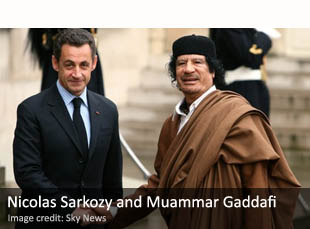
Nicolas Sarkozy and Muammar GaddafiBy JOSEPH FITSANAKIS | intelNews.org |
Nearly a year after the sensational death of Colonel Muammar Gaddafi, sources in Libya have claimed that a French intelligence agent killed the Libyan leader acting under orders by the French government. The Libyan dictator was captured by armed fighters of the Libyan National Liberation Army on October 20, 2011, after his convoy was reportedly bombed by North Atlantic Treaty Organization aircraft. Videos showed Gaddafi being taken aboard a van alive; mysteriously, however, he was pronounced dead a few hours later. The Libyan National Transitional Council blamed the Libyan leader’s death on overzealous militia members, but this explanation did not satisfy the United Nations, which called for an investigation into the incident. But Mahmoud Jibril, a National Transitional Council member who was Libya’s interim Prime Minister during most of 2011, has said in an interview that Gaddafi was killed by a French intelligence officer. Speaking yesterday on Egyptian television, Jibril said that the agent “mixed with the revolutionary brigades” and killed Gaddafi by shooting him twice in the head from close range. Jibril’s comments came two days after one of Italy’s most reputable newspapers, Corriere della Sera, published a report claiming that the alleged French intelligence agent was acting under direct instructions by the French government. The paper said that the order had come down from the office of French President Nicolas Sarkozy. According to the article, Sarkozy was eager to prevent the possibility of Gaddafi standing trial, particularly after the Libyan leader had threatened to expose his alleged financial dealings with the French President. These refer to persistent rumors in France that the Libyan dictator had contributed millions of dollars to Sarkozy’s 2007 election campaign. Read more of this post

News you may have missed #798

Alexander LitvinenkoBy IAN ALLEN | intelNews.org |
►►Britain to hold inquest over death of ex-KGB officer. Britain and Russia appear to be on a collision course over the death of Alexander Litvinenko, a former Russian intelligence officer who died in 2006 after ingesting polonium-210, a rare radioactive isotope. Britain’s Crown Prosecution Service has accused Andrei Lugovoi and Dmitry Kovtun, both former KGB agents, for the death of Litvinenko. Russia has refused British requests to extradite the two, leading to a row with Moscow and the tit-for-tat expulsion of Russian and British diplomats. Until now, the British Foreign Office had attempted to limit the scope of an inquest into the death of Litvinenko, fearing further diplomatic fallout. But coroner Sir Robert Owen said last week that he endorsed a previous ruling by his predecessor in the case, Andrew Reid, that there should be an “open and fearless” investigation into the matter.
►►Ex-CIA operative who illegally sold arms to Libya dies. Edwin P. Wilson, a former CIA officer who was convicted in 1983 for illegally shipping 20 tons of C4 plastc explosives to Libya, has died aged 84. In his trial he claimed he had shipped the weapons to Libya at the request of the CIA, because, as he said, the agency was trying to establish good relations with the Libyan government. But the court did not buy his story, so he spent over 20 years in prison, mostly in solitary confinement, until his release in 2004. He maintained his innocence to the very end.
►►Analysis: Libya an opportunity for CIA if it sticks around. The attack in Benghazi, Libya, that killed four Americans, including a US ambassador and two former Navy SEALs, has led Americans to vacate Benghazi for their safety, even though various militant groups continue their operations. It is a disaster for US intelligence efforts in the region, especially since the attack has made brutally clear how real the jihadi threat in eastern Libya remains. But there may be the smallest of silver linings to this black cloud, if American operatives are able to capitalize on it. The aftermath of the attack shows widespread displeasure with Benghazi’s jihadist groups, with thousands marching in protest. That is an opportunity the CIA could use to rebuild its intelligence gathering.

News you may have missed #793

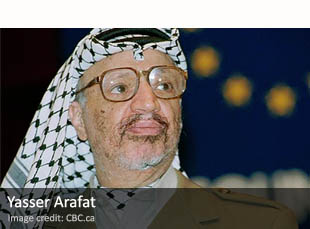
Yasser ArafatBy IAN ALLEN | intelNews.org |
►►Britain recruits tech start-ups for spy gadgets. British security services seem to have decided to widen the net for suppliers of state-of-the-art spyware for “covert surveillance”. Traditionally, British intelligence organizations including MI5 and GCHQ, have relied on a network of trusted contractors. But the change in approach represents an opportunity for burgeoning technology companies. According to a senior Whitehall official, who spoke to The Financial Times, these agencies “are appealing to a wide range of innovators, small and large, and saying: ‘Here are some problems we encounter. Can you solve them?’”.
►►French investigators to exhume Arafat’s remains. Three French investigating magistrates will travel to Ramallah in the West Bank to exhume the remains of the late Palestinian President Yasser Arafat so they can take tissue samples to determine what killed him. New evidence emerged from an investigation in July by the Al Jazeera television network when the Institut de Radiophysique, in Lausanne, Switzerland, said it had discovered significant traces of the rare radioactive element polonium-210 on the late leader’s clothing and toothbrush.
►►Panetta speaks out against book on bin Laden killing. As former US Navy SEAL Matt Bissonnette continues to make headlines about his book, No Easy Day, about the killing of al-Qaeda founder Osama bin Laden, US Defense Secretary Leon Panetta has spoken out publicly on the subject for the first time. The former Director of the CIA said “the American people have a right to know about this operation”. But, he added, “people who are a part of that operation, who commit themselves to the promise that they will not reveal the sensitive operations and not public anything […] when they fail to do that, we have got to make sure that they stand by the promise that they made to this country”.

Mossad allegedly behind assassination of Egyptian militant in Sinai

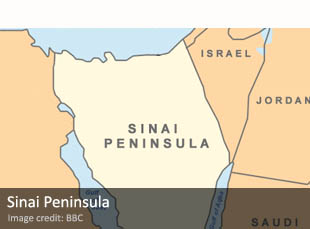
Sinai PeninsulaBy JOSEPH FITSANAKIS | intelNews.org |
Israeli intelligence operatives were allegedly behind the assassination late last month of an Egyptian militant who died when his motorcycle suddenly exploded in Egypt’s Sinai Peninsula. Citing unnamed Egyptian security sources, the Palestinian Ma’an News Agency said the target of the assassination was Ibrahim Ouda Bereikat, a member of the militant group Jamaat Ansar Bait Al-Maqdis fi Sinaa. The group had claimed responsibility for a series of cross-border attacks in August of 2011, which killed eight Israeli citizens. Five Egyptian police officers and ten militants were also reportedly killed in the attacks, which sparked a diplomatic episode between Cairo and Tel Aviv. The Ma’an report cited Egyptian sources who said that the Israeli raid was the first known incursion into Sinai ever since Israel and Egypt signed the 1979 Camp David Accords. The news agency said that Bereikat’s assassination was carried out by a team of four officers from the Mossad, Israel’s primary covert-action agency. The four allegedly bribed several Bedouin tribesmen who live in southern Sinai, and had them lead them to Bereikat’s whereabouts, approximately 10 miles (15 kilometers) into Egyptian territory. The report claims that the eight-member team —four Mossad operatives and four Bedouins— first tried to kill Bereikat on August 22, but failed because, ironically, their target had been picked up for questioning by Egyptian security forces. The Mossad officers thus returned late on Saturday, August 25, and planted explosives on Bereikat’s motorcycle. Read more of this post

France opens murder inquiry into Palestinian leader Yasser Arafat’s death

Yasser ArafatBy JOSEPH FITSANAKIS | intelNews.org |
French prosecutors have opened an official murder inquiry into the 2004 death of Palestinian statesman Yasser Arafat, following allegations that he may have been poisoned. The decision, announced Tuesday, comes less than two months after the results of a lengthy forensic toxicological investigation raised the possibility that the Palestinian leader may have been poisoned with polonium-210. The nine-month study was commissioned by Qatari news channel Al Jazeera and was conducted by the Institut de Radiophysique (IRA) in Lausanne, Switzerland. According to the results, announced in early July, significant traces of the radioactive substance were discovered on the personal artifacts that Arafat used during his final days while in hospital in Paris, France. According to the IRA, some of the Fatah founder’s personal belongings, including his underwear and his toothbrush, contained levels of polonium that were as many as ten times higher than those in random samples used as control subjects in the study. Shortly following the IRA study, Arafat’s wife and daughter filed an official complaint with French judicial authorities, who in turn decided to open an official murder investigation. The decision was taken despite the fact that many in the medical profession appear cautious about the claims of the IRA study. But one British observer told the BBC that the French government was obliged to take the request by the two women “very seriously because of its diplomatic aspect”. Last week, IRA officials in Switzerland said they had received permission from Arafat’s family and the Palestinian National Authority to travel to Ramallah, West Bank, and examine Arafat’s exhumed remains for traces of polonium-210. Read more of this post

Syria denies Air Force intelligence chief assassinated

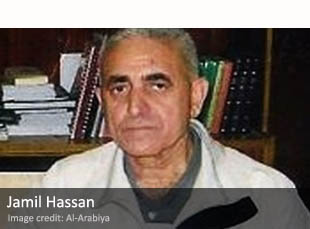
Jamil HassanBy JOSEPH FITSANAKIS | intelNews.org |
A Syrian state-owned television channel has denied reports that the head of Syria’s Air Force Intelligence has been assassinated by one of his aides. The government-controlled al-Dynya TV called reports about the assassination of Lieutenant Jamil Hassan “absolutely false”. However, unlike Syria’s Vice-President, Farouq al-Sharaa, who appeared on television yesterday to dispel rumors he had defected to Jordan, Hassan made no such appearance. Earlier on Sunday, sources affiliated with the opposition Free Syrian Army (FSA) told the Saudi-owned Al-Arabiya television network that Lieutenant Hassan had been killed in his office in Syrian capital Damascus. Born into a prominent military family in the western city of Homs, Syria’s third-largest city and site of some of the worst violence in the ongoing Syrian uprising, Hassan belongs to the country’s Alawite community. It is the same Syrian-based branch of Shiite Islam that counts the country’s President, Bashar al-Assad, as its member. Hassan is believed to be a key member of the Syrian military and a close advisor of the President. Opposition forces consider Hassan a hardline supporter of the Assad regime and charge him with leading the ‘iron fist’ caucus inside the Syrian government. A Syrian opposition source once quoted Hassan as telling Assad: “let me kill a million protesters to end the revolution and I will go to [the International Criminal Court in] The Hague in your place”. Although this quote remains anecdotal, there is little doubt that Hassan’s vocal support for the Assad regime has repeatedly attracted the attention of the opposition FSA, which sees him as one of the most vicious and criminal elements inside the Syrian state. Read more of this post