News you may have missed #685

Aleksandr Z. AnkvabBy IAN ALLEN| intelNews.org |
►►Abkhazia President survives assassination attempt. Unidentified assassins tried on Wednesday to kill Aleksandr Z. Ankvab, the president of Abkhazia, a Russian-backed rebel enclave of Georgia. The assailants used automatic rifles, grenade launchers and a powerful roadside bomb in an attack that raised fresh questions about Moscow’s ability to preserve order there.
►►Groups object to CIA declassification charges. Open government advocates are protesting a recently adopted CIA policy that allows the agency to charge up to $72 an hour to review requests to declassify secret records. The effect “will be to price the public out of submitting” requests for “mandatory declassification review,” the American Library Association, Sunlight Foundation and more than 30 other organizations said in a letter Thursday to CIA Director David Petraeus.
►►Analysis: Fallout from Syrian colonel’s abduction in Turkey. The smokescreen surrounding the abduction of Syrian Col. Hussein Harmush, who defected to Turkey in June 2011 before being handed over to the Syrian secret service in September 2011, has begun to clear in recent weeks following a judicial probe. Claims that Turkey’s spy agency, the National Intelligence Organization (MİT), was involved in handing Harmush over to Syria were finally confirmed on February 2 when the Adana Chief Public Prosecutor’s Office issued a written statement saying one MİT agent had been arrested for questioning and further MİT officials had been called to testify as “suspects” in the scandalous repatriation case.

News you may have missed #683

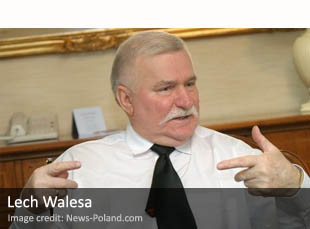
Lech WalesaBy IAN ALLEN | intelNews.org |
►►Walesa scorns new claims he was communist informant. Poland’s former President and Solidarity founder Lech Walesa has brushed off new claims that crucial documents concerning his alleged collaboration with Poland’s communist secret services may be stored in the Polish parliament’s archives. “I know that if there are any papers on me that are unknown, they are only toilet paper”, he said in an interview with Polish television network TVN. Rumors and accusations that Walesa, an anti-communist union leader was in fact a secret communist informant have been circulating for years in Poland.
►►Israeli embassy in Singapore dismisses Barak assassination plot. The Israeli embassy in Singapore confirmed Friday that Defense Minister Ehud Barak had visited the city-state, but dismissed reports of an assassination plot targeting him. Kuwaiti newspaper Al Jarida wrote recently that Barak had been targeted for assassination by three members of a Hezbollah militant cell during his trip to Singapore from February 12-15.
►►Moves to question Turkish spy chiefs quashed. State prosecutors have abandoned an attempt to question Turkey’s spy chiefs over past secret contacts with Kurdish militants, after government moves to curb their investigation of the intelligence agency (MİT). State media said on Monday that prosecutors lifted an order summoning MİT head Hakan Fidan. Nice to be reminded who is really in charge in 21st-century ‘democratic’ Turkey.
Analysis: The How and Why of Modern Assassinations

Bomb blast site in New Delhi, IndiaBy JOSEPH FITSANAKIS | intelNews.org |

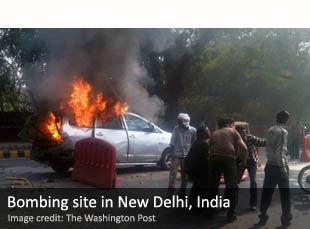
Reports on the discovery last week of a synchronized plan to attack Israeli diplomats in India, Georgia, and Thailand, are still unfolding. At least four people —including the wife of an Israeli diplomat— were injured in New Delhi, when a bomb ripped through a van belonging to the Israeli embassy there. Another bomb was defused by Georgian counterterrorist forces after it was found fastened under an Israeli diplomatic vehicle in Tbilisi. And in Bangkok, two Iranian nationals were arrested after a bomb they were manufacturing exploded prematurely in a rented house in the Thai capital. In an interview I gave this past weekend to The Journal, one of Ireland’s most popular newsmagazines, I noted that the use of targeted assassinations as a means of achieving broader political goals is, of course, not new. But there are definite trends that we have been able to see developing during the past decade or so. For starters, even though the methods of assassination vary greatly, there are common trends one can point out, particularly in the organizational infrastructure of state-sponsored assassination operations. There is, to be precise, an increasing complexity in the way these operations are planned prior to their execution by specialized hit teams. I told The Journal’s interviewer, Susan Ryan, that the increasing sophistication of these types of operations can be appreciated by comparing older examples with case studies that are more recent. Take, for instance, the Black September killings, conducted by Israeli intelligence in response to the 1972 massacre of Israeli athletes at the Munich Olympics. Read more of this post

News you may have missed #677: Analysis edition

Che Guevara after his arrest in BoliviaBy IAN ALLEN | intelNews.org |
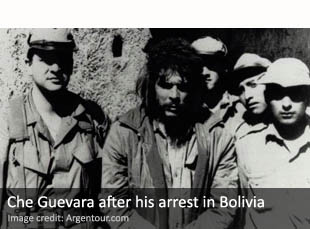
►►New book ties Johnson administration to Che Guevara’s death. Michael Ratner and Michael Steven Smith are the co-authors of a new book about the US role in the killing of Cuban revolutionary Ernesto “Che” Guevara. In their book, Who Killed Che?, Ratner and Smith draw on previously unpublished government documents to argue the CIA played a critical role in the killing. “The line of the [US] government was that the Bolivians did it, we couldn’t do anything about it. That’s not true”, Smith said. “This whole operation was organized out of the White House by Walt Whitman Rostow. And the CIA, by this time, had become a paramilitary organization”.
►►CIA digs in as US withdraws from Iraq and Afghanistan. The CIA is expected to maintain a large clandestine presence in Iraq and Afghanistan long after the departure of conventional US troops as part of a plan by the Obama administration to rely on a combination of spies and Special Operations forces to protect US interests in the two longtime war zones, US officials said. They added that the CIA’s stations in Kabul and Baghdad will probably remain the agency’s largest overseas outposts for years.
►►Indian Army ‘preparing for limited conflict with China’. Noting that India is increasingly getting concerned about China’s posture on its border, James Clapper, US Director of National Intelligence, said this week that the Indian Army is strengthening itself for a “limited conflict” with China. “The Indian Army believes a major Sino-Indian conflict is not imminent, but the Indian military is strengthening its forces in preparation to fight a limited conflict along the disputed border, and is working to balance Chinese power projection in the Indian Ocean,” he said.

News you may have missed #672

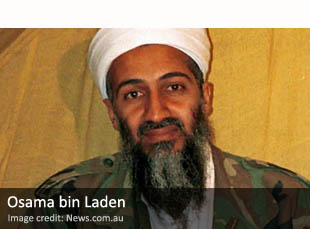
Osama bin LadenBy IAN ALLEN | intelNews.org |
►►CIA claims bin Laden death photos would trigger violence. The Central Intelligence Agency says releasing images of a dead Osama bin Laden “could trigger violence, attacks, or acts of revenge against the United States”. Disclosing such images, including one showing the bullet wound to bin Laden’s head, the government said, “plausibly and logically pose a particularly grave threat of inflaming anti-American sentiment and resulting in retaliatory harm”. The agency made that argument Wednesday in a Freedom of Information Act lawsuit brought by Judicial Watch, which claims the CIA should release the photos taken by US forces. The American public, Judicial Watch said, has a “right to these historical artifacts”.
►►Kuwait accused of tapping phones of prominent citizens. According to the report published in Kuwaiti media, the country’s State Security Department purchased an integrated intelligence system from a former Soviet country last year, and placed it in a restricted zone inside the headquarters’ building. But last July, everything in the isolated room, including staff members hired specifically to operate the devices, vanished without an explanation, said sources. An investigation is currently ongoing to unearth the mystery behind the devices’ disappearance, and also examine information which hint that the devices could have been used by a certain unnamed individual to spy on prominent Kuwaitis.
►►Did US FDA spy on whistleblowers? The US Food and Drug Administration electronically spied on whistleblowers who alerted the Obama administration and Congress of alleged misconduct in the agency, according to a complaint filed in a US federal court. Named as defendants in the lawsuit are the FDA and several of its employees, the Surgeon General, the Health and Human Services Secretary, among others.

News you may have missed #676

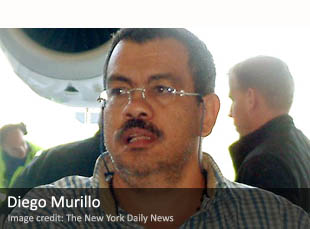
Diego MurilloBy IAN ALLEN| intelNews.org |
►►US admits Pakistani doctor was CIA agent. The United States has confirmed publicly for the first time that a Pakistani doctor long suspected of collecting vital evidence before the assassination of Osama bin Laden was indeed working for the CIA. Defense Secretary Leon Panetta has told 60 Minutes on CBS that Shakil Afridi helped provide proof that the compound in Abbottabad, to which they had tracked a Bin Laden courier, was indeed sheltering the al-Qaeda leader. Panetta also told 60 Minutes that he remains convinced that someone in the Pakistani government “must have had some sense” that a person of interest was in the compound. He added that he has no proof that Pakistan knew it was bin Laden.
►►Czech secret services accused of political spying. The Czech government “spies on” the Communist Party of Bohemia and Moravia (KSCM), Miroslav Grebenicek, its former leader, said in a parliamentary question to Prime Minister Petr Necas. Grebenicek said he had recently received information that the Interior Ministry and some intelligence bodies were “tasked to spying on the KSCM or to incite for, organize and execute the shadowing of the KSCM”. Necas dismissed the allegation, saying that the government does not shadow any party.
►►Colombian paramilitaries protected by spy agency. Colombia’s rightwing paramilitary organization AUC received the support of the country’s now-defunct intelligence agency DAS. The group also helped the government of former President Alvaro Uribe in a conspiracy to discredit the country’s Supreme Court that was investigating ties between the paramilitaries and politicians, according to official testimony by senior AUC commander Diego Murillo, alias “Don Berna”.

Ex-KGB spy Litvinenko was working for MI6 when he died

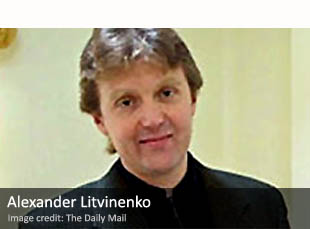
Alexander LitvinenkoBy JOSEPH FITSANAKIS | intelNews.org |
Confidential documents leaked to the British press show that a leading medical examiner wants to reinspect the 2006 death of a former Soviet intelligence officer, in light of new revelations. Alexander Litvinenko was an employee of the Soviet KGB and its successor organization, the FSB, who in 2000 defected with his family to the United Kingdom. He soon became known as an increasingly vocal critic of the administration of Russian President Vladimir Putin. In 2006, Litvinenko came down with radioactive poisoning soon after meeting a former colleague, Andrey Lugovoy, in a London restaurant. The latter is believed by British authorities to have assassinated Litvinenko “with the backing of the Russian state”. Although much of the case remains shrouded in mystery, an important new clue was added to the equation in October, when Litvinenko’s widow publicly admitted that her husband had been a paid employee of British intelligence services MI5 and MI6. Marina Litvinenko told British tabloid newspaper The Mail on Sunday that Alexander had advised both agencies on “combat[ing] Russian organized crime in Europe”. She had previously denied rumors that her husband had been working for British intelligence when he was killed —ostensibly by the Russian government. The revelation appears to have prompted a British coroner to request that the medical investigation into Litvinenko’s death be reopened. Documents leaked to The Mail on Sunday appear to show that Andrew Reid, a coroner at St Pankras Hospital in London, has formally requested that both MI5 and MI6 release all of their internal files on Litvinenko, in the context of a new investigation. Read more of this post

News you may have missed #670: Analysis edition

Michael ChertoffBy IAN ALLEN | intelNews.org |
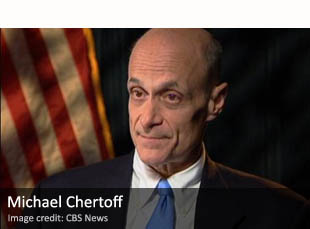
►►Some argue US DHS should change intelligence mission. A decade after Congress created the Department of Homeland Security, the Aspen Homeland Security Group, which is co-chaired by former Homeland Security Secretary Michael Chertoff (pictured), says it is time for the agency to shift its focus from foreign threats to working with local governments and the private sector. Aspen pushes for even more intelligence outsourcing —no surprises there.
►►Not-so-covert Iran war buys West time but raises tension. “Ten out of 10. They hit the target and nobody got caught”, former US intelligence officer Robert Ayers told Reuters of the January 11 killing of Iranian nuclear scientist Mostafa Ahmadi-Roshan. “What makes these things so impressive is they gather a lot of information and do their ‘on the ground’ homework, which can take months”. Sidney Alford, a British explosives expert, says the hit was technically “professional. It worked and it worked very well”.
►►Inside Mossad’s war on Tehran. “In the five attacks on nuclear scientists, the hit squad has used a motorbike every time. The motorcyclist is ubiquitous in the capital’s traffic jams, often wearing a surgical mask for protection against the heavy pollution and able to move close to the target between the lines of stationary cars without attracting attention”.

News you may have missed #665

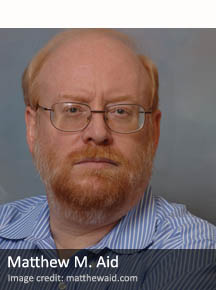
Matthew M. AidBy IAN ALLEN | intelNews.org |
►►Joseph Fitsanakis interviewed on ABC Radio National. IntelNews‘ own Dr Joseph Fitsanakis was interviewed on Friday by reporter Suzanne Hill, for ABC Radio National’s flagship evening news program ‘PM‘. In the interview, which was about the assassination of Iranian nuclear scientist Mostafa Ahmadi-Roshan, Fitsanakis points the finger at the Mossad, and explains why he doesn’t believe the United States had anything to do with the killing. You can listen to the interview here. The transcript is here.
►►India releases diplomat jailed for spying. Last April, Madhuri Gupta, second secretary at the Indian high commission in Islamabad, Pakistan, was arrested for working for Pakistan’s ISI spy agency. She apparently had a “relationship of personal affection” with an aide of her Pakistani handler. On Tuesday, she was granted bail by an Indian court, after 21 months in prison.
►►Matthew Aid interviewed about his new book. Matthew M. Aid, author of The Secret Sentry, has written a new book, Intel Wars: The Secret History of the Fight Against Terror. You can listen to an extensive interview he gave on January 11 on NPR’s Fresh Air, in which Aid outlined his view that “overlapping jurisdictions, bureaucratic policies and a glut of data have crippled the intelligence community in its war against would-be terrorists”.
►►British spies to be cleared on torture allegations. The British government, including Scotland Yard and the Crown Prosecution Service, has just finished a four-year inquiry into the country’s security and intelligence services, sparked by allegations by terrorist suspects released from Guantanamo Bay, that they were severely tortured. The results have not yet been announced. But British media report that, according to information from trusted sources, the inquiry has concluded that (…drumroll…) there is no evidence that officers from either MI5 or MI6 were aware of the mistreatment of prisoners.

Comment: Drawing Careful Conclusions from the Iran Assassination

Mostafa Ahmadi-Roshan's carBy JOSEPH FITSANAKIS* | intelNews.org |
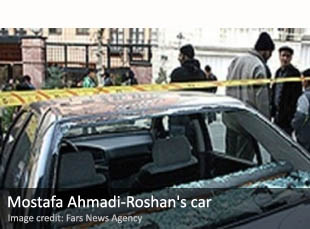
The body of Iranian academic Mostafa Ahmadi-Roshan was still warm when officials in Tehran began accusing Israel and the United States of having planned his assassination. Leveling such accusations without offering adequate proof is certainly unstatesmanlike; but even hasty conclusions can be logical, and even sworn enemies of the Iranian government would find it difficult to point at other possible culprits. Keeping in mind that, at this early stage, publicly available information about the assassination remains limited, are there conclusions that can be drawn with relative safety by intelligence observers? The answer is yes. Roshan, 32, was a supervisor at Iran’s top-secret Natanz fuel enrichment plant. His scientific specialty was in the technology of gas separation, the primary method used to enrich uranium in Iran’s nuclear energy program. His assassination, which took place in broad daylight amidst Tehran’s insufferable morning traffic, was a faithful reenactment of the attacks that killed two other Iranian nuclear scientists in November of 2010. A motorcycle, practically indistinguishable from the thousands of others that slide maniacally between cars in the busy streets of the Iranian capital, made its way to the car carrying Ahmadi-Roshan. As the driver kept his eyes on the road, the passenger skillfully affixed a magnetic explosive device to the outside surface of the targeted vehicle, next to where Ahmadi-Roshan was sitting. By the time the blast killed the scientist, as well as the car’s driver, and injured a third passenger, the motorcyclists were nowhere to be found. Two-and-a-half hours later, when the report of Ahmadi-Roshan’s assassination was making its way through the newsroom of Iran’s state-owned Fars news agency, the assassins were making their way to Dubai, Oman, Qatar, or various other destinations around the Middle East. Read more of this post

News you may have missed #660

Margaret ThatcherBy IAN ALLEN | intelNews.org |
►►Taiwan President accused of spying on political opponents. Taiwan’s opposition challenger for the presidency, Tsai Ing-wen, has accused intelligence services under the control of incumbent President Ma Ying-jeou of tracking her campaign events for political advantage. The allegations – unproven and denied by Ma – conjure up memories of Taiwan’s one-party past when Ma’s party, the Nationalists, used their total control of the state apparatus to persecute opponents.
►►Analysis: Has Israeli-Australian spy relationship been restored? Intelligence sharing between Israel and Australia was halted this time last year, when a Mossad hit squad with forged Australian passports assassinated senior Hamas official Mahmoud al-Mabhouh in in Dubai. But Australian newspaper The Age reports that “the flow of top secret intelligence between the two countries has now been restored”, in a move apparently initiated by the Australian side.
►►Thatcher threatened to ban BBC program on MI5 and MI6. The Conservative government of British Prime Minister Margaret Thatcher threatened to “veto” a BBC investigative program about British intelligence services MI5 and MI6, because it would reveal details about how they operated and question their public accountability. In a letter marked “top secret and personal”, cabinet secretary Sir Robert Armstrong, recommended that Margaret Thatcher consider invoking the rarely used power, saying that “the government has the power to ban any program”. Thatcher wrote on the note: “I would be prepared to use the veto”.

Mossad spy network allegedly busted in Mauritania

Fares al-BannaBy JOSEPH FITSANAKIS | intelNews.org |

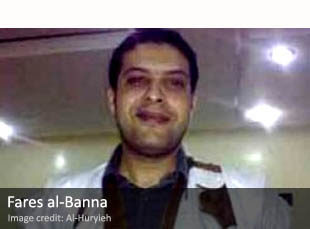
Authorities in the northwestern African country of Mauritania have allegedly busted an Israeli spy network linked to the 2010 assassination of Hamas operative Mahmoud al-Mabhouh in Dubai. One of Mauridania’s leading daily newspapers, Al-Huriyeh, says that the spy ring, which allegedly consisted “businessmen and activists [from] several Arab nationalities”, was uncovered following the arrest of one of its members, identified as Fares al-Banna. A Jordanian citizen of Palestinian extraction, al-Banna was arrested for larceny, which eventually lead to a warrant issued for searching his premises. Upon searching his house, authorities reportedly found a handwritten letter, addressed to the Ambassador of the United Arab Emirates in Mauritanian capital Nouakchott, in which al-Banna claimed had been recruited by Israeli intelligence agency Mossad. In the letter, al-Banna also claimed that he had participated in the January 2010 assassination of Hamas weapons procurer Mahmoud al-Mabhouh in Dubai. The letter also alleges that al-Banna helped Mossad carry out a bombing of Ethiopian Airlines flight ET409, which blew up in mid-air on January 24, 2010, five minutes after taking off from Beirut’s Rafiq Hariri International Airport, en route to Addis Ababa. Al-Huriyeh reports that al-Banna’s letter suggests the Mossad blew up the plane in order to kill one or more Hezbollah targets who were on board. The Mauritanian daily says that police officers who searched al-Banna’s home, as well as his office at a travel agents called “United Travel Services”, found several different passports containing his picture, “dozens of credit cards”, as well as a sophisticated device believed to be a transmitter of some kind. Read more of this post

Inquiry examines whether IRA had mole inside Irish police

Provisional IRA muralBy JOSEPH FITSANAKIS | intelNews.org |
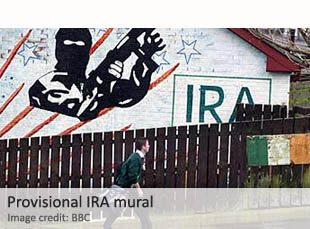
An Irish government investigation has unearthed intelligence reports claiming that an informant within the Irish police, the Garda, helped the Provisional Irish Republican Army plan the killings of a judge and two senior British police officers in the 1980s. Sir Maurice Gibson, a Lord Justice of Appeal for the British Crown, was killed along with his wife, by a remote-controlled car bomb, as they drove over the Irish border back into Northern Ireland on 27 April 1987, following a holiday. A little less than two years later, on March 20, 1989, Royal Ulster Constabulary officers Harry Breen and Robert Buchanan, were killed in an IRA road ambush in South Armagh. The two RUC officers, who were killed as they drove back from a meeting with Garda officers in the Republic of Ireland, were targeted despite the fact that they were riding in an unmarked car. This has sparked rumors that the victims’ travel itinerary had been supplied to the IRA by an inside source, possibly an officer in the Garda. In 2000, Jeffrey Donaldson, a British Member of Parliament, told the House of Commons that Garda Detective Sergeant Owen Corrigan was the IRA mole that leaked the itineraries of Judge Gibson and the two RUC officers. The Smithwick Tribunal in Dublin, which was set up in response to Mr. Donaldson’s allegations, is scheduled to conclude at the end of this month, following public testimony by several individuals. One of those is Detective Superintendent Brian Burton, of the Dundalk Garda station, the very same station in which Det. Sgt. Corrigan served at the time of the IRA killings. Read more of this post

News you may have missed #616

CSIS seal

CSIS seal

►►S. Koreans say several N. Korean assassination bids stopped. South Korea has arrested several North Korean agents for plotting to assassinate anti-Pyongyang activists, according to Won Sei-Hoon, head of South Korea’s National Intelligence Service, who spoke to the parliament’s intelligence committee. Earlier this month, Seoul prosecutors charged a North Korean agent with trying to murder Park Sang-Hak, an outspoken activist in Seoul, with a poison-tipped weapon.
►►MI5 inspectors’ website shut down after security blunder. A new website for the former High Court judges responsible for oversight of MI5, MI6 and wiretapping has been shut down after it emerged that anyone could edit any page of it. The security blunder forced the Intelligence Services Commissioner, Sir Mark Waller, and the Interception of Communications Commissioner, Sir Paul Kennedy, to pull the plug on their new website.
►►Report urges Canadian spies to share more info with diplomats. Canada’s spy agency needs to share more information with the Department of Foreign Affairs so the department is better prepared for negative reactions to Canadian intelligence work overseas, according to a new report by Canada’s Security Intelligence Review Committee. The Committee, which reports to Parliament on the work of the Canadian Security Intelligence Service, found the organization had “limited exchanges” with Canada’s diplomats on its operations.

News you may have missed #615

Clair E. George

Clair E. George

►►Ex-KGB spy Litvinenko’s widow seeks donations. The widow of Alexander Litvinenko has appealed for donations to help expose her husband’s murderers. Marina Litvinenko said she has to know the truth about the Russian ex-KGB spy’s death in London on November 23, 2006. He died of radioactive Polonium 210 poisoning in London’s University College Hospital. He had fallen ill shortly after drinking tea during a meeting with former KGB contacts at a West End hotel.
►►Memorial ceremony for controversial CIA figure. Clair George, who died in August from cardiac arrest at 81, has a rare status in CIA lore. He was the first high-ranking agency official to be found guilty of felony charges while carrying out official duties. Despite the public outrage about CIA actions during the Iran-Contra affair, George remained a popular figure among agency alumni because they believe his loyalty never faltered.
►►Taiwan intelligence agency accused of wasting money. Taiwan’s military-intelligence body has come under fire after one of its agents returned as a Le Cordon Bleu-certified chef following a so-called undercover mission in France. The agent, whose U$42,000 tuition for the cooking classes in France was sponsored by the military, has now lent his Le Cordon Bleu certificate to someone else for a fee, according to reports.