White House reinstalls visas for 2009 Honduran coup plotters
September 8, 2011 Leave a comment
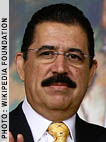
Manuel Zelaya
By JOSEPH FITSANAKIS | intelNews.org |
On June 26, 2009, a clandestine meeting of the Honduran Supreme Court issued a secret warrant for the arrest of the country’s democratically elected President, Manuel Zelaya. Less than 48 hours later, in the early hours of June 28, uniformed officers of the Honduran Army stormed the Presidential Palace in Tegucigalpa and arrested Zelaya. Shortly afterwards, the deposed President was placed on a plane and sent into enforced exile. It was the first coup d’état in the Central American country since 1978, and the first in Latin America in several years. The US administration of President Barack Obama almost immediately condemned the coup and halted American military aid to Honduras; but it failed to officially designate Zelaya’s ouster as a ‘military coup’, which would have required Washington to outlaw and terminate nearly all forms of government —and some private— aid to Honduras. In August, after several weeks of heavy criticism from Latin American governments, the Obama White House proceeded to “temporarily suspend” non-immigrant visas for over 1,000 Honduran military and civilian leaders, who had endorsed President Zelaya’s unconstitutional ouster. Many of whom had participated in the first post-coup government of former Speaker of the Honduran Congress, Roberto Micheletti. But a news report by the Associated Press suggests that Washington may now be quietly reinstating visas to Micheletti government officials, and that some of them are already travelling to and from the United States. The article quotes a “US embassy spokesperson”, who “spoke on condition of anonymity”, as saying that “the Department of State has determined that some of the Hondurans whose eligibility for visas was restricted following the June 2009 coup d’etat are again eligible to be considered for visas”. Read more of this post







 intelNews.org
Mystery compound in Nicaragua shows Russia’s resurgence in Americas, say experts
April 10, 2017 by Joseph Fitsanakis 2 Comments
Nicaragua has a long Cold War legacy that culminated in the 1980s. In 1979, a leftist insurgency toppled the country’s longtime dictator, Anastazio Somoza. The rebels, who called themselves the Sandinista National Liberation Front (known widely as the Sandinistas), alarmed the government of US President Ronald Reagan. Consequently, the White House authorized a series of covert operations against Nicaragua’s leftist government. They centered on the Contras, an anti-communist counter-insurgency that was largely funded by Washington throughout the so-called Contra war that dominated the country’s politics in the 1980s. But the war also affected politics in the US, and almost toppled the Reagan administration when the Iran-Contra affair (illegal arms sales to Iran by the US government, which then used the proceeds to secretly fund the Contras) was revealed in the media.
In an article published last week, The Washington Post reported that, under the Presidency of Vladimir Putin, Russia has reemerged as a force in Latin American politics. Moscow now regularly supplies weapons to several countries in the hemisphere, including Ecuador, Peru, Argentina and Venezuela. It has also expanded its influence through the banking sector and via government loans in countries such as Brazil and Mexico. But Nicaragua, says The Post, has emerged as Russia’s closest ally in the region. For over a decade, the country’s political landscape has been dominated by the Sandinistas, who returned to power in 2006 and continue to govern the country today. The party was supported by the Soviet Union during the Cold War and thus retains strong historical links with Moscow. The Post reports that, according to some analysts, Russia seeks to cement its presence in America’s traditional backyard as a form of response to the eastward expansion of the US-led North Atlantic Treaty Organization.
► Author: Joseph Fitsanakis | Date: 10 April 2017 | Permalink
Filed under Expert news and commentary on intelligence, espionage, spies and spying Tagged with Analysis, Central America, global positioning system, GLONASS, Latin America, Managua (Nicaragua), Nicaragua, Russia, United States