German think-tank researcher arrested on suspicion of spying for Chinese intelligence
July 7, 2021 Leave a comment

A GERMAN POLITICAL SCIENTIST, who worked for years as a senior member of a prominent Munich-based think-tank, has been arrested by German authorities on suspicion of spying for Chinese intelligence. In line with German privacy laws, the man has been named only as “Klaus L.”. He is believed to be 75 years old and to live in Munich.
According to reports, the suspect worked since the 1980s for the Hanns Seidel Stiftung, a political research foundation named after a former chairman of the conservative Christian Social Union (CSU) of Bavaria. The Munich-headquartered foundation is the informal think-tank of the CSU, which is the Bavarian arm of German Chancellor Angela Merkel’s Christian Democratic Union.
As part of his job, Klaus L. traveled frequently to countries in Africa, Asia and Europe, as well as former Soviet states. It is also believed that, for over 50 years, he had worked as a paid informant for the German Federal Intelligence Service (BND) —Germany’s foreign intelligence agency, which is equivalent to the United States Central Intelligence Agency. According to a government press statement, Klaus L. would provide the BND with information relating to his foreign travels, conference attendance and other “certain issues” of interest to the spy agency. In return, the BND allegedly funded some of his travel and conference expenses, and provided him with a regular stipend.
But in the summer of 2010, Klaus L. was allegedly approached by Chinese intelligence during a trip to the city of Shanghai. According to German counterintelligence, he was persuaded by the Chinese to cooperate with Chinese intelligence operatives, and did so until the end of 2019. In November of that year, German police searched his home in Munich, as part of an investigation into his activities. In May of this year, Klaus L. was charged with espionage and on July 5 he was formally arrested.
Interestingly, Klaus L. does not deny that he provided sensitive information to China. He argues, however, that he informed his BND handler about his contacts with the Chinese, and that these were known to German intelligence. He therefore claims that his Chinese contacts were part of a German counterintelligence operation targeting the Chinese government. His trial is scheduled for this fall.
► Author: Joseph Fitsanakis | Date: 07 July 2021 | Permalink
 POLICE STATIONS IN CHINA are reportedly experimenting with a new technology that uses artificial intelligence to detect the emotions of subjects, and even monitors their skin pores, according to a source who spoke to the BBC. The source is a software engineer, whose identity has not been disclosed by the BBC. He said he helped install the controversial technology in a number of police stations in the Chinese region of Xinjiang.

 A LEADING CHINESE TELECOMMUNICATIONS firm has strongly denied a claim by a newspaper that its service personnel could listen in on calls made by Dutch telephone users, including senior government officials. The report dates from 2010 and was authored by consultancy firm Capgemini on behalf of KPN, one of Holland’s largest telecommunications service providers. The Rotterdam-based firm had hired Capgemini to conduct a risk analysis on whether more equipment should be purchased from Chinese telecommunications giant Huawei. By that time the Chinese company, one of the world’s largest in its field, was already supplying KPN with hardware and software equipment.


 CITING NATIONAL SECURITY GROUNDS, the government of Lithuania has canceled an agreement with a Chinese-owned company to supply baggage-scanning equipment at airports across the Baltic country. The Beijing-based company, Nuctech, is owned by Tsinghua Tongfang, which is in turn controlled by the China National Nuclear Corporation (CNNC). Tasked with managing China’s nuclear fuel supply and development program, CNCC is owned by the Chinese government.
 THREE CHINESE NON-OFFICIAL cover intelligence officers, who were working in London under journalistic cover, were expelled from Britain in the past year, according to a new report. The claim was made on Thursday by The Telegraph newspaper, which
 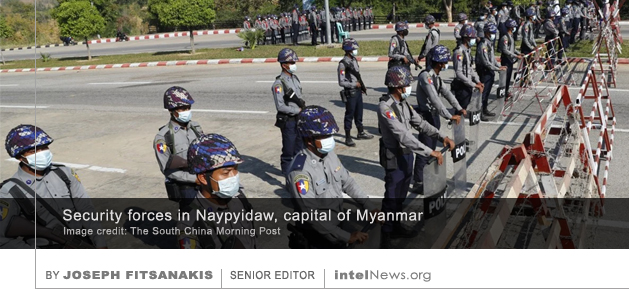 CHINESE GOVERNMENT OFFICIALS HAVE denied claims that Beijing consented to, and even supported, the coup that took place in Myanmar on Monday. The Southeast Asian country’s armed forces seized control of key government installations in the early hours of Monday, before announcing that parliament had been dissolved. Hundreds of politicians, including Myanmar’s State Counsellor Aung San Suu Kyi, have been arrested, and the fate of many of them remains unknown. The military claims that the general elections of November 8, 2020, which gave Aung San Suu Kyi’s National League for Democracy party 61 percent of the vote, were fraudulent.
 The Afghan government reportedly expelled from the country 10 Chinese intelligence officers on Saturday, after they were found to have contacts with pro-Taliban groups. Meanwhile the White House was recently briefed about claims that Beijing offered Afghan militants bounties for killing American soldiers.










More evidence uncovered of Chinese spy programs that target expatriates
July 23, 2021 by Joseph Fitsanakis Leave a comment
AN INVESTIGATION INTO THE activities of China’s state security apparatus has uncovered more evidence of the existence of a worldwide spy operation aimed at forcibly repatriating fugitives and dissidents living abroad, including many who reside in Western countries. The operation, code-named FOXHUNT (first reported in 2015), and a sister-project, code-named SKYHUNT, were launched in 2014. They reportedly constitute a major pillar of the nationwide campaign against corruption, which was initiated in 2012 by Chinese Premier Xi Jinping. This extensive campaign is so far believed to have led to the indictment of over 100,000 people for financial crimes, though critics say it is also being used by Xi to neutralize political opponents and dissidents across China.
The investigative group ProPublica, which carried out the study of FOXHUNT and SKYHUNT, said on Thursday that the same techniques used to capture international fugitives wanted for financial crimes, are also employed against expatriates who criticize the Chinese state’s politics. Most of the targets of these operations live in countries that are located near China —such as Vietnam, Laos, or Malaysia. Thousands of others, however, live in Western Europe, Australia and the United States, where “hundreds of people, including US citizens”, have been targeted by the Chinese state, according to ProPublica.
Operations FOXHUNT and SKYHUNT are carried out by “undercover repatriation teams” of Chinese government agents, who allegedly enter foreign countries “under false pretenses”, according to ProPublica. At the same time, Chinese intelligence officers enlist expatriates as assets and use them as “intermediaries to shield Chinese officers”, said the report. These intermediaries are coached to “relentlessly hound their targets”, or surveil their activities and report about them to their handlers.
In several countries, including Vietnam and Australia, Chinese “undercover repatriation teams” have at times abducted their targets, “defying with impunity [local] laws” and international borders, the ProPublica report claims. But in countries like the United States, the Chinese tread more lightly, relying mainly on coercion aimed at compelling their targets to voluntarily return to China. In many cases, according to the report, authorities in China have subjected their targets’ family members to “harassment, jail [or] torture”. Allegedly, they have even recorded “hostage-like videos” that were shown to the targets of the repatriation operations, in an effort to force them to return to China.
Alongside wealthy Chinese tycoons with oversized offshore bank accounts, repatriation targets have reportedly included political dissidents and whistleblowers who had managed to escape abroad. Other victims were members of the Tibetan or Uighur communities in exile, as well as followers of religious sects, such as the Falun Gong. The Chinese government denies that operations FOXHUNT and SKYHUNT exist. But critics claim that Beijing’s forced repatriation program is real, and reflects “the authoritarian nature of the Chinese government and their use of government power to enforce conformity and repress dissent”, ProPublica reports.
► Author: Joseph Fitsanakis | Date: 23 July 2021 | Permalink
Filed under Expert news and commentary on intelligence, espionage, spies and spying Tagged with blackmail, China, forcible repatriation, immigration intelligence, News, Operation FOX HUNT, Operation SKYHUNT