Germany ‘might scrap’ no-spy treaty with US, UK, France

Thomas de MaizièreBy JOSEPH FITSANAKIS | intelNews.org
The German government is considering scrapping a decades-old no-spy agreement with the three Allied victors of World War II, following the arrest of a German intelligence officer who was caught spying for the United States. The treaty was signed in 1945 between the German state and the governments of the United States, France and Britain. Their intelligence services are defined in the treaty as allied with Germany’s and are seen as working with Germany’s national interest in mind. Consequently, Berlin pledges not to direct counterespionage operations against French, American and British intelligence activities inside Germany. Implicit in the agreement is the understanding that these three countries can spy on German soil only when targeting non-German operatives in the country. However, in an interview with German tabloid newspaper Bild, Germany’s Minister of the Interior, Thomas de Maizière, said that Berlin is now seriously considering scrapping the postwar treaty, in response to the recent revelations about alleged espionage activities against Germany by the US Central Intelligence Agency. He was referring to news, aired last week, that an officer of the BND, Germany’s main external intelligence organization, was found to have spied for the CIA for over two years. On Monday, the Reuters news agency said it had confirmed that the alleged double spy had indeed been recruited by the CIA, and that the Agency’s Director, John Brennan, had asked to brief senior members of Congressional intelligence committees about the issue. Also on Monday, White House Press Secretary Josh Earnest told reporters in Washington that the US government would “work with the Germans to resolve this situation appropriately”. But these assurances seem to have done little to quell Berlin’s irritation. Another senior German politician, Stephan Mayer, who is close to German Chancellor Angela Merkel, told Bild that it was time for German intelligence to “focus more strongly on our so-called allies”. Read more of this post


Germany summons US ambassador following arrest of CIA spy

BND headquarters in BerlinBy JOSEPH FITSANAKIS | intelNews.org
Authorities in Germany have summoned the American ambassador to Berlin following the arrest of a German intelligence officer who was apprehended last week on suspicion of spying for the United States. The man, who has not been named, is suspected of passing classified government information to American intelligence operatives on a variety of subjects. His most recent undertakings are said to have targeted activities of a German parliamentary committee investigating US espionage against Germany. The episode is expected to further strain relations between the two allies, which were damaged by revelations last year that the National Security Agency, America’s signals intelligence organization, had bugged the telephone of German Chancellor Angela Merkel. The revelation, which was made public by Edward Snowden, an American defector to Russia who had previously worked for the NSA, showed that Chancellor Merkel had been targeted as part of a wider US spy operation against Germany. The revelations sparked the establishment of a nine-member parliamentary committee that is tasked with evaluating Snowden’s revelations and proposing Germany’s response. It appears that the man arrested, who is believed to have been secretly employed by the Central Intelligence Agency, tried to spy on the activities of the committee on behalf of his American handlers. According to German media reports, the man, who is said to be 31 years old, is a “low-level clerk” at the Bundesnachrichtendienst, or BND, Germany’s external intelligence agency. According to Der Spiegel newsmagazine, he is believed to have spied for the CIA for approximately two years, and to have supplied the American spy agency with around 200 classified German government documents in exchange for around €25,000 —approximately $30,000. Read more of this post

CIA ‘stripped of spies’ in embattled Iraq, say sources

US embassy compound, IraqBy JOSEPH FITSANAKIS | intelNews.org
The Sunni uprising in Iraq, in combination with the Shiite domination of the government in Baghdad, has drastically limited the ability of the United States Central Intelligence Agency to collect dependable intelligence, according to sources. Newsweek’s veteran intelligence correspondent, Jeff Stein, said on Friday that the Agency had been “stripped of its spies” in the embattled country and was struggling to rebuild its network of assets. Stein cited “knowledgeable intelligence sources” as saying that the CIA had lost many of its sources inside the government in Baghdad, which is now firmly in Shiite hands. Since assuming power in 2006, Iraq’s Shiite Prime Minister, Nouri al-Maliki, gradually purged most Sunnis from senior government positions, thus shutting down the CIA’s eyes and ears in Baghdad. The intelligence-collection problem for the Agency has worsened since the breakout of the Sunni uprising in the west of the country, which has prompted mass defections of senior tribal leaders to al-Qaeda-inspired rebel groups. Many of these leaders were previously valuable sources of information for the CIA, which has traditionally had far more contacts with Iraqi Sunnis than Shiites. To make things worse, says Stein, CIA operatives in Iraq are unable to travel outside of Baghdad due to the worsening security situation in the country. Instead, they remain “holed up” in the American embassy compound and rely almost exclusively on “technical means” of intelligence collection (and, one presumes, a variety of open sources). Inevitably, the Agency is now much more reliant than usual on information provided by regional intelligence services, such as Turkey’s and Jordan’s, who still have agents on the ground in Iraq. Read more of this post

CIA resumes drone strikes in Pakistan after six-month hiatus

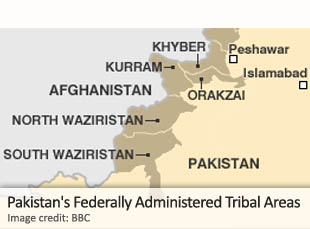
Pakistan's Federally Administered Tribal AreasBy IAN ALLEN | intelNews.org
The United States Central Intelligence Agency appears to have resumed its targeted assassinations using unmanned aerial drones in Pakistan, following a nearly six-moth hiatus. The Agency launched its lethal drone program in Afghanistan and Pakistan in 2004, and intensified it in 2008 under the supervision of US President George Bush, who then passed it on to his successor, Barack Obama. Nearly 400 strikes on Pakistani soil have been attributed to the CIA in the past decade, which have killed in excess of 3,000 militants and civilians by some estimates. But, in an unprecedented move, Washington completely seized carrying out airstrikes on Pakistani soil after December 25 of last year. That changed on Wednesday, June 11, when several powerful missiles landed outside a house located a few miles outside of Miramshah, in Pakistan’s North Wazieristan Province. The area is an operational stronghold of Pakistan’s most powerful armed militant group, the Pakistani Talban, and its close affiliate, the Haqqani Network. The air strikes took out a number of vehicles that were allegedly filled with explosives and killed at least 16 people, including alleged Taliban and Haqqani commanders, as well as, reportedly, members of the Islamic Movement of Uzbekistan (IMU). Washington said that those targeted were on their way to conduct cross-border raids in Afghanistan when they were killed. As it always does in these instances, Pakistan’s Ministry of Foreign Affairs condemned the strikes as violations of the country’s sovereignty. But reports in the Pakistani media claimed that Washington had sought and received Islamabad’s approval prior to launching last week’s attacks. What prompted the change in policy? According to one local observer, the CIA had agreed to stop its aerial attacks after it was asked to do so by the government of Pakistan, which has been engaged in peace talks with the Taliban for several months. But these talks collapsed following the June 6 suicide attack on Karachi’s Jinnah International Airport by the Taliban and the IMU, which killed 36 people, including all 10 attackers. Read more of this post

US journalist facing jail term for refusing to testify in CIA officer’s trial

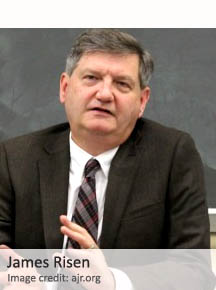
James RisenBy IAN ALLEN | intelNews.org
A leading American journalist is facing a possible jail term after the United States Supreme Court refused to consider his appeal against testifying at the trial of a former Central Intelligence Agency officer. Jeffrey Alexander Sterling, who worked for the CIA from 1993 until 2002, was arrested in early 2011 in St. Louis, Missouri. He was charged with leaking classified information about Operation MERLIN, a botched CIA covert operation targeting Iran’s nuclear weapons program. The operation was publicly revealed for the first time in New York Times reporter James Risen’s 2006 book State of War: The Secret History of the CIA and the Bush Administration. In chapter 9 of the book, Risen details a bungled operation by the CIA’s Iran Task Force to pass to the Iranians a series of faulty nuclear bomb design documents. Risen alleges that the CIA operation backlashed and may actually have helped the Iranian nuclear weapons program, as Iranian nuclear engineers would have been able to “extract valuable information from the blueprints while ignoring the flaws”. Risen was summoned to testify in Sterling’s trial, but refused, arguing that having to identify the source of his allegation about Operation MERLIN would infringe on press freedom. On the other side of the argument, the United States government claimed that the freedom of the press does not permit journalists “to refuse to provide direct evidence of criminal wrongdoing by confidential sources”. Risen filed a case in a Virginia court, arguing that he should not be forced to comply with the subpoena issued to him to testify at Sterling’s trial. After the court upheld the subpoena, Risen’s legal team filed an appeal with the Supreme Court. But the Court has now refused to hear the case, which means that Risen will have to testify in Sterling’s trial or face a possible jail sentence. Read more of this post

White House ‘investigating’ inadvertent naming of CIA station chief

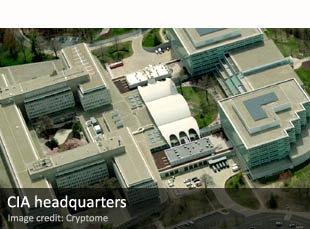
CIA headquartersBy IAN ALLEN | intelNews.org
United States government officials are said to be investigating the apparently inadvertent disclosure of the name of America’s senior spy in Afghanistan last weekend. The Washington Post reported on Sunday that the name of the person in charge of all Central Intelligence Agency operations in Afghanistan had been mistakenly included in a press release issued to a host of news organizations by the White House. The release included the names of all individuals that had been scheduled to meet with US President Barack Obama, during the latter’s unannounced trip to Afghanistan. The US President visited American soldiers stationed in the Asian country during part of the Memorial Day weekend, a federally sanctioned commemoration in the United States, which is designated to honor those who have died while serving in the country’s armed forces. The press release, which was directly issued to over 6,000 journalists, included the name of the CIA official, followed by the designation “Chief of Station, Kabul”. A CIA Chief of Station is the highest-ranking Agency official in a particular country or region, tasked with overseeing CIA operations within his or her geographical area and maintaining a functional institutional relationship with the host nation’s intelligence agencies. Speaking on CNN on Tuesday, President Obama’s Deputy National Security Adviser, Tony Blinken, said the White House was “trying to figure out what happened [and] why it happened”, adding that US officials wanted to “make sure it won’t happen again”. He added that the White House Counsel, Neil Eggleston, had been tasked by White House Chief of Staff, Denis McDonough, to “look into the matter”. CNN reporters asked Blinken whether the inadvertent identification of the CIA’s Station Chief in the Afghan capital had endangered the life of the officer and his family. Read more of this post

Alleged CIA spy seeks retrial after Iranian court slashes his sentence

Amir Mirzaei HekmatiBy IAN ALLEN | intelNews.org
A United States citizen held in Iran since 2011 on spy charges has appealed for a retrial after an Iranian court quashed his earlier death sentence for espionage. Amir Mirzaei Hekmati, a former Marine born in the US state of Arizona, was arrested in August of 2011 in Iran and charged with carrying out a covert mission for the Central Intelligence Agency. In December of 2011, Hekmati appeared on Iranian state television and acknowledged that he was an operative of the CIA. He said in an interview that he had been trained “in languages and espionage” while in the US Army and that, in 2009, after nearly a decade of intelligence training, he was recruited by the CIA and specifically prepared to carry out what intelligence operatives sometimes refer to as a ‘dangling operation’ in Iran. The aim of the mission, said Hekmati, was to travel to Tehran, contact Iran’s Ministry of Intelligence and National Security, and pose as a genuine American defector wishing to supply the Iranians with inside information about American intelligence. His immediate task was to gain the trust of Iranian authorities by giving them some correct information in order to set the stage for a longer campaign of disinformation aimed at undermining a host of Iranian intelligence operations. In 2012, Hekmati was sentenced to death for spying. Members of his family, however, who live in Michigan, have continuously denied that he is an intelligence operative and maintain that he traveled to Iran to visit his grandparents. Their denials have been echoed by the government in Washington, which has denied employing Hekmati in any intelligence capacity. In March of 2012, the Supreme Court of Iran quashed Hekmati’s death sentence and ordered a retrial, calling his previous prosecution “incomplete”. At the retrial, Iran’s Revolutionary Court overturned Hekmati’s initial espionage conviction, charging him instead with “collaborating with a hostile government”. His original sentence was reduced to 10 years in prison. But Hekmati’s lawyer, Mahmoud Alizadeh Tabatabaei, told journalists on Sunday that his client would appeal even that sentence, thus seeking an immediate release from prison. Read more of this post

Court allows CIA to keep Cuba invasion document secret

Court documentsBy IAN ALLEN | intelNews.org
The United States Central Intelligence Agency has successfully defended itself against a lawsuit that sought the release of a secret document detailing the failed Bay of Pigs Invasion. On April 17, 1961, a brigade of 1,300 CIA-funded and -trained anticommunist Cubans mounted a surprise assault on the Caribbean island. The failure of the operation prompted the CIA to produce a multi-volume report, whose fifth and final part was authored in the early 1980s by CIA resident-historian Jack Pfeiffer. The first four volumes of the history of the Invasion have been released to the public, one voluntarily by the CIA and three through Freedom of Information Act requests. George Washington University’s National Security Archive sued the CIA in 2011, eventually forcing the Agency to declassify Volumes I, II and IV of the report. This left Volume V, which is the subject of an ongoing dispute between historians and the CIA, going back to 2005. On Tuesday, the US Court of Appeals for the Circuit of the District of Columbia ruled in a split 2-1 decision that the CIA had the right to maintain the secrecy of the entire fifth volume of the report. The two judges that ruled in favor of the CIA’s position, Brett Kavanaugh and Stephen Williams, argued that the volume in question had been “rejected for inclusion in the final publication” of the CIA report. As such, it was not a finished product, but rather a draft manuscript and was therefore not subject to US declassification rules under the Freedom of Information Act. The judges added that, since the document was “predecisional and deliberative” in character, it should be granted the so-called “deliberative process privilege”. This clause stipulates that the authors of deliberative documents are entitled to concrete and long-lasting assurances that the draft documents they are producing will remain secret. This, said the two judges, would allow the authors to advise those who commission their work freely and candidly. Read more of this post

Is Texas Army base home to secret CIA weapons facility?

Camp StanleyBy JOSEPH FITSANAKIS | intelNews.org
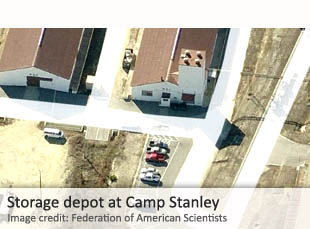
Observers of the Central Intelligence Agency know that the Agency maintains two widely acknowledged facilities inside the United States —both in the state of Virginia. One is its headquarters in Langley. The other is inside the Armed Forces Experimental Training Activity, known more commonly as Camp Peary, located near Williamsburg, where officers of the CIA’s National Clandestine Service are allegedly trained. However, for many decades researchers have speculated that the Agency maintains a third facility, which it uses to stockpile and distribute weapons around the world. The facility has been referred to in declassified documents as the “Midwest Depot”. It is said that billions of dollars of untraceable weapons have been dispatched from the “Midwest Depot” to CIA-supported groups such as Brigade 2506, which conducted the 1961 Bay of Pigs invasion. Other paramilitary groups said to have received weapons from the CIA’s “Midwest Depot” include the Honduras-based Contras, who fought the Sandinistas government in 1980s’ Nicaragua, Angola’s UNITA anti-communist group, as well as the Sunni mujahedeen who fought the Soviet Red Army in Afghanistan. Now the location of this mysterious depot may have been unearthed thanks to Allen Thomson, a retired CIA analyst. In a 73-page research paper, Thomson concludes that the location of the “Midwest Depot” is actually in Texas. The paper has been published (.pdf) on the website of the Federation of American Scientists’ Intelligence Resource Program, which maintains an extensive archive on topics of current interest to intelligence researchers. Based on what The New York Times calls “a mosaic of documentation”, Thomson claims that the CIA’s “Midwest Depot” is located inside Camp Stanley, located north of San Antonio, Texas. The latter is officially indexed as a US Army weapons depot. But Thomson says the depot is in fact commanded by the CIA. His paper highlights an explicit reference made to Texas in a memo drafted in 1986 by Colonel Oliver North, who was eventually convicted in connection with the Iran-Contra scandal. In it, North states that the CIA would transport missiles headed for Iran from a military facility to its “Midwest Depot, Texas”. Read more of this post

CIA operative who defected to Cuba resurfaces in British film

Frank TerpilBy IAN ALLEN | intelNews.org
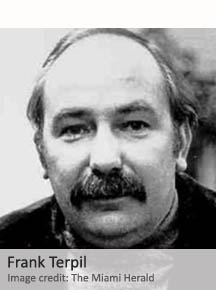
An operative of the United States Central Intelligence Agency, who defected to Cuba in 1981 to avoid charges of criminal conspiracy, has reemerged in a British documentary film about the late Libyan dictator Muammar al-Gaddafi. Frank Terpil, 74, resigned from the CIA in 1970, allegedly after he was caught running a pyramid scheme in India, where he had been posted by the CIA. Soon after his forced resignation from the Agency, US federal prosecutors leveled criminal charges on Terpil and his business partner. The former CIA operative was also charged with conspiracy to commit murder, after it was found that he had helped facilitate the illegal transfer of over 20 tons of plastic explosives to the government of Libya. Terpil managed to leave the US and reappeared in Lebanon in 1980, shortly before a court in New York sentenced him in absentia to five decades in prison for conspiring to smuggle 10,000 submachine guns to African warlords, including Uganda’s dictator Idi Amin. As agents of various countries started to zero in on Terpil’s Lebanon hideout, he disappeared again and resurfaced in 1981 in Havana, Cuba. Shortly afterwards, Cuba’s General Intelligence Directorate hired him as an operative under the operational alias CURIEL. Since that time, Terpil has been repeatedly mentioned as having played a part in Cuban intelligence operations around the world, but has rarely given interviews. He resurfaced again this month, however, in a documentary entitled “Mad Dog: Inside the Secret World of Muammar Gaddafi”. The film was made by British company Fresh One Productions on behalf of Showtime, an American premium cable and satellite television network. The film’s co-producer, Michael Chrisman, told news agencies that Terpil was interviewed “at his home” in Cuban capital Havana, where he apparently still lives, along with his “much younger” Cuban girlfriend. Read more of this post

Pilot program gives Syrian rebels advanced Western weaponry

Syrian rebelsBy JOSEPH FITSANAKIS | intelNews.org
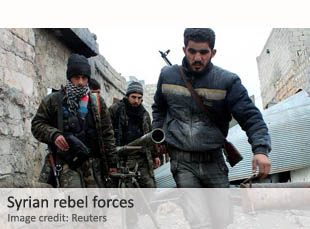
A pilot program operated by American and Saudi intelligence services has allegedly supplied Syrian rebel groups with sophisticated Western weaponry for the first time. Last weekend, The Wall Street Journal cited “people briefed on the effort” as stating that “a small number” of advanced American antitank missiles have been offered to Syrian rebel groups. The move is reportedly part of a new clandestine program, which, if successful, could open the door to “larger flows” of sophisticated Western-made weaponry in the hands of Syrian rebels. The paper said that Washington made the decision to give the weapons to the rebels following the collapse of the Western-backed peace talks early this year, coupled by the apparent military victories of Syrian government forces on the ground in the embattled Middle Eastern country. The effort is apparently part of a “small, tailored program”, which The Journal says is coordinated by American and Saudi intelligence services, aimed at “testing the waters” in Syria. Specifically, Washington and Riyadh are trying to discern whether these advanced weapons will fall into the hands of some of Islamist-inspired rebel groups on the ground, some of which have strong links with al-Qaeda. According to the paper, American and Saudi intelligence operatives have funneled “about a dozen” BCM-71 TOW armor piercing antitank systems to at least one rebel group on the ground. The group, Harakat Hazm, emerged earlier this year through the union of several small secular rebel groups in northern Syria. One weapons expert told The Journal that the antitank systems are equipped with a “complex, fingerprint-keyed security device” that should hopefully help limit the number of individuals that can fire the weapons. The article adds that US and Saudi intelligence services have entered a period of closer collaboration aimed at increasing material support for the Syrian rebels. Read more of this post

White House confirms CIA Director visited Ukraine

John BrennanBy JOSEPH FITSANAKIS | intelNews.org
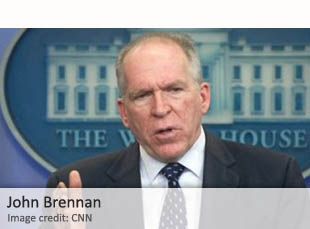
White House officials has confirmed that the director of the Central Intelligence Agency visited Ukraine over the weekend, following reports in the Russian media. On Sunday, Moscow urged Washington to respond to allegations in the Russian press that CIA Director John Brennan had made an incognito visit to Ukrainian capital Kiev. The reports alleged that Brennan, who assumed the directorship of the CIA a year ago, traveled to Ukraine on official business under a false identity in order to avoid attention. Russian media further alleged that the CIA head met with a host of Ukrainian intelligence and security officials and advised them on how to respond to the ongoing crisis in eastern Ukraine. Initially, Washington denied comment on the allegations. But early on Monday White House Press Secretary Jay Carney told reporters that Brennan had indeed traveled to Ukraine over the weekend. He said that the White House normally declines comment on the whereabouts of the CIA Director. However, “given the extraordinary circumstances” in the case of Ukraine, he said he was willing to confirm that Brennan was in Kiev over the weekend “as part of a trip to Europe”. He went on to state that he hoped the official confirmation of Brennan’s trip by the White House would suffice to discredit the “false claims being leveled by the Russians at the CIA”. Carney added that there was nothing inherently suspicious about a CIA Director’s trip to a foreign country. He argued that “senior-level visits of intelligence officials [abroad] are a standard means of fostering mutually beneficial security cooperation” and that such visits —some of which have been to Russia— go back “to the beginnings of the post-Cold War era”. Read more of this post

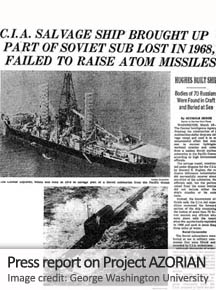
More documents emerge on CIA effort to salvage Soviet submarine

Project AZORIANBy IAN ALLEN | intelNews.org
New documents have emerged about a massive effort by the United States Central Intelligence Agency to recover a sunken Soviet nuclear submarine in the 1970s. This blog has written before about Project AZORIAN, a 1974 attempt to recover a Soviet submarine in 5,200 meters of water. The initiative cost the CIA over $800 million, which translates to something like $3 billion in today’s prices. It centered on an effort to salvage K-129, a Soviet Golf II class submarine that had suffered an internal explosion while on a routine patrol mission in the Pacific Ocean, in 1968. The explosion caused the vessel to sink along with the three nuclear ballistic missiles it was carrying and nearly 100 crew members, all of whom died in the incident. The Soviets initiated an immediate frantic effort to recover the vessel but gave up after two months, unable to bring it to the surface. After the Soviets abandoned the site, a number of CIA scientists proposed to undertake an American effort to recover the sunken submarine. This, they suggested, would allow Washington to study the design features of Soviet nuclear warheads, as well as obtain cryptographic hardware that could prove useful in deciphering Soviet naval codes. This prompted the launch of Project AZORIAN, which commenced in 1974, once the Agency secured the necessary funds. As we have indicated before, the recovery team nearly caused a nuclear explosion when the submarine split while being raised, and its body hit the ocean floor. The CIA prepared to enter a new phase of the project in 1975, aimed at launching a second attempt to raise the sunken vessel. But the attempt was cancelled when vague snippets of information about the project were leaked to the press. Nothing more emerged until 2010, when the CIA aired a heavily redacted article about the project, which had originally appeared in the 1980s in Studies in Intelligence, the Agency’s in-house publication. Now, however, intelligence historians are able to rely on 200 pages of mostly fresh information on Project AZORIAN, released under the US Department of State’s Foreign Relations of the United States (FRUS) program. Read more of this post

News you may have missed #875 (CIA edition)

Boris PasternakBy IAN ALLEN | intelNews.org
►►Ex-CIA head criticizes Pollard release rumors. General Michael Hayden, the former Director of the CIA, said Sunday that he doesn’t think releasing Jonathan Pollard to save the Israeli-Palestinian peace talks is a good idea. Hayden, a Bush administration appointee, told Fox News Sunday that “it’s almost a sign of desperation that you would throw this into the pot in order to keep the Israelis talking with the Palestinians”.
►►CIA official dies in apparent suicide. An unnamed senior CIA official has died in an apparent suicide this week from injuries sustained after jumping off a building in northern Virginia. A source close to the agency said the man who died was a middle manager and the incident occurred after the man jumped from the fifth floor a building in Fairfax County. CIA spokesman Christopher White confirmed the death and said the incident did not take place at CIA headquarters in McLean, Va.
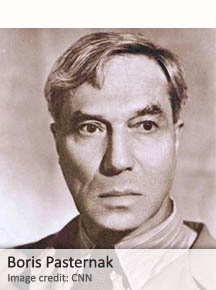
►►How the CIA turned Doctor Zhivago into a Cold War weapon. Newly disclosed documents indicate that the operation to publish Boris Pasternak’s Doctor Zhivago in several Eastern European languages was run by the CIA’s Soviet Russia Division, monitored by CIA director Allen Dulles and sanctioned by President Dwight Eisenhower’s Operations Coordinating Board, which reported to the National Security Council at the White House. The board, which oversaw covert activities, gave the CIA exclusive control over the novel’s “exploitation”. The “hand of the United States government” was “not to be shown in any manner”, according to CIA records. IntelNews has reported previously on allegations that the CIA may have influenced teh Swedish Academy’s decision to award the 1958 Nobel Prize for Literature to Pasternak.

Senate report: CIA misled US government about torture

CIA headquartersBy JOSEPH FITSANAKIS | intelNews.org
A United States Senate report on the use of torture to extract intelligence from terrorism detainees accuses the Central Intelligence Agency of severely overstating the usefulness of the information gained. Details of the long-awaited report, produced after a four-year investigation by the Senate Select Committee on Intelligence, have been leaked to The Washington Post. The paper reports that the probe is a damning indictment on the CIA’s ‘enhanced interrogation’ program, implemented during the administration of President George W. Bush. The report contains over 20 different conclusions. But the most critical are that the CIA misled the government and the American public by: (a) understating the severity of the interrogation methods used; and (b) overstating the actionable intelligence extracted through torture. The Post cites unnamed “US officials” who have reviewed the Senate report as stating that the CIA’s ‘enhanced interrogation’ program “yielded little, if any, significant intelligence”. According to one source, in some cases the Agency proceeded to waterboard terrorism detainees after recognizing that all actionable intelligence had already been extracted from them. In one instance, says the paper, nearly all valuable intelligence gained from al-Qaeda operative Abu Zubaida was extracted by CIA interrogators before he was subjected to waterboarding nearly 100 times. Notably, the Senate report also highlights deep divisions within the CIA, as many units protested the practices employed under the Agency’s interrogation program. But The Post also quotes “current and former officials” who are critical of the Senate report for containing “factual errors” and “misguided conclusions”. One CIA veteran told the paper that the 6,300-page document reflected “Federal Bureau of Investigation biases”, and that CIA officials are critical of the fact that one of the report’s main authors is a former FBI analyst.
Read more of this post