Declassified files shed light on 1956 disappearance of MI6 agent

Lionel CrabbA set of newly released files from the archives of the British Cabinet Office shed light on the mysterious case of a highly decorated combat swimmer, who vanished while carrying out a secret operation against a Soviet ship. The disappearance happened during a historic Soviet high-level visit to Britain in 1956. In April of that year, First Secretary of the Communist Party of the USSR, Nikita Khrushchev, and Nikolai Bulganin, Chairman of the Council of People’s Commissars, arrived in Britain aboard Russian warship Ordzhonikidze, which docked at Portsmouth harbor. Their eight-day tour of Britain marked the first-ever official visit by Soviet leadership to a Western country. But the tour was marred by a botched undersea operation led by Britain’s Secret Intelligence Service, known commonly as MI6. The operation, which aimed to explore the then state-of-the-art Ordzhonikidze, ended in the disappearance of MI6 diver Lionel “Buster” Crabb. The body of Crabb, one of several MI6 operatives involved in the operation, was never recovered.

Now a set of documents released by the Cabinet Office, a British government department tasked with providing support services to the country’s prime minister and senior Cabinet officials, show that the operation had been mismanaged by MI6 from the start. According to The Daily Telegraph, the documents show that miscommunication between the British Foreign Office and MI6 caused the latter to believe that the operation to target the Ordzhonikidze had been authorized by the government, when in fact no such thing had ever occurred.

Moreover, MI6 had housed Crabb and other operatives in a Portsmouth hotel, where the agency’s handler had provided the front-desk clerk with the real names and addresses of the underwater team members. The documents also reveal that several of Crabb’s relatives and friends had been told by him that he would be diving in Portsmouth on the week leading up to his death. Those who knew included one of Crabb’s business partners, with whom he operated a furniture outlet. The partner apparently told the authorities that he was contemplating “consulting a clairvoyant, Madame Theodosia”, in an effort to discover the fate of his missing business partner.

After Crabb disappeared, British government officials were convinced that he had been abducted or killed by the Soviets and that the KGB was in possession of his body. Should the Soviets decide to disclose the existence of the MI6 operation to the world, there would be “no action that [MI6] could take [that] could stave off disaster”, said one British government memo. As intelNews has reported before, n 2007, Eduard Koltsov, a retired Russian military diver, said he killed a man he thinks was Crabb, as he was “trying to place a mine” on the Soviet ship.

Author: Joseph Fitsanakis | Date: 28 October 2015 | Permalink

Cambridge spy’s last years in Russia are detailed in new biography

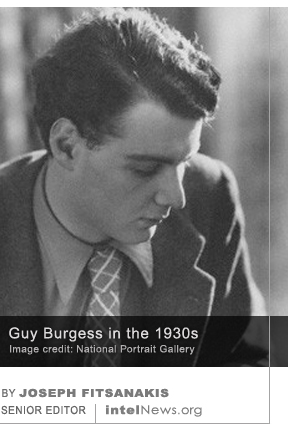
Guy BurgessThe life of Guy Burgess, one of the so-called ‘Cambridge Five’ double agents, who spied on Britain for the Soviet Union before defecting to Moscow in 1951, is detailed in a new biography of the spy, written by Andrew Lownie. Like his fellow spies Kim Philby, Donald Maclean, Anthony Blunt and John Cairncross, Burgess was recruited by the Soviets when he was a student at Cambridge University. He shook the British intelligence establishment to its very core when he defected to the USSR along with Maclean, after the two felt that they were being suspected of spying for the Soviets.

A few years after his defection, Burgess wrote to a close friend back in the UK: “I am really […] very well and things are going much better for me here than I ever expected. I’m very glad I came”. However, in his book, entitled Stalin’s Englishman: The Lives of Guy Burgess, Lownie suggests that Burgess’ life in the USSR was far from ideal. After being welcomed by the Soviets as a hero, the Cambridge University graduate was transported to the isolated Siberian city of Kuybyshev. He lived for several months in a ‘grinder’, a safe house belonging to Soviet intelligence, where he was debriefed and frequently interrogated until his Soviet handlers were convinced that has indeed a genuine defector.

It was many years later that Burgess was able to leave Kuybyshev for Moscow, under a new name, Jim Andreyevitch Eliot, which had been given to him by the KGB. Initially he lived in a dacha outside Moscow, but was moved to the city in 1955, after he and Maclean spoke publicly about their defection from Britain. He was often visited in his one-bedroom apartment by Yuri Modin, his Soviet intelligence handler back in the UK. According to Lownie, Burgess often complained to Modin about the way he was being treated by the Soviet authorities. His apartment had apparently been bugged by the KGB, and he was constantly followed each time he stepped outside.

The British defector worked for a Soviet publishing house and produced foreign-policy analyses for the Soviet Ministry of Foreign Affairs. He also produced a training manual for KGB officers about British culture and the British way of life. But he did not like living in the USSR and argued that he should be allowed to return to the UK, insisting that he could successfully defend himself if interrogated by British counterintelligence. Eventually, Burgess came to the realization that he would never return to his home country. He became depressed, telling friends that he “did not want to die in Russia”. But in the summer of 1963 he was taken to hospital, where he eventually died from acute liver failure caused by his excessive drinking.

Andrew Lownie’s Stalin’s Englishman: The Lives of Guy Burgess, is published by Hodder & Stoughton in the UK and by St Martins’ Press in the US. It is scheduled to come out in both countries on September 10.

Author: Joseph Fitsanakis | Date: 04 September 2015 | Permalink
‘Day of the Jackal’ author reveals he was MI6 agent for 20 years

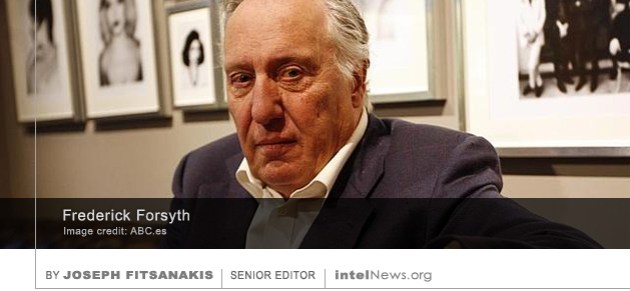
Frederick ForsythFrederick Forsyth, the esteemed British author of novels such as The Day of the Jackal, has confirmed publicly for the first time that he was an agent of British intelligence for two decades. Forsyth, who is 77, worked for many decades as an international correspondent for the BBC and Reuters news agency, covering some of the world’s most sensitive areas, including postcolonial Nigeria, apartheid South Africa and East Germany during the Cold War. But he became famous for authoring novels that have sold over 70 million copies worldwide, including The Odessa File, Dogs of War and The Day of the Jackal, many of which were adapted into film. Several of his intelligence-related novels are based on his experiences as a news correspondent, which have prompted his loyal fans to suspect that he might have some intelligence background.
But Forsyth had never commented on these rumors until last weekend, when was interviewed on the BBC’s main evening news program. He spoke to the station on the occasion of the upcoming publication of his autobiography, The Outsider: My Life, which will be in stores in October. He told the BBC that he was first recruited by the Secret Intelligence Service (MI6) in the late 1960s while covering the Nigerian Civil War. The bloody conflict, which is also known as the Biafran War, pitted the separatist Igbo people against the Nigerian federal government. Like other military conflicts in postcolonial Africa, it attracted the attention of the world’s powers, including France, the Soviet Union, the United States, and Britain. London was firmly on the side of the government in Lagos, but MI6 had reservations, believing that the Nigerian military forces were committing mass atrocities in Biafra. Forsyth said he was recruited by an MI6 officer who wanted to know if children were dying in Biafra as a result of the Nigerian government’s military policies against the Igbo separatists. The intelligence service were apparently hoping that they could use this information to change London’s stance on the brutal civil war. The author told the BBC that he spent the rest of the war “sending both journalistic reports to the media and other reports to my new friend”, referring to his MI6 handler.

When asked if he was paid for his services, he said his assistance to MI6 was provided on a strictly voluntary basis. “The attitude, the spirit of the age, was different back then”, he said, adding that “the Cold War was very much on” and when the British government asked a reporter for a favor it was “very hard to say no”. He did say, however, that MI6 promised to approve passages of some of his novels by way of payment. The author of The Day of the Jackal said he was given a number to call and told to send MI6 his manuscripts for vetting. “If they are too sensitive, we will ask you not to continue”, Forsyth told the BBC.

Author: Joseph Fitsanakis | Date: 31 August 2015 | Permalink

Maltese far-right party had links to CIA, British documents suggest

Josie MuscatA Maltese ultra-nationalist group believed to be behind a string of bombings in the 1980s was believed by British intelligence to have links to the United States Central Intelligence Agency (CIA), according to recently declassified documents. The Front Freedom Fighters (FFF) was a staunchly anticommunist group whose members violently objected to what they saw as Malta’s overly close contacts with the Communist Bloc. During the 16-year rule of the Maltese Labour Party, which began in 1971, the Mediterranean island maintained close relations with countries during such as Libya and North Korea. The Maltese Nationalist Party, which formed the main opposition to Labour, was highly critical of these contacts, but failed to win three consecutive electoral contests and was thus unable to influence the country’s foreign policy in any significant way.
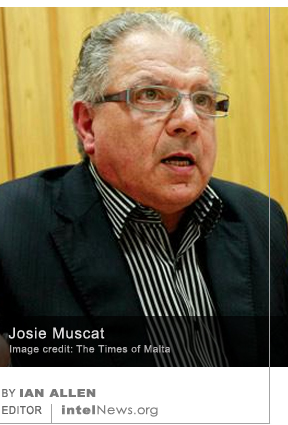
The FFF emerged in the early 1980s from within the ranks of the Nationalist Party. It consisted of younger activists who favored a violent response to the rule of the Labour Party. The group was led by Josie Muscat, a dynamic anticommunist campaigner and longtime Nationalist Party Member of Parliament, who gathered around him some of the more extreme rightwing elements in the Nationalist Party. A string of bombings and threats directed at Labour Party facilities on the island was attributed to the FFF by the popular press, though Muscat himself consistently denied such accusations. Many believed that the FFF was actively preparing to launch an armed coup d’etat.

Eventually, the leadership of the Nationalist Party, which saw itself as falling within the mainstream of the European conservative tradition, began distancing itself from the FFF’s rhetoric and actions. In July of 1983, the party expelled FFF leaders from its ranks and forbade its members from associating with FFF-linked groups. Few Nationalist Party members followed Muscat, and his movement eventually suffered what some observers described “a natural death”.

However, new documents released this month by the National Archives in Britain show that the British Foreign Office believed that the FFF was being funded by the CIA. A Foreign Office Report from the early 1980s states that the group was probably behind several bomb explosions targeting Labour Party activists, as well as moderate Nationalist Party members. The report describes the FFF as “neo-Fascist in character” that prioritized crude violence as its main tactic. It goes on to say that the group consisted of about 500 determined members, but that its violent core was much smaller. The Foreign Office report also suggests that Muscat may have traveled abroad to meet CIA officers, as well as to network with other anticommunist organizations throughout Europe.

Asked to give his reaction to the British government documents, Muscat told The Times of Malta that he “hadn’t had such a good laugh in years”. The now retired politician denied having any links to the CIA and said that the FFF’s activities had been “mostly limited to political debating and had never even come close to any form of violence”.

Author: Ian Allen | Date: 25 August 2015 | Permalink

British government releases MI5 file on little-known Cold War spy

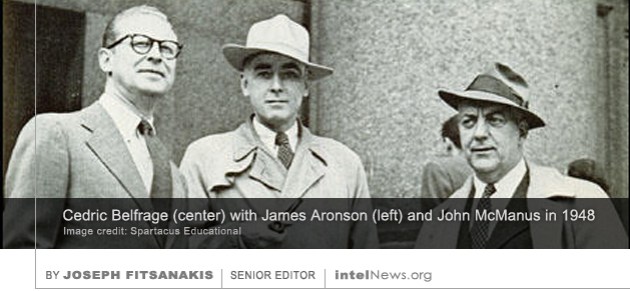
Cedric BelfrageThe British government has released a nine-volume file on an influential film critic who some believe was “one of the most important spies the Soviet Union ever had”. Cedric Belfrage was born in 1904 in London and read English Literature at Cambridge University in the 1920s. While a student at Cambridge he made a name for himself as a reviewer of motion pictures, and by the early 1930s he was known as Britain’s highest-paid film critic. Soon afterwards he moved to the American city of Los Angeles, where he became a film and theater correspondent for British tabloid newspaper The Daily Express. But a multivolume file on him compiled by the British Security Service (MI5) and released last week by the National Archives in London, confirms that Belfrage spied for Soviet intelligence under the codename BENJAMIN.
According to the file, Belfrage turned to communism after witnessing the effects of the Great Depression in the United States. After a 1936 trip to the USSR, he reached out to the Communist Party of the US, which eventually put him in touch with a number of Soviet intelligence operatives in America. In 1940, the Secret Intelligence Service (MI6) set up the British Security Coordination (BSC) in New York. It was a clandestine propaganda project aimed at turning local public opinion in favor of America’s entry into World War II. Belfrage was one of many writers and intellectuals that were recruited by the BSC to help counter the prevalent isolationist sentiment in the country. The film critic worked for MI6 until 1943, and then returned to Britain to join another wartime propaganda outfit, the Political Warfare Executive.

At war’s end, Belfrage returned to the US, only to find that he had attracted the attention of the Federal Bureau of Investigation. The FBI had discovered that the British film critic had dealings with the Communist Party in the 1930s and suspected that he may have worked for Soviet intelligence. Further investigations revealed that Belfrage had indeed conducted espionage under the guidance of Jacob Golos, a Ukrainian-born American who managed a large network of pro-Soviet spies in America in the interwar period. But when he was questioned by the FBI, Belfrage said that he had given Golos a number of British —not American— government documents under direct orders by MI6. The latter allegedly hoped that the Soviets would reciprocate the move within the context of the anti-Nazi alliance between the UK and the USSR.

Eventually, Belfrage was brought up before the House Un-American Activities Committee (HUAC) of the US Congress in 1953. The Committee was conducting public hearings aimed at unmasking suspected communist sympathizers in the American entertainment industry. But the British-born film critic refused to answer questions put to him, prompting HUAC to recommend that he should be deported from the country. The government adopted the Committee’s recommendation and deported Belfrage in 1955 for having been a member of the Communist Party under a fake name. Belfrage traveled throughout the Caribbean and Latin America before settling in Mexico, where he died in 1990, aged 86.

Interestingly, the British files reveal that MI5 decided not to prosecute Belfrage, most likely in order to avoid the embarrassment of admitting that British intelligence had employed a Soviet spy. The decision was probably not unrelated to the public scandal that followed the escape of the so-called Cambridge spies to the Soviet Union. Interestingly, Belfrage studied at Cambridge at the same time that Kim Philby (Soviet cryptonym STANLEY), Donald Duart Maclean (HOMER) and Guy Burgess (HICKS) were students there. But there is no evidence he ever collaborated with them, as he was not interested in politics at that time.

Author: Joseph Fitsanakis | Date: 24 August 2015 | Permalink

Soviet mole penetrated Australian intelligence, says former officer

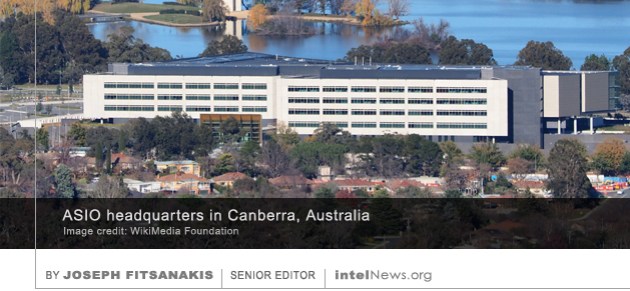
ASIO AustraliaA Soviet double spy was able to penetrate the senior echelons of Australia’s intelligence agency during the Cold War, according to a retired Australian intelligence officer who has spoken out for the first time. Molly Sasson, was born in Britain, but worked for the Australian Security Intelligence Organisation (ASIO) from 1969 until her retirement in 1983. A fluent German speaker, Sasson was first recruited during World War II by the Royal Air Force, where she worked as an intelligence officer before transferring to the Security Service (MI5), Britain’s domestic intelligence agency. At the onset of the Cold War, Sasson helped facilitate the defection to Britain of Colonel Grigori Tokaty, an influential rocket scientist who later became a professor of aeronautics in London. But in the late 1960s, Sasson moved with her husband to Australia, where she took up a job with ASIO, following a personal invitation by its Director, Sir Charles Spry. Upon her arrival in Canberra, Sasson took a post with ASIO’s Soviet counterintelligence desk, which monitored Soviet espionage activity on Australian soil.

Aged 92 today, Sasson spoke publicly for the first time on Australia’s ABC News television network about her life and times. She told the reporter that she had “no doubt at all” that ASIO had been infiltrated by at least one Soviet-handled double spy in the 1970s. “If we put on an operation, it failed”, she said, adding that the Soviets “always seemed to be a step ahead of us. There must have been a tip-off. It can’t have been otherwise”, said Sasson. The 92-year-old former intelligence officer recounted one specific operation involving a Russian diplomat named Vladimir Dobrogorsky, who was believed by ASIO to be an intelligence operative. According to Sasson, ASIO counterintelligence officers were monitoring Dobrogorsky and knew the precise time and place that he was scheduled to meet with an Australian informant in downtown Canberra. However, not only did the meeting not occur, but Dobrogorsky left the Soviet embassy in the Australian capital that morning, never to return.

“I am convinced that someone within ASIO tipped him off”, said Sasson. Not only that, but when she and other ASIO officers expressed their concerns about the possible existence of a mole inside ASIO, senior agency officials dismissed them. At one point she was told to “not open this can of worms”, she told ABC News. The former ASIO officer added that the chief of the United States Central Intelligence Agency station in Canberra shared similar concerns with the ASIO’s leadership, but that they too were dismissed. Soviet intelligence operatives were notably active in Australia and New Zealand during the Cold War, as it was believed that intelligence agencies in the two Pacific Rim countries offered an easier path toward accessing British and American government secrets, due to the so-called Five Eyes agreement.

Author: Joseph Fitsanakis | Date: 19 August 2015 | Permalink

Memos may relate to secret NSA deal with leading cryptography vendor

William FriedmanIn 2007 I wrote in my “National Security Agency: The Historiography of Concealment” that America’s leading signals intelligence agency had made a secret deal with Crypto AG, a Swiss-based manufacturer of cryptographical equipment. The agreement, which lasted for much of the Cold War, allegedly allowed the NSA to read the classified messages of dozens of nations that purchased encoding equipment from Crypto AG. As I expected, the claim drew criticism from individuals connected with Crypto AG, including company scientists, who argued that the Swiss manufacturer would never have agreed to a deal that undermined its professional reputation as a trusted and neutral vendor of cryptological devices. Now, however, the BBC has revealed two recently declassified NSA memos that appear to provide further proof of the deal.

My 2007 claim was based on a string of well documented allegations that surfaced in the early 1980s. While conducting research for his seminal book The Puzzle Palace, historian James Bamford came across references to Project BORIS, which involved a pact between the NSA and the Swiss company. To be precise, the deal appeared to have been struck between the Swiss inventor and Crypto AG founder Boris Hagelin and William F. Friedman, an American cryptologist who led the Armed Forces Security Agency, a forerunner of the NSA. The two men were united by a deep personal friendship, which was forged during World War II by their mutual hatred of Nazism.

Bamford’s claim was echoed in 1996 by Scott Shane and Tom Bowman, reporters for The Baltimore Sun. In a six-part investigative series about the NSA, the two journalists wrote that Friedman visited Hagelin during a trip to Switzerland in 1955 and asked for his help so that American could dominate its Cold War rivals. According to Shane and Bowman, Hagelin agreed and built a type of cryptological backdoor in Crypto AG’s devices, which allowed the NSA to read millions of messages for many decades. The company, of course, reacted furiously, saying that claims of a secret deal were “pure invention”.

On Thursday, however, BBC security correspondent Gordon Corera confirmed that a BBC investigation of 55,000 pages of documents, which were declassified by the NSA in April, claim to have found proof of the secret agreement. The declassified material, said Corera, contains two versions of the same NSA memorandum, as well as an earlier draft, which refer to a “gentleman’s agreement” between Friedman and Hagelin. Under the agreement, Crypto AG would inform the NSA about periodical changes to the technical specifications of its encoding machines. The company would also provide the American spy agency with detailed lists showing the precise models purchased by various national governments around the world. Furthermore, Crypto AG agreed not to sell the more advanced, customizable models of its equipment to countries viewed by Washington as directly adversarial. This, says the BBC, amounted to Crypto AG deceiving some of its customers, by offering them “watered-down versions” of its encoding devices.

Corera notes that there is no evidence in the memos that Crypto AG built any kind of back door in its devices for use by the NSA. Instead, by providing the American agency with detailed operational knowledge of the devices, it enabled American codebreakers to reduce the time and effort needed to break encoded messages intercepted by the NSA.

There are a couple of minor errors in Corera’s article. For instance, the “father of American code-breaking” is not Friedman, as he claims, but Herbert Yardley, who led the so-called Black Chamber (also known as the Cipher Bureau) in 1919, long before Friedman was in the picture. Additionally, he fails to mention Bowman’s contribution to Shane’s Baltimore Sun article, which was published in 1996, not 1995, as he writes. These minor errors aside, however, the BBC discovery is absolutely crucial for our understanding of cryptological history in the Cold War.

Author: Joseph Fitsanakis | Date: 31 July 2015 | Permalink

Key testimony from Rosenberg spy case released after 64 years

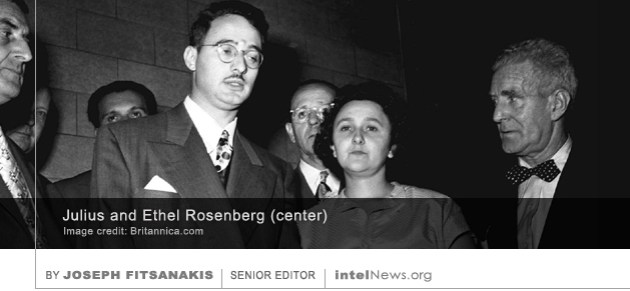
Julius and Ethel RosenbergThe final piece of sealed testimony in one of the most important espionage cases of the Cold War has been released, 64 years after it was given. The case led to the execution in 1953 of Julius and Ethel Rosenberg, an American couple who were convicted of spying for the Soviet Union. The Rosenbergs were arrested in 1950 for being members of a larger Soviet-handled spy ring, which included Ethel’s brother, David Greenglass. Greenglass agreed to testify for the US government in order to save his life, as well as the life of his wife, Ruth, who was also involved in the spy ring. He subsequently fingered Julius Rosenberg as a courier and recruiter for the Soviets, and Ethel as the person who retyped the content of classified documents before they were surrendered to their handlers. That piece of testimony from Greenglass the primary evidence used to convict and execute the Rosenbergs.
However, although historians are confident that Julius Rosenberg was indeed an active member of the Soviet spy ring, there are doubts about Ethel. Many suggest that her involvement with her husband’s espionage activities was fragmentary at best, and that she refused to cooperate with the Federal Bureau of Investigation in an ill-judged attempt to protect her husband. The argument goes that Ethel was put to death as a warning to Moscow, as well as to intimidate other American spies, rather than on the basis of actual evidence of her involvement in espionage. Many years after the Rosenbergs’ execution, Greenglass claimed he had lied about Ethel’s role in the spy affair in order to protect his wife, who was the actual typist of the espionage ring.

The debate over Ethel Rosenberg’s fate was rekindled by US District Judge Alvin Hellerstein’s decision in May of this year to unseal Greenglass’ testimony. The documents could not be made public while Greenglass was alive, because he objected to their release. But he died last year in a nursing home in New York, so Judge Hellerstein said his testimony could now legally be made available to the public as a “critical piece of an important moment in our nation’s history”.

Greenglass’ grand jury testimony, made under oath in 1950, six months before he implicated his sister in nuclear espionage for the Soviets, was posted online on Wednesday by George Washington University’s National Security Archive. Speaking at a press conference about the release, several experts said the new information directly contradicts Greenglass’ later testimony in which he accused his sister of being a spy. In the press conference of his grand jury testimony, Greenglass emphatically denies that Ethel had a role in the atom spy ring. When asked whether she was involved in espionage, Greenglass responds: “my sister has never spoken to me about this subject”. Later on he recounts how Julius tried to convince him to prolong his US Army service in order to continue to have access to classified information. When asked whether Ethel also tried to convince him to continue to spy for the Soviets, he responds: “I said before, and say it again, honestly, this is a fact: I never spoke to my sister about this at all”.

National Security Archive Director Tom Blanton said at the press conference that the evidence made it clear that Julius Rosenberg led an active spy ring; but Ethel was not an active spy, he said, even though witting.

Author: Joseph Fitsanakis | Date: 17 July 2015 | Permalink: https://intelnews.org/2015/07/17/01-1737/

KGB spy shares details of his escape to Britain in 1985

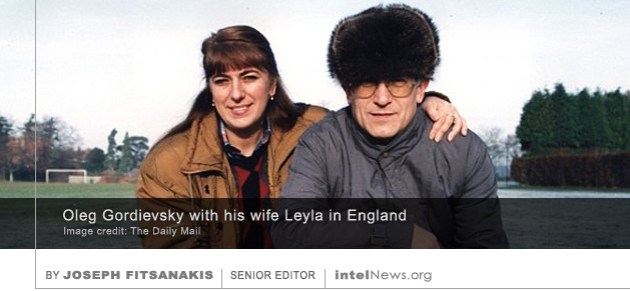
Oleg GordievskyA Soviet double spy, who secretly defected to Britain 30 years ago this month, has revealed for the first time the details of his exfiltration by British intelligence in 1985. Oleg Gordievsky was one of the highest Soviet intelligence defectors to the West in the closing stages of the Cold War. He joined the Soviet KGB in 1963, eventually reaching the rank of colonel. But in the 1960s, while serving in the Soviet embassy in Copenhagen, Denmark, Gordievsky began feeling disillusioned about the Soviet system. His doubts were reinforced by the Soviet invasion of Czechoslovakia in 1968. It was soon afterwards that he made the decision to contact British intelligence.
Cautiously, Britain’s Secret Intelligence Service (known as MI6) communicated with Gordievsky, and in 1974 he secretly became an agent-in-place for the United Kingdom. Eight years later, in 1982, Gordievsky was promoted to KGB rezident (chief of station) in London. While there, he frequently made contact with his MI6 handlers, giving them highly coveted information on Soviet nuclear strategy, among other things. He is credited with informing London of Mikhail Gorbachev’s imminent ascendency to the premiership of the Soviet Union, long before he was seen by Western intelligence as a viable candidate to lead the country.

But in May of 1985, Gordievsky was suddenly recalled to Moscow, where he was detained by the KGB. He was promptly taken to a KGB safe house in the outskirts of Moscow and interrogated for five hours, before being temporarily released pending further questioning. Remarkably, however, Gordievsky managed to escape his KGB surveillance and reappear in Britain less than a week later. How did this happen? On Sunday, the former double spy gave a rare rare interview to The Times, in which he revealed for the first time the details of his escape to London. He told The Times’ Ben Macintyre that he was smuggled out of the USSR by MI6 as part of Operation PIMLICO. PIMLICO was an emergency exfiltration operation that had been put in place by MI6 long before Gordievsky requested its activation in May of 1985.

Every Tuesday, shortly after 7:00, a British MI6 officer would take a morning stroll at the Kutuzovsky Prospekt in Moscow. He would pass outside a designated bakery at exactly 7:24 a.m. local time. If he saw Gordievsky standing outside the bakery holding a grocery bag, it meant that the double agent was requesting to be exfiltrated as a matter of urgency. Gordievsky would then have to wait outside the bakery until a second MI6 officer appeared, carrying a bag from the Harrods luxury department store in London. The man would also be carrying a Mars bar (a popular British candy bar) and would bite into it while passing right in front of Gordievsky. That would be a message to him that his request to be exfiltrated had been received.

Four days later, Gordievsky used his skills in evading surveillance and shook off (or dry-cleaned, in espionage tradecraft lingo) the KGB officers trailing him. He was then picked up by MI6 officers and smuggled out of the country in the trunk of a British diplomatic car that drove to the Finnish border. Gordievsky told The Times that Soviet customs officers stopped the car at the Finnish border and surrounded it with sniffer dogs. At that moment, a British diplomat’s wife, who was aware that Gordievsky was hiding in the car, came out of the vehicle and proceeded to change her baby’s diaper on the trunk, thus safeguarding Gordievsky’s hiding place and masking his scent with her baby’s used diaper. If it hadn’t been for the diplomat’s wife, Gordievsky told The Times that he might have been caught.

After crossing the Soviet-Finnish border, Gordievsky traveled to Norway and from there he boarded a plane for England. Soviet authorities promptly sentenced him to death, but allowed his wife and children to join him in Britain six years later, after British Prime Minister Margaret Thatcher personally lobbied the Soviet government. Gordievsky’s death penalty still stands in Russia. In 2007, the Queen made Gordievsky a Companion of the Most Distinguished Order of St. Michael and St. George for services rendered to the security of the British state.

Author: Joseph Fitsanakis | Date: 6 July 2015 | Permalink: https://intelnews.org/2015/07/06/01-1729/

Cold War files show secret war between CIA and KGB in Canada

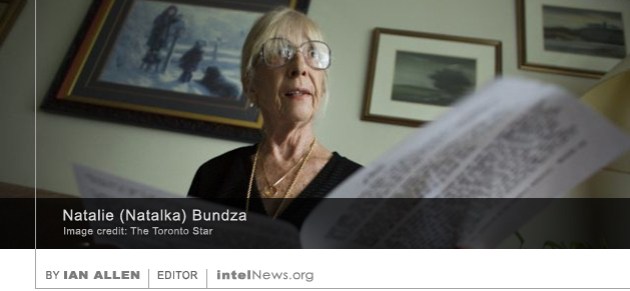
Natalie (Natalka) BundzaA set of declassified intelligence documents from the 1950s and 1960s offer a glimpse into the secret war fought in Canada between American and Soviet spy agencies at the height of the Cold War. The documents were authored by the United States Central Intelligence Agency and declassified following a Freedom of Information Act request filed on behalf of the Canadian newspaper The Toronto Star. According to the paper, they show that Toronto was a major hub of a prolonged espionage conflict fought between the CIA and the Soviet KGB.
Much of the espionage activity by the two spy agencies concentrated on Toronto’s sizable Eastern European expatriate community, especially on immigrants with Ukrainian and Polish roots. In one document dating from 1959, a CIA officer details the profiles of 18 Canadian citizens, most of them Toronto residents, who were suspected by Langley to be working for the KGB. Most of them were believed to be non-official-cover operatives, or NOCs, as they are known in the US Intelligence Community. The term typically refers to high-level principal agents or officers of an intelligence agency, who operate without official connection to the diplomatic authorities of the country that employs them. The declassified document explains that the suspected NOCs had secretly traveled to the USSR after being recruited by the KGB. They were then trained as spies before returning to Canada years later under new identities.

Others, like a naturalized Canadian identified in the documents as Ivan Kolaska, were believed by the CIA to have immigrated to Toronto as part of a broader KGB effort to infiltrate the ranks of the anti-communist Eastern European expatriate community in Canada. Some of these infiltrators were able to settle in Canada, marry locals, get jobs and have families, while living a double life. The Star spoke to one Ukrainian immigrant to Canada whose name features in the declassified CIA files. Natalie Bundza, now 78, worked as a travel agent in 1950s’ Toronto and regularly led tourist groups to communist countries. She was a Ukrainian nationalist and anticommunist, but the CIA believed she was pretending to have these beliefs in order to infiltrate the Ukrainian expatriate community in Toronto. The American agency kept tabs on her and was able to compile a sizable file with information about Bundza’s friends and associates, her travel itineraries, and even the contents of her suitcases she took with her on international trips.

Author: Ian Allen | Date: 3 July 2015 | Permalink: https://intelnews.org/2015/07/03/01-1728/

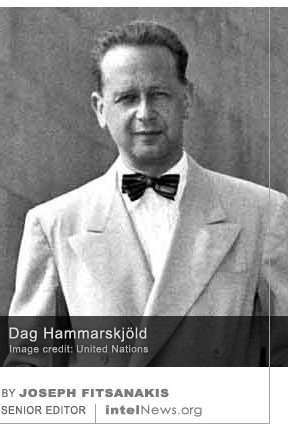
Panel to present findings on mysterious death of UN secretary general

Dag HammarskjöldA panel of experts commissioned by the United Nations is about to unveil fresh evidence on the mysterious death in 1961 of UN secretary general Dag Hammarskjöld, who some claim was murdered for supporting African decolonization. The evidence could spark a new official probe into the incident, which has been called “one of the enduring mysteries of the 20th century”.
On September 17, 1961, a Douglas DC-6 transport aircraft carrying United Nations Secretary General Dag Hammarskjöld crashed in the British-administered territory of Northern Rhodesia (now Zambia). The crash killed everyone onboard. Three successive investigations into the crash, conducted by the Rhodesian Board of Investigation, the Rhodesian Commission of Inquiry, and the United Nations Commission of Investigation, viewed “pilot error” as the most likely cause of the tragedy. However, the latter probe, which was closed in 1962, opined that deliberate sabotage could not be ruled out as a likely cause of the tragedy.

Since that time, numerous scholars and independent investigators, such as Swedish development expert Göran Björkdahl and British academic Susan Williams, have raised the possibility that the plane carrying Secretary General Hammarskjöld may have been “shot down by an unidentified second plane”. Several commentators have also pointed to what seemed like eagerness by British colonial administrators in Northern Rhodesia to obscure the details of the incident. One argument is that Hammarskjöld, described as the most independent-minded secretary general in the history of the UN, had angered many world powers due to this fierce support for anti-colonial movements that were sweeping the African continent. Indeed, at the time of his death, Hammarskjöld was flying to the Congo’s mineral-rich Katanga region to meet European-supported chieftains who in 1960 had seceded from the nationalist government of Congolese Prime Minister Patrice Lumumba. Ironically, Lumumba had been assassinated in a Western-backed coup exactly eight months before Hammarskjöld’s own death.

In 2012, the independently funded Hammarskjöld Inquiry Trust appointed an international team of jurists to study all available evidence on the plane crash. The team, called the Hammarskjöld Commission, was composed of a diplomat and three judges from the Netherlands, the United Kingdom, South Africa, and Sweden. The Commission reported in 2013 that “significant new evidence” had emerged, which suggested that American intelligence agencies, notably the National Security Agency and the Central Intelligence Agency, held “crucial evidence” that could help clarify the causes of the crash.

The report by the Hammarskjöld Commission prompted the UN’s current Secretary General, Ban Ki-moon, to appoint a UN-sponsored panel of experts to examine the new evidence and present it before the UN General Assembly. The three-member panel traveled to several countries, including Zambia, the US, Britain and Belgium, to access government, as well as private archives. Its report is expected to be delivered to the UN General Assembly this week. It is said to include written testimony by a Belgian pilot who says he shot down the plane carrying Hammarskjöld by error, while trying to divert it on orders by a government entity. Another witness, a former intelligence officer with the US National Security Agency, is believed to have told the UN experts that he listened to a recording of a pilot who said he shot down the UN Secretary General’s plane.

Once this new evidence is presented, the UN General Assembly will have to vote on whether the UN should hold an official probe into the plane crash. It would mark the first such inquiry since 1962.

Author: Joseph Fitsanakis | Date: 22 June 2015 | Permalink: https://intelnews.org/2015/06/21/01-1719/

Judge orders release of key testimony from Rosenberg spy case

Julius and Ethel RosenbergA United States district judge has ordered the release of the last major piece of sealed evidence in one of the most important espionage cases of the Cold War. The case led to the execution in 1953 of an American couple, Julius and Ethel Rosenberg, who were convicted of conspiring to spy for the Soviet Union. The Rosenbergs were arrested in 1950 for being members of a larger Soviet-handled spy ring, which included Ethel’s brother, David Greenglass. Greenglass later told a US court that he firmly believed the USSR should have access to nuclear technology and actively tried to give Moscow information on the Manhattan Project. Greenglass agreed to testify for the US government in order to save his life, as well as the life of his wife, Ruth, who was also involved in the spy ring. He subsequently fingered Julius Rosenberg as a courier and recruiter for the Soviets, and Ethel as the person who retyped the content of classified documents before they were surrendered to their handlers. This piece of testimony from Greenglass was used as the primary evidence to convict and execute the Rosenbergs.

However, although historians are confident that Julius Rosenberg was indeed an active member of the Soviet spy ring, there are doubts about Ethel. Many suggest that her involvement with her husband’s espionage activities was fragmentary at best, and that she refused to cooperate with the Federal Bureau of Investigation in an ill-judged attempt to protect her husband. The argument goes that Ethel was put to death as a warning to Moscow, as well as to intimidate other American spies, rather than on the basis of actual evidence of her involvement in espionage. Many years after the Rosenbergs’ execution, Greenglass claimed he had lied about Ethel’s role in the spy affair in order to protect his wife, who was the actual typist of the espionage ring.

The debate over Ethel Rosenberg’s fate will undoubtedly by rekindled by US District Judge Alvin Hellerstein’s decision last week to unseal Greenglass’ testimony. The documents could not be made public while Greenglass was alive, because he objected to their release. But he died last year in a nursing home in New York, so his testimony can now legally be made available to the public. In making his decision known, Judge Hellerstein said Greenglass’ testimony was a “critical piece of an important moment in our nation’s history”. The United States government is legally permitted to block the release of the documents should it decide to do so. But when a White House spokesperson was asked about the subject by the Associated Press, she decline to comment.

Author: Joseph Fitsanakis | Date: 26 May 2015 | Permalink: https://intelnews.org/2015/05/26/01-1703/

Ex-Soviet spy living in America comes out 25 years after Cold War

Jack Barsky, real name Albrecht DittrichBy JOSEPH FITSANAKIS | intelNews.org
An Eastern Bloc spy, who still lives in the United States after arriving there in 1978 on orders of the Soviet KGB, has spoken out for the first time. The spy assumed a forged American identity and remained operational for a decade before abandoning his post and quietly blending into American suburbia, toward the end of Cold War. He spoke last weekend to CBS’ flagship investigative program 60 Minutes. He told the program that he now lives in the US as Jack Barsky, an identity he assumed soon after arriving in New York with a forged Canadian passport.

But his real name is Albrecht Dittrich, and he was born in communist-era East Germany. He was a PhD student in chemistry when, in 1970, he was approached by the Stasi, the East German secret police, and asked whether he would consider training as an intelligence operative. He accepted and trained for three years under the supervision of the Soviet KGB. In 1973, he was taken to East Berlin and detailed to the KGB for training as an operations officer. He was later transferred to Moscow, where he underwent a full year of phonetics training and was taught to speak English with “no trace of a German accent”, he says.

Soon after arriving in the US, in 1978, he acquired a social security card using a birth certificate issued for Jack Philip Barsky, an American child who had died at the age of 10 in the Washington, DC, area. He told everyone that he was born in Orange, New Jersey. He eventually enrolled in a Manhattan college, where he studied computer systems. His first job out of college was as a computer programmer for Metropolitan Life Insurance, commonly known as MetLife. While there, he stole computer code for the KGB, including “a very prominent piece of industrial software still in use today”, which was “helpful to the Soviet Union”, he says. Barsky traveled back to East Germany often, using a series of false passports. During one of those visits, he married his longtime girlfriend and had a son with her. But he also married in the United States, and had two children with his wife, so as to better blend into American society. The two families knew nothing of each other’s existence.

Then, in 1988, the KGB informed Barsky that he was to return home immediately because of fears that the Federal Bureau of Investigation may be closing in on him. But the spy disobeyed orders; he decided to abandon his post and continue living in the US. He lived a comfortable life in rural Pennsylvania, until 1997, when the FBI began monitoring him. His name had been provided to the US government by Vasili Mitrokhin, a retired archivist for the KGB, who in 1992 defected to Britain, taking with him several suitcases of classified KGB material. The FBI purchased a house next to Barsky’s and eventually bugged his home. The former KGB spy was arrested in May 1997, but struck a deal with the FBI and was spared a jail sentence in return for sharing everything he knew about his training, mission and operations with the Bureau. Today he still lives in the US. He is divorced, but says his life is in America, not in Germany.

Germany helped Israel build atom bomb, says leading nuclear expert

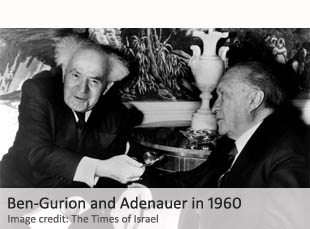
Ben-Gurion and Adenauer in 1960By JOSEPH FITSANAKIS | intelNews.org
The government of West Germany secretly funded the Israeli nuclear weapons program during the Cold War, according to a leading German nuclear expert. Today, Israeli authorities continue to deny the existence of the country’s nuclear weapons arsenal. However, it is generally accepted that the country’s atom program began as early as 1952, with the establishment of the Israeli Atomic Energy Commission. By the mid-1960s, Israeli scientists had built at least one nuclear bomb; and by the time the Six-Day War broke out in 1967, the Jewish state had at least two nuclear warheads in its possession.

But how could a small, developing country fund one of the most expensive weapons programs in existence? According to Hans Rühle, one of Germany’s leading nuclear experts, the Israeli nuclear weapons program was primarily funded by the Federal Republic of Germany. Rühle was head of planning for Germany’s Ministry of Defense in the 1980s, and subsequently held various management positions in the North Atlantic Treaty Organization (NATO). In an article published last week in German newspaper Die Welt, Rühle says that Germany was “almost certainly” the financial powerhouse behind the ambitious Israeli nuclear weapons program.

The German expert states that the initial bilateral agreement was struck in 1960 in New York, during a meeting between Israeli Prime Minister David Ben-Gurion and West German Chancellor Konrad Adenauer. The program, codenamed “Aktion Geschäftsfreund” (“Operation Business Partner”) was solidified during a subsequent meeting between the two men in French capital Paris, in 1961. It stipulated that Germany would lend Israel 2 billion deutschmarks (approximately $500 million) for 10 years, under the pretext of developing the Negev desert into land suitable for agricultural production. The project had been zealously promoted by Ben-Gurion ever since he had become leader of his newly founded country.

The deal, says Rühle, was administered through Germany’s government-owned Kreditanstalt für Wiederaufbau development bank, which specialized in providing grants to emerging economies. It bore all the hallmarks of a typical capital assistance program aimed at strengthening West Germany’s economic and political ties with developing countries. However, with the full support of the German government, the funds were secretly channeled to building several nuclear facilities in Israel, including the Negev Nuclear Research Center. The latter’s existence was publicly revealed in 1986 by Mordechai Vanunu, an Israeli engineer who had worked in the top-secret Negev facility from 1976 to 1985. The Israeli Mossad eventually abducted Vanunu from Italy and renditioned him to Israel, where he was jailed.

Ex-KGB spy killed in London ‘warned Italy about Russian terror plot’

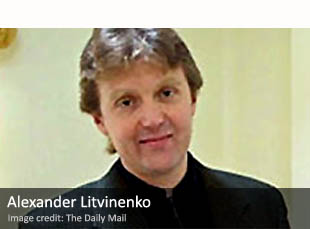
Alexander LitvinenkoBy JOSEPH FITSANAKIS | intelNews.org
A witness has told a British inquiry investigating the murder of ex-KGB officer Alexander Litvinenko that the former spy may have been killed because he warned Italian authorities about an impending Russian terror plot. Litvinenko was an employee of the Soviet KGB and one of its successor organizations, the FSB, until 2000, when he defected with his family to the United Kingdom. He soon became known as a vocal critic of the administration of Russian President Vladimir Putin. In 2006, Litvinenko came down with radioactive poisoning soon after meeting former KGB/FSB colleague Andrey Lugovoy at a London restaurant. Many suspect that the Russian government is behind Litvinenko’s murder.

Speaking in a London court on Monday, Italian newspaper editor and politician Paolo Guzzanti said he believed Litvinenko was murdered by the Kremlin because he was helping Italian authorities assess a series of Soviet and Russian intelligence operations in the country. Guzzanti was speaking as the former president of the so-called Mitrokhin Commission, a parliamentary board set up in 2002 to investigate past intelligence operations by the Soviet KGB in Italy. Most of the work of the Commission stemmed from the revelations in the Mitrokhin Archive, named after Vassili Mitrokhin, who for three decades was the archivist in the KGB’s First Chief Directorate. Mitrokhin defected to the Britain in 1992, taking with him a treasure trove of documents about Soviet intelligence activities that took place abroad during the Cold War.

Guzzanti told the inquiry that Litvinenko had cooperated with the Mitrokhin Committee and had even shared information with one of its consultants, Mario Scaramella, about ongoing attempts by the FSB to organize terrorist strikes in Italy. According to Guzzanti, Litvinenko informed Scaramella that Russian intelligence operatives were helping transport weapons from Ukraine to Italy in order to assassinate Guzzanti and thus sabotage the work of the Mitrokhin Committee. Based on Litvinenko’s information, Scaramella accused Alexander Talik, a Ukrainian former officer of the KGB who lived in Naples, Italy, of helping Russian intelligence operatives smuggle guns into the country. Talik and a number of his accomplices were promptly arrested by Italian authorities after they found several weapons and grenades in their possession. According to Guzzanti, Litvinenko’s role in stopping the alleged assassination attempt against him and other members of the Mitrokhin Committee was what led to the Kremlin’s decision to murder the former KGB spy.

At the end of Monday’s proceedings, the inquiry directors announced the would adjourn until the next provisional hearing, which has been scheduled for July 27.