Mossad chief sees historic shift of alliances as Arab states side with Israel against Iran
July 2, 2019 2 Comments
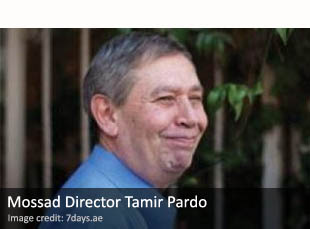
 In a rare public appearance, the director of the Mossad spy agency said that the Middle East is witnessing a historic shift of alliances as many Arab states are forming tacit pacts with Israel against Iran and its proxies. Yosef “Yossi” Cohen spoke on Monday morning at the Herzliya Conference, a security-themed event organized by the Interdisciplinary Center, a university in Herzliya, just north of Tel Aviv.
In his 40-minute speech Cohen said that the Mossad had identified the present time as “a rare opportunity —perhaps the first in the history of the Middle East— to reach a regional understanding that would lead to an inclusive regional peace agreement” between Israel and most of the Arab states. He justified his reasoning by claiming that many Arab states are siding with Israel to pursue “common interests [such as] the fight against rivals like Iran and jihadist terrorism”. This historic shift in alliances is happening as Israel is enjoying “close relations with the White House” and keeping open “channels of communication with the Kremlin”, said the spy chief. These factors “combine to create what might be a one-time window of opportunity” for Israel to form a strategic alliance with the majority of its Arab neighbors, said Cohen.
The Mossad chief went on to allege that the Islamic Revolutionary Guard Corps (IRGC) were behind the recent bombings of commercial oil tankers in the Persian Gulf. He told the conference that he could “say with certainty that Iran was behind these attacks” and that they were “approved by the Iranian leadership and carried out by the [IRGC]”. Cohen cited “the best sources of Israeli and Western intelligence” but did not provide specific evidence to support his allegation, which Iran denies. Later in his speech, Cohen said that the IRGC and Iranian intelligence agencies had carried out assassinations throughout Europe and had discussed further plans to attack Jewish and Israeli targets in Denmark, Azerbaijan and the North America. “And that is only the tip of the iceberg”, said Cohen, and went on to claim that the IRGC had set up a network of 300 agents in the African continent and was heavily present in Syria, mainly through its Lebanese proxy Hezbollah.
At the conclusion of his speech, the Mossad chief repeated prior warnings by Israeli officials that the Jewish state would never allow the development of an Iranian nuclear arsenal. “Mossad and the State of Israel have not signed the nuclear deal and will do all to ensure Iran will never possess a nuclear arsenal”, said Cohen.
► Author: Joseph Fitsanakis | Date: 02 July 2019 | Permalink
 A symposium about the life, activities and legacy of World War I-era double spy Mata Hari is to take place in London this month, on the 100th anniversary of her death by execution. Mata Hari was born Margaretha Geertruida Zelle in Holland in 1876. In 1895 she married Rudolf MacLeod, a Dutch Army Captain of Scottish descent serving the Dutch colonial administration of what is now Indonesia. She eventually divorced the alcoholic and abusive MacLeod, who was 20 years her senior, and joined the circus in Paris. Eventually she became wildly popular as an exotic dancer, a position that placed her in direct and close contact with several influential men in France, including the millionaire industrialist Émile Étienne Guimet, who became her longtime lover. Several of her male devotees came from military backgrounds from various European countries. Most historians agree that by 1916 Mata Hari was working for French intelligence, gathering information from her German lovers. However, in February of the following year she was arrested by French counterintelligence officers in Paris and accused of spying on behalf of the German Empire. French prosecutors accused her of having provided Germany with tactical intelligence that cost the Triple Entente the lives of over 50,000 soldiers.
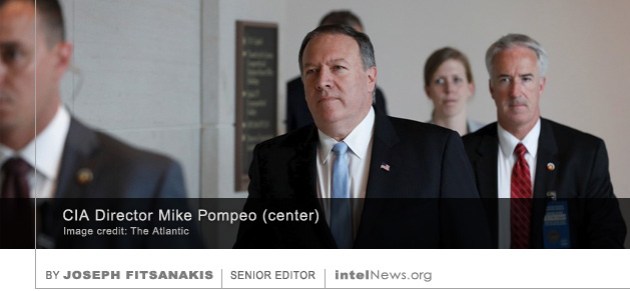 The man appointed by President Donald Trump to lead the United States Central Intelligence Agency has outlined his plans to promote more aggressive intelligence operations and combat what he described as “red tape” in the agency’s culture. Mike Pompeo, a former aerospace and oil executive, who is a member of the conservative Tea Party movement, assumed the directorship of the CIA in January of this year. He succeeded John Brennan, a career CIA officer, who has been an outspoken critic of the Trump administration’s attitude to intelligence since he left office in January.

 By IAN ALLEN | intelNews.org |










 intelNews.org
German intelligence agencies discuss ongoing espionage and hybrid challenges
May 6, 2024 by intelNews 1 Comment
The event (see agenda in .pdf) was organized by the Federal Ministry of the Interior and the Federal Chancellery Office. This year’s topic was: “Intelligence Agencies and Armed Conflicts”. It included the tried and tested mix of academics —predominantly legal scholars—, practitioners and heads of various government authorities. The majority of the external experts discussed the complicated and, in Germany, arduous parliamentary procedures that would arise in the event of a war.
In view of the controls increasingly being placed on German intelligence agencies by various bodies and authorities —which were also represented at the symposium— a certain discrepancy became apparent repeatedly in the presentations: How can the German intelligence agencies react adequately and quickly to hybrid threats when these types of threat do not concern themselves with administrative-legal subtleties and parliamentary procedures? Although the concept of hybrid threats was generally taken for granted and therefore hardly discussed in terms of content, those present agreed at a minimum that disinformation is part of it. All the more worrying was the statement by one speaker who explained that there was no official definition of disinformation within the German security authorities’ legal codes.
In the discussion, the panel moderated by Center for Intelligence Service Training and Further Education (ZNAF), the common training and study location of the Federal Intelligence Service (BND) and the Federal Office for the Protection of the Constitution (BfV), clearly stood out and underscored that this relatively new institution has made a name for itself in the academic intelligence landscape since its establishment in 2019.
However, the symposium also showed that the German security bureaucracy tends to reach its limits when it comes to current developments in the unconventional domain. This was demonstrated, for example, by a speaker’s demand that hybrid risks ought to be assigned to a “state area of responsibility”. The problem, however, lies precisely in the statelessness of hybrid risks. The existing regulations are also proving to be counterproductive, in view of the challenges: there would simply be highly heterogeneous participants in the so-called Cyber Defense Centre, which would also include police authorities. However, due to the strict separation in the legal domain, personal data cannot simply be passed on from the BND to the Federal Police, for example. Read more of this post
Filed under Expert news and commentary on intelligence, espionage, spies and spying Tagged with BND, conferences, Federal Office for the Protection of the Constitution (Germany), Germany, News