Turkish diplomats stepping up espionage in Europe, claims German report

Turkish embassy in GermanyTurkish state agencies have asked the country’s diplomats stationed all over Europe to spy on Turkish expatriate communities there, in an effort to identify those opposed to the government, according to a German report. The government of Turkish President Recep Tayyip Erdoğan accuses members of the so-called Gülen movement of orchestrating a military coup in July of last year, which resulted in an armed attack on the country’s parliament and the murder of over 200 people across Turkey. The Gülen movement consists of supporters of Muslim cleric Fethullah Gülen, who runs a global network of schools, charities and businesses from his home in the United States. The government of Turkey has designated Gülen’s group a terrorist organization and claims that its members have stealthily infiltrated state institutions since the 1980s.

According to German newsmagazine Der Spiegel, the Erdoğan government has now tasked its diplomats stationed abroad to engage in intelligence collection targeting alleged Gülen sympathizers. The report cited “a confidential analysis by the Federal Office for the Protection of the Constitution” (BfV), Germany’s counterintelligence agency. The analysis allegedly states that Turkish diplomats are now conducting systematic espionage activities in Germany, Austria, Switzerland, Holland, Belgium, and other Western European countries. The BfV report allegedly claims that much of the espionage conducted by Turkish diplomats is directed by the country’s Religious Affairs Directorate, known as Diyanet. The agency is seen as the institutional guardian of Turkey’s Sunni Muslim orthodoxy. It provides schools with religious education that is carefully tailored to be compatible with the country’s secular constitution, and trains the country’s imams, who are employed by the state. Der Spiegel claimed on Monday that Diyanet has asked its religious representatives stationed in Europe to look for Gülen sympathizers. According to the German newsmagazine, information is now pouring in from Turkey’s embassies and consulates. It includes names of individuals, as well as student groups, cultural organizations, schools and day-care centers that are seen as not sufficiently critical of the Gülen movement. Der Spiegel said it had seen a report sent to Diyanet by the Turkish embassy in Berne, Switzerland, which warned that many Gülenists had left Turkey and were now operating in Switzerland.

Late last summer, Der Spiegel claimed that Turkey’s National Intelligence Organization (known by its Turkish initials, MİT) secretly contacted its German counterpart, the Federal Intelligence Service (BND) and asked for assistance to investigate and arrest supporters of the Gülen movement living in Germany, some of whom are German citizens. The BND reportedly refused to cooperate with the request. Another German news outlet, Die Welt, cited an unnamed German security official who said that the MİT employed more operatives in Germany than the East German spy agency did at the height of the Cold War.

Author: Joseph Fitsanakis | Date: 20 February 2017 | Permalink

Pakistani man sought out assassination targets for Iran, says Germany

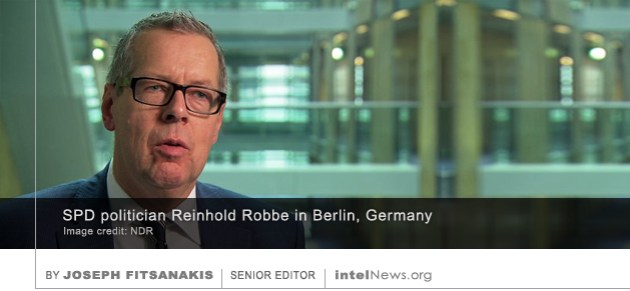
Reinhold RobbeAuthorities in Germany have pressed espionage charges against a Pakistani man who allegedly spied for Iran and even compiled lists of potential targets for assassination. The man, who has been identified in media reports only as “Syed Mustafa H.”, is a 31-year-old worker at the German Aerospace Center in the northern German city of Bremen. He is also reportedly a graduate of the Materials Science and Production Engineering department of the Universität Bremen. According to court documents, he is believed to have been spying for Iranian intelligence since the summer of 2015. It appears that the Federal Office for the Protection of the Constitution (BfV), Germany’s domestic intelligence agency, had been aware of the man’s espionage activities for at least a year prior to his arrest.

German media, including the newspapers Süddeutsche Zeitung and Die Zeit, as well as public broadcasters Taggesschau, WDR and NDR, report that Syed Mustafa H.’s main task was to compile lists of potential assassination targets. These included prominent Jews or German-Israelis living in northern Germany. Among them was Reinhold Robbe, a politician with the center-left Social Democratic Party (SPD), who served for a number of years as president of the German-Israeli Congress (DIG). According to reports, the Pakistani spy had compiled detailed maps of Robbe’s daily movements, which outlined his travel routines and the routes he took from his home to the DIG headquarters in Berlin. German officials believe that the type of surveillance that Syed Mustafa H. carried out against Robbe indisputably leads to the conclusion that the politician’s assassination was being planned.

Reports in the German media suggest that Syed Mustafa H.’s work was a small part of a much broader operation by Iranian intelligence. The operation aims to identify prominent individuals throughout Europe, who have Israeli connections. These individuals can be targeted during a future conflagration between Israel and Iran, or in retaliation to an Israeli intelligence operation against Tehran. If Syed Mustafa H. is found guilty of targeting Robbe, it will mark the first proven case of a German political figure who has been targeted for possible assassination by an Iranian intelligence agency.

Author: Joseph Fitsanakis | Date: 10 January 2017 | Permalink
Russian espionage in Germany rising sharply, says Berlin

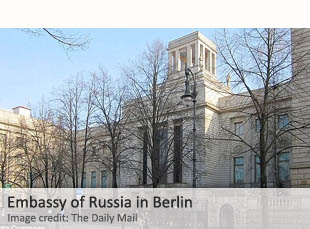
Embassy of Russia in BerlinBy JOSEPH FITSANAKIS | intelNews.org
Russian espionage activity in Germany has reached levels not seen since the days of the Cold War, according to senior counterintelligence officials in Berlin. An article published in weekly newspaper Die Welt am Sonntag on Sunday said Russian intelligence-gathering activities in the German capital center on infiltrating German political institutions and corporations. The Berlin-based publication said Russian spies typically seek to gain “intimate knowledge” of German energy policy as well as corporate practices. Another area of interest for Russian intelligence concerns Germany’s activities in the European Union and the North Atlantic Treaty Organization. Citing Hans-Georg Maassen, Director of the Office for the Protection of the Constitution (BfV —Germany’s primary counterintelligence agency), Die Welt said that no foreign intelligence service is more active on German soil than Russia’s SVR —one of the KGB’s successor agencies. Most Russian intelligence officers “pose as embassy workers”, said the paper, adding that the BfV believes up to a third of all Russian diplomats stationed at the German capital have a “background in intelligence gathering”. According to Burkhard Even, who directs the BfV’s counterintelligence operations, the primary task of Russian intelligence operatives in Germany is to “closely analyze individuals who could be of interest” to Moscow. Those targeted —usually key staffers at the Bundestag (Germany’s federal parliament) or major German companies— are then systematically accosted by Russian ‘diplomats’. The latter often ask to take them out to lunch or dinner, said Maaßen, and will often pick up the bill. Read more of this post

News you may have missed #747

Israeli athletes at the 1972 Munich OlympicsBy TIMOTHY W. COLEMAN | intelNews.org |
►►Dutch media reportedly spied on China. Dutch media participated in a clandestine intelligence collection effort on behalf of the Netherlands General Intelligence and Security Service (AIVD) during the 2008 Summer Olympic Games in Beijing. According to Dutch sources, at least seven reporters attending the Olympics were coaxed into, and were paid for, collecting information and taking photos of targeted Chinese officials interested in speaking with Dutch company and industry representatives. The AIVD did not comment on the allegations but did remark that Dutch law allows them to contact anyone who could provide or has access to intelligence.
►►Nicaragua arrests Colombian national for espionage. According to the Spanish-language weekly newspaper Semana, General Julio Cesar Aviles, the head of Nicaragua’s Army, announced the arrest of Colombian national Luis Felipe Rios, for seeking to “obtain Nicaraguan state documents about defense and national security”. The 34-year old Rios was apparently captured in Managua on Tuesday after having been under the surveillance of Nicaraguan counterintelligence officials for over a year. Rios was in Nicaragua under the guise of being a Spanish national working for a media outlet. The lead prosecutor in Nicaragua, Armando Juarez, claimed that there was “sufficient proof” to prosecute Rios. Colombian officials, including President Juan Manuel Santos, have stated they are investigating the matter.
►►Neo-Nazi linked to 1972 Munich Olympic terrorists. Recently released files by Germany’s security service, the Federal Office for the Protection of the Constitution (BfV), links neo-Nazi Willi Pohl to forged passports provided to Black September terrorists who perpetrated the 1972 attack at the Munich Olympics. The attack resulted in the deaths of 11 Israeli athletes. According to German magazine Der Spiegel, over 2,000 documents were released in which the BfV asserts that Pohl assisted and even chauffeured one Black September member around Germany in the weeks leading up to the attack. German police arrested Pohl in 1972 for “unauthorized possession of firearms” and sentenced him to two years’ incarceration for possessing grenades and weapons. He was released only a few days after his conviction and he fled the country, ending up in Lebanon.

Spy activity heats up in Berlin, recent arrests show

Syrian embassy in BerlinBy IAN ALLEN | intelNews.org |
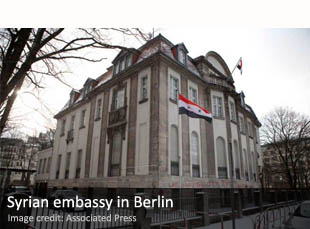
During the Cold War, Berlin was considered one of the world’s paramount intelligence hotspots —a gathering place for spies from Western Europe, the Soviet bloc, America, and beyond. But recent developments in the German capital show that the city’s illustrious espionage heritage is far from over. On Wednesday, German authorities announced the arrest of a 56-year-old man on charges of spying on Western Saharan opposition activists operating on German soil. The man, who has been identified only as “Mohammed B.”, is reportedly a German-Moroccan dual citizen, and the statement by the German prosecutor’s office hints that he is an accredited intelligence officer. According to the official press release by the prosecutor, Mohammed B. was arrested for operating as an unregistered agent of the Moroccan intelligence services. His main targets appear to have consisted of activists involved with the POLISARIO Front, the main political vehicle of the Western Saharan independence movement, which seeks to separate the territory from Moroccan control. POLISARIO, along with its military wing, the Sahrawi People’s Liberation Army, was founded after 1975, when Morocco unilaterally annexed the former Spanish colony. A police spokesman in Berlin said German authorities searched Mohammed B’s apartment, as well as businesses and houses belonging to “two other suspects”, who do not appear to have been apprehended. The arrest took place exactly a week after the German government summarily expelled four Syrian diplomats, whom it accused of engaging in “activities incompatible with their diplomatic status” —code language for espionage. Read more of this post

Revealed: German spy agency monitors leftwing politicians

Die Linke's Gregor GysiBy JOSEPH FITSANAKIS | intelNews.org |
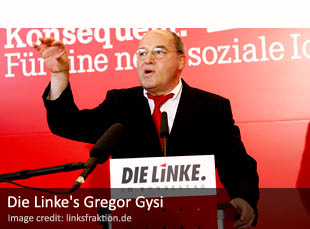
Well over a third of leftwing German parliamentarians are currently being monitored by the country’s domestic intelligence agency, according to a government report released on Sunday. Germany’s quality newsmagazine Der Spiegel has cited an internal document from the Ministry of the Interior, which states that 27 of the Left Party’s 76 members of parliament are currently “being observed” by the authorities. The document, which is dated January 4, 2012, also reveals that the Federal Office for the Protection of the Constitution (BfV, Germany’s primary domestic spy organization) is keeping tabs on another 11 Left Party elected officials serving in regional parliaments. The document does not name the 27 parliamentarians, but the list is believed to include the Left Party’s leading political figures. The party, known in Germany as Die Linke, is one of the country’s largest, having received nearly 12% of the national vote in the 2009 federal elections. It was established in 2007, after the Electoral Alternative for Labor and Social Justice party merged with the Party of Democratic Socialism —the successor of the Socialist Unity Party of Germany, which ruled East Germany until 1989. The party’s electoral stronghold rests in the regions of the former East Germany, while some of the party’s older members held senior government positions under East Germany’s communist system. For this reason, some in Germany view the Left Party as an extremist organization —a characterization that presumably forms the rationale for the BfV’s monitoring operation. On the other hand, some critics raise concerns that, even if some Die Linke members have links with the former East German security establishment, the BfV operation against the party is too intense, and that more attention should instead be given to German neo-Nazi groups, such as the National Democratic Party (NPD). Read more of this post

Analysis: United States and Germany spy on each other

BND seal

BND seal

By JOSEPH FITSANAKIS | intelNews.org |
Newly released documents reveal that the Central Intelligence Agency has maintained an active program of espionage against Germany in the post-Cold War era, and experts say that Germany reciprocates the ‘favor’. According to an article in the latest issue of German newsmagazine Focus, the US intelligence community, led by the CIA, has been keeping tabs on Germany’s intelligence agencies since the 1950s, and continues to do so today. The magazine’s editors say they are in possession of internal government documents, which describe constant CIA monitoring on the Bundesnachrichtendienst (BND), Germany’s main external intelligence agency. The CIA’s spying extends to Germany’s counterintelligence agency, known as the Federal Office for Protection of the Constitution (Bundesamt für Verfassungsschutz). CIA operations against the Office have reportedly included the interception of telephone calls, some of which involved high-level conversations between German and British or French intelligence officials. Focus claims that CIA spying against the BND actually intensified following German reunification in 1990, as the American agency kept tabs on German intelligence officers with former Nazi or communist past. According to one report, the CIA was able to verify that at least two BND officers with service in the Nazi SS had joined a NATO sabotage unit. The magazine spoke to an unnamed former BND counterintelligence officer, who said he was not in the least surprised by the revelations. Commenting yesterday on the Focus report, Washington-based reporter Jeff Stein argued that a little friendly spying is to be expected among allied intelligence services. The veteran intelligence correspondent spoke to an unnamed former CIA officer, who told him that the espionage between Washington and Berlin has not been “a one-way street” —the BND also spies on the CIA and other American intelligence agencies. Read more of this post

West German defector dies in Moscow

Hans-Joachim Tiedge

Tiedge

By JOSEPH FITSANAKIS | intelNews.org |
A senior West German counterintelligence official, whose 1985 defection to the Soviet bloc shocked Western intelligence, has died in Moscow. Hans-Joachim Tiedge headed the Cologne office of West Germany’s now-defunct Federal Office for the Protection of the Constitution (BfV). He was also involved in the BfV’s counterintelligence work against East German spy operations on West German soil. But on August 19, 1985, Tiedge boarded a train to East Germany. Once there, he walked over to a branch of the Ministry for State Security (commonly known as the Stasi) and declared his intent to defect. His defection caused disarray in West German intelligence circles, prompting the recall of dozens of West German officers and agents operating in East Germany. It eventually led to the resignation of the Director of the BfV, Heribert Hellenbroich. In his autobiography, published in 1998, Tiedge said he decided to defect “due to personal problems” relating to chronic alcoholism and financial debt. He also said his decision to flee to East Germany was prompted by the fear that he was about to be reassigned to a less desirable post inside the BfV. Read more of this post

News you may have missed #418

  • US military pays for intel widely available online. Experts say that the vast majority of the ‘intelligence’ needed by the United States is freely available on the Internet. But that has not stopped a company called Military Periscope from selling its subscription services to the US government, on things such as updates on foreign militaries, peacekeeping missions, weapons databases and terrorist organizations “via monthly CD-ROM delivery”.
  • Son of Russian spies could return to US for school. Tim Foley, the elder son of Donald Howard Heathfield and Tracey Lee Ann Foley, the two deported US residents who were living a double life as Russian spies, may be trying to return to study in the United States, but his younger brother plans to stay in Moscow.
  • German spy chief notes cyberattack surge. Cyberattacks against German corporate and government computers have been on the rise since 2005, according to Heinz Fromm, Director of Germany’s Federal Office for the Protection of the Constitution. He said the attacks “come mainly from Asia, often from China”, and that often “state agencies are involved”.

A terrible week for German spy agencies

BND logo

BND logo

By JOSEPH FITSANAKIS | intelNews.org |
Germany’s largest intelligence agencies are in for a challenging few days, as two spy scandals are making headlines in the country’s media. The Federal Office for the Protection of the Constitution, Germany’s foremost domestic intelligence organization, is firmly in the hot seat after it emerged that a woman it employed as an undercover informer was among seven extremists indicted for helping operate a hardcore neo-Nazi online radio station. The woman, who has been identified only as “Sandra F.”, had been hired by the spy agency to monitor the German People’s Union (DVU), a national socialist political grouping with substantial following in Brandenburg and Saxony. Read more of this post

News you may have missed #0168

  • 1,600 suggested daily for FBI’s terrorist watch list. Newly released data show that, during a 12-month period ending in March this year, the US intelligence community suggested 1,600 names daily for entry on the FBI’s terrorist-watch list. The ever-churning list is said to contain over a million entries and more than 400,000 unique names, of which around 5 percent are US citizens or legal residents.
  • German spies keep files on leftist politicians. Germany’s Federal Office for the Protection of the Constitution, a domestic intelligence service, has kept tabs on 27 elected German lawmakers since 2005. All of those targeted are members of Germany’s Left Party. The news, disclosed during an internal German parliament investigation, is certain to upset members and supporters of the Left Party, which holds 76 seats in the country’s 662-seat federal parliament.

Bookmark and Share

Iran government spying on ex-pat dissidents, says Germany

Manfred Murck

Manfred Murck

By JOSEPH FITSANAKIS | intelNews.org |
A German intelligence official has said Iranian government agents are actively spying on Iranian dissidents living in Germany. Speaking to the Panorama program on Germany’s ARD state-owned television station, Manfred Murck, deputy director of the Hamburg branch of the Federal Office for the Protection of the Constitution (BfV), Germany’s primary domestic intelligence service, said his department is aware of Iranian intelligence activity targeting Iranians living in Germany. “We know that the Iranian (secret) service has its people circulating in demonstrations. Read more of this post

German provincial spy boss caused bomb scare

Günter Heiss

Günter Heiss

By IAN ALLEN | intelNews.org |
The director of German’s domestic intelligence organization in the state of Lower Saxony will receive a fine for instigating a bomb scare by leaving his briefcase unattended during a social gathering. Günter Heiss, who heads the northwester German state’s office of the Federal Office for the Protection of the Constitution (Bundesamt für Verfassungsschutz), has admitted responsibility for the blunder. He was among 700 guests at a cocktail party hosted in the Hannover city hall by Lower Saxony’s Christian Democratic parliamentary group. Read more of this post

News you may have missed #0007

  • German counterintelligence chief accuses Russia of commercial spying. Burkhard Even, Germany’s director of counterintelligence at the Federal Office for the Protection of the Constitution, has told German newspaper Die Welt am Sonntag that Russian spies have intensified espionage operations on the German energy sector to help Russian firms gain commercial advantages. On May 26, intelNews reported on similar accusations by the German Association for Security in Industry and Commerce (ASW). Its director told Mitteldeutsche Zeitung that the targeting of German research and commercial enterprises by mainly Chinese and Russian agents is so extensive that it usually costs the German economy over €20 billion per year, and it may be costing as high as €50 billion per year since 2007.
  • Spanish intelligence agents kicked out of Cuba. Spanish newspaper ABC reports that the recently expelled officers of Spain’s National Intelligence Centre (CNI) were secretly recorded at Havana cocktail parties “making derogatory comments about the Castro brothers and other [Cuban] government officials”. 
  • Proposed US bill would boost congressional oversight of covert spy programs. Key lawmakers in Washington have endorsed a proposed bill that would force the president to make fuller disclosure of covert spy programs. The legislation, which has already been approved by the House Intelligence Committee, would force the president to disclose classified operations to all members of Congress’ intelligence oversight panels. 
  • Report claims CIA, Mossad scoring points against Hezbollah. A new report claims American and Israeli intelligence organizations have scored notable recent successes against Hezbollah, in places such as Azerbaijan, Egypt and Colombia.