Turkish diplomats stepping up espionage in Europe, claims German report
February 20, 2017 Leave a comment
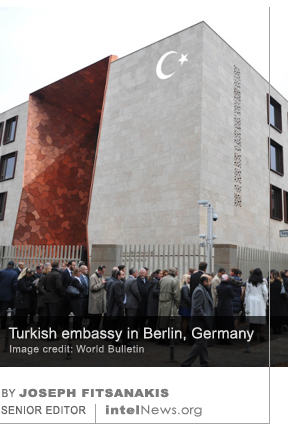 Turkish state agencies have asked the country’s diplomats stationed all over Europe to spy on Turkish expatriate communities there, in an effort to identify those opposed to the government, according to a German report. The government of Turkish President Recep Tayyip Erdoğan accuses members of the so-called Gülen movement of orchestrating a military coup in July of last year, which resulted in an armed attack on the country’s parliament and the murder of over 200 people across Turkey. The Gülen movement consists of supporters of Muslim cleric Fethullah Gülen, who runs a global network of schools, charities and businesses from his home in the United States. The government of Turkey has designated Gülen’s group a terrorist organization and claims that its members have stealthily infiltrated state institutions since the 1980s.
According to German newsmagazine Der Spiegel, the Erdoğan government has now tasked its diplomats stationed abroad to engage in intelligence collection targeting alleged Gülen sympathizers. The report cited “a confidential analysis by the Federal Office for the Protection of the Constitution” (BfV), Germany’s counterintelligence agency. The analysis allegedly states that Turkish diplomats are now conducting systematic espionage activities in Germany, Austria, Switzerland, Holland, Belgium, and other Western European countries. The BfV report allegedly claims that much of the espionage conducted by Turkish diplomats is directed by the country’s Religious Affairs Directorate, known as Diyanet. The agency is seen as the institutional guardian of Turkey’s Sunni Muslim orthodoxy. It provides schools with religious education that is carefully tailored to be compatible with the country’s secular constitution, and trains the country’s imams, who are employed by the state. Der Spiegel claimed on Monday that Diyanet has asked its religious representatives stationed in Europe to look for Gülen sympathizers. According to the German newsmagazine, information is now pouring in from Turkey’s embassies and consulates. It includes names of individuals, as well as student groups, cultural organizations, schools and day-care centers that are seen as not sufficiently critical of the Gülen movement. Der Spiegel said it had seen a report sent to Diyanet by the Turkish embassy in Berne, Switzerland, which warned that many Gülenists had left Turkey and were now operating in Switzerland.
Late last summer, Der Spiegel claimed that Turkey’s National Intelligence Organization (known by its Turkish initials, MİT) secretly contacted its German counterpart, the Federal Intelligence Service (BND) and asked for assistance to investigate and arrest supporters of the Gülen movement living in Germany, some of whom are German citizens. The BND reportedly refused to cooperate with the request. Another German news outlet, Die Welt, cited an unnamed German security official who said that the MİT employed more operatives in Germany than the East German spy agency did at the height of the Cold War.
► Author: Joseph Fitsanakis | Date: 20 February 2017 | Permalink
 Authorities in Germany have pressed espionage charges against a Pakistani man who allegedly spied for Iran and even compiled lists of potential targets for assassination. The man, who has been identified in media reports only as “Syed Mustafa H.”, is a 31-year-old worker at the German Aerospace Center in the northern German city of Bremen. He is also reportedly a graduate of the Materials Science and Production Engineering department of the Universität Bremen. According to court documents, he is believed to have been spying for Iranian intelligence since the summer of 2015. It appears that the Federal Office for the Protection of the Constitution (BfV), Germany’s domestic intelligence agency, had been aware of the man’s espionage activities for at least a year prior to his arrest.

 By IAN ALLEN | intelNews.org |














German spy officials dismiss calls to create European intelligence agency
October 6, 2017 by Joseph Fitsanakis Leave a comment
But these calls were rebuffed this week in Berlin, where Germany’s two most senior intelligence officials rejected any and all calls for the creation of a European intelligence service. The officials are Bruno Kahl, director of Germany’s Federal Intelligence Service, the BND, and Hans-Georg Maaßen, who heads the country’s Federal Office for the Protection of the Constitution, known as the BfV. The two men spoke before a special session of the Intelligence Oversight Committee of the German Federal Parliament, known as the Bundestag. The BND’s Kahl said Europe already had an intelligence-based early-warning center, known as the European Union Intelligence and Situation Center (EU INTCEN). He argued that there was “no need for a European intelligence agency or any other supplemental Europe-wide intelligence organization” and added that “intelligence is better organized on the national level”. He was backed by BfV’s Maaßen, who warned that the creation of a European intelligence service would “create additional bureaucratic structures, both on the European and domestic levels”, which would “profoundly lower our efficiency”.
The two German intelligence officials said that cooperation between European Union member-states had improved substantially in the past few years, and that the current model of bilateral exchange was “the most efficient […] and quickest way to share information”. The current system of inter-agency coordination would be weakened if a European intelligence service was created, according to the two men.
► Author: Joseph Fitsanakis | Date: 06 October | Permalink
Filed under Expert news and commentary on intelligence, espionage, spies and spying Tagged with BND, Bruno Kahl, Dimitris Avramopoulos, Emmanuel Macron, European Union, Federal Office for the Protection of the Constitution (Germany), Hans-Georg Maaßen, intelligence cooperation