Same hacker group is targeting French and German elections, says report

Konrad Adenauer FoundationThe same group cyber-spies that attacked the campaign of French presidential candidate Emmanuel Macron is now attacking German institutions that are connected to the country’s ruling coalition parties, according to a report by a leading cyber-security firm. The Tokyo-based security software company Trend Micro published a 41-page report on Tuesday, in which it tracks and traces the attacks against French and German political targets over the past two years. The report, entitled From Espionage to Cyber Propaganda: Pawn Storm’s Activities over the Past Two Years, concludes that the hackers are seeking to influence the results of the national elections in the European Union’s two most powerful nations, France and Germany.
The Trend Micro report focuses on a mysterious group that cyber-security experts have dubbed Pawn Storm —otherwise known as Sednit, Fancy Bear, APT28, Sofacy, and STRONTIUM. It says that the group has launched an aggressive phishing campaign against German political institutions, which has intensified in the past two months. The group allegedly set up fake computer servers in Germany and the Ukraine, and used them to try to infiltrate the computer networks of two elite German think-tanks, the Konrad Adenauer Foundation (KAF) and the Friedrich Ebert Foundation (FEF). The KAF is connected with the Christian Democratic Union party, which is led by Germany’s Chancellor, Angela Merkel. The FEF has strong ties with the centrist Social Democratic Party, which is part of Germany’s governing alliance.

The report’s leading author, cyber-security expert Feike Hacquebord, told the Reuters news agency that the hackers were possibly seeking to infiltrate the two think-tanks as a means of gaining access to the two political parties that are connected with them. Some cyber-security experts in Europe and the United States have said that the Russian Main Intelligence Directorate, the country’s military intelligence agency, known as GRU, is behind the cyber-attacks on France, Germany and the United States. But the Trend Micro report did not attempt to place blame on Moscow or any other country for the cyber-attacks. The Kremlin has denied involvement with the alleged hacking operations.

Author: Ian Allen | Date: 26 April 2017 | Permalink

British tip helped French police foil ‘imminent’ terrorist attack

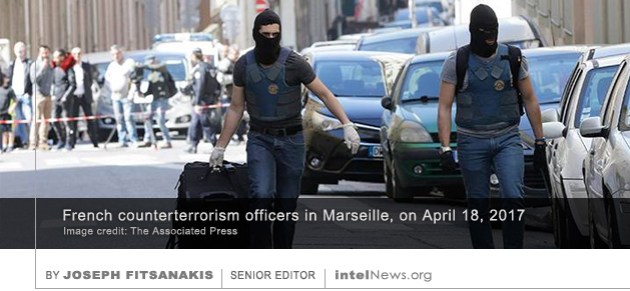
DGSEA tip from British intelligence helped French counterterrorist officials arrest two men who are thought to have been in the final stages of planning a large-scale terrorist attack, according to French media. Government sources in Paris say officers from the country’s domestic intelligence agency, DGSE, arrested two men on Monday. Both men are reportedly French citizens from France’s northern regions. They were residing in the southern port city of Marseilles, where they were arrested by the DGSE. They were later named as Merabet Mahiedine, 29, and Clement Baur, 23. It is alleged that Mahiedine has North African roots, but that Baur is a Caucasian convert to Islam. Both were allegedly known to French police for having repeatedly stated views in support of radical Islamist policies.
According to France’s Minister of the Interior, Matthias Fekl, the two men were planning to carry out a large-scale armed attack in Marseilles this week, which is the last before the long-awaited presidential election in the country. Some sources in the French intelligence community claim that the two men planned to kill one of the major candidates in the election. A number of reports suggest that their target was François Fillon, a conservative presidential candidate who served as Prime Minister from 2007 to 2012 under President Nicolas Sarkozy. It is not known why Fillon may have been targeted, though some observers speculate that radical Islamists seek to promote the aspirations of Fillon’s main rival, the far-right candidate Marine LePen, whom they see as someone whose policies would further-radicalize Muslims in France and North Africa.

Reports in the French media state that DGSE officers confiscated several guns and significant quantities of bomb-making material that were found in an apartment belonging to one of the two men. Meanwhile, an aide to Mr. Fillon told the Paris-based newspaper Le Figaro that the primary tip that led to the arrest of the two men in Marseilles came from British intelligence. The subsequent capture of the two men prevented an attack that would have almost certainly taken place “in the next couple of days”, according to sources in Paris.

Author: Joseph Fitsanakis | Date: 19 April 2017 | Permalink

French intelligence warn of Russian meddling in upcoming election

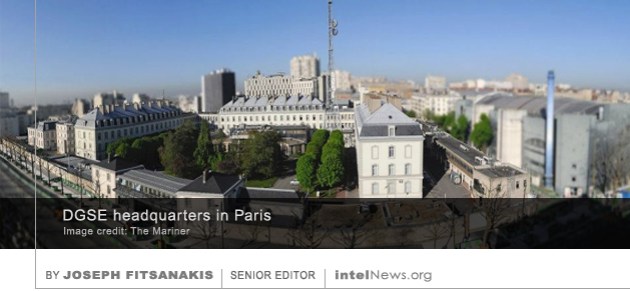
dgse franceFrance’s primary intelligence agency warned the country’s government this week that Russia has launched a secret operation to try to influence the outcome of the upcoming French presidential election in favor of the far right. According to the Paris-based weekly newspaper Le Canard Enchaîné, France’s Directorate-General for External Security (DGSE) has notified the country’s leadership that a covert operation by the Kremlin is already underway, and is expected to intensify in the run-up to April’s election. The spy agency allegedly believes that Russian efforts aim to promote Marine Le Pen, leader of the ultra-right National Front. Le Pen wants to curb immigration to France and remove the country from the European Union.
In an article published on Wednesday, Le Canard Enchaîné said the DGSE’s warning has alarmed the Élysée Palace. The paper also said that French President François Hollande, who chairs the country’s defense council, has decided to devote the entire agenda of the council’s next meeting to the subject of Russia’s alleged interference in the election. Anonymous sources told the paper that, according to a classified DGSE report, Russian spy agencies are using automated systems designed to “fill the Internet with tens of millions” of articles, images and memes that support the National Front candidate. Additionally, several news media that are controlled by Moscow will try to discredit Le Pen’s rivals for the presidency. At the same time, websites such as WikiLeaks —which some American commentators accuse of working with Moscow— will publish leaked information designed to damage Le Pen’s competitors.

The Le Canard Enchaîné allegations sound very similar to accusations leveled against the Kremlin by American intelligence agencies and by members of the United States Democratic Party. However, these allegations have not been supported by concrete evidence, and Russia denies that it had any involvement in last November’s presidential election in the US, which was won by Donald Trump.

Author: Joseph Fitsanakis | Date: 10 February | Permalink

French citizens killed in Malta plane crash were intelligence officers

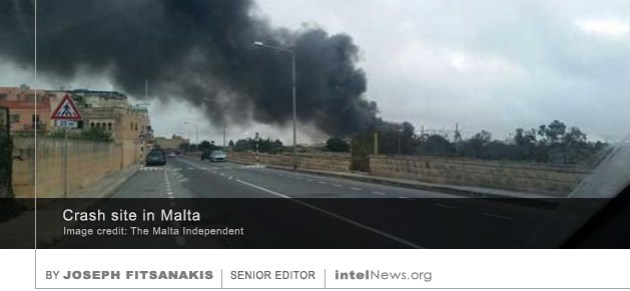
MaltaDespite initial denials, it appears that at least three of the five French citizens who were killed in an airplane crash in Malta earlier this week were employees of the country’s external intelligence agency. The crash happened in the early hours of Monday near the village of Luqa in southern Malta. Early reports identified that the plane as a light aircraft and was carrying five French citizens when it crashed, shortly after taking off from the nearby Malta International Airport. Initial statements from Maltese and French government officials said the plane was on a local flight route and had not been scheduled to land outside of the Mediterranean island. The five passengers were identified in press statements as “customs officers” who were conducting a joint project with their Maltese counterparts.

Subsequent reports in the French media, however, said that at least three of the five French passengers who perished in the crash were officers of the General Directorate for External Security, France’s external intelligence agency, which goes by the initials DGSE. It is also believed that the airplane was registered in the United States and was operated by a Luxembourg-based company. Reports from Libya state that the plane’s mission is “shrouded in mystery”. Some articles suggest that it was heading to the city of Misrata in northern Libya, or that it may have been conducting a reconnaissance operation over the Mediterranean, aimed at gathering intelligence on smuggling activities originating from Libya.

The French intelligence services are known to be active on the ground in Libya, where several Sunni Islamist groups, including the Islamic State, control territory. In July of this year, Paris acknowledged for the first time that it had Special Forces and intelligence operatives in Libya, after three DGSE officers were killed in a helicopter crash in the North African country. The latest air crash was not preceded by an explosion, according to French media. The French government has launched an investigation into the incident.

Author: Joseph Fitsanakis | Date: 27 October 2016 | Permalink

France’s ex-cyber spy chief speaks candidly about hacking operations

Bernard BarbierThe former director of France’s cyber spy agency has spoken candidly about the recent activities and current state of French cyber espionage, admitting for the first time that France engages in offensive cyber operations. Between 2006 and 2013, Bernard Barbier was director of the technical division of the General Directorate for External Security, France’s external intelligence agency, which is commonly known as DGSE. During his tenure at DGSE, the organization’s technical division witnessed unprecedented financial and administrative growth. Today it is said to employ over 2500 people, nearly half of DGSE’s total personnel.
Earlier this month, Barbier was interviewed on stage during a symposium held by the CentraleSupélec, a top French engineering university based in Paris. He spoke with surprising candor about France’s cyber espionage operations. In the first part of his interview, which can be watched on YouTube, he recounted the history of what he described as “France’s cyber army”. He said that France began to build “teams of hackers” in 1992. Around that time, the DGSE purchased an American-built Cray supercomputer, said Barbier, and soon discovered that it could use the machine’s immense computing power to break passwords. More recently, said the former cyber spy chief, the DGSE has been trying to “catch up” with its American and British counterparts, the National Security Agency and the Government Communications Headquarters, by increasing its annual budget to over half a billion and hiring hundreds of young hackers. Many of these new employees have little to no university education, said Barbier, and are instead self-taught, having started hacking in their teenage years.

Like most governments, France will not officially admit to conducting offensive cyber operations using computer hacking and other techniques. But Barbier said during his interview that France was behind an offensive cyber operation that targeted Iran in 2009. He added that the DGSE has also directed cyber operations against Canada, Ivory Coast, Algeria, Norway, as well as its European Union partners Spain and Greece. He also complained that French government executives do not understand the importance of cyber operations and are not aiming high enough when it comes to planning, direction and hiring. The DGSE’s technical division still needs between 200 and 300 more staff members, Barbier argued in his interview.

Author: Joseph Fitsanakis | Date: 16 September 2016 | Permalink

French government acknowledges it has special forces, spies, in Libya

French special forcesThe death of three French Special Forces soldiers in Libya has prompted the first public acknowledgement by France that its troops are involved in “dangerous intelligence operations” in the North African country. The acknowledgement was made on Wednesday in an official statement issued by Jean-Yves Le Drian, France’s Minister of Defense. In the statement, Le Drian said he “regretted the loss of three French officers who expired while on mission in Libya”. The acknowledgement came less than 24 hours after the Associated Press news agency claimed that a helicopter carrying French troops had been shot down in Libya. The report quoted unnamed Libyan officials as saying that the helicopter had been shot down by an Islamist militia in the outskirts of the city of Benghazi, in eastern Libya.
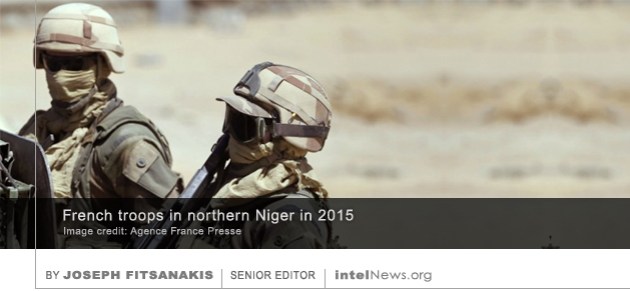
Paris has previously acknowledged the presence of French warplanes in Libya, which it says are only involved in reconnaissance operations. It is also known that France has set up a forward operating base in Niger, close to the southern Libyan border. But the French government has never before acknowledged the presence of French troops or intelligence operatives on Libyan soil. During the uprising that deposed longtime Libyan dictator Muammar Gaddafi, there were persistent rumors of daring operations by French commandos and intelligence operatives, which were never confirmed. In February of this year, French newspaper Le Monde claimed that French troops and spies were active in Libya. In a leading article titled “France’s Secret War in Libya”, the French daily said that President François Hollande had secretly authorized operations by elite special forces and officers of the DGSE, France’s General Directorate for External Security. But France’s Defense Ministry refused to comment on Le Monde’s allegations, while Laurent Fabius, who was then France’s Minister of Foreign Affairs, denied the newspaper’s claims, saying that France did not have the means to intervene militarily in Libya.

Speaking shortly after Wednesday’s disclosure by the Defense Ministry, President Hollande said the three special forces soldiers had died while “carrying out perilous intelligence operations” in Libya. In a subsequent interview on the Paris-based France Info Radio, French government spokesman Stephane Le Foll admitted that French operatives are indeed active in Libya. Asked whether the Defense Ministry’s statement offered such an acknowledgement, Le Foll responded: “French special forces are [in Libya], naturally, to offer assistance and to ensure that France has a presence wherever the struggle against international terrorism is taking place”.

Author: Joseph Fitsanakis | Date: 21 July 2016 | Permalink

Terrorism most likely cause of EgyptAir disaster, despite no ‘smoking gun’

EgyptAirEgypt’s aviation minister has joined the head of Russia’s domestic security service, unnamed US intelligence sources, as well as a host of aviation security experts, in seeing terrorism as the most likely cause behind the EgyptAir MS804 air disaster. That is despite the absence of a clear ‘smoking gun’ and silence from the Islamic State, which leads many to still caution that the possibility of an accident should not be ruled out. The regularly scheduled flight departed Paris, France, late on Wednesday, heading for Cairo, Egypt. But it disappeared from radar screens just minutes after entering Egyptian airspace and is now believed to have crashed into the Mediterranean Sea.

On Thursday, Egypt’s Minster of Aviation, Sherif Fathi, told reporters that, when carefully weighing what is known about the plane’s disappearance, “the possibility of having a different action or a terror attack is higher than the possibility of having a technical failure”. He was soon joined by Alexander Bortnikov, Director of Russia’s Federal Security Service, the FSB, who said that Wednesday’s air disaster was “in all likelihood” caused by an act of terrorism. Asked by reporters if the FSB had evidence pointing to a terrorist attack on the plane, Bortnikov refused to comment.

Also on Thursday, the American network CBS cited an unnamed “US intelligence source” familiar with US investigations into EgyptAir MS804, who said that “all indicators” were that “a catastrophic event took down the airplane”. The network added that American investigators were leaning toward the possibility of an explosion onboard the aircraft because of its chaotic flight path in the moments before its disappearance from radar screens. Additionally, US government sources noted that the aircraft descended “like a rock”, at extremely high speed, which also pointed to a sudden, catastrophic event. In contrast, aircraft engine failure typically results in a much lower rate of descent. Citing “two US government officials” CNN network reported that Washington was operating on the assumption that the EgyptAir flight had been “taken down by a bomb”, despite the absence of a “smoking gun”. Conflicting reports indicated that US reconnaissance satellites did not register evidence of an explosion or flash in the eastern Mediterranean around the time that the jetliner disappeared. However, it was also noted that US satellites monitoring the region were “not calibrated to detect explosions”.

In France, the former director of the country’s Bureau of Investigation and Analysis for Aviation Security (BAE), Jean-Paul Troadec, said that the possibility of an accident was unlikely. “It’s a modern plane, the incident happened in mid-flight in extremely stable conditions. The quality of the maintenance and the quality of the plane are not in question in this incident”, he told Europe 1 Radio, adding that EgyptAir was authorized to operate out of European airports, so “it is not on any blacklist”. Another expert that weighed in on Thursday was CNN’s aviation correspondent Richard Quest. He told the network that, in today’s aviation environment, “planes just do not fall out of the sky for no reason, particularly at 37,000 feet”, adding that the EgyptAir jetliner disappeared while in cruising mode, which is typically the safest segment of any airborne journey.

Meanwhile, intelligence and security services in the Middle East, Europe and the US have been searching for evidence of a claim of responsibility issued by a group such as the Islamic State or al-Qaeda. There are also searches taking place to determine whether cellular or online ‘chatter’ from sources associated with terrorist groups has changed in volume or intensity, but so far no obvious signs of a change have been spotted, according to reports. The last time the Islamic State downed an airplane was when it targeted Metrojet Flight 9268, owned by Russian holiday tour operator Kogalymavia, over Egypt’s Sinai Peninsula. The militant group quickly assumed responsibility for the attack, then 20 days later revealed photographs of the bomb that caused the fatal blast.

Author: Joseph Fitsanakis | Date: 20 May 2016 | Permalink

EgyptAir Flight MS804: Was it a terrorist attack?

EgyptAir MS804In the early hours of Thursday, May 19, EgyptAir, Egypt’s national airline carrier, announced via Twitter that flight MS804 had vanished from the radar. The regularly scheduled flight had departed Paris, France, on time at 11:09 p.m. and had been scheduled to arrive in Egyptian capital Cairo at 3:05 local time. The airplane, an Airbus A320-232, was carrying 59 passengers and 10 crew. According to reports, the airplane disappeared over the eastern Mediterranean, southeast of the island of Crete.

Was this a terrorist attack? It will be several hours before this question can be conclusively answered. However, there are some early indicators that can help shed some light on the incident.

1. What has happened to the plane? The plane has almost certainly crashed into the sea. It has now been five hours since it disappeared from the radar. The eastern Mediterranean is not like the vast Indian Ocean, where Malaysia Airlines Flight 370 literally disappeared in March 2014, never to be found. In the case of EgyptAir MS804, if the plane had landed at a regional airport, the sighting would have been reported immediately —even if it was in rebel-held Syrian regions, or Islamic State-controlled territory in Iraq.

2. If the plane has indeed crashed, what brought it down? The possibility of a mechanical failure cannot be excluded. However, the plane is relatively new; it was built in France in 2003 and is less than 13 years old, which may mean that a serious mechanical failure is relatively unlikely. Additionally, weather conditions over the eastern Mediterranean were reportedly “clear and calm” at the time when the plane vanished from the radar. Last but not least, it must be stressed that there was reportedly no distress call made by the pilots or crew before the flight disappeared from radar screens. Which brings us to the next question, namely:

3. Was this a terrorist attack? American and European intelligence agencies, including France’s own DGSE, have warned repeatedly in previous weeks that the Islamic State was “planning new attacks […] and that France [was] clearly targeted”. The Islamic State is currently one of very few terrorist organizations that have the technical expertise and momentum to compromise security measures at a European airport. Moreover, the Islamic State has declared war on France, has attacked the country numerous times, and has stated repeatedly that it intends to continue and even intensify itsQ Quote efforts. The group has remained silent since early this morning, when EgyptAir announced the disappearance of flight MS804. However, it typically waits for several hours, and sometimes days, before assuming responsibility for high-profile attacks.
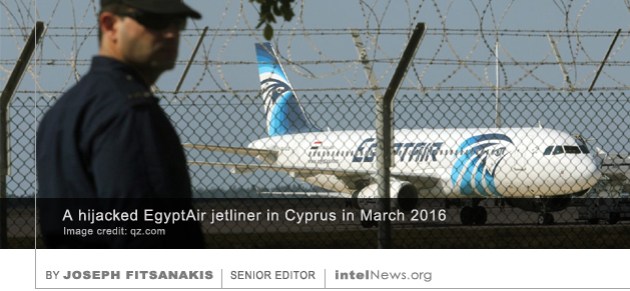
4. If it was a terrorist attack, how was the plane brought down? It is important to note that the plane is believed to have been flying at 37,000 feet when it vanished from radar screens. This means that, assuming that a non-state actor caused the aircraft’s disappearance, the attack must have been perpetrated from inside the plane. At least three of the 10-member crew are believed to be armed security guards. If that is the case, a team of hijackers would have to have been sizeable enough and sufficiently armed to overpower three armed security guards. What is more likely is that a bomb may have been planted on the plane, either in Paris or Cairo (the plane was returning to Cairo, having left from there for Paris earlier on Wednesday). The last time that the Islamic State assumed responsibility for downing an airliner, it did so by planting a bomb aboard the plane with the help of a ground worker in Egypt who had secretly joined the militant group.

5. If it was a terrorist attack, what does it mean? Should the Islamic State assume responsibility for this attack, it will make it increasingly difficult for France —and possibly other Western European nations— to resist putting boots on the ground in Iraq and Syria. Moreover, if a bomb was planted on the plane at Paris’ Charles De Gaulle airport, it will mean that the Islamic State, or possibly another militant group, has found a way to beat what are perhaps the most stringent airline travel security measures in all of Europe. It could be that the group behind this possible terrorist attack has found a unique and thus far unforeseen way to defeat the latest technological measures used to secure airline travel. Such a possibility could spell even more massive changes for the world’s airline industry, which is already reeling from all sorts of financial and administrative pressures in the post 9/11 era.

France seizes ship with ‘hundreds of weapons’ heading for Yemen

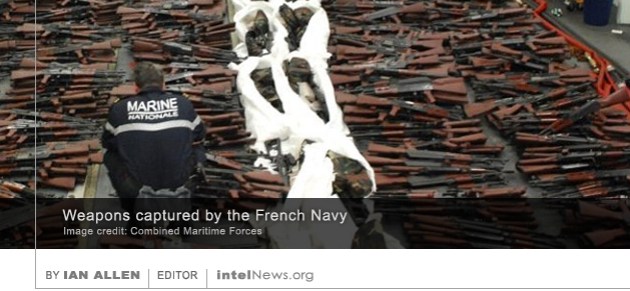
Combined Maritime ForcesThe United States says a ship carrying hundreds of weapons, which was captured by the French Navy in the Indian Ocean, originated from Iran, and that the cargo was destined for Yemeni rebels through Somalia. The ship was seized on March 20 by a French warship patrolling the Indian Ocean as part of the Combined Maritime Forces (CMF). The CMF is a multinational naval fleet that aims to implement United Nations sanctions on Somalia. The sanctions are designed to frustrate the activities of al-Shabaab, an al-Qaeda-linked Somali militant group, and to put an end to maritime piracy in the Horn of Africa.
The ship carrying the weapons is believed to have been initially spotted by a French helicopter that was conducting surveillance flights in support of CMF’s mission. Soon after boarding the ship, French forces discovered large amounts of weaponry. A statement posted on the CMF website said that the ship was found to be carrying “several hundred AK47 assault rifles, machine guns and anti-tank weapons”. The French Ministry of Defense said that the vessel was not registered to any country and that the crew of 10 was multinational. All crew members were released after being questioned by their French captors.

An assessment of the ship’s capture by the US Department of Defense states that the arms shipment probably originated in Iran and that it was heading to Somalia. However, the most likely final destination of the cargo was not al-Shabaab, but Houthi rebels in Yemen. Iran is known to be supporting and funding Houthi rebels, who are Shiite and are fighting a bitter civil war against the country’s Saudi-supported Sunni government.

It is worth noting that the recent capture of the unregistered vessel is the third such seizure of a large cache of weapons heading for Yemen through Somalia since September. In the previous most recent case, an Australian Navy ship sailing off the coast of Oman intercepted a large cache of weapons being transported to Yemen. US sources speculated that the intercepted ship originated from Iran and was heading to Yemen.

Author: Ian Allen | Date: 31 March 2016 | Permalink

French commandos kill senior al-Qaeda leader in Mali

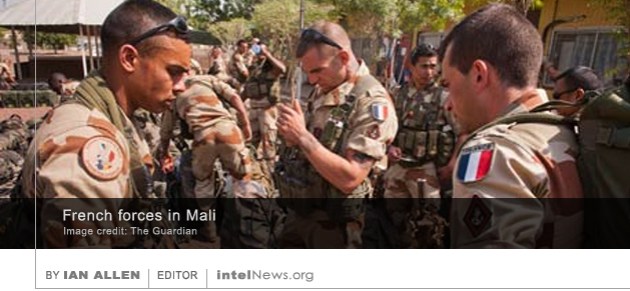
French troops MaliFrench troops have reportedly killed a Spanish citizen who was a senior commander of al-Qaeda in the Islamic Maghreb (AQIM), one of the most prolific al-Qaeda-linked groups in Africa. The Spaniard, Abu al-Nur al-Andalusi, 35, was from Melilla, a coastal Spanish enclave in northern Africa, which borders Morocco. Since 2014, al-Nur had operated as a military leader of AQIM, an armed Islamist group that aims to create a caliphate in northern Africa. AQIM emerged in the 1990s out of the brutal Algerian Civil War, which pitted the country’s secular but authoritarian government against a host of Islamist groups, including the Armed Islamic Group, known as GIA. In 1998 a band of GIA members left the group in protest against its indiscriminate killing of civilians, and formed a separate organization, which called itself Salafist Group for Preaching and Combat. In2007 the group renamed itself AQIM and pledged allegiance to al-Qaeda’s co-founder Osama bin Laden.
Al-Nur was reportedly in charge of a brigade of around two dozen AQIM fighters —most of them Algerians and Moroccans, with the addition of some Libyans. These fighters had been operating in the inhospitable desert north of the Malian city of Timbuktu. Some believe that Al-Nur helped coordinate AQIM’s attacks against Western targets in Mali and Burkina Faso in recent months. Moreover, al-Nur’s brigade has been linked to a daring attack against members of a United Nations peacekeeping force in Mali a few months ago.

Citing sources from Mali, Spanish intelligence expert Salvador Burguet said on Wednesday that al-Nur had been killed in a raid by a team of French commandos. Burguet, who directs the Spanish-based private intelligence company AICS, said the French troops specifically targeted an al-Qaeda meeting held by senior commanders of the organization in northern Mali. But he added that it is not known at this time whether al-Nur was the only AQIM militant killed in the attack. The Reuters news agency, which reported on the story, said it was able to corroborate al-Nur’s death by speaking to two unnamed “security officials in Mali”.

French forces were deployed in Mali in 2003, ostensibly to prevent the rapid rise of Islamist militancy following the collapse of the Libyan government of Muammar al-Gaddafi and the influx of weapons into the area. After the French military deployment, AQIM activities in the country receded. However, scattered groups of AQIM continue to operate in rural areas, and Paris maintains a force of nearly 4,000 troops throughout the country. Reuters said it contacted the French Department of Defense and Spain’s Ministry of Foreign Affairs, but both agencies declined comment on the Spaniard’s reputed death.

Author: Ian Allen | Date: 04 March 2016 | Permalink

Weapon used in Paris attacks was purchased in the United States

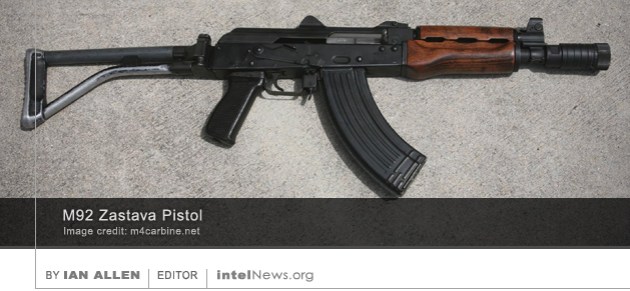
M92 Zastava PistolOne of the guns used by Islamist militants to attack locations in downtown Paris on November 13 was purchased legally through a dealer in the United States, according to a report by the Associated Press. Investigators have confirmed that several of the weapons used in the attack, which killed 130 and injured hundreds more, were manufactured in Serbia. Most are slightly modified versions of the Soviet-era AK-47, known in the West as “shortened Kalashnikov”. All were produced in a weapons factory called Zastava, which is located in the city of Kragujevac, in central Serbia. They were made in the 1980s and sold within the former Yugoslavia.

Last Thursday, however, the director of the Zastava factory, Milojko Brzakovic, told the Associated Press that he had contacted authorities in France to inform them that one of the weapons used in the Paris attacks was made in his factory and sold to a US dealer. It was an M92 semi-automatic pistol, which had been legally sold to an American online arms seller called Century Arms in May 2013. The seller, based in the state of Florida, is believed to import tens of thousands of weapons from the Zastava factory each year. Brzakovic said the M92 could only fire single shots, and was thus in accordance with American law. It sells for less than $500 a piece in the US, he said.

When asked how the weapon got into the hands of militants affiliated with the Islamic State of Iraq and Syria, Brzakovic said he had no idea. He told the Associated Press that all guns exports by Zastava to Century Arms and other American weapons dealers are in strict compliance with US government regulations. Someone, he said, must have illegally modified the weapon into an automatic at a later stage. Brzakovic also said he had no idea how the weapon left America and ended up in France. All weapons exports from the US must be approved by the US Department of State, he said, so the M92 pistol must have made its way to Europe illegally.

Author: Ian Allen | Date: 16 December 2015 | Permalink | News tip: R.W.

Paris attack mastermind evaded Athens police raid in January

Abdelhamid AbaaoudThe man who masterminded November’s Islamist attacks in Paris was based in Athens, and last January managed to escape arrest during a joint Greek-Belgian police operation aimed at capturing him. Moroccan-born Abdelhamid Abaaoud, who had lived in Brussels for years, died in a gun battle with French police on November 18, just days after the multiple attacks in Paris that killed 130 people and injured hundreds. It is believed that the perpetrators of the attacks, who were based in Belgium, were guided and directed by Abaaoud. He, however, was not based in Belgium, but in Athens, Greece. It was from there that he directed the Islamist cells, mostly by phone, according to the BBC.
Citing “a Belgian anti-terrorism source” the BBC said on Tuesday that Belgian and Greek authorities were aware of Abaaoud’s general whereabouts and were able to trace some of his phone calls to Islamist militants in Belgium. Eventually, a senior Belgian law enforcement official traveled to Athens to help coordinate a Greek police operation aimed at capturing Abaaoud. By that time, the Moroccan-born militant had been sentenced by a Paris court to 20 years imprisonment in absentia for his role in at least four planned attacks in France —all of which had been foiled by police. Upon capture, Greek authorities planned to extradite Abaaoud to France, where he would serve his sentence. However, the militant was able to get away, though the BBC said that the circumstances of his escape remain unclear. According to the report, an Algerian associate off Abaaoud was arrested during the operation in Athens and was extradited to Belgium.

Abaaoud was not the only Islamic State-linked militant known to have operated in Greece. The two suicide bombers who tried to enter the Stade de France in Paris on November 13 had entered the European Union through the Greek island of Leros, after crossing the Aegean by boat from Turkey. Meanwhile, another of Abaaoud’s associates, Belgian-born Frenchman Salah Abdeslam, whose current whereabouts are unknown, is believed to have traveled by ferry from Italy to Greece in August.

Author: Joseph Fitsanakis | Date: 10 December 2015 | Permalink

In change of policy, Russia and US begin sharing intelligence with France

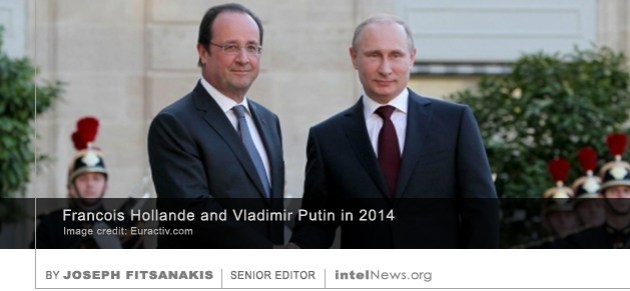
Hollande and PutinThe United States and Russia, which have traditionally been cautious about sharing Middle East-related intelligence with France, have both announced that they will begin giving classified information to Paris. On Wednesday, France’s Defense Minister Jean-Yves Le Drian said at a press conference that intelligence shared by the US had been instrumental in enabling the French Air Force to intensify its air campaign against the Islamic State. Asked to respond to Drian’s comments, US Department of Defense spokesman Peter Cook said that the US Armed Forces had indeed “increased intelligence-sharing with France”.

French officials described that development as a “change in the US position”. IntelNews readers will recall that the United States and France limited their intelligence cooperation last summer, after it emerged that the US had spied on the communications of three French presidents, from 1995 to 2012. Paris scaled back drastically its intelligence cooperation with Washington following subsequent revelations that the National Security Agency had targeted the personal cell phone of Francois Hollande, France’s current head of state.

Also on Wednesday, Russian President Vladimir Putin instructed the Russian Armed Forces stationed in Syria to treat their French counterparts “as allies”. Putin reportedly told the leadership of the Russian military in Syria that they “must establish direct contact with the French and work with them as with allies”. This is a significant development, given that Russia is one of the few countries that continues to maintain an active intelligence-collection program on the ground in Syria. Unlike the US, France, and most other Western states, Russia has not closed its embassy in Damascus and is thus able to run networks of human sources throughout the country. The news of increased Russian intelligence-sharing with France came as Moscow announced//announced// on Wednesday that it was stepping up intelligence-gathering throughout the Middle East, according to Andrei Kartapolov, a senior official in the Russian Army’s General Staff.

Meanwhile, an unnamed Moroccan security official told Reuters on Wednesday that intelligence shared by the Moroccan intelligence services with their French counterparts led to a raid in an apartment in Paris in connection with the November 13 attacks there. Two people were shot dead or committed suicide and seven others were arrested during Wednesday’s dramatic raid in the Paris suburb of St. Denis.

Author: Joseph Fitsanakis | Date: 19 November 2015 | Permalink

ISIS bombing of Beirut is more important than Paris attacks

Bourj al-Barajneh The recent attacks by Islamic State militants in Paris continue to dominate the world’s headlines. But the double suicide blasts that struck Beirut three days earlier are far more significant for the future of the Syrian Civil War. The outpouring of grief that followed the attacks of November 15 in the French capital prompted charges of discrimination against the world’s media. The latter practically ignored the bombing of Lebanese capital Beirut on November 12, which killed 43 and injured over 200 people. The Islamic State, known also as the Islamic State of Iraq and Syria (ISIS), claimed responsibility for the deadly blasts, which marked the bloodiest attack in the Lebanese capital since the end of the country’s civil war in 1990.

The contrast between the media’s treatment of the attacks in Paris and Beirut could not have been starker. The news of the double suicide blasts in Beirut hardly penetrated global headlines, with the exception of outlets like Al Jazeera and Al Arabiya. Even the BBC, which typically pays more attention to non-Western news, relegated the incident to third place, behind a story about corruption in the international football association and the news of the killing of “Jihadi John”. There was no “safety check” app on Facebook, and no Lebanese flags were superimposed on users’ profile photos. Yet the blasts in Beirut are more significant than the attacks in Paris, for two reasons.

First, because attacking “soft targets” in Paris is far easier than attacking Beirut. Paris is a city of 2.2 million people, who are used to a life of relative security and hardly pay attention to their surroundings. The “city of light” features a café in nearly every corner, 13,000 restaurants and over 2,000 hotels; it is easy to enter and exit, and is hardly policed, even by Western standards. Beirut, on the other hand, is a tense Middle Eastern city with heavy police and military presence. The southern Beirut neighborhood of Bourj al-Barajneh, which was targeted by ISIS on November 12, is a Hezbollah stronghold, and probably one of the most tightly policed urban areas in the Eastern Mediterranean. There is little government presence there; but this does not mean that there is no security. On the contrary, Hezbollah militias and volunteers provide protection and conduct careful monitoring of nearly every street. Like its neighboring Dahieh, Bourj al-Barajneh is a world far removed from the fashionable streets of downtown Beirut, where Starbucks cafés and McDonald’s restaurants are frequented by fashionable Lebanese Christians and Western diplomats. Western intelligence has almost no presence Q Quotethere, and even the Mossad, Israel’s feared spy service, rarely ventures in the Hezbollah-controlled neighborhoods.

The fact that ISIS was able to penetrate and bomb Bourj al-Barajneh is a monumental development in the ever-widening Syrian Civil War. It demonstrates the advanced planning and operational sophistication of ISIS and places the ball squarely in Hezbollah’s court. What is more, it was the second time in less than two years that ISIS bombed southern Beirut. The Shiite group has been humiliated, having been shown to lack the resources to protect its heartland from Sunni attacks. Moreover, the Lebanese group, which is almost exclusively funded by Iran, will have to respond to that provocation. For several months, the Middle East has been buzzing with rumors that Iran and Hezbollah are preparing a two-front, large-scale ground assault against ISIS forces. Do last week’s twin suicide attacks bring that possibility closer? The answer to that question may change the entire course of the Syrian Civil War. Read more of this post

Analysis: The West should weigh carefully its response to the Paris carnage

Paris FranceParis is still reeling from Friday’s unprecedented carnage, which left at least 130 people dead and over 350 wounded. The six separate incidents included the first known suicide bombings in the country’s history and marked the deadliest coordinated attacks on French soil since World War II. The magnitude of the attacks prompted the French government to close the country’s borders and declare a nationwide state of emergency —the first since 1961. The shock from the mass killings is today reverberating throughout Europe, a continent that had not seen such a deadly incident since the Madrid train bombings of 2004, when a group of al-Qaeda-inspired militants killed 191 people in the Spanish capital. A response from France and its Western allies is to be expected. However, the West should pause and think very carefully before deepening its engagement in a chaotic and unpredictable war that is like nothing it has ever experienced. Specifically, Western leaders should consider the following:

I. The adversaries know and understand the West, its culture and way of life, far better than the West understands them. Ever since 9/11 and the London bombings of 2005, a number of Western observers have cautioned against the so-called “Islamization of Europe”. Nothing could be further from the truth. In reality, the events of 9/11 caused a widening gulf between an increasingly Islamophobic West and Muslims; the latter are viewed by European critics of Islam as foreign bodies. What is far more prevalent and important is the Europeanization of Islam, which means that adherents of radical Islam are studying and interacting with European culture, norms and values, more intensely than ever before. Consequently, armed attacks carried out by Islamist militants against Western targets reflect a deep understanding of Western culture that far exceeds the West’s understanding of them. The November 13 attacks in Paris typify this: they were not “indiscriminate”, as some have suggested. They were carefully selected to achieve core political objectives, while at the same time sending a symbolic message against the Western way of recreation, which Islamists view as decadent. That was highlighted in a statement about the Paris attacks issued by the Islamic State, in which the group singled out the Bataclan Theater as Q Quotea venue where “a party of perversity” was taking place. Europe’s response to this phenomenon is dismissal and indifference. Most Westerners are still at a loss trying to understand the basic differences between Sunni and Shia Islam, let alone the ideological and spiritual underpinnings of groups like the Islamic State, Jabhat al-Nusra, and others. The idea that radical Islam can be defeated before it is understood is naïve and dangerous.

II. The West does not have the intelligence and security infrastructure that is necessary to take on the Islamic State. It should not be forgotten that last Friday’s attacks took place despite the state of heightened alert that France has been under after the Charlie Hebdo shootings of January 2015. Since that time, French authorities have reportedly managed to stop at least six advanced plots against civilian targets, while alert passengers were able to prevent a mass shooting aboard a French train in August of this year. However, if France deepens its involvement in the Syrian Civil War, these attacks will continue with a scale and complexity that is bound to stretch —and possibly overwhelm— the country’s security infrastructure. Nine months after the Charlie Hebdo shootings, the presence of thousands of police officers and even troops in the streets of Paris has become common. But that did nothing to stop Friday’s attacks in a city of 2.2 million people, which features 35,000 cafés, 13,000 restaurants and over 2,000 hotels. The sheer number of these “soft targets” makes Paris a city that is virtually impossible to defend against determined suicide assailants. The French are also used to traveling with ease within their country and across Europe, as the borders between France and its neighbors, such as Belgium, Germany and Switzerland, have become practically meaningless. Moreover, French authorities estimate that at least 13,000 radicalized Muslims live in France —a fraction of the country’s nearly 6 million Muslim citizens, but large enough to overwhelm the French security services. Read more of this post