French prosecutors urge end to Yasser Arafat poisoning inquiry

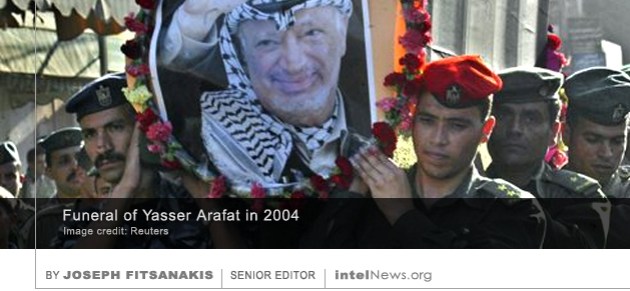
Arafat funeralA government prosecutor in France has urged that a probe looking into whether the late Palestinian leader Yasser Arafat was poisoned with a radioactive substance should be dropped, because evidence shows he died of natural causes. Arafat was the founder of Palestinian nationalist group Fatah and led the Palestine Liberation Organization for over three decades before becoming the first president of the Palestinian Authority. He died in November 2004 at the Percy military hospital in Paris, France, weeks after being transferred there from his headquarters in Ramallah, West Bank. His official records indicate that he died from a stroke, which he suffered as a result of a blood disorder known as disseminated intravascular coagulation.
However, a year-long investigation by a team of forensic pathologists at the Vaudois University Hospital Centre in Lausanne, Switzerland, suggested in 2013 that the late Palestinian leader was likely poisoned with radioactive polonium. According to the results of the study, which included tests on Arafat’s bones and on soil samples from around his corpse, there was “unexpected high activity” of polonium-210. Traces of the same substance were discovered on the personal artifacts that Arafat used during his final days in Paris. The Swiss lab followed its probe with a second set of tests, which confirmed the initial results and were eventually published in the British peer-reviewed medical journal The Lancet.

The Swiss investigation prompted Arafat’s widow, Suha Arafat, to file a civil suit at a court in Nanterre, which launched a murder inquiry in August 2012. Further tests were carried out on Arafat’s belongings and his body was exhumed from its burial place in Ramallah. Tests were also carried out by the Russian Federal Medical and Biological Agency, which concluded that the late Palestinian statesman had died “not from the effects of radiation, but of natural causes”. The French inquiry was concluded in April of this year, and the results communicated to the French government prosecutor in Nanterre, Catherine Denis.

On Tuesday, Denis said she had studied the results of the medical investigation and had concluded that the polonium-210 isotopes found in Arafat’s remains and at his gravesite, were without question “of an environmental nature”. Consequently, the case should be dismissed, she said, adding that her view represented the opinion of the prosecution in the case of Arafat’s alleged poisoning. The court must now determine whether to accept the prosecutor’s advice or continue with the case, as is the wish of Arafat’s family.

Author: Joseph Fitsanakis | Date: 22 July 2015 | Permalink: https://intelnews.org/2015/07/22/01-1740/

French-US spy cooperation continues despite WikiLeaks revelations

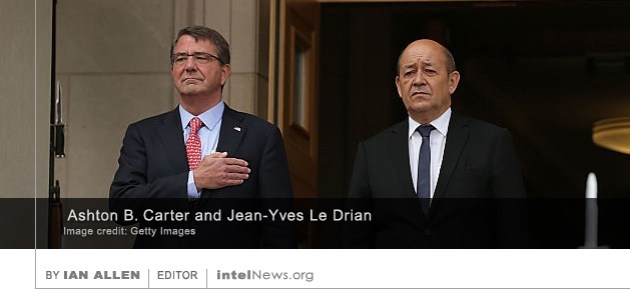
 Ashton B. Carter and  Jean-Yves Le DrianA fortnight ago, I gave an interview to Spanish newspaper La Razón, in which I argued that last month’s WikiLeaks revelations about American espionage against France would not cause any drastic disruption in the intelligence cooperation between the two countries. I added that “the two countries depend on each other to address a number of international issues that affect both, such the worrying situation in Syria and Iraq, the continuing crises in Ukraine and in Libya, as well as the financial meltdown in Greece. So there is a recognition that their intelligence agencies must continue to work together on several pressing issues”.

This was confirmed on Monday morning, as the American and French defense secretaries met in the US. French Minister of Defense Jean-Yves Le Drian paid his first visit to the Pentagon since Ashton B. Carter was appointed Secretary of Defense, in February of this year. After an extensive meeting behind closed doors, the two men told reporters gathered at the Pentagon that America’s security cooperation with France “has never been stronger”. Secretary Carter pointed to France’s leading military involvement in several African nations, including Mali, Chad, and Niger, and said that French forces deployed there could expect “more intelligence-sharing with the United States”. He added that actions had been taken during that morning’s meeting to “increase that [intelligence-sharing] yet further”.

The French Defense Minister agreed with his American counterpart and added that the “multiplication of international crises” were bringing the defense and intelligence establishments of France and the US closer. Both men pointed to examples of ongoing French-American security collaboration in Mali and Chad, where the Pentagon is providing French military forces with aerial cargo delivery and refueling facilities. They also mentioned the FS Charles de Gaulle, France’s flagship aircraft carrier, which has been deployed to the Arabian Gulf since March of this year. Secretary Carter told reporters that the Charles de Gaulle had “integrated seamlessly” with American forces in the region, and was helping the Pentagon launch airstrikes against Islamic State forces in Iraq.

The two men declined comment on last month’s claims by WikiLeaks that the US National Security Agency wiretapped three successive French presidents, including the country’s current head of state, Francois Hollande.

Author: Ian Allen | Date: 08 July 2015 | Permalink: https://intelnews.org/2015/07/08/01-1731/

New documents show US spied ‘on every major French company’

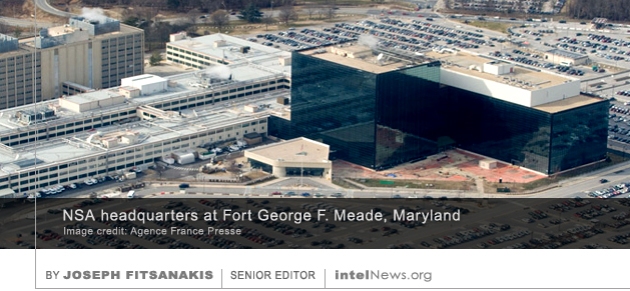
NSANew information published by international whistleblower website WikiLeaks seems to suggest that the United States National Security Agency (NSA) collected information on export contracts by French companies and sought inside information on France’s position in international trade negotiations. According to the website, which published the new material on Monday, the documents appear to suggest concerted efforts by Washington to obtain secret information about the economic policies of the French government and the country’s financial sector.
The WikiLeaks release contains a list of “Information Needs” (IN), which signifies collection requirements on France that are part of the US National Signals Intelligence Requirements List. The latter is updated regularly to reflect wide-ranging intelligence requirements put to the NSA by its customers, who include US policy makers and other members of the US Intelligence Community. The IN list is labeled “2002-204”, which means it was created in 2002 and has been updated ever since. The documents also include an “Essential Elements of Information” (EEI) list, which points to more narrow areas of interest that the NSA’s collection teams are instructed to focus on. The EEI list released by WikiLeaks includes France’s economic relations with the US and other Western countries and France’s dealings with international financial agencies and institutions. It also includes France’s international economic and trade policies, as well as its policy maneuvers in the G-8 and G-20 group of nations.

At one point, the EEI list appears to instruct NSA collection units to target every French-registered company involved in negotiations for international projects or other sales contracts valued at over $200 million. According to WikiLeaks, the target list would inevitably include every major French company, including car makers Peugeot and Renault, banking conglomerate BNP Paribas, as well as Credit Agricole, one of Europe’s leading agricultural credit unions.

Representatives of the US Intelligence Community do not deny spying on foreign companies. But they insist that Washington does not use information collected from such operations to benefit American companies competing for international contracts. However, the latest WikiLeaks revelations are bound to fuel speculation in Europe that US intelligence-collection priorities may include an economic component. Last week, US President Barack Obama had to personally assure his French counterpart, Francois Hollande, that he was not being spied on by the NSA, after WikiLeaks released documents showing that the American spy agency had targeted the communications of three successive French presidents.

Author: Joseph Fitsanakis | Date: 30 June 2015 | Permalink: https://intelnews.org/2015/06/30/01-1725/

Calls in France to offer asylum, citizenship, to Snowden and Assange

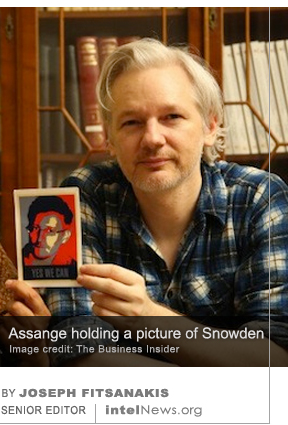
Assange and SnowdenLeaders from all sides of the French political spectrum urged the French government on Thursday to offer political asylum, and even French citizenship, to the American defector Edward Snowden and to WikiLeaks founder Julian Assange. The calls were made in response to news earlier this week that the United States National Security Agency spied on the personal communications of three French presidents from the 1990s to at least 2012. The files were published on Tuesday by the international whistleblower website WikiLeaks. They consist of what the website described as “top secret intelligence reports and technical documents”, which detail NSA spying operations against the French presidency, as well as espionage directed at several French government ministers and at France’s ambassador to the US. As intelNews predicted on Wednesday, the French government’s response to the revelations has been relatively muted. But many French politicians, including one minister in the government of French President Francois Hollande, called for Paris to extend offers of political asylum, and even French citizenship, to Assange and Snowden.

The initial call was issued by Laurent Joffrin, the influential managing editor of Libération, the Paris-based newspaper that partnered with WikiLeaks to release the NSA documents earlier this week. In a leading editorial published in the paper on Thursday, Joffrin said that French protests against NSA spying “have no more effect than scolding a rude toddler”, and added that by offering asylum to Snowden, France would “stand up [to America] and send a clear and effective message to Washington”.

Shortly after Joffrin’s editorial, Jean-Christophe Lagarde, president of the centrist Union of Democrats and Independents in the French Parliament, said that France should have given Snowden political asylum back in 2013, when he originally requested it. Lagarde was quoted in the French press as saying that “the French nation has already been dishonored by refusing to accept Edward Snowden’s request for political asylum when he asked for it in 2013”. Jean-Luc Mélenchon, the leftist member of the European Parliament, agreed with Lagarde, adding that Assange and Snowden must not only receive political asylum in France, but also be given “the French nationality”.

On Thursday afternoon, Jean-Pierre Mignard, a close friend and longtime political advisor to President Hollande, said that “given the service they have rendered to the cause of human freedom, France could accommodate a request for asylum from Assange and Snowden, should they request it”. Mignard added that “French law allows the Republic to grant asylum to any foreign subject who faces persecution for taking action in favor of human freedom”.

When asked by BFM TV, France’s most popular news channel, whether political asylum could be extended to Snowden and Assange, France’s Justice Minister Christiane Taubira said that she was “absolutely shocked by the idea”, because such a course of action would drive a powerful wedge between France and the US, two countries with deep historical ties. But she added that such a move would constitute a strong “symbolic gesture” against espionage, and thus remained on the table as a possible policy maneuver to be adopted by the government of France.

Late on Thursday, however, France’s Prime Minister Manuel Valls indicated that any discussion of an offer of asylum to Assange and Snowden by the government of France was premature. Speaking at a hastily organized press conference to discuss the NSA espionage revelations during an official visit to Colombia, Valls told reporters that the question of offering asylum to the two men “did not arise” during internal government talks. “And in any case”, said Valls, such an initiative “would not address the issue at hand”, namely American espionage against the French presidency. France’s goal is to extract guarantees from Washington that all espionage against French officials would stop, noted the French prime minister. If France offered asylum to Assange and Snowden, American espionage against French targets would likely reach unprecedented levels, he added.

Author: Joseph Fitsanakis | Date: 26 June 2015 | Permalink: https://intelnews.org/2015/06/26/01-1723/

Analysis: French are upset, but not surprised, by news of US spying

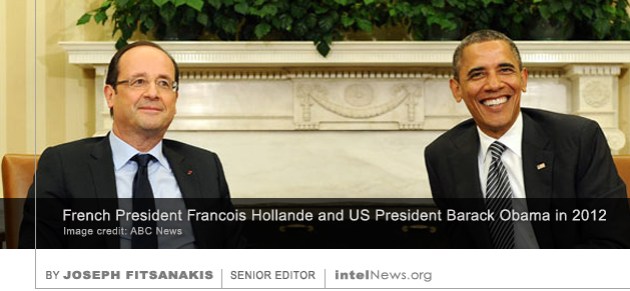
Before Edward Snowden, the revelation that the United States National Security Agency spied on three successive French presidents would have shocked many. But in the post-Snowden era, the news came and went without much tumult. The French President, Francois Hollande, called two emergency meetings of senior government officials at the Élysée Palace; the American ambassador to France was summoned for an official protest; but nothing more came of it. It was reported that US President Barack Obama spoke directly with his French counterpart on Wednesday, and assured him in no uncertain terms “that the US is no longer spying on France”.

The French leader, who is one of three French presidents mentioned in the WikiLeaks documents as a target of the NSA, is genuinely upset. And there will be some in his government who will push for a harder response than simply summoning the American envoy in Paris to file an official protest. But nobody in Paris or Washington thinks that Mr. Hollande, or indeed any other senior French official, was shocked or even surprised by the revelations of American espionage against France. Nor will the revelation cause any drastic disruption in the intelligence cooperation between France and the US. The two countries depend on each other to address a number of international issues that affect both, such the worrying situatioQ Quoten in Syria and Iraq, the continuing crises in Ukraine and in Libya, as well as the financial meltdown in Greece. So there is a recognition that their intelligence agencies must continue to work together on several pressing issues.

However, the French response may become a lot more direct if WikiLeaks publish further revelations about US espionage against French officials. The whistleblower website noted on Tuesday that “French readers can expect more timely and important revelations in the near future”. Unlike Edward Snowden, who is known to release progressively more damning documents in stages, WikiLeaks does not have a history of aiming for a crescendo through progressive releases of classified information. But there is speculation that Edward Snowden may in fact be the source of this latest WikiLeaks disclosure. If that is the case, we should not exclude further releases of relevant documents, and thus a more robust French response.

And what about America’s retort? Washington has suffered considerable diplomatic blowback from revelations in 2013 and 2014 that it spied on the leaders of Germany, Brazil and Argentina. Is the NSA still spying on America’s allied leaders? I am of the opinion that the NSA is not currently targeting the personal communications of allied government leaders as a matter of Q Quoteroutine practice. However, I do believe that this regimen can easily be changed to address particular needs, through what is called a “presidential finding”, basically a direct order issued by the president of the United States to target an individual foreign leader.
In the past two years, we have witnessed the diplomatic fallout that can result from publicly revealing these practices. However, for an intelligence agency like the NSA, having access to the personal communications of a foreign head of state is a temptation that is simply too difficult to resist. Moreover, it should not be assumed that political leaders are always completely in the know about the practices of their country’s intelligence agencies. American intelligence history amply demonstrates this truism. Finally, I would point to the well known maxim that intelligence agencies do not typically distinguish between adversaries and allies. All targets are considered fair game. This will admittedly do little to appease the French, but it will at least give them an accurate impression of what to expect in the brave new world of wholesale communications interception.

* This editorial is based on an interview given by the author to the Spanish newspaper La Razón.

Author: Ian Allen | Date: 25 June 2015 | Permalink: https://intelnews.org/2015/06/25/01-1722/

French president calls crisis meeting to discuss US spy revelations

France Hollande ObamaThe president of France has convened an emergency meeting of the country’s highest national security forum in response to revelations that the United States spied on three French presidents. The Conseil de la Défense is to convene in Paris on Wednesday to discuss the emergence of documents that appear to implicate the US National Security Agency (NSA) in spying on Jacques Chirac and Nicolas Sarkozy, who ruled France from 1995 to 2012. The documents further indicate that the NSA may have also targeted the personal communications of Francois Hollande, France’s current head of state.

The files were published on Tuesday by the international whistleblower website WikiLeaks. They consist of what WikiLeaks described as “top secret intelligence reports and technical documents”, which detail NSA spying operations against the French presidency, as well as espionage directed at several French government ministers and at France’s ambassador to the US. WikiLeaks would not indicate whether it acquired the documents from American defector Edward Snowden, who is currently living in Russia. But it said that “French readers can expect more timely and important revelations in the near future”.

The material –termed “Espionnage Élysée” by WikiLeaks– features a list of “selectors”, which includes French government telephone numbers targeted for interception. One of the numbers is identified as belonging to the president of France. The document collection also includes a handful of intelligence briefs, which are presumably based on intercepted communications from the telephone lines listed among the “selectors”. They detail the thoughts and diplomatic maneuvers by French presidents and other senior officials on subjects such as the Greek economic crisis, the Israeli-Palestinian dispute, and the United Nations.

French newspaper Liberation, which partnered with WikiLeaks to release the NSA material, said on Tuesday that the revelation should not surprise anyone in the post-Snowden era, but that it was still likely to cause a significant rift in French-American relations. In 2014, Germany expelled the station chief of the Central Intelligence Agency in Berlin –essentially the highest-ranking American intelligence officer in the country– over revelations that the US spied on the personal communications of Chancellor Angela Merkel.

Liberation contacted the NSA but was told by its spokesman, Ned Price, that the Agency was “not going to comment on specific intelligence allegations”. A spokesman from the Élysée Palace told the paper that an official statement would be issued following the Conseil de la Défense meeting on Wednesday.

Author: Joseph Fitsanakis | Date: 24 June 2015 | Permalink: https://intelnews.org/2015/06/24/01-1721/

News you may have missed #892 (legislative update)

Jens MadsenBy IAN ALLEN | intelNews.org
►►Canadian lawmakers vote to expand spy powers. Legislation that would dramatically expand the powers of Canada’s spy agency has cleared a key hurdle. The House of Commons on Wednesday approved the Anti-Terror Act, which was spurred by last year’s attack on parliament. The act would give the Canadian Security Intelligence Service’s (CSIS) the ability to operate overseas and make preventative arrests. It also makes it easier for police to arrest and detain individuals without charge. Dominated by the Conservative party, the Senate is expected to approve the act before June.
►►Danish spy chief resigns over Islamist attacks. The head of Denmark’s Police Intelligence Service (PET), Jens Madsen, quit just hours before a report was due to be released into February’s fatal shootings in Copenhagen by an Islamist. Omar El-Hussein killed two people at a free speech debate and a synagogue before being shot dead by police. “It’s no secret that it is a very demanding position,” said Madsen, without giving a reason for his resignation. Justice Minister Mette Frederiksen declined to say whether the move was linked to criticisms of the police response to the attack.
►►OSCE urges France to reconsider controversial spying bill. The Organization for Security and Cooperation in Europe urged French lawmakers to reconsider provisions of a proposed law that would expand government surveillance, a measure that was backed by French parliamentarians on Tuesday, despite criticism from rights groups. “If enforced, these practices will impact the right of journalists to protect the confidentiality of sources and their overall work”, OSCE Representative on Freedom of the Media Dunja Mijatovic said Wednesday. “If confidentiality of sources is not safeguarded within a trusted communications environment, the right of journalists to seek and obtain information of public interest would be seriously endangered”, he added

France approves sweeping spy bill in response to Islamist attacks

Attack on Charlie HebdoBy JOSEPH FITSANAKIS | intelNews.org
Lawmakers in the French National Assembly have overwhelmingly approved a new bill giving the country’s intelligence services unprecedented domestic spy capabilities. The bill, which is dismissed by critics as France’s version of the United States’ PATRIOT Act, was drafted by the ruling Socialist Party just days after a group of armed Islamists attacked several targets in Paris. The attacks were primarily directed against France’s popular satirical magazine Charlie Hebdo (see photo). A dozen members of the magazine’s staff, including several internationally-known cartoonists, were killed at the magazine’s headquarters in the French capital on January 7 of this year.

The newly approved bill provides blanket-approval for the wholesale interception and storage of communications metadata, which include information about the location and size of Internet-based communications exchanges. They also include information on the identities of those sending or receiving electronic messages. The legislation also includes a provision for the establishment of a new supervisory body called the National Commission for Control of Intelligence Techniques. Its mission will be to supervise the use of surveillance powers by France’s six intelligence agencies, as well as to handle complaints relating to communications interception from members of the public.

As the bill progressed through France’s houses of parliament, the French government and its supporters argued that the country needed national legislation that would take into consideration the rapid technical changes in digital telecommunications. But critics, which included most of France’s Internet service providers, claimed that the new law would give intelligence agencies unreasonably broad surveillance powers and would hamper online commerce. These claims, however, failed to convince lawmakers; the bill was thus approved by 438 votes for to 86 against. Most parliamentarians from France’s three main parties —the Socialist Party, the rightwing Union for a Popular Movement, and the centrist Union of Democrats and Independents— voted in favor of the bill. Observers noted with surprise that most lawmakers from the Radical Party of the Left also voted in favor of the bill. In contrast, the communist-led Left Front, as well as the Greens, voted overwhelmingly against the bill.

Al Jazeera reporters not linked to mystery drones seen over Paris

Eiffel TowerBy JOSEPH FITSANAKIS | intelNews.org
Three Al Jazeera journalists, who were arrested yesterday for flying a drone over a Paris park, are not linked to the earlier mysterious sightings of drones flying over famous landmarks and security installations in the French capital, according to media reports. The bizarre sightings began last October, when security officials from France’s state-owned power company EDF filed a police complaint after noticing several mini-drones flying over at least seven nuclear power plants. Another 20 sightings of drones were documented in November, all of them seen flying over nuclear installations in various parts of France.

On January 20, another drone was seen hovering over the Elysee Palace in Paris, which is the official residence French President Francois Hollande. Less than a week later, several drones were observed flying over a maximum-security French naval base in Brittany, which houses nuclear submarines. At least ten more sightings were reported on Monday and Tuesday night this week, this time flying over important buildings and landmarks in Paris. Among the apparent surveillance targets of the mysterious drones were the embassy of the United States, the Eiffel Tower, the Invalides national military museum, the Place de la Concorde at the eastern end of the Champs-Élysées, and the Bastille monument. Security forces also reported drone sightings near major public thoroughfares leading in and out of the French capital. French authorities said on Tuesday that they were investigating the incidents under the assumption that they were linked.

On Wednesday, French police announced that three journalists working for Qatar-based television station Al Jazeera had been detained for piloting a drone that was seen flying over a park in Bois de Boulogne, an area located at the edge of the French capital. But initial reports in the media that the three Al Jazeera reporters were somehow linked to the mysterious drone sightings of earlier weeks appear to be dismissed by the authorities. The latter said on Wednesday that there was “no suggestion” of any connection between the journalists and the string of drone incidents over the French capital. As for explaining the drone sightings, French authorities say they have no idea whether it is the work of tourists, practical jokers, criminals or prospective terrorists. Government spokesman Stephane Le Foll told reporters on Wednesday that “people should not be worried, but vigilant”, as the incidents were “taken very seriously”.

Opinion: Paris attackers bring Mideast urban warfare to Europe

Attack on Charlie HebdoBy JOSEPH FITSANAKIS* | intelNews.org
Until Wednesday morning, the last time the offices of Charlie Hebdo, France’s best known satirical weekly, were attacked was on November 2, 2011. On that day, unknown assailants had thrown Molotov cocktails into the premises, setting them on fire. Since that attack, France has seen its share of Islamist-inspired terrorist incidents. In March of 2012, French citizen Mohammed Merah shot dead three French soldiers before attacking a Jewish school in Toulouse, where he killed three students and a teacher. Last May, authorities in Marseille arrested another Frenchman, Mehdi Nemmouche, for opening fire at a Jewish museum in Belgian capital Brussels earlier that month, killing a French national and two Israeli citizens. And the French public has been shocked in recent months by a number of seemingly random attacks on pedestrians by vehicles driven by Muslim Frenchmen, who appear to be politically motivated.

The common thread running through these incidents is that they were all haphazardly planned and executed by ‘lone-wolf’ attackers, who were markedly limited in both resources and skill. But the men implicated in Wednesday’s attack on Charlie Hebdo, which left 12 people dead, were different. The two brothers, Cherif and Said Kouachi, who are said to be the main perpetrators of the assault, are believed to have “returned to France from Syria in the last year”, according to MSNBC. Undoubtedly, the two siblings saw action in the Syrian armed conflict, which is primarily fought in urban settings, and were systematically trained in urban warfare by men with considerable experience in it.

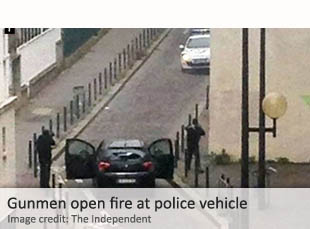
This explains their proficient delivery on Wednesday, as shown in the footage of the bloody attack, which has emerged since. The assailants arrived at their target carrying Kalashnikov rifles and magazines, neither of which can be easily acquired in France. Once inside the building, they remained there for a good 12 minutes, carefully executing their victims, some of whom they methodically sought out by name. They exited just as they entered, calm and collected. Even when they encountered a police vehicle, they stopped, aimed and shot at its passengers with considerable discipline, firing single or —in a handful of cases— double shots, instead of opting for bursts of rapid fire, which is the hallmark of inexperienced users of automatic rifles in moments of panic. After executing the police officers, they calmly walked back into their getaway vehicle and slowly drove away. It has been reported that at no point did they break the speed limit during their escape. Read more of this post

‘Sensitive files’ stolen as Saudi motorcade is ambushed in Paris

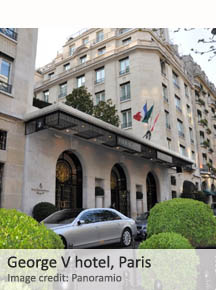
George V hotel, ParisBy JOSEPH FITSANAKIS | intelNews.org
A 12-vehicle entourage transporting a Saudi royal to a Paris airport was ambushed on Monday in cinematic fashion by heavily armed men, who stole a suitcase full of cash and diplomatic files described as “sensitive”. French police are trying to determine whether the ambush, which occurred on Monday evening just north of downtown Paris, was aimed at the money or the documents, which French newspaper Le Parisien described as “sensitive”. According to French police, the Saudi motorcade was heading from the renowned Four Seasons George V hotel on the Champs Elysées to Le Bourget airport, 15 miles north of Paris, which handles private jets. But as the convoy drove through Porte de la Chapelle, two BMWs without license tags suddenly made their way to the top of the motorcade and forced it to stop. Within seconds, eight heavily armed men brandishing handguns and AK-47s stormed out of the two cars and hijacked a Mercedes minivan that was part of the motorcade. Several of them boarded the vehicle and drove away, taking with them its three occupants, a driver, a bodyguard and another official. Later on, the three hostages were abandoned by the side of the road. The minivan, as well as one of the two BMWs used by the armed assailants, were later found burnt out in the village of Saint-Mesmes, northeast of the French capital. But the thieves took with them a suitcase containing €250,000 ($330,000) in cash, as well as what the French press said were “important diplomatic documents”. One French police detective told journalists that the operation was “clearly an ambush by a commando group that was well-informed” about the movements of their target and “quite expert […] and aware of what they would find by attacking this one vehicle [the Mercedes minivan] and not the others”. Another police detective said the nature of the incident would change drastically into “something more complicated” if it were determined that the gunmen were going after the documents, and not the cash in the minivan. Police sources have not revealed the identity of the Saudi royal involved in the incident. But the Four Seasons George V hotel, from which the Saudi convoy departed, is owned by Prince Al-Waleed bin Talal bin Abdulaziz al Saud, Read more of this post

News you may have missed #879

Mossad sealBy IAN ALLEN | intelNews.org
►►Israeli spy budget close to $2 billion. According to reports in the Israeli media, the 2014 budget for Israel’s secret services is 6.88 billion shekels, which amounts to US$1.97 billion). This figure represents an approximate increase of 4 percent compared to last year. The funds cover the operations of the Shin Bet, Israel’s domestic security service, and the Mossad, which is the country’s external covert-action agency.
►►Australia and France sign intelligence accord. Australia has struck a second intelligence-sharing agreement in less than a week, this time with France, as fears rise about the Syrian civil war becoming a hub for home-grown terrorism. The two countries have agreed, among other things, to share intelligence on their respective citizens who have gone to Syria to fight in that country’s civil war. A week earlier, Canberra had signed a similar intelligence-sharing agreement with the government of Indonesia.
►►Nazi spy could have changed course of D-Day. Days before the Normandy landings, the Lisbon-based Nazi spy Paul Fidrmuc got wind of the final details of Operation Overlord and sent an urgent message to Berlin. The Allies were not planning to land in Calais, as the Nazis thought and where they had massed 200,000 soldiers. Instead, he wrote, “the preferred plan is around La Manche”. But his dispatch was ignored by his Berlin handlers.

Spain shelves charges against French alleged ‘assassin’ spies

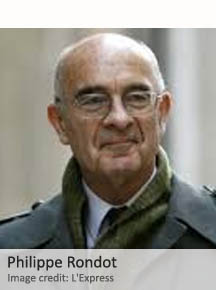
Philippe RondotBy JOSEPH FITSANAKIS | intelNews.org
A court in Spain has quietly shelved charges against two French spies who were caught in Barcelona with a custom-designed sniper rifle. The two men were detained in the Catalonian town of Manresa in April of 2002. The Audi car in which they were riding was stopped at a checkpoint manned by members of the Mossos d’Esquadra, the Catalan regional police, who promptly searched it. In the back of the car, police officers found a large PVC tube that contained a sniper rifle complete with a laser telescopic light and a silencer. The two men carried French travel documents identifying them as “Christian Piazzole” and “Rachid Chaouati”. Piazzole’s documents were found to be false, and there were suspicions that Chaouati’s may also have been forged. Spanish authorities concluded that the two men, who admitted they were officers of France’s General Directorate for External Security (DGSE), were in Spain to conduct an assassination. In a words of a state prosecutor in Barcelona, the DGSE spies had come to Spain “to kill”. Their arrest prompted an emergency visit to Madrid of a high-level French government delegation headed by General Philippe Rondot, a former senior intelligence officer at the DGSE. Rondot told Spanish officials that the two men were “on a training exercise”. In October of 2002, the Spanish Ministry of Interior commanded the Office of the State Attorney General to grant the two French spies “provisional release”, based on the rationale that there had been no victims involved in the case. Piazzole and Chaouati were promptly released after Rondot provided personal assurances that they would return to Spain to attend their trial for illegal weapons possession in early 2004. The charges carried a maximum sentence of seven years. It was said at the time that, in exchange for the two spies’ release, Paris pledged to continue to assist Spanish intelligence in their efforts against the Basque separatist militants of ETA, and agreed to extradite a number of ETA members serving time in French prisons. However, soon after their release, Piazzole and Chaouati vanished. They were found to be in contempt of court after they failed to return to Spain for their 2004 trial, as agreed. Since that time, Spanish media have sought to solve the mystery of the two French spies, but have been met with a wall of silence from Spanish and French authorities. Read more of this post

News you may have missed #873 (controversy edition)

Alvaro UribeBy IAN ALLEN | intelNews.org
►►German parliament confirms NSA inquiry to start in April. Germany’s four major parties have unanimously approved a parliamentary inquiry into surveillance by the NSA and its allied counterparts, like the GCHQ in the UK. Another key question for the committee will likely be whether the German intelligence agencies were either aware of, or complicit in, the gathering of people’s data. A German newspaper reported that whistleblower Edward Snowden, currently in Russia, may testify via Skype.
►►Former Colombia spy chief sentenced over illegal wiretapping. Carlos Arzayus, former director of Colombia’s now-defunct intelligence agency DAS was sentenced to nearly ten years in prison on Thursday for his role in the illegal wiretapping of Supreme Court justices and government critics during the Alvaro Uribe administrations during the years 2002 to 2010. Additionally, Arzayus was ordered to pay damages to the victims of the wiretapping.
►►French spies allegedly spy on Orange customer data. The French intelligence agency in charge of military and electronic spying is massively collecting data and monitoring networks of telecoms giant Orange, Le Monde newspaper reported in its Friday edition. “The DGSE can read, like an open book, the origin and destination of all communications of Orange customers”, the paper said.

Discovery of spy parts leaves French-UAE satellite deal in doubt

Jean-Yves Le Drian and Crown Prince Sheikh Mohammed bin ZayedBy IAN ALLEN | intelNews.org
The planned acquisition of two French-built spy satellites by the United Arab Emirates appeared to be in doubt last night, after news that technicians discovered “security-compromising components” in the satellites’ software. The agreed purchase, which is to be completed in 2018, concerns two Falcon Eye military observation satellites worth nearly €700 million (US $930 million). The deal, signed last July by French Defense Minister Jean-Yves Le Drian and Crown Prince Sheikh Mohammed bin Zayed of Abu Dhabi, includes the provision of a ground station, as well as the training of up to 20 UAE engineers who will staff it. Two companies, Thales Alenia Space and Airbus Defence and Space, were contracted for the project. The French bid was chosen from an original shortlist of 11 bidders, along with a similar one from the United States. Ultimately, the American bid was rejected by Abu Dhabi, due to the operational restrictions placed by the American makers of the proposed satellites. At the time, the French-UAE deal raised eyebrows in defense circles worldwide, as it was the first time that France had agreed to sell military-grade high-resolution satellites to a foreign buyer. But an article in US-based defense industry publication Defense News, said software engineers in the UAE had discovered a number of components in the satellites that seem designed to “provide a back door to the highly secure data transmitted to the ground station”. Interestingly, the back-door components appeared to have come from US suppliers. Read more of this post