Airbus fires employees for accessing classified German military documents
December 2, 2019 Leave a comment
 The European multinational aerospace corporation Airbus has fired 16 of its employees for illegally possessing classified documents belonging to the German military. The Netherlands-registered aviation company, one of the world’s largest, has been cooperating with an investigation into the incident. The probe has been led by German authorities since September of 2018.
The incident, which German authorities have termed as industrial espionage, concerns two Airbus cybersecurity projects for weapons systems used by the German military. The projects are led by Airbus scientists at the company’s Communications, Intelligence and Security (CIS) program line, which is based in the German city of Munich. In September of last year, German media reported that a number of Airbus employees at the CIS facility had been found to possess classified files belonging to the German military, which they should not have been able to access.
An Airbus official said at the time that the classified documents related “to two future German [military] procurement projects”, and that the company had “self-reported […] potential wrongdoings by several employees […] to German authorities”. The official added that “[s]ome of our employees had documents that they shouldn’t have had”. It later emerged that the documents related to plans by the German Armed Forces to acquire a communication system from one of Airbus’ rival companies.
Following the September 2018 announcement, Airbus said that it had suspended 20 of its employees while it conducted an “ongoing internal review with the support of an external law firm”. At the same time it said that it was “fully cooperating with relevant authorities [in Germany] to resolve the matter”. It was also reported at the time that the German military had taken disciplinary action against one of its employees, but no further information was disclosed.
It has now emerged that Airbus has fired 16 of its CIS employees who were suspended last year. The news was first announced on Sunday by Deutsche Presse-Agentur (DPA), Germany’s largest news agency. Airbus subsequently confirmed the DPA’s report, but provided no further details about the case. It is not currently known whether the case has been closed.
► Author: Joseph Fitsanakis | Date: 02 December 2019 | Permalink
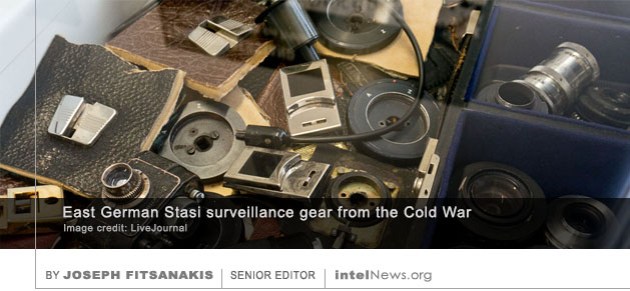 State-sponsored industrial espionage aimed at stealing foreign technical secrets may boost a country’s technological sector in the short run, but ultimately stifles it, according to the first study on the subject. The study is based on over 150,000 declassified documents belonging to the East German Ministry for State Security, known as Stasi. The now-defunct intelligence agency of communist-era East Germany was known for its extensive networks of informants, which focused intensely on acquiring technical secrets from abroad.








 intelNews.org
Sweden charges consultant with spying for Russia, expels Russian diplomat
February 24, 2021 by Joseph Fitsanakis 2 Comments
Government prosecutors said the Swedish man is 47 years old and worked as a consultant for numerous Swedish manufacturers. His employers included the car manufacturer Volvo, as well as Scania, a company that builds commercial vehicles, such as buses and trucks. According to Sweden’s public broadcaster, SVT, the man was arrested two years ago, in February 2019, while he was meeting in Stockholm with an accredited Russian diplomat. According to news reports, during the meeting the Swedish man gave the Russian a bag containing commercial secrets. In return, he received an envelope containing 27,800 Swedish kronor (US$3,350). These were confiscated by Swedish counterintelligence.
The indictment states that the 47-year-old Swede spied for Russia “for a number of years”, during which he routinely “transferred commercial secrets from his work computer to his home computer”. He would then transfer the files to USB memory sticks and pass them on to his Russian hander. Eventually, when his employer installed security software that monitored employees’ use of USB memory sticks, the consultant resorted to photographing material appearing on his work computer screen. He now faces “a lengthy sentence” if convicted, according to SVT.
► Author: Joseph Fitsanakis | Date: 24 February 2021 | Permalink
Filed under Expert news and commentary on intelligence, espionage, spies and spying Tagged with industrial espionage, News, Russia, Russian embassy in Sweden, Scania AB, Sweden, Volvo Cars