German spy agency concerned about Russian penetration of Austrian government

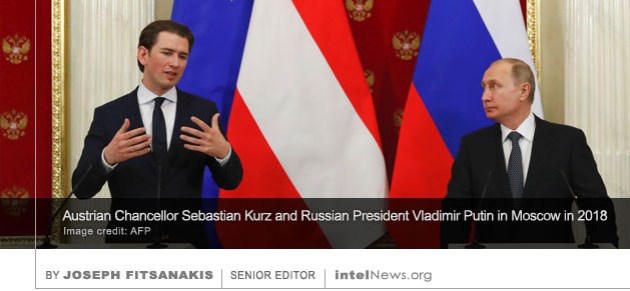
Sebastian Kurz Vladimir PutinA day after Austria’s political system was thrown into a disarray by a covert video featuring the country’s vice chancellor and a woman posing as a Russian investor, German intelligence sources have raised fears that Russia may have penetrated the Austrian government with informants. Heinz-Christian Strache, who heads Austria’s far-right Freedom Party, stepped down from the post of vice chancellor on Saturday. His resignation came a day after two German media outlets aired a covert video in which Strache appears to be promising to award state contracts in the construction sector to a woman posing as a Russian investor. In return for the state contracts, the unnamed woman said that she would have the firm of her uncle —a Russian oligarch— purchase an Austrian newspaper and use it to support Strache’s political party.

According to the German newspaper Süddeutsche Zeitung, the video was filmed in Spain in 2017, two months before the Freedom Party won a record 26 percent in Austria’s national election. This gave the party 51 seats in the Austrian parliament and propelled Strache to the post of vice chancellor. In his resignation statement, Strache said he was filmed while drunk and was engaged in “macho talk” in an atttempt to “impress the attractive hostess”. He also dismissed the airing of the covertly filmed video as “a targeted political assassination”, but added that he was resigning from the government as a matter of principle. Shortly afterwards, the Austrian Chancellor Sebastian Kurz, Chairman of the rightwing Austrian People’s Party, announced that new national elections would be held “as soon as possible”.

Meanwhile, German newspaper Die Welt am Sonntag reported on Saturday that the director of Germany’s Federal Office for the Protection of the Constitution (BfV), warned that sharing intelligence with Austria was “risky”. The Berlin-based newspaper said that BfV director Thomas Haldenwang was speaking at a closed-door meeting with German parliamentarians. He reportedly told his parliamentary audience that, due to the close relationship between the Freedom Party and Moscow, members of the Austrian government could potentially “misuse” and in some cases “forward to Russia” intelligence that they receive from other European Union member-states. This is not the first time that such warnings have come out of Germany. Last year August Hanning, who served as director of Germany’s Federal Intelligence Service (BND) openly warned Western officials to stop sharing intelligence with the government of Austria, because of its alleged proximity to the Kremlin.

Author: Joseph Fitsanakis | Date: 20 May 2019 | Permalink
British commander in Iraq contradicts US assessment of increased Iranian threat

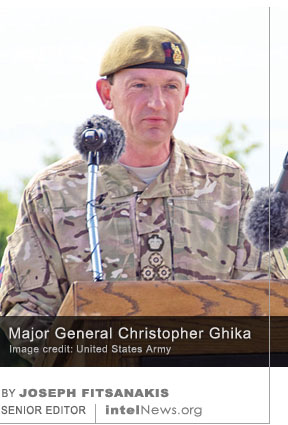
Christopher GhikaThe most senior British military officer in the war against the Islamic State contradicted American assessments of a heightened threat from Iran, prompting an unusually strong rebuke from Washington. Last week, the White House ordered the USS Abraham Lincoln carrier strike group to sail to Middle Eastern waters, following intelligence showing that “Iran or its proxies were planning attacks against US forces in Iraq, Syria and at sea”.

On Tuesday, however, this view appeared to be challenged by Major General Christopher Ghika, Britain’s most senior military official in the Middle East, who is deputy commander of Operation Inherent Resolve (OIR). The OIR umbrella brings together all pro-Western forces that are fighting the Islamic State in Iraq and Syria. General Ghika spoke to American reporters at the US Department of Defense via a live video-link from Baghdad, where he is currently stationed as OIR deputy commander. In responding to questions by reporters about alleged threats to Western forces from Iran or its proxies, General Ghika said that the OIR forces were “aware of that presence [or Iranian-led Shia militia groups in Iraq and Syria], clearly. And we monitor them along with a whole range of others because that’s the environment we are in”. However, added the general, “no, there has been no increased threat from Iranian-backed forces in Iraq and Syria”.

British newspaper The Guardian, which published General Ghika’s comments on Tuesday, noted that his statements appeared to directly contradict Washington’s claims of a heightened Iranian threat in the region. But in a statement released on Tuesday night local time, the US Central Command CENTCOM, whose responsibilities include the Middle East and Central Asia theaters, rejected General Ghika’s comments. “Recent comments from OIR’s Deputy Commander run counter to the identified credible threats available to intelligence from U.S. and allies regarding Iranian backed forces in the region”, said the statement. The Guardian described CENTCOM’s statement as “particularly striking” and “an extraordinary rebuke of an allied senior [military] officer”. The British Ministry of Defense had not responded to CENTCOM’s statement by Wednesday morning.

Author: Joseph Fitsanakis | Date: 15 May 2019 | Permalink

German spies dismiss US warnings about Huawei threat to 5G network

Huawei 2German intelligence officials appear to be dismissing Washington’s warning that it will limit security cooperation with Berlin if China’s Huawei Telecommunications is allowed to build Germany’s 5G network. The company, Huawei Technologies, is a private Chinese venture and one of the world’s leading telecommunications hardware manufacturers. In recent years, however, it has come under scrutiny by some Western intelligence agencies, who view it as being too close to the Communist Party of China. More recently, Washington has intensified an international campaign to limit Huawei’s ability to build the infrastructure for 5G, the world’s next-generation wireless network. Along with Britain, Australia and Canada, the US is concerned that the Chinese telecommunications giant may facilitate global wiretapping on behalf of Beijing’s spy agencies.
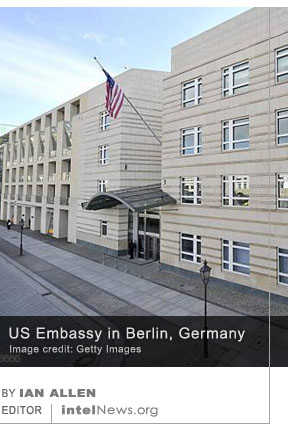
In the past several months the United States has repeatedly warned Germany that intelligence sharing between the two countries will be threatened if the Chinese telecommunications giant is awarded a 5G contract by the German government. In March, Washington informed German officials that intelligence cooperation between the two allies would be severely impacted if Chinese telecommunications manufacturers were given the green light to build Germany’s 5G infrastructure. The warning was allegedly included in a letter to Peter Altmaier, Germany’s Minister of Economic Affairs and Energy, written by Ambassador Richard Grenell, America’s top diplomat in Germany. The letter urged the German government to consider rival bids by companies belonging to American allies, such as the Swedish telecommunications equipment manufacturer Ericsson, Finland’s Nokia Corporation, or the South Korean Samsung Corporation.

But a report by Bloomberg on Wednesday said that German authorities were not convinced by Grenell’s argument. Citing “four people with knowledge on the matter”, the news agency said that Germany’s intelligence community see Washington’s warnings as “political grandstanding”. The US and Germany “need each other’s resources to tackle global conflicts” and “rely on each other too much to risk jeopardizing crucial data sharing”, said the report. The anonymous officials told Bloomberg that Germany does benefit from America’s “vast array” of intelligence. However, German spy agencies also provide their American counterparts with crucial intelligence from several regions of the world, they said. The US Department of State did not comment on the Bloomberg report. The Chinese government has repeatedly dismissed allegations that Huawei poses an espionage threat to Western nations.

Author: Ian Allen | Date: 18 April 2019 | Permalink

US warns Germany it will end intelligence sharing if Huawei is given 5G contract

US embassy Berlin GermanyThe United States has warned Germany that intelligence sharing between the two countries will be threatened if the Chinese telecommunications giant Huawei is awarded a contract to build Germany’s 5G network. The company, Huawei Technologies, is a private Chinese venture and one of the world’s leading telecommunications hardware manufacturers. In recent years, however, it has come under scrutiny by some Western intelligence agencies, who view it as being too close to the Communist Party of China. More recently, Washington has intensified an international campaign to limit Huawei’s ability to build the infrastructure for 5G, the world’s next-generation wireless network. Along with Britain, Australia and Canada, the US is concerned that the Chinese telecommunications giant may facilitate global wiretapping on behalf of Beijing’s spy agencies.
But some American allies, including Spain, France and Germany, are not satisfied with Washington’s arguments and claim that the United States is eyeing the financial benefits that would arguably come from its domination of the global digital superhighway. German officials, in particular, have told their American counterparts that Berlin has not seen any evidence that Huawei’s telecommunications hardware come with hidden interception features. Moreover, Germany says that it plans to subject Huawei’s systems to rigorous security tests before using them. On Friday, Washington increased its pressure on Berlin by informing German officials that intelligence cooperation between the two allies would be severely impacted if Chinese telecommunications manufacturers are given the green light to build Germany’s 5G infrastructure.

According to The Wall Street Journal, the warning was included in a letter signed by Ambassador Richard Grenell, America’s top diplomat in Germany. It was allegedly sent to Peter Altmaier, Germany’s Minister of Economic Affairs and Energy. The paper says that Grenell suggests in his letter that Berlin should consider rival bids by companies belonging to American allies, such as the Swedish telecommunications equipment manufacturer Ericsson, Finland’s Nokia Corporation, or the South Korean Samsung Corporation, which is the world’s leading telecommunications hardware manufacturer. The Wall Street Journal did not reveal how it acquired Grenell’s letter, nor did it say whether the German government responded to it.

Author: Ian Allen | Date: 12 March 2019 | Permalink

European Union agrees to establish joint intelligence training school

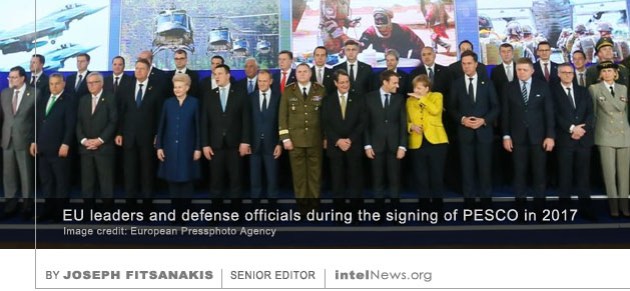
PESCO EUTwenty-five members of the European Union have agreed to establish a joint intelligence training academy, a move interpreted by some as a concrete effort to deepen inter-European security cooperation following Brexit. The announcement came just hours after leading EU heads of state spoke in favor of establishing a joint EU defense force. Calls for tighter cooperation between EU members in the areas of defense and security have been issued for decades. But the upcoming departure of Britain from the EU —popularly known as Brexit— has prompted Germany and France to propose deeper integration as a response to the rise of anti-EU sentiment across the continent.
The decision to establish a joint intelligence training school was approved on Monday by the ministers of defense and foreign affairs of 25 EU members. It was part of a wider agreement involving 16 other joint defense and security projects under the Permanent Structured Cooperation (PESCO) pact. The pact was first agreed on in September of 2017, and has since been functioning under the supervision of the European Defense Agency and the External Action Service —the diplomatic service of the EU. Nearly 20 projects of a military or security nature have since been signed under PESCO. Monday’s agreement virtually doubled the PESCO projects in existence. The new EU intelligence academy initiative will be led by Greece —an EU member since 1981— and will be headquartered in Cyprus, which joined the EU in 2004. When it becomes operational, the academy will provide “education and training in intelligence disciplines and other specific fields to EU member states’ intelligence personnel”, according to a joint PESCO communique issued on Monday.

The new intelligence school will work in cooperation with the individual intelligence agencies of the 25 co-signatory states, along with the North Atlantic Treaty Organization and with other regional security bodies, said PESCO. However, three EU states, namely Denmark, Malta and the United Kingdom, refused to support the project. Denmark and Malta are not participants in PESCO, while the United Kingdom is expected to leave the EU in March of next year. However, even before Brexit, London had vetoed the idea of closer EU intelligence cooperation, which it saw as a potential competitor to the so-called Five Eyes alliance, a postwar intelligence pact between the United States, the United Kingdom, Australia, New Zealand and Canada. Additionally, despite the overwhelming support for the intelligence academy by EU officials, it remains to be seen whether it will be realized. Observers told Politico on Monday that many other PESCO projects have “yet to get much beyond the drawing board” since their announcement last year.

Author: Joseph Fitsanakis | Date: 20 November 2018 | Research credit: K.A. | Permalink


Poisoned Russian spy advised Spanish intelligence, say officials

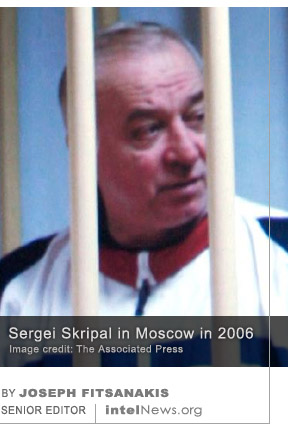
Sergei SkripalSergei Skripal, the Russian double agent who was poisoned with a military-grade nerve agent in England earlier this year, worked with Spanish intelligence after his defection to the United Kingdom, according to sources. Skripal, a former military intelligence officer who spied for Britain in the early 2000s, had kept a low profile while living in the English town of Salisbury. He was resettled there in 2010 by the British Secret Intelligence Service (MI6), after he was released from a Russian prison. But he and his daughter Yulia made international headlines in March, after they were poisoned by a powerful nerve agent that nearly killed them. The attack has been widely blamed on the Russian government, but the Kremlin denies that it had a role in it.
The attempt to kill Skripal surprised some intelligence observers due to the fact that the Russian government had officially pardoned the double agent prior to exchanging him with Russian spies who had been caught in the West. As intelNews wrote in May, “typically a spy who has been pardoned as part of an authorized spy-swap will not need to worry about being targeted by the agency that he betrayed. If it indeed tried to kill Skripal, the Russian government may therefore have broken the unwritten rules of the espionage game”. Eventually, however, it was revealed that, instead of retiring after his defection to the UK, Skripal traveled extensively in Eastern Europe, where he advised local intelligence agencies on how to defend against Russian espionage. The double agent participated in MI6-sponsored events in which he briefed intelligence practitioners in at least two countries, Estonia and the Czech Republic. These activities may have convinced the Kremlin that Skripal had broken the unwritten conditions of his release, namely that he would not participate in any intelligence-related activities against Russia.

Now The New York Times has claimed that, in addition to consulting for Czech and Estonian spies, Skripal also visited Spain, where he met with officers from the country’s National Intelligence Center (CNI). Citing an unnamed Spanish former police chief and Fernando Rueda, a Spanish intelligence expert, The Times said that Skripal advised the CNI about the activities of Russian organized crime in Spain and the alleged connections between Russian mobsters and the Kremlin. When he traveled to Spain under MI6 protection, said the paper, Skripal was effectively returning to the place where he had been initially recruited to spy for the British. Skripal spent several years in Spain, said The Times, serving as a military attaché at the Russian embassy in Madrid. It was there that he began to work secretly for MI6. However, the precise timing of Skripal’s return trips to Spain after 2010, as well as the content of his discussions with Spanish intelligence officials, remain unknown, according to The Times.

Author: Joseph Fitsanakis | Date: 07 September 2018 | Permalink

German ex-spy chief tells West to stop sharing intelligence with Austria

Peter GridlingA former director of Germany’s foreign intelligence service has warned Western officials to stop sharing intelligence with the government of Austria, because of its alleged proximity to the Kremlin. August Hanning served as chief of Germany’s Federal Intelligence Service, known as BND, from 1998 to 2005. He went on to serve as the most senior civil servant in the Ministry of the Interior until his retirement in 2009. In an interview published on Wednesday in Germany’s Bild newspaper, Hanning argued that “caution is necessary with [an intelligence] service [like that of Austria,] which cannot protect its own secrets or the sources and sensitive information of its partners”. He went on to add that “there is […] now extreme caution when sharing information] with the Austrian intelligence services.
Hanning’s statement came less than a week after The Washington Post claimed in a major article that most Western intelligence services had stopped sharing sensitive information with the Austrian government. The newspaper alleged that the disruption in intelligence cooperation between Austria and other Western countries was sparked by an unprecedented police raid on the headquarters of Austria’s spy agency in February of this year. On February 28, Austrian police raided the central offices of the Office for the Protection of the Constitution and Counterterrorism (BVT), which operates as Austria’s domestic intelligence agency. By that evening, thousands of classified documents had been removed from the BVT’s headquarters and stored in police facilities in Vienna. Austrian officials claimed that the raid was sparked by allegations made by South Korean intelligence that blank Austrian passports had been acquired by the North Korean government.

However, according to The Post, the raid was politically motivated by Austria’s far-right Freedom Party, which is part of the country’s ruling coalition. The purpose of the raid, said the article, was to neutralize the BVT, whose mission includes defending the Austrian constitution from domestic threats from the far left and the far right. Many Western services were alarmed by the February 28 raid on the BVT and immediately stopped sending sensitive information to the agency’s Vienna headquarters, according to The Post. It also said that Western European powers are concerned by the seemingly close relations between some members of Austria’s government and the Kremlin. Last week, Russian Premier Vladimir Putin traveled to Austria to attend the wedding of Karin Kneissl, Austria’s Minster of Foreign Affairs, who is politically close to the Freedom Party. The Russian leader said that he attended Kneissl’s wedding on a “purely private” capacity. But that did little to appease European Union leaders.

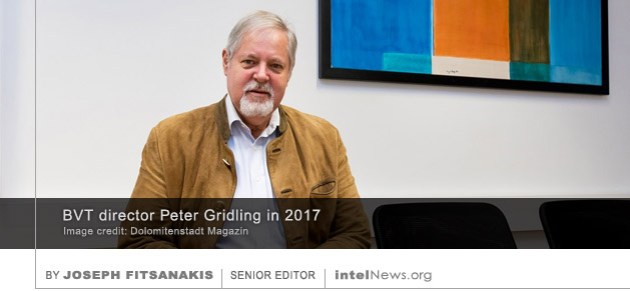
On Monday, the BVT rejected the claims made by The Post. In a statement issued to the media, BVT director Peter Gridling (pictured) said that “cooperation [between the BVT and] partner intelligence services continues to work well in key areas such as the fight against terrorism”.

Author: Joseph Fitsanakis | Date: 23 August 2018 | Permalink

Chinese influence in New Zealand threatens intelligence-sharing, says Canadian report

CSIS canadaChina’s influence in New Zealand is so extensive that it threatens the traditionally close intelligence contacts between New Zealand and its Western allies, according to a report written by the Canadian spy agency. Since World War II, New Zealand has been a member of what is sometimes referred to as the UK-USA Security Agreement. Known also as the UKUSA Agreement or the Five Eyes alliance, the pact, which was strengthened in 1955, provides a multilateral framework for intelligence cooperation between the United Kingdom, the United States, Canada, Australia, and New Zealand. But a new report produced by Canadian intelligence warns that Chinese political and economic influence in New Zealand is making it difficult for the Pacific Ocean island country to continue to operate within the framework of the agreement.

The report, entitled China and the Age of Strategic Rivalry, was authored by experts at the Canadian Security Intelligence Service (CSIS). It contains a summary of views expressed by participants at an academic outreach workshop that was organized in Canada by the CSIS. In a section focusing on Chinese “interference in democratic systems”, the report suggests that, despite its small size, New Zealand is “valuable to China […] as a soft underbelly through which to access Five Eyes intelligence”. In recent years, claims the report, Beijing has adopted “an aggressive strategy” that has sought to co-opt political and economic elites in New Zealand as a means of influencing political decision making in the country. As part of that process, China seeks to gain advantages in trade and business negotiations, suppress negative views of China, facilitate espionage and control the views of the Chinese expatriate community in New Zealand, according to the report. Ultimately, Beijing seeks to “extricate New Zealand from […] its traditional [military and intelligence] partners]” as a means of asserting its regional and —eventually— global influence, the report concludes.

In a separate but connected development, it emerged this week that China expert Peter Mattis told an American Congressional committee last month that New Zealand’s position in the Five Eyes alliance was tenuous due to China’s influence. Mattis, a former China analyst for the United States Central Intelligence Agency, was speaking before the US-China Economic and Security Review Commission, a group of experts that advise the US Congress. He told the Commission that the influence of the Chinese Communist Party in New Zealand is so deep that it raises questions about whether the Pacific Ocean country can continue to share intelligence with the other members of the Five Eyes alliance.

On Wednesday, New Zealand’s Prime Minister Jacinda Ardern emphatically dismissed questions about her country’s role in the Five Eyes alliance. She told reporters in Wellington that the issue of New Zealand’s Five Eyes membership had “never been raised” with her “or anyone else” by Five Eyes partners. Ardern added that her government received its information “from official channels, not opinions expressed at a workshop”.

Author: Joseph Fitsanakis | Date: 31 May 2018 | Permalink

Britain shared “unprecedented” intelligence details to secure expulsions of Russians

Diplomatic ExpulsionsBritain secured the largest expulsion of Russian diplomats in history by sharing “unprecedented degrees of intelligence” with dozens of foreign countries about the attempted killing of former spy Sergei Skripal. Nearly 30 countries and international organizations, including the European Union and the North Atlantic Treaty Organization, have expelled or refused to accredit over 150 Russian diplomats in the past 72 hours. The coordinated move came in response to the alleged attack on Skripal, a Russian former intelligence officer who has been living in England since 2010. Skripal left Russia after he was released from prison as part of a spy swap between Russia, the United Kingdom and the United States. He had previously been caught spying on Russia for Britain’s Secret Intelligence Service, known as MI6. Skripal, 66, and his daughter Yulia, 33, are currently in a comatose state in hospital.
The United States, Canada and Australia joined most European countries in expelling Russian spies, after Britain accused Moscow of using a Soviet-era nerve agent to attack the Skripals. But according to a senior British government official, the coordinated expulsions were not coincidental. The official, who refused to be named, told The Financial Times that the British government took the unprecedented decision to share “unprecedented degrees of intelligence” with dozens of countries in order to convince them to take action against the Kremlin. Shared information included complete intelligence assessments of Russian activities. Complete intelligence assessments are rarely —if ever— shared by nations. The latter typically share headline assessments —short snippets of longer analyses produced by their intelligence agencies— with allied nations. But in this case, British officials were authorized to share complete intelligence reports along with underlying data, which included a “detailed scientific analysis of the nerve agent used in the attack”, said The Financial Times.

Sharing complete intelligence reports runs the risk of revealing how much a nation knows about the secret activities of its adversaries, and may end up harming its intelligence-collection efforts. But the paper said that the complete intelligence shared with dozens of countries around the world convinced them that “there was no plausible alternative other than […] the Russian state” was behind the attack on the Skripals. Moreover, said the paper, London shared intelligence with foreign governments that pointed to the existence of an “explicit” state-backed assassination program run by the Kremlin. The program allegedly includes targets in numerous countries worldwide, said The Financial Times. The Russian government has vehemently rejected London’s assertions and has suggested that the attack on the Skripals was part of a British intelligence operation aimed at turning Russia into an international pariah.

Author: Joseph Fitsanakis | Date: 29 March 2018 | Permalink

Pakistan halts intelligence cooperation with US, but US embassy denies knowledge

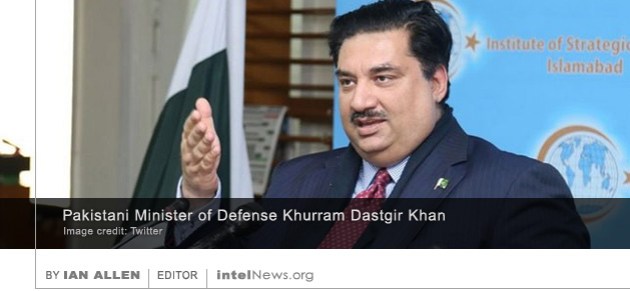
Khurram Dastgir KhanPakistan said on Tuesday that it had suspended military and intelligence cooperation with the United States in the wake of Washington’s decision to stop security assistance to Pakistan. On Tuesday, Pakistan’s Minister of Defense, Khurram Dastgir Khan, said that his country had terminated all cooperation with the US in the areas of defense and intelligence. He said that the move was a response to the announcement by US President Donald Trump last week that Washington would stop providing security assistance to Pakistan. American officials stated that the change in policy took place because Pakistan had allegedly deceived America in the global war on terrorism. On Thursday last week, the President Trump accused the Pakistani government of having given the US “nothing but lies and deceit”. Trump’s accusation was followed by an official statement by the Pentagon, which said that Pakistan should cease to provide “sanctuaries in its territory for Taliban and Haqqani network leaders and operatives”.

On Tuesday, while speaking at a conference in Islamabad, Defense Minister Khan said that Pakistan had suspended “a wide field of intelligence cooperation and defense cooperation”. He was speaking during a conference hosted by the Institute of Strategic Studies, which is a government-sponsored think-tank based in the Pakistani capital. Khan accused the US of treating Pakistan as a “scapegoat” for its military and political failures in neighboring Afghanistan. He also warned Washington that Pakistan would not allow America’s war in Afghanistan to be fought on Pakistan’s territory. He ended his talk, entitled “Contours of Security Environment of Pakistan”, with what he described as “a reminder”, saying that Washington needs Pakistan’s support in its efforts against the Taliban and the Islamic State in Afghanistan: “Logistics trumps strategy”, he said.

But the Voice of America news service reported on Tuesday that the US embassy in Islamabad had no information about Khan’s announcement concerning Pakistan’s termination of military and intelligence cooperation with Washington. A spokesman at the embassy told the news service that the embassy had “not received any formal communication regarding a suspension” of military and intelligence cooperation by Islamabad. Last week, the US Secretary of Defense James Mattis insisted that his department kept open lines of communications with the Pakistani military leadership despite the suspension of security assistance by Washington. Islamabad said that communication lines with North Atlantic Treaty Organization forces remained open, but military cooperation with Washington had been terminated.

Author: Ian Allen | Date: 10 January 2018 | Permalink

Israeli armed raid in Syria reportedly led to US banning laptops on some flights

Ibrahim al-AsiriA temporary ban issued by United States authorities on laptop computers onboard some commercial flights earlier this year came from a tip by Israeli intelligence, according to a new report. The report was published last week in the American magazine Vanity Fair. It claimed that Israeli commandos carried out a dangerous night-time operation deep inside Syria, in order to acquire physical proof that the Islamic State had  built bombs that were not detectable by X-ray screening systems at airports. But some Israeli intelligence officials became infuriated with Donald Trump after the US President allegedly gave Russia background information about the commando operation, according to the article.
The order to temporarily ban electronic devices larger than cellphones was issued by the US government on March 20, 2017. It applied to direct flights to the US departing from a dozen international airports in the Middle East. In June, the New York Times alleged that the ban was aimed at stopping Islamic State operatives from bringing onboard airplanes bombs disguised as laptop batteries. The paper also said that the information about these bombs had been acquired by Israeli government hackers who had penetrated Islamic State computer systems. But now a new report by Vanity Fair claims that Tel Aviv tipped off the Americans following a commando raid deep inside Syrian territory, which acquired physical evidence of the bombs. The magazine alleges that the raid was carried out by the Sayeret Matkal, an elite unit of the Israel Defense Forces, under the supervision of the Mossad, Israel’s external spy agency. Its target was a highly secretive cell of explosives experts, who were led Ibrahim al-Asiri, a Saudi militant who built bombs for the Yemen-based Al-Qaeda in the Arabian Peninsula. The Mossad shared some of the intelligence from that raid with the Central Intelligence Agency, which in turn told President Trump. That led to the decision to ban laptops from selected flights, until X-ray machines at airports were modified to detect the new type of bomb.

The Vanity Fair article repeats earlier claims that President Trump shared intelligence given to him by the Israelis with Russian Foreign Minister Sergei Lavrov and Russian Ambassador to the United States Sergei Kislyak, when he met them in May of this year. According to Israeli sources, Mr. Trump did not tell the Russian officials that Israel was behind the operation. But he allegedly identified the city in Syria where the raid took place, and in doing so placed the life of an Israeli human asset at risk, according to some. The Israeli government will not comment on these allegations. Additionally, Vanity Fair said that one “former Mossad officer with knowledge of the operation and its aftermath” would not say whether the asset in question had been safely exfiltrated from Syria or even whether he or she was still alive.

Author: Joseph Fitsanakis | Date: 27 November 2017 | Permalink

German spy officials dismiss calls to create European intelligence agency

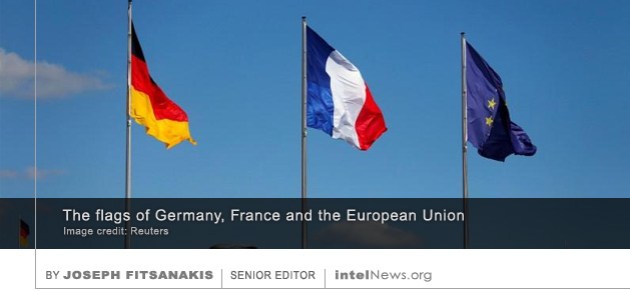
European UnionGermany’s two most senior intelligence officials have dismissed suggestions by European officials and leaders, including the president of France, to create a Europe-wide intelligence agency. The numerous deadly attacks carried out by Islamic State supporters across Europe in recent years have given rise to calls from various quarters for the establishment of a new intelligence service that would combine resources from every member-state of the European Union. Last month, the European Union’s Commissioner for Migration, Home Affairs and Citizenship, Dimitris Avramopoulos, said that the time had come for Europe to be “ambitious and bold, to overcome the security taboos of the past and finally work in order to build a European intelligence system”. He went on to say that, had there been sufficient “cooperation, information sharing and exchanging” between the various European intelligence services, “maybe some of these tragic events could have been predicted and prevented”. Avramopoulos’ remarks were echoed last week by France’s new President, Emmanuel Macron. Speaking at Sorbonne University in Paris, France’s head of state said that the creation of a European Intelligence Agency would “strengthen links between our countries” and prevent emerging security threats.
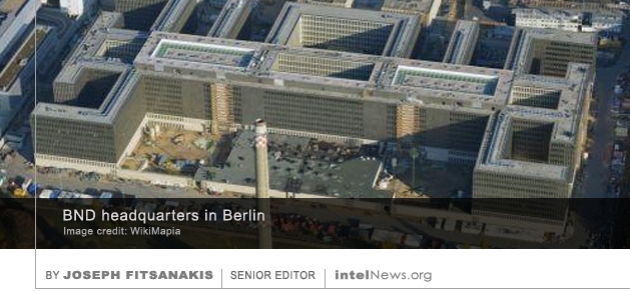
But these calls were rebuffed this week in Berlin, where Germany’s two most senior intelligence officials rejected any and all calls for the creation of a European intelligence service. The officials are Bruno Kahl, director of Germany’s Federal Intelligence Service, the BND, and Hans-Georg Maaßen, who heads the country’s Federal Office for the Protection of the Constitution, known as the BfV. The two men spoke before a special session of the Intelligence Oversight Committee of the German Federal Parliament, known as the Bundestag. The BND’s Kahl said Europe already had an intelligence-based early-warning center, known as the European Union Intelligence and Situation Center (EU INTCEN). He argued that there was “no need for a European intelligence agency or any other supplemental Europe-wide intelligence organization” and added that “intelligence is better organized on the national level”. He was backed by BfV’s Maaßen, who warned that the creation of a European intelligence service would “create additional bureaucratic structures, both on the European and domestic levels”, which would “profoundly lower our efficiency”.

The two German intelligence officials said that cooperation between European Union member-states had improved substantially in the past few years, and that the current model of bilateral exchange was “the most efficient […] and quickest way to share information”. The current system of inter-agency coordination would be weakened if a European intelligence service was created, according to the two men.

Author: Joseph Fitsanakis | Date: 06 October | Permalink

German parliament report on NSA spying contains little consensus

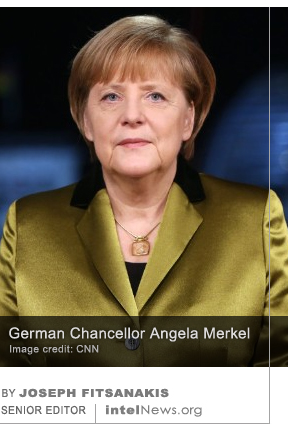
Angela MerkelA lengthy parliamentary report on American intelligence activities in Germany was presented last week in Berlin, but was condemned by opposition parties as insufficient and incomplete, prompting calls for a new investigation. The parliamentary probe was initiated in 2013, following a series of revelations by Edward Snowden, a former employee of the United States Central Intelligence Agency and National Security Agency who defected to Russia. Snowden alleged that both agencies spied on Germany, with the NSA going so far as to eavesdrop on the personal telephone communications of German Chancellor Angela Merkel. The allegations shocked German public opinion, and resulted in the unprecedented expulsion of the CIA station chief in Berlin —the most senior US intelligence official in the country. However, the parliamentary probe soon broadened its scope to include subsequent allegations that German intelligence agencies collaborated with the NSA in spying against other Western countries.
Last Wednesday, after three years of work, the parliamentary committee, known officially as the “German Parliamentary Committee Investigating the NSA Spying Scandal”, presented its findings to the Bundestag. They consist of thousands of pages of technical details concerning interception methods and capabilities. However, the final report fails to draw concrete conclusions, and its concluding section does not reflect a consensus among the committee’s members. The section begins by noting that, “unfortunately, despite an initial shared conviction by all parliamentary groups about the need for the investigation, substantial disagreements emerged between the governing and opposition groups, concerning the methodology and goals of the committee’s work”. Read more of this post

German intelligence agency spied on thousands of targets in the United States

BND GermanyThe foreign intelligence service of Germany spied on at least 4,000 targets in the United States from 1998 until 2006, according to a leaked document published yesterday by leading German newsmagazine Der Spiegel. The German investigative weekly said that the surveillance was carried out by the German Federal Intelligence Service, known as BND. The Hamburg-based magazine claimed to have in its possession a list of approximately 4,000 “selector keywords”, unique distinguishing terms, addresses or numbers that identify individual targets for surveillance. The list allegedly includes names, telephone or fax numbers, and email addresses of people that the BND had identified as worthy of individual attention between 1998 and 2006.


According to Der Spiegel, the list of targets in the United States includes officials in the White House, the Department of the Treasury and the Department of State. Their work and private phone numbers, and often emails, are listed in the BND document. The latter also focuses on the American military sector, paying particular attention to the US Air Force and the Marine Coprs. Other targets include the National Aeronautics and Space Administration and the Defense Intelligence Agency, the US Pentagon’s intelligence organization. In addition to US government targets, the BND exercised surveillance on American companies with ties to the state, such as Lockheed Martin, as well as state-owned universities. The leaked list also includes targets in international organizations that have an institutional presence in the US, such as the International Monetary Fund and the Arab League, which has an office in Washington. Hundreds of foreign embassies and consulates in the US were also targeted, said Der Spiegel.

German-American relations suffered a major setback in 2013, when it was revealed that Washington had spied on the personal cell phone of German Chancellor Angela Merkel. In response to the revelations, Germany expelled the Central Intelligence Agency’s station chief in Berlin —the most senior American intelligence officer in the country. It remains to be seen whether Thursday’s revelations will affect the current relations between the two transatlantic allies. Neither the BND nor the US embassy in Berlin responded to questions about Der Spiegel‘s report.

Author: Joseph Fitsanakis | Date: 23 June 2017 | Permalink

Israel revises intel-sharing rules with US, after alleged disclosure to Russians

Donald Trump and Benjamin NetanyahuAuthorities in Israel have revised their intelligence-sharing protocols with the American government after it became known that United States President Donald Trump inadvertently exposed Israeli secrets to Russia. The alleged exposure of Israeli secrets came earlier this month, during a meeting between Mr. Trump and a delegation of Russian government officials, which included Foreign Minister Sergey Lavrov and Sergey Kislyak, Moscow’s Ambassador to Washington.

During the meeting, the US President allegedly gave the two Russians details about plans by the Islamic State to smuggle explosives onboard airplanes, by hiding them inside laptop computers. However, according to reports in the American press, the information shared by Mr. Trump originated from Israel, which had voluntarily shared it with US intelligence. What is more, Tel Aviv had not authorized Washington to share the precise details behind this intelligence with other countries. Some reports in the US media suggest that Mr. Trump shared the Israeli-derived intelligence with the Russians in such a way as to expose ‘sources and methods’ —that is, the most sensitive aspects of the intelligence business, which intelligence agencies typically never disclose to adversaries. Additionally, even though the US president claims he never disclosed the source of the information, American media reports suggest that the Russians could easily determine that it came from Israel.

Israeli sources allegedly complained strongly to Washington, claiming that the intelligence shared by the US president “had put an [Israeli] agent’s life in peril”. Tel Aviv’s reaction appears to have been swift. On Wednesday, Israel’s Defense Minister Avigdor Liberman said in an interview that Tel Aviv promptly “did our checks” and “clarified [things] with our friends in the United States”. Speaking to Israel Army Radio, the official radio station of the Israel Defense Forces, Mr. Liberman said that Israel had done “a spot repair”, prompting the Voice of America to claim that the Jewish state had altered its intelligence-sharing methods with the US. Liberman was asked by the Israel Army Radio to clarify, but refused to specify what changes had been made in the Israel-US intelligence-sharing arrangements. He only added that “there is [now] unprecedented intelligence cooperation with the United States”.

Author: Joseph Fitsanakis | Date: 25 May 2017 | Permalink