Opinion: Trump’s astonishing wiretapping claims deepen volatility of US politics

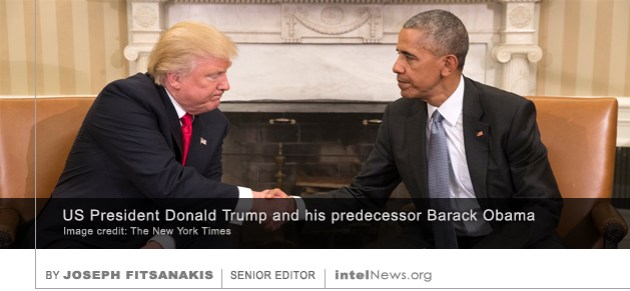
Trump and ObamaThe absurdity of American politics reached new heights over the weekend, as President Donald Trump dramatically alleged on Twitter that his predecessor, Barack Obama, wiretapped his telephones last year. Even for a highly impulsive public figure known for his sensational and often-unsubstantiated allegations, Mr. Trump’s latest claims prompted a new sense of abnormality and astonishment in Washington. If the president is unable to prove his dramatic claims, his reliability will be further-eroded, and what little is left of his relationship with the American intelligence and national-security communities will disintegrate. If his allegations are proven, they will cause a scandal of unprecedented proportions from which American political institutions —including the presidency— will find it difficult to recover.

Mr. Trump appears to claim that Mr. Obama personally instructed the machinery of government to intercept the telecommunications of his campaign in the run-up to the 2016 US presidential election. But experts —including the present author, whose PhD focuses on government-sponsored wiretapping— correctly note that, barring a complete and systematic breakdown of law and q-quoteorder at the highest levels of the American government, Mr. Trump’s claims cannot possibly be true. American presidents have not been legally allowed to order wiretaps since 1978, when the Foreign Intelligence Surveillance Act (FISA) was established. Prompted by the abuse of executive power revealed through the Watergate scandal, FISA forces government agencies to seek the approval of specially mandated judges before installing wiretaps. If an agency like the Federal Bureau of Investigation (FBI) wants to wiretap an individual or group suspected of acting as agents of a foreign power, it must convince one of 11 federal district judges who rotate on the FISA court that the case warrants a wiretap order. Thus, before authorizing the wiretap, a FISA judge must be convinced by examining the available evidence presented before him or her.

Usually FISA counterintelligence cases involve foreign subjects who are suspected of operating in the US as unregistered agents of a foreign power —that is, spies or handlers of spies. However, if the case proposed by the FBI involves the targeting of American citizens’ communications, then the application for a wiretap must be personally reviewed by the US attorney general. Only if the attorney general approves the application does it get sent to a FISA judge. That is precisely why President Trump’s allegation is so explosive: if Mr. Obama personally directed a law enforcement or intelligence agency to wiretap the Trump campaign’s telecommunications, it would mean that a US president deliberately violated FISA regulations and kept the Department of Justice in the dark while wiretapping the telecommunications of American citizens. Read more of this post

Opinion: America in deep and profound security crisis as Michael Flynn resigns

Michael Flynn and Donald TrumpThe ongoing security crisis in the United States reached new heights last night as Michael Flynn, President Donald Trump’s national security advisor, resigned. In his letter announcing his decision, the former general admitted that he “inadvertently” gave members of the Trump administration “incomplete information” about his conversations with the Russian ambassador to the US in December of last year. This development is only the latest in a series of unprecedented incidents in Washington. The city, and by extension the country, are now in a deep and profound security crisis with unpredictable consequences for the US and its allies.

The sense of normality in America’s capital, the seat of government of the world’s most powerful nation, is becoming increasingly scarce, as the country faces one astonishing situation after another. Today, three weeks after Donald Trump assumed the reins of power in DC, the relationship between the Executive and the Intelligence Community is almost nonexistent. A growing q-quotenumber of former insiders warn that senior intelligence officials are —in the words of former National Security Agency officer John Schindler— “beginning to withhold intelligence from a White House which our spies do not trust”. Last month, Steve Hall, a former senior member of the Central Intelligence Agency’s National Clandestine Service, cautioned that officers at Langley are suspicious of the White House’s links with Russia. Currently, Michael Flynn, who served as director of the Defense Intelligence Agency, and the man chosen by the president to serve as his national security advisor, is being investigated as part of a counterintelligence probe by the Federal Bureau of Investigation and is facing a separate set of questions from the military. On Tuesday, Senior Republican lawmakers called for a Congressional investigation into Moscow’s alleged proximity with the Trump White House.

Meanwhile, the (now former) acting attorney general and several judges have sought to stop the president from violating Constitutional norms with the imposition of an ill-fated travel ban. In response, q-quoteMr. Trump summarily fired the head of the Department of Justice and openly challenged the legitimacy of a judge who ruled against his executive order. The president did not even address the concerns of the Intelligence Community, which largely views the travel ban as nonsensical, unworkable and counterproductive. Mr. Trump also dismissed the significance of a “Dissent Channel” memorandum, signed by over 1,000 State Department employees —an unprecedented number with no parallel in American diplomatic history— who openly objected to the violation of “core American and constitutional values that we, as federal employees, took an oath to uphold”.

Discord and disharmony are not novel concepts in American political life. But the current situation is anything but conventional. It is not normal for the president to summarily fire the chief legal counsel to the US government —acting or not. Nor is it normal for his national security advisor, a man who is privy to the most sensitive secrets of the US government, to be the subject of a counterintelligence investigation, and for one of his senior aides to be denied a security clearance by the CIA. It is unprecedented for a US president to question the usefulness of the North Atlantic Treaty Organization while seemingly consenting to Russia’s annexation of an important American ally —namely Ukraine. It is equally remarkable to watch conservative governments in Western Europe warn against US policies and even refuse to have Mr. Trump address their parliaments. We are witnessing unparalleled developments ofq-quote inconceivable magnitude, with implications that may well shape the future of America and its place in the world.

These are not partisan considerations, which this website shies away from as a matter of policy. Rather, they are political observations that go to the very heart of America’s ability to govern itself, provide security to its citizens and lead the Western world in our century. Anyone who rejects the notion that the US is currently at the onset of one of the most serious crises in its modern political history is simply disconnected from empirical reality. Anyone —Republican or Democrat— who tries to exploit the current crisis for narrow political gain is not simply foolish, but dangerous to the wellbeing of this country. Mr. Trump’s many friends and adversaries within and without his political party must reach out to him and attempt to mend the damage he has inflicted on America’s government, while preventing further injury to the machinery of national administration. It is every sane person’s hope that the president will take heed at this crucial time, and introduce the much-needed qualities of caution and prudence to his inexperienced administration. History will be particularly unkind to him and his colleagues if they fail to act responsibly. The world is watching.

Author: Joseph Fitsanakis | Date: 14 February 2017 | Permalink

Analysis: US expulsion of Russian spies is mostly symbolic, aimed domestically

Russian embassy in WashingtonThere had been rumors for some time about a possible expulsion of Russian diplomats from the United States, in response to alleged Russian interference in the 2016 US Presidential election. The White House confirmed the rumors on Thursday morning, by announcing the expulsion of 35 accredited Russian diplomats from the US, and the reclamation of two “recreational facilities” used by Russian diplomats in New York and Maryland. Washington said the Russian diplomats are spies operating under diplomatic cover and that the recreational facilities were being “used for Russian intelligence activities”. Although the sanctions may seem significant at first, they are mostly symbolic, and their impact will be temporary and limited. They may even end up hurting the United States more than Russia.

As I told Newsweek‘s intelligence correspondent Jeff Stein earlier today, the current size of Russia’s human-intelligence presence in the United States is estimated at more than 100 officers. Therefore, the expulsion of a third of those operatives will set back Russian human-intelligence activities on US soil —but only temporarily, since most of the expelled officers will be replaced in time. Moreover, Moscow will probably respond in kind, so Washington is likely to suffer a proportional reduction of its human-intelligence presence in Russia. That could hurt the US more than Russia, because the American human-intelligence presence in Russia is smaller and more needed in a relatively closed society as Russia’s. Thus, a proportional expulsion of Russian and American spies from each other’s territory may actually harm Washington more than Moscow.

In reality, the expulsions and sanctions pertain more to domestic American politics than foreign policy. They are designed to place the incoming president, Donald Trump, who is seen as a friend of Russia, in a difficult position, by further-complicating Russian-American relations in the last weeks of President Barack Obama’s Administration. These measures should arguably have been implemented much earlier this year, and certainly before November 8, when they may have had some impact. At this late stage, they can hardly be taken seriously, given the inconsistency in US national policy toward Russia, as shown in the differing viewpoints of the Obama and Trump teams.

Assuming that Russia was indeed behind a systematic effort to influence the 2016 US Presidential election, it has already achieved one of its main goals. It was to weaken the reputation of American political institutions as a whole and to divide America by intensifying the already growing mistrust between American —and by extension Western— civil society and its political institutions. Moscow will see the US response, such as it is, as a price worth paying, given the broader accomplishments of its covert operation against US democracy.

Author: Joseph Fitsanakis | Date: 29 December 2016 | Permalink

Analysis: Boko Haram insurgency far from over, despite Nigerian claims

NigeriaOn Saturday, Nigerian President Muhammadu Buhari made a statement announcing that the country’s military had delivered a “final crushing” on Boko Haram’s “last enclave” deep in the Sambisa Forest. He then congratulated the Nigerian troops for “finally entering [the forest] and crushing the remnants of the Boko Haram insurgents”. This is not the first time that a Nigerian head of state announces the “final crushing” of the Boko Haram insurgency. Even though Boko Haram has suffered significant territorial losses since 2014, the armed conflict that has destabilized the entire Lake Chad region for nearly a decade is far from over, and Boko Haram may even bounce back, just as it has done in the past.

Boko Haram emerged as a public-pressure group in predominantly Muslim northeastern Nigeria in 2003, stating multiple grievances against the corruption and nepotism of Nigeria’s ruling elite. In 2009, the group launched an armed insurgency against the government, with the stated aim of establishing an Islamic state ruled by sharia (Quranic law) in Nigeria’s northeast. In 2015, Boko Haram’s leader, Abubakar Shekau, pledged the group’s allegiance to the Islamic State of Iraq and Syria and announced the establishment of “Islamic State West Africa Province”. Since then, the group has continued to fight the Nigerian military in a seven-year war that has killed more than 15,000 people and displaced two million more. The United Nations estimates that at least 14 million people in the Lake Chad region have been affected by the war and in immediate need of significant humanitarian assistance.

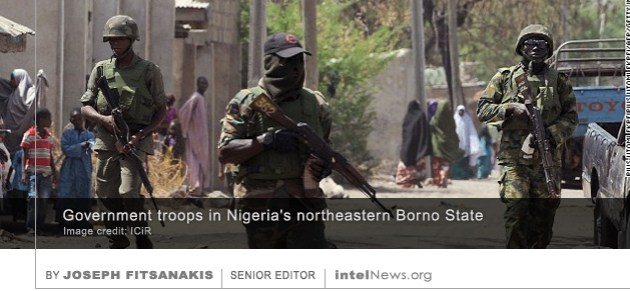
By early 2014, Boko Haram had managed to drive out all Nigerian government presence from the country’s northeastern Borno state and control an area of approximately 12,000 sq. mi. At that time, however, the Nigerian military, in association with Chadian and Nigerien forces, launched Operation LAFIYA DOLE, with the aim of recapturing Boko Haram’s territory. The operation involves thousands of Nigerian, Chadian and Nigerien ground forces, as well as airplanes and even construction crews, who built dirt roads leading deep into the Sambisa Forest in search of Boko Haram’s camps. As government forces have been advancing on all sides, Boko Haram fighters have retreated deeper into the 500-sq. mi. forest. On Saturday, the Nigerian president announced that government troops sacked Boko Haram’s “Camp Zero” and that the insurgents were desperately fleeing into the surrounding areas. There was no word about the fate of Shekau, the group’s leader. Read more of this post

Analysis: Russia did meddle in US election, but its goal was not to elect Trump

Trump 2016No person familiar with the theory and practice of intelligence will be shocked by allegations that Russia interfered in the recent American presidential election. On the contrary, the claim will strike experienced observers as a textbook case of covert operation —an intelligence activity designed to influence foreign political, military or economic developments. Far from being physically violent, most covert operations involve actions like secretly funding political parties, planting misinformation or propaganda in foreign media outlets and —in more extreme cases— bribing or extorting key political actors. During the Cold War, hardly a national election took place without attracting the covert attention of the Central Intelligence Agency (CIA) and its Soviet equivalent, the KGB. This practice continues today, as nearly every intelligence agency engages in covert operations of some form or other.

It would thus be extremely unusual and highly uncharacteristic of Russian spy agencies if they did not launch at least a rudimentary covert campaign to target the 2016 US presidential election. To not have done so would mean that the Russian intelligence apparatus failed to abide by its mission statement. Such an eventuality would be unthinkable, especially given the size and importance of the target. It should therefore be presumed that Russian spy agencies, in particular the Foreign Intelligence Service and the Main Intelligence Directorate, engaged in systematic efforts to meddleq-quote in last month’s US election. Indeed, the opposite would be strange.

The view that Russian spy agencies interfered in the US presidential election does not, for the moment, rely on publicly available evidence. The latter remains absent, though it is worth noting that, according to The Washington Post, US intelligence agencies concluded “with high confidence” that Russia meddled in the campaign over many months. It is always wise to treat claims in the media by unnamed “US officials” with some skepticism. But if The Post’s allegation is factual, then the words “with high confidence” are significant. The business of intelligence analysis is one of accuracy and precision. The term “high confidence” is rarely employed, and when it is, it typically denotes an almost indisputable degree of confidence in an analytical conclusion.

That the president-elect chose to automatically dismiss The Post’s allegations by describing them as “ridiculous” and denouncing the CIA in its entirety as “the same people that said Saddam Hussein had weapons of mass destruction” is worrying. It indicates a fundamental misunderstanding of the intelligence profession and its role in executive decision-making. Ideally, the president-elect should have remained silent until he had an opportunity to confer with the CIA and examine the evidence behind the report. Instead, during a Sunday morning interview on Fox News, Trump said simply: “I don’t believe it”. But this has nothing to do with belief. It has to do with facts and data, which he ought to examine before summarily dismissing an entire agency.

What is more, the evidence behind these allegations must be presented to the American people, who were the ultimate targets of the alleged operation. This was not about the two presidential q-quotecandidates. This was about the reputation of the American electoral process. In fact, the primary goal of Russia’s involvement in the US election —which, again, must be presumed— was not to empower a particular candidate, but to weaken the reputation of American political institutions as a whole. Those who claim that the Kremlin tried to promote Trump because the Republican candidate appears to be more favorably disposed toward Russia are wrong. They misunderstand the complex nature of Russian-American relations and underestimate Russian strategy. Moscow understands that its bilateral relationship with Washington rests on a set of longstanding geopolitical variables and does not depend on ephemeral personal relations between individual leaders. Furthermore, the Kremlin views Trump as an inherently unpredictable actor that is not to be trusted. The Russian plan, therefore, was not to help elect Trump. Rather, it was to sow mistrust between American –and by extension Western– civil society and its political institutions. Given the challenges currently being faced by European and American democracy, that is not a far-fetched goal.

The current state of American politics, which is characterized by ugly sectarianism the likes of which have not been witnessed since the Vietnam War, favors Russia’s strategic goals. Many Americans are currently convinced that the president-elect and some of his most senior aides are influenced by Moscow. Instead of actively trying to alleviate these concerns, Trump has now gone on an all-out offensive against the US Intelligence Community while essentially defending Russia. Americans who care about the current state and future of the Republic must be seriously concerned with this picture, regardless of their political affiliation. It may be that the history textbooks of the future will record the Russian meddling in the 2016 US presidential election as one of the most successful covert operations of modern times.

Author: Joseph Fitsanakis | Date: 12 December 2016 | Permalink

Analysis: Turkey’s entry in Syrian war further-complicates a chaotic conflict

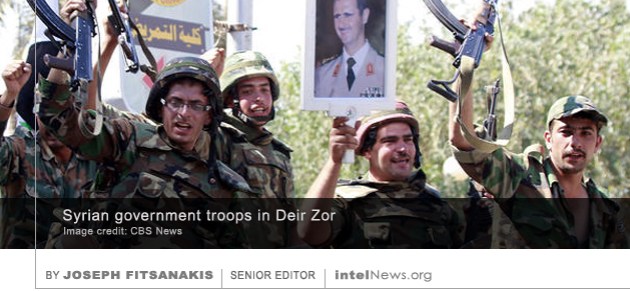
Syrian troopsEver since 2011, when the Syrian Civil War erupted, Turkey has refrained from directly intervening in the conflict, other than to provide material support to opponents of Syrian President Bashar al-Assad. The hope in Ankara was that Islamist and pro-Assad forces would exhaust each other. There is no evidence that Turkey was at any point seriously alarmed about the rise of Sunni militancy in Syria. Instead, the Turkish government of President Recep Tayyip Erdoğan made no secret of its primary concern, which was the rise of Kurdish nationalism in northern Syria.

However, a possible demise of the Islamic State may strengthen Kurdish forces in Syria and Iraq and could leave the al-Assad regime in place in Damascus. That would be the worst possible outcome for Turkey, which has always viewed the Syrian president a direct threat to its national security, surpassed only by Kurdish separatism. In a desperate effort to avoid such an outcome, Turkey is now increasingly intervening in the war. Its current goal is to have a strong say in how the region will look like once the Islamic State has been defeated.

With the exception of some pro-Turkish rebels, such as the Syrian Turkmen Brigades, who openly welcome Ankara’s intervention, no rebel factions in Syria are especially elated by Turkey’s entry in the war. Most recognize that the sole reason for Turkey’s intervention is the protection of its own national interest, which centers on preventing a rise of an independent Kurdish state —either official or de facto— in northern Syria.

Turkey’s involvement in the Syrian war will further complicate the conflict and is likely to prolong it. The more international actors are involved in the war, the more convoluted it gets and the longer it will take for it to end. Currently we have the Syrian government, various Sunni rebel forces, the Islamic State, Russia, the United States, Iran, Saudi Arabia, the Kurds, and several European powers involved in the war. The last thing this conflict needs is yet another foreign intervention, no matter where it comes from.

Moreover, Ankara’s overall role in the Syrian conflict has been inconsistent, as the country has at times sharply distanced itself from both Russian-led and American-led efforts in the region. President Erdogan’s policy on Syria —as on most other matters— has been spasmodic and haphazard, and has been primarily shaped by domestic concerns, as Turkey’s political strongman tries to solidify its rule inside the country. Consequently neither Moscow nor Washington have much faith in the reliance of the Turkish military contribution to the conflict.

The election of Donald Trump in the United States could further-complicate the regional balance of power in the Middle East and Turkey’s role in it. If a rapid rapprochement takes place between Washington and Moscow in 2017, Turkey will feel increasingly uneasy about its regional role. The Kurds, who have been working closely with Russia in Syria and with America in Iraq, will expect to be rewarded and compensated once the dust settles in the region. There have been voices in Moscow and Washington calling for the establishment of a de facto independent Kurdish state in northern Syria. If that happens, it will signal a massive setback for Turkey’s foreign policy and negatively affect its relations with Russia and possibly the United States.

Over a million people have now died in the Syrian civil war. Millions more have been displaced internally and abroad. Things could get immeasurably worse if Russian-led and American-led forces launch all-out attacks in Aleppo and Mosul respectively. There is no reason to believe at this point that the Islamic State and other rebel groups will abandon these cities, where over a million people remain trapped between the warring sides. We could be seeing the largest slaughter of civilians since World War II. At that point, there will be little that Ankara or anyone else can do to restore stability in that desperately troubled region.

Author: Joseph Fitsanakis | Date: 30 November 2016 | Permalink

Analysis: Is Putin planning to restore the Soviet-era KGB?

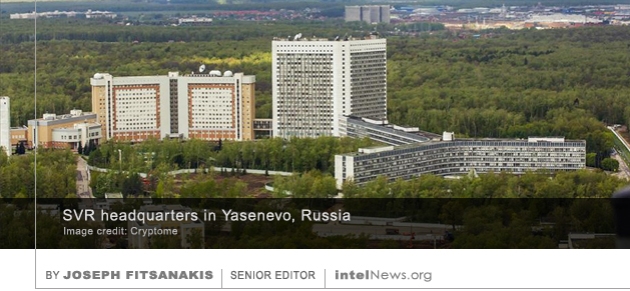
SVR hqLast week, following the results of Russia’s parliamentary election, Russian media run a story suggesting that the Kremlin is planning to implement far-reaching changes to the country’s intelligence apparatus. According to the Moscow-based daily Kommersant, the administration of President Vladimir Putin is considering merging Russia’s two major intelligence and counterterrorism agencies into one. Specifically, the Russian Foreign Intelligence Service, or SVR, will merge with the FSB, the Federal Security Service, according to Kommersant. The merger will create a new amalgamated intelligence agency that will be named “Ministry of State Security”, or MGB, in Russian. The last time this title was used was from 1946 to 1953, during the last years of the reign of Soviet Premier Joseph Stalin. It was one of several agencies that were eventually combined to form the Soviet KGB in 1954.

If the Kommersant article is accurate, Russia’s two main intelligence agencies will merge after an institutional separation that has lasted a quarter of a century. They were separated shortly after the official end of the Soviet Union, in 1991, when it was recognized that the KGB was not under the complete control of the state. That became plainly obvious in August of that year, when the spy agency’s Director, Vladimir Kryuchkov, helped lead a military coup aimed at deposing Soviet Premier Mikhail Gorbachev. The two new agencies were given separate mandates: the SVR inherited the mission of the KGB’s foreign intelligence directorates and focused on collecting intelligence abroad; the FSB, on the other hand, assumed the KGB’s counterintelligence and counterterrorist missions. A host of smaller agencies, including the Federal Agency of Government Communications and Information (FAPSI), the Federal Protective Service (FSO) and others, took on tasks such as communications interception, border control, political protection, etc.

Could these agencies merge again after 25 years of separation? Possibly, but it will take time. An entire generation of Russian intelligence officers has matured under separate institutional roofs in the post-Soviet era. Distinct bureaucratic systems and structures have developed and much duplication has ensued during that time. If a merger was to occur, entire directorates and units would have to be restructured or even eliminated. Leadership roles would have to be purged or redefined with considerable delicacy, so as to avoid inflaming bureaucratic turf battles. Russian bureaucracies are not known for their organizational skills, and it would be interesting to see how they deal with the inevitable confusion of a possible merger. It could be argued that, if Putin’s goal is to augment the power of the intelligence services —which is doubtful, given their long history of challenging the power of the Kremlin— he would be better off leaving them as they are today.

Author: Joseph Fitsanakis | Date: 04 October 2016 | Permalink

Analysis of the Islamic State’s ‘wedding attack’ in Gaziantep, Turkey

Gaziantep, TurkeySaturday’s suicide bombing, which killed over 50 and injured dozens at a wedding in Gaziantep, Turkey, was without doubt the work of the Islamic State. It was yet another attempt by the militant Sunni group to discourage the Kurds from confronting it in battle, by pointing to the deadly consequences. It was also fueled by the desire for vengeance against a population that has consistently resisted the Islamic State’s ideology. Additionally, if confirmed, the use of a child as a suicide bomber by the Islamic State may form a pattern of operational activity that can lead to broader conclusions about the current state of the organization.

It has become increasingly clear in the past two years that the armed Kurdish groups in northern Syria and Iraq, as well as Kurdish peshmerga units based in Turkey, are some of the most formidable opponents of militant Jihadists on the ground. By bombing soft targets inside Turkey, the Islamic State is sending a message to the Kurds that armed opposition on the ground will carry a heavy cost at home. Contrary to initial impressions, there was nothing special about the particular wedding ceremony that was targeted on Saturday. Any wedding would have been suitable for the Islamic State’s purpose. In fact, the randomness of the attack increases its shock value by demonstrating to the local population that any activity can be attacked, even if it does not involve notables. Additionally, the specific choice of a wedding magnifies the brutality of the attack, by targeting a young couple on what is typically the happiest day of their lives. The high concentration of children among the casualties may indicate that the bomber was given specific operational instructions to attack younger participants. The clear warning here is that the disruption will leave nothing untouched –including something as ‘off-limits’ as a couple on their wedding day, or groups of children– if the Kurds continue to fight the Islamic State.

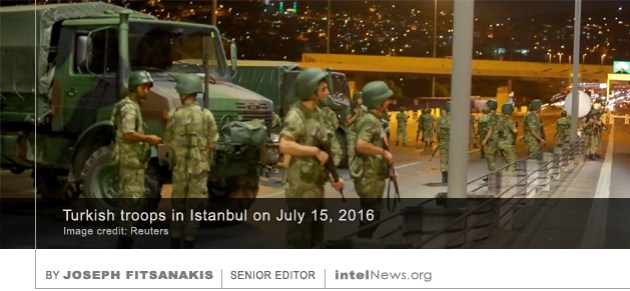
Moreover, the Islamic State is trying to widen the already deep division between the Turkish state and the Kurds, by exposing the inability of the government in Ankara to protect its Kurdish population from attacks. The Kurds already resent Turkey’s ‘soft policy’ on the Islamic State. They and the rest of the world can see that Ankara has typically viewed the government of Bashar al-Assad in Damascus as far more threatening than the continuing rise of Islamist fundamentalism. Since the failed July 15 coup, the Turkish state has begun to revise its soft stance on the Islamic State, but this comes too late to pacify the country’s infuriated Kurdish population. This latest attack will only intensify the deep anger felt by the Kurds against the Turkish state.

Initial reports indicate the possible use of a child or a teenager to carry out the Gaziantep bombing. These may or may not be accurate. They could easily be an attempt by the Kurds to further-incense international public opinion against the Islamic State. If the reports are accurate, they do not necessarily represent some sort of break from the traditional tactics of the Islamic State. According to the group’s war-fighting doctrine, there is no differentiation between men and children when it comes to what it sees as the defense of Sunni religious doctrine. Every Muslim, regardless of race, gender, or age, is required to engage in holy war. Indeed, the Islamic State has deployed children before, in warfare, executions and suicide bombings against both hard and soft targets. However, even though the use of a child to carry out the Gaziantep bombing is not in itself unique, or particularly important, it matters if it forms part of a broader pattern. If it is verified that ISIS is increasingly using children in suicide bombings, or in warfare, it may signify two things: first, that the organization is finding it difficult to recruit able-bodied men for missions. Second, that adult ISIS recruits are becoming scarcer, so the organization is trying to preserve them for decisive battles.

It may be, of course, that a child or younger teenager was selected in order to avoid security profiling by the Kurds. Still, the use of children in warfare or suicide missions can result in a large degree of unpredictability. Children may be relatively easy targets for recruiters, for the obvious reason that they are young and impressionable. Their reality can therefore be effectively altered by fantastical tales of the supernatural, which the Islamic State is very skilled at. However, children are not necessarily very dependable in war, or terrorism. They can be easily frightened, can change their mind at the last minute, and they do not stay calm under pressure. There are several recent examples of children or teenagers who were recruited for suicide operations but surrendered after changing their mind.

Ultimately, shocking massacres such as Saturday’s attack in Gaziantep cannot be prevented. They can only be limited through careful police and intelligence work. In the case of Turkey, however, this will be difficult. The country’s police, intelligence and military structures have been significantly weakened following the failed July 15 coup. Thousands of government officials, police officers, intelligence and military personnel have been fired, demoted or imprisoned. The state, which is becoming increasingly synonymous with the President Recep Tayyip Erdoğan’s AKP party, is too preoccupied with preserving its own stability to concentrate on combating the terrorist spillover from Syria.

Author: Joseph Fitsanakis | Date: 23 August 2016 | Permalink

Analysis: It seems everyone predicted the coup in Turkey except its spy agency

Turkey coupAfter the failure of the recent military coup d’état in Turkey, much attention has been given to the country’s armed forces, the police, even the judiciary. In contrast, little to no information has surfaced about Turkey’s intelligence establishment, which is led by MİT, the National Intelligence Organization. Did it anticipate the plot, and how did it fare as the crisis unfolded in the early hours of July 16?

Two days after the failed coup, American Congressman Peter King (R-NY), a senior member of the United States House of Representatives’ Committee on Homeland Security, claimed that “no one […] saw this coup coming”. Speaking on WNYM, a conservative talk-radio station in his home state of New York, Rep. King said that, as far as he was aware, “there was no diplomatic talk; there was no intelligence talk of this coup”. Speaking a day earlier, US Secretary of State John Kerry had stated that the White House had “no idea” that a coup was imminent in Turkey, and that developments in the country had “surprised everybody”.

As is often the case, King and Kerry were both wrong. Even as early as October of 2015, Norman Bailey, of the University of Haifa in Israel and the Institute of World Politics in Washington, was stating with certainty that Turkey’s “army will step in and take over” if it senses that the country is descending into chaos. On March 12 of this year, Russian observers warned that Turkey’s military was “gradually building up its political influence, thus laying grounds for a military coup”. Later in the same month, Michael Rubin, of the American Enterprise Institute, asked: “could there be a coup in Turkey?”, and answered that “no one should be surprised […] if the Turkish military moves to oust Erdogan and place his inner circle behind bars”. And on March 30, the esteemed journal Foreign Affairs hosted an article by Gönül Tol, founding director of The Middle East Institute’s Center for Turkish Studies, in which she explained that Turkey was about to face its “next military coup”. During an interview on July 2 of this year, the present author spoke about the “very volatile situation within [Turkey]” and added: “I can’t think of any countries in the region that are more unsettled and unpredictable right now than Turkey”.

If analysts relying on open sources were able to issue concrete warnings about Turkey’s political instability at least a year in advance of the coup, it should be taken for granted that intelligence observers were equally alarmed over the same period. We know, for instance, that American intelligence analysts were “concerned for months” prior to the coup “about simmering tensions between President […] Tayyip Erdoğan and Turkish military brass”. Read more of this post

Analysis: Mullah Mansour’s killing will shape future of Afghan War

Mullah MansourThe American operation that killed the leader of the Afghan Taliban, Mullah Akhtar Mohammad Mansoor, on May 21, was unprecedented in more ways than one. It marked the first known effort by the United States to neutralize the leadership of the Afghan Taliban. It was also the first US drone strike in Pakistani Baluchistan, a region that is far removed from the Federally Administered Tribal Areas, where American operations have traditionally focused. Mullah Mansour’s killing also marked the most high-profile American incursion into Pakistani territory since the May 1, 2011 attack that killed al-Qaeda co-founder Osama bin Laden. Q QuoteIronically, just hours before killing Mansour, Washington was calling the Taliban to join the negotiation table for peace talks with the Afghan government. So what exactly was America’s intention in killing the leader of the Afghan Taliban?

PROSPECTS FOR A MODERATE SUCCESSOR

There is no question that Mansour represented the most intransigent and militant segment of Afghanistan’s militant Pashtuns. He consistently dismissed efforts by Washington and Kabul to strike a deal with his forces as a ploy designed to weaken the Taliban’s role in Afghan politics. So the primary outcome that the US is seeking from his death is the possibility that a more moderate figure will emerge from within the ranks of the Taliban. That, however, is far from guaranteed. Even if it does happen, it will probably come after a period of leadership struggle between different factions and tribes within the Taliban, much like the heated infighting that broke out after the announcement of the death of the Taliban’s founding leader, Mullah Mohammad Omar. There are even some who believe that the death of two successive Taliban leaders in such a short period may split the group into three or more factions.

To avoid such a prospect, the Afghan Taliban have already begun internal consultations in order to quickly enthrone a new emir. Major candidates include the late Mullah Omar’s son, Mullah Yakoub, and his brother, Mullah Abdul Manan Akhund. The list of contenders also features the late Mullah Mansour’s deputies, including Sirajuddin Haqqani, head of the Haqqani Network, which recently consolidated its forces with those of the Afghan Taliban. Many observers believe that Haqqani is Mansour’s most likely successor, as well as the most militant of all contenders for the group’s leadership.

THE END OF PEACE NEGOTIATIONS?

If the Afghan Taliban are led by Haqqani, a man described by the White House as a terrorist mastermind, the chances of seeing Afghanistan’s militant Pashtuns join peace negotiations with Kabul are slim to none. The country’s President, Ashraf Ghani, said last week that he hoped that the death of Mansour would weaken the Taliban hardliners and open the path to negotiations with his government. It is difficult to see, however, how the Taliban could sit at the table with the Afghan government and its American allies, namely the same people who just Q Quotekilled the group’s leader.

They only way that could possibly happen is if Pakistan, which is the Afghan Taliban’s state patron, compels them to do so. But such a prospect is unlikely. In the hours after Mansour’s assassination, the US Secretary of State John Kerry described it as an “action that sends a clear message to the world that we will continue to work with our Afghan partners”. Indeed, Mansour’s killing was a source of jubilation in Kabul. But there were no celebrations in Islamabad, which was notified about the US drone strike on its soil after its completion. The Pakistani position has always been that military action against the Afghan Taliban will only push them further underground. Instead, Pakistan argues that the Taliban should be brought to the table to sign a comprehensive peace treaty that will ensure ethnic rights for Afghanistan’s Pashtun population. But the prospect of that happening after Mansour’s assassination are slim, even if a more moderate figure succeeds him at the helm.

THE FUTURE OF THE AFGHAN WAR

What are, then, the prospects for peace in Afghanistan? A notable rise in violence should be expected, as various Taliban factions lash out against the government in Kabul with the aim of augmenting their standing against internal competitors. The Taliban now control more territory in Afghanistan than at any other point following the 2001 US invasion. If their alliance with the Haqqani Network survives, they will continue to be a formidable force in the country and the surrounding region, and will become increasingly difficult to defeat militarily. The group will continue to operate with considerable force even if Mansour’s position is not filled soon, as local Taliban forces have shown that they are capable of taking unilateral initiative in times like this. In the meantime, observers in Kabul and Islamabad, as well as the Afghan Taliban’s leadership in Quetta, will be wondering whether the assassination of Mansour marks the beginning of a more aggressive approach by Washington in the ongoing Afghan war. The answer to that question remains elusive, but will likely shape the future of the 40-year-old Afghan war.

Author: Joseph Fitsanakis | Date: 24 May 2016 | Permalink

EgyptAir Flight MS804: Was it a terrorist attack?

EgyptAir MS804In the early hours of Thursday, May 19, EgyptAir, Egypt’s national airline carrier, announced via Twitter that flight MS804 had vanished from the radar. The regularly scheduled flight had departed Paris, France, on time at 11:09 p.m. and had been scheduled to arrive in Egyptian capital Cairo at 3:05 local time. The airplane, an Airbus A320-232, was carrying 59 passengers and 10 crew. According to reports, the airplane disappeared over the eastern Mediterranean, southeast of the island of Crete.

Was this a terrorist attack? It will be several hours before this question can be conclusively answered. However, there are some early indicators that can help shed some light on the incident.

1. What has happened to the plane? The plane has almost certainly crashed into the sea. It has now been five hours since it disappeared from the radar. The eastern Mediterranean is not like the vast Indian Ocean, where Malaysia Airlines Flight 370 literally disappeared in March 2014, never to be found. In the case of EgyptAir MS804, if the plane had landed at a regional airport, the sighting would have been reported immediately —even if it was in rebel-held Syrian regions, or Islamic State-controlled territory in Iraq.

2. If the plane has indeed crashed, what brought it down? The possibility of a mechanical failure cannot be excluded. However, the plane is relatively new; it was built in France in 2003 and is less than 13 years old, which may mean that a serious mechanical failure is relatively unlikely. Additionally, weather conditions over the eastern Mediterranean were reportedly “clear and calm” at the time when the plane vanished from the radar. Last but not least, it must be stressed that there was reportedly no distress call made by the pilots or crew before the flight disappeared from radar screens. Which brings us to the next question, namely:

3. Was this a terrorist attack? American and European intelligence agencies, including France’s own DGSE, have warned repeatedly in previous weeks that the Islamic State was “planning new attacks […] and that France [was] clearly targeted”. The Islamic State is currently one of very few terrorist organizations that have the technical expertise and momentum to compromise security measures at a European airport. Moreover, the Islamic State has declared war on France, has attacked the country numerous times, and has stated repeatedly that it intends to continue and even intensify itsQ Quote efforts. The group has remained silent since early this morning, when EgyptAir announced the disappearance of flight MS804. However, it typically waits for several hours, and sometimes days, before assuming responsibility for high-profile attacks.

4. If it was a terrorist attack, how was the plane brought down? It is important to note that the plane is believed to have been flying at 37,000 feet when it vanished from radar screens. This means that, assuming that a non-state actor caused the aircraft’s disappearance, the attack must have been perpetrated from inside the plane. At least three of the 10-member crew are believed to be armed security guards. If that is the case, a team of hijackers would have to have been sizeable enough and sufficiently armed to overpower three armed security guards. What is more likely is that a bomb may have been planted on the plane, either in Paris or Cairo (the plane was returning to Cairo, having left from there for Paris earlier on Wednesday). The last time that the Islamic State assumed responsibility for downing an airliner, it did so by planting a bomb aboard the plane with the help of a ground worker in Egypt who had secretly joined the militant group.

5. If it was a terrorist attack, what does it mean? Should the Islamic State assume responsibility for this attack, it will make it increasingly difficult for France —and possibly other Western European nations— to resist putting boots on the ground in Iraq and Syria. Moreover, if a bomb was planted on the plane at Paris’ Charles De Gaulle airport, it will mean that the Islamic State, or possibly another militant group, has found a way to beat what are perhaps the most stringent airline travel security measures in all of Europe. It could be that the group behind this possible terrorist attack has found a unique and thus far unforeseen way to defeat the latest technological measures used to secure airline travel. Such a possibility could spell even more massive changes for the world’s airline industry, which is already reeling from all sorts of financial and administrative pressures in the post 9/11 era.

Analysis: Taliban-Haqqani alliance marks new phase in Afghan war

Haqqani NetworkAn expanding alliance between two of the most powerful armed groups in Afghanistan, the Taliban and the Haqqani Network, is reshaping regional power dynamics and possibly altering the course of the ongoing Afghan war. It was last summer when it was announced that Sirajuddin Haqqani, the leader of the notorious Haqqani Network based in southeastern Afghanistan, had been appointed deputy leader of the Taliban. The move, which brought together two groups that traditionally acted autonomously, was seen as largely symbolic at the time. But observers are now suggesting that the two groups are actively integrating more than ever before, and that their increasing cooperation is drastically changing the dynamics of the bloody Afghan war.

THE HAQQANI NETWORK

The Haqqani Network dates from the mid-1970s, when a group of pro-royalist Pashtuns took up arms against the government of Mohammad Daud Khan, a former cabinet minister who in 1973 led a coup that overthrew the country’s king, Mohammad Zahir Shah. The group, founded by Jalaluddin Haqqani, was actively supported by Pakistan, which perceived Khan’s government as pro-Soviet. As it became increasingly clear that the Soviet Union would invade the country, Pakistan’s assistance to the Haqqani Network was augmented by support from Saudi Arabia and the United States. During the Afghan-Soviet War of the 1980s, the Haqqani Network formed a major backbone of the anti-Soviet resistance. The group, and the Pashtun tribes that form its base in Afghanistan and Pakistan, have remained in a state of war against various invaders ever since. Today the Haqqani Network is led by Jalaluddin’s son, Sirajuddin Haqqani, who has closely followed in his father’s footsteps. He has continued to pledge allegiance to the Taliban by recognizing its commander-in-chief, Mullah Akhtar Mansour, as the Leader of the Faithful —essentially the Emir of the Islamic caliphate. At the same time, however, like his father, Siraj has maintained the Haqqani Network as an autonomous entity that operates based on its own command structure andQ Quote tactical priorities.
THE HAQQANI-TALIBAN ALLIANCE

The deepening cooperation between the Haqqani Network and the Taliban must be examined within the context of the failed efforts to broker a peace treaty between the Afghan government and the Taliban. In early 2016, the Quadrilateral Coordination Council, set up by the United States, China, Pakistan and the Afghan government, sought to bring the Taliban to the negotiation table, so that an official peace treaty could be put in place between them and Kabul. Throughout that time, however, the Afghan government has become increasingly weaker, faltering under the weight of its own ineptitude, corruption and sectarian divisions. The growing discontent against it among the people, as signified by the rise in mass immigration by young Afghans, has weakened Kabul’s trustworthiness as a national actor and strengthened the Taliban. At the same time, the Taliban, although strong, are not unilaterally capable of solidifying their power across the country unless they have the support of the many autonomous tribes and clans. For that reason, Taliban leader Mullah Mansour has spearheaded a policy of consolidation between his forces and regional groups, including the Haqqani Network.

The latter are also extremely capable militarily, having maintained a powerful armed force since the late 1970s, with its own heritage, traditions and command structure. During the 1980s, they were trained and supplied with ample war materiel by Saudi, Pakistani and American intelligence agencies, while also developing their own funding channels abroad. Today, Siraj Haqqani’s mother, who is an Arab, and many of his brothers, are located in the Persian Gulf, and are able to pursue alliances between the Network and oil-rich Arab donors. The group also maintains a large network of shell companies that operate internationally and bring in a substantial revenue to the group. Consequently, due to their strong financial backing, Haqqani forces are well-trained, well-supplied and have near-unparalleled military capabilities in the region. They are currently one of a handful of groups that have shown to be capable of striking at the heart of the Afghan government inside Kabul. Alongside their military prowess, Haqqani forces maintain an efficient, parallel administrative infrastructure in southeastern Afghanistan, which includes a justice Q Quotesystem, job centers, taxation offices and community militias. The administrative and military efficiency of the Haqqani Network only adds to the strength of the Taliban and places them in a renewed position of power vis-à-vis Kabul.
THE PAKISTANI FACTOR

Along with the Haqqanis and the Taliban, the Pakistanis have also gained strength in the past year as a regional actor. There is little doubt that the Haqqani Network, which operates a series of bases inside Pakistan’s North Waziristan region, maintains close connections with Inter-Services Intelligence directorate (ISI), Pakistan’s powerful spy agency. These links, which were forged in the 1980s during the Afghan-Soviet War, continue unabated and often —though not always— allow the Pakistanis to use the Haqqani Network as a proxy group to advance their interests in Afghanistan. Islamabad does not want India to dominate the region and has done more than any other regional actor to maintain the Taliban, Haqqanis, and other Pashtun groups as strong rivals to the central government in Kabul. By strengthening the role of the Haqqanis, which, unlike the Taliban, the US officially classifies as a terrorist group, Islamabad is making it more difficult for Washington to reach out to the Taliban in search of a comprehensive peace treaty. This development spells more violence and war in Afghanistan for the foreseeable future, as local and regional actors appear to be positioning themselves for a showdown between the Afghan government and its tribal rivals.

Author: Joseph Fitsanakis | Date: 10 May 2016 | Permalink
Analysis: The security implications of the Panama Papers

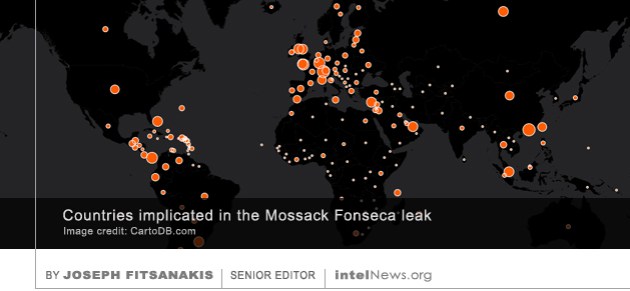
First Post HAside from their immediate shock value, the Panama Papers reveal the enormous extent of tax evasion on a worldwide scale. This unprecedented phenomenon is inextricably tied with broader trends in globalized finance-capitalism that directly threaten the very survival of the postwar welfare state. National intelligence agencies must begin to view offshore tax evasion as an existential threat to the security of organized government and need to augment their economic role as part of their overall mission to protect and secure law-abiding citizens.
THE BACKGROUND OF THE LEAK

The source of the Panama Papers leak —the largest in history— is apparently a single individual who contacted the widely respected German newspaper Süddeutsche Zeitung over a year ago. After receiving assurances that his or her anonymity would be safeguarded, the source proceeded to provide the paper with what eventually amounted to over 11.5 million files. They include company emails, banking transaction records, and files of clients that span the years 1977 to 2015. The source asked for no financial compensation or other form of reimbursement in return, saying only that he or she wanted to “make these crimes public”.

Faced with the largest data leak in recorded history, the Süddeutsche Zeitung reporters contacted the International Consortium of Investigative Journalists (ICIJ), which is the international arm of the Washington-based Center for Public Integrity. With ICIJ acting as an umbrella group, the German reporters were eventually joined by 370 journalists representing 100 news outlets from 76 Q Quotecountries. On Sunday, following a year-long analysis of the data, the reporting partners began publishing revelations from the Panama Papers, and say they will continue to do so for several days to come.

THE ROLE OF MOSSACK FONSECA

The documents are from the internal records of Mossack Fonseca, a law firm headquartered in Panama City, Panama, with offices in 42 countries. The company is one of the world’s most prolific registrars and administrators of shell companies in offshore locations. It has created more than 300,000 shell companies throughout its history, most of them in offshore tax havens like the British Virgin Islands, Cyprus, or Guernsey. Its clients are offered the ability to incorporate a generic-sounding company and headquarter it in an offshore tax haven. In exchange for an annual fee, Mossack Fonseca provides the company with a sham director and shareholders, thus concealing the true owner and actual beneficiary of the business.

The power of the leaked documents is that they reveal the actual owners of 214,000 offshore shell companies managed by Mossack Fonseca. The long list of names includes dozens of current and former heads of state, as well as hundreds of politicians, public figures and celebrities. Many of these individuals have failed to declare their earnings from their shell companies in their annual tax Q Quotestatements, which means they have not been paying taxes in their country of citizenship or residency. Thus, there are now thousands of Mossack Fonseca clients in over 100 countries who are preparing to face the legal consequences of tax evasion.
SECURITY IMPLICATIONS

Equally importantly, however, the leaked documents reveal that Mossack Fonseca’s clients appear to include at least 33 individuals and companies that are involved in organized crime or have close contacts with terrorist organizations. This sheds light on the increasingly disappearing line that once separated illicit activities such as tax avoidance and tax evasion, from money laundering, organized crime and terrorism. This phenomenon is assisted by unscrupulous companies like Mossack Fonseca, which act as anonymizing platforms for wealthy celebrities, criminals and terrorists alike.

The leak also shows the extent to which national governments have been unable to stem the tide of unfettered finance-capitalism, which today threatens the stability and cohesion of developed and developing economies alike. Moreover, the sheer scale of offshore capital funds, which, according to one expert, amount to as much as $32 trillion, threaten the economic security of nation states and must be viewed as an existential threat to the ability of states to fund public expenditures though taxation. The political arrangement that led to the creation of the postwar welfare state is today being directly threatened by the inability or unwillingness of organized states to monitor the largely unregulated flow of capital to offshore tax havens.

Today, entire economies, including much of southern Europe, the Balkans, as well as Latin America, are crumbling under the fiscal weight created by mass-scale tax evasion and organized crime. Organized criminals are now actively working closely with the banking sector, thus creating even more opportunities for money laundering and other financial illegality on an unprecedented scale. The Süddeutsche Zeitung revelations demonstrate that the line that separates legitimate economic activity from the rogue underbelly of global capitalism is exceedingly thin. It is high time that Western intelligence agencies viewed this worrying development as an asymmetrical threat against the security of law-abiding societies and began dealing with offshore tax havens with the same intensity that they have displayed against terrorist safe havens since 9/11.

Author: Joseph Fitsanakis | Date: 04 April 2016 | Permalink

Comment: Europe’s answer to Brussels bombs may be more damaging than ISIS

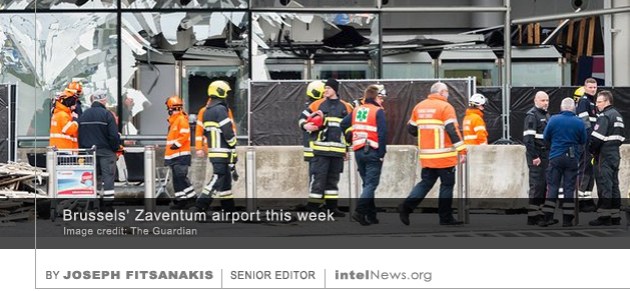
Brussels airportIn the past year, the Islamic State has claimed responsibility for at least nine terrorist attacks on foreign capitals. The growing list, which features Jakarta, Tunis, Paris, Beirut, Ankara, and Kuwait City, now includes the Belgian capital, Brussels. At least 34 people died in the attacks that rocked Brussels’ Zaventum airport and Maelbeek metro station on March 22, while another 300 were injured, 60 of them critically. This week’s bombings officially constitute the bloodiest terrorist attacks in Belgium’s history, prompting the country’s government to declare three days of national mourning.


Why did the Islamic State attack one of Europe’s smallest countries, with a population of just over 11 million? Some have suggested that Brussels was targeted by the terrorist group because it was an easy target. Observers noted that Belgium’s security and intelligence services are underfunded and demoralized —a “weak link in Europe”, in the words of one expert. There is no question that Belgium’s security apparatus is in need of serious overhaul; but the need is equally great in Amsterdam, in Athens, in Madrid, in Dublin, and elsewhere in Europe. In fact, the Islamic State could have struck any of these European capitals with the same ease that it attacked Brussels —and might still do so.

In reality, the Islamic State’s decision to attack Brussels was carefully calculated and consistent with the group’s overall strategy. The primary reason that the Islamists attacked Brussels is that Belgium is one of 30 countries that actively participate in the Combined Joint Task Force, the international group behind Operation Inherent Resolve. Led by the United States military, the operation has been targeting Islamic State forces in Iraq and Syria since October 2014. The Islamic State wished to send a message to Europeans that their military intervention in the Middle East will be costly at home. Secondly, Brussels was struck because it is the headquarters of the European Union, which last month declared the Islamic State’s campaign against religious and ethnic minorities in Syria and Iraq as an act of genocide. Third, and perhaps most importantly, Belgium was targeted because a significant percentage of its population —as much as 7 percent by some estimates— is Muslim.

What is more, the degree of integration of Belgian Muslims in mainstream life is markedly limited and partly explains why so many of them —400 by some estimates, the highest per-capita number in Europe—have emigrated to Syria and Iraq in order to join the Islamic State. It is worth remembering that the Islamic State emerged as the de facto guarantor or Sunni Muslims by essentially provoking Iraq’s Shiites to attack and marginalize the country’s Sunni Arab minority. Following a series of Shiite attacks against Sunni communities in Iraq, which were part of a broader post-2003 sectarian conflict between Sunnis and Shiites, the Islamic State emerged as the protector of Sunni Arabs and has since fought against Syrian Alawites, Hezbollah, Iranian forces, Iraqi Shiites, and others. Its popular support in Iraq and Syria stems from the fear held by Sunni Arabs that, if the Islamic State is defeated, their communities will be exterminated by vengeful and unforgiving Shiites.

Having gained from sectarianism in the Middle East, the Islamic State is now implementing the same tactic in Europe. It is thus targeting countries like France and Belgium, which have significant Muslim populations, in order to provoke aggressive reactions against domestic Muslim communities. In other words, it expects that attacks like those in Belgium will favor extremist ideologies throughout the European continent, and in turn further-marginalize European Muslims. The rise of Islamophobia, the strengthening of extremist political parties, and the disintegration of European values such as acceptance and tolerance, are likely to create a new generation of disaffected European Muslim youth, many of whom will be prime candidates for Islamic State membership.

European societies must not allow the Islamic State to change the political identity of an entire continent through violence. Along with meticulous police and intelligence work, the bombs in Brussels must be answered with concerted attempts to deepen the social integration of European Muslims, and more broadly to promote cohesion between ethnic and religious groups in Europe. Anything short of that will provide the Islamic State with the same strategic advantage it has enjoyed in the Middle East for nearly a decade.

* Joseph Fitsanakis is Assistant Professor in the Intelligence and National Security Studies program at Coastal Carolina University in the United States.

Analysis: The real danger in Syria is not ISIS, but a war between major powers

Vladimir PutinThere are many unpredictable aspects of the Syrian conflict, but the downing of the Russian bomber by Turkish jets on Tuesday was not one of them. Indeed, given the simultaneous military campaigns taking place in a relatively small swath of territory by Russian, American, French, Syrian, Iranian, and other forces, it is surprising that such an incident did not happen earlier. Nevertheless, the downing of a Russian Sukhoi Su-24 by Turkish jets marked the first attack on a Russian fighter aircraft by a North Atlantic Treaty Organization (NATO) member state since 1953. Although this incident is not by itself sufficient to provoke an armed conflict between Turkey and Russia, it illustrates the main danger confronting the world in Syria: namely a conflagration between regional powers, many of which are armed with nuclear weapons.

In response to earlier incidents, Turkey had warned the Russian Air Force that it would not tolerate further violations of its air space by Russian jets conducting an air campaign in support of Syrian President Bashar al-Assad. The message delivered to the Russian ambassador in Ankara was that Turkish pilots would be ordered to open fire next time. That was precisely what happened on Tuesday, when a Turkish F-16 jet brought down a Russian bomber aircraft with a single missile strike. By most accounts, the Russian airplane was barely two miles inside Turkish airspace, presented no immediate threat to Turkey’s national security, and would probably have returned to Syrian airspace within seconds. But that did not stop the Turkish F-16 from shooting down the Russian plane. Adding injury to insult, Turkish-backed rebels on the Syrian side of the border shot dead one of the plane’s two Russian pilots and opened fire on a Russian rescue team that tried to save the crew, killing at least one marine.

Rather expectedly, a visibly furious Russian President Vladimir Putin, who is not used to being challenged militarily, described the incident as “a stab in the back” by “accomplices to terrorists”, and warned Ankara of “serious consequences”. But why would Turkey provoke Russia in such a direct way? Like every other country involved directly or indirectly in the Syrian Civil War, Turkey and Russia wish to see the Islamic State of Iraq and Syria (ISIS) Q Quotedestroyed. But they differ drastically on what should follow. The Kremlin is adamant that President al-Assad, whom it considers its strongest ally in the Middle East, should remain in power. The Turks, on the other hand, view the Syrian president as an existential threat, due to his support for Kurdish militancy throughout the region.

The roots of the animosity between the Turkish state and the al-Assad regime go back to 1978, when the Kurdistan Workers Party (PKK) was established in Lebanon’s Beqaa Valley, which was at the time occupied by Syria. The PKK is a Marxist militant organization that seeks to establish a Kurdish homeland in eastern Turkey and northern Iraq. The group was actively trained, funded, armed and protected by Syria and the Soviet Union. The latter was actively interested in destabilizing Turkey, a NATO member, while Syria used the PKK to exercise pressure on its northern neighbor, with whom it was embroiled in a series of complex land- and water-rights disputes. In 1998, the al-Assad regime was forced to expel PKK leader Abdullah Öcalan, who was living in Damascus under Syrian protection, after Turkey threatened an all-out war if the Syrian intelligence services continued to shelter the PKK leadership.

Ankara saw the outbreak of the Syrian Civil War in 2011 as an opportunity to get rid of the al-Assad regime, which it sees as a primary threat to regional stability. Along with the United States, Turkey has been funding, arming and training a host of Syrian rebel groups, while at the same time hosting over 2 million refugees from Syria. The subsequent rise of ISIS alarmed America and its Western allies; but in the eyes of Ankara, ISIS pales into insignificance in comparison to the resurgence of Kurdish nationalism, which has been fueled by the demise of Ba’ath in Iraq and the fragmentation of Syria. For Turkey, Kurdish separatism poses an existential threat to the survival of the Turkish Republic, and is the primary reason for its involvement in the Syrian conflict.

It follows that Russia’s entry in the Syrian Civil War strengthens President al-Assad and the PKK, and is thus regarded by Turkey as a direct threat to its national security. Ankara is also concerned about France’s efforts to build a broad anti-ISIS alliance that includes Russia, and fears that the West is now openly flirting with the possibility of allowing al-Assad to stay in power in Damascus. The deliberate downing of the Russian airplane, which was undoubtedly authorized by the most senior levels of government in Ankara, was aimed at disrupting France’s efforts to build an anti-ISIS coalition, while at the same time pushing back against Russia’s regional ambitions.

What will happen next? Theoretically, Turkey could invoke Article 5 of the NATO charter, which would compel member-states to rush to its assistance. In reality, however, such an eventuality is remote, especially given the expressed willingness of Western leaders to help deescalate the Turkish-Russian row. Following their closed-door meeting on Tuesday, French President FrancoisQ Quote Hollande and his American counterpart Barack Obama went out of their way to avoid mentioning the Russian plane incident, and briefly commented on it only after they were asked to do so by reporters. This does not mean that Russia will not respond; but it will most likely do so behind the scenes, probably by increasing its support for the PKK and other Kurdish separatist groups.

The downing of the Russian bomber highlights the immense contradictions and complica- tions that plague the anti-ISIS forces involved in the Syrian Civil War. It is clear that ISIS is now in a position to attack targets that are located far from its territory in Syria and Iraq, or in its wilayah (provinces) in Libya, Somalia, and elsewhere. However, the threat that ISIS currently poses to international peace and stability is at most marginal and symbolic. Of far more importance to the security of the world is the possibility of an armed conflagration between regional powers, which are being drawn into Syria by the vacuum created by the civil war. All of these regional powers, including Turkey, Russia, Iran, Saudi Arabia, Lebanon, Israel, and the US, are heavily armed, many with nuclear weapons. Moreover, they radically disagree on what a post-ISIS Middle East should look like.

The possibility of a serious conflagration between heavily armed regional actors will be removed only if and when the Syrian Civil War ends, even if that results in the loss of land to the so-called Islamic State. That must be the immediate goal of the Combined Joint Task Force and every other regional actor that wishes to see the end of ISIS. It is only after peace has been achieved in Syria that ISIS can be dealt with effectively.