Iran announces spy arrests after Ahmadinejad helicopter ‘accident’

Iran and its regionBy IAN ALLEN | intelNews.org |
Iran announced the arrest of an alleged 12-member spy network on Sunday, just hours after a helicopter carrying the country’s President was forced to make an emergency landing due to an unspecified “accident”. Iran’s state controlled media reported late on Sunday that the alleged spy ring had been instructed “to carry out terrorist acts” aimed at disrupting the Iranian presidential election, which is to be held on June 14. In a carefully worded statement, the Iranian Intelligence Ministry said the alleged spy ring operated under the direction of Israel’s covert-action agency, Mossad. The statement added that the ring’s leader had been recruited through “a reactionary Arab country” in the region and his espionage and sabotage activities in Iran were directed from “a headquarters in Britain”. Unconfirmed news reports claimed yesterday that “a remarkable amount of weapons” had been confiscated by Iranian counterintelligence forces as they apprehended the 12 ring members. The government’s statement said the weapons were meant to be used to “conduct terrorist acts” before and during the June 14 election day, and to “create ethnic and religious divisions” inside the country. On June 14, Iran is scheduled to hold its first presidential election since 2009, when the reelection of Mahmoud Ahmadinejad sparked mass demonstrations organized by the opposition ‘Green Movement’. Some have called these demonstrations a precursor of the Arab Spring, which led to the toppling of regimes in several Arab countries, including Egypt and Libya. Read more of this post

Ex-Mossad official denies Zygier compromised intelligence operation

Ben ZygierBy JOSEPH FITSANAKIS | intelNews.org |
A former Mossad official has dismissed as “nonsense” suggestions that an Australian-born Israeli spy, who killed himself in 2010, had been jailed for inadvertently compromising an Israeli secret mission. Ben Zygier was an officer in Israel’s covert-action agency Mossad for several years before he was placed in solitary confinement following his arrest in Israel, in February of 2010. Known to the outside world only as ‘Prisoner X’, he allegedly killed himself in his cell a few months later. In March, German newsmagazine Der Spiegel alleged that Zygier was arrested by Israeli intelligence after contacting a Lebanese Hezbollah operative without Tel Aviv’s authorization. The Australian-born spy was allegedly trying to recruit the operative on his own initiative and without permission from his superiors. In order to prove his Mossad credentials, Zygier is said to have given the man several names of Israel’s double agents operating inside Hezbollah. But the Lebanese recruit surrendered Zygier’s information to Hezbollah, which promptly arrested many of Israel’s informants inside the organization. Those arrested included Ziad al-Homsi, who at the time was believed to be one of the Mossad’s most lucrative assets inside the Lebanese militant group. On Tuesday, the Australian Broadcasting Corporation said that, at the time of his arrest in Lebanon, al-Homsi was preparing to assist the Mossad in recovering the bodies of three Israeli soldiers that had been killed in Syria during the 1982 Lebanon War. Read more of this post

Israel spy agency has presence in Syria, says senior rebel general

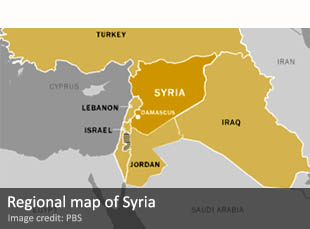
Regional map of SyriaBy JOSEPH FITSANAKIS | intelNews.org |
Israel is one of several countries that maintain a significant intelligence presence inside Syria, according to the top commander of the Syrian rebel forces. General Salim Idriss, Chief of Staff for the Free Syrian Army, told CNN’s Christiane Amanpour that the Jewish state has “many, many” intelligence officers in various parts of Syria. The Arab country has been rocked since 2011 by a violent civil war, which has cost the lives of at least 60,000 people. Idriss was responding to comments made earlier this week by Brigadier General Itai Brun, senior intelligence analyst for the Israel Defense Forces (IDF). Brun, who heads the Division for Research and Analysis of the IDF’s Military Intelligence Directorate, was speaking at a conference hosted in Tel Aviv, Israel, by the Institute for National Security Studies. He told an audience of intelligence experts that the IDF was “quite certain” that the Syrian government headed by President Bashar al-Assad had resorted to the use of chemical weapons against rebel forces on at least one instance. According to Brun, footage obtained by the IDF of rebel casualties from a March 19 attack by Syrian government forces, pointed to the use of sarin nerve gas. He referred to evidence such as the victims’ dilated pupils and “the foam coming out of their mouths” as strong proof of the use of weaponized sarin nerve gas in the battlefield. Responding to Brun’s allegations, General Idriss suggested that Syrian government forces had used chemical weapons repeatedly in a variety of locations, including Aleppo, Homs, and the outskirts of capital Damascus. Read more of this post

Israel’s Prisoner X ‘gave Mossad secrets to Hezbollah’: German report

Ben ZygierBy JOSEPH FITSANAKIS | intelNews.org |
An Australian-born Israeli spy, who killed himself while being held in an Israeli prison in 2010, had been arrested for sharing Israeli secrets with the Lebanese militant group Hezbollah, according to a German report.  Ben Zygier was an officer in Israel’s covert-action agency Mossad for several years before he was placed in solitary confinement following his arrest in Israel, in February 2010. Known to the outside world only as ‘Prisoner X’, he allegedly killed himself in his cell a few months later. In February of this year, when an Australian television program identified ‘Prisoner X’ as Zygier, the Australian government admitted it had been aware of its citizen’s incarceration and death, but chose not to extend to him diplomatic support. One of the burning questions in the Zygier case relates to the precise reasons for his detention. On Sunday, German newsmagazine Der Spiegel said that the Australian-born Zygier was arrested by Israeli intelligence after contacting —on his own initiative and without permission— an individual with links to militant Shiite group Hezbollah. According to the Spiegel report, Zygier had been demoted from an operations officer to a desk clerk, having failed to produce actionable results after several years of fieldwork in Europe. Seeing his demotion as a major obstacle to his career, the Australian-born spy allegedly embarked on a ‘rogue’ mission, in an attempt to impress his Mossad superiors. In 2008, when the Israeli government allowed Zygier to return to Australia to pursue graduate studies, he secretly traveled to Europe and established contact with a man from a Balkan country known to have close links with Hezbollah, considered by Tel Aviv as one of Israel’s mortal enemies. Read more of this post

Israel wiretapped PLO head office in Tunisia: report

Yasser Arafat in Tunis in 1993By JOSEPH FITSANAKIS | intelNews.org |
Israeli intelligence was able to intercept the conversations of senior Palestinian leaders in Tunisia in the months leading to the 1993 Oslo Accords, according to an article published Monday by a leading Israeli newspaper. Veteran security correspondent Ronen Bergman wrote in Yedioth Ahronoth  that sophisticated listening devices were planted in the office of Mahmoud Abbas. Today, Abbas, known also as Abu Mazen, is the President of the Palestinian National Authority, based in the occupied West Bank. But in 1993 he was Deputy Chairman of the Palestinian Liberation Organization (PLO), serving under its founder and Chairman, Yasser Arafat. At that time, the PLO was headquartered in Tunisian capital Tunis, where it had relocated in 1982 after it was driven out of Lebanon during Israel’s invasion. Bergman said that the operation, codenamed GOLDEN FLEECE, was authorized by Shabtai Shavit, who was at the time Director of the Mossad, Israel’s primary covert-action agency. The operation, considered one of the Mossad’s most important and secret at the time, was carried out by a Palestinian agent who had been recruited by Israeli intelligence. The agent, described by Bergman as a “man within the PLO leadership”, was allegedly affiliated with Fatah, a Palestinian political party that has traditionally formed the largest faction within the PLO. The agent allegedly managed to plant at least two eavesdropping devices at the personal office of the PLO’s Vice Chairman, one in his office chair and one inside one of the desk lamps in the room. Bergman says that, on the day the devices became operational, Shavit held an emergency meeting to inform the Mossad’s senior commanders about their existence. Read more of this post

Former Mossad officer describes Zygier affair as ‘scandalous’

Ben ZygierBy JOSEPH FITSANAKIS | intelNews.org |
A former member of Israeli spy agency Mossad, who claims to have worked in the same covert-operations unit as Ben Zygier, has described the latter’s incarceration and subsequent death as “scandalous”. The Australian-born Zygier was a Mossad officer several years before he was placed in solitary confinement following his arrest in Israel, in February 2010. Known to the outside world only as ‘Prisoner X’, he allegedly killed himself in his cell a few months later. Earlier this month, when an Australian television program identified ‘Prisoner X’ as Zygier, the Australian government admitted it had been aware of its citizen’s incarceration and death, but chose not to extend to him diplomatic support. So far, the Mossad, Israel’s foremost covert-action agency, has remained silent on the matter. But a former Mossad operative, who uses the name Michael Ross, has weighed in with his opinion. Ross was born in Canada and converted to Judaism before joining the Mossad for 13 years, seven of which he claims to have spent in the same covert-operations unit as Zygier. Although he never met his Australian-born colleague, Ross wrote in The Daily Beast in the weekend that he and Zygier “were in the field at the same time, albeit in different units”. In his article, the former Mossad spy dismisses allegations that Zygier may have betrayed his employer, saying that he has seen no evidence that the Australian-born Jew was not dedicated to the mission of the Mossad. He argues that the circumstances surrounding Zygier’s incarceration in solitary confinement were “scandalous”, because the jailed spy presented “no danger to the public”. Instead, says the former spy, Zygier could have been dismissed from the spy service and placed under house arrest for as long as it would have been necessary for the accusations against him to be “dealt with internally”. Read more of this post

New information emerges on Hezbollah commander’s assassination

Imad MughniyahBy JOSEPH FITSANAKIS | intelNews.org |
A Lebanese newspaper has published the most detailed account to date of the 2008 assassination of Hezbollah commander Imad Mughniyah. The car explosion that killed Mughniyah in Syrian capital Damascus on February 12, 2008, is widely believed to have been the work of the Mossad, Israel’s foremost covert-action agency. Mughniyah was among the founders of Hezbollah, the Shiite militant group that controls large parts of southern Lebanon. At the time of his assassination, Mughniyah headed the Hezbollah’s security apparatus and was among the organization’s most senior intelligence officials. On Tuesday, Arabic-language newspaper al-Akhbar , which is based in Lebanese capital Beirut and is informally affiliated with Hezbollah, published a detailed article that reads like an unclassified version of the militant group’s internal investigation into Mughniyah’s killing. The article claims that “Hezbollah is absolutely positive that Israel was behind […] the operation from A to Z”. It says that Mughniyah’s assassins “were not Syrian citizens”, but rather entered Syria from abroad and stayed there six weeks while planning and executing the assassination operation. The article also claims that the Mossad recruited a Syrian expatriate, who visited Damascus on a regular basis in order to provide logistical support for the operation. This included renting a villa in the outskirts of Damascus and purchasing at least three vehicles to be used in the operation. Read more of this post

Did Aussies ‘burn’ Israel’s Prisoner X and was he also a British citizen?

Ben ZygierBy JOSEPH FITSANAKIS | intelNews.org |
As intriguing questions continue to mount about the case of Israel’s so-called ‘Prisoner X’, the flow of verifiable information from official channels in Australia and Israel has slowed to a trickle. However, two important analyses appeared over the weekend, which could potentially place the incarceration and subsequent death of Ben Zygier under new light. One claims that the Australian-born Israeli was a low-level Mossad operative who did not commit any serious crime —let along high treason. The other suggests that Zygier might have held British citizenship, in addition to being a dual Australian and Israeli citizen, and that the British government might have been privy to the information regarding his arrest and subsequent incarceration in Israel’s Ayalon prison. In an article for Ynet, the online outlet for Israel’s high-selling newspaper Yediot Ahronot, veteran security correspondent Ron Ben-Yishai posits that Zygier was simply a “support operative” for the Mossad, adding that he “did not commit treason”. Instead, says Ben-Yishai, Zygier was probably arrested by the Israelis because they suspected he might have given, or might consider giving, information about forged Australian passports to Canberra. The Mossad decided to detain him after he told them he had been contacted by Australian journalist Jason Koutskoukis in late 2009 and asked whether he was a Mossad operative. Koutsoukis was tipped-off by Australian counterintelligence, which suspected Zygier of supplying the Mossad with Australian passports in his possession. It was the stigma of being considered a traitor by his own people that drove Zygier —a passionate Zionist— to suicide, claims Ben-Yishai. Read more of this post

Interview: Israel’s ‘Prisoner X’ linked to 2010 al-Mabhouh killing

Ben ZygierThis morning I spoke to SBS Radio Australia’s Greg Dyett about the mysterious case of Ben Zygier, an Australian-born naturalized citizen of Israel, who is said to have killed himself in 2010 while being held at a maximum-security prison near Tel Aviv. As intelNews reported on Wednesday, Zygier, who is believed to have been recruited by Israel’s covert-action agency Mossad, had been imprisoned incommunicado for several months and was known only as ‘Prisoner X’, even to his prison guards. Is there any connection between Zygier’s incarceration and the January 2010 assassination of Palestinian arms merchant Mahmoud al-Mabhouh, in Dubai? And what could Zygier have done to prompt Israel to incarcerate him? You can listen to me discuss this mysterious case in an eight-minute interview here, or read the transcript, below.

Q: You say that, after conferring with your contacts in Israel, Europe and the United States, you believe that Ben Zygier had some sort of involvement in the assassination of Mahmoud al-Mabhouh in Dubai in January 2010.

A: Mahmoud al-Mabhouh was a weapons procurer for the Palestinian militant group Hamas. At this point, there is little doubt that the Mossad was behind this operation. Several members of the team that killed al-Mabhouh were using third-country passports —Irish, British, Australian, and others— to travel to and from Dubai. In the aftermath of the assassination, there were questions about how the Mossad operatives managed to get those passports; and, if you’ll remember, that led to the expulsion of several Israeli diplomats from around the world, including Australia. Read more of this post

Israel’s ‘Prisoner X’ supplied Australian passports to the Mossad

Ben ZygierBy JOSEPH FITSANAKIS | intelNews.org |
Concerns about the routine use of Australian passports by Israeli spies led to the exposure of Israel’s mystery ‘Prisoner X’, who killed himself in 2010 while in prison, it has been claimed. On Tuesday, ABC Australia reporter Trevor Bromann identified the mystery prisoner as Ben Zygier, an Australian father of two, who had been recruited by the Mossad, Israel’s covert-action agency, after moving to Israel in 2000. Zygier, whose identity had been withheld even from his prison guards, was arrested in early 2010 and was held for several months in Ayalon, Israel’s most secure prison, located southeast of Tel Aviv. Ayalon’s Unit 15, where Zygier was held, consists of a single cell constructed in 1995 to house Yigal Amir, the assassin of Israel’s Prime Minister Yitzhak Rabin. Remarkably, shortly after ABC Australia revealed Zygier’s identity, Israeli news outlets received telephone calls from the Office of Israel’s Prime Minister, requesting urgent meetings “in the interest of Israel’s national security”. Israeli media reported that senior news editors across Israel were told by the government “to exercise restraint” and refrain from exposing information that could have “very dramatic repercussions” for Israel’s security. Read more of this post

Israel’s ‘Prisoner X’ identified as Australian Mossad agent

Ben ZygierBy JOSEPH FITSANAKIS | intelNews.org |
In late 2010, an unnamed man known in Israel as ‘Prisoner X’ allegedly hanged himself while being held at a maximum-security prison near Tel Aviv. He committed suicide despite being under constant surveillance inside a facility originally built for the man who assassinated Israeli Prime Minister Yitzhak Rabin in 1995. So secret was the identity of the mysterious prisoner that, it was claimed, not even his guards knew his identity. Some in Israel speculated at the time that it might have been an abducted Iranian general. On Tuesday, however, an investigative Australian television program identified the dead man as an Australian citizen who had allegedly been recruited by the Mossad, Israel’s covert-action agency. ABC’s Foreign Correspondent program identified ‘Prisoner X’ as Ben Zygier, an Australian father of two, who moved to Israel in 2000 at the age of 24. The program said Zygier, who in Israel went by the name Ben Alon, was arrested by Israeli authorities in 2010 for unknown reasons. There is intense speculation, however, that Zygier’s secretive incarceration might be connected with an extremely serious security case, possibly involving high treason against the state of Israel. Despite the allegation by ABC of Zygier’s Mossad connection, Israeli news outlets are subjected to an active court order authorizing Israel’s Shin Bet internal security service to prohibit any media discussion on the subject. Israeli newspaper Ha’aretz reported on Tuesday that, hours after ABC’s revelation of Zygier’s identity, Israeli news outlets received telephone calls from the Office of the Israeli Prime Minister. Read more of this post

Canadian passports still highly coveted by spies and terrorists

Canadian passportBy JOSEPH FITSANAKIS | intelNews.org |
An extensive investigation into a bus bombing that targeted Israeli tourists in Bulgaria points to the continued attraction of forged Canadian passports for terrorist groups and intelligence agencies. Bulgaria’s Minister of the Interior, Tsvetan Tsvetanov, said on Tuesday that the July 18, 2012, terrorist attack, was perpetrated by Al-Muqawama al-Islamiyya, the military wing of Hezbollah. The militant Shiite group, which controls large parts of southern Lebanon, has denied involvement in the bombing, which killed seven people, including five Israeli tourists. Tsvetanov said that, during a lengthy police investigation, which was assisted by American and Israeli investigators, the printer used to produce forged driver licenses found on two of the plotters was traced to Lebanon. He also told a press conference in Bulgarian capital Sofia that the suicide bomber, who died in the attack, entered Bulgaria using a forged Canadian passport. Commentator Paul Koring, of Canadian newspaper The Globe and Mail, correctly suggests that the revelation by the Bulgarian authorities points to the continued status of Canadian passports as the international travel documents of choice for both spies and terrorists. In the 1970s, Hezbollah’s biggest enemy, the Israeli intelligence service Mossad, used Canadian passports in Operation WRATH OF GOD (also known as Operation BAYONET). The operation exterminated almost every original member of Black September, the Palestinian group that perpetrated the massacre of the Israeli athletes in the 1972 summer Olympic Games in Munich. In 1997, the Israeli spy agency employed Canadian passports once again, during the famously disastrous attempt to kill Khaled Mashal, Chairman of the Political Bureau of Palestinian militant group Hamas, in Jordan. Read more of this post

News you may have missed #822 (Israeli airstrikes on Syria)

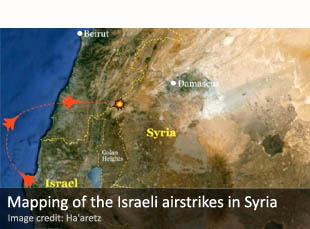
Mapping of the Israeli airstrikes in SyriaBy IAN ALLEN | intelNews.org |
►►Should we be preparing for another Mideast war? Assad may not want a war with Israel, but Tehran could have other calculations. Over the weekend, Iran warned that it would consider any attack on Syria to be an attack on Iran. Claims by Syrian television that Israel hit a research facility near Damascus might be a pretext for an Iranian escalation with Israel. The Israeli army also deployed some of its Iron Dome batteries to northern Israel for the first time. It would not have done so if the chances of a war on Israel’s northern border weren’t increasing.
►►Why did Israel attack Syria now and why did the Syrians admit it? Two days before the Israeli attack on Syria, Iran said it would view any attack on Syrian territory as an attack against Iran itself. But the combination of strategic circumstances in the region at the moment makes the chance of a direct Iranian response unlikely. A Syrian military response seems even less likely, though neither possibility can be ruled out. The most worrying unknown since Tuesday night concerns Hezbollah’s reaction. It seems we are at the beginning of the story —and not the end.
►►Ex-Mossad head says Syria and Hezbollah will not respond. The former Director of Israel’s Mossad spy agency, Danny Yatom, has ruled out any response by the Syrian army or Hezbollah in Southern Lebanon to the Israeli attack on Syria. He told newspaper Yedioth Ahronoth on Wednesday he did not think there would be “any response, since there is no benefit for Hezbollah and Syria to do so”. He added: “Al-Assad is experiencing deep problems in his country and Hezbollah is doing its best to help him, so I don’t think that they will consider any response”.

News you may have missed #817 (assassinations edition)

Patrick FinucaneBy IAN ALLEN | intelNews.org |
►►British PM apologizes in killing of IRA lawyer. The Prime Minister of the United Kingdom, David Cameron, has apologized after a government report found that British intelligence officials had colluded with loyalist paramilitaries in the 1989 killing of lawyer Patrick Finucane in Belfast, Northern Ireland. Finucane, who had represented members of the Irish Republic Army in court, was shot dead by two gunmen from a Protestant paramilitary group while having a Sunday dinner at his home with his wife and three children.
►►Behind the plot to kill Afghanistan’s spy chief. On December 11, we reported that the Afghan government accused Pakistani intelligence of having played a role in the assassination of Assadullah Khaled, who heads Afghanistan’s National Directorate for Security. But how was the attempt on Khaled’s life carried out, and how did the aspiring assassins get so close to the controversial intelligence chief? Time magazine reports that it was Khaled’s self-confidence “bordering on recklessness” that almost got him killed. Sources say that, even after taking over the NDS, Khalid frequently drove around without bodyguards.
►►How Mossad bid to kill Hamas leader ended in fiasco. Khaled Mashal’s recent presence in the Gaza Strip will have rudely reminded Benjamin Netanyahu, the Israeli Prime Minister, of one of the greatest fiascos in the history of special operations, writes The Daily Telegraph‘s David Blair. Fifteen years ago, Netanyahu authorized a risky attempt to assassinate Mashal in the Jordanian capital, Amman. Everything went wrong. The Jordanian security forces responded to this brazen daylight attack, arresting two of the Israeli operatives and forcing three to hide in their country’s embassy, which was promptly surrounded by troops.

Iran accuses Israel of kidnapping former Deputy Defense Minster

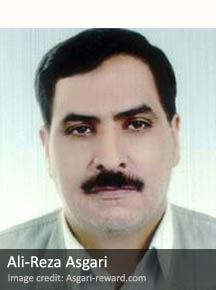
Ali-Reza AsgariBy JOSEPH FITSANAKIS | intelNews.org |
Iran’s Deputy Defense Minister has accused Israel of kidnapping his predecessor in 2006, while he was on an official visit trip to Turkey. Brigadier General Ali-Reza Asgari, who once commanded Iran’s Revolutionary Guard Corps, disappeared on December 9, 2006, from his hotel room in Istanbul. His fate remains unknown. But on Saturday, Brigadier General Hossein Daqiqi, who is currently Tehran’s second most senior military official, pointed the finger at Israel’s foremost covert-action agency, the Mossad. He was speaking to reporters in the Iranian capital during a public ceremony to mark the sixth anniversary of Asgari’s disappearance. He told Iranian media that the government had “a lot of evidence proving that members of the Israeli intelligence service have kidnapped Asgari”. There are conflicting reports about Asgari’s whereabouts, but most observers seem to believe he is still alive. A year after his disappearance from Turkey, Hans Rühle, former Director of Policy Planning in the German Ministry of Defense, wrote in Swiss newspaper Neue Zuercher Zeitung that Asgari was in Western hands and that “information was obtained” from him. Israeli media have reported that the Iranian General is in the hands of the United States and that he is helping Washington crack the “most inner workings [of] Iranian nuclear development”. Danny Yatom, former director of the Mossad, told the London-based Times newspaper in 2007 that Israel had played no part in Asgari’s disappearance and that the Iranian General had willingly defected “to the West”, but that he didn’t know his exact whereabouts. Since then, other sources have echoed Yatom’s claim that Asgari defected willingly, including Dafna Linzer of the Washington Post and intelligence historian Gordon Thomas, in his 2009 book Secret Wars: One Hundred Years of British Intelligence (see intelNews book review). Read more of this post