Holland suspends its ambassador to China due to suspected honey trap
October 19, 2016 Leave a comment
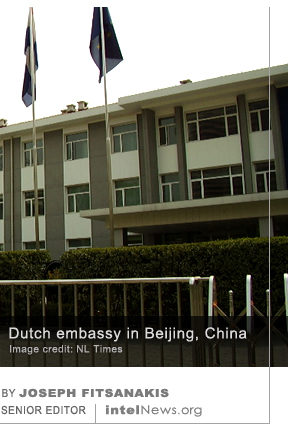 The Dutch government has suspended its ambassador to China and has launched an official investigation into an alleged secret relationship between the ambassador and a female Chinese employee at the Dutch embassy. The ambassador, Ron Keller, is a career diplomat and senior member of the Dutch foreign service corps, who has served in Russia and Turkey among other international posts. He assumed duties as Holland’s ambassador to China in late 2015. In December of that year, he arrived in Beijing and took command of one of the largest Dutch embassies in the world.
Last weekend, however, Dutch newspaper De Telegraaf reported that Keller had been suspended from his post after it was alleged that he had a secret affair with an employee at the embassy. The employee, whose name has not been released, is reportedly a female Chinese national. Her position at the embassy is not known, but is thought to be of a clerical nature. Foreign diplomats stationed in China —whether married or single— are routinely warned to avoid having intimate relationships with Chinese nationals due to concerns that the latter may be in the service of Chinese intelligence. Some refer to this practice as a ‘honey trap’. In 2011, Taiwan suffered its most serious espionage case in over half a century when it was revealed that the director of the Taiwanese military’s Office of Communications and Information fell for a “tall, beautiful and chic” Chinese female operative, who held an Australian passport, but later turned out to be a Chinese intelligence officer. In 2014, a leaked British military report warned United Kingdom government officials of attempts by Chinese intelligence services to compromise them using sexual entrapment.
De Telegraaf said it contacted the Dutch Ministry of Foreign Affairs about Keller’s suspension. In a statement, the ministry confirmed the diplomat’s suspension but said that it could not comment on the case. The newspaper reported that Keller is currently back in Holland and that his return to Beijing in an official capacity is not likely.
► Author: Joseph Fitsanakis | Date: 19 October 2016 | Permalink
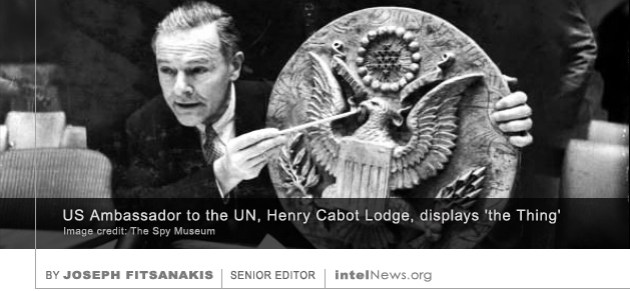 A tightly knit group of Dutch technical experts helped American spies bug foreign embassies at the height of the Cold War, new research has shown. The research, carried out by Dutch intelligence expert Cees Wiebes and journalist Maurits Martijn, has brought to light a previously unknown operation, codenamed EASY CHAIR. Initiated in secret in 1952, the operation was a collaboration between the United States Central Intelligence Agency and a small Dutch technology company called the Nederlands Radar Proefstation (Dutch Radar Research Station).
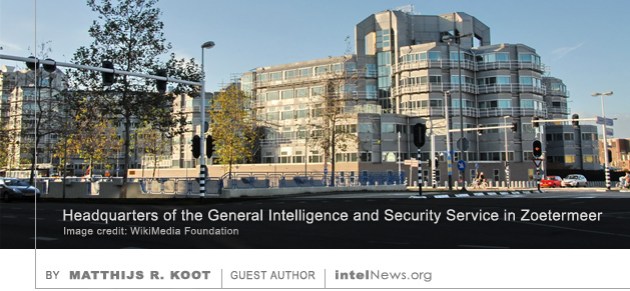 A 28-year-old criminal investigator of the Dutch National Crime Squad was arrested by Dutch police on September 29 over allegations of corruption, neglect of duty, and money laundering. The man, named as Mark M., applied for a job at the Dutch police in 2009. According to an online résumé, M. dropped out of professional college in journalism after several years of being self-employed as a freelance reporter covering crime issues.
 The German and Dutch governments allegedly joined forces to investigate a Russian supercomputer specialist, who studied in Germany and Holland, suspecting him of passing technical information to Russian intelligence. German weekly newsmagazine Der Spiegel, which published the report in its current issue, identified the physicist only as “Ivan A.” and said that the 28-year-old man was a member of a physics laboratory affiliated with the Max Planck Institute in the western German city of Bonn.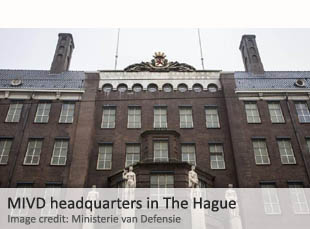




 By JOSEPH FITSANAKIS | intelNews.org |








 intelNews.org
Headstone for unmarked grave of Nazi spy who died undetected in wartime Britain
July 11, 2017 by Ian Allen 3 Comments
Between October 31 and November 2, 1940, the 26-year-old Fukken was secretly parachuted over the Buckinghamshire village of Haversham in central England. British authorities found his discarded parachute a few days later, but by that time Fukken had made his way on foot to the city of Cambridge. Fukken’s precise mission remains unknown. Speculation that he was sent to Britain to assassinate the country’s wartime leader, Sir Winston Churchill, is dismissed as fantastical by most historians. What is known is that Fukken carried with him false Dutch papers identifying him as Jan Willem Ter Braak, and a suitcase that contained a radio transmitter supplied to him by the Abwehr.
In Cambridge, Fukken took lodgings with a local family, posing as a member of the Free Dutch Forces, anti-Nazi Dutch officials who had fled to London after the German invasion of Holland and formed a government in exile. Fukken spent the next four months living undercover in Cambridge, and did not register with the authorities, as required. He traveled on most days to locations in England bombed by the Luftwaffe, inspecting the damage and reporting back to his Abwehr handlers in Hamburg by radio or by mail, using secret writing techniques. But his failure to register with the authorities meant that he had no access to ration cards, which were required to purchase food in wartime Britain. He then attracted the attention of the local authorities, after presenting them with a forged ration card that was detected during inspection by a police officer. Fearing arrest, he quickly moved lodgings, but was unable to solve the problem of access to food. Repeated attempts to get the Abwehr to exfiltrate him failed, and his calls for money and usable ration cards were not facilitated, as the Nazi leadership in Berlin had begun to shelve Operation SEA LION. Read more of this post
Filed under Expert news and commentary on intelligence, espionage, spies and spying Tagged with Englebertus Fukken, history, Jan Willem Ter Braak, National Socialist German Workers' Party, Netherlands, News, non-official-cover, World War II