Swiss intelligence employee stole ‘millions’ of classified pages

NDB offices in Bern, Switzerland

By JOSEPH FITSANAKIS | intelNews.org |
Swiss authorities have warned Western intelligence agencies that their secrets may have been compromised by a disgruntled intelligence employee who stole “thousands or even millions of pages of classified material”. Citing “European national security sources”, Reuters said the employee at the center of the case worked for the NDB, Switzerland’s Federal Intelligence Service. He had been employed by NDB for eight years as a network technician with “full administrator rights” and had unrestricted access to the NDB’s computers, as well as to those of Switzerland’s Federal Department of Defense, under which the NDB operates. About a year ago, however, the unnamed technician apparently became disgruntled after his views on how to structure the NDB’s databases were allegedly sidelined or ignored. He eventually decided to use several portable hard drives to download countless classified documents from Swiss government servers and managed to carry them out of the office building where he worked, using a backpack. According to Swiss authorities, he intended to sell the classified information to foreign governments or black-market operatives. He was apprehended, however, after he tried to set up a numbered bank account with Swiss-based UBS bank, using what bank security officials described as “suspicious identification documentation”. Read more of this post

Israel asked for Jordan’s approval to bomb Syria, say sources

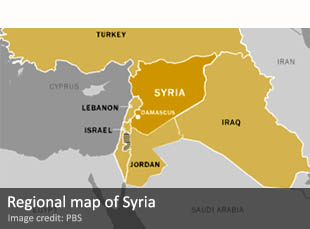
Regional map of SyriaBy JOSEPH FITSANAKIS | intelNews.org |
The government of Israel has sent Jordan at least two requests in the past two months to bomb targets in Syria, according to intelligence sources. The Atlantic magazine, which published the revelation on Monday, said Tel Aviv has been seeking Amman’s “permission” to move ahead with “a plan to take out many of Syria’s chemical weapons sites”. Citing unnamed “intelligence officials in two countries”, The Atlantic said that the Israeli requests were communicated to the Jordanian government by officials from the Mossad, Israel’s primary covert-action agency. In both instances, the Mossad delegation was allegedly dispatched to Amman on the orders of the Office of Benjamin Netanyahu, Israel’s Prime Minister. However, the Jordanians are so far resisting the Israeli proposals, says The Atlantic, telling their Jewish neighbors that “the time [is] not right” for direct military action. It is worth pointing out that Israel does not technically require Jordan’s permission to bomb Syria. Its air force can do so without assistance from Amman. This was demonstrated on September 6, 2007, when Israel bombed a target at Al-Kibar, deep in the Syro-Arabian Desert, thought to be the site of a nuclear reactor. Even though Tel Aviv has not officially admitted a role in the attack, Israeli officials have repeatedly hinted that Israel was behind it. According to German newsmagazine Der Spiegel, which published a detailed account of the bombing, the attack was codenamed Operation ORCHARD. The difference this time appears to be that many of Syria’s chemical weapons facilities, which Israel allegedly wants to destroy, are located along the Syrian-Jordanian border. Read more of this post

News you may have missed #814

Ilir KumbaroBy IAN ALLEN | intelNews.org |
►►Israel accuses Palestinian of spying for Hezbollah. Israel’s Shin Bet internal security agency says a Palestinian man has been charged with relaying information to Hezbollah in Lebanon about sensitive government sites, including parliament. It identified the suspect as Azzam Mashahara, a resident of east Jerusalem, which Israel captured in 1967. Palestinian residents of east Jerusalem, unlike Palestinians from the West Bank or the Gaza Strip, have Israeli identity cards that allow them to travel freely within Israel. Mashahara was charged with maintaining contacts with a foreign agent and relaying information to the enemy.
►►UK agency tries to crack coded message from WWII-era carrier pigeon. The note, written on official stationary with the heading “Pigeon Service,” was discovered in a red canister attached to the skeletal leg of a pigeon in a chimney in Surrey, England. The message is made up of 27 seemingly random five-letter blocks and though it’s undated, government analysts believe the pigeon met his end while on a secret mission during the Second World War. The note is signed “Sjt W Stot” and was intended for the destination “XO2”. In a statement, Britain’s Government Communications Headquarters (GCHQ), said that during the war secret communications would often utilize specialized codebooks “in which each code group of four or five letters had a meaning relevant to a specific operation, allowing much information to be sent in a short message”. The GCHQ said that those messages may have been put through an additional layer of security by being re-coded with what’s known as a one-time pad.
►►Albania court convicts fugitive ex-spy chief. An Albanian court has convicted Ilir Kumbaro, the country’s fugitive former intelligence chief, of murder for the 1995 death of a suspect who was illegally detained for an alleged plot to murder the President of the Republic of Macedonia. The victim, businessman Remzi Hoxha, an ethnic Albanian from Macedonia, was abducted by the secret police 17 years ago along with two other suspects for allegedly planning to kill then-Macedonian President Kiro Gligorov during a visit to Albania. The court said the three suspects were held illegally and tortured during questioning. Kumbaro traveled to Britain in 1996 under a false identity, claiming to be a refugee from Kosovo. He has been missing for a year, after skipping an extradition hearing in London. Hoxha was never found and is presumed to have died in custody.

Saudi diplomat shot dead in Yemen by gunmen disguised as soldiers

By IAN ALLEN | intelNews.org |
An official at the Saudi Arabian embassy in Yemen has been shot dead along with this Yemeni bodyguard by a group of gunmen disguised as government security forces. According to television station al-Arabiya, which is owned by the Saudi government, the diplomat and his bodyguard were killed on Wednesday when their car was “raked with gunfire” in the heart of Yemeni capital Sana’a. Later in the day, the incident was confirmed by the Kingdom’s Ministry of Foreign Affairs, which identified the assassinated diplomat as Sergeant Khaled Shobeikan al-Anzi. IntelNews understands that al-Anzi worked as an aide to the Military Attaché at the Saudi Arabian embassy in Sana’a. There are rumors, however, that his diplomatic credentials may have been a cover for his intelligence work for Al-Mukhabarat Al-A’amah, Saudi Arabia’s military intelligence agency. Sources in Yemen report that the attack took place in Haddah, one of Sana’a’s more exclusive districts, which houses the majority of foreign embassies and diplomatic compounds in the capital. It is also worth noting that the assailants were reportedly “dressed in the uniforms of [Yemen’s] Central Security Organization”, a 50,000-strong National Guard-type force that operates under the direction of the Ministry of the Interior. Wednesday’s assassination of the Saudi diplomat is the latest incident in a series of attacks against diplomatic targets in Sana’a, which have included employees in the British and American embassies there. In late March of this year, Islamist militants kidnapped Saudi Arabia’s Deputy Consul in Yemen’s southern port city of Aden, who remains in captivity. Read more of this post

Belgian intelligence employees ‘outed themselves’ on LinkedIn

LinkedIn logoBy JOSEPH FITSANAKIS | intelNews.org |
Several alleged employees of Belgian security and intelligence agencies have revealed their identities on social networking sites, it has been reported. Belgian newspaper De Standaard, which made the revelation in a leading article on Tuesday, said that many LinkedIn and Facebook users appear to list their employer as Belgium’s State Security Agency (Sûreté de l’État or SE/SV) or the Coordinating Body for Threat Analysis (OCAM/OCAD). The SE is Belgium’s foremost civilian intelligence agency, operating under the country’s Ministry of Justice. OCAM is one of Belgium’s several anti-terrorist intelligence collection and analysis agencies, which operates under the joint supervision of the Justice and Interior Ministries. De Standaard contacted the two agencies, which refused to comment on whether the social networking profiles are authentic. But the paper spoke with an unnamed Belgian senior intelligence official, who said that this was potentially a very serious issue for Belgian national security. “Russian and Chinese intelligence services employ thousands of people”, said the official, “and have the resources and time to manually search for such profiles and then exploit the information they provide. Our people could, by their very presence on such sites, become the target of hostilities”. De Standaard also spoke to Belgian Senator Dirk Claes, who is a member of the country’s Parliamentary Committee on Intelligence. He told the paper that his colleagues in the Committee would be up in arms if the profiles turned out to be authentic. “These individuals have security clearances and are obligated to stay in the background, as much as possible. I will be raising this issue in the [Intelligence] Committee”, Claes told De Standaard. Read more of this post

Freed Russian scientist convicted for spying maintains innocence

Valentin DanilovBy JOSEPH FITSANAKIS | intelNews.org |
A Russian scientist who was pardoned last week, after spending nearly a decade behind bars for allegedly spying for China, has dismissed the charges against him as “pure fantasy”. Physicist Valentin Danilov was arrested by the FSB, the Russian Federal Security Service, in February of 2001 and charged with conducting espionage in the service of the Chinese space program. At the time of his arrest, Danilov headed the Thermo-Physics Center at Russia’s Krasnoyarsk State Technical University (KSTU), located in Siberia’s third largest city. For several years leading up to his arrest, he conducted research on the impact of solar activity on the condition and performance of space satellites. During his lengthy trial, Danilov admitted selling to the Chinese information on satellite technology belonging to the Russian government. But his defense team argued that the information in question had already been declassified and available in public sources since the early 1990s. Eventually, in November of 2004, a Russian Federal court found Danilov guilty of treason and sentenced him to 14 years in prison. He was supposed to be released in 2017. Earlier this month, however, a court in Krasnoyarsk found that, since Danilov had served most of his prison sentence in good behavior, and since his health was weak, he would be released early. In his first public interview since his release, Danilov, 66, has said he intends to take his case against the Russian government to the European Court of Human Rights. Speaking to reporters as soon as he emerged from prison, the Russian scientist said: “I would truly appreciate it if someone finally told me what state secret I sold”. He went on to comment directly on Russian President Vladimir Putin: “Everybody would be the same as him in his place, because it is the court that makes the czar”, he said, employing a traditional Russian proverb. Read more of this post

Muslim to head India’s domestic spy agency in historic first

Asif IbrahimBy JOSEPH FITSANAKIS | intelNews.org |
For the first time in the history of India, a Muslim officer has been selected to head the country’s domestic intelligence agency. The Intelligence Bureau (IB), one of India’s most powerful intelligence organizations, will be led by Syed Asif Ibrahim, one of relatively few Muslim senior officers serving in the country’s predominantly Hindu security and intelligence apparatus. It will be the first time that the IB, which was formed in 1877 under British colonial rule, and today operates under the Ministry of Home Affairs, will be led by a Muslim. Formerly a senior officer in the Indian Police Service, Ibrahim, 59, has served for years in the IB’s Directorate of Operations, and recently served as the Bureau’s Chief of Station at the Indian High Commission in London, United Kingdom. His supervisory experience includes roles in the IB’s counter-cyberespionage and counterterrorism units. IntelNews hears that Ibrahim is widely seen by Indian intelligence officers as someone with a “crystal-clear understanding” of Islamic-inspired militancy inside the country. Ibrahim’s appointment was announced late last week by the Appointments Committee of the Cabinet, a senior government body lead by the Indian Prime Minister Manmohan Singh. Following the announcement, observers noted that at least four IB officials, who had been tipped for the job of director and were above Ibrahim in terms of seniority, were assigned to positions outside the Bureau, ostensibly to clear the way for Ibrahim’s appointment. Read more of this post

Did US spies hack French government computers using Facebook?

The Palais de l'ÉlyséeBy JOSEPH FITSANAKIS | intelNews.org |
A sophisticated computer virus discovered at the center of the French government’s secure computer network was planted there by the United States, according to unnamed sources inside France’s intelligence community. Paris-based magazine L’Express, France’s version of Time magazine, says in its current issue that the alleged American cyberattack took place shortly before last April’s Presidential elections in France. It resulted in the infection of the entire computer system in the Palais de l’Élysée, which is the official residence of the President of France. The French magazine cites unnamed sources inside the French Network and Information Security Agency (ANSSI), which is responsible for cybersecurity throughout France. The sources claim that the snooping virus allowed its handlers to gain access to the computers of most senior French Presidential aides and advisers during the final weeks of the administration of French President Nicolas Sarkozy, including his Chief of Staff, Xavier Musca. The article claims that the virus used a source code nearly identical to that of Flame, a super-sophisticated version of Stuxnet, the virus unleashed a few years ago against the computer infrastructure of the Iranian nuclear energy program. Many cybersecurity analysts believe that the US and Israel were instrumental in designing both Stuxnet and Flame. IntelNews understands that the alleged virus was initially directed at employees of the Palais de l’Élysée through Facebook. The targets were allegedly befriended by fake Facebook profile accounts handled by the team that operated the virus. The targets were then sent phishing emails that contained links to phony copies of the login page for the Palais de l’Élysée intranet website. Read more of this post

News you may have missed #813 (CIA edition)

CIA headquartersBy IAN ALLEN | intelNews.org |
►►Who is leading the CIA for now? Acting CIA Director Michael J. Morell, who has worked for the CIA for 32 years, served a stint as acting director last year and his will be one of several names considered by US President Barack Obama for the permanent job. Starting as an analyst tracking international energy issues, Morell worked for 14 years as an analyst and manager on East Asia, rising to director of the Directorate of Intelligence’s Office of Asian Pacific and Latin American Analysis in 1999. In May 2010, Morell succeeded Stephen Kappes, who had resigned suddenly and without explanation, as deputy director of the CIA, serving under Directors Leon Panetta (February 2009-June 2011) and David Petraeus (September 2011-November 2012).
►►No perfect choice to fill Petraeus vacancy at CIA. President Barack Obama needs a quick, no-drama solution to a sensational personnel problem. But the vacancy left at the top of the Central Intelligence Agency by David Petraeus’s abrupt departure amid a headline-grabbing sex scandal calls for a particularly complex skill set. It requires a charismatic chief to oversee the large, notoriously tough-to-manage intelligence apparatus. It needs a leader who has a strong relationship with the president. And most of all, it calls for a politically savvy operator who understands how to interact with Congress —and can assuage some of the current anger on Capitol Hill that lawmakers were kept in the dark about the probe.
►►CIA climate-change unit is shut down. Republican lawmakers in the US began criticizing the Central Intelligence Agency’s Center on Climate Change and National Security before it was even established, calling it a “misguided defense funding priority”. Concerted resistance by conservative lawmakers did not allow the program to stand on solid ground, and it now looks like the Center has actually closed down, having lost its most important supporter, former CIA Director Leon Panetta.

Ex-intelligence official: cyber espionage more dangerous than terrorism

Raymond BoisvertBy JOSEPH FITSANAKIS | intelNews.org |
A former senior member of Canada’s intelligence community has said that the threat of cyber espionage requires more resources that are currently being diverted to counterterrorism. Ray Boisvert, who retired last year from the post of Assistant Director of Intelligence for the Canadian Security Intelligence Service (CSIS), said in an assertive speech last week that cyber espionage is “fundamentally undermining [Canada’s] future prosperity as a nation”. Speaking on Friday in Ottawa, Boisvert compared cyber espionage to the climate-change debate, which has been marked by a series of ignored warnings, due to “some willful blindness on behalf of individuals”. As a result, he said, the need to establish essential security measures to protect worldwide electronic infrastructure is being neglected, while desperately needed resources are being diverted to counterterrorism. He explained the lack of action on three levels: first, the resistance emanating from technologically challenged decision-makers in the government and private sector, who simply do not understand the technical complexities of digital telecommunications security. Second, it is rooted in the government’s reluctance to invest the funds required to shield the nation’s communications infrastructure from espionage attacks. Finally, he placed the blame on the fragmentation and shortsightedness of the private sector, which owns and operates nearly 90 percent of Canada’s critical communications infrastructure and yet is too consumed by competition to sit around the same table on matters of security. In giving examples of the seriousness of the threat of cyber espionage, Boisvert cited the attacks last year on the computer systems of Canada’s Treasury Board and Finance Department, which compromised trade secrets of several national industries. He also mentioned the attacks on Nortel Networks Inc., which he said lasted for over a decade and may have contributed to the company’s 2009 demise. Read more of this post

Russian court paroles scientist convicted of spying for China

Valentin DanilovBy JOSEPH FITSANAKIS | intelNews.org |
A court in Siberia has issued a rare verdict to parole a Russian academic who was convicted in 2004 of conducting espionage on behalf of China. Russian physicist Valentin Danilov headed the Thermo-Physics Center at Russia’s Krasnoyarsk State Technical University (KSTU), which is located in Siberia’s third largest city. For several years prior to his arrest, he conducted research on the impact of solar activity on the condition and performance of space satellites. In 1999, Danilov was among the signatories of a lucrative contract between KSTU and the state-owned China Aerospace Science and Technology Corporation, which is the main contractor for the Chinese government’s space program. The contract stipulated that KSTU was to help China Aerospace evaluate the performance of artificial satellites in real-life space conditions. Less than two years later, in February of 2001, Danilov was arrested by the FSB, the Russian Federal Security Service, and charged with conducting espionage in the service of the Chinese space program. In his trial, which took place in 2003, Danilov admitted selling to the Chinese information on satellite technology belonging to the Russian government. But his defense team argued that the information in question had already been declassified and available in public sources since the early 1990s. Largely due to this argument, the jury acquitted Danilov of all charges at the end of 2003. However, by the middle of June of next year, the physicist had been arrested again, after the Russian Supreme Court overturned his earlier acquittal. In November of 2004, another court found Danilov guilty of treason and sentenced him to 14 years in prison. Read more of this post

MI5 arrests Royal Navy petty officer for trying to spy for Russia

Edward DevenneyBy JOSEPH FITSANAKIS | intelNews.org |
An member of the British Royal Navy has been arrested in a counterintelligence sting operation, after trying to sell top-secret government documents to people he believed were Russian operatives. Petty Officer Edward Devenney, who has been in the Royal Navy for over a decade, was arrested earlier this week while meeting with two MI5 officers posing as Russian spies. Originally from Northern Ireland, Devenney, 29, appears to have been motivated by disgruntlement against the Navy, after his planned promotion to commissioned officer was halted due to financial austerity measures imposed on the military by the British government. According to the court indictment, Devenney contacted an unnamed “embassy of a foreign country” in London, offering to provide classified information in exchange for money. It is unknown at this point how exactly MI5, the British government’s foremost counterintelligence organization, became privy to the content of Devenney’s communication with officials at the unidentified embassy. What is known is that, after several messages were exchanged between the parties, Devenney arranged to meet two people he believed were Russian government employees. In reality, the two individuals were MI5 officers, who were able to film the clandestine meeting. Devenney was apparently arrested on the spot, having first announced that he wished to “hurt the Navy” because his promotion to a commissioned officer had been “binned” by the British government. Read more of this post

News you may have missed #812

Yasser ArafatBy IAN ALLEN | intelNews.org |
►►Russia to help probe Yasser Arafat’s death. Russia will join an international investigation to determine whether the first Palestinian president, Yasser Arafat, was murdered, the current Palestinian leader, Mahmoud Abbas, has said. French and Swiss experts are due to exhume Arafat’s body in Ramallah later this month in an attempt to discover how he died after an al-Jazeera documentary in July suggested he was killed by a rare radioactive poison. Abbas asked Russian foreign minister Sergei Lavrov for Moscow’s help during talks in Jordan, Palestinian sources said.
►►Revisiting the foiled 1984 Nigerian kidnap plot. In London in 1984, a team of Nigerians and Israelis attempted to kidnap and repatriate the exiled former Nigerian minister Umaru Dikko. Mr. Dikko, who had fled Nigeria after a military coup, was accused of stealing $1bn (£625m) of government money. The plot was foiled by a young British customs officer and, as a result, diplomatic relations between the UK and Nigeria broke down and were only fully restored two years later. The Nigerian and Israeli governments have always denied involvement in the kidnapping.
►►Putin congratulates KGB double spy on his birthday. Russian President Vladimir Putin has congratulated famous double agent George Blake on his 90th birthday, the Kremlin press office has said. Blake betrayed British intelligence starting in the 1950s; he was found out in 1961 and sentenced to 42 years in prison. But he escaped five years later using a ladder of rope and knitting needles, made his way to the Soviet Union and has been living out his last years serenely in a cottage outside Moscow. After his escape from the Wormwood Scrubs prison in London, he was smuggled to Berlin in a wooden box in the back of a van. In the interview published last week, he said he then presented himself to border guards in East Berlin, asked to speak to a Soviet officer, and when told to wait, immediately fell into a deep sleep.

News you may have missed #811

Efraim HalevyBy IAN ALLEN | intelNews.org |
►►Former Mossad chief pushes for dialogue with Iran. After Meir Dagan, another former chief of Israeli intelligence agency Mossad has publicly called for a dialogue between the West and Iran. Speaking to Al-Monitor, an American website covering Middle-East news, Halevy, who directed the Mossad from 1998 to 2002, said that “the Iranians, in their heart of hearts, would like to get out of their conundrum”. IntelNews readers may remember Halevy’s comments in August, when he warned that Israel’s threats of a military attack on Iran were “credible” and “serious”, adding that, if he were an Iranian, he would be “very fearful of the next 12 weeks”.
►►UK says attack on Iran ‘not right course at this time’. The British government has reiterated that it does not believe military action against Iran would be appropriate at the moment, following the disclosure that Britain has rebuffed US requests to use UK military bases to support the buildup of forces in the Gulf. US diplomats have lobbied for the use of British bases in Cyprus, and for permission to fly from US bases on Ascension Island in the Atlantic and Diego Garcia in the Indian Ocean, both of which are British territories.
►►German spy agencies disclose spy tools in rare move. Most law enforcement agencies refuse to reveal the surveillance technologies they use, claiming doing so could threaten national security. But authorities in Germany have shown it is possible to be transparent without the sky falling in —by disclosing how they have spent millions on spy tools to help monitor Skype, email, and mobile phones. Earlier this year, German politician Jan Korte submitted a series of written questions to the country’s federal ministry of home affairs regarding surveillance tools. The answers Korte received were published in German in July, but have only this month been translated (.pdf) into English.

Mossad ‘tried to kill’ Saddam Hussein using ‘exploding book’

Saddam HusseinBy JOSEPH FITSANAKIS | intelNews.org |
Israeli intelligence tried unsuccessfully to kill Iraqi leader Saddam Hussein in the 1970s using a bomb disguised as a book. This revelation is included in a new documentary film, which was aired on Monday evening on Israel’s Channel 1 television. The documentary, entitled Sealed Lips, focuses on the life and intelligence exploits of Yitzhak Hofi. Known informally as “Khaka”, Hofi was the fifth Director of the Mossad, Israel’s foremost covert-action intelligence agency, which he led form 1974 to 1982.  Aside from Hofi, who is still living in Israel, aged 85, the film includes interviews with five other former Directors of the Mossad, as well as with some of the agency’s best-known covert-action operatives. One of them is Brigadier General (ret.) Tzuri Sagi, said to have been the mastermind behind the plan to kill Hussein, who had assumed power in Iraq following a coup in 1968. According to the documentary, as soon as the Mossad tasked Sagi with assassinating Hussein, he employed the best-known bomb-maker in the Israeli intelligence and security services, known by his operational name, “Natan”. “Natan” put together a carefully constructed explosive device, which was hidden inside an Arabic-language book. The device was wired to detonate once the front cover of the book was opened. The film suggests that the Mossad did manage to find a way for the book to reach the Iraqi leader. However, Hussein appeared suspicious about the book and had one of his close aides, an unnamed senior Iraqi government official, open it. Read more of this post