Belarus arrests 33 Russians, accuses Kremlin of trying to subvert upcoming elections
July 31, 2020 1 Comment
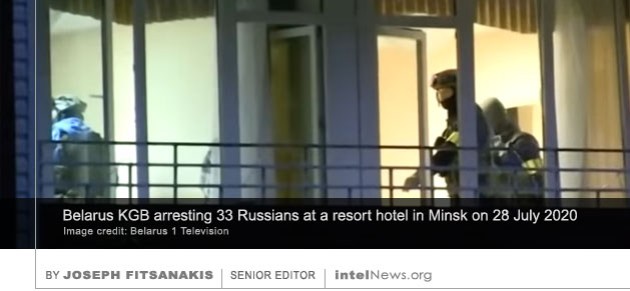 Belarussian secret services announced on Wednesday the arrest of 33 Russian citizens, who are allegedly members of a Kremlin-backed private military firm. The government of Belarus accuses the Russians of trying to subvert next month’s presidential elections on behalf of Moscow. The 33 Russians were charged with terrorism against the state on Thursday. They are allegedly employees of Wagner Group, a private Russian military company that some believe is in reality a private paramilitary wing of the Russian Armed Forces. However, the Kremlin has denied these accusations and says it has no connections with Wagner.
On Wednesday the state-owned Belarus 1 television channel aired footage of the 33 Russians being placed under arrest by the Belarussian State Security Committee (KGB). The arrests were later confirmed by Andrey Rawkow, secretary of the Security Council of Belarus, an interdepartmental body that supervises national security operations in the country. Rankow said the Investigative Committee, Belarus’ primary investigating authority, had determined that the 33 had entered the country as part of a 200-strong group of Russians working for Wagner, in order to “destabilize the situation during the election campaign”.
Rankow was referring to the upcoming presidential elections of August 9, in which the country’s authoritarian leader, Alexander Lukashenko, will be seeking a sixth term in office. Since the collapse of the Soviet Union and the independence of Ukraine in 1991, Lukashenko has ruled the country with an iron fist. This time, however, partly because of the growing coronavirus crisis, his leadership is in dispute more than ever before and opposition protests have gripped the country in recent months.
Meanwhile, the close relationship between Minsk and Moscow has suffered numerous setbacks since 2018, as Russia’s economic struggles have forced the Kremlin to curtail its financial outreach to Belarus. There have been differences between the two countries over the price of energy that Belarus imports from Russia each year. Sensing his faltering support among the population, which is broadly mistrustful of Moscow, Lukashenko has campaigned on a largely anti-Russian ticket this time around, hoping to attract independent voters.
According to Belarussian state television, the 33 Russians were found in possession of Sudanese currency and a Sudanese smartphone card. Sudan is one of the Wagner Group’s most active areas of operation, according to some observers, and in the past the company has used Belarus as a transit center from which it coordinates its operations in the African continent. There were also reports in the state-owned Belarussian media that the 33 Russians were connected with the jailed husband of Sviatlana Tsikhanouskaya, a leading opposition presidential candidate. Tsikhanouskaya’s husband, Syarhey Tsikhanouski, is a blogger with substantial social-media following among younger voters. Some now suspect that the government will use this opportunity to bar Tsikhanouskaya from running for office.
Late on Wednesday, Belarus’ state-owned Belta news agency published the names and birth dates of all 33 Russian suspects. Soon afterwards, the government of Ukraine said its intelligence agency, the Security Service of Ukraine (SBU), had asked it to file extradition requests for the 33 Russians, who are believed to have worked with separatists in eastern Ukraine in recent years.
► Author: Joseph Fitsanakis | Date: 31 July 2020 | Permalink
 Two days after dropping charges against three Saudi men for spying on American soil, United States prosecutors submitted a new indictment that restates the two original charges and adds five more. The original complaint was filed by the Federal Bureau of Investigation in November of last year in San Francisco, California. It accused three men of “acting as unregistered agents” of Saudi Arabia since 2015. The phrase is used in legal settings to refer to espionage.
 In a surprising move, the United States government is seeking to dismiss espionage charges it filed last year against three men, including a member of staff of Saudi Arabia’s royal family, who were caught spying on American soil. Last November, the Federal Bureau of Investigation
 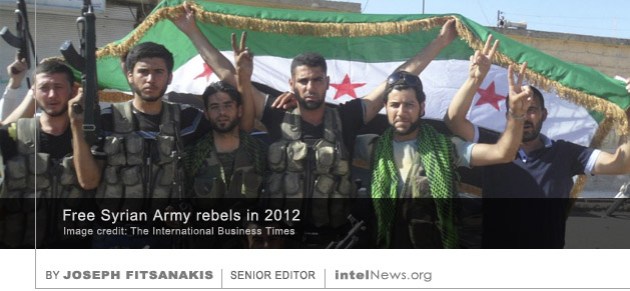 Turkey’s spy agency systematically downplayed the Islamist views of men seeking to join a Syrian rebel group, which was supported by the United States Central Intelligence Agency on account of its moderate leanings. The United States
 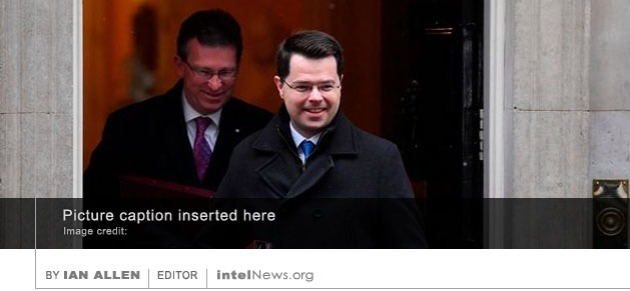 Senior United Kingdom officials have said the country will seek to “modernize” its laws on counterespionage, after a long-awaited parliamentary report criticized the government for failing to stop Russian spy operations. Earlier this week saw the release of the report by the British Parliament’s Intelligence and Security Committee. The
 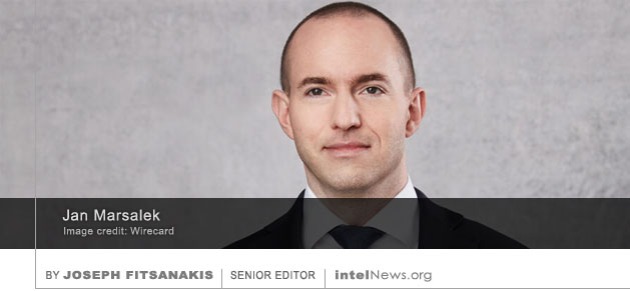 An Austrian financier, who disappeared following the outbreak of a massive financial scandal in Germany last month, and is wanted by several Western spy agencies, is reportedly hiding under Russian protection. The financier, Jan Marsalek, dubbed by some as “the world’s most wanted man”, is connected with the sudden collapse of Wirecard AG in Germany last month.
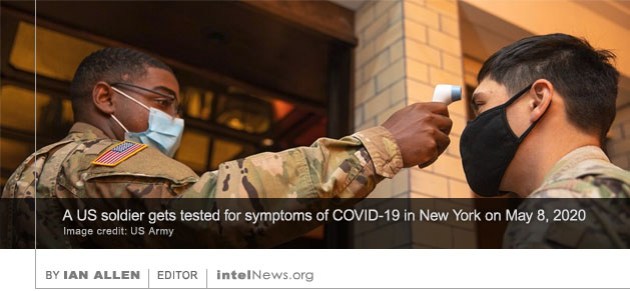 United States military officials are raising concerns about the rate of increase of COVID-19 cases in the Armed Forces, which appears to be growing at
  Belgium’s spy services were aware of financial rewards that Russia allegedly offered to the Taliban in exchange for killing American and other Western troops in Afghanistan, according to Belgium’s defense minister. Late last month, three leading American newspapers, The New York Times, The Washington Post and The Wall Street Journal
 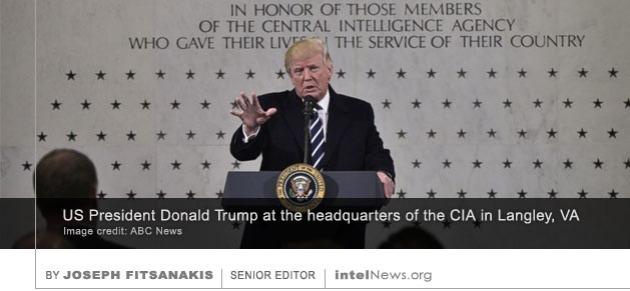 The United States Central Intelligence Agency was secretly authorized by the White House in 2018 to drastically expand its offensive cyber operation program —a development that some experts describe as a significant development for the secretive spy agency. However, the move has reportedly not pleased the Department of Defense, which sees itself as the primary conduit of American offensive operations in cyberspace.
 The personal smartphones of leading Catalan pro-independence politicians were hacked using a highly invasive software built by a controversial Israeli firm, according to an investigative report by two newspapers. The revelation is likely to reignite a tense row between Madrid and pro-independence activists in one of the country’s wealthiest regions, which led to a major political crisis in 2017.
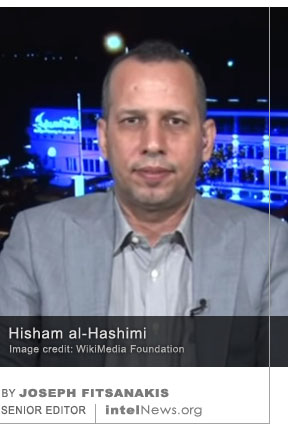 A leading Iraqi expert on paramilitary groups has been shot dead outside his home in Baghdad, raising concerns that the Iraqi government is unable to curtail the activities of militias in the country. Hisham al-Hashimi, 47, was a Baghdad University-educated historian, who rose to prominence in post-Ba’athist Iraq as an expert on paramilitary groups in the country. He was seen as a leading local authority on the Islamic State and advised the United States-led coalition on the group’s inner workings.
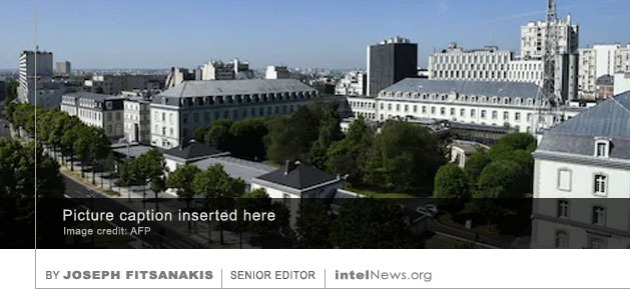 A court in Paris has sentenced to prison two former employees of France’s external intelligence agency, who were accused of spying for the government of China. A third person, the wife of one of the accused, was also handed a jail sentence.
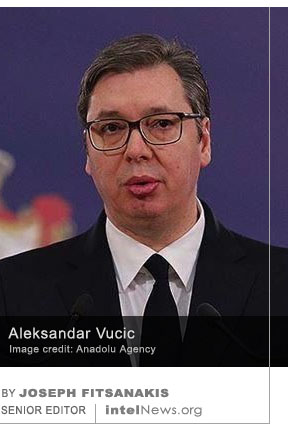 The president of Serbia has said that foreign intelligence services were partly behind a violent protest on Tuesday, which ended up with rioters storming the national parliament building in the capital Belgrade. The protest began in the afternoon, apparently prompted by the government’s decision to reintroduce lockdown measures following a resurgence of COVID-19 incidents in the country. But by the evening the rally had evolved into a full-scale riot led by far-right militants, as well as by some far-left groups.
 Russia’s security service has arrested the media advisor to the director of the country’s space agency, accusing him of supplying military secrets to a spy agency of an unnamed Western country. The Russian Federal Security Service (FSB)








Grandfather of new MI6 boss was IRA fighter who won medals in war with Britain
August 3, 2020 by Joseph Fitsanakis 2 Comments
Moore, 57, will be replacing Sir Alex Younger, who has served as MI6 chief since 2014. British media reported that Moore served as an undercover MI6 officer for years before being appointed ambassador in 2014. Moore was born in Libya to British parents and studied at the Universities of Oxford and Harvard. He then joined MI6 and served under official cover in Vietnam, Pakistan, Malaysia and Turkey, where his cover was as the British embassy’s press attaché, from 1990 to 1992. He then held a number of posts in Britain’s Foreign and Commonwealth Office, including his current position, Director General for Political Affairs. Before that he served as British Ambassador to Turkey, where he lived from 2014 to 2017.
Following the announcement of Moore’s appointment as MI6 director, it emerged in the British press that his grandfather, Jack Buckley, was a volunteer in the Irish Republican Army (IRA) in Cork, Ireland. Buckley reportedly joined the separatist IRA in 1916 and served in its ranks until 1922. He was eventually honored by Sinn Fein —the IRA’s political wing— with a medal for his service in the war against the British, which resulted in the independence of most of Ireland and the creation of the Free Irish State. It is today commemorated across Ireland as the Irish War of Independence.
Moore discussed his grandfather’s membership in the IRA during his stint as ambassador to Turkey. He told a Turkish newspaper that he was of Irish origin and that his grandfather had “fought against the British government in the separatist Irish Republican Army”. He was making the point that, over time, national differences between peoples can be smoothed out given the right conditions, and made a comparison between his family’s experience and the conflict between Turkey and the Kurds.
Moore is scheduled to assume his new post in the fall. He is expected to remain as director of MI6 until 2025.
► Author: Joseph Fitsanakis | Date: 03 August 2020 | Permalink
Filed under Expert news and commentary on intelligence, espionage, spies and spying Tagged with IRA, MI6, News, Richard Moore, UK