Singapore officials reject rumors of spy devices used at Trump-Kim summit
June 25, 2018 2 Comments
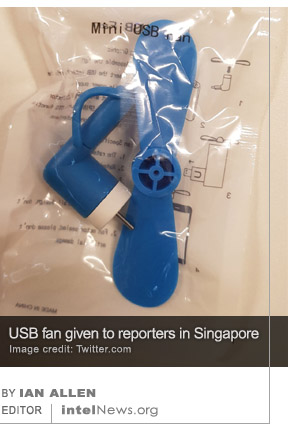 Singaporean officials have dismissed reports that a promotional item given away for free during the June 12 summit between the leaders of the United States and North Korea contained an espionage device. Over 2500 reporters from nearly every country covered the meeting between US President Donald Trump and North Korean Supreme Leader Kim Jong-un. Upon arriving in Singapore’s Sentosa Island, where the summit took place, journalists were given a free promotional packet that included novelty items such as pens, notepads, a water bottle, and a USB fan. The USB fan consisted of blades connected to a miniature electric motor, which was in turn connected to a USB cable. The cable allowed the device to be powered by a computer or other electronic device with a built-in USB port.
But rumors soon emerged in the media that the free USB fans, which were made in China, contained malware. As soon as the fans were plugged into an electronic device, the malware penetrated its operating system, allowing hackers to access its contents remotely, said the reports. The allegations were first aired on Radio France Internationale, the French government’s international broadcaster. They were then picked up by the BBC, which said that many reporters covering the historic summit had been warned “not to plug [the USB fans] in to their laptops”. According to the reports, the malware installed on the USB fans was able to steal computer files and turn a laptop’s built-in camera and microphone into remotely-controlled eavesdropping devices.
But the government of Singapore has strongly rejected these reports. In a statement issued in English, Singapore’s Ministry of Communications and Information said that the USB fans had been a gift of the Sentosa Development Corporation, a Singapore government body tasked with promoting tourism in Sentosa Island, where the Trump-Kim summit took place. The ministry added that the USB fans had been produced long before Trump and Kim decided to meet in Singapore and that they had been originally manufactured as gifts for tourists visiting the island. The statement issued by the ministry also said that reporters appreciated the fans, given the tropical climate on Sentosa Island, where the temperature reached 33C (91F) on the day of the summit.
► Author: Ian Allen | Date: 25 June 2018 | Permalink
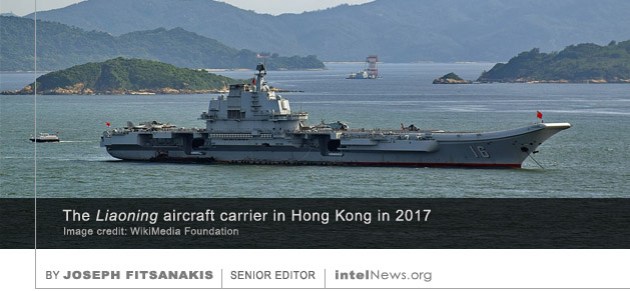 One of China’s most senior shipbuilding executives, who has not been seen in public for nearly two weeks, has been charged with giving secrets about China’s aircraft carriers to the United States. Sun Bo, 57, is general manager of the China Shipbuilding Industry Corporation (CSIC), China’s largest state-owned maritime manufacturer, which leads nearly every major shipbuilding project of the Chinese navy. Most notably, Sun headed the decade-long retrofitting of the Liaoning, a Soviet-built aircraft carrier that was commissioned to the Chinese Navy’s Surface Force after the collapse of the Soviet Union.
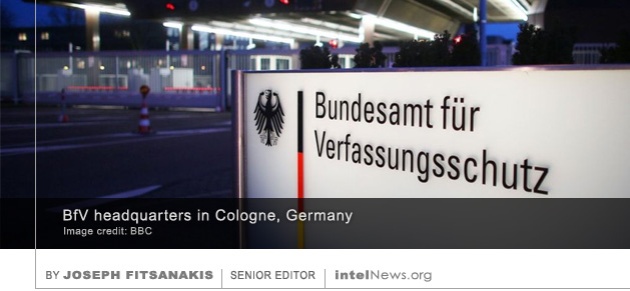 The head of Germany’s domestic security agency has publicly blamed the Russian government for a large-scale cyberattack that has targeted German energy providers. The comments follow a June 13 announcement on the subject by Germany’s Federal Office for Information Security (BSI), which is charged with securing the German government’s electronic communications. According to the BSI, a widespread and systematic attack against Germany’s energy networks has been taking place for at least a year now. The attack, which the BSI codenamed BERSERK BEAR, consists of various efforts by hackers to compromise computer networks used by German companies that provide electricity and natural gas to consumers around the country.
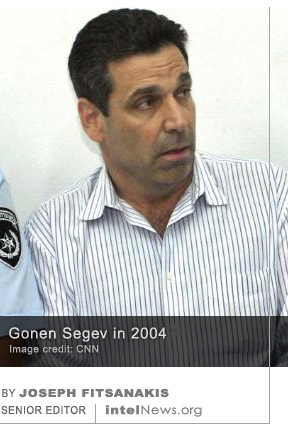 Israel has charged Gonen Segev, who served as the Jewish state’s Minister of Energy and Infrastructure, with spying for its archenemy, Iran. Segev, 62, was reportedly detained last month during a trip to Equatorial Guinea following a request by Israeli officials. He was then extradited to Israel and arrested as soon as he arrived in Tel Aviv last month, according to a statement by the Shin Bet, Israel’s domestic security service. On Monday it emerged that Israeli authorities had imposed a gag order on the case, forbidding Israeli media from reporting any information about it. The order appears to have now been lifted.
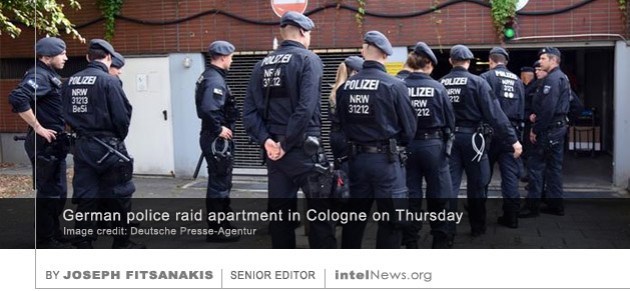 German authorities have charged a Tunisian citizen with building a biological weapon, after finding significant quantities of the highly toxic substance ricin in his apartment. The 29-year-old man is referred to in public reports only as “Sief Allah H.”, in compliance with German law that forbids the naming of suspects until they are found guilty in court. German officials said last Thursday that the man remains in custody and has been charged with violating Germany’s War Weapons Control Act (known as Kriegswaffenkontrollgesetz) and “preparing a serious act of violence against the state”.
 Belgium will investigate whether Spanish intelligence spied on Carles Puigdemont, the separatist Catalan leader who escaped to Brussels after launching an unsuccessful independence bid last year. Puigdemont, 56, served as president of the Spanish region of Catalonia from January 2016 until October 2017. He was forcibly removed from office by the Spanish government, after he led the government of Catalonia in a unilateral declaration of independence from Spain. As soon as the Catalan Parliament declared that the region was independent, Madrid dissolved it, imposed direct rule on the country’s easternmost province, and declared fresh elections.
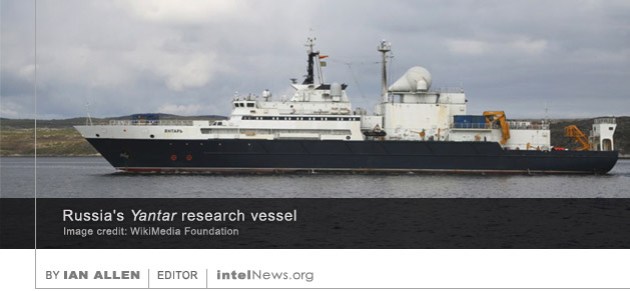 The United States has for the first time imposed economic sanctions on a number of Russian companies, which it says helped the Kremlin spy on targets in North America and Western Europe. On Monday, the US Department of the Treasury said it would apply severe economic restrictions on a number of Russian firms that work closely with the Kremlin. One of the companies was
 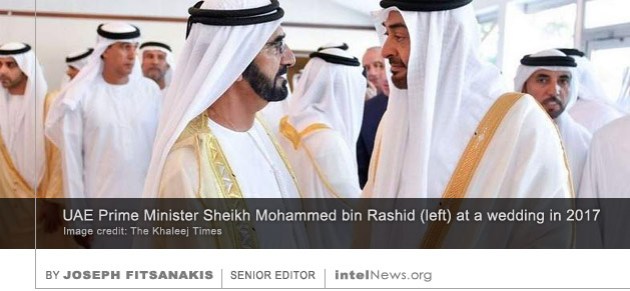 A lengthy exposé by a leading American newsmagazine has claimed that Israel and the United Arab Emirates, two countries that officially have no relations, have been secretly collaborating for more than two decades. Their secret cooperation has been extremely tight and has included clandestine weapons sales and intelligence-sharing, according to the exposé, which was published on the website of The New Yorker on Monday and will feature in the magazine’s print edition on June 18. The lengthy piece, which deals with the changing geopolitics of the Middle East, is written by Adam Entous, national security correspondent for The Washington Post, who has previously reported for more than two decades for Reuters and The Wall Street Journal.
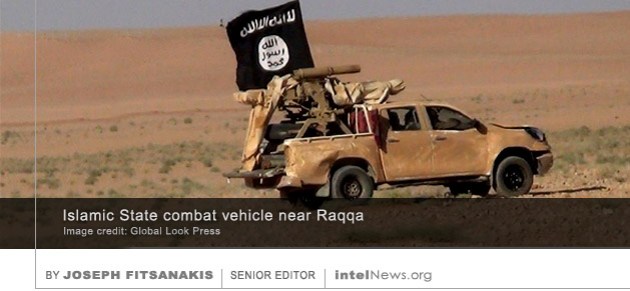 In a recent series of interviews to promote his new book, Anatomy of Terror, former FBI special agent and current counterterrorism expert Ali Soufan insists that the Islamic State remains potent and dangerous.
  way out. The group’s meteoric rise marked a watershed moment in the modern history of militant Sunni Islam. Even if it is militarily annihilated —a prospect that is far from certain— its physical absence will in no way erase its impact and influence among its millions of supporters and sympathizers. In fact, experts warn that the group is —like al-Qaeda before it— proving to be resilient and able to withstand intense military pressure from its enemies. Currently, all signs show that the Islamic State is actively reorganizing under the command of its leader, Abu Bakr al-Baghdadi. The prolonged absence of the Iraqi-born al-Baghdadi has prompted wild speculation about this supposed demise or severe incapacitation. There are even some who
 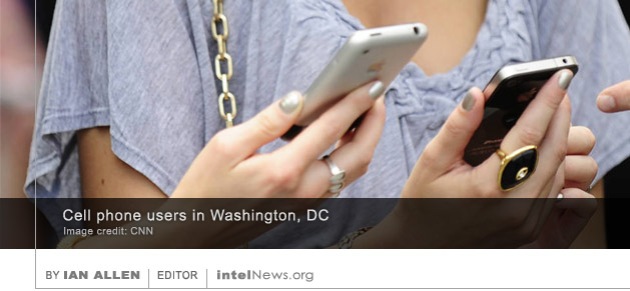 The majority of government-sponsored hacking now targets cell phones, not personal computers, according to researchers who say that political dissidents are especially targeted by totalitarian regimes around the world. Until 2015, most government-sponsored hacking operations were directed against the personal computers of targeted individuals. However, experts
 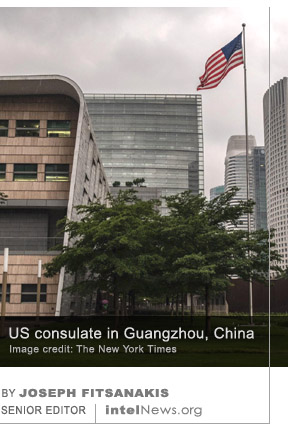 The United States has evacuated at least two more diplomatic personnel from its consulate in the Chinese city of Guangzhou, after they experienced “unusual acute auditory or sensory phenomena” and “unusual sounds or piercing noises”. The latest evacuations come two weeks after the US Department of State
  The online social media company Facebook shares data about its users with a Chinese telecommunications company that has been flagged in United States government reports as a threat to security. The New York Times
 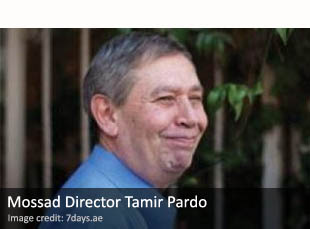 Israeli officials have denied reports that the head of the country’s internal security service was asked by the prime minister to spy on the director of the Mossad intelligence agency and the head of the military. The denials were prompted by allegations that will be made in full on Thursday, when the latest installment of the investigative news program Uvda (Fact) will be aired on Israel’s Channel 12 television channel. According to the program, the Israeli Prime Minister Benjamin Netanyahu requested that the personal phones of senior Israeli security officials, including those of the heads of the Mossad and the military, be wiretapped for security reasons.
 China’s influence in New Zealand is so extensive that it threatens the traditionally close intelligence contacts between New Zealand and its Western allies, according to a report written by the Canadian spy agency. Since World War II, New Zealand has been a member of what is sometimes referred to as the UK-USA Security Agreement. Known also as the UKUSA Agreement or the Five Eyes alliance, the pact, which was strengthened in 1955, provides a multilateral framework for intelligence cooperation between the United Kingdom, the United States, Canada, Australia, and New Zealand. But a new report produced by Canadian intelligence warns that Chinese political and economic influence in New Zealand is making it difficult for the Pacific Ocean island country to continue to operate within the framework of the agreement.






 intelNews.org
Norway spy agency urges IT firms to be cautious when outsourcing operations abroad
June 27, 2018 by Joseph Fitsanakis Leave a comment
In September of 2015, Broadnet fired 120 of its Norway-based employees and outsourced their jobs to India, in search of cost-cutting measures. The company signed a multimillion dollar contract with Tech Mahindra, an outsourcing firm based in Mumbai. But an audit by the Norwegian government soon discovered several instances of security breaches by Tech Mahindra staff. The latter were reportedly able to access Nødnett without authorization through Broadnet’s core IT network, which was supposed to be off-limits to outsourced staff without Norwegian security clearances. Soon after the breaches were discovered, Broadnet began to bring its outsourced operations back to Norway. By the end of 2017, all security-related IT tasks had been returned to Norway. In the meantime, however, Broadnet had come under heavy criticism from the Norwegian government, opposition politicians, and the NSM —the government agency responsible for protecting Norway’s IT infrastructure from cyber threats, including espionage and sabotage.
The NSM warning —published earlier this month in the form of a 20-page report— makes extensive mention of the Broadnet affair. It recognizes the right of Norwegian IT firms to outsource some or all of their operational tasks as a cost-cutting measure. But it also stresses that the country’s IT firms are required by law to abide to national security protocols when outsourcing part of their IT portfolios to foreign companies. There have been numerous instances in recent years, where “risk management obligations relative to outsourcing decisions by Norwegian [IT] companies have fallen short”, the NSM report states. It adds that IT firms must abide to strict protocols of risk management when making outsourcing decisions. It also states that the firms’ Norway-based senior managers must regain complete overview of outsourced projects at every step of the way.
► Author: Joseph Fitsanakis | Date: 27 June 2018 | Permalink
Filed under Expert news and commentary on intelligence, espionage, spies and spying Tagged with Broadnet (Norway), intelligence outsourcing, National Security Authority (Norway), News, Norway, Tech Mahindra, telecommunication service providers, telecommunications industry