North Korean state now uses cyber attacks to steal cash, says report

North KoreaNorth Korea’s intelligence establishment has shifted its attention from spying for political gain to spying for commercial advantage –primarily to secure funds for the cash-strapped country, according to a new report. Since the 1990s, the Democratic People’s Republic of Korea (DPRK) has used computer hacking in order to steal political and military secrets from its rivals. But there is increasing evidence that Pyongyang is now deploying armies of computer hackers in order to steal cash from foreign financial institutions and internet-based firms. This is the conclusion of a new report by the Financial Security Institute of South Korea, an agency that was set up by Seoul to safeguard the stability of the country’s financial sector.

The report, published last week, analyzed patterns of cyber attacks against South Korean state-owned and private financial institutions that took place between 2015 and 2017. It identified two separate computer hacking groups, which it named Lazarus and Andariel. According to the report, both groups’ activities, which are complementary, appear to be directed by the government of North Korea. An analysis of the groups’ targets suggests that Pyongyang has been directing its computer spies to find ways to secure hard currency for use by the government. Foreign currency has been increasingly hard to come by in North Korea in recent years, due to a host of international sanctions that were imposed on the country as a form of pressure against its nuclear weapons program.

Several cyber security experts and firms have claimed in recent months that North Korea has been behind recent cyber attacks against international banking institutions. The DPRK has also been blamed for a 2014 attack against the Hollywood studios of the Japanese multinational conglomerate Sony. Regular readers of intelNews will recall our story in March of this year about comments made on the subject of North Korea by Rick Ledgett, a 30-year veteran of the United States National Security Agency. Speaking at a public event hosted by the Aspen Institute in Washington, Ledgett expressed certainty that the government of North Korea was behind an attempt to steal nearly $1 billion from Bangladesh Bank —the state-owned central bank of Bangladesh—in 2016. Eventually the bank recovered most of the money, which were made through transactions using the SWIFT network. But the hackers managed to get away with approximately $81 million.

More recently, cyber security experts have claimed that the government of North Korea has been behind attempts to hack into automated teller machines, as well as behind efforts to steal cash from online gambling sites. In April of this year, the Russian-based cyber security firm Kaspersky Lab identified a third North Korean hacker group, which it named Bluenoroff. The Russian experts said Bluenoroff directed the majority of its attacks against foreign financial firms. There are rumors that Pyongyang was behind the wave of WannaCry ransomware attacks that infected hundreds of thousands of computers in over 150 countries in May. But no concrete evidence of North Korean complicity in the attacks has been presented.

Author: Joseph Fitsanakis | Date: 31 July 2017 | Permalink

North Korea secretly imports Russian oil through Singapore, says defector

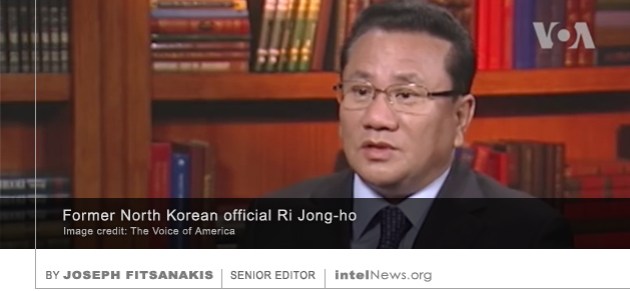
Ri Jong-hoThe government of North Korea uses intermediary firms in Singapore to import thousands of tons of Russian oil each year, according to a senior North Korean defector who has spoken publicly for the first time since his defection. Ri Jong-ho was a senior official in the Democratic People’s Republic of Korea under its previous leader, the late Kim Jong-il. He rose through the ranks of the Workers’ Party of Korea and was directly mentored by Kim, who personally appointed him to a post in Bureau 39. The powerful body is in charge of securing much-needed foreign currency for Pyongyang —often through illegal activities— and partly funds the personal accounts of the ruling Kim dynasty.

From the mid-1990s until his 2014 defection, Ri spent nearly three decades in senior positions inside the DPRK. These included the chairmanship of the board of the Korea Kumgang Group, a state-managed firm that oversees large-scale economic activity in North Korea, such as constructing energy networks and commissioning oil and natural-gas exploration. Between 1998 and 2004, Ri lived in the Chinese city of Dalian, where he headed the local branch of the Korea Daesong Trading Corporation. The Pyongyang-based company facilitates North Korea’s exports to China in exchange for Chinese goods and products.

But Ri’s mentor, Kim Jong-il, died in 2011. His son and successor, Kim Jong-un, engaged in a brutal campaign to remove his father’s advisers and replace them with his own people. During that time, said Ri, thousands of senior and mid-level officials were purged, some physically. Frightened and disillusioned, Ri defected with his family to South Korea in October 2014; fifteen months later, in March 2016, he arrived in the United States. On Tuesday, the Voice of America published Ri’s first public interview since his defection.

Among other things, the former Bureau 39 official said that the North Korean regime sustains itself with the help of oil it imports from nearby countries. One of the regime’s main sources of energy is Russia, which supplies Pyongyang with between 200,000 and 300,000 tons of oil every year. But the trade does not occur directly, said Ri. Moscow sells the oil to energy-trading companies in Singapore. These mediators then sell the oil to the DPRK through separately agreed contracts, so that Russia does not appear to be providing Pyongyang with desperately needed oil. The so-called “Singapore line” was established by North Korea in the 1990s, said Ri, and appears to still be active. In addition to Russian oil, the DPRK imports approximately 500,000 tons of oil per year from China, through pipelines, according to Ri.

Author: Joseph Fitsanakis | Date: 29 June 2017 | Permalink
Did North Korean leader’s brother meet with a US spy before he was assassinated?

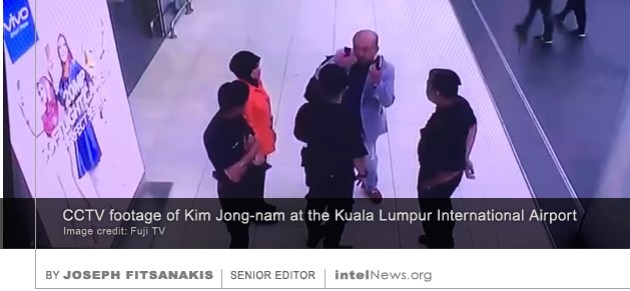
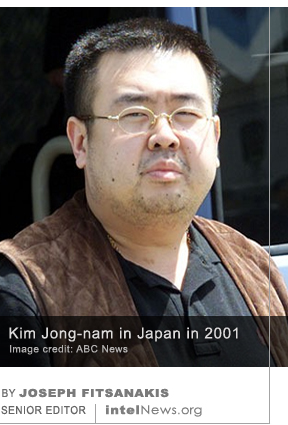
Kim Jong-nam murderThe exiled half-brother of North Korea’s leader, who was assassinated in Malaysia in February, is thought to have met with a man believed to be an American intelligence officer shortly before he was killed, according to reports. Kim Jong-nam the grandson of North Korea’s founder Kim Il-Sung, died after two women approached him at the Kuala Lumpur International Airport and splashed his face with liquid poison on February 13 of this year. Kim was about to board a flight to Macau, where he had been living in self-exile with his family since 2007. His relations with his brother, North Korean Supreme Leader Kim Jong-un, and the regime in Pyongyang, were adversarial, and some suggest that he had survived at least one assassination attempt in the past.
According to Malaysian investigators, who have been probing Kim’s murder, the estranged half-brother of the North Korean dictator arrived in Kuala Lumpur from Macau on February 6, a week before he was killed there. Two days later, on February 8, he traveled to Langkawi, a resort island in the Andaman Sea, located 20 miles from Malaysia’s mainland coast, near the Thai border. According to the Japanese newspaper Asahi Shimbun, a day after his arrival at Langkawi, Kim met with a man believed by Malaysian authorities to be in the employment of American intelligence. The man, who has not been named, is reportedly middle-aged, Korean-American with United States citizenship, and lives in Bangkok. The Osaka-based paper said that Malaysian police have accessed footage from the Langkawi hotel’s security cameras, which show Kim and the American man enter a hotel suite and staying there for nearly two hours before departing.

The newspaper further claims that Malaysian counterintelligence has been tracking the American man each time he has entered Malaysia from Thailand for quite some time, believing him to be a case officer. It is also thought that Kim had met the same man in Malaysia “several times in the past”, said Asahi Shimbun. The paper further states that Malaysian investigators believe the meeting between Kim and the American man was the reason behind North Korea’s decision to kill him. The American man reportedly left Malaysia on February 13, the same day Kim was assassinated in Kuala Lumpur.

Author: Joseph Fitsanakis | Date: 26 May 2017 | Permalink

North Korea accuses US of murder plot as CIA opens new DPRK mission center

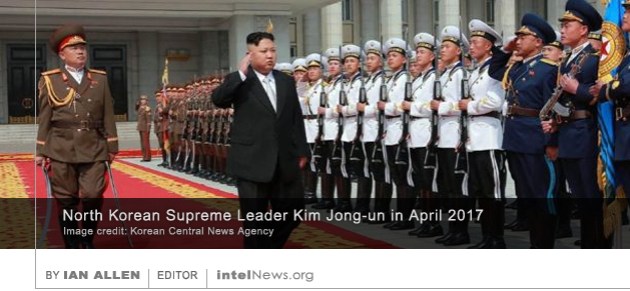
North KoreaThe United States Central Intelligence Agency has announced the establishment of a new center focusing on North Korea, shortly after Pyongyang accused Washington of plotting to assassinate its supreme leader. Last week, the regime’s Vice Minister of Foreign Affairs, Han Song Ryol, said the CIA tried to kill North Korean Supreme Leader Kim Jong-un. He was speaking during a meeting with foreign diplomats in the North Korean capital, where he repeated previously stated claims by government officials that American spies had tried to assassinate their country’s leader. According to Pyongyang, the plot involved an attack by a North Korean CIA agent, who had been trained in the use of a biochemical weapon by his handlers. The North Koreans also accuse South Korea of collaborating with the alleged CIA assassination plot, claiming that Seoul either bribed or blackmailed the would-be assassin.
Meanwhile, the CIA announced last week that it has established a dedicated center focusing on developments in the Korean peninsula. The purpose of the center, said the CIA, is to “address […] the nuclear and ballistic missile threat posed by North Korea”. There are only 11 such centers in the CIA, which the Agency calls “Mission Centers”. They focus on specific issues or locations around the world, in accordance with the geopolitical priorities of the US policymaker community, led by the White House. The establishment of a dedicated Korean Mission Center is designed to reflect the elevation of the North Korean government’s missile program to a critical foreign-policy issue by the administration of US President Donald Trump.

The new Mission Center will be located at the CIA headquarters in Langley, Virginia, and will bring together several intelligence analysts and even operations officers from a variety of directorates and units across the Agency. The goal of the new Center, according to the CIA, is to “integrate [these individuals] in one entity” in order to produce regular situation reports and analytical forecasts from the troubled region. Speaking to reporters late last week, CIA spokeswoman Heather Fritz Horniak said that the new Mission Center would allow Langley to “harness the full resources, capabilities and authorities of the Agency” in dealing with Pyongyang. But she refused to comment on North Korea’s allegations that the CIA tried to assassinate the communist state’s leader.

Author: Ian Allen | Date: 17 May 2017 | Permalink

CIA director makes unannounced visit to South Korea to discuss tensions

Korean DMZThe director of the United States Central Intelligence Agency made an unannounced visit to South Korea over the weekend, to discuss the rising tensions in the Korean Peninsula with his South Korean counterpart and other senior officials. A spokesperson from the US embassy in Seoul made an official announcement on Monday, in which he revealed the visit by Mike Pompeo, the CIA director who was appointed by US President Donald Trump in January of this year. When asked for details, however, the spokesperson refused to provide them. Consequently, Pompeo’s date of arrival to Seoul remains unknown, as is his date of departure. It is believed that he is now back in the US.
During his visit to the South Korean capital, Pompeo met with South Korean counterpart, Lee Byung-ho, who heads South Korea’s National Intelligence Service. South Korean media reports said Pompeo also met with senior officials in the office of the South Korean president. Additionally, he is said to have held several meetings with American intelligence and military officials stationed in South Korea, including a meeting with General Vincent Brooks, commander of United States Forces Korea. Reports in local media outlets said Pompeo’s visit aimed to coordinate American and South Korean intelligence responses to what Washington claims is increasing provocation by North Korea. The United States objects to North Korea’s repeated missile tests in recent weeks. On Saturday, Pyongyang attempted to launch a missile without success. The attempt, the third one in a month, elicited strong criticism from Washington and Seoul.

Pompeo’s trip to Seoul marked the fourth visit to South Korea by a senior US government official in recent weeks. The CIA director’s unannounced visit was preceded by separate official visits to Seoul by US Vice President Mike pence, Secretary of State Rex Tillerson, and Secretary of Defense James Mattis. Additionally, last Wednesday the White House organized an “extraordinary national security briefing” about North Korea for members of the United States Senate. The briefing featured presentations by senior American diplomats and military officials.

Author: Ian Allen | Date: 02 May 2017 | Permalink

North Korea is now robbing banks, says US intelligence official

North KoreaComments made by a senior American intelligence official on Tuesday appeared to suggest that the North Korean government was behind an attempt to steal nearly $1 billion from a Bangladeshi bank last year. The heist took place in February of 2016, when a computer malware was used to issue several requests to transfer funds from Bangladesh Bank —the state-owned central bank of Bangladesh— using the SWIFT network. The hackers were able to transfer five separate sums of $101 million each to a linked Bangladesh Bank account at New York’s Federal Reserve Bank. However, when further requests were issued, Federal Reserve Bank employees contacted Bangladesh Bank and blocked further transactions. Eventually, most of the transferred funds, which neared $1 billion, were recovered; but the hackers managed to get away with approximately $81 million worth of funds.
Forensic investigators described the heist as technically advanced. The antivirus company Symantec said it identified a piece of code in the malware that is known to have been used by North Korean government hackers in the past. Not everyone agreed with the claim that Pyongyang was behind the bank heist. But those who did, said that it was unprecedented in scope and aggressiveness. Some even said that the heist showed that North Korea’s cyber capabilities were among the most sophisticated and powerful in the world.

Meanwhile the United States government did not comment on the matter. However, this past Tuesday the deputy director of the National Security Agency appeared to confirm reports that North Korea was behind the Bangladesh Bank heist. Rick Ledgett, a 30-year veteran of the NSA, who is due to retire in 2018, was speaking at a public event hosted by the Aspen Institute in Washington, DC. He reminded the audience that private researchers had connected the malware code used in the Bangladesh Bank heist with that used in previous hacking attempts launched by North Korea. “If that linkage […] is accurate”, said Ledgett, it “means that a nation state is robbing banks”. When asked by the moderator whether he believes that to be the case, Ledgett responded “I do. And that’s a big deal”. Foreign Policy magazine reached out to Ledgett following his talk and asked him for clarification about his comments regarding the Bangladesh Bank heist. But the NSA official simply said that “the public case [about the heist] was well-made”. Foreign Policy also contacted the NSA, but the agency said it preferred not to comment on the matter.

Author: Joseph Fitsanakis | Date: 23 March 2017 | Permalink

Malaysia assassination highlights North Korea’s network of front companies

North KoreaThe sensational assassination of Kim Jong-nam, half-brother of North Korea’s Supreme Leader Kim Jong-un, on February 13, revealed much about the current operational mindset of Pyongyang. But it also brought to light the shady network of front companies set up by the North Korean regime to facilitate the country’s illicit financial activities around the world. This extensive network permits Pyongyang to evade international sanctions against it, and to coordinate the activities of hundreds of clandestine operatives around the world. Through these activities, the reclusive country has been able to develop its weapons of mass destruction program unabated, despite concerted efforts by the United Nations to prevent it from doing so.
Writing for Forbes, Scott Snyder, senior fellow for Korea Studies and director of the program on US-Korea Policy at the Council on Foreign Relations, notes that the UN has for many years employed sanctions to “block international financial and material support for North Korean nuclear and missile development efforts”. But now the UN’s own experts have concluded that Pyongyang has been able to evade these sanctions so skillfully that it has “largely eviscerated the intent and impact of UN sanctions resolutions”. How has it done so? Mostly through a network of countries that routinely turn a blind eye to North Korea’s illicit activities. These include several countries in the Middle East, as well as Singapore, China, Indonesia, and Malaysia. Pyongyang maintains an extensive network of front companies in these countries, says Snyder, with the main purpose of enabling it to evade international sanctions against it.

Malaysia has been a primary hub of North Korean illicit activity. In that, Pyongyang has been crucially assisted by the fact that —until last week— North Korean citizens could travel to Malaysia without entry visas. Malaysia thus provides a useful base for dozens of North Korean front companies, such as Glocom, which ostensibly markets radio communications equipment, or Pan Systems Pyongyang, which just happens to trade in exactly the kind of commercial items that could be described as “dual-use goods” in UN sanctions resolutions. Pan Systems is connected to several Malaysian-based subsidiaries, including International Global Systems and International Golden Services, which, according to investigators, are operated by North Korean intelligence.

Many of these companies also serve as exporting and importing hubs for Pyongyang. In the last five years, several ships have been intercepted while carrying illicit cargo dispatched from North Korea or destined for the reclusive state. In one such instance in 2013, the Jie Shun, a Cambodian-registered ship with a North Korean crew, was found to be carrying over 30,000 rocket propelled grenades hidden under thousands of tons of iron ore. The shipment was intended for an “undisclosed Middle Eastern destination”, says Snyder and was traced to a firm called “Dalian Haoda Petroleum Chemical Company Ltd.”. Many of these mysterious firms are headquartered in China, registered in Hong Kong, but actually work on behalf of North Korea, often using banking facilities in Europe and the United States to conduct financial transactions.

Author: Joseph Fitsanakis | Date: 07 March 2017 | Permalink

Indonesia to investigate North Korean restaurant reportedly used as spy base

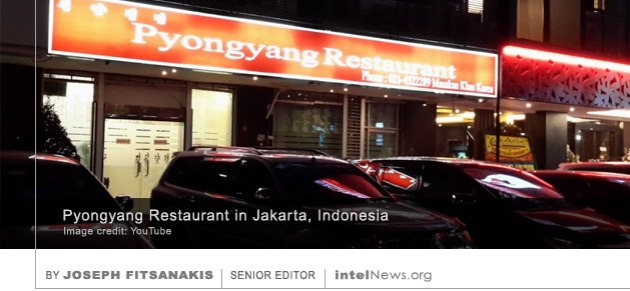
Pyongyang Restaurant in Jakarta, IndonesiaIndonesian authorities said on Sunday that they will investigate a North Korean restaurant in the country, after a Singaporean news agency claimed it was being used as a center for espionage. The announcement comes amidst heightened tensions between North Korean and its neighbors, following the murder last week in Malaysia of Kim Jong-nam, half-brother of North Korea’s Supreme Leader Kim Jong-il. Kim, the grandson of North Korea’s founder Kim Il-Sung, died after two women approached him at the Kuala Lumpur International Airport and splashed his face with liquid poison. Sources in South Korea and the United States have pointed at Pyongyang as the culprit of the assassination.
On Friday of last week, the Singapore-based news agency Asia One published a lengthy report into alleged North Korean espionage operations in Southeast Asia. The report claimed that North Korean intelligence agencies have operated extensive networks of operatives in Indonesia, Malaysia and Singapore, and that these networks have operated unimpeded for over two decades. The news agency cited an unnamed “intelligence source” as saying that the spy networks are operated by North Korea’s Reconnaissance General Bureau (RGB). The RGB is in charge of special activities abroad, which include covert operations and intelligence collection involving espionage. It operates under the Ministry of State Security and answers directly to North Korea’s supreme leader.

According to Asia One, the RGB maintains some of its largest spy networks abroad in Indonesia, Singapore and Malaysia, where Kim Jong-nam met a gruesome death last week. RGB personnel operating in these countries are North Korean citizens who are employed in the construction sector, as well as the tourism industry. Some operate North Korean restaurants, which are popular tourist attractions across Southeast Asia. The unnamed intelligence source told Asia One that North Korean restaurants serve “as a main front to conduct intelligence gathering and surveillance [against] Japanese and South Korean politicians, diplomats, top corporate figures and businessmen”. The RGB’s network in Indonesia is based in textile factories located in several Indonesian cities, said Asia One. There is also “an apartment located above a North Korean restaurant in [the Indonesian capital] Jakarta that is part of the RGB Indonesia office”, according to the report.

Following the news agency’s allegations, Argo Yuwono, senior commander for the Indonesian National Police, said that an investigation would take place into Asia One’s allegations. He said that his detectives would coordinate their activities with the Indonesian Foreign Ministry before moving ahead with the probe.

Author: Joseph Fitsanakis | Date: 21 February 2017 | Permalink

Two women arrested for assassinating North Korean leader’s half-brother

Kim Jong-namTwo women have been arrested in the past 48 hours in connection with the assassination of Kim Jong-nam, half-brother of North Korea’s supreme leader, who died in Malaysia on Monday. Kim, the grandson of North Korea’s founder Kim Il-Sung, died after two women approached him at the Kuala Lumpur International Airport and splashed his face with liquid poison. Some reports suggest that he was injected with a poisoned needle. According to Malaysian media, Kim was about to board a flight to Macau, where he had been living in self-exile since 2007. His relations with his brother, North Korean Supreme Leader Kim Jong-un, and the regime in Pyongyang, were adversarial, and some suggest that he had survived at least one assassination attempt in the past.

On Wednesday, Malaysian authorities announced the arrest of a woman carrying a Vietnamese travel document, which identified her as Doan Thi Huong (also reported as Doan Thin Hoang). No elaboration was offered on whether the travel document is genuine or forged. The 28-year-old woman is believed to have been arrested at the same airport where Kim’s assassination took place. Apparently she returned there by herself on Wednesday to catch an outbound flight to Vietnam, but was recognized by security personnel through the airport’s closed-circuit television monitoring system. Another woman, carrying an Indonesian passport, was arrested on Thursday in connection with the assassination, but no information was released about her. Some reports in the Malaysian media suggested that the second woman had been observed wandering around the Kuala Lumpur International Airport immediately following Kim’s assassination. It is believed that her co-conspirators inadvertently left her behind as they escaped the scene of the crime. Malaysian police said they also arrested a taxi driver who transported the women to the airport on the morning of the assassination. Four males, who are also believed to have helped organize the attack, remain at large.

Meanwhile South Korean and American government sources told news agencies that the assassins are thought to be agents of the North Korean government. Malaysian media said that senior North Korean diplomats were dispatched to Kuala Lumpur on Wednesday and held lengthy meetings with Malaysian government officials. Reports suggest that Pyongyang exercised pressure on Malaysian officials to cancel a planned post mortem examination of Kim’s body. But the request was allegedly denied. Malaysian officials did not respond to queries about whether Kim’s body will be handed to North Korea or flown to China for burial.

Author: Joseph Fitsanakis | Date: 16 February 2017 | Permalink

North Korean leader’s half-brother killed by female assassins in Malaysia

DPRK assassinThe half-brother of North Korean Supreme Leader Kim Jong-un has been killed in an audacious attack in Malaysia, reportedly by two female assassins who used a poisonous substance to murder him. Kim Jong-nam, was the eldest son of Kim Jong-il, and grandson of Kim Il-Sung, who founded the Democratic People’s Republic of Korea in 1948. However, he left the country in 2007, reportedly after it became clear that his younger half-brother, Kim Jong-un, was the regime’s preferred successor to his father, Kim Jong-il.
Since that time, it is believed that the self-exiled Kim split his time between Singapore and China, and that he had a residence in the former Portuguese colony of Macau. It is also believed that he employed a variety of passports, including South Korean, Portuguese and Swiss, some of which were reputed to be forgeries. Even though Kim kept a relatively low profile in the past decade, relations between him and the North Korean regime were adversarial. He made occasional comments to the press that were critical of the government in Pyongyang, and at times criticized his half-brother’s character and actions. Intelligence sources in South Korea claimed that the DPRK tried to kill him at least once in the past.

It appears that Pyongyang may have finally managed to kill Kim on Monday morning, at the Kuala Lumpur International Airport, Malaysia’s main international flight hub and one of Southeast Asia’s largest. The attack is believed to have taken place at 9:00 a.m. at the airport’s economy class terminal, where Kim was waiting to board a 10:00 a.m. flight to Macau. According to Malaysian news media, Kim was approached by two women, one of whom attacked him from behind. The female suspect reportedly covered Kim’s face with a “cloth laced with a poisonous liquid” that burned his eyes. A frantic Kim managed to run away and alert an airport employee, who called an ambulance. According to police, the victim told paramedics that someone had grabbed him from behind and “splashed a burning liquid on his face”. Some reports claimed that Kim was attacked with a poisonous needle or acid spray. According to Malaysian police spokesman Fadzil Ahmat, the grandson of North Korea’s founder expired on the way to a nearby hospital.

It was later confirmed that, at the time of his death, Kim was using a North Korean passport issued under the name “Kim Chol” and giving his date of birth as June 10, 1970. However, the travel document is believed to have been forged. Malaysian authorities said on Tuesday they had been unable to identify the suspects, but that an investigation was ongoing. Early on Wednesday, Malaysian authorities released CCTV footage of one of the suspects (pictured). Meanwhile, Kim’s body has been subjected to an autopsy, but the results remain unavailable. South Korean authorities told the Reuters news agency that Kim had been killed by assassins working for the North Korean government.

Author: Joseph Fitsanakis | Date: 15 February 2017 | Permalink

Observers speak of uncertainty as North Korean leader fires spy chief

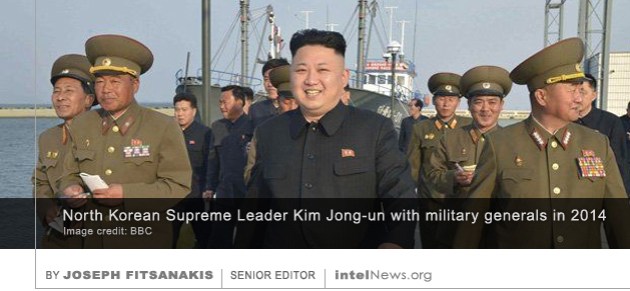
kim jong unObservers of North Korean politics raised alarm bells over the weekend, as it emerged that Supreme Leader Kim Jong-un fired his spy chief, interfering for the first time with a state institution that had not until now experienced major purges. The news circulated on Friday, following a report by South Korea’s Ministry of Unification —Seoul’s government department responsible for promoting the reunification of Korea. The ministry said that, according to its sources in the North, General Kim Won-hong had been dismissed from his post as Minister for State Security.
Kim is believed to have joined the Korean People’s Army (KPA) in 1962, at age 17. He rose through the ranks of the military to become a commander and a commissar (political officer) with the KPA’s General Political Bureau. In 1998, Kim was elected to North Korea’s Supreme People’s Assembly, which functions as the country’s parliament. In 2003, the North Korean leadership appointed Kim to director of the Military Security Command —the North Korean Army’s intelligence directorate. By 2009, Kim had been made a General and had entered the personal circle of Kim Jong-un. In 2011, when Kim Jong-un became supreme leader of North Korea, General Kim was widely viewed as one of his most trusted advisors. Few were surprised, therefore, when Kim was made State Security Minister, in April 2012. From that position, General Kim oversaw the activities of the regime’s secret state police, North Korea’s most powerful security institution, which is answerable only to the country’s supreme leader.

But it now appears that General Kim was dismissed from his powerful post two weeks into 2017, allegedly on charges of corruption and abuse of state power. Some reports suggest that his dismissal may be related to the defection of Thae Yong-ho, a senior North Korean diplomat who defected with his family while serving in the country’s embassy in London last year. It is also believed that Kim was demoted from a four-star to a one-star general.

Since he assumed power in the country in late 2011, Kim Jong-un has purged several layers of elite government apparatchiks. But he has not interfered in the country’s intelligence and security agencies. Thus, if General Kim was indeed dismissed, it would mark the first major demotion of a senior official in the Ministry of State Security in over six years. Some observers suggest that Kim’s demotion may mark the beginning of a major round of purges in the country’s security and intelligence services. But others think that that Kim was demoted by the country’s supreme leader in a pre-emptive action aimed at preventing a possible military coup against him.

Author: Joseph Fitsanakis | Date: 06 February 2017 | Permalink

North Koreans are studying nuclear physics in Japan, say human rights activists

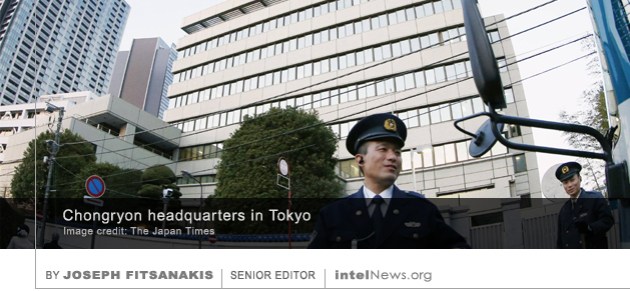
ChongryonStudents who have pledged allegiance to North Korea are being taught advanced courses in nuclear physics and control engineering in Japan, which violates United Nations sanctions, according to human rights campaigners. The students take classes at Korea University, a higher-education institution located in in Kodaira, a western suburb of the Japanese capital Tokyo. The University is funded directly by the government of North Korea through Chongryon, a pro-Pyongyang organization otherwise known as the General Association of Korean Residents in Japan. The group represents tens of thousands of ethnic Koreans living in Japan, who are ideologically affiliated with Pyongyang.
But an organization called Human Rights in Asia has accused the Korea University of offering advanced technical courses on subjects related to nuclear engineering. According to the organization, the courses directly violate UN sanctions aimed at preventing North Korea from further-developing its nuclear weapons program. Human Rights in Asia is a partner with Human Rights Watch, Amnesty International, Freedom House, and others, in a worldwide campaign calling itself the International Coalition to Stop Crimes Against Humanity in North Korea. The Japanese director of Human Rights in Asia, Ken Kato, claims that the Korea University curriculum directly violates the UN sanctions imposed on Pyongyang. His organization recently submitted a petition about the topic to the UN Security Council Committee pursuant to resolution 1718. The Committee was set up in 2006 to monitor sanctions placed on North Korea, after the country announced that it possessed nuclear weapons. The petition claims that the Korea University’s curriculum violates several paragraphs of the UN sanctions resolution, which forbid the provision of specialized teaching and training on subjects relating to nuclear science. The petition also accuses the Korea University of operating as “a center for North Korea’s espionage activities in Japan”.

In February of this year, authorities in South Korea arrested an associate professor of Korea University in Japan on espionage charges. Pak Chae Hun, 49, a citizen of Japan, allegedly operated as an intelligence handler for North Korean sleeper agents operating in South Korea, Japan and China. South Korean counterintelligence officials said they intercepted encrypted email messages sent to Pak from Japan. The messages allegedly contained instructions from Office 225 of the North Korean Workers’ Party Korea, which is tasked with overseeing the activities of sleeper agents operating in South Korea. Pak is also accused of having provided North Korean agents with telephone devices and ATM cards, which they used to withdraw cash from banks in South Asia.

Author: Joseph Fitsanakis | Date: 23 December 2016 | Permalink

More on senior North Korean diplomat who defected in London

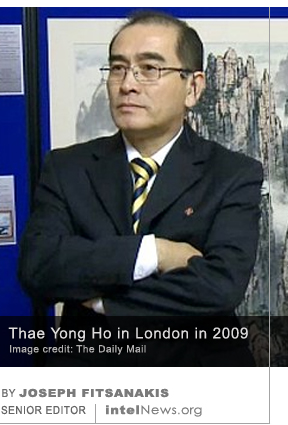
Thae Yong-HoA high-ranking North Korean diplomat, who defected with his wife and children in London, and is now in South Korea, is from a privileged family with a long revolutionary pedigree in North Korean politics. South Korea’s Ministry of Unification confirmed on Wednesday that Thae Yong-Ho, the second-in-command at the North Korean embassy in the United Kingdom, had defected with his wife and children and had been given political asylum in South Korea. As intelNews reported earlier this week, Thae, a senior career diplomat believed to be one of North Korea’s foremost experts on Western Europe, had disappeared with his family and was presumed to have defected “to a third country”.
New information has since emerged on Thae and his family, confirming that both he and his wife are members of North Korea’s privileged elite, with decades-old connections to the ruling Workers’ Party of Korea. According to the Seoul-based JoongAng Daily, Thae’s wife, O Hye-Son, is a niece of the late O Peak-Ryong, a decorated communist guerrilla who fought Korea’s Japanese colonialists in the 1930s. O, who died in the 1980s, joined the Korean anti-Japanese struggle alongside Kim Il-Sung, founder of the Workers’ Party of Korea and first leader of North Korea. This means that O Hye-Son is also the cousin of O Peak-Ryong’s son, General O Kum-Chol, who is currently vice chairman of the General Staff of the Korean People’s Army. Thae himself is the son of Thae Pyong-Ryol, a four-star general who also fought against the Japanese in the 1930s, alongside Kim Il-Sung. In the postwar period, General Thae became a senior member of the Workers’ Party of Korea and was appointed to the Party’s powerful Central Committee. He died in 1997.

JoongAng Daily quoted an unnamed “source familiar with the matter” of Thae’s defection, who said that the diplomat’s loyalty to the North Korean leadership had been unquestioned prior to his surprise defection. Most North Korean diplomats are posted at an embassy abroad for a maximum of three years before being moved elsewhere in the world. The fact that Thae had been allowed to remain in the United Kingdom for 10 years shows his privileged status within the Workers’ Party of Korea, said the source. Additionally, the children or most North Korean diplomats are required to return to their native country after completing high school. But this did not seem to apply to Thae, whose three children were living with him in Britain even after graduating from university. This and many other clues reflect Thae’s “impeccable credentials”, said the source, which made him one of the most trusted government officials in the regime’s bureaucratic arsenal.

It is believed that Thae defected because he had been told that his tenure in London was coming to an end after a decade, and he would have to relocate to a less desirable location, or possibly recalled back to Pyongyang. Defections among North Korea’s privileged elite are rare, but have been happening increasingly frequently in the past few years. This makes some observers believe that disillusionment among Supreme Leader Kim Jong-Un’ inner circle is growing and that the North Korean regime is becoming weaker.

Author: Joseph Fitsanakis | Date: 19 August 2016 | Permalink

Senior North Korean diplomat reportedly defects in London (updated)

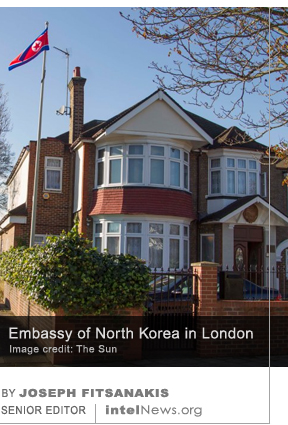
DPRK Embassy in LondonA senior member of North Korea’s diplomatic representation in the United Kingdom, who is considered one of his country’s leading specialists in Western European affairs, has reportedly defected “to a third country” with his family. The alleged defection was first reported on Tuesday by South Korean newspaper JoongAng Ilbo. Citing “a source with in-depth knowledge of North Korea”, the Seoul-based paper said that the diplomat had disappeared several weeks ago, and that staff at the embassy of North Korea in London had failed in attempts to find him. Later on the same day, the British state-owned broadcaster BBC identified the missing diplomat as Thae Yong-Ho.

In a brief report, the BBC said that the diplomat had lived with his wife and children in London for a decade, and that the family —especially its younger members— were very integrated in British culture and way of life. Further updates in South Korean media said Thae was serving as deputy consul at the embassy, essentially as second-in-command after Ambassador Hak Bong Hyon. It is also believed that Thae was tasked with promoting a positive image of North Korea to British audiences, and was also in charge of cultivating the embassy’s relations with the UK Korean Friendship Association, an organized group of North Korean ideological sympathizers in Britain. But some reports indicate that the alleged defector also performed intelligence tasks, such as monitoring the activities of North Korean defectors living in London.

Thae is believed to be a senior member of North Korea’s diplomatic community. He grew up in China and is fluent in Chinese and English, in addition to his native Korean. He joined North Korea’s diplomatic ranks soon after graduating from university and is said to be one of the country’s foremost experts on Western Europe. If confirmed, his defection will deliver a serious blow to North Korea’s prestige and arguably hurt its intelligence capabilities in the West. This development will also have a major impact on the operations of the Asian country’s embassy in London, which is run by only five diplomats, including the ambassador. No comments have been made on this story by the UK Foreign and Commonwealth Office, the embassy of North Korea in London, or the government of South Korea. According to JoongAng Ilbo, Thae is currently “going through procedures to seek asylum in a third country” with his family.

Update 17 Aug. 2016, 5:00 p.m. GMT: The BBC now reports that Thae has defected to South Korea and that he and his family are “under the [South Korean] government’s protection”, according to officials in Seoul. He is believed to be the most senior North Korean official to have ever defected in the history of the communist state.

Author: Joseph Fitsanakis | Date: 17 August 2016 | Permalink

North Korea resumes Cold-War-era radio broadcasts for its spies abroad

Voice of KoreaIn a development that is reminiscent of the Cold War, a radio station in North Korea appears to have resumed broadcasts of encrypted messages that are typically used to give instructions to spies stationed abroad. The station in question is the Voice of Korea, known in past years as Radio Pyongyang. It is operated by the North Korean government and airs daily programming consisting of music, current affairs and instructional propaganda in various languages, including Arabic, Chinese, Spanish, French, English, and Russian. Last week however, the station interrupted its normal programming to air a series of numbers that were clearly intended to be decoded by a few select listeners abroad.


According to the South Korean public news agency, Yonhap, the coded segment was broadcast on shortwave at 12:45 a.m. on Friday, July 15. It featured a female announcer slowly reading a series of seemingly random numbers from an instruction sheet. The announcer began the segment by stating that she would “now provide a review on the topic of mathematics, as stipulated by the distance-learning university curriculum for the benefit of agents of the 27th Bureau”. She went on to read a series of numbers: “turn to page 459, number 35; page 913, number 55; page 135, number 86; page 257 number 2”, etc. This went on for approximately 12 minutes, said Yonhap.

The technique described above is informally known as ‘numbers stations’, and was extensively used by both Western and communist countries during the Cold War to send operational instructions to their intelligence personnel stationed abroad. Armed with a shortwave radio, an intelligence officer would turn to the right frequency on a pre-determined date and time, write down the numbers read out and proceed to decrypt them using a ‘number pad’, a tiny book that contained the key to deciphering the secret message aired on the radio. But the era of the Internet, mobile phones and microwave communications has caused the demise of ‘numbers stations’. The latter are rarely heard nowadays, though a number of nations, including Cuba, South Korea and Israel, are believed to still use them.

The last time North Korea is thought to have employed ‘numbers stations’ to contact its spies stationed abroad was in the spring of 2000, prior to the historic first Inter-Korean Summit that featured a face-to-face meeting of the then South Korean President Kim Dae-jung and the then North Korean Supreme Leader Kim Jong-il. Since that time, the North Koreans are believed to have stopped deploying broadcasts to communicate with their intelligence operatives in foreign countries. Yonhap quoted an unnamed South Korean government source as saying that last Friday’s broadcast was the first number sequence aired by Pyongyang in over 16 years. According to the news agency, the broadcast has Seoul worried about “possible provocations” that may be planned by North Korean spies living secretly in the south.

Author: Joseph Fitsanakis | Date: 20 July 2016 | Permalink