Location of UK’s ‘above top-secret’ Middle East spy base revealed
June 4, 2014 4 Comments
 By JOSEPH FITSANAKIS | intelNews.org
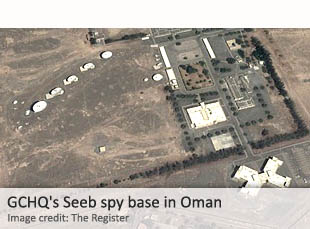
The location of a British listening base in the Middle East, which is classified by the British government as “three levels above top-secret”, has been revealed by a technology website. The information had been previously leaked by American defector Edward Snowden to several British newspapers, but the latter refrained from airing it following pressure by the British government. However, the highly classified material was published on Tuesday in online technology review The Register. The author of the revelatory article is Duncan Campbell, a longtime investigative journalist and researcher who has been reporting on intelligence matters for over three decades. In his article, Campbell alleges that the secret British spy base is located in Seeb, in northeast Oman, and is operated by the General Communications Headquarters (GCHQ), Britain’s signals intelligence agency. The base’s primary operational goal is to monitor undersea telecommunications cables serving the Arabian Sea and the Persian Gulf, which pass through the Strait of Hormuz. According to Campbell, the listening facility was initially constructed with British funding as a joint intelligence center with the Omani authorities, with the purpose of intercepting the signals of civilian communications satellites orbiting in the wider region. But it has since developed into one of three high-value GCHQ locations in Oman (referred to as Overseas Processing Centres —OPCs). The three locations, codenamed TIMPANI, GUITAR and CLARINET, form part of a region-wide communications interception program codenamed CIRCUIT. Through CIRCUIT, London has allegedly managed to gain access to nearly a dozen underwater cables passing through the Strait of Hormuz, which link a host of Arab countries, including Iraq, Iran, Saudi Arabia, the United Arab Emirates and Kuwait. Interestingly, GCHQ relies on the close cooperation of several telecommunications service providers to meet its interception targets, says Campbell. These include British Telecom, codenamed REMEDY in internal GCHQ documents, and Vodafone, the world’s second-largest mobile telecommunications company, which GCHQ has codenamed GERONTIC. Read more of this post







 intelNews.org
Israel intel official says Bahrain and Oman could follow UAE in normalizing relations
August 17, 2020 by Joseph Fitsanakis Leave a comment
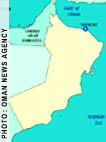
The announcement was greeted with enthusiasm and skepticism, with some observers claiming it could reshape Middle East politics, and others warning it could bring Palestinian factions closer to Iran. But on Sunday, Eli Cohen, Israel’s Minister of Intelligence and member of the country’s Security Cabinet, said the agreement between Israel and the UAE was likely to be the first of several similar deals. Speaking on Israel Army Radio, Cohen said that “additional agreements” would follow “in the wake of this agreement”, and that “Bahrain and Oman are definitely on the agenda”. The two Gulf countries are close allies of the United States and Saudi Arabia, which is one of Iran’s strongest regional rivals. In official statements issued on Thursday, Bahrain and Oman praised the normalization of relations between the UAE and Iran, but did not speak to whether they were contemplating following in the UAE’s footsteps. Meanwhile, the government of Kuwait said in an official statement last week that its position toward Israel remained unchanged, signaling that a change of status in its treatment of the Jewish state was not on the horizon.
Cohen also told Israel Army Radio that, in his assessment, “there is a chance that already in the coming year there will be [agreements between Israel and] Muslim countries in Africa […] chief among them Sudan”. In recent years, Israeli Prime Minister Benjamin Netanyahu has met with Omani and Sudanese leaders. The Israeli prime minister said last week he expected “more countries will be joining us in the peace circle”, adding that the Israel-UAE agreement signaled “a historic change which advances peace with the Arab world and will eventually advance a real, sober and secure peace with the Palestinians”. There are many critics of this view, especially among Netanyahu’s own voter base, which was highly supportive of his prior pledges that Israel would annex parts of the West Bank.
► Author: Joseph Fitsanakis | Date: 17 August 2020 | Permalink
Filed under Expert news and commentary on intelligence, espionage, spies and spying Tagged with Bahrain, diplomacy, Eli Cohen, Israel, News, Oman, secret diplomacy, United Arab Emirates