Russia fired officials over Smolenkov defection, filed INTERPOL search request

INTERPOLThe Russian government reportedly fired a number of officials over the defection of a senior Kremlin aide, who alleged worked as an American spy. Meanwhile, Moscow has filed a search request with INTERPOL about the alleged defector’s whereabouts. News of the defection was reported on September 9 by the American news network CNN. The network alleged that the man —which it did not name— was exfiltrated from Russia in 2017 by the United States Central Intelligence Agency, over fears about his life. A subsequent report in the Russian daily newspaper Kommersant identified the alleged defector as Oleg Smolenkov, 50, and said that he disappeared along with his wife and three children in the summer of 2017 while on holiday in Montenegro.

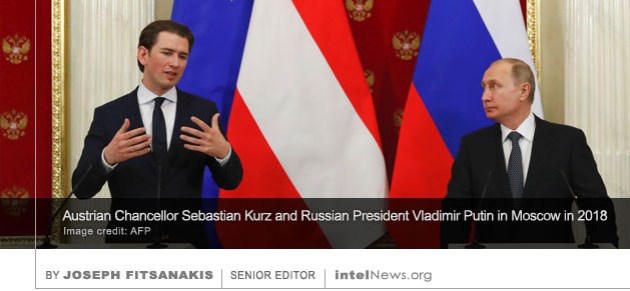
On September 11, the Reuters news agency revealed that Smolenkov was a career diplomat who served as senior aide to Yuri Ushakov, Russia’s former ambassador to the United States and senior international affairs advisor to Russian President Vladimir Putin. But the Kremlin disputes claims that Smolenkov was a highly placed official or that he could have been in possession of damaging classified intelligence.

According to a new report from Russia’s InterFax news agency, the Kremlin disciplined a number of Russian officials for permitting Smolenkov and his family to travel to Montenegro. The disciplinary action was taken soon after Smolenkov’s disappearance and led to a number of firings, said InterFax, citing anonymous government sources. In the summer of 2016, the Kremlin had issued a travel ban for Montenegro, which barred government employees from traveling there, due to the deteriorating relations between Moscow and the former Yugoslav Republic. Montenegrin authorities had previously claimed that Russia tried to stage a coup and planned to kill the country’s prime minister. According to InterFax, an investigation by “the relevant law enforcement agencies” concluded that those officials who had allowed the Smolenkovs to travel to Montenegro had “violated the ban”. They were therefore “disciplined and [some] were fired”, said the anonymous source.

Meanwhile it was reported on Friday that the Russian Ministry of Foreign Affairs filed a search request for Smolenkov and his family with INTERPOL, the international agency that facilitates worldwide cooperation between national police organizations. When asked about it by Western news media, a Russian government spokeswoman said that Russia did what any other country would do in this situation: it contacted INTERPOL with “questions regarding the disappearance of […] a citizen of Russia on the territory of a foreign state along with his family […] and his presence on the territory of the United States”, said the spokeswoman.

Author: Joseph Fitsanakis | Date: 16 September 2019 | Permalink
CIA denies Trump’s mishandling led to alleged exfiltration of senior Russian asset

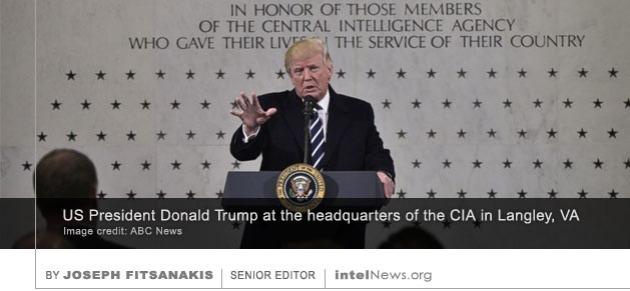
Trump CIA - JFThe United States Central Intelligence Agency has questioned the accuracy of a media report, which claimed that “repeated mishandling” of intelligence by President Donald Trump resulted in the exfiltration of a high-level source from Russia. According to the American news network CNN, the CIA carried out the exfiltration operation in 2017. Despite the success of the operation, the removal of the asset has left the US without this high-level source at a time when it is most needed, said CNN. The network cited “a person directly involved in the discussions” to exfiltrate the asset, but said it was withholding key details about the case in order to “reduce the risk of the person’s identification”.
According to CNN, the CIA asset was so highly placed inside the Kremlin that the US had “no equal alternative” inside the Russian government. The asset was in a position to provide “both insight and information” on Russia’s secretive President, Vladimir Putin. But by 2016, the sheer length of the asset’s cooperation with the CIA had caused some intelligence officials at Langley to consider exfiltrating him from Russia. Typically agents-in-place have short careers; they are either captured by their adversaries or are exfiltrated once their handlers start to believe that they are burned out or that their life may be in danger. But exfiltration operations in so-called “denied areas” —regions or countries with formidable counterintelligence resources that make it difficult for the CIA to operate there— are rare.

The CNN report claims that the decision to exfiltrate the high-level source was taken after a May 2017 meeting between Trump and Putin, with the participation of senior American and Russian officials. The latter included Foreign Minister Sergei Lavrov and then-Ambassador to Washington Sergey Kislyak. Citing an American “former senior intelligence official”, CNN alleges that Trump “repeatedly mishandled classified intelligence” at that meeting, which could have led to the exposure of the CIA’s asset. At that time, the CIA decided that it was time to exfiltrate the asset and proceeded to do so successfully.

But the CIA disputed the accuracy of CNN’s story. The agency’s Director of Public Affairs, Brittany Bramell, dismissed what she called “CNN’s narrative” as “inaccurate”. She added that the agency’s judgements about exfiltrations of agents are “life-or-death decisions” that are based solely on “objective analysis and sound collection”, not on “misguided speculation that the President [mishandled] our nation’s most sensitive intelligence —which he has access to each and every day”. CNN said on Monday that Trump and “a small number of senior officials” were told about the exfiltration in advance. The news network also said that it was not privy to details about the extraction operation or about the current whereabouts of the exfiltrated asset.

Author: Joseph Fitsanakis | Date: 10 September 2019 | Permalink

Italy arrests Russian ex-foreign ministry official for espionage following US request

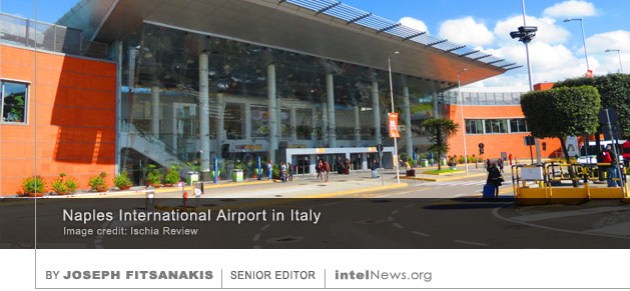
Naples International AirportItaly has arrested a Russian business executive and former foreign ministry official who is wanted by the United States for carrying out espionage against an American aviation firm. Alexander Yuryevich Korshunov, 57, who is a former official in Russia’s Ministry of Foreign Affairs, was reportedly arrested on August 30 at Naples International Airport in Italy. On Thursday, the US Department of State filed a criminal complaint against Korshunov, accusing him of trade secret theft. According to the complaint, Korshunov’s espionage benefited a Russian state-owned aviation company. He was allegedly assisted by 59-year-old Maurizio aPolo Bianchi, an Italian citizen, who remains at large.
The US government claims that the two men conspired to steal blueprints for the design of gearbox accessories used in jet engines. The company they allegedly stole the information from is GE Aviation, a company based in the US state of Ohio. Bianchi reportedly used to work for one of GE Aviation’s subsidiaries in Italy and dealt with clients from Russia and China, among other countries. But he eventually left the company and joined another firm that contracted with Aviadvigatel, a subsidiary of United Engine Corporation. The latter is a Russian-owned aerospace company that employed Korshunov. During his work for Aviadvigatel, Bianchi is accused of having employed a number of current and former employees of GE Aviation as consultants. But the work that Bianchi carried out for his new company compromised trade secrets belonging to GE Aviation, according to the US Department of Justice. Moreover, the Department claims that both Bianchi and Korshunov, who supervised Bianchi’s work on behalf of Aviadvigatel, were aware that they were exploiting trade secrets that did not belong to them.

There is no information on Bianchi’s whereabouts. If convicted, the two men face up to 10 years in prison each. On Thursday, the Russian President Vladimir Putin dismissed the charges against Korshunov as biased and said they were likely motivated by “unfair competition” practices by American companies. The Italian government has issued no public comment about Korshunov’s arrest.

Author: Joseph Fitsanakis | Date: 06 August 2019 | Permalink

Russian bank accused of being ‘den of spies’ relocates to NATO member Hungary

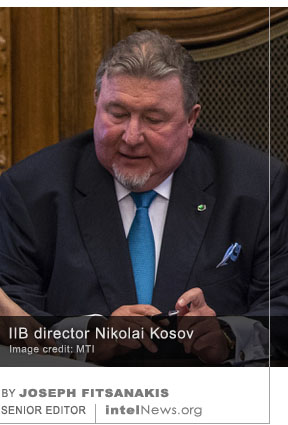
Nikolai KosovA Russian-backed development bank, which is accused by its critics of being an intelligence front for Moscow, has relocated to Hungary, a member of the European Union (EU) and the North Atlantic Treaty Organization (NATO). The International Investment Bank (IIB) was founded in 1970 by the Soviet Union as a multilateral development banking institution. Its purpose was to assist in the economic development of the Soviet Union’s allies under the umbrella of the Soviet-led Council for Mutual Economic Assistance (COMECON). Like other Soviet financial institutions with foreign branches, it was suspected by Western spy agencies of being used by Moscow to station intelligence personnel under non-official cover.
In 1991, following the disintegration of the Soviet Union and the Eastern Bloc, the IIB entered a period of stagnation, as did many Soviet institutions of the Cold War period. But in 2002 Russian President Vladimir Putin spearheaded a government-led effort to revive the bank. Today the Russian government has a 47 percent stake in the IIB, with the remaining 53 percent owned by its other member-countries. These are all communist of former communist states: Cuba, Vietnam, Cuba, Bulgaria, Romania, Slovakia, the Czech Republic, and Hungary. Each of these member states is represented on the IIB with an official who speaks for his or her government.

Some critics express concerns that the IIB continues to serve as a front company for Russian intelligence. Some point to the IIB’s director, Nikolai Kosov, whose parents were officers in the KGB and served in several European countries, including Hungary, during the Cold War. Such criticisms resurfaced earlier this year, when it was announced that the IIB would move its headquarters to Budapest. The Hungarian government said it would host IIB’s 100 personnel and granted the IIB building privileges that are usually extended to diplomatic facilities. For instance, Hungarian authorities will not be able to enter the IIB premises without prior authorization by the bank.

The Hungarian government of Prime Minister Viktor Orban has said that the IIB’s relocation to Budapest will further-strengthen Hungary’s relations with Russia and help promote the former Soviet ally as a growing financial hub in Europe. But one critic told the Al Jazeera news network that the IIB “is more likely to make Budapest a Russian intelligence center than a financial hub”. Another critic, referred to by Al Jazeera as a “diplomatic source”, said that NATO has limited its sharing of classified information with Hungary “due to fears it leaves the door open to Russia”.

Author: Joseph Fitsanakis | Date: 03 September 2019 | Permalink

Chechen shot dead in broad daylight in Berlin, Russian spy services suspected

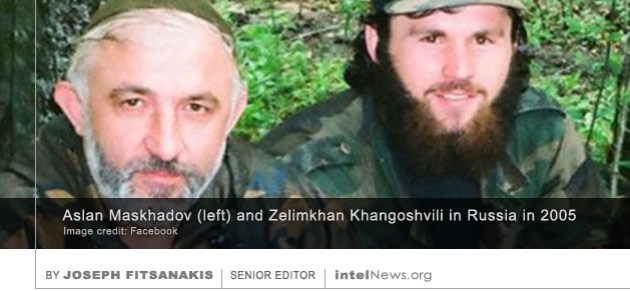
Zelimkhan KhangoshviliAuthorities in Germany suspect that Moscow may have been behind the assassination of a Chechen separatist who was shot in broad daylight in Berlin by a man wearing a wig and carrying a pistol fitted with a silencer. The victim of the attack was Zelimkhan Khangoshvili, 40, who was a leading figure in the so-called Second Chechen War. The conflict pitted the Russian military against groups of Muslim fighters in the North Caucasus between 1999 and 2009.
Khangoshvili, a Muslim who was born in Georgia, was a bodyguard of Aslan Maskhadov, the self-described leader of the Muslim separatists in the Northern Caucasus. Maskhadov was killed in 2005 in a raid by Russian Special Forces, and Khangoshvili fled to his native Georgia. In 2015, Khangoshvili sought political asylum in Germany after two men tried to kill him in Tbilisi. The German authorities initially placed him on a terrorism watch list, but removed him after he began to collaborate with German counterterrorism agencies and participate in programs designed to de-radicalize Muslim youth.

Khangoshvili was reportedly killed last Friday as he was walking to his local mosque. Witnesses said a man on a bicycle approached Khangoshvili from behind as he was walking in the middle of Kleiner Tiergarten, a small park in downtown Berlin. The cyclist shot Khangoshvili and then immediately fled the scene on his bicycle. Police later found a Glock 26 semi-automatic pistol fitted with a silencer, a wig and the assailants bicycle. All had been dumped in a nearby lake. Later that evening the police announced the arrest of a Russian citizen identified only as “Vadim S.”, who is alleged to have shot Khangoshvili.

German newsmagazine Der Spiegel quoted Martin Steltner, from the Berlin prosecutor’s office, who said that Vadim S. had arrived in Berlin from Moscow via Paris less than a week before Khangoshvili’s murder. Steltner added that there were “indications the deed was pre-planned and may have political motives behind it”. An anonymous source from German intelligence told Der Spiegel that “if it turns out that a state actor like Russia is behind this, we will have a second [Sergei] Skripal case on our hands, with all that this entails”.

Author: Joseph Fitsanakis | Date: 28 August 2019 | Permalink

Russian deep-cover spy speaks to Western media for first time

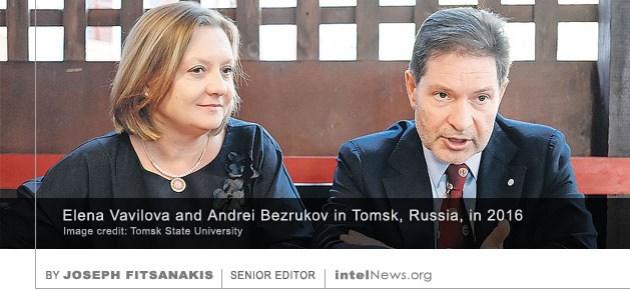
Elena Vavilova Andrei BezrukovOne of the ten Russian deep-cover spies who were arrested in the United States in 2010, and swapped with American- and British-handled spies held by Moscow, has spoken to Western media for the first time. Elena Vavilova was arrested by the Federal Bureau of Investigation in June of 2010 along with her husband, Andrei Bezrukov. In its two decades of operating under deep cover in the US, the married couple used the stolen identities of two dead Canadian citizens, Tracy Foley and Donald Heathfield. Vavilova claimed to be of French-Canadian origin and worked as a real estate agent. The couple never spoke Russian at home and their two sons, Alex and Tim Foley, were unaware of their parents’ secret identities.
Last week, Vavilova, who now works as a private consultant in Moscow, spoke to Shaun Walker, Russia correspondent for British newspaper The Guardian. It was the first face-to-face encounter between a Western news outlet and one of the 10 outed Russian ‘illegals’. The reason for the interview was Vavilova’s upcoming book, A Woman Who Can Keep Secrets (in Russian), which presents a fictionalized account of her career and marriage to Bezrukov. It offers rare insights into the longstanding Russian ‘illegals’ program, which dates back to Soviet times. The book’s two protagonists meet as students in Siberia, where they are eventually recruited by the KGB, and spend several years training in languages and tradecraft. Part of their training includes living in a KGB house modeled after suburban American homes, so that they can get used to domestic life in the West. This account is believed to include true elements of the lives and careers of Vavilova and Bezrukov. The two married in Russia but moved to Canada separately, using fake Canadian identities. They pretended to meet for the first time in Canada, where they ‘dated’ and eventually ‘married’ before moving to the US to begin their espionage work.

Vavilova told Walker that the popular view of the 10 Russian illegals as having achieved little of intelligence value during their time in the US is misguided. “Of course I can’t talk about it”, she said, “but I know what we were doing and it doesn’t matter what others say”. She also said that training for illegals involved learning how to handle guns and using martial arts. But she added that these skills were never used in the field and were mostly good for building self-confidence —especially for missions that took place under cover of night in America, where street crime was far more prevalent than in Russia during the Cold War. Walker said that Vavilova’s English remains perfect, as does her husband’s. Like Vavilova, Bezrukov now works as a consultant and also teaches at a university in Moscow. Vavilova refused to discuss current Russian politics in her interview.

Author: Joseph Fitsanakis | Date: 26 August 2019 | Permalink

New report details growing presence of Russian private security firms in Africa

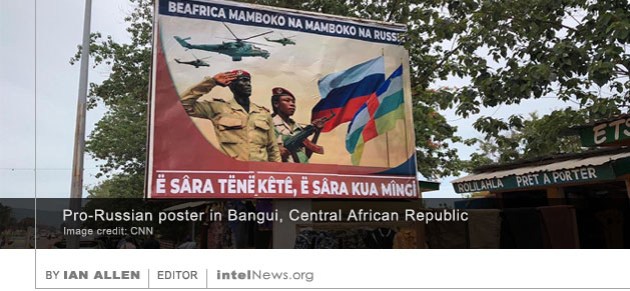
Central African Republic RussiaA new report by the American news network CNN has shed new light into the little-researched subject of Russian-owned private military and security operations in Africa. CNN said the report took a month to complete. It claims that a Russian tycoon by the name of Yevgeny Prigozhin has been instrumental in the growth of Russian private security operations in the continent. Prigozhin is one of the closest confidantes of Russian President Vladimir Putin. The United States accuses him of helping fund the Internet Research Agency, a Russian company based in Saint Petersburg, which allegedly participated in the Kremlin’s efforts to meddle in the 2016 US presidential election. CNN claims that Prigozhin is also connected with PMC Wagner, a Russian security contractor with presence on the ground in Syria and eastern Ukraine. Western officials allege that firms like Wagner could not operate without permission from the Kremlin.
According to the CNN report Prigozhin turned to African countries like Sudan, Libya and the Central African Republic in order to make up for his financial losses in Syria and Ukraine. He allegedly has a role in many of Russia’s 20 military agreements with African states where he provides security and weapons training on behalf of Moscow. In return, his group of companies, headed by a firm called Concord, receives exploration permits and the rights to exploit precious metals found throughout Africa, according to CNN. The network sent correspondents to the Central African Republic where they found that a radio station and a major military training base are run by a group of 250 Russian contractors. None of them will say who pays them, according to CNN, and at least one of them claims to be a “security adviser” for Central African Republic President Faustin-Archange Touadéra. Most of the Russians operate out of Palais de Berengo, a dilapidated presidential palace located 30 miles south of the capital Bangui, which used to belong to the country’s late dictator Jean-Bedel Bokassa. At a nearby mining site there are now hundreds of locals who work for the Russians, said CNN.

The CNN report also notes that last year three Russian journalists, Kirill Radchenko, Alexander Rastorguyev and Orkhan Dzhemal, were ambushed and executed near Sibut in the central region of the country, allegedly “by men wearing turbans and speaking Arabic after refusing to surrender their vehicle and equipment”. They were in the Central African Republic to research the presence of Russian private security firms. Their trip was funded by the Center for Investigation, a London-based foundation owned by the Russian exiled billionaire Mikhail Khodorkovsky. No one has been arrested or charged for the killings of the three Russian journalists. Central African Republic authorities told CNN that “investigations were continuing” into the matter.

Author: Ian Allen | Date: 14 August 2019 | Permalink

Austria issues international arrest warrant for alleged Russian spy

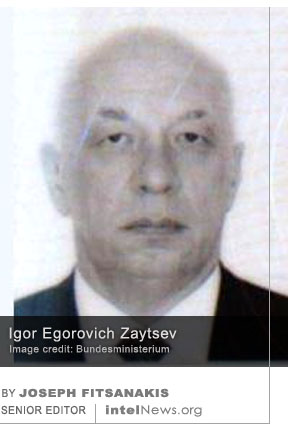
Igor Egorovich ZaytsevThe Austrian government has issued an international arrest warrant for a Russian man who allegedly recruited a retired colonel in the Austrian Federal Army to spy for Moscow. The arrest warrant was issued on Tuesday by the public prosecutor’s office in the city of Salzburg. It identifies the Russian man as Igor Egorovich Zaytsev. Austrian officials allege that the Moscow-born Zaytsev is in fact an intelligence officer for the Main Directorate of the General Staff of the Russian Armed Forces. Known as GRU, the organization is Russia’s primary military-intelligence agency.
In an accompanying press statement issued on Tuesday, the Austrian Ministry of the Interior said that Zaytsev had facilitated the “betrayal of state secrets” and that his actions had been “to the detriment of the Republic of Austria”. The arrest warrant accuses Zaytsev of having participated in the “intentional disclosure of a military secret”, but does not provide details. However, in a subsequent statement, Austrian police directly linked the search for Zaytsev with an espionage case that was reported in the Austrian media last year. The statement said that Zaytsev is believed to have recruited a man known as “Martin M.” to spy on Austria. This appears to refer to the arrest last November of a 70-year-old colonel in the Austrian Army, who was stationed in Salzburg. He is believed to have spied for Russia from at least 1992 until his arrest. Austrian media reported that the accused spy was believed to have given Russia information on a range of weapons systems used by the Austrian Army and Air Force, as well as the personal details of high-ranking officers in the Austrian Armed Forces.

Soon after the arrest of “Martin M.”, Austrian authorities arrested a second man, identified only as “O.”, who is also suspected on having spied for Russia. According to the Vienna Public Prosecutor’s Office, “O.” was an employee of the Austrian Office for Protection of the Constitution and Counterterrorism, known as BVT. He had been investigated on suspicion of espionage for more than a year prior to his arrest. The man’s arrest took place alongside simultaneous raids at two residential addresses associated with him, according to reports. No further details have been made available since the arrest. It is not known whether Zaytsev’s is also connected with the case of “O.”.

Author: Joseph Fitsanakis | Date: 26 July 2019 | Permalink

Western spies used ‘crown jewel’ of espionage tools to hack into Russia’s Google

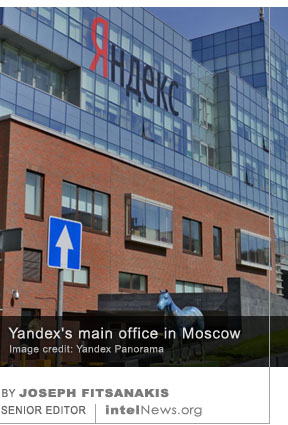
Yandex RussiaHackers used a malware described by experts as the “crown jewel” of cyber-espionage tools to hack into Russia’s version of Google, in an effort to breach user accounts, according to the Reuters news agency. The hackers targeted Yandex (Яндекс), a Moscow-headquartered company that operates as the Russian version of Google. Yandex is the largest technology venture company in the Russian Federation and the fifth most popular search engine in the world. It also provides services such as mapping and email in Russia and several other countries in Central Asia and the Middle East. It claims that it serves more than 150 million monthly users worldwide.
On Thursday, Reuters cited “four people with knowledge on the matter […] in Russia and elsewhere”, who said that Yandex was targeted by a sophisticated hacking operation between October and November of 2018. The news agency said that three of its sources had direct knowledge of the details of the cyber-espionage operation against Yandex. According to the unnamed sources, the hackers appeared to be primarily interested in breaching the accounts of specific employees in Yandex’s research and development unit. Their purpose was to acquire technical information about how Yandex authenticates user accounts. That information could potentially enable them to impersonate Yandex users and access private information, including email messages, geolocation information, and other sensitive private data. Reuters said that the hackers attempted to breach Yandex for purposes of espionage, not sabotage or disruption, or stealing intellectual property for commercial purposes.

Moreover, the hackers used Regin, a highly sophisticated malware that a technical expert from the Symantec Corporation described as “the crown jewel of attack frameworks used for espionage”. Regin was identified as a malware employed by intelligence services of the so-called Five Eyes intelligence alliance between spy agencies of the United Kingdom, Canada, New Zealand, Australia and the United States. It was identified as a Western cyber-espionage tool in 2014, based on revelations made by Edward Snowden, the American former employee of the National Security Agency and the Central Intelligence Agency who defected to Russia. The same malware was used in 2013 to access about a dozen mainframe computers of Belgacom, Belgium’s largest telecommunications service provider, which is partly state-owned. The attack was widely attributed to a consortium of Western intelligence services led by the NSA.

According to Reuters, the hackers were able to penetrate Yandex’s networks for several weeks or longer, without being noticed by the company’s cyber-security monitors. When the penetration was detected, Yandex hired a cyber-security team from the Russian anti-virus firm Kaspersky. The Kaspersky team identified Regin and, according to Reuters, concluded that the hackers behind the cyber-espionage operation were tied to Western intelligence agencies. Kaspersky, the Russian government, and intelligence agencies from the Five Eyes alliance declined requests by Reuters to comment on the story. Yandex confirmed the cyber-espionage attack in a statement to Reuters, but said that its cyber-security experts had been able to detect and “fully neutralize [it] before any damage was done”. Consequently, said Yandex, “no user data was compromised in the attack”.

Author: Joseph Fitsanakis | Date: 28 June 2019 | Permalink

Israel leaked video that brought down Austrian government, says German ex-spy chief

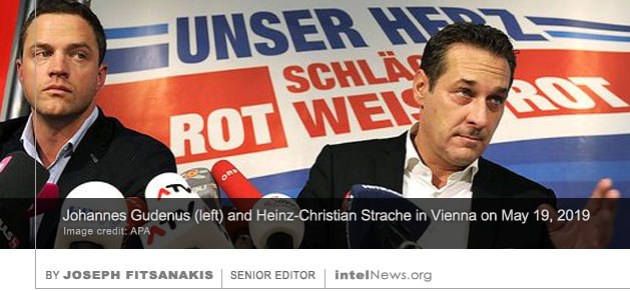
Strache GudenusIsraeli intelligence was likely behind the leaked video that brought down the far-right governing coalition in Austria on Monday, according to the former deputy director of Germany’s spy agency. The surreptitiously recorded video was leaked to two German media outlets on May 17, days before Austrian voters participated in the continent-wide elections for the European Union. In the video, two senior members of Austria’s governing far-right Freedom Party are seen conversing with an unnamed woman posing as a Russian investor. The two men in the video were Heinz-Christian Strache, the the Freedom Party’s leader and until recently Austria’s Vice Chancellor, and Johannes Gudenus, the party’s deputy leader and a member of parliament. In the video, Gudenus and Strache promise to award the woman’s firm state contracts if her uncle —a Russian oligarch— purchases an Austrian newspaper and uses it to support the Freedom Party. The video threw Austria’s political system into disarray and prompted the resignations of both Strache and Gudenus. On Monday, Austria’s Chancellor, Sebastian Kurz, was removed from power during a special parliamentary session in Vienna.
But the question is who leaked the video, and why? In an article in the Cicero, a monthly political magazine based in Berlin, a former senior official in Germany’s Federal Intelligence Service (BND) argues that Israeli intelligence was probably behind the leak. The article’s author is Rudolf Adam, who served as deputy director of the BND from 2001 to 2004, before serving as president of the Federal Academy for Security Policy of the German Ministry of Defense. Adam argues that the actions of Strache and Gudenus, as shown in the leaked video, seem “half mafia-like and half-treasonable”, and that the two should face legal consequences. But he goes on to ask “a far more interesting question”, namely “who is behind this intrigue [and] what were the intentions of its initiators?”. Adam points out that nothing is known about the woman in the video; she reportedly met Gudenus several months before the video was filmed. She posed as the Latvian niece of a Russian oligarch with ties to Russia’s President Vladimir Putin. In exchanges that lasted for several months, the woman told Gudenus that she planned to move with her daughter to Vienna and was interested in investment opportunities. She eventually invited him and Strache to a meeting in a villa in the Spanish resort island of Ibiza. It was there where the video was recorded. Read more of this post

ISIS threatens stability of former Soviet Republics, says Russian spy chief

ISIS Afghanistan

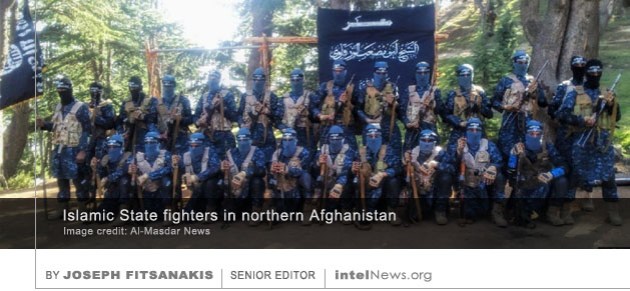
Thousands of Islamic State fighters are operating in Afghanistan’s northern border regions and are attempting to destabilize former Soviet Republics with substantial Muslim populations, according to Russia’s domestic spy chief. This warning was issued by Alexander Bortnikov, director of Russia’s Federal Security Service (FSB), which functions as Russia’s primary counter-terrorism agency. Bortnikov made these remarks during a visit to the capital of Tajikistan, Dushanbe, for a meeting of the heads of intelligence agencies of the Commonwealth of Independent States (CIS), an intergovernmental organization comprised of former Soviet Republics in the Eurasian region. The meeting was reportedly held behind closed doors, but Russia’s government-owned news agency TASS carried a summary of Bortnikov’s remarks.

The Russian intelligence chief said that, with the aid of the intelligence services of CIS states like Uzbekistan, Azerbaijan, Tajikistan, Kyrgyzstan, and others, the FSB was able to uncover and suppress eight Islamic State cells in the past year, which operated in the Central Asian region. However, the reach of the CIS countries does not extend to Afghanistan, said Bortnikov, where as many as 5,000 Islamic State fighters are congregating along the country’s border with three CIS states, namely Turkmenistan, Uzbekistan and Tajikistan. Many of these fighters are Turkmens, Uzbeks, Tajiks, Russians, and other citizens of CIS states, who previously fought with the Islamic State in Syria and elsewhere, and now form integral components of the Islamic State’s fighting force in Afghanistan and Pakistan. It appears that the Islamic State is now attempting to exploit the mountainous and porous borders of northern Afghanistan in order to destabilize neighboring countries, he said. These fighters intend to exploit “migrant and refugee flows [in Central Asia] in order to operate covertly from the Afghan battle zones to neighboring countries” and from there possibly to Russia, according to Bortnikov.

These covert activities of Islamic State fighters have already caused an escalation of tensions in the region and can be expected to continue to do so, as these groups radicalize and co-opt Muslim communities in CIS countries, noted Bortnikov. He added that popular responses to Islamist radicalization are prompting increasing incidents of “anti-Islamic terrorism”, which further-fuel religious and ethnic tensions in the region. As a reminder, last week the Islamic State announced that its so-called Khorasan Province fighters would be amalgamated into a new armed group calling itself Islamic State – Pakistan Province. Earlier this month, the group also proclaimed the establishment of a new overseas province in India’s Jammu and Kashmir state, called “wilayah al-Hind” (province of Hind). In addition to these two forces, there are currently an estimated 3,000 to 4,000 Islamic State fighters in Afghanistan’s Pashtun regions.

Author: Joseph Fitsanakis | Date: 22 May 2019 | Permalink

German spy agency concerned about Russian penetration of Austrian government

Sebastian Kurz Vladimir PutinA day after Austria’s political system was thrown into a disarray by a covert video featuring the country’s vice chancellor and a woman posing as a Russian investor, German intelligence sources have raised fears that Russia may have penetrated the Austrian government with informants. Heinz-Christian Strache, who heads Austria’s far-right Freedom Party, stepped down from the post of vice chancellor on Saturday. His resignation came a day after two German media outlets aired a covert video in which Strache appears to be promising to award state contracts in the construction sector to a woman posing as a Russian investor. In return for the state contracts, the unnamed woman said that she would have the firm of her uncle —a Russian oligarch— purchase an Austrian newspaper and use it to support Strache’s political party.

According to the German newspaper Süddeutsche Zeitung, the video was filmed in Spain in 2017, two months before the Freedom Party won a record 26 percent in Austria’s national election. This gave the party 51 seats in the Austrian parliament and propelled Strache to the post of vice chancellor. In his resignation statement, Strache said he was filmed while drunk and was engaged in “macho talk” in an atttempt to “impress the attractive hostess”. He also dismissed the airing of the covertly filmed video as “a targeted political assassination”, but added that he was resigning from the government as a matter of principle. Shortly afterwards, the Austrian Chancellor Sebastian Kurz, Chairman of the rightwing Austrian People’s Party, announced that new national elections would be held “as soon as possible”.

Meanwhile, German newspaper Die Welt am Sonntag reported on Saturday that the director of Germany’s Federal Office for the Protection of the Constitution (BfV), warned that sharing intelligence with Austria was “risky”. The Berlin-based newspaper said that BfV director Thomas Haldenwang was speaking at a closed-door meeting with German parliamentarians. He reportedly told his parliamentary audience that, due to the close relationship between the Freedom Party and Moscow, members of the Austrian government could potentially “misuse” and in some cases “forward to Russia” intelligence that they receive from other European Union member-states. This is not the first time that such warnings have come out of Germany. Last year August Hanning, who served as director of Germany’s Federal Intelligence Service (BND) openly warned Western officials to stop sharing intelligence with the government of Austria, because of its alleged proximity to the Kremlin.

Author: Joseph Fitsanakis | Date: 20 May 2019 | Permalink

Russian teams bribed Madagascar presidential candidates, BBC claims

Marc Ravalomanana Andry RajoelinaTeams of “Russian technical specialists” bribed several leading candidates in last year’s presidential elections in Madagascar, in an effort to influence the outcome, according to an investigation by the BBC. The 2018 presidential campaign was among the most closely fought in Madagascar’s 60-year post-independence history. The electorate’s attention concentrated mostly on two former presidents, Marc Ravalomanana, and Andry Rajoelina. Following a closely contested second round in late December, Rajoelina was elected president, having received 500,000 votes more than his opponent. Since his election, Rajoelina has promoted closer ties with Russia. Most notably, he has strengthened his country’s military cooperation with Moscow —a process that was initiated by his predecessor in October of last year.
But a new investigation by the BBC suggests there was a “systematic and coordinated operation” by a group of Russian businessmen with ties to the Kremlin to help Rajoelina get elected. There were “clear signs of Russian meddling in the polls”, claims the BBC, adding that at least six leading candidates in the election were offered money by the Russians to support rival candidates in the second round of the elections. Among them was Andre Mailhol, a Christian pastor who ran for president and ended up in fourth place with around 60,000 votes. He told the BBC that a group of Russians paid his deposit to run in the election and funded his campaign. In return, they asked that he would support their preferred candidate in the second round of the elections. Mailhol said that the Russians made him sign a contract promising to do as he was told.

The BBC claims that the payments to several presidential candidates were made by “dozens of Russians” who are central figures in Madagascar’s business community. They allegedly include Andrei Kramar and Roman Pozdnyakov, who live permanently in the island country. Other alleged accomplices are diamond trader Vladimir Boyarishchev, as well as Maksim Shugaley, a political campaign manager who lives in Russia. The BBC claims that their activities were funded by Yevgeny Prigozhin, a Kremlin operative who has been indicted in the United States for his alleged interference in the 2016 US presidential election. Prigozhin has allegedly been financing “teams of Russian technical specialists” to sway the results of elections in Madagascar and other African countries, according to the BBC.

Author: Joseph Fitsanakis | Date: 08 April 2019 | Permalink

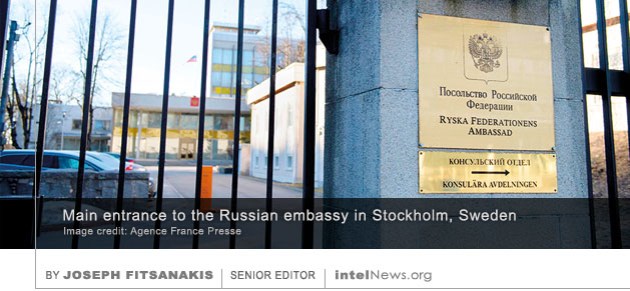
Russian diplomat involved in espionage leaves Sweden after ‘unusual’ delay

Russian Embassy SwedenRussia has recalled one of its diplomats from Sweden after he was caught receiving classified information from a computer expert at a nightclub in Stockholm. The computer expert was later identified as Kristian Dmitrievski, a 45-year-old naturalized Swede who was born in Russia. The Swedish government accuses him of having been recruited by Russian intelligence in 2017 or earlier. He allegedly met with his Russian handlers on a regular basis since his recruitment, passing them classified information of a technical nature.


Dmitrievski was reportedly arrested on the evening of February 26, while meeting his alleged Russian handler in a downtown area of the Swedish capital. Both Dmitrievski and his alleged handler were detained by officers of the Swedish Security Service, known as SÄPO. Swedish authorities later said that Dmitrievski’s alleged handler was a member of staff of the Russian embassy in Stockholm and had diplomatic immunity. SÄPO added that the Russian diplomat was believed to be a Russian intelligence officer who worked under diplomatic cover. The Russian man’s diplomatic status granted him immunity, so Swedish authorities were unable to file espionage charges against him. However, the Swedish Foreign Affairs Ministry summoned the Russian ambassador to file a protest, while the alleged intelligence officer was told to leave the country.

Surprisingly, however, Moscow did not recall the diplomat, as expected, and no further reports were issued about the incident. Then on March 28, the Swedish daily Dagens Nyheter named the Russian diplomat as Yevgeny Umerenko. Later that day, the Associated Press news agency said that it had seen “an intelligence report from a European service” that identified Dmitrievski’s Russian handler as Yevgeny Umerenko. The Associated Press described Umerenko as a “Line X officer” —a Soviet-era classification referring to case officers specializing in technological espionage. Western intelligence agencies had apparently been monitoring Umerenko’s activities ever since he had a similar role at the Russian embassy in Berlin, immediately before being transferred to Stockholm.

In its report, the Associated Press said that Moscow had finally recalled Umerenko from its embassy in Sweden, and that he was back in Russia. The news agency added it spoke to Anna Lundbladh, a spokeswoman for Sweden’s Ministry for Foreign Affairs, who confirmed that Umerenko had left Sweden, but went on to say that the Swedish government would “not discuss this matter in further detail”.

Author: Joseph Fitsanakis | Date: 01 April 2019 | Permalink

Moscow confirms arrival of Russian troops in Venezuela

Russian planes CaracasRussian media reports have confirmed that an airplane carrying 100 Russian troops arrived in Caracas on Saturday, causing tensions to rise between Washington and Moscow over the deepening crisis in Venezuela. The arrival of the Russian troops in the Venezuelan capital was first reported on Saturday morning by Venezuelan reporter Javier Mayorca, who said on Twitter that two Russian military airplanes had landed in Caracas. The reporter said that an Antonov An-124 Ruslan cargo plane belonging to the Russian Air Force could be seen on the tarmac of the Simón Bolívar International Airport in the Venezuelan capital. Another, smaller aircraft, also bearing the Russian flag on its fuselage, landed shortly afterwards, said Mayorca.

Within hours, several Venezuelan media reports appeared to confirm Mayorca’s claims, some even posting photographs of the two Russian planes surrounded by what appeared to be uniformed Russian soldiers. The BBC reported that the Russian cargo plane had delivered 100 Russian troops and 35 tons of military equipment. The force was led by General Vasily Tonkoshkurov, commander of the General Staff of Russia’s Armed Forces, according to the BBC. Later on Saturday, the Russian government-owned news agency Sputnik confirmed that Russian troops had arrived in Caracas. Citing anonymous “diplomatic sources”, Sputnik said the Russian troops had been sent to Caracas in order “to fulfil technical military contracts” and “to take part in consultations […] on defense industry cooperation” with Venezuelan officials. It added that there was “nothing mysterious” about the visit and that it was “related to [military] contracts that had been signed by the two countries years ago”.

Russia has supported Venezuela militarily, economically and diplomatically ever since 1999, when Hugo Chávez became president. The recent political crisis in the Latin American country, which has prompted a direct diplomatic intervention by Washington, has brought Caracas and Moscow closer together, as Russia has strongly opposed efforts by the United States to bring down the government of Nicolás Maduro. Earlier this year, Russia sent two Tu-160 long-range bomber aircraft to take part in a military exercise organized by the Venezuelan government.

On Monday, Washington said that the United States Secretary of State Mike Pompeo had a telephone conversation with Russian Foreign Affairs Minister Sergei Lavrov. Pompeo told his Russian counterpart that Moscow should “cease its unconstructive behavior” and warned him that the United States would “not stand idly by as Russia exacerbated tensions” in Venezuela. Late on Monday, Sputnik quoted a “diplomatic source” as saying that that the “visit of Russian military personnel to Venezuela [was] in no way connected to the statements of the United States on potential intervention in Venezuela”.

Author: Joseph Fitsanakis | Date: 26 March 2019 | Permalink