Guest Comment: Radio Still Medium of Choice for Many Spies
August 2, 2012 7 Comments
 By PAUL BEAUMONT* | intelNews.org |
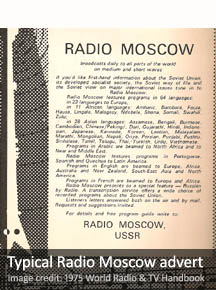
In 1975 whilst the Cold War was still being fought, short wave listeners were treated nightly to whatever stations they chose to listen to from wherever, propagation permitting. These broadcast stations carried a catholic mix of information, political views and insights, propaganda, religious ideology (usually with a political point) and music and other cultural statements of the government of the day. Broadcast stations with good signals were the BBC World Service, Voice of America, and Radio Moscow. But not all was as it seemed. Radio Moscow used very high powers so that those furthest from their transmitters still received signals at good strength whilst the propagation conditions ensured the frequencies were selected for the most efficient transfer of radio programs. One could sit in one’s armchair with no more than a telescopic antenna raised from the radio set and hear news from a foreign station and quickly retuning, could hear the same news but with a totally different bent. Even the music was not what it seemed, especially for two particular British spies, one being Frank Clifton Bossard, an officer with Britain’s Ministry of Defence Missile Guidance Branch, the other John Symonds, an ex-Detective Sergeant wanted in connection with Operation COUNTRYMAN. Bossard was strapped for cash and approached the KGB, whilst finding himself overseas with no funds Symonds found himself working for the KGB as a ‘Romeo Spy’ seducing wives of diplomats for information. Interestingly MI5 denied that Symonds acted as he did and suggested such actions were a figment of John Symonds’ imagination. Read more of this post










 intelNews.org
North Korea resumes Cold-War-era radio broadcasts for its spies abroad
July 20, 2016 by Joseph Fitsanakis 3 Comments
According to the South Korean public news agency, Yonhap, the coded segment was broadcast on shortwave at 12:45 a.m. on Friday, July 15. It featured a female announcer slowly reading a series of seemingly random numbers from an instruction sheet. The announcer began the segment by stating that she would “now provide a review on the topic of mathematics, as stipulated by the distance-learning university curriculum for the benefit of agents of the 27th Bureau”. She went on to read a series of numbers: “turn to page 459, number 35; page 913, number 55; page 135, number 86; page 257 number 2”, etc. This went on for approximately 12 minutes, said Yonhap.
The technique described above is informally known as ‘numbers stations’, and was extensively used by both Western and communist countries during the Cold War to send operational instructions to their intelligence personnel stationed abroad. Armed with a shortwave radio, an intelligence officer would turn to the right frequency on a pre-determined date and time, write down the numbers read out and proceed to decrypt them using a ‘number pad’, a tiny book that contained the key to deciphering the secret message aired on the radio. But the era of the Internet, mobile phones and microwave communications has caused the demise of ‘numbers stations’. The latter are rarely heard nowadays, though a number of nations, including Cuba, South Korea and Israel, are believed to still use them.
The last time North Korea is thought to have employed ‘numbers stations’ to contact its spies stationed abroad was in the spring of 2000, prior to the historic first Inter-Korean Summit that featured a face-to-face meeting of the then South Korean President Kim Dae-jung and the then North Korean Supreme Leader Kim Jong-il. Since that time, the North Koreans are believed to have stopped deploying broadcasts to communicate with their intelligence operatives in foreign countries. Yonhap quoted an unnamed South Korean government source as saying that last Friday’s broadcast was the first number sequence aired by Pyongyang in over 16 years. According to the news agency, the broadcast has Seoul worried about “possible provocations” that may be planned by North Korean spies living secretly in the south.
► Author: Joseph Fitsanakis | Date: 20 July 2016 | Permalink
Filed under Expert news and commentary on intelligence, espionage, spies and spying Tagged with Cold War, history, North Korea, numbers stations, radio communications, shortwave radio communications, South Korea, Voice of Korea