Swiss police saw Russian oligarch Abramovich as threat to security, files reveal

Roman AbramovichPolice in Switzerland cautioned that allowing the Russian billionaire Roman Abramovich to live there would threaten public security and damage the country’s reputation, according to files released this week. The Soviet-born Abramovich took advantage of Russia’s privatization laws in the early 1990s to gain considerable financial and political influence there. His friendship with Russia’s first post-Soviet President, Boris Yeltsin, was instrumental in his business career, and eventually placed him in close proximity to Russia’s current President, Vladimir Putin. Unlike many other oligarchs, Abramovich is believed to have remained close to Putin, despite living mostly in the United Kingdom in the past decade. The Russian oligarch has been staying in a mansion valued at close to $120 million in London’s exclusive suburb of Kensington. His lawyers have been renewing his British residence visa every six months.

However, the attempted assassination of Russian former spy Sergei Skripal earlier this year prompted the British government to intensify its scrutiny of Britain’s sizeable Russian expatriate community. London introduced tighter regulations that require Russian citizens applying to live in the UK to declare the source of their income in a far greater detail than previously. Soon after the new regulations were put in place, Abramovich’s lawyers withdrew his application to renew his British residency visa. Then, in May of this year, the Russian oligarch acquired Israeli citizenship. He has made it clear, however, that he does not intend to live in Israel. Instead, his legal team focused on an application for Swiss residency, which Abramovich first filed in the summer of 2016. In the application papers, Abramovich wrote that he intended to reside full time in Verbier, an Alpine village in the canton of Valais that is a popular holiday destination for celebrities and royalty.

A year later, following resistance and increasingly persistent questioning from the Swiss government, Abramovich’s legal team withdrew his residency application. Last February, when the Swiss press attempted to investigate the reasons behind the Swiss government’s reluctance, Abramovich’s lawyers secured an injunction forbidding the publication of information regarding his application to live in Switzerland. But the injunction was overturned late last week, and on Tuesday the Swiss media conglomerate Tamedia published some of the relevant documents. They include a letter from the Swiss Federal Police that strongly cautions against allowing the Russian-Israeli oligarch to resettle in Switzerland. The letter remarks that Abramovich has been repeatedly implicated in “suspicion of money laundering” and that the billionaire is “presumed [to have] contacts with criminal organizations”. Additionally, the letter states that Abramovich’s “assets are at least in part of illegal origin”. The letter concludes by strongly cautioning against allowing the oligarch to move to Switzerland, and argues that doing so would pose a “threat to public security” and be detrimental to the country’s international reputation.

The letter has raised eyebrows since its publication, because Switzerland is known for being highly welcoming of foreign billionaires while displaying minimal curiosity about the sources of their fortunes. Moreover, there are no known court rulings against Abramovich for money laundering or connections to organized crime. It is therefore presumed that the Swiss police report is based mostly on confidential informants and other informal sources. On Wednesday, Abramovich’s Swiss lawyer, Daniel Glasl, issued a statement saying that the Russian-Israeli magnate has never been charged with involvement in money laundering. He also reminded readers that his client has a blank criminal record.

Author: Joseph Fitsanakis | Date: 28 September 2018 | Permalink

Western spy agencies thwarted alleged Russian plot to hack Swiss chemical lab

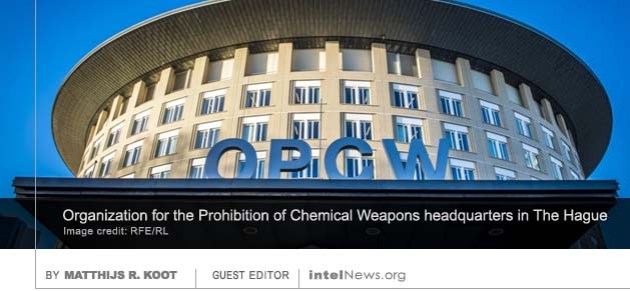
OPCW HagueWestern intelligence agencies thwarted a plot involving two Russians intending to travel to a Swiss government laboratory that investigates nuclear, biological and chemical weapons, and hack its computer systems. According to two separate reports by Dutch newspaper NRC Handelsblad and Swiss newspaper Tages-Anzeiger, the two were apprehended in The Hague in early 2018. The reports also said that the Russians were found in possession of equipment that could be used to compromise computer networks. They are believed to work for the Main Intelligence Directorate, known as GRU, Russia’s foremost military intelligence agency. The apprehension was the result of cooperation between various European intelligence services, reportedly including the Dutch Military Intelligence and Security Organization (MIVD).

The laboratory, located in the western Swiss city of Spiez, has been commissioned by the Netherlands-based Organization for the Prohibition of Chemical Weapons (OPCW) to carry out investigations related to the poisoning of Russian double agent Sergei Skripal and his daughter Yulia in March of this year. It has also carried out probes on the alleged use of chemical weapons by the Russian-backed government of President Bashar al-Assad in Syria. In the case of the Skripals, the laboratory said it was able to duplicate findings made earlier by a British laboratory.

Switzerland’s Federal Intelligence Service (NDB) reportedly confirmed the arrest and subsequent expulsion of the two Russians. The Swiss agency said it “cooperated actively with Dutch and British partners” and thus “contributed to preventing illegal actions against a sensitive Swiss infrastructure”. The office of the Public Prosecutor in the Swiss capital Bern said that the two Russians had been the subject of a criminal investigation that began as early as March 2017. They were allegedly suspected of hacking the computer network of the regional office of the World Anti-Doping Agency in Lausanne. The Spiez laboratory was a target of hacking attempts earlier this year, according to a laboratory spokesperson. “We defended ourselves against that. No data was lost”, the spokesperson stated.

On April 14, Russian Minister of Foreign Affairs Sergei Lavrov stated that he had obtained the confidential Spiez lab report about the Skripal case “from a confidential source”. That report confirmed earlier findings made by a British laboratory. But the OPCW, of which Russia is a member, states that its protocols do not involve dissemination of scientific reports to OPCW member states. Hence, the question is how Foreign Minister Lavrov got hold of the document.

As intelNews reported in March, in the aftermath of the Skripals’ poisoning the Dutch government expelled two employees of the Russian embassy in The Hague. In a letter [.pdf] sent to the Dutch parliament on March 26 —the day when a large number of countries announced punitive measures against Russia— Holland’s foreign and internal affairs ministers stated that they had decided to expel the two Russian diplomats “in close consultation with allies and partners”. The Russians were ordered to leave the Netherlands within two weeks. It is unknown whether the two expelled Russian diplomats are the same two who were apprehended in The Hague, since none have been publicly named.

A November 2017 parliamentary letter from Dutch minister of internal affairs Kajsa Ollongren, states[4] that Russian intelligence officers are “structurally present” in the Netherlands in various sectors of society to covertly collect intelligence. The letter added that, in addition to traditional human intelligence (HUMINT) methods, Russia deploys digital means to influence decision-making processes and public opinion in Holland.

Author: Matthijs Koot | Date: 17 September 2018 | Permalink

Germany drops espionage case against senior Swiss intelligence official

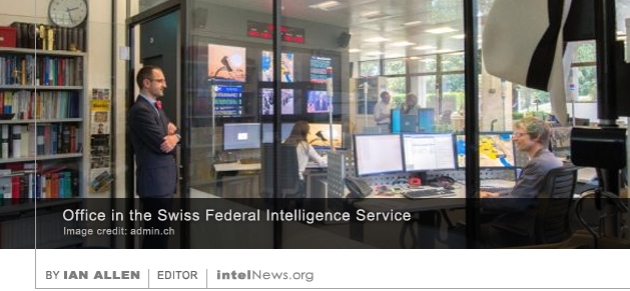
Paul ZinnikerGermany has dropped a criminal case against the second-in-command of Switzerland’s intelligence agency, who was accused by Berlin of authorizing an espionage operation against the German tax collection service. A year ago, Germany launched an unprecedented investigation into three senior officials of Switzerland’s intelligence agency, the Federal Intelligence Service (NDB). The probe was launched on suspicion that the Swiss officials masterminded a spy operation against German tax investigators who were probing the activities of Swiss banks. The German probe was launched three months after authorities in Germany arrested a Swiss intelligence officer, identified only as “Daniel M.”, for engaging in espionage on German soil.
The German government believes that billions of euros have been deposited by its citizens in banking institutions in European tax-havens like Liechtenstein, Switzerland or Monaco. For the past decade, German authorities have resorted to bribing whistleblowers in offshore banks in order to acquire internal documents that reveal the identities of German citizens who are hiding their money in foreign bank accounts. It is estimated that over a hundred million dollars have been paid to whistleblowers by German authorities since 2006. The latter argue that the proceeds collected from unpaid taxes and fines more than justify the payments made out to whistleblowers. But the Swiss government has strongly criticized Berlin for encouraging Swiss banking sector employees to steal internal corporate information that often breaks Switzerland’s stringent privacy laws. It is believed that the NDB has been instructed by the Swiss government to monitor efforts by German tax-fraud investigators to approach potential whistleblowers working in the Swiss banking sector.

The man identified as “Daniel M.” appears to be one of several Swiss spies who have been collecting information on the activities of German tax investigators. For a while it appeared that German counterintelligence officials were intent on targeting Paul Zinniker (pictured), Deputy Director of the NDB. They claimed that Zinniker was the main support officer of the operation that “Daniel M.” was participating in when he was arrested in Germany in 2017. According to the Germans, it was Zinniker’s who conceived the operation in 2011. But on Monday a spokesman for Germany’s federal prosecutor told the Swiss News Agency that Berlin dropped the case against Zinniker back in June. The revelation came less than 48 hours after a report in the Sunday edition of the Swiss newspaper Neue Zürcher Zeitung claimed that the charges against Zinniker would be dropped. According to the German federal prosecutor’s office, the case against the Swiss spy official was dropped because of the lack of cooperation by Swiss authorities, which made it impossible to prove that Zinniker was indeed the mastermind of the espionage operation against Berlin.

Author: Joseph Fitsanakis | Date: 04 September 2018 | Permalink

Swiss trying to change image as Europe’s spy hub, say officials

Federal Intelligence Service SwitzerlandOfficials in Switzerland say new laws enacted in recent months will help them change their country’s image as one of Europe’s most active spy venues. For decades, the small alpine country has been a destination of choice for intelligence officers from all over the world, who use it as a place to meet assets from third countries. For example, a case officer from Britain’s Secret Intelligence Service (MI6) will travel to Switzerland to meet her Algerian agent. She will exchange money and documents with him before she returns to Britain and he to Algeria, presumably after depositing his earnings into a Swiss bank account.

There are multiple reasons that explain Switzerland’s preferred status as a meeting place for spies and their handlers. The country is suitably located in the center of Europe and is a member of the European Union’s Schengen Treaty, which means that a passport is not required to enter it when arriving there from European Union member-states. Additionally, the country features an efficient transportation and telecommunication infrastructure, and its stable political system offers predictability and security, despite the limited size and strength of its law enforcement and security agencies. Perhaps most important of all, the Swiss have learned not to ask questions of visitors, many of whom flock to the country to entrust their cash to its privacy-conscious banking sector.

But, according to the Swiss Federal Intelligence Service (FIS), foreign spies and their handlers should find another venue to meet in secret. Speaking to the Sunday edition of Switzerland’s NZZ newspaper, FIS spokeswoman Isabelle Graber said she and her colleagues were aware that their country is a venue for meetings between intelligence operatives from third countries. Such meetings have “continued to rise in the last few years” and include “everyone from security agency employees to freelancers”, as “the market in trading secrets has exploded”, she said. That trend, added Graber, has led to a corresponding rise in meetings aimed at exchanging information for money. Many such meetings take place throughout Switzerland, she noted, and are “in violation of Swiss sovereignty and can lead to operations against the interests of the nation”.

In the past, said Graber, FIS was unable to prevent such activities on Swiss soil, due to pro-privacy legislation, which meant that the agency’s ability to combat foreign espionage in Switzerland was “far more limited than in other countries”. However, said the intelligence agency spokeswoman, the law recently changed to permit FIS to break into homes and hotels, hack into computers, wiretap phones, and implement surveillance on individuals believed to be spies or intelligence officers of foreign countries. Armed with the new legislation, the FIS is now “working hard to clear up third-country meetings [and] to prevent these from happening or at least disrupt them”, said Graber. Several times this year alone, FIS had forward information about “third-country meetings” to judicial authorities in Switzerland, she said.

Author: Ian Allen | Date: 06 February 2018 | Permalink

French-Swiss firm allegedly bribed Islamic State to keep its factory working in Syria

LafargeHolcimThe world’s largest building materials manufacturer, LafargeHolcim, which is headquartered in France and Switzerland, allegedly bribed the Islamic State to keep its factory working in Syria, according to court witnesses. The company specializes in the manufacture of building materials such as cement, concrete and various byproducts. It was formed in 2015 by a merger of France-based Lafarge and Swiss-based Holcim, and currently employs an estimated 120,000 employees in nearly 100 countries around the world.

In 2011, soon after the Syrian Civil War broke out, various militant groups began operating in the area around one of LafargeHolcim’s plants, located in in north-central Syria, 10 miles south of the Syrian-Turkish border. In June of 2016, French newspaper Le Monde published allegations that LafargeHolcim’s subsidiary, Lafarge Cement Syria (LCS), which owns the plant, bribed various militias to stay away from its factory. According to the paper, at least €20,000 (approximately $24,000) went to the Islamic State, which eventually conquered the area around the LafargeHolcim plant. The article further claimed that LCS managers in Syria sent detailed emails to LafargeHolcim executives in Europe about their dealings with various militias, including the Islamic State. LafargeHolcim approved the use of funds to bribe the militias, said Le Monde, in order to allow the factory to remain operational and to avoid having their employees taken hostage.

The newspaper’s allegations prompted the Office of the Public Prosecutor in Paris to launch a preliminary investigation in October of the same year. Eventually, an official complaint was filed by the French Ministry of Finance, which argued that the activities of LCS may have constituted illicit financial relations between a French-owned company and a terrorist group. An official investigation was opened in June of 2017 into whether LafargeHolcim illegally financed terrorist groups through its subsidiaries, Lafarge and LCS. Investigators are also examining claims that the company presented the French government with forged accounting documents in order to hide the bribes it gave to various Syrian armed groups.

Last week, investigators heard from the first time from witnesses, three of whom were LCS employees in 2014, when the company first made contact with Islamic State militants. They allegedly told prosecutors that the French-Swiss company paid approximately $20,000 a month to various armed groups, including al-Qaeda, al-Nusra Front, and the Islamic State. Prosecutors did not discuss details about the witnesses’ testimonies, but Le Monde said it spoke to individuals with direct knowledge of the investigation, who said that the witnesses’ testimonies were particularly damning for LafargeHolcim. The probe continues.

Author: Joseph Fitsanakis | Date: 25 September 2017 | Permalink

Germany’s celebrity spy Werner Mauss on trial for multi-million dollar tax evasion

Werner MaussGermany’s most famous living spy is on trial this week for hiding assets totaling $50 million in offshore bank accounts. He claims the money was given to him by unspecified “Western intelligence agencies” for his services. Werner Mauss became widely known in 1997, when he was arrested in Colombia for using a forged passport. He had traveled to the Latin American country to secure the release of a German woman who had been kidnapped by leftist guerrillas. The Colombian authorities eventually released him, following heavy diplomatic pressure from the German government. But the German media began investigating his background, and it soon became apparent that he was working for the German Federal Intelligence Service.

Following his unmasking in 1997, Mauss enjoyed celebrity status in Germany. Published accounts of his exploits claim that he was directly involved in neutralizing over 100 criminal gangs and that his work led to the capture of 2,000 criminals and spies. Mauss also claims to have helped prevent dangerous chemical substances from falling into the hands of terrorist groups, and that he stopped the Italian Mafia from killing Pope Benedict. Last year, however, Mauss saw his celebrity status diminish after the German government charged him with tax evasion. German prosecutors uncovered several overseas bank accounts belonging to him, which they said contained tens of millions of dollars in hidden income. They alleged that Mauss used the funds to finance a luxurious lifestyle centered on expensive overseas holidays, luxury cars, expensive gifts to women, as well as a private jet.

On Monday, the 77-year-old Mauss made his final plea in a lengthy court case concerning two of his off-shore accounts, located in UBS bank branches in the Bahamas and Luxembourg. The prosecution alleges that he failed to pay tax on assets totaling in excess of $50 million in the decade between 2002 and 2012 alone. Additionally, it is claimed that Mauss traveled from Germany to Luxembourg several times a year, to withdraw approximately $330,000 in cash per month from his secret accounts. But the accused former spy claims that the money was given to him by “Western intelligence agencies” in return for his services against international crime and terrorism, and that he should not have to pay taxes on it. In previous court appearances, he claimed that the money was not his, but belonged to various Western intelligence agencies and he simply used it to carry out intelligence operations.

The trial continues. If Mauss is convicted, he could spend nearly seven years in prison.

Author: Ian Allen | Date: 19 September 2017 | Permalink

Germany investigates Swiss intelligence officers over espionage claims

Germany SwitzerlandGermany has launched an unprecedented investigation into three officers of Switzerland’s intelligence agency on suspicion that they spied on German tax investigators who were probing the activities of Swiss banks. News of the investigation comes three months after authorities in Germany arrested another Swiss intelligence officer, identified only as “Daniel M.”, for engaging in espionage on German soil. German media report that the three unnamed men are officers of Switzerland’s Federal Intelligence Service (NDB). They are suspected of engaging in the same type of activity as “Daniel M.”, namely monitoring German tax-fraud investigators.
The German government believes that billions of euros are deposited by its citizens in banking institutions in European tax-havens like Liechtenstein, Switzerland or Monaco. For the past decade, German authorities have resorted to bribing whistleblowers in offshore banks in order to acquire internal documents that reveal the identities of German citizens who are hiding their money in foreign bank accounts. It is estimated that over a hundred million dollars have been paid to whistleblowers by German authorities since 2006. The latter argue that the proceeds collected from unpaid taxes and fines more than justify the payments made out to whistleblowers. But the Swiss government has strongly criticized Berlin for encouraging Swiss banking sector employees to steal internal corporate information that often breaks Switzerland’s stringent privacy laws. It is believed that the NDB has been instructed by the Swiss government to monitor efforts by German tax-fraud investigators to approach potential whistleblowers working in the Swiss banking sector.

According to German media, the investigation against the three NDB officers was launched earlier this month. The news is likely to further complicate relations between Berlin and Bern. The two governments have been at loggerheads since the arrest of “Daniel M.”. Switzerland responded to the arrest by issuing arrest warrants for a number of German tax investigators. But Germany dismissed the move, saying it would refuse to comply with the warrants. On Monday, several European news media quoted German foreign minister Sigmar Gabriel, who described the alleged activities of the NDB as “incredible” and warned that the ongoing dispute between Germany and Switzerland could “wreck” their bilateral relationship.

Author: Joseph Fitsanakis | Date: 16 August 2017 | Permalink

Swiss officials defend alleged spying on German tax-fraud investigators

SwitzerlandSenior Swiss government officials, including the defense minister and the director of the country’s intelligence agency, have defended Switzerland’s right to spy on European tax-fraud investigators who meddle in Swiss affairs. Earlier this week, German authorities announced the arrest of a Swiss national who was allegedly spying on the activities of German tax-fraud investigators in Frankfurt. According to German officials and media reports, the man, identified only as Daniel M., is an employee of the Swiss Federal Intelligence Service. The agency, known by its German-language initials, NDB, is Switzerland’s main intelligence organization.

As intelNews reported on Monday, Daniel M. was said to be monitoring the activities of German tax-fraud investigators who have been trying for years to stop German citizens from having secret bank accounts abroad. In the past decade, German authorities have paid nearly $100 million to employees of Swiss banks in return for information about the identities of German bank account holders in the small alpine country. The Swiss government has strongly criticized Berlin for encouraging Swiss banking sector employees to steal internal corporate information, a practice that goes against Switzerland’s stringent privacy laws. On Tuesday, Germany’s Foreign Minister, Sigmar Gabriel, summoned Switzerland’s ambassador to Germany, Christine Schraner Burgener, to the Foreign Ministry, in order discuss Daniel M.’s arrest. A press statement that the Foreign Ministry sent on Tuesday to the German media said that the meeting had been called “in the interest of German-Swiss friendship”.

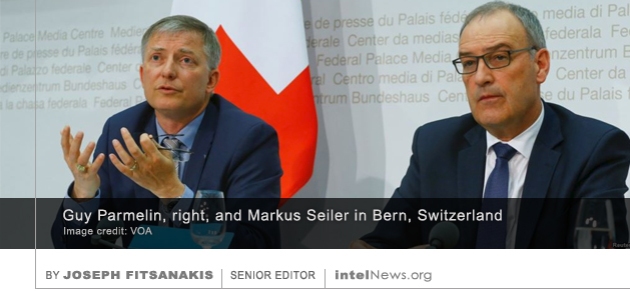
But the Swiss do not appear to be interested in discussing. On Tuesday, Markus Seiler, Director of the NDB, defended his agency’s right to spy on anyone who “uses illegal methods in Switzerland to steal state or business secrets”. Seiler, who was speaking in Bern, classified all such practices as espionage targeting the the Swiss economy. Asked by reporters whether Daniel M. was an NDB employee, Seiler said he could not comment. But he defended the NDB’s right to “fight the theft of business secrets” and “uphold Swiss laws”. He also refused to specify whether the NDB is active in Germany, stating instead that the agency is “active at home and abroad”. Switzerland’s Minister of Defense, Guy Parmelin, who supervises the NDB’s activities, was equally general when asked to discuss the arrest of Daniel M. He said simply that he and other Swiss government officials had to “protect [the NDB’s] methods and sources”.

Author: Joseph Fitsanakis | Date: 04 April 2017 | Permalink

Germany arrests Swiss spy who was monitoring tax-fraud investigators

Frankfurt AirportAuthorities in Germany have announced the arrest of a Swiss national who was allegedly spying on the activities of German tax-fraud investigators in Frankfurt. According to prosecutors in the German state of Hesse, of which Frankfurt is the largest city, the Swiss man was arrested on Friday and is currently in custody. He has been identified only as Daniel M., and is believed to be in his mid-50s. According to news reports, German counterintelligence officers had been monitoring the suspect for over a year. They were issued a warrant for his arrest in December of last year, but waited until he was on German soil to arrest him. He was arrested at Frankfurt Airport.
German federal prosecutors said simply that Daniel M. was employed in the financial and banking sectors of Germany until early 2012. However after that time, he is believed to have been employed by “the intelligence service of a foreign power”. German officials refused to identify the “foreign power”. However, the Berlin-based German newspaper Die Welt said on Sunday that the Swiss man arrested on Friday is an employee of the Swiss Federal Intelligence Service. The agency, known by its German-language initials, NDB, is Switzerland’s main intelligence agency, tasked with safeguarding the security of the small alpine nation by collecting and analyzing information.

The question is, what was a Swiss spy doing in Germany, and why was he arrested? According to Die Welt, Daniel M. was monitoring the activities of German tax-fraud investigators who have been trying for years to stop German citizens from having secret bank accounts abroad. The German government believes that billions of euros are deposited by its citizens in banking institutions in European tax-havens like Liechtenstein, Switzerland or Monaco. For the past decade, German authorities have resorted to bribing whistleblowers in offshore banks in order to acquire internal documents that reveal the identities of German citizens who are hiding their money in foreign bank accounts. It is estimated that over a hundred million dollars have been paid to whistleblowers by German authorities since 2006. The latter argue that the proceeds collected from unpaid taxes and fines more than justify the payments made out to whistleblowers. But the Swiss government has strongly criticized Berlin for encouraging Swiss banking sector employees to steal internal corporate information that often breaks Switzerland’s stringent privacy laws.

It is believed that Daniel M. was arrested while monitoring efforts by German tax-fraud investigators to approach potential whistleblowers working in the Swiss banking sector. Soon after the Swiss man’s arrest, officers from Germany’s Federal Criminal Police Office (BKA) searched a hotel room, several apartments and a number of business premises in Frankfurt and nearby cities. It is worth noting that Frankfurt is a major global financial center, which also hosts the headquarters of the European Central Bank. If found guilty, Daniel M. could face up to 10 years in prison for espionage.

Author: Joseph Fitsanakis | Date: 01 May 2017 | Permalink

Swiss court reopens probe of alleged espionage by Kazakh agents

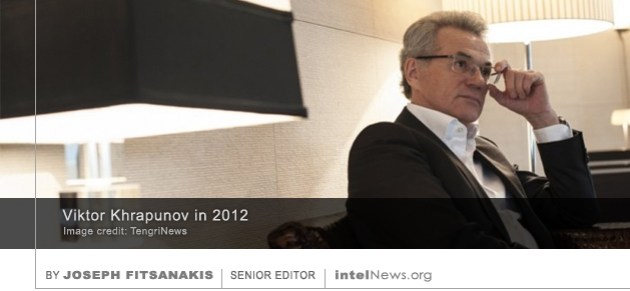
Viktor KhrapunovA Swiss court has reopened an investigation of alleged espionage activities by agents of the government of Kazakhstan against a high-profile political exile living in Switzerland. The case, which dates to 2014, centers on Viktor Khrapunov, a former senior Kazakh government official, who has been living in Geneva since 2008. In the years immediately following the dissolution of the Soviet Union, Khrapunov served as Kazakhstan’s Minister for Energy and Coal, a post that was later renamed to Minister of Energy and Natural Resources. After 1997, he was appointed mayor of Almaty, Kazakhstan’s largest city, which is inhabited by 10 percent of the country’s population. But by 2006, Khrapunov had fallen out with the government of Kazakhstan’s authoritarian President Nursultan Nazarbayev. The government claimed that Khrapunov was embroiled in a series of fraudulent real-estate schemes and that he laundered large sums of money for his own personal use.
In 2008, a chartered airplane carrying Khrapunov and his wife landed in Switzerland, reportedly with a millions of dollars in cash, fine jewelry and antiques onboard. The Khrapunovs were granted asylum in the small alpine country and have since lived in the Lake Geneva area. In 2012, the government of Kazakhstan requested that Khrapunov be placed on Interpol’s list of wanted persons. Khrapunov himself dismissed the charges against him as politically motivated and blasted Nazarbayev as “a third-world dictator”.

In early 2014, the Swiss Attorney General’s office opened an investigation into allegations by Khrapunov that he had been followed around by Kazakh intelligence officers, had an electronic tracker covertly installed in his car, and had his computers hacked by Kazakh spies. The case was closed in March of this year, after Swiss authorities said they did not have enough evidence to confirm the precise identity of the perpetrators, two of whom were reportedly holders of British passports. On Monday, however, the Federal Criminal Court in the Swiss city of Bellinzona ordered that the case be reopened, after allegations by Khrapunov that the espionage against him continues.

Kazakh authorities have been regularly accused by European governments of conducting aggressive espionage and intimidation operations targeting exiled adversaries of President Nazarbayev. Last year, Kazakhstan’s former spy chief and a former presidential bodyguard were acquitted after a lengthy trial in Austria after a co-defendant in their double-murder trial, who was also the Kazakh president’s former son-in-law, was found dead in his Vienna cell.

Author: Joseph Fitsanakis | Date: 01 November 2016 | Permalink

Swiss vote to give unprecedented surveillance powers to spy agencies

Federal Intelligence Service SwitzerlandVoters in Switzerland have strongly approved a proposed law that aims to expand the surveillance powers of Swiss intelligence agencies. The move is uncharacteristic of the Swiss, who have historically been skeptical of giving far-reaching surveillance powers to their government. In the late 1980s, Swiss public opinion was shocked by the revelation that the country’s Federal Military Department had spied without permission on tens of thousands of Swiss citizens for many decades under a top-secret project codenamed P-27. In response to the revelations, P-27 was ended, the Swiss intelligence agencies were reorganized, and stricter parliamentary controls were imposed on their activities. Today, even CCTV cameras are rarely used in Switzerland, while Google has not been given permission to incorporate the country’s streets into its Streetview application due to strict local privacy laws.

Opponents of the proposed law warned that it would end Switzerland’s long history of protecting civil liberties and would increase cooperation between Swiss and foreign spy agencies, thus harming the country’s tradition of political neutrality. But terrorist attacks in nearby Belgium and France have shaken public opinion in the small alpine country, which is home to numerous international agencies, including a regional branch of the United Nations. Consequently, nearly 66 percent of voters backed the proposal in elections on Sunday, which saw a 41 percent rate of participation. The result will allow the Swiss intelligence and security services, such as the Federal Intelligence Service, to put suspects under electronic surveillance using wiretaps, internet-based software, and hidden devices such as cameras and microphones.

Despite its long history of political neutrality, Switzerland is not unaccustomed to espionage scandals. In 2009, Switzerland’s Neue Zürcher Zeitung newspaper said that a number of listening devices, most likely of Israeli origin, had been discovered in a room designated for sensitive meetings on disarmament issues at the United Nations building in Geneva. In June 2013, the Swiss parliament blocked legislation designed to help the United States identify tax evaders, just days after it was revealed that the US Central Intelligence Agency had conducted an espionage operation targeting a Swiss bank executive. And in 2015, the Swiss Federal Prosecutor launched an investigation into claims that the country’s largest telecommunications provider, Swisscom AG, had been spied on by a consortium of German and American intelligence agencies.

Author: Ian Allen | Date: 26 September 2016 | Permalink

Switzerland made secret deal with PLO in the 1970s, new book alleges

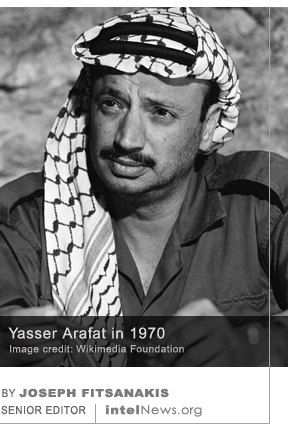
Yasser ArafatSwitzerland secretly agreed in the 1970s to support calls for Palestinian statehood, in return for not being targeted by Palestinian militants, according to a new book. Written by Marcel Gyr, a journalist with the Zurich-based Neue Zürcher Zeitung, the book alleges that the Swiss government took the unprecedented step of contacting Palestinian militants in 1970. According to Gyr, the move followed a series of attacks against Israeli targets in Switzerland by several Palestinian armed groups. In February 1969, Palestinian militants fired on an El Al airliner at Zurich’s Kloten Airport, killing the pilot. A year later, a Swissair Flight 330 from Zurich to Hong Kong with a stopover In Tel Aviv, Israel, exploded in mid-air, killing nearly 50 passengers and crew. The Syrian-backed Palestinian group Popular Front for the Liberation of Palestine – General Command (PFLP-GC) later claimed responsibility for the attack. In September 1970 another Swissair flight, headed to the United States, was hijacked and diverted to Jordan, where its passengers were held hostage.

It was during the latter incident, claims Gyr, that Switzerland’s Minister of Foreign Affairs, Pierre Graber, clandestinely contacted the Palestine Liberation Organization (PLO), the umbrella group that coordinated the activities of a multitude of Palestinian armed groups. Gyr alleges that Graber reached out to the PLO without informing his colleagues in the cabinet, and that he used a junior Swiss parliamentarian as an envoy and intermediary. Eventually, the PLO, which at the time was led by Yasser Arafat, agreed to release the hostages. He also offered to stop launching armed attacks, hijackings, and other violent operations on Swiss soil. In return, claims Gyr, Switzerland would agree to quietly abandon the investigation into the bombing of Swissair Flight 330, and to push for diplomatic recognition of the PLO as the legal representative of the Palestinian people.

Gyr claims that both sides kept their side of the bargain. The Swiss government gradually abandoned the investigation into the bombing of Swissair Flight 330. The country also led European efforts to offer diplomatic status to the PLO. Meanwhile, although the war between the PLO and Israel continued throughout Europe, no Palestinian attacks ever took place again on Swiss soil. Responding to Gyr’s book, Switzerland’s current Minister of Foreign Affairs, Didier Burkhalter, said he had no idea about the secret agreement and that he was “very surprised indeed” to know about it. Some Swiss political figures have asked for the establishment of a parliamentary inquiry to investigate Gyr’s allegations. It is unclear whether such a committee would have access to hundreds of thousands of pages about the Palestinian attacks in Switzerland, which today remain classified.

Author: Joseph Fitsanakis | Date: 25 January 2016 | Permalink

Memos may relate to secret NSA deal with leading cryptography vendor

William FriedmanIn 2007 I wrote in my “National Security Agency: The Historiography of Concealment” that America’s leading signals intelligence agency had made a secret deal with Crypto AG, a Swiss-based manufacturer of cryptographical equipment. The agreement, which lasted for much of the Cold War, allegedly allowed the NSA to read the classified messages of dozens of nations that purchased encoding equipment from Crypto AG. As I expected, the claim drew criticism from individuals connected with Crypto AG, including company scientists, who argued that the Swiss manufacturer would never have agreed to a deal that undermined its professional reputation as a trusted and neutral vendor of cryptological devices. Now, however, the BBC has revealed two recently declassified NSA memos that appear to provide further proof of the deal.

My 2007 claim was based on a string of well documented allegations that surfaced in the early 1980s. While conducting research for his seminal book The Puzzle Palace, historian James Bamford came across references to Project BORIS, which involved a pact between the NSA and the Swiss company. To be precise, the deal appeared to have been struck between the Swiss inventor and Crypto AG founder Boris Hagelin and William F. Friedman, an American cryptologist who led the Armed Forces Security Agency, a forerunner of the NSA. The two men were united by a deep personal friendship, which was forged during World War II by their mutual hatred of Nazism.

Bamford’s claim was echoed in 1996 by Scott Shane and Tom Bowman, reporters for The Baltimore Sun. In a six-part investigative series about the NSA, the two journalists wrote that Friedman visited Hagelin during a trip to Switzerland in 1955 and asked for his help so that American could dominate its Cold War rivals. According to Shane and Bowman, Hagelin agreed and built a type of cryptological backdoor in Crypto AG’s devices, which allowed the NSA to read millions of messages for many decades. The company, of course, reacted furiously, saying that claims of a secret deal were “pure invention”.

On Thursday, however, BBC security correspondent Gordon Corera confirmed that a BBC investigation of 55,000 pages of documents, which were declassified by the NSA in April, claim to have found proof of the secret agreement. The declassified material, said Corera, contains two versions of the same NSA memorandum, as well as an earlier draft, which refer to a “gentleman’s agreement” between Friedman and Hagelin. Under the agreement, Crypto AG would inform the NSA about periodical changes to the technical specifications of its encoding machines. The company would also provide the American spy agency with detailed lists showing the precise models purchased by various national governments around the world. Furthermore, Crypto AG agreed not to sell the more advanced, customizable models of its equipment to countries viewed by Washington as directly adversarial. This, says the BBC, amounted to Crypto AG deceiving some of its customers, by offering them “watered-down versions” of its encoding devices.

Corera notes that there is no evidence in the memos that Crypto AG built any kind of back door in its devices for use by the NSA. Instead, by providing the American agency with detailed operational knowledge of the devices, it enabled American codebreakers to reduce the time and effort needed to break encoded messages intercepted by the NSA.

There are a couple of minor errors in Corera’s article. For instance, the “father of American code-breaking” is not Friedman, as he claims, but Herbert Yardley, who led the so-called Black Chamber (also known as the Cipher Bureau) in 1919, long before Friedman was in the picture. Additionally, he fails to mention Bowman’s contribution to Shane’s Baltimore Sun article, which was published in 1996, not 1995, as he writes. These minor errors aside, however, the BBC discovery is absolutely crucial for our understanding of cryptological history in the Cold War.

Author: Joseph Fitsanakis | Date: 31 July 2015 | Permalink

Swiss reject contract bid by UK-owned internet firm over spy fears

UPC CablecomThe Swiss federal government has rejected a multi-million dollar contract bid by one of the world’s largest broadband Internet service providers, saying it is foreign-owned and could serve as “a gateway for foreign spies”. The company, UPC Cablecom, is headquartered in Zurich, is subject to Swiss law, and is currently the largest broadband cable operator in Switzerland. However, in 2005 it became a subsidiary of the UPC Broadband division of Liberty Global Europe, an international telecommunications and television company based in London, England. It is therefore technically considered a foreign company according to Swiss law. In 2013, UPC Cablecom submitted a bid for a competitive contract to provide broadband Internet services to Swiss government agencies. But in January 2014, the company was informed by Swiss officials that such a contract could not be awarded to a foreign-owned telecommunications service provider such as UPC Cablecom.
Until last week, it had been generally assumed that the decision to exclude UPC Cablecom’s bid on the basis of the company’s foreign ownership had been taken by the officials in charge of evaluating the contract. However, on Friday of last week, the Swiss daily Berner Zeitung reported that the decision to drop UPC Cablecom’s bid had been taken by no other than the Swiss Federal Council. Consisting of seven members representing various cantons and political parties, the Federal Council serves as Switzerland’s collective head of government and effectively operates as the country’s head of state. It was the Federal Council, said Berner Zeitung, that intervened in the contract evaluation proceedings and instructed the Swiss Federal Department of Finance to exclude bids by foreign-owned companies. The argument was that such companies could serve as “potential gateways for foreign intelligence constituencies”, said the paper. It added that the decision had been taken in light of information revealed by American former intelligence operative Edward Snowden, who is currently living in Russia.

The ruling by the Federal Council meant that Swisscom became the sole bidder for the government contract, which is worth 230 million Swiss francs (US $378 million). Meanwhile, UPC Cablecom has filed a complaint with Switzerland’s Federal Administrative Court, claiming that the Federal Council abused its power by intervening in the service contract. The Court’s decision is not expected for several months.

Author: Joseph Fitsanakis | Date: 9 June 2015 | Permalink: https://intelnews.org/2015/06/09/01-1711/

Switzerland to probe claims it was spied on by US, German agencies

SwisscomThe office of the Swiss Federal Prosecutor has launched an investigation into claims that the country’s largest telecommunications provider was spied on by a consortium of German and American intelligence agencies. The spy project was reportedly a secret collaboration between Germany’s BND (Bundesnachrichtendienst) and America’s National Security Agency (NSA). According to Austrian politician Peter Pilz, who made the allegations on Wednesday, the BND-NSA collaboration was codenamed EIKONAL and was active from 2005 to 2008. Speaking during a press conference in Bern, Switzerland, Pilz said many European phone carriers and Internet service providers were targeted by the two agencies.

Among EIKONAL’s targets, said Pilz, was Swisscom AG, Switzerland’s largest telecommunications provider and one of the successor companies to the country’s national carrier, the PTT (short for Post, Telegraph, Telephone). The government of Switzerland still retains a majority of Swisscom shares, which makes the Bern-based company the closest thing Switzerland has to a national telecommunications carrier. Under the EIKONAL agreement, the BND accessed Swisscom traffic through an interception center based in Frankfurt, Germany. From there, said Pilz, the intercepted data was transferred to a BND facility in Bad Aibling to be entered into NSA’s systems. Pilz shared numerous documents at the press conference, among them a list of key transmission lines that included nine Swisscom lines originating from Zurich and Geneva.

Switzerland’s Office of the Federal Prosecutor said on Wednesday that a criminal investigation was already underway into Peter Pilz’s claims, and that the Swiss Federal Intelligence Service was in contact with Swisscom and other actors targeted by EIKONAL. Meanwhile, Pilz refused to answer questions about where he got the documents about the alleged spy operation. He said, however, that he did not think Swisscom was aware of the BND-NSA actions against it. The company issued a statement on Wednesday saying it had “no agreements with the NSA, the BND, or any other foreign intelligence agency that permit eavesdropping” on company lines.

Author: Ian Allen | Date: 28 May 2015 | Permalink: https://intelnews.org/2015/05/28/01-1705/