Analysis: The real danger in Syria is not ISIS, but a war between major powers

Vladimir PutinThere are many unpredictable aspects of the Syrian conflict, but the downing of the Russian bomber by Turkish jets on Tuesday was not one of them. Indeed, given the simultaneous military campaigns taking place in a relatively small swath of territory by Russian, American, French, Syrian, Iranian, and other forces, it is surprising that such an incident did not happen earlier. Nevertheless, the downing of a Russian Sukhoi Su-24 by Turkish jets marked the first attack on a Russian fighter aircraft by a North Atlantic Treaty Organization (NATO) member state since 1953. Although this incident is not by itself sufficient to provoke an armed conflict between Turkey and Russia, it illustrates the main danger confronting the world in Syria: namely a conflagration between regional powers, many of which are armed with nuclear weapons.

In response to earlier incidents, Turkey had warned the Russian Air Force that it would not tolerate further violations of its air space by Russian jets conducting an air campaign in support of Syrian President Bashar al-Assad. The message delivered to the Russian ambassador in Ankara was that Turkish pilots would be ordered to open fire next time. That was precisely what happened on Tuesday, when a Turkish F-16 jet brought down a Russian bomber aircraft with a single missile strike. By most accounts, the Russian airplane was barely two miles inside Turkish airspace, presented no immediate threat to Turkey’s national security, and would probably have returned to Syrian airspace within seconds. But that did not stop the Turkish F-16 from shooting down the Russian plane. Adding injury to insult, Turkish-backed rebels on the Syrian side of the border shot dead one of the plane’s two Russian pilots and opened fire on a Russian rescue team that tried to save the crew, killing at least one marine.

Rather expectedly, a visibly furious Russian President Vladimir Putin, who is not used to being challenged militarily, described the incident as “a stab in the back” by “accomplices to terrorists”, and warned Ankara of “serious consequences”. But why would Turkey provoke Russia in such a direct way? Like every other country involved directly or indirectly in the Syrian Civil War, Turkey and Russia wish to see the Islamic State of Iraq and Syria (ISIS) Q Quotedestroyed. But they differ drastically on what should follow. The Kremlin is adamant that President al-Assad, whom it considers its strongest ally in the Middle East, should remain in power. The Turks, on the other hand, view the Syrian president as an existential threat, due to his support for Kurdish militancy throughout the region.
The roots of the animosity between the Turkish state and the al-Assad regime go back to 1978, when the Kurdistan Workers Party (PKK) was established in Lebanon’s Beqaa Valley, which was at the time occupied by Syria. The PKK is a Marxist militant organization that seeks to establish a Kurdish homeland in eastern Turkey and northern Iraq. The group was actively trained, funded, armed and protected by Syria and the Soviet Union. The latter was actively interested in destabilizing Turkey, a NATO member, while Syria used the PKK to exercise pressure on its northern neighbor, with whom it was embroiled in a series of complex land- and water-rights disputes. In 1998, the al-Assad regime was forced to expel PKK leader Abdullah Öcalan, who was living in Damascus under Syrian protection, after Turkey threatened an all-out war if the Syrian intelligence services continued to shelter the PKK leadership.

Ankara saw the outbreak of the Syrian Civil War in 2011 as an opportunity to get rid of the al-Assad regime, which it sees as a primary threat to regional stability. Along with the United States, Turkey has been funding, arming and training a host of Syrian rebel groups, while at the same time hosting over 2 million refugees from Syria. The subsequent rise of ISIS alarmed America and its Western allies; but in the eyes of Ankara, ISIS pales into insignificance in comparison to the resurgence of Kurdish nationalism, which has been fueled by the demise of Ba’ath in Iraq and the fragmentation of Syria. For Turkey, Kurdish separatism poses an existential threat to the survival of the Turkish Republic, and is the primary reason for its involvement in the Syrian conflict.

It follows that Russia’s entry in the Syrian Civil War strengthens President al-Assad and the PKK, and is thus regarded by Turkey as a direct threat to its national security. Ankara is also concerned about France’s efforts to build a broad anti-ISIS alliance that includes Russia, and fears that the West is now openly flirting with the possibility of allowing al-Assad to stay in power in Damascus. The deliberate downing of the Russian airplane, which was undoubtedly authorized by the most senior levels of government in Ankara, was aimed at disrupting France’s efforts to build an anti-ISIS coalition, while at the same time pushing back against Russia’s regional ambitions.

What will happen next? Theoretically, Turkey could invoke Article 5 of the NATO charter, which would compel member-states to rush to its assistance. In reality, however, such an eventuality is remote, especially given the expressed willingness of Western leaders to help deescalate the Turkish-Russian row. Following their closed-door meeting on Tuesday, French President FrancoisQ Quote Hollande and his American counterpart Barack Obama went out of their way to avoid mentioning the Russian plane incident, and briefly commented on it only after they were asked to do so by reporters. This does not mean that Russia will not respond; but it will most likely do so behind the scenes, probably by increasing its support for the PKK and other Kurdish separatist groups.

The downing of the Russian bomber highlights the immense contradictions and complica- tions that plague the anti-ISIS forces involved in the Syrian Civil War. It is clear that ISIS is now in a position to attack targets that are located far from its territory in Syria and Iraq, or in its wilayah (provinces) in Libya, Somalia, and elsewhere. However, the threat that ISIS currently poses to international peace and stability is at most marginal and symbolic. Of far more importance to the security of the world is the possibility of an armed conflagration between regional powers, which are being drawn into Syria by the vacuum created by the civil war. All of these regional powers, including Turkey, Russia, Iran, Saudi Arabia, Lebanon, Israel, and the US, are heavily armed, many with nuclear weapons. Moreover, they radically disagree on what a post-ISIS Middle East should look like.

The possibility of a serious conflagration between heavily armed regional actors will be removed only if and when the Syrian Civil War ends, even if that results in the loss of land to the so-called Islamic State. That must be the immediate goal of the Combined Joint Task Force and every other regional actor that wishes to see the end of ISIS. It is only after peace has been achieved in Syria that ISIS can be dealt with effectively.
South Korean lawmakers accuse North of helping Islamic State

Syria North KoreaA powerful South Korean parliamentary committee has accused the North Korean government of ties to the Islamic State, an allegation that is vehemently denied by Pyongyang. On November 18, members of the Intelligence Committee of the National Assembly of Korea stated in a press conference that they believed North Korea had “possible ties to ISIS”. They were referring to the Islamic State of Iraq and Syria, which calls itself Islamic State. On Monday, North Korea’s state-run media blasted the South Korean allegations as “slander and fabrications”, and said they threatened to derail collaboration efforts between Seoul and Pyongyang.
The North Korean website Uriminzokkiri, which provides content from the Korean Central News Agency, accused Seoul of “carelessly tossing around claims of connections to terrorist groups”, in order to bring the two neighboring countries “closer to war”. Tensions remain high in the Korean Peninsula, despite an agreement that was struck in August between the two sides. In the preceding months, Pyongyang had threatened to carry out all-out invasion of South Korea, accusing Seoul of harboring aggressive intentions against it. A report in Uriminzokkiri warned that the August agreement “would be undone” if the South persisted in alleging that North Korea provided assistance to ISIS.

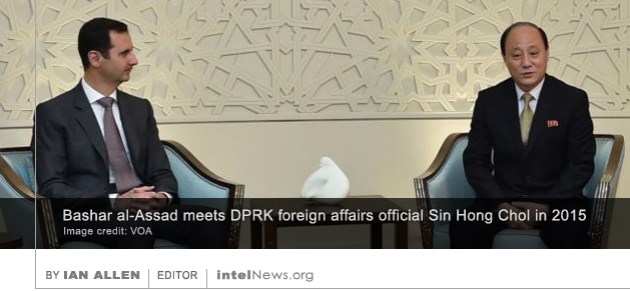
It should be noted that the Intelligence Committee of South Korea’s National Assembly has not given evidence of its claims that Pyongyang is supporting ISIS. Additionally, the North Korean regime is believed to be a strong international ally of Syrian President Bashar al-Assad, who is a primary adversary of ISIS. The two countries have longstanding military and commercial ties. It is believed that North Korean technicians aided in the construction of Syria’s al-Kibar nuclear facility, which was bombed by Israeli jets in Operation ORCHARD in 2007. Today, North Korea is among a small number of countries that maintain fully staffed embassies in Syrian capital Damascus. In September of this year, the government of Syria dedicated a park in the capital to Kim Il Sung, North Korea’s late leader.

Author: Ian Allen | Date: 10 November 2015 | Permalink

Russian-Iranian alliance over Syria is not as strong as some believe

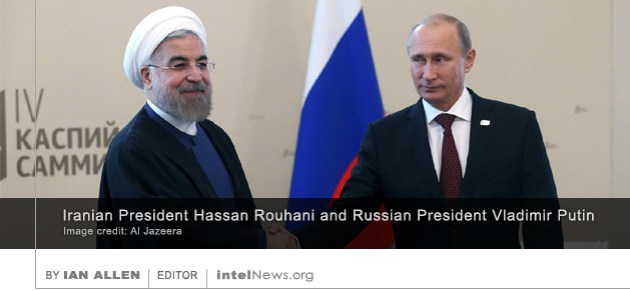
Rouhani PutinThe governments of Russia and the Islamic Republic of Iran are arguably the two most important allies of Syrian President Bashar al-Assad. But the Russian-Iranian alliance over Syria is not as solid —and may not be as durable— as some believe. On Monday, Iranian news agency ISNA reported that Iran’s minister for intelligence condemned Russia’s increased military involvement in Syria and said it would weaken Iran’s security. The minister, Mahmoud Alavi, opined at a press conference in Tehran that the intensification of Russia’s military operations in Syria would backfire against Iran, because it would prompt the Islamic State to “redouble its efforts to destabilize Iran’s security”.
Alavi’s comments came two weeks after Major General Mohammad Ali Jafari, the head of Iran’s Revolutionary Guards Corps said that Iran cared about the stability of al-Assad’s regime in Syria more than Russia did. Jafari was responding to earlier comments made by Maria Zakharova, spokeswoman for the Russian Ministry of Foreign Affairs, who said that Moscow would not insist in keeping al-Assad in power in Damascus as a matter of principle. When asked to comment on Zakharova’s comments, Jafari said Iran had to accept that Russia “may not care if al-Assad stays in power as we do”. The difference between Tehran and Moscow, said Jafari, was that “we don’t know any better person to replace him”.

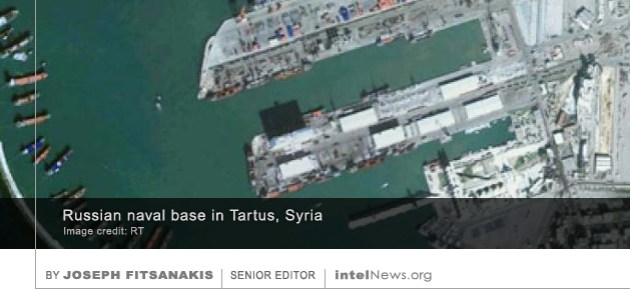
So does that spell changes in the dynamics of the Russian-Iranian alliance over Syria? Such an eventuality should not be discounted, says Sergey Aleksashenko, nonresident senior fellow at the Brookings Institution. He explains that, although both the Russians and the Iranians have aided al-Assad, their reasons for doing so are very different. Russia’s interests in Syria center on maintaining access to its naval base in Tartus, and on retaining a geopolitical presence in the Middle East. Iran’s support for Assad aims to prevent Tehran’s traditional foes, namely Saudi Arabia and the Gulf States, from turning Syria into their protectorate. Additionally, says Aleksashenko, Iran appears much more willing to deploy ground troops in the fight against ISIS than Russia. The Islamic Republic is also much more willing to go against the wishes of other regional powers, like Saudi Arabia and Turkey, which Moscow tends to court.

Ultimately, says Aleksashenko, “although Russia has strategic interests in Syria, it has no intention to keep a military presence in the Middle East forever”. The Iranians, however, have no choice but to dwell in one of the world’s most unstable regions. Al-Assad’s removal would add significantly to that instability, and that is not something that Tehran is willing to permit.

Author: Ian Allen | Date: 18 November 2015 | Permalink

Iraq now using Russian intelligence in war against Islamic State

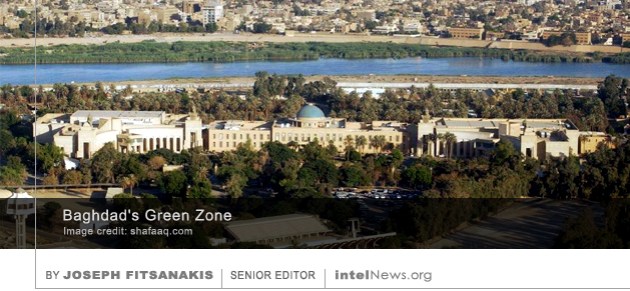
Baghdad IraqThe Iraqi government is now using intelligence supplied by the Russian military in its war against the Islamic State, according to officials in Baghdad. As intelNews reported in September, the Iraqi Joint Forces Command announced it had entered a formal intelligence-sharing agreement with the governments of Russia, Syria and Iran. The purpose of the collaboration was to defeat the Islamic State, the Sunni militant group that currently controls a third of Iraq’s territory and much of neighboring Syria. Many were surprised by last month’s announcement, as it was the first time that Iraq, an American ally, had entered an alliance with Washington’s Cold-War adversary Russia, as well as with Iran and Syria, two countries with which the United States has no diplomatic relations.
According to US media reports, the headquarters of the intelligence-sharing center is located in Baghdad’s so-called Green Zone, where US forces were stationed until 2012. Each of the member states has six officers at center, who are given intelligence by their respective countries’ militaries with the intent of sharing it with the other three participating militaries. In addition to these officers, there are two Russian one-star generals stationed at the center, according to The Washington Times, which cited “an Iraqi official who asked not to be identified”.

Back in September, when the four-partite agreement was announced, the US said it respected Iraq’s freedom to enter into security pacts with regional governments, but warned that Syria was a major violator of human rights and should not be part of the intelligence-sharing treaty. On Tuesday, White House press secretary Josh Earnest said he could see no reason why Baghdad would want to enter into an intelligence-sharing agreement with Moscow, given that the US-led coalition had been sharing intelligence with Iraq for over a year. The coalition’s intelligence collaboration with Baghdad had “worked effectively with the Iraqis to make progress against [the Islamic State] inside of Iraq”, he said.

Author: Joseph Fitsanakis | Date: 15 October 2015 | Permalink

Iran, Hezbollah to launch ground assault on Syria rebels, says Reuters

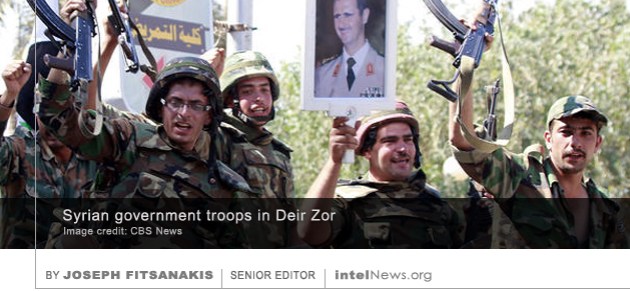
Syrian troopsHundreds of ground troops from Iran and Lebanon have been entering Syria in the past two weeks and are about to launch a large-scale ground attack against rebel groups, according to Reuters. The news agency quoted Lebanese sources “familiar with political and military developments in the conflict”. One source said that the Russian airstrikes in Syria, which began earlier this week, are the first phase of a large-scale military offensive against the Islamic State and other anti-government forces operating on the ground.
The Lebanese official told the news agency that hundreds of Iranian “soldiers and officers” had arrived in Syria in September. These forces “are not advisors”, said the source; rather, they have entered Syria “with equipment and weapons, specifically to participate in this battle. And they will be followed by more”, said the source, adding that some “Iraqis would also take part in the operation”, without specifying whether these would be regular troops or Iraqi Shiite militias. According to Reuters, the operation will be supported by Russian airstrikes and aims to recapture territory that is currently in the hands of various rebel groups, including the Free Syrian Army, Jabhat al-Nusra, and the Islamic State.

Last week it was reported that the governments of Russia, Iraq and Iran had entered a formal intelligence-sharing agreement with Syria, in an effort to defeat the forces fighting against the regime of Syrian President Bashar al-Assad. According to the Baghdad-based Iraqi Joint Forces Command, the agreement entails the establishment of a new intelligence-sharing center in the Iraqi capital. It will be staffed with intelligence analysts from all four participating countries, who will be passing on shared information to their respective countries’ militaries. The announcement of the agreement came as Russia continued to reinforce its military presence in Syria by deploying troops in Latakia.
Author: Joseph Fitsanakis | Date: 2 October 2015 | Permalink

Russia, Iraq, Iran, Syria, sign intel-sharing agreement against Islamic State

Tartus SyriaThe governments of Russia, Syria and Iran have entered a formal intelligence-sharing agreement with Iraq, in an effort to defeat the Islamic State, it has been announced. Intelligence-sharing has been practiced for a while between Russia, Syria and Iran; but this is the first time that Iraq, an American ally, has entered the alliance. According to the Baghdad-based Iraqi Joint Forces Command, the agreement entails the establishment of a new intelligence-sharing center in the Iraqi capital. It will be staffed with intelligence analysts from all four participating countries, who will be passing on shared information to their respective countries’ militaries.

Iraqi officials said on Sunday that the intelligence-sharing agreement had been forged by Moscow, which was “increasingly concerned about the presence of thousands of terrorists from Russia undertaking criminal acts” as members of the Islamic State. The announcement of the agreement comes as Russia has been reinforcing its military presence in Syria, by deploying troops in Latakia. Security observers have interpreted the move as a strong message by the government of Russian President Vladimir Putin that it is prepared to safeguard the regime of Syrian President Bashar al-Assad. The latter also enjoys strong support from Iran, which has poured billions of dollars in aid to support the regime in Damascus, and has deployed hundreds of Hezbollah advisers and militia members in defense of Assad.

Speaking from Baghdad, Colonel Steve Warren, the American spokesman for the Western-led military campaign against the Islamic State, said that Washington was respectful of Iraq’s need to enter into security agreements with other regional governments. But he added that the US objected to the Syrian government’s role in the intelligence-sharing agreement, because it was “brutalizing its own citizens”. The US government has also protested against the Russian government’s expansion of its base in Tartus and its increased military presence in Latakia. But, according to Foreign Policy, US officials have privately expressed support for the move, saying that “it could, in the short term, help rein in the Islamic state”.

Author: Joseph Fitsanakis | Date: 30 September 2015 | Permalink

Leaked document confirms Israel was behind Syrian official’s killing

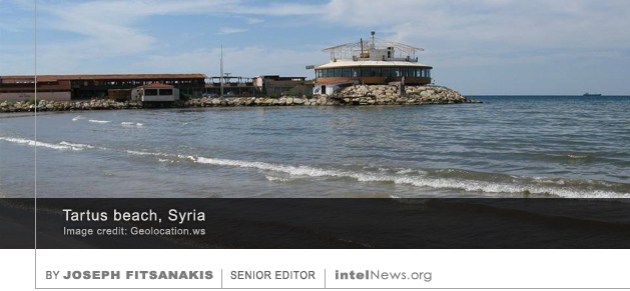
Tartus, SyriaA leaked document from an American intelligence agency appears to confirm that Israeli commandos were behind the assassination of a top Syrian government official, who was shot dead outside his luxury villa on the Syrian coast in 2008. Muhammad Suleiman had been a close aide of current Syrian President Bashar al-Assad even before the latter rose to power in 2000. Once al-Assad became ruler of Syria, Suleiman was appointed special presidential advisor in the areas of arms procurement and strategic weapons. He handled intelligence affairs for the Assad regime and he was involved in weapons transfers from Iran to the Lebanese militant group Hezbollah, while also helping train Hezbollah operatives. He was also rumored to have a senior administrative role in the Syrian nuclear weapons program.
On August 1, 2008, Suleiman was shot dead with bullet wounds to the head and neck fired from a silenced rifle. He was shot as he was hosting a party on the beach behind his luxury villa at the Rimal al Zahabiya (Golden Sands) resort area, located to the north of the Mediterranean port city of Taurus. The assassins are believed to have fired the shots from a yacht, which was seen rapidly sailing away from Rimal al Zahabiya moments after the shooting. Most observers put the blame squarely on Israel. In 2009, an investigative report by German newsmagazine Der Spiegel said Israel had killed Suleiman due to his leading role in Syria’s nuclear program. However, a cable released by whistleblower website WikiLeaks in 2011 revealed that French intelligence analysts believed Suleiman had been killed as a result of a bloody power struggle within the Assad regime. These have been the two leading theories behind Suleiman’s mysterious killing.

On Wednesday, however, a document authored by the United States National Security Agency (NSA) was leaked, which shows that American intelligence analysts are certain that Israeli commandos were behind Suleiman’s assassination. The document was leaded by former NSA contractor Edward Snowden, who defected to Russia in 2013. It comes from Intellipedia, the US Intelligence community’s classified version of Wikipedia, which was formally launched in 2006. It describes Suleiman’s killing as an operation carried out by “Israeli naval commandos” and calls it “the first known instance of Israel targeting a legitimate [foreign] government official”. According to The Intercept, which published the leak, the Intellipedia document is labeled “SI”, which means that the information contained in it was not voluntarily shared with the US by Israel, but was rather acquired through the interception of electronic signals.

If the leaked document is accurate, it would mark the first confirmation by a government agency that Israel was indeed behind Suleiman’s assassination. The Intercept contacted the NSA and the Office of the Prime Minister of Israel. However, neither party responded to several requests for comment.

Author: Joseph Fitsanakis | Date: 16 July 2015 | Permalink: https://intelnews.org/2015/07/16/01-1736/

Syrian spy chief placed under house arrest by Assad, say sources

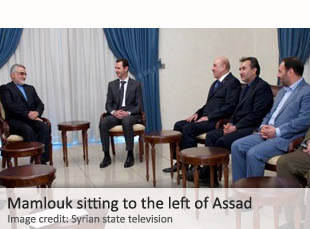
Bashar al-Assad (center) and Ali Mamlouk to his leftBy JOSEPH FITSANAKIS | intelNews.org
Citing sources inside Syria’s presidential palace, a leading British newspaper has alleged that the director of Syria’s national intelligence agency has fallen out with the regime and is now under house arrest. Lieutenant General Ali Mamlouk, who heads Syria’s National Security Bureau, is known as a hardline supporter of Syrian President Bashar al-Assad. He personally leads every major domestic-security operation in the country and is believed to be among the Syrian president’s most trusted advisers. In recent weeks, however, Mamlouk, who is one of the regime’s most publicity-prone figures, has not surfaced in the news or in any public venues. His absence has prompted intense speculation that he might be sick, under arrest, or even dead. Several news outlets in the Middle East hypothesized that the general, who is 69, is undergoing chemotherapy to combat a rapidly progressing cancer. Then, amidst growing rumors about Mamlouk’s health, the general was shown on state television (see photo) sitting by Assad’s side during a meeting with a visiting Iranian delegation. But the footage only served to inflame speculation that the Syrian official was actually under house arrest, and that he was only brought out of his detention for the meeting with the Iranians, so as to help quieten rumors about an alleged growing rift within the regime’s inner circle.

On Monday, British newspaper The Daily Telegraph cited “sources inside the presidential palace” in Damascus, in claiming that Mamlouk was removed from his post in the National Security Bureau and is currently under house arrest in the Syrian capital. The paper said that the General had fallen out with the country’s president and had been organizing a military coup against him, prompted by his fierce opposition to Iran’s growing influence in Damascus. It is widely believed that Tehran’s increasing involvement in the Syrian Civil War on the side of Assad is largely responsible for the regime’s military and economic survival. According to The Telegraph, most of the president’s economic and military advisers at the presidential palace are now Iranian.

But Syria’s alignment with Iran is creating a backlash among Assad’s inner circle, which consists of secular nationalists, liberal Alawites or Christians. As a result, says the paper, Assad is “struggling to keep together [his] inner circle”, as senior administration officials are “increasingly turning on each other”. Mamlouk was one such insider, who was disturbed by Iran’s rising influence in Syria. Prior to his arrest, says The Telegraph, the general was secretly communicating with Turkish intelligence through an intermediary.

Captured files reveal new information about structure, history of ISIS

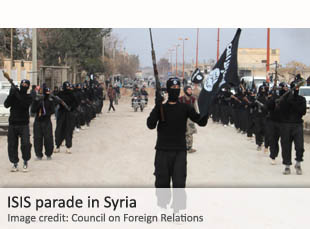
ISIS parade in SyriaBy JOSEPH FITSANAKIS | intelNews.org
A folder of secret documents, drafted by a senior commander of the Islamic State, reveals previously unknown information about the origins, meticulous planning and intelligence structure of the organization. Among other things, the documents show that the organization, which is also known as the Islamic State of Iraq and Syria (ISIS), had plans to capture territory in both countries as early as 2010 —several years before its existence was even known. The folder belonged to Samir Abd Muhammad al-Khlifawi, a military general and political ally of Iraq’s late leader, Saddam Hussein. Better known as Haji Bakr, the former Baathist general became a founding member of ISIS and helped shape the organization until his death in a firefight in 2014. Following his demise, an unnamed informant stole the documents and secretly smuggled them into Turkey. It was there that German investigative newsmagazine Der Spiegel accessed them. On Saturday, following months of research, the newsmagazine published its findings based on the stolen documents. They reveal important information about the history and structure of the mysterious organization known as ISIS.

Der Spiegel notes in its analysis that Bakr himself is characteristic of the complexity of ISIS, which today controls territory equal to approximately that of Great Britain in both Iraq and Syria. Before the United States invasion, the former Iraqi general was a typical Baathist, who, like the regime he served, expressed strong secular views. But he became violently bitter in 2003, when he found himself unemployed and stripped of his status after the invading US forces dissolved the Iraqi military. He eventually joined a number of other unemployed former Baathist military and intelligence officers and decided to launch a counteroffensive against the predominantly Shiite Iraqi government. In 2010, this group of conspirators decided to inculcate their group with a Sunni religious identity, for reasons of political expediency. It was then that they appointed a highly educated and charismatic Sunni cleric, Abu Bakr al-Baghdadi, as the ideological face of the organization. In late 2012, the group began to actively exploit the chaos caused by the Syrian Civil War as an opportunity to capture territory in Syria, and then use it as a base to invade Iraq. The plan worked.

The folder acquired by Der Spiegel contains handwritten fragments from 31 different pages bearing organizational charts, lists of ISIS officials, as well as programmatic schedules. It reveals a hierarchical organizational structure with direct and indirect chains of command, which reach all the way down to local cells. According to the documents, these cells were initially set up in disguised form, so as to resemble Islamic schools or missionary facilities. Today these have expanded to include detention facilities, weapons depots, as well as a complex structure of Sharia-compliant educators, judges and enforcers. The organization also has an elaborate intelligence structure, which appears to undertake daily surveillance and security tasks. The latter depend on an army of officers, agents and informants, many of whom are as young as 16.

The documents detail several ISIS espionage operations in Syria and Iraq, which include meticulous studies of power structures of the local tribes. These were done in an effort to detect what Der Spiegel describes as “age-old faults within the deep layers of [tribal] society]”, and were then used by ISIS to divide and eventually subjugate dissident elements within the territory under their control. In other cases, informants were instructed to detect the personal weaknesses and faults of local leaders, which were subsequently used to blackmail them. Priority was given to recruiting members of powerful families, so as to “ensure penetration of these families without their knowledge”, Spiegel notes.

Turkish media disclose identity of alleged spy for Canada

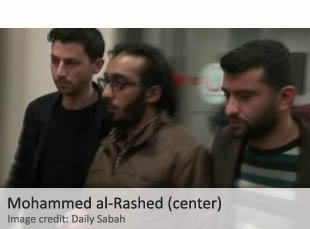
Mohammed al-RashedBy JOSEPH FITSANAKIS | intelNews.org
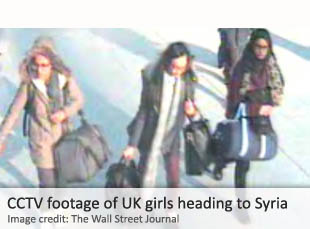
Turkish media have released the name, as well as video footage, of an alleged agent for Canadian intelligence, who says he helped three British schoolgirls travel to territory controlled by the Islamic State of Iraq and Syria. The three girls, aged between 15 and 16 years old, crossed into ISIS-controlled territory on February 17, after traveling by plane from London to Istanbul. The incident prompted international criticism of the Turkish government’s hands-off attitude toward a growing influx of Western Islamists who cross into Syria from Turkey, intent on joining ISIS. However, Turkey’s Minister of Foreign Affairs, Mevlut Cavusoglu said last week that the girls had been assisted by an intelligence agent working for a member-state of the military coalition fighting ISIS.

The minister declined to offer further details. But Turkish media eventually disclosed the identity of the alleged agent, who has been detained by authorities in Turkey as Mohammed al-Rashed. Also known as “Mohammed Mehmet Rashid” or “Dr. Mehmet Rashid”, the man is a Syrian national who claims to be working for the Canadian Security Intelligence Service. According to Turkey’s pro-government daily Sabah, al-Rashed is a 28-year-old Syrian dentist who fled from Syria to Jordan in 2013 to escape the civil war there. While in Jordan, he sought asylum at the Canadian embassy in Amman. He was subsequently offered Canadian citizenship, said Sabah, in return for working as an agent of CSIS. According to the Turkish daily, al-Rashed then traveled to Canada, where he stayed for several months before returning to Jordan.

Sources in Turkey say al-Rashed explained upon his detention that he had been tasked by CSIS to uncover the methods by which European and American ISIS recruits travel to Syria through Turkey. For that reason, he said, he had helped at least 15 individuals, including the three British schoolgirls, cross form Turkey to Syria. He would then provide information on the transfers —including passport data and baggage tags— to the Canadian embassy in Jordan, he said. Sabah added that the Canadians would pay for al-Rashed’s frequent trips to Jordan, where he would meet a Canadian embassy employee called “Matt”, who would then pass on the information to his superior at the embassy, called “Claude”. The Syrian alleged agent added that CSIS would compensate him for his work through frequent deposits of between $800 and $1,500 made to bank accounts opened in his name in British banks. Turkish sources added that al-Rashed had recorded details of his activities on a personal laptop, which had been seized and was being examined.

The Canadian government has yet to comment publicly on the allegations about al-Rashed. Unnamed Canadian sources said last week that he was neither a Canadian citizen nor a CSIS employee. But officials so far refused to speculate on what they describe as “operational matters of national security”.

Turkey says Canadian spy helped British schoolgirls travel to Syria

CCTV footage of UK girls heading to SyriaBy JOSEPH FITSANAKIS | intelNews.org
In a development described by observers as “highly unusual”, a Turkish government minister has claimed that a Canadian spy helped three British schoolgirls travel to territory controlled by the Islamic State of Iraq and Syria. The three girls, Kadiza Sultana, 16, Shamima Begum, 15, and Amira Abase, also 15, crossed into ISIS-controlled territory on February 17, after having traveled by plane from London to Istanbul. The incident prompted renewed international criticism of the Turkish government’s hands-off attitude toward the growing influx of Western Islamists who cross into Syria from Turkey, intent on joining ISIS.

But Turkey’s Minister of Foreign Affairs, Mevlut Cavusoglu said on Thursday that the girls had been assisted during their trip by an intelligence agent working for a foreign country. In responding to criticism against Turkey, the minister claimed during a television interview that Turkish security forces had arrested a foreign intelligence operative who had enabled the three British citizens to cross into Syria. The man, said Cavusoglu, was a spy from a member-state of the military coalition fighting ISIS. “It is not a member-state of the European Union”, he added, “nor is he from the United States. But he is working for the intelligence [agency] of a country within the [anti-ISIS] coalition”. Later on Thursday, an unnamed Turkish government source told local media that the agent was not a Turkish citizen and that he had been arrested earlier in March.

Several press agencies, including Reuters and Agence France Presse reported on Thursday that the individual in question was “connected” with the Canadian Security Intelligence Service, but stopped short of saying that he was working for the government of Canada. A statement from the office of Steven Blaney, Canada’s Minister for Public Safety, who is responsible for overseeing the work of CSIS, said simply that the Ministry was “aware of these reports” but would “not comment on operational matters of national security”. An anonymous government source in Ottawa denied that the individual arrested in Turkey was a Canadian citizen or that he ever worked for CSIS.

Israelis dispute CIA was behind Hezbollah strongman’s killing

Imad MughniyahBy JOSEPH FITSANAKIS | intelNews.org
Sources in Israel are disputing reports from January that the United States’ Central Intelligence Agency was behind the assassination of one of Hezbollah’s most senior officials. On January 31 of this year, two US-based publications, The Washington Post and Newsweek, claimed that it was the CIA, not Israel’s Mossad intelligence agency as previously thought, who led the 2008 assassination of Imad Mughniyah. Mughniyah, who was among the founders of Hezbollah, the Shiite militant group that today controls large parts of Lebanon, was killed when a car laden with explosives blew up at a central parking lot in Syrian capital Damascus, where he had been living in secret.

According to the reports, the Mossad alerted the CIA after uncovering Mughniyah’s whereabouts in 2007, and suggested a joint operation to kill the Hezbollah strongman. The American covert-action agency proceeded to have a bomb designed by technicians from its Science & Technology Directorate, who carried out dozens of tests at a CIA facility in North Carolina. It was, according to the Post and Newsweek reports, the very bomb that killed Mughniyah on the evening of February 12 near his home in the Syrian capital.

But Dan Raviv, the Washington-based national correspondent for CBS News, said on Sunday that Israeli intelligence insiders are disputing claims that the CIA was the leading force in the operation. In a report published on Sunday, Raviv cited “Israelis close to their country’s services” as saying that the operation against Mughniyah was “almost all blue-and-white, and just a little bit red-white-and-blue” —a direct reference to the colors in the Israeli and American flags. The CBS correspondent said Israelis had been “miffed that the Americans were taking too much credit” for the strike against Mughniyah, and were actively “speaking with Western officials and diplomats to offer corrections”.

According to Raviv, it was the Mossad and Aman (Israel’s primary military-intelligence agency) that discovered Mughniyah’s whereabouts in 2007, and proceeded to design a bomb after the US declined Israel’s invitation to help organize a joint strike. Eventually, claims Raviv, Israel’s then-Prime Minister, Ehud Olmert, convinced then-US President George W. Bush to approve a strike against Mughniyah, by showing him videos of the custom-made car bomb being tested in Israel. An impressed President Bush then authorized the CIA to participate in the operation. But by that time, says Raviv, the Israelis were firmly in command of the project and remained so until its final execution. Neither the CIA nor the Mossad have commented on the allegations regarding Mughniyah’s assassination.

CIA had central role in Hezbollah official’s killing, say sources

Imad MughniyahBy JOSEPH FITSANAKIS | intelNews.org
The United States, not Israel, as previously thought, led an assassination operation that targeted a senior member of Lebanese militant group Hezbollah in 2008, according to two separate reports that came out last week. Imad Mughniyah was among the founders of Hezbollah, the Shiite militant group that today controls large parts of Lebanon. At the time of his assassination, Mughniyah headed the Hezbollah’s security apparatus and some claim he was the organization’s second-in-command. He was killed on the evening of February 12, 2008, when a car laden with explosives blew up at a central parking lot in Syrian capital Damascus, where he had been living in secret. The Shiite group blamed Israel for his killing. But two reports that aired this week, one in The Washington Post and the other in Newsweek, cited unnamed former government officials in the US in claiming that the operation was in fact led by the Central Intelligence Agency. The Washington Post’s Adam Goldman and Ellen Nakashima said the CIA was assisted in the operation by its Israeli counterpart, the Mossad, while Newsweek’s Jeff Stein wrote that the effort was personally approved by then-US President George Bush and was closely supervised by then-CIA Director Michael Hayden.

According to the reports, the Mossad uncovered Mughniyah’s whereabouts in 2007 and alerted the CIA, suggesting a joint operation to kill the Hezbollah strongman. Soon after President Bush approved the strike, officers in the CIA’s Near East Division planned the logistics of the operation, which involved building a complex bomb, smuggling it into Syria and placing it inside the spare tire of a locally-purchased vehicle. The bomb was allegedly designed by technicians from the CIA’s Directorate of Science & Technology, who carried out dozens of tests at a CIA facility in Harvey Point, North Carolina.

The operation was allegedly coordinated from a CIA safe house located near Mughniyah’s apartment in the Syrian capital. On the evening February 12, a team of Mossad and CIA operatives employed facial-recognition technology to identify their target as he was walking out of a local restaurant. When Mughniyah approached the explosives-laden SUV, the bomb was remotely detonated, decapitating him and blasting his torso through a nearby window (note: Goldman and Nakashima claim that the bomb was remotely detonated by Mossad officers located in Tel Aviv; Stein suggests the blast was triggered by a CIA officer who had been placed in charge of the remote-control mechanism).

The reports describe the operation as “one of the most high-risk covert actions” undertaken by the CIA in recent years, because it targeted a high-profile individual in a country with which the US was not officially at war. Additionally, the method used —a car bomb— is particularly controversial, as it is typically a method of operation preferred by organized criminals and terrorist organizations.

The US has not acknowledged participation in Mughniyah’s assassination, and the CIA declined to comment when contacted by The Washington Post on Friday. Mark Regev, spokesman for the office of the Israeli prime minister, said simply that Tel Aviv had “nothing to add at this time”.

Western intelligence points to new Syrian nuclear plant: report

Al-Qusayr, SyriaBy JOSEPH FITSANAKIS | intelNews.org
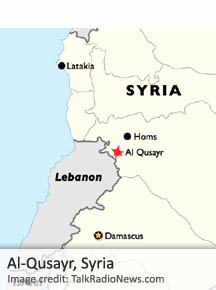
Western intelligence indicates that the government of Syria is in the process of constructing a new secret nuclear plant aimed at producing nuclear weapons. In the early hours of September 7, 2007, an air attack believed to have been carried out by Israel destroyed a mysterious facility deep in the Syro-Arabian Desert. The site, named al-Kibar, located 20 miles from Deir el-Zor in eastern Syria, is widely thought to have been a nuclear reactor under construction by Damascus. The Syrian government has never commented or protested about the incident. But in late 2008, the Israeli government told the International Atomic Energy Agency (IAEA) that Syria was once again “actively involved in plutonium production” and that Damascus had renewed its nuclear collaboration with North Korea, which was actively supplying Syria “with nuclear materials and research”. Now a report in leading German newsmagazine Der Spiegel claims that the government of Syrian President Bashar al-Assad had transported 8,000 fuel rods that had been destined for al-Kibar to a new location in the southwest of the country. The report, published on Saturday, cited information from “Western intelligence sources”, which it did not identify. The newsmagazine said it had seen intelligence reports containing satellite photographs and transcriptions of intercepted radio traffic, which left little doubt that the Syrian government was in the process of constructing a new nuclear reactor. The German-language publication said the plant is being constructed deep underground in a remote mountainous region near the small town of Al-Qusayr, located less than two miles from the northern Lebanese border. According to the report, construction on the al-Qusayr plant, which the Syrians appear to have codenamed “Zamzam”, began in 2009 under the watchful eye of Lebanese paramilitary group Hezbollah, which currently guards the plant with “elite units”. The site appears ideal, said Der Spiegel, as it is adjacent to significant supplies of water, and is connected to the energy grid through special access nodes. The newsmagazine said radio traffic intercepts include conversations between senior Syrian military officials and Ibrahim Othman, head of the Syrian Atomic Energy Commission. The discussions seem to indicate that the construction project is being assisted by members of the Islamic Revolutionary Guard Corps. The article points out that Western monitors are certain the technical aspects of the project are being led by North Korean experts, and that some of them are currently in Damascus. According to the IAEA, the Syrian government is in possession of approximately 50 tons of natural uranium, which, if enriched, could provide material for up to three nuclear bombs.

Analysis: Well-trained spy agency adds to strength of Islamic State

ISIS parade in SyriaBy IAN ALLEN | intelNews.org
The militants of the Islamic State, who now control large parts of Syria and Iraq, boast a well-trained and agile intelligence apparatus that is partly responsible for the group’s continuing expansion and strength. Sources on the ground in Iraq report that many of the intelligence officers that staff the Islamic State’s spy agency are former employees of the Syrian and Iraqi governments. They were trained by either Russian or American spies during their government service, and are now lending their advanced intelligence skills to the Islamic State. Al-Monitor’s Ali Mamouri, who is based in Iraq, writes that the Islamic State’s intelligence agency is similar to other government intelligence apparatuses around the world in both structure and operational tactics. Principal among its tasks is political protection of the militant regime’s senior commanders, several of whom have already been killed in Mosul and other cities of northwestern Iraq. Islamic State intelligence officers have tightened security precautions in recent weeks, advising Islamic State leaders to limit their public appearances and arresting individuals suspected of acting as informants for Kurdish or other opposition groups linked to the Iraqi or Syrian governments. Another task of the Islamic State’s intelligence apparatus, Mamouri reports, is counterintelligence —i.e. detecting and preventing attempts by Iraqi and Syrian government spies to infiltrate Islamic State governing structures or military outfits. The intelligence agency also works closely with armed groups reminiscent of the German Nazi Party’s Sturmtruppen (Stormtroopers), namely uniformed street thugs whose task is to identify, monitor and physically eliminate opponents of the regime. The list of undesirables includes Shiites, moderate Sunnis, as well as leaders of tribes who cooperated with the Syrian or Iraqi governments in the recent past.