Catalan pro-independence leader’s phone hacked using Israeli spy software
July 15, 2020 Leave a comment
 The personal smartphones of leading Catalan pro-independence politicians were hacked using a highly invasive software built by a controversial Israeli firm, according to an investigative report by two newspapers. The revelation is likely to reignite a tense row between Madrid and pro-independence activists in one of the country’s wealthiest regions, which led to a major political crisis in 2017.
An estimated 50 percent of the population of the autonomous Spanish region of Catalonia wishes to secede from Spain. However, Madrid refused to recognize the legitimacy of an independence referendum organized by secessionist activists in 2017. The stalemate led to massive protests throughout the country, which were marred by violence and thousands of arrests, as Spain faced its deepest political crisis since the 1970s. In response to the protests, the central government suspended Catalonia’s autonomous status and arrested many of the independent movement’s leaders. Many of them have been given lengthy jail terms, while others remain abroad and are wanted by the Spanish government for promoting insurrection.
On Monday, British newspaper The Guardian and Spanish newspaper El País revealed the results of a joint investigation, according to which the smartphones of senior Catalan pro-independence politicians were targeted by hackers in 2019, and possibly even earlier. Among them was Roger Torrent, who serves as the speaker of the Parliament of Catalonia. The newspapers said he had been alerted to the hacking by cybersecurity employees of WhatsApp, a Facebook-owned company whose application was allegedly used by the hackers to take control of Torrent’s phone.
The software that was allegedly used to hack the Catalan politicians’ phones was Pegasus. It was built by NSO Group, an Israeli software development company that specializes in surveillance technologies. According to WhatsApp, which sued NSO Group in 2019, NSO Group specifically developed the Pegasus hacking platform to enable its users to exploit flaws in WhatsApp’s servers and to gain access to the telephone devices of targeted individuals. Pegasus allegedly allows its users to covertly operate a compromised phone’s camera and microphone. Read more of this post
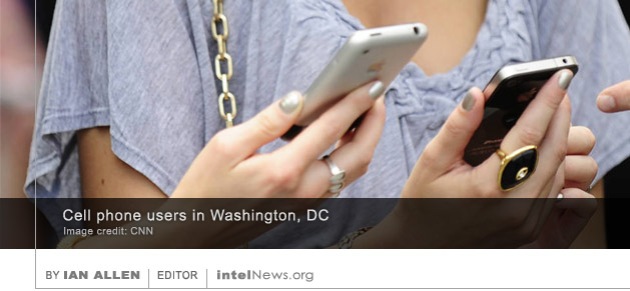 The majority of government-sponsored hacking now targets cell phones, not personal computers, according to researchers who say that political dissidents are especially targeted by totalitarian regimes around the world. Until 2015, most government-sponsored hacking operations were directed against the personal computers of targeted individuals. However, experts
 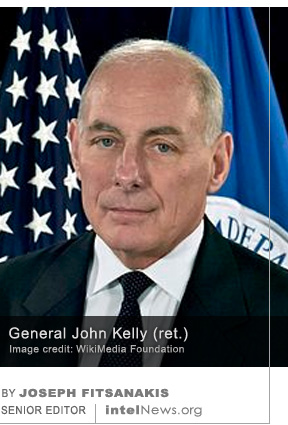 The personal cell phone of the White House Chief of Staff John Kelly (photo) was compromised by persons unknown and may have been bugged for nearly a year, according to United States government officials. General Kelly retired from the US Marine Corps in 2016, after serving as chief of the US Pentagon’s Southern Command, where he supervised American military operations in Latin America and the Caribbean. Soon afterwards, he was appointed by US President Donald Trump to lead the Department of Homeland Security, which he joined in January of 2017. Six months later, however, he replaced Reince Priebus, who resigned abruptly from the post of White House Chief of Staff, citing differences over management style with the Trump administration.










 intelNews.org
Russia says it uncovered U.S. operation to compromise Apple phones
June 2, 2023 by Joseph Fitsanakis 1 Comment
The source of the allegation is the Federal Security Service (FSB), Russia’s primary counterterrorism and counterintelligence agency. On Thursday, the FSB said that “an intelligence action of the American special services” had been uncovered by FSB officers with the assistance of the Federal Protective Service. Known in Russia by its initials, FSO, the Federal Protective Service operates federal emergency communications systems and provides personal security for high-ranking government officials.
According to the FSB, “several thousand Apple telephones” were targeted in the alleged NSA operation, including devices belonging to “domestic Russian subscribers”, as well as devices belonging to foreign diplomats stationed in Russia. The latter allegedly include diplomats from Israel, Syria and China, according to the FSB. The Russian agency also claimed that Russia-based foreign diplomats from North Atlantic Treaty Organization member-states had their phones targeted, as well as diplomats from former Soviet states.
In the same press release, the FSB accused the NSA and Apple of working in “close cooperation” with each other —an allegation that the Russian government has been making for several years. In a follow-up media statement, the Russian Ministry of Foreign Affairs accused the United States of engaging in “hidden data collection” and dismissed Apple iPhones as “absolutely transparent”.
Kremlin spokesman Dmitry Peskov urged Russians to avoid using Apple products and lamented reports that one in three Russian government workers continue to utilize Apple products for their personal use. When asked by reporters if the Russian government had plans to outlaw the use of Apple products by government employees, Peskov responded that the Kremlin did “not have the power to even recommend that”, except for those government employees with access to classified information.
► Author: Joseph Fitsanakis | Date: 02 June 2023 | Permalink
Filed under Expert news and commentary on intelligence, espionage, spies and spying Tagged with Apple, FSB, FSO (Russia), iPhone, News, NSA, Russia, Russian Federal Protective Service, telephone hacking