Percentage of unvaccinated US spy agency employees remains unknown: report

COVID-19 Pentagon

MOST AMERICAN INTELLIGENCE AGENCIES will not disclose the percentage of their employees who are vaccinated for COVID-19, or how many are resisting government vaccination mandates for federal workers. All United States federal government employees and federal contractors are required to comply with vaccination mandates by November 22. Those who refuse to get vaccinated without having been granted a medical exemption, are likely to face a suspension for up to 14 days, which could result in permanent dismissal.

The vaccine mandate for government workers is part of a nationwide effort to combat the coronavirus pandemic, which has killed more than 750,000 people in the United States since early 2020. Studies by the United States Centers for Disease Control and Prevention show that unvaccinated virus hosts are 11 times more likely to die from COVID-19 than those who are vaccinated. It is currently estimated that around 80 percent of the adult population of the United States has received at least one dose of the vaccine, and around 70 percent is fully vaccinated.

The percentage of intelligence employees and contractors who are vaccinated against the coronavirus is not known, though it is generally believed to be higher than the percentage among the general population in the country. The Central Intelligence Agency has disclosed that fewer than 3% of its employees are unvaccinated, while the National Reconnaissance Office has stated that about 9 percent of its employees have yet to receive a single shot of the vaccine. No information is available about the 16 other agencies of the United States intelligence community.

Last week, Chris Stewart (R-UT), who is a member of the House of Representatives Permanent Select Committee on Intelligence, claimed that as many as 20 percent of government personnel remain unvaccinated in some of the intelligence agencies. He added that agencies “that are more closely affiliated with the military tended to report lower vaccination rates”. He did not elaborate, but questioned whether suspending or dismissing unvaccinated employees of intelligence agencies was a prudent course of action, given their role in national security.

But other lawmakers expressed support for implementing the government’s vaccination mandate in the intelligence community. Jason Crow (D-CO), who also belongs to the House Permanent Select Committee on Intelligence, said the nation’s intelligence agencies were seeing high rates of vaccination. He added that, if some employees are “not willing to do what’s necessary to protect their own health and the health of their unit, that actually calls into question their ability to effectively do the job” of protecting national security.

In reporting on this story, the Associated Press said last week it had contacted a number of intelligence agencies to inquire about the vaccination rates among their employees, but had received no information. The news agency said that several intelligence organizations, among them the National Geospatial-Intelligence Agency, the Defense Intelligence Agency and the National Security Agency, had “declined to provide their vaccination rate when asked”. Similarly, the Office of the Director of National Intelligence, which coordinates the activities of the intelligence community, also “declined several requests to provide figures for the intelligence community” as a whole.

Author: Ian Allen | Date: 08 November 2021 | Permalink

US government report details first-ever drone attack on energy grid

Electrical substation

A REPORT ISSUED BY the United States government last month provides details of what is thought to be the first known attack on the country’s energy infrastructure by an unmanned aircraft system. The report appears in a Joint Intelligence Bulletin (JIB) dated October 28, 2021. The JIB is a collaborative intelligence product of the Department of Homeland Security, the Federal Bureau of Investigation and the National Counterterrorism Center.

The report documents an apparent drone attack that took place on July 16, 2020. The target of the attack was an electrical substation in the state of Pennsylvania. The document does not provide details about the geographic location of the attack, nor does it identify the substation that was targeted. It does, however, give details about the type of commercial drone that was used, which it identifies as a Chinese-built DJI Mavic 2. The DJI Mavic 2 is a compact quadcopter drone, which is popular among aerial photography enthusiasts in the United States. It costs between $1,300 and $4,450, depending on its design and amount of features.

The specific device used in the attack in Pennsylvania had been modified by its operator, most likely in order to cause a short circuit and damage the distribution lines or transformers it came in contact with. The device had a thick copper wire hanging from its body, which was attached with nylon cords. Additionally, the perpetrator of the attack had taken steps to anonymize the device, be removing its quality control markings and other identifying information from it. The camera and internal memory card, which are standard technical features of DJI Mavic 2 drones, had also been removed, according to the report. As a result, the operator of the device has not been identified.

The report concludes that illicit [drone] activity is expected “to increase over energy sector and other critical infrastructure facilities as use of these systems in the United States continues to expand”.

Author: Joseph Fitsanakis | Date: 05 November 2021 | Permalink

CIA director concludes surprise two-day visit to Russia for high-level meetings

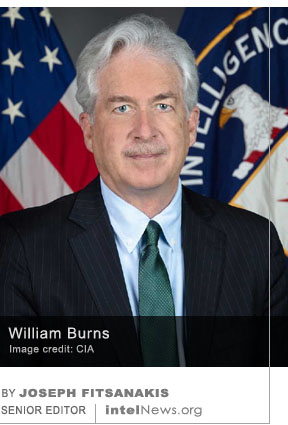
William BurnsTHE DIRECTOR OF THE United States Central Intelligence Agency has returned to Washington from a surprise visit to Russia, where he led a high-level team of American officials in meetings with their Russian counterparts. The two-day visit was announced almost simultaneously by both the American and Russian governments, following the arrival of the CIA director, William Burns, to Moscow on Tuesday.

Little information has emerged about the participants in the meetings. A statement from the American embassy in Moscow said simply that Burns had traveled there at the request of President Joe Biden, and that other United States officials had traveled with him. It is believed that Karen Donfried, the State Department’s assistant secretary for European and Eurasian Affairs, traveled with Burns. According to the American embassy, the meetings were held on Tuesday and Wednesday and concerned “a range of issues in the bilateral relationship between the United States and Russia.

A minute-long video, which was posted on social media by the Russian TASS news agency on Tuesday, showed a group of five American officials meeting with five Russian officials. The latter appeared to include Nikolai Patrushev, a close political ally of Russian President Vladimir Putin, who heads the Security Council of Russia —a body that is roughly equivalent to the United States National Security Council. Prior to his current role, Patrushev served as director of the Russian Federal Security Service (FSB).

It is worth noting that Burns speaks Russian and served twice as a diplomat in Russia, most recently as the American ambassador there. Some observers noted that Burns’ trip to Moscow is part of a broader pattern of increasingly frequent meetings between American and Russian officials in recent months. The last four months have seen at least four visits to Russia by senior officials in the Biden administration.

Author: Joseph Fitsanakis | Date: 04 November 2021 | Permalink

Senior American, Japanese and S. Korean spy officials to meet behind closed doors

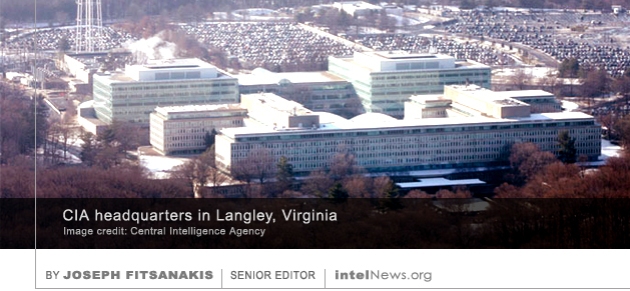
Avril HainesTHE INTELLIGENCE CHIEFS OF the United States, Japan and South Korea are to meet behind closed doors this week. The meeting will take place nearly two years after a major diplomatic spat between Japan and South Korea threatened to significantly harm intelligence cooperation between them. In November of 2019, the South Korean government threatened to terminate the General Security of Military Information Agreement (GSOMIA). The agreement was initiated in 2016 under American tutelage, with the aim of facilitating the sharing of intelligence between South Korea and Japan about North Korea’s missile and nuclear programs.
As intelNews explained at the time, the agreement fell victim to an escalating tit-for-tat row between the two Asian countries, which was rooted in the use of forced Korean labor by Japanese troops during World War II. The South Korean government demanded financial compensation for the use of slave labor, including sex slaves, by Japanese occupation troops during the annexation of Korea by Japan, which lasted from 1910 until 1945.

Tokyo responded to a mass boycott of Japanese goods in South Korea by limiting the export of electronics for use in South Korea’s ship-building industry. It also removed South Korea from the list of countries that can fast-track their exports to Japan. South Korea responded by threatening to not renew GSOMIA prior to it lapsing. With hours to go before GSOMIA’s expiration deadline, Seoul announced it would prolong the treaty. But the dispute continues to stymie intelligence cooperation between the two Asian nations.

On Saturday, the South Korean Yonhap News Agency cited “a government source” in reporting that the intelligence chiefs of the United States and Japan would travel to Seoul next week, in order to hold a series of meetings with their South Korean counterpart. Thus, United States Director of National Intelligence, Avril Haines, and Japan’s Director of Cabinet Intelligence, Hiroaki Takizawa, will meet with Park Jie-won, who heads South Korea’s National Intelligence Service.

The three officials will meet behind closed doors to discuss “strengthening their trilateral intelligence cooperation”, according to the report. There is renewed hope in Seoul and Tokyo that relations between the two nations can be mended, following the election of a new government in Japan earlier this month, under Prime Minister Fumio Kishida. The officials are also expected to discuss efforts to re-initiate negotiations with North Korea on a number of issues. Last month, South Korean President Moon Jae-in offered to begin negotiations with North Korea aimed at drafting a formal declaration to officially end the Korean War of 1950-1953.

Author: Joseph Fitsanakis | Date: 18 October 2021 | Permalink

CIA asks its case officers to focus more on security in ‘unusual’ message

CIA

IN A MESSAGE DESCRIBED by observers as “unusual”, the United States Central Intelligence Agency has warned its case officers to give priority to security when recruiting spies in foreign countries. Fictional treatments of espionage work usually refer to CIA personnel as “spies”. In real-life espionage work, however, this term is actually reserved for citizens of foreign countries who are recruited by CIA case officers to work as informants.

According to The New York Times, large numbers of these foreign CIA informants have been “captured or killed” in recent years. The number is reportedly so high that the CIA’s counterintelligence mission center sent “an unusual top secret cable” last week to every CIA station around the world, drawing attention to that fact. The cable was unusual in its candor and even went so far as to relay the precise number of informants who had been captured, killed or compromised in recent times. According to the paper, the cable made specific mention of informants who were neutralized in countries such as Pakistan, Iran, China and Russia.

The top-secret cable continued by highlighting the importance of placing security at the center of the CIA’s mission, especially when recruiting new informants, said The Times. Case officers —personnel in the CIA’s Directorate of Operations, whose job is to recruit foreigners— are expected to recruit with consistency, and are promoted based on that consistency. But the top-secret cable “reminded CIA case officers to focus not just on recruiting sources, but also on security issues, including vetting informants and evading adversarial intelligence services”, according to The Times. The paper added that the language in the cable implied that CIA case officers have often underestimated the agency’s adversaries abroad.

The Times said it reached out to the CIA with questions about the top-secret memo, but “a CIA spokeswoman declined to comment”.

Author: Joseph Fitsanakis | Date: 07 October 2021 | Research credit: J.S. | Permalink

Venezuelan ex-spy chief captured in Madrid after two years on the run

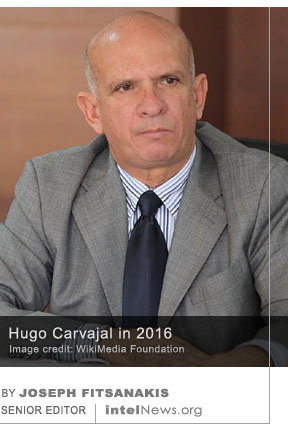
Hugo CarvajalTHE FORMER DIRECTOR OF Venezuela’s military spy agency has been captured in Madrid after two years on the run, and is now likely to be extradited to the United States, where he will face drug trafficking charges. Hugo Carvajal is a retired general and former diplomat, who was a member of the late Venezuelan President Hugo Chávez’s inner circle. From 2004 to 2011, under Chávez’s tutelage, Carvajal headed Venezuela’s Directorate General of Military Counterintelligence (DGCIM).

In 2008 the American government named Carvajal as a major facilitator of international drugs trafficking and imposed financial sanctions on his assets around the world. Washington accused Carvajal of assisting the paramilitary group known as the Revolutionary Armed Forces of Colombia (FARC) transport drugs from Latin America to Mexico, and from there to the US. Things took an interesting turn, however, when in February of 2019, Carvajal posted a video on social media in which he denounced Chávez’s successor, President Nicolás Maduro, and sided with his arch-nemesis, Juan Guaido, the President of the National Assembly of Venezuela.

In his video, Carvajal urged the Venezuelan armed forces to stop siding with Maduro and support Guaido as Venezuela’s acting president. Guaido is openly supported by the United States and dozens of other Western countries. Soon after making his announcement, Carvajal fled to Spain, where he was promptly arrested pursuant to a warrant issued by the US Department of Justice. The US then filed a formal request for the former spy chief’s extradition to America. However, amidst a series of contradictory decisions by Spanish courts, Carvajal disappeared in November of 2019. Since that time, he has been making statements on social media while remaining on the run.

All that changed on September 9, however, when Spanish police and US Drug Enforcement Administration agents forcibly entered an apartment in Madrid, and soon afterwards apprehended Carvajal. The former spy was reportedly wielding a knife until he was convinced by agents to disarm. According to media reports, it is now highly likely that Carvajal will be extradited to the United States, where he will face two choices: spend the rest of his life in prison or cooperate in a large-scale investigation of Venezuelan government officials and their connections to the FARC’s narcotics-trafficking operations.

Author: Joseph Fitsanakis | Date: 22 September 2021 | Permalink

CIA sees early signs of al-Qaeda regrouping in Afghanistan, says US official

David CohenAMERICAN INTELLIGENCE AGENCIES ARE noticing early signs that al-Qaeda may be regrouping in Taliban-controlled Afghanistan, according to the deputy director of the United States Central Intelligence Agency. The presence of al-Qaeda in Afghanistan was the primary reason behind the invasion of the country by the United States in 2001. In subsequent years, the militant group, which was behind the terrorist attacks of September 11, 2001, suffered heavy losses, and saw its members disperse across the region. Many others were captured or killed.

Now, however, with the Taliban back in power in Afghanistan, there are concerns that al-Qaeda may make a comeback in the war-torn country. Under the leadership of Osama bin Laden, al-Qaeda worked closely with the upper echelons of the Taliban in the 1990s and early 2000s. Contacts between the two groups continue to exist, and could potentially deepen following the exit of the United States and its Western allies from Afghanistan.

On Tuesday, David Cohen, who serves as deputy director of the CIA, said that American intelligence agencies are closely monitoring the situation. Speaking at the Intelligence and National Security Summit in Washington, DC, Cohen acknowledged that the shuttering of the United States embassy in Kabul, as well as the closure of a network of CIA stations across Afghanistan, had “diminished” the ability of American intelligence agencies to assess conditions on the ground. He added, however, that current intelligence reports indicate “some potential motion of al-Qaeda [returning] to Afghanistan”.

Cohen added that much of the intelligence that has been collected in recent weeks comes from “over-the-horizon platforms”, meaning that the collection is taking place from countries that border Afghanistan. However, the CIA in particular is already working to develop “methods to work within the horizon”, he said. At the moment, the United States intelligence community estimates that it could take al-Qaeda between one and two years to amass its former strike capability, so as to directly threaten American interests.

Author: Joseph Fitsanakis | Date: 15 September 2021 | Permalink

Mystery arrest of Russian mercenaries in Belarus ‘was US-Ukrainian sting operation’

Belarus KGB

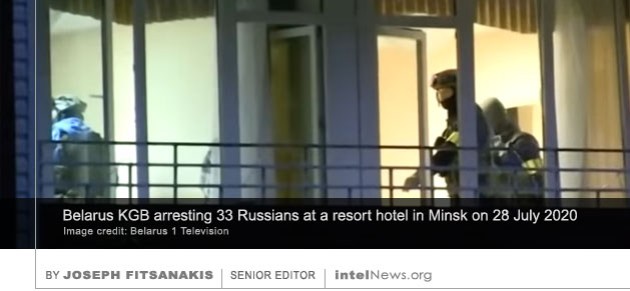
THE BIZARRE CASE OF the arrest of three dozen Russian mercenaries in Belarus in 2020, allegedly for trying to destabilize the country, was in reality a joint Ukrainian-American sting operation that went awry, according to a new report. IntelNews readers will remember the puzzling July 2020 announcement by Belarusian authorities of the arrest of 33 Russians, who were said to be employees of Wagner Group, a Kremlin-backed private military firm.

The 33 Russians were charged with terrorism against the government of Belarussian strongman Alexander Lukashenko, who was then seeking a sixth term in office. Soon afterwards, the Belarussian State Security Committee (KGB) said the Russians had entered the country as part of a 200-strong group of mercenaries working for Wagner, in order to “destabilize the situation during the election campaign” of Lukashenko. That, however, made little sense, given that Lukashenko is one of Moscow’s strongest international allies. To add to the mystery, the Russians were quietly released from custody just a few days later.

What was behind that mysterious case? According to the American news network CNN, the bizarre incident was part of an international sting operation set up by the Ukrainian intelligence services with the support of the United States Central Intelligence Agency (CIA). Citing three former high-ranking Ukrainian military intelligence officials, CNN claims that the sting operation aimed to lure, and eventually arrest, Russian mercenaries who have participated in the Kremlin’s invasion of eastern Ukraine since 2014.

The news network claims that the Ukrainian intelligence services set up a fake Russian private military company and used it to advertise $5,000-a-month contracts to provide security for Venezuelan oil facilities. Hundreds of Russian would-be contractors sent in applications. When quizzed by the fake company about their bona-fides, the applicants freely provided evidence of their participation in the ongoing Russo-Ukrainian War.

The ultimate goal of the sting operation was to sign up the Russian contractors and offer to transport them to Turkey, from where they would supposedly fly to Caracas and begin working. In reality, however, the Russians would be transported to Ukraine, where they would face arrest and potential imprisonment for war crimes. However, the COVID-19 pandemic prevented their transportation via air. Instead, the sting organizers chose to transport them by bus to neighboring Belarus, from where they planned to transport them to Ukraine. However, the presence of 33 burly Russians in a hotel sanatorium outside of Minsk raised suspicions, and led to their eventual arrest by the Belarussian security forces.

The report by CNN claims that the CIA provided the Ukrainian intelligence services with “cash, technical assistance and advice”. But the news network also says that United States officials “deny having a direct role” in the sting operation.

Author: Joseph Fitsanakis | Date: 13 September 2021 | Permalink

Russia denies rumors that its chief security official met with CIA director in India

Russian embassy India

A RUSSIAN GOVERNMENT SPOKESMAN has denied reports Moscow’s Security Council Secretary met secretly this week with the director of the United States Central Intelligence Agency in the India. The United States, however, has not commented on the reports.

As intelNews and others reported yesterday, General Nikolai Patrushev, Secretary of the Security Council of the Russian Federation, arrived in Delhi on September 7, “for high-level consultations on Afghanistan”, according India’s Ministry of External Affairs. General Patrushev, who is Russia’s highest-ranked security official, traveled to India at the invitation of his counterpart there, National Security Adviser Ajit K. Doval.

Interestingly, The Hindu, one of India’s two newspapers of record, reported on Tuesday that “an American delegation of intelligence and security officials” were visiting Delhi, and had already “held consultations” with officials. According to the newspaper, the American delegation was led by no other than CIA Director William Burns, who is said to be touring the region, and is also expected to visit Islamabad in the coming days.

Like General Patrushev, Burns met with National Security Adviser Doval about “issues arising from the Afghanistan evacuation effort and Taliban government formation”, said The Hindu. But unlike the Russian delegation’s visit, which was announced by the Indian government, the alleged American delegation’s visit remains speculative, and has not been officially confirmed by either Delhi or Washington.

It was not long before Indian media began to report that the American and Russian teams had met in secret, allegedly in order to discuss the situation in Afghanistan. On Wednesday, however, a spokesman for the Russian Security Council flatly refuted the rumors of a meeting between Burns and Patrushev. The Russian-government owned TASS news agency quoted Russian Security Council spokesman Yevgeny Anoshin as saying that “Patrushev did not plan to, and did not meet, with the CIA head in Delhi”.

The United States government has yet to comment on these reports.

Author: Joseph Fitsanakis | Date: 09 September 2021 | Permalink

High-level American, Russian intelligence delegations visit India on the same day

Nikolai PatrushevHIGH LEVEL DELEGATIONS OF intelligence officials from the United States and Russia visited India on the same day this week, for talks with Indian officials about the situation in Afghanistan, according to news reports. This development highlights the frantic pace with which Moscow and Washington are maneuvering around the region, following the dramatic takeover of Afghanistan by the Taliban last month.

India’s Ministry of External Affairs announced on Tuesday that General Nikolai Patrushev (pictured), Secretary of the Security Council of the Russian Federation, would be in Delhi “for high-level consultations on Afghanistan” between September 7 and 8. General Patrushev —Russia’s highest-ranking security official— is traveling to India at the invitation of his Indian counterpart, National Security Adviser Ajit K. Doval, according to the announcement. He was scheduled to meet with, aside from Doval, Indian Prime Minister Narendra Modi and External Affairs Minister S. Jaishanka.

Late yesterday, however, the Chennai-based English-language newspaper The Hindu reported that “an American delegation of intelligence and security officials” had visited Delhi on Tuesday, and had “held consultations” with officials there. According to the newspaper, the American delegation was led by Central Intelligence Agency (CIA) Director William Burns, who is touring the region and is also expected to visit Islamabad in the coming days. The report also said that Burns spoke at length with Doval about “issues arising from the Afghanistan evacuation effort and Taliban government formation”.

It is worth noting that India’s Ministry of External Affairs and the embassy of the United States in Delhi declined to confirm or deny the news about the CIA director’s visit to the country.

Author: Joseph Fitsanakis | Date: 08 September 2021 | Permalink

Israel has drastically curtailed intelligence-sharing with the US, report claims

Natanz Iran

THE GOVERNMENT OF ISRAEL scaled back significantly intelligence cooperation with the United States in January of this year, following the change of guard in the White House, according to The New York Times. In an article published on Thursday, the paper cited several unnamed Israeli and American sources in claiming that the Israeli administration of then-Prime Minister Benjamin Netanyahu limited its intelligence relationship with Washington almost as soon as Joe Biden assumed the presidency of the United States.

According to the report, the Israelis decided to scale back intelligence-sharing with Washington in order to keep the Biden administration in the dark about the latest developments in the Iranian nuclear program. Following the demise of much of its intelligence network in Iran in 2019, the United States relies heavily on Israeli intelligence when it comes to following developments inside Iran, said The Times. The hope in Israel is that, by denying the Biden administration information about developments inside Iran, Israel can prevent the White House from making drastic changes to former President Donald Trump’s policy on Iran.

To illustrate its claim, the paper referred to the sabotage attack against Iran’s Natanz nuclear plant in April of this year, which has been widely attributed to Israel. According to the report, the Israelis gave the White House two hours’ notice of the plan, which was allegedly a deliberate attempt to prevent Washington from assessing the operation, and potentially pressuring Israel to cancel it.

American sources told The Times that the move by the Netanyahu administration had its roots in the bad blood between it and the administration of US President Barack Obama, who spearheaded the now-defunct nuclear deal with Iran. Additionally, American officials told the paper that the change of policy on intelligence-sharing by the Israeli government represented a violation of “a longstanding, unwritten agreement to at least advise the United States of covert operations” and giving Washington an opportunity to challenge specific courses of action.

But Israeli officials who spoke to the paper said that the reason why Washington was not given earlier notice about the attack on the Natanz nuclear plant was because of fears that it would be leaked. United States officials have leaked information before about pending Israeli covert operations, according to the Israelis. The report also suggested that the American and Israeli governments have tried to reset their intelligence relationship since the Natanz operation, but relations remain tense.

Author: Joseph Fitsanakis | Date: 27 August 2021 | Permalink

US spy agencies warned Kabul would fall, but did not give precise timeline, says report

US embassy in Afghanistan

ANALYSES BY UNITED STATES INTELLIGENCE agencies about the dynamics of the Taliban insurgency in Afghanistan became progressively grim over the summer, but did not provide precise timelines of the impending disaster, according to a new report. In his television address on Monday, US President Joe Biden admitted that his administration had rested on inaccurate estimates about the ability of the Taliban to overrun Afghan government defenses. Some —including many in the US intelligence community— have interpreted that statement to mean that the assessments given to the White House by the intelligence agencies were faulty or otherwise inaccurate.

On Tuesday, The New York Times reported that the intelligence community continuously revised its assessments of the Afghan civil war in the past year. Earlier this year, the consensus among intelligence agencies was allegedly that the Afghan government could potentially remain in power for as long as two years after a US military withdrawal. But that consensus had been shattered by mid-summer, according to The Times. By July, intelligence reports, led by those produced by the Central Intelligence Agency (CIA), “had grown more pessimistic” and explicitly “laid out the growing risks to Kabul”, according to the paper. These reports also warned that the Afghan government, including its intelligence and military components, would not be able to withstand an assault on the capital and other major urban centers by the Taliban.

At the same time, however, these assessments were typically “not given a high confidence judgment” or a particularly high level of certainty by the agencies, according to the report. One source told the paper that “it was often hard to get [CIA] analysts to clearly predict how quickly [a Taliban victory] would occur”. Instead, its assessments “could often be interpreted in a number of ways, including concluding that Afghanistan could fall quickly or possibly over time”.

The Times report seems to indicate that the White House rested much of its decision-making on earlier assessments by the intelligence community, which projected a less radical pace of change in Afghanistan. For instance, one report from April of this year suggested that the Taliban were at least 18 months away from being able to conquer Kabul. The article also points out the possibility that different agencies may have had differing views on the speed with which the Taliban would conquer Afghanistan, with the CIA being on the more pessimistic end of the scale.

Author: Joseph Fitsanakis | Date: 18 August 2021 | Permalink

CIA considers establishing stand-alone China mission center, report claims

CIA headquarters

THE UNITED STATES CENTRAL Intelligence Agency is weighing the possibility of establishing a stand-alone mission center that would focus on China, according to a new report. Traditionally, questions regarding China have fallen under the agency’s Mission Center for East Asia and Pacific, which focuses on the broader geographical region that includes China. However, according to the Bloomberg news agency, that may about to change.

Quoting “three current and former officials” with knowledge of “internal deliberations” at the CIA, Bloomberg said on Thursday that the proposal to establish a stand-alone China mission center orginages from the agency’s new director, William Burns. According to the report, Burns is looking for ways to “make it easier to secure headcount, funding and high-level attention for [the spy agency’s] China-related activities”.

A stand-alone China mission center would allow the CIA to utilize and combine diverse resources across its various directorates and units. Additionally, elevating the topic of China to a stand-alone mission would reflect the policy priorities of the administration of US President Joe Biden, said Bloomberg. The report comes less than a month after Burns said during an interview that the CIA might deploy China specialists at US government facilities around the world. This would mirror the agency’s approach to the challenge posed by Soviet Union during the Cold War.

During his Senate confirmation hearing in February of this year, Burns stated that he viewed China as the most serious threat to American national security in the near and long term. He added that China’s “adversarial [and] predatory leadership” aimed to “replace the United States as the world’s most powerful and influential nation”.

Author: Ian Allen | Date: 13 August 2021 | Permalink

Moscow denounces ‘NATO propaganda’ as Albania probes alleged Russian spies

DEFENDER-Europe 21

THE RUSSIAN GOVERNMENT HAS accused media in Albania of channeling “propaganda”, as authorities in the Balkan country are investigating alleged military espionage by two Russian citizens. The case centers on DEFENDER Europe 21, a large-scale multinational military exercise, which is held every year under the auspices of the United States Army and the North Atlantic Treaty Organization (NATO). A portion of the exercise, which brings together nearly 30,000 troops from 26 nations, took place in Albania in April and May of this year.

Late last month, reports in the Albanian media said that the Office of the Prosecutor in the capital Tirana was investigating two Russian and five Czech citizens, who may have engaged in espionage activities. According to the reports, one of the Russian citizens had entered Albania on May 12, and traveled to Durres, Albania’s second most populous city, which is centrally located along the country’s Adriatic coast. Durres is the closest urban center to the site of the DEFENDER Europe 21 exercise. A few days later, the Russian citizen was found deploying a drone, according to the Tirana prosecutor.

The Albanian authorities then began looking into the case of another Russian citizen, who had entered the country in March, and was based in Orikum, a small coastal town southern Albania. Like Durres, Orikum is in close proximity to military training facilities. Albanian authorities have not disclosed any information about the fate of the five Czech nationals. But they said last week that a criminal case had been opened against the two Russians.

Last Friday, the Russian Ministry of Foreign Affairs accused the Albanian media of “fueling the hype” about the two Russians, adding that the case was “an exercise in NATO propaganda”. Meanwhile, the Russian embassy in Tirana said that it had sent a formal inquiry about the criminal case to Albania’s Ministry for Europe and Foreign Affairs. Relations between the former Warsaw Pact allies are currently at a low point. In January of this year, Tirana expelled a Russian diplomat, accusing him of ignoring safety protocols relating to COVID-19. In 2018, two Russian diplomats were expelled from Albania after they allegedly engaged in espionage. Shortly afterwards, Moscow expelled two Albanian diplomats in return.

Author: Joseph Fitsanakis | Date: 12 July 2021 | Permalink

Main suspect in potentially momentous hacker-for-hire case seeks plea deal in NY

Computer hacking

IN A DRAMATIC CASE, described by observers as “unusual”, a suspect in a hacker-for-hire scheme of potentially global proportions has told United States government prosecutors he is ready to discuss a plea deal. The case centers on Aviram Azari, a highly sought-after private detective who served in an Israeli police surveillance unit in the 1990s before launching a private career in investigations.

Azari was arrested in Florida in 2019 during a family vacation, and was shortly afterwards indicted in New York on charges of aggravated identity theft, conspiracy to commit computer hacking, and wire fraud. These charges reportedly date back to 2017 and 2018. Azari’s alleged objective was to target carefully selected individuals in order to steal their personal information, including email usernames and passwords. Last year, The New York Times reported that the case against Azari is connected with a potentially massive hacker-for-hire scheme code-named DARK BASIN.

Further information about DARK BASIN was published by Citizen Lab, a research unit of the University of Toronto’s Munk School of Global Affairs and Public Policy, which focuses on information technology, international security and human rights. It said DARK BASIN was orchestrated by an India-based firm called BellTroX InfoTech Services. It also claimed that the company is one of a number of hacker-for-hire firms based in India. These companies are said to be employed by private detectives in Western countries, who are usually hired by large multinationals or wealthy individuals.

Accordingly, the targets of DARK BASIN activities appear to have been investment firms based in the US and elsewhere, as well as government officials, pharmaceutical companies, lawyers, large banks, and even environmental activists who campaign against large multinationals. Additionally, some of DARK BASIN’s thousands of targets appear to be people involved in high-stakes divorce proceedings. Perhaps more alarmingly, among DARK BASIN’s targets are journalists around the world, who seem to have been targeted systematically in efforts to reveal their sources of information.

Azari has pleaded not guilty. But the fact that he his lawyer has now communicated his client’s desire to seek a plea deal with US government prosecutors may be a major game-changer in this case, which may have global ramifications. The Reuters news agency, which reported the latest developments on this case this week, said it reached out to the US Attorney’s Office in Manhattan, but spokesmen there declined to provide any information on Azari’s case.

Author: Joseph Fitsanakis | Date: 02 July 2021 | Permalink