News you may have missed #719

Benny GantzBy IAN ALLEN | intelNews.org |
►►Iran says it has cracked US spy drone secrets. Iran claims it has cracked the encryption on the computer software onboard a US RQ-170 Sentinel drone which crashed in the country in December. General Amir Ali Hajizadeh, head of the Revolutionary Guards aerospace division, said engineers were decoding the last pieces of data from the spy plane, which came down near the Afghan border. An Iranian defense official recently said that Tehran has had several requests for information on the craft and that China and Russia have shown an interest.
►►Israel steps up covert operations says defense chief. Israel’s defense chief, Lieutenant General Benny Gantz, has confirmed his forces are carrying out increased special operations beyond the country’s borders. In an interview published on Wednesday to mark the eve of Israel’s Independence Day, Gantz said Israel was ready to attack Iran’s nuclear sites if ordered to do so. But he added that did not mean he was about to order the air force to strike. He also said that he had increased the number of covert Israeli operations in other countries, but gave no details. “I do not think you will find a point in time where there is not something happening, somewhere in the world”, he said.
►►US Pentagon plans new intelligence-gathering service. The US Pentagon is revamping its spy operations to focus on high-priority targets like Iran and China in a reorganization that reflects a shift away from the war zones of Iraq and Afghanistan that have dominated America’s security landscape for the past decade. Under the plan approved last week by Defense Secretary Leon E. Panetta, case officers from the new Defense Clandestine Service would work more closely with counterparts from the Central Intelligence Agency at a time when the military and spy agency are increasingly focused on similar threats.

Analysis: Nepotism, ethnic favoritism impede Afghan spy agency

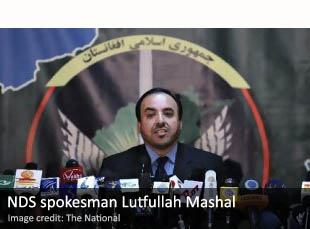
NDS spokesman Lutfullah MashalBy JOSEPH FITSANAKIS | intelNews.org |
Hundreds of Taliban insurgents were involved in the unprecedented attacks that shook the Afghan capital Kabul and several other key locations around the country last week. And yet not a single Afghan or foreign intelligence operative appeared to have the slightest idea the attacks were coming. No wonder that Afghan President Hamid Karzai was one of many government officials who openly admitted that the “infiltration in Kabul and other provinces [was] an intelligence failure for us”. But why is Afghan intelligence so notoriously unreliable? The answer to this question is complicated, but according to an excellent analysis piece published this week in The Christian Science Monitor, much of it centers on two chronic issues that permeate Afghan society: nepotism and ethnic favoritism. When one speaks of Afghan intelligence, one mainly refers to the National Directorate for Security (NDS), an institution established by the United States, and funded almost entirely by Washington. The roots of the NDS are in the Northern Alliance, the indigenous Afghan opposition to the Taliban, which fought alongside the United States during the 2001 invasion of the Central Asian country. Like most other institutions in Afghanistan, the Northern Alliance is composed largely by members of a single tribe, namely Tajiks, many of whom are from Afghanistan’s Panjshir province. As a result, when Washington set up the NDS, it selected its leadership from among the Panjshir Tajiks. They, in turn, relied on their local networks to staff the newly formed organization. As a result, today around 70 percent of the NDS’ staff “hail from Panjshir or have ties with the Northern Alliance”, says The Monitor. This helps establish rapport and ethnic unity among the institution’s 30,000-strong employee community; but it has virtually eliminated the NDS’ ability to collect intelligence from among rival ethnic groups and factions, including the Haqqani Network and the nearly all-Pashtun Taliban. Read more of this post

News you may have missed #718 (GCHQ edition)

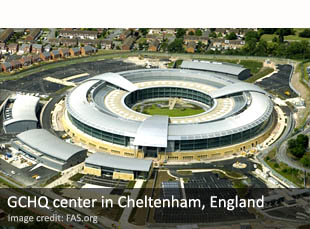
GCHQ center in Cheltenham, EnglandBy IAN ALLEN | intelNews.org |
►►GCHQ releases Alan Turing papers. Britain’s signals intelligence agency, GCHQ has released two mathematical papers written by cryptographer Alan Turing after keeping the works secret for over half a century. The intelligence agency believes the handwritten papers were produced by Turing during his time at Bletchley Park, the World War II code-breaking center. The year 2012 marks the centenary of Alan Turing’s birth. Turing, whose work heavily contributing to the Allied war effort, committed suicide in 1954 by taking cyanide. Turing had been convicted of homosexuality, which was then a crime, and was given the choice between prison or chemical castration. The UK government officially apologized over Turing’s treatment in 2009, over 50 years after his death.
►►Britain’s GCHQ sued for ‘racism’. Alfred Bacchus, 42, claims he was bullied by bosses while he was a senior press officer at the Government Communications Headquarters in Cheltenham. He says he wanted to publish an official report in 2010 into race bias inside GCHQ which warned that not enough ethnic minority staff were being recruited to help fight terrorism. It found that black and Asian intelligence officers at GCHQ complained of a racist culture in which they were insulted by white colleagues and challenged over their loyalty to Britain.
►►Ex-GCHQ chief wants more surveillance of Facebook and Twitter. Sir David Omand, an ex-Cabinet Office security chief and former director of Britain’s GCHQ electronic eavesdropping agency, said it was essential that monitoring of social media was put on a proper legal footing. A report by the think-tank Demos, which Sir David co-authored, said existing laws regulating the interception of communications by police and intelligence agencies needed to be overhauled to meet the complexities of social media. However, the ability of state security agencies and the police to intercept social network communications such as tweets must be placed on a clear legal footing, the report says.

MI6 set up fake mosque in Europe to attract Muslim extremists

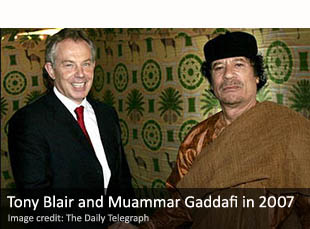
Tony Blair and Muammar Gaddafi in 2007By JOSEPH FITSANAKIS | intelNews.org |
British and Libyan intelligence collaborated during the reign of Libyan leader Muammar al-Gaddafi, in setting up a radical mosque in a European city aimed at luring Muslim extremists. The revelation was made last weekend by British newspaper The Sunday Telegraph, which said it was in possession of documents describing the complex ruse. The paper said that the documents, which were authored by MI6, were discovered in the abandoned headquarters of the ESO, Libya’s External Security Organization, following the collapse of the Gaddafi regime. They allegedly describe a series of operations resulting from the close collaboration between the ESO and MI6, Britain’s Secret Intelligence Service, which began in 2003. During that time, the two intelligence agencies re-established contact in the context of the diplomatic ‘thaw’ between London and Tripoli, which began with Libya’s decision to abandon its nuclear weapons program. With ESO’s assistance, MI6 recruited an agent who was “closely connected” to a senior al-Qaeda commander in Iraq. Codenamed JOSEPH, the agent was slowly groomed to infiltrate an al-Qaeda cell operating in a Western European city. The project’s ultimate goal was for JOSEPH to help establish a mosque aimed at luring Muslim extremists planning to launch terrorist attacks. The Telegraph states that the name of the city, which is in continental Europe, “cannot be named for security reasons”. In December 2003, JOSEPH was flown to the UK by MI6, along with a Libyan intelligence officer who had previously been stationed in London. The two men met with MI6 officers in a British hotel, where they discussed plans to set up the mosque. After taking some time to address JOSEPH’s strong reservations about his personal safety, MI6 officers met with him again in 2004 in “a city in the north of England”. Read more of this post

News you may have missed #717

Lieutenant General Michael FlynnBy IAN ALLEN | intelNews.org |
►►CIA wants more drone strikes in Yemen. The CIA is seeking permission to launch more airborne drone strikes in Yemen, even when there is a risk the victims might not always be terrorists, The Washington Post reports. The paper quotes an unnamed Obama administration official saying that “there is still a very firm emphasis on being surgical and targeting only those who have a direct interest in attacking the United States”. But critics of the drone program say killings of innocent victims could become more common if the strikes are expanded. The CIA proposal for the “signature strikes” is awaiting a decision by the National Security Council, The Post quotes unnamed US officials as saying.
►►US military intelligence critic to lead spy agency. Lieutenant General Michael Flynn, who once blasted the work of US military spies in Afghanistan as “only marginally relevant”, has been nominated to take over the Defense Intelligence Agency, which is the US Pentagon’s intelligence organization. Flynn was a scathing public critic of military intelligence in Afghanistan, where he served as a top intelligence officer in 2010, saying it failed to provide decision makers with a clear picture of conditions on the ground. Flynn is credited with playing an influential role during his tenure at Joint Special Operations Command (JSOC), the secretive headquarters that oversees elite commandos like the team that killed Osama bin Laden in May 2011.
►►Taiwanese man detained for spying for China. A Taiwanese businessman, identified by his surname Cheng, has been detained for allegedly spying for China. He was allegedly recruited by China when he moved to the southeastern coastal province of Fujian to do business a few years ago, prosecutors said. Cheng is accused of trying to lure a former classmate, who is now a military officer, to meet with Chinese officials abroad for money; but the officer turned him in to Taiwanese authorities.

UK Foreign Secretary asked if murdered businessman was MI6 spy

Neil HeywoodBy JOSEPH FITSANAKIS | intelNews.org |
Britain’s Foreign Secretary has been officially asked by a parliamentary committee whether Neil Heywood, the British businessman who was found murdered in China last November, was spying for British intelligence. There is no question that Heywood, a financial consultant and fluent Chinese speaker, who had lived in China for over a decade, maintained contacts with intelligence insiders. In the past, he had collaborated with Hakluyt, a business intelligence firm established and staffed by former officers of MI6, Britain’s external intelligence agency. British government sources have denied that the murdered businessman had ever been employed by the British state. But Heywood’s background —his schooling at Harrow, his background in international relations, his contacts with senior Chinese Communist Party apparatchiks, and his language skills— have given rise to intense speculation that he may have been an asset for British intelligence. Yesterday British newspaper The Daily Mail cited “a well-placed source” in claiming that Heywood “passed information to MI6 as an agent of influence”. Speculation about Heywood’s alleged contacts with British intelligence is bound to increase following news of an official request on the subject, issued to British Foreign Secretary William Hague, by the House of Commons Foreign Affairs Committee. The request, submitted in the form of a letter (.pdf) authored by Committee Chairman Ricahrd Ottaway, urges Hague to address “speculation” about the murdered Englishman’s profession. In the letter, Ottaway asks the Foreign Secretary to clarify whether Haywood had ever supplied intelligence “on a formal or informal basis” to Britain’s embassy in Beijing or its consulate in the city of Chongqing, where Heywood was found dead last November. Read more of this post

Iran offers more details on alleged Israeli sabotage ring

Israel and IranBy IAN ALLEN | intelNews.org |
Iranian state media have released fresh details about the arrests of several members of an alleged Israeli sabotage ring, which were initially announced last week. According to the original reports from Tehran, which were notably vague, the ring was allegedly supported by Israel and its members were “plotting attacks” against Iranian government targets. The latest reports from Iran’s IRNA news agency state that the arrestees include “more than fifteen Iranian and foreign nationals […] spying for Israel” and that those arrested were involved in a complex sabotage plot orchestrated by the “Zionist regime” —a term used by Iranian government media to refer to the Jewish state. The reports claim that the group had planned to assassinate an Iranian government “specialist”, possibly a reference to employees in the Islamic Republic’s nuclear program. Moreover, Iranian state prosecutors allege that the planned assassination had been scheduled for last February 10, but was preempted by the planners’ arrests. The date suggests that the arrests were conducted over two months ago. If the February 10 date is accurate, it would also signify that the alleged assassination had been planned for the day before the 33rd anniversary of the 1979 Islamic Revolution, which commemorates the day when the regime of Iran’s Shah collapsed and power was transferred to the hands of the revolutionaries led by Ayatollah Khomeini. Read more of this post

News you may have missed #716 (analysis edition)

Mordechai VanunuBy IAN ALLEN | intelNews.org |
►►Kabul attacks show intel failures in Afghanistan. Dozens, possibly hundreds of people would have been involved in training, equipping and then infiltrating into the heart of Kabul the large number of insurgents who were prepared to fight to a certain death in the Afghan capital last Sunday. Yet neither Afghan nor foreign intelligence operatives appeared to have any idea that an unprecedented wave of attacks was about to engulf both Kabul and several other key locations around the country. So it seems that Afghan President Hamid Karzai may have a point when he says that the “infiltration in Kabul and other provinces is an intelligence failure for us and especially for NATO and should be seriously investigated”.
►►Report claims China spies on US space technology. China is stealing US military and civilian space technology in an effort to disrupt US access to intelligence, navigation and communications satellites, according to a report authored by the State and Defense Departments. The report (.pdf) argues China should be excluded from recommendations made to the US government to ease restrictions on exports of communications and remote-sensing satellites and equipment. Chinese officials have denied the report’s allegations, calling it a “Cold War ghost”.
►►The long and sordid history of sex and espionage. Using seduction to extract valuable information is as old as the Old Testament —literally— Whether from conviction or for profit, women —and men— have traded sex for secrets for centuries. The Cold War provided plenty of opportunities for so-called “honey-pot” scandals. Perhaps the most dramatic case of seduction in recent times involved Israeli nuclear technician Mordechai Vanunu. In 1986 he visited London and provided The Sunday Times with dozens of photographs of Israel’s alleged nuclear weapons program. But Mossad was on his trail and a female agent —Cheryl Ben Tov— befriended him (reportedly bumping into him at a cigarette kiosk in London’s Leicester Square). She lured him to Rome for a weekend, where he was drugged and spirited to Israel.

Israel ‘conducts espionage incursions into Iran from Kurdish Iraq’

Kurds in the Iran-Iraq border regionBy JOSEPH FITSANAKIS & IAN ALLEN | intelNews.org |
Israeli intelligence services are routinely using an undisclosed base in Iraqi Kurdistan to launch regular intelligence missions into Iran, according to The Sunday Times. The London-based newspaper cited unnamed “Western intelligence sources” in alleging that Israeli commandos and highly trained special forces members have been conducting cross-border operations from northern Iraq’s semi-autonomous Kurdistan province. But, says the paper, these risky intelligence missions have been intensified to an unprecedented degree in the past few months, as the Israelis are desperately seeking “smoking gun evidence” to convince the United States and the United Nations that Iran is actively constructing a nuclear warhead. The Israelis, according to the Times, deploy twelve-member fully armed teams into Iran on modified Black Hawk helicopters, which are able to fly for approximately 500 miles without needing to refuel. After landing into Iran, the Israeli commandos, who are usually in Iranian military uniforms, are transported to target locations in vehicles made to look like those used by the Iranian military. Their target destinations include Iranian military complexes such as that in Parchin, located 19 miles southeast of Tehran. The Times claims that the Israeli commando teams have also been to Fordow, near Qum, a heavily guarded former Islamic Revolutionary Guard Corps base that houses an underground uranium enrichment facility. The article claims that, once they reach their destination, the Israeli commando teams use “sensitive equipment” to monitor levels of radioactivity and record the magnitude of any explosives tests that might be carried out at those locations. IntelNews has paid particular attention over the years to reports of alleged cooperation between Israeli intelligence agencies and Kurdish groups in Iraq and elsewhere. Read more of this post

US denies arms dealer’s release is part of swap deal with Iran

Amir Mirzaei HekmatiBy JOSEPH FITSANAKIS| intelNews.org |
The United States government has denied that the quiet release and deportation of an Iranian arms dealer is part of a secret deal to swap imprisoned agents with Iran. A US State Department spokesman confirmed on Tuesday that Iranian citizen and convicted arms smuggler Amir Hossein Ardebili had been released from US custody and was on his way back to Iran. Ardebili was captured and abducted by US government operatives in the Republic of Georgia in 2007, during a controversial sting operation. His abduction was the culmination of a three-year-long sting operation, during which he allegedly tried to arrange a clandestine shipment of sensitive military technology from the US to Iran. He was eventually extradited to the US in 2008, and sentenced the following year to five years in prison, for operating as an “arms acquisitions agent for the government of Iran”. Last month, however, he was discretely released from prison in Minnesota and handed over to US Immigration and Customs Enforcement for deportation. US State Department spokesman Noel Clay said that Ardebili was on his way to Tehran via Europe, because he had “completed serving his criminal sentence and has no legal immigration status in this country”. The spokesman also pointed out that Ardebili’s five-year prison sentence was meant to include the nearly two years he spent in Georgian and US detention, prior to his 2009 trial. But some observers, including Laura Rozen at Yahoo News, speculate that there might be a connection between Ardebili’s deportation and the reversal earlier this month of a death sentence imposed by a Tehran court on a former US marine captured in Iran on spy charges. Tehran recently announced that Amir Mirzaei Hekmati (pictured), from Arizona, who was captured in Iran while allegedly on a CIA mission, is to have his death sentence voided, and will face a retrial. Read more of this post

News you may have missed #686

Folkert Arie van KoutrikBy IAN ALLEN| intelNews.org |
►►WikiLeaks to publish 5 million StratFor emails. In its latest high-profile data dump, WikiLeaks is to reveal five million internal and external emails from StratFor today. In a press release late Sunday, Wikileaks said the emails “show StratFor’s web of informers, pay-off structure, payment-laundering techniques and psychological methods”, and reveal “how StratFor has recruited a global network of informants who are paid via Swiss banks accounts and pre-paid credit cards. Stratfor has a mix of covert and overt informants, which includes government employees, embassy staff and journalists around the world”.
►►Analysis: Blurred line between espionage and truth under Obama. “There is plenty of authorized leaking going on, but this particular boat leaks from the top. Leaks from the decks below, especially ones that might embarrass the administration, have been dealt with very differently […]. And it’s worth pointing out that the administration’s emphasis on secrecy comes and goes depending on the news. Reporters were immediately and endlessly briefed on the “secret” operation that successfully found and killed Osama bin Laden. And the drone program in Pakistan and Afghanistan comes to light in a very organized and systematic way every time there is a successful mission”.
►►Nazis had spy in MI5 but failed to use him. Dutchman Folkert Arie van Koutrik was the first German agent to ever infiltrate MI5 when he was employed by them in 1940, just a month before Anthony Blunt, who was later exposed as a Soviet spy. Koutrik had already worked for Abwehr, the German secret service, before the war as a double agent with MI6 in Europe and exposed some of the UK’s top agents. But, incredibly, after he moved to the UK and joined MI5 all contact appears to have broken off.

News you may have missed #652

Amir Mirzaei HekmatiBy IAN ALLEN | intelNews.org |
►►Kremlin accused of covert tactics against opposition. The Kremlin says it will allow opposition groups to hold rallies, but cases of alleged preemptive arrests and phone-tapping show that it may be still seeking to defeat the protest movement. For previous intelNews coverage of civil liberties in Russia see here.
►►Iran releases two Kuwaitis accused of spying. Iran’s semi-official Mehr news agency says that two Kuwaitis detained In Iran for spying last month have been cleared of their charges and released. The report quoted Iran’s ambassador to Kuwait, Ruhollah Qahremani, as saying the men had illegally worked as journalists in Iran while traveling on tourist visas, but initial speculation that they were spies “had been wrong”.
►►US sources deny spy charges for American detained in Iran. Amir Mirzaei Hekmati (pictured), from Arizona, who has been captured in Iran allegedly on a CIA mission, has not received any intelligence training from the US military, according to Pentagon sources. Also, one of Hekmati’s colleagues claims the Iranian-American helped develop an electronic translator for US troops but “wouldn’t have been involved in espionage”.

Comment: Is China the New Spy Superpower?

US and China

US and China

By JOSEPH FITSANAKIS* | intelNews.org |
In fifteen years of monitoring intelligence-related developments, I have rarely seen so many news items about China appear simultaneously in the Western press, as I did during the past fortnight. On December 5, financial news network Bloomberg reported that the United States government invoked “Cold War-era national security powers” to compel telecommunications companies operating on American soil to disclose confidential data about their networks. The plan, spearheaded by the US Department of Commerce, but undoubtedly prompted and monitored by the National Security Agency, features a detailed survey distributed to dozens of telecommunications service providers, as well as hardware and software developers. The latter are reportedly required to supply “a detailed accounting” of every piece of “foreign-made hardware and software” installed on their networks, in a move that Bloomberg interprets as “a hunt for Chinese cyber-spying”. A few days later, intelligence researcher and author David Wise opined in The New York Times that the West had better recognize that China “has developed a world-class espionage service —one that rivals the CIA”. He qualified his statement by providing several examples of major espionage triumphs achieved by the Chinese intelligence services in the last decade, such as the acquisition of design blueprints for the US-built B-1 bomber and Northrop Grumman’s B-2 stealth bomber. Other examples given by Wise include China’s attainment of the design specifications for the US Navy’s Quiet Electric Drive system, aimed at enhancing the stealth abilities of submarines, as well as the remains of the modified Black Hawk helicopter that crashed in Abbottabad, Pakistan, during the CIA-led operation to assassinate al-Qaeda founder Osama bin Laden last May. Most of all, Wise laments the acquisition by the Chinese of the design specifications for the W-88 warhead, the symbol of America’s next-generation of mini-nuke weapons. Read more of this post

News you may have missed #646

Syed Ghulam Nabi Fai

Syed Fai

►►Analysis: Reorganizing Colombia’s disgraced spy agency. One former director of Colombia’s Administrative Department of Security, or DAS, has been convicted of conspiring to kill union activists. A former high-ranking manager is accused of collaborating with death squads to assassinate a television humorist. Dozens of agents have been implicated in what prosecutors call a systematic effort to illegally spy on the Supreme Court and opposition politicians, which some former DAS agents said was done with US equipment and funding. The new man in charge, however, Ricardo Giraldo, is an affable bankruptcy lawyer and former university professor, and his role is decidedly different from his predecessors’: namely to dismantle the agency.
►►Russian site snubs FSB request to block opposition networking. Russia’s top social networking site on Thursday defiantly rejected a request by the Federal Security Service to block opposition groups from using it to organize street protests accusing the authorities of rigging this week’s election. Over 45,000 people in Moscow alone have pledged on Facebook and the Russian site, VKontakte, to join fresh protests on Saturday against the 12-year rule of Vladimir Putin and the victory of his United Russia party in last Sunday’s parliament vote.
►►American citizen admits he took Pakistan spy money. Ghulam Nabi Fai, who is accused of working in Washington for Pakistan’s Inter-Services Intelligence (ISI) directorate, to lobby for Kashmiri independence, has pleaded guilty to secretly receiving millions of dollars from Pakistan’s spy agency in violation of US federal laws.

News you may have missed #613 (court case edition)

Katia Zatuliveter

Katia Zatuliveter

►►Russian accused spy admits affair with British MP. Katia Zatuliveter, 26, who is accused by British counterintelligence service MI5 of being a spy for Russia, has admitted having a four-year affair with Liberal Democrat MP Mike Hancock, 66, while she worked as his parliamentary researcher. She also admitted that before meeting Mr Hancock she had affairs with a NATO official and a Dutch diplomat. However, she has denied working as a spy or targeting Mr Hancock in a honey trap operation.
►►Trial for ex-CIA officer accused of leaking secrets delayed. The trial for Jeffrey Sterling, a former CIA officer charged with leaking classified defense information has been delayed. Opening arguments were expected to begin this week, but the trial was postponed on Monday after prosecutors said they intended to appeal the judge’s decision to strike two witnesses.
►►UK justice secreary plans closed-door terrorism trials. Intelligence gathered by British intelligence agencies MI5 and MI6, even if obtained by torture, will never be disclosed in court proceedings, under proposals announced by British justice secretary Kenneth Clarke. The proposals have been welcomed by the security and intelligence agencies, but criticized by civil rights groups for promoting “secret justice”.