World reaction to Snowden’s spying revelations continues

Edward SnowdenBy JOSEPH FITSANAKIS | intelNews.org |
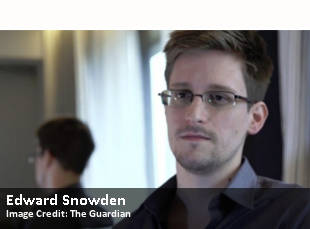
Governments around the world continue to issue sharp official reactions to the revelations of large-scale spying by the United States, as Washington attempts to minimize the diplomatic fallout from the disclosures. The President of the European Commission, Jose Manuel Barroso, told a session of the European Parliament on Tuesday that, if confirmed, the claims of US espionage against European Union institutions would be “very disturbing”. He was referring to allegations, aired last week by German newsmagazine Der Spiegel, that America spies on the communications of many of its allies, including European Union (EU) agencies, with the same intensity it spies on China and Iraq. The claims were based on documents supplied by American whistleblower Edward Snowden, a former technical expert with the Central Intelligence Agency, who is currently believed to be in Russia. Numerous EU officials have contacted the US with requests for clarification, while EU ambassadors are scheduled to hold a meeting in Brussels, Belgium, on Thursday, to discuss how to commonly respond to Der Spiegel’s revelations. Some of the strongest criticisms against US intelligence policies have been issued by German officials, as some business figures in the country are raising concerns about US economic espionage against German financial interests. Christian Social Union politician Hans Michelbach reminded participants in a German parliamentary session this week that the EU may be a political ally of the US, but “is indeed a strong competitor in the global economy”. He added that business circles in Berlin are concerned that US intelligence collection aimed at German businesses would give Washington “dishonest advantages”. In Italy, the country’s Minister of Foreign Affairs, Emma Bonino, attended a special parliamentary session on Thursday, in which she assured those present that the Italian embassy in Washington was not being spied upon by US intelligence services. She noted that Italy’s “secret services have not unearthed elements of espionage in our [Washington] embassy”. The government of India, meanwhile, expressed strong concerns on Wednesday over reports that US intelligence services have especially targeted nearly 40 diplomatic missions in Washington, including that of India. Ministry of External Affairs spokesman Syed Akbaruddin said New Delhi would “take up the issue with US authorities”. But the strongest reactions to Snowden’s revelations have come from the government of Bolivia. Read more of this post

Bugging device found in Ecuador’s UK embassy where Assange lives

Ricardo PatinoBy JOSEPH FITSANAKIS | intelNews.org |
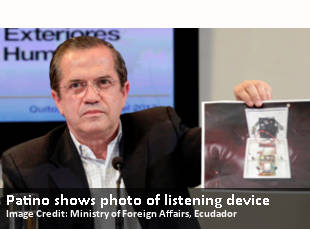
The government of Ecuador has announced the discovery of a “hidden listening device” inside its embassy in London, United Kingdom, where WikiLeaks founder Julian Assange has taken refuge. Ecuador’s Minister of Foreign Affairs, Trade and Integration, Ricardo Patino, said the device was discovered during a security sweep on June 14, in preparation for his official visit there. Speaking during a press conference on Wednesday in Ecuadorean capital Quito, Patino told journalists that the microphone was discovered inside the office of Ambassador Ana Alban, Ecuador’s envoy to the UK. Patino arrived in London two days later and met with Assange, as well as with Britain’s Secretary of State for Foreign Affairs, William Hague, to discuss Assange’s case. The WikiLeaks founder has been hosted inside the Ecuadorean embassy for over a year, resisting extradition to Sweden, where his is facing charges of rape and sexual assault. Assange denies the charges are valid and maintains that the Swedish government is intent on extraditing him to the United States, where he is likely to face more charges over Cablegate. This is the term commonly used to describe the unauthorized release in 2010 by WikiLeaks of thousands of classified cables sent to the US State Department by American diplomatic missions around the world. Patino told journalists on Wednesday that he “regretted to have to inform” them about the discovery, which he characterized as “another instance of declining ethics in the international relations between governments”. Read more of this post
US spies on Germany, EU agencies, as much as on China and Iraq

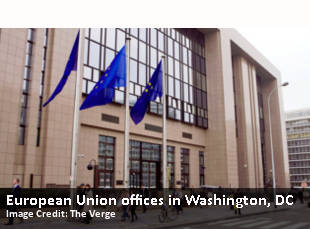
European Union offices in Washington, DCBy JOSEPH FITSANAKIS | intelNews.org |
America spies on the communications of German and other European Union agencies with the same intensity it spies on China and Iraq, documents show. German newsmagazine Der Spiegel aired these claims on Sunday, based on documents it said it obtained from American whistleblower Edward Snowden. Snowden, a former technical expert with the Central Intelligence Agency, remains holed up inside the transit section of Moscow’s Sheremetyevo International Airport, as Russian authorities have rejected repeated requests by Washington to extradite him to the US. According to Spiegel, American intelligence operatives placed interception equipment in the offices of the European Union’s representation in Washington, DC, before infiltrating the building’s computer network. Similar methods were aimed at the EU’s official representation to the United Nations in New York, and even in Brussels, Belgium, where the EU is headquartered. In a separate article, also published on Sunday, Der Spiegel said the National Security Agency, America’s foremost communications interception agency, monitors data from over half a billion communications exchanges taking place in Germany each month. The data is derived from telephone calls, emails, mobile text messages, and even chat transcripts, said the newsmagazine. The information appears to suggest that United States communications intelligence agencies are far more active in Germany than in any other of the EU’s 28 member states. Late on Sunday, a spokeswoman at the Office of the German Federal Prosecutor told Spiegel that the question of whether German citizens’ rights have been violated by illegal American intelligence activities is currently being looked at, and that “criminal charges” relating to the spying revelations “appear likely”. Read more of this post

Germany probes UK spy program revealed by CIA whistleblower

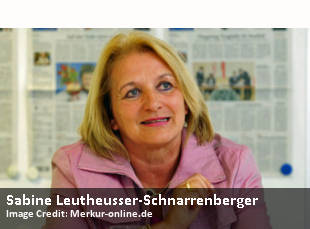
Sabine Leutheusser-SchnarrenbergerBy JOSEPH FITSANAKIS | intelNews.org |
Germany wants to know whether its citizens were spied on under a British government surveillance program revealed by American intelligence whistleblower Edward Snowden. The program, codenamed Project TEMPORA, was disclosed earlier this week by Snowden, a former technical assistant for the United States Central Intelligence Agency (CIA). Snowden remains holed up at Moscow’s Sheremetyevo International Airport, as Russian authorities have rejected repeated requests by Washington to extradite him to the US. According to British newspaper The Guardian, which first wrote about Project TEMPORA on June 21, Britain’s General Communications Headquarters (GCHQ) has been able to “plug into the cables that carry internet traffic into and out” of the United Kingdom. The agency, which is tasked with communications interception, has therefore collected and stored massive quantities of foreign telephone call data and email messages, and has shared much of it with its US counterpart, the National Security Agency. On June 25, Germany’s Federal Minister of Justice, Sabine Leutheusser-Schnarrenberger, wrote a letter to her British counterpart, Chris Grayling, asking for immediate clarification on the precise legal basis for Project TEMPORA. In her letter, which was copied to the British Home Secretary, Theresa May, the German cabinet minister also inquires whether TEMPORA has been authorized by the appropriate judicial authorities. She argues that “European institutions should shed light on this [issue] immediately” and warns her British colleagues that she plans to raise the subject during the July 2013 meeting of European  Union Justice and Home Affairs ministers, which will be held in Brussels, Belgium. Read more of this post

Australia fears Asia backlash over PRISM surveillance revelations

David IrvineBy JOSEPH FITSANAKIS | intelNews.org |
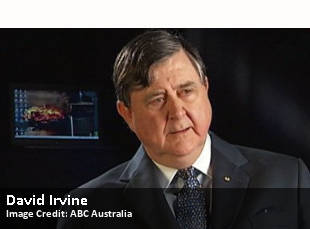
The government of Australia is concerned that American whistleblower Edward Snowden may leak classified information that could damage Australia’s relations with its Asian neighbors, including China and Malaysia. Early this month, Snowden, a former technical assistant for the United States Central Intelligence Agency (CIA), disclosed the existence of PRISM, a clandestine electronic surveillance program operated by the US National Security Agency (NSA). Information provided by Snowden to British newspaper The Guardian suggests that Washington routinely shares PRISM intelligence with Canada, New Zealand, the United Kingdom and Australia. These four countries, along with the United States, are signatories to the so-called UKUSA agreement, a multilateral accord for cooperation in signals intelligence (SIGINT) collection, which was established secretly in 1946. Australian media reported on Wednesday that the Australian Parliament’s Joint Committee on Intelligence and Security had been briefed by senior intelligence officials on Australia’s role in PRISM. The Sydney Morning Herald said that David Irvine, Director of the Australian Security Intelligence Organisation, and Ian McKenzie, who heads Australia’s Defence Signals Directorate, were among those who briefed the parliamentary Committee. Its members were reportedly told that the disclosures about PRISM were likely to damage Canberra’s relations with several Asian countries, in ways that are difficult to predict. One unidentified Australian intelligence official told The Herald that Snowden had “very wide access” to classified information held by the NSA, and that some of it probably includes “much detail of communications intelligence cooperation between the US and Australia”. One source went as far as to say that Snowden’s disclosures have already “damaged […] Australia’s intelligence capabilities”. Read more of this post

Snowden flees to Russia despite US passport revocation

Edward SnowdenBy JOSEPH FITSANAKIS | intelNews.org |
An American former intelligence contractor, who leaked classified information about intelligence operations, was able to leave Hong Kong for Russia on Sunday, despite having his United States passport revoked. Earlier this month, Edward Snowden, a former technical assistant for the Central Intelligence Agency, disclosed the existence of PRISM, a clandestine electronic surveillance program operated by the US National Security Agency (NSA). Shortly before leaking information about US intelligence operations to the world’s media, Snowden traveled to Hong Kong, a territory under the control of the People’s Republic of China. Last week, Washington charged Snowden, a self-described whistleblower, under the Espionage Act, and revoked his American passport, in an attempt to prevent him from leaving Hong Kong. But reports emerged on Sunday that Snowden had boarded an Aeroflot flight from Honk Kong to Russian capital Moscow, despite the revocation of his American passport. US authorities claim that Snowden’s transfer to Moscow occurred after Washington revoked his American passport, which raises the question of how the former CIA employee was able to exit Chinese territory. Several reports suggest that Snowden was accompanied by “unidentified diplomats” as he left Hong Kong for Moscow. Previously, the US had applied considerable diplomatic pressure on China, requesting Snowden’s extradition. But Hong Kong allowed the American fugitive to board a plane to Moscow, saying it had been given “no legal basis to restrict Mr. Snowden from leaving”. Read more of this post

Analysis: PRISM revelations harm US political, financial interests

NSA headquartersBy JOSEPH FITSANAKIS | intelNews.org |
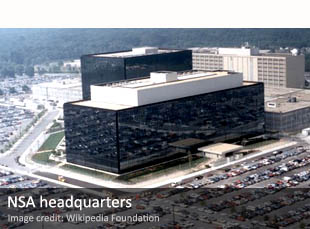
Ever since June 6, when Edward Snowden, a former United States Central Intelligence Agency (CIA) technician, exposed a vast communications spying system called PRISM, observers have focused on the ramifications of this controversy inside America. But in an excellent analysis written for ComputerWorld magazine’s New Zealand edition, Taylor Armerding points out that Snowden’s revelation could result in extensive international blowback for the United States, in both the political and economic realms. Armerding quotes Toronto University political science professor Ron Deibert, who argues that this latest revelation of massive communications interception activity by the National Security Agency (NSA) carries with it “unintended consequences […] that will undermine US foreign policy interests”. Deibert points out that the spy scandal has the potential to undercut America’s role and influence in global Internet governance. In the words of renowned security expert Bruce Schneier, many around the world are beginning to view the US as “simply too untrustworthy to manage the Internet”. Even policymakers and ordinary users friendly to Washington are worried about what they perceive as the “huge disadvantages” of their dependence on US-managed Internet networks that host the content of social media sites, cloud computing databases, or telecommunications exchanges, says Deibert. But the biggest potential damage to US interests, argues Armerding, is not political, but economic. “It is not just personal information that is being swept into the NSA’s massive databases”, he notes; “it is corporate data as well”. Indeed, the vast foreign and domestic spying represented by PRISM poses a direct threat to the global competitiveness of the American technology sector. Read more of this post

Swiss parliament halts US tax deal following CIA espionage claims

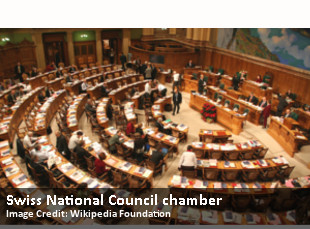
Swiss National Council chamberBy JOSEPH FITSANAKIS | intelNews.org |
The lower house of the Swiss parliament has voted to stop considering a legislation designed to help the United States identify tax evaders, just days after a former Central Intelligence Agency (CIA) employee revealed an espionage operation targeting a Swiss bank executive. The legislation, which was drafted by the government of Switzerland, is aimed at addressing demands by Washington for Swiss banks to turn over to US authorities the identities of American tax dodgers. It is believed that tens of thousands of wealthy Americans manage to evade their tax obligations each year by exploiting strict Swiss banking privacy laws, which effectively shield them from US internal revenue authorities. The legislation has already been approved by the upper house of the Swiss Federal Assembly (the Council of States), but it needs to be cleared by the lower house (the National Council) before it can be officially enacted. Interestingly, the legislation was halted in the lower house just days after American intelligence whistleblower Edward Snowden revealed a US espionage operation aimed at recruiting a Swiss bank official. Snowden, a former technical assistant for the CIA, disclosed the existence of PRISM, a clandestine national security electronic surveillance program operated by the United States National Security Agency (NSA). In addition to PRISM, Snowden, 29, spoke about a CIA operation in 2007, when he was allegedly stationed under diplomatic cover at the CIA station in Geneva, Switzerland. Read more of this post

UK/US spy agencies targeted heads of state at London G20 meeting

NSA/GCHQ listening station in Menwith HillBy JOSEPH FITSANAKIS | intelNews.org |
British and American intelligence agencies targeted the communications of heads of state and other senior officials during a G20 summit held in London in 2009, according to documents. The summit was hosted by the then British Prime Minister Gordon Brown and was attended by delegates from 20 major world economies, including then Russian President Dmitry Medvedev, who was specifically targeted in the spy operation. British newspaper The Guardian, which published the information, said that delegates had their personal computers and cellular telephones monitored during a joint effort by the US National Security Agency (NSA) and Britain’s General Communications Headquarters (GCHQ). The two agencies, which are tasked with intercepting communications signals on behalf of their respective governments, maintain a jointly administered listening base inside the Royal Air Force station in Menwith Hill near Harrogate, North Yorkshire. According to one of the documents, entitled “Russian Leadership Communications in support of President Dmitry Medvedev at the G20 summit in London —Intercept at Menwith Hill station”, the listening facility was utilized to spy on the communications of the Russian President during his stay in London. The targeting began as soon as President Medvedev and the Russian delegation arrived in the British capital on April 1, and continued for several days. The top-secret document, which was shared between British, American, Australian, Canadian, and New Zealand intelligence services, noted “a change in the way Russian leadership signals have been normally transmitted” through satellite links from the Russian embassy in London. Another set of documents, also published by The Guardian, indicate that some G20 summit delegates were “tricked into using Internet cafes [that] had been set up by British intelligence agencies” in order to intercept their email communications. Read more of this post

UK planned to spy on 2009 Commonwealth heads of state meeting

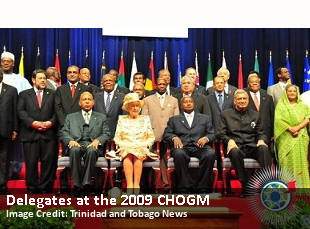
Delegates at the 2009 CHOGMBy JOSEPH FITSANAKIS | intelNews.org |
British intelligence agencies had plans to spy on a British Commonwealth meeting, which was attended by Queen Elizabeth and the President of France, among other heads of state. The plans to spy on the meeting, which was held in 2009, are revealed in a document disclosed to The Guardian newspaper by American whistleblower Edward Snowden. Earlier this month, Snowden, a former technical assistant for the United States Central Intelligence Agency (CIA), disclosed the existence of PRISM, a clandestine national security electronic surveillance program operated by the United States National Security Agency (NSA). The Guardian said on Sunday that it had in its possession a page from an internal classified document given to NSA by Britain’s General Communications Headquarters (GCHQ), which is tasked with collecting signals intelligence. The document apparently outlines plans to spy on international delegates in order to “give UK ministers an advantage in talks with their Commonwealth counterparts”. Some “key intelligence [collection] requirements” at the summit, which took place in 2009 in Trinidad, included “intelligence on South Africa’s views on Zimbabwe”, as well as “climate change reporting”. The document, says The Guardian, also sets out a schedule for various British intelligence agencies to arrive and begin operations in the South American island-nation. GCHQ is instructed to initiate its surveillance activities following the arrival of the international delegates. On the other hand, the Secret Intelligence Service (SIS, also known as MI6), which is Britain’s primary external intelligence agency, is expected to set up operations in Port of Spain several days prior to the event. Read more of this post

Secretive US cyber unit has been spying on China for 15 years

NSA headquartersBy JOSEPH FITSANAKIS | intelNews.org |
A secretive cyberattack unit within the United States National Security Agency (NSA) has been engaged in protracted offensive cyberespionage operations against China for nearly 15 years. The revelation, made this week by veteran NSA watcher Matthew M. Aid, appears to confirm recent allegations made by Chinese government officials that Beijing’s secrets come under regular attack by US government-sponsored hackers. It also agrees with claims made by several intelligence observers, including this blog, that America’s cyber-security posture is not purely defensive. According to Aid’s article, published this past Monday in Foreign Policy, China’s allegations that it has been the target of sustained cyberespionage attacks by the US “are essentially correct”. Citing “a number of highly confidential sources”, Aid alleges that the NSA maintains a substantial “hacker army”. These ‘cyberwarriors’ allegedly operate under the NSA’s Office of Tailored Access Operations, known inside NSA simply as TAO. Its personnel is said to have successfully penetrated the Chinese government’s telecommunications networks and servers since the late 1990s, generating “some of the best and most reliable intelligence information” gained by Washington. It does so through computer network exploitation (CNE) techniques, such as surreptitious hacking, password exploitation, and even by compromising Chinese network security technicians. Aid alleges that TAO works closely with the Central Intelligence Agency (CIA) and the Federal Bureau of Investigation (FBI), through a small “clandestine intelligence gathering unit”. The latter employs CIA and FBI operatives who perform what are known as “off-net operations”, a term that refers to physical break-ins of Chinese and other foreign diplomatic facilities, in order to compromise the security computer hardware. Read more of this post

World’s first undergraduate intelligence journal publishes first issue

Security and Intelligence Studies JournalBy JOSEPH FITSANAKIS | intelNews.org |
The study of security and intelligence used to be considered strictly a graduate-level preoccupation. Today, however, it is routinely encountered in undergraduate curricula and constitutes one of the fastest growing programs in the humanities. To satisfy the growing undergraduate interest in this field of study, King University in Bristol, Tennessee, launched The Security and Intelligence Studies Journal. It is the world’s first undergraduate scholarly journal focusing exclusively on themes of intelligence, security, counterterrorism, geopolitics and international relations. The first issue of the Journal is now out and available to purchase on Amazon for $9.00. It contains some of the finest undergraduate research on subjects ranging from the rise of Islamic militancy in West Africa, the Syrian Civil War, the Iranian nuclear program, to terrorism funding, and the rise of far-right militancy in the United States, among other issues. On the journal’s website, visitors can find subscription information, as well as the journal’s theme for issue 2, which is scheduled for publication in December 2013. Undergraduate students from all over the world are invited to submit 3,000-word papers on the subject: Al-Qaeda: past, present, future. The theme’s description is as follows: “In less than a quarter of a century, al-Qaeda grew from a small administrative unit in the Hindu Kush Mountains to a leading global agent of Sunni militancy. The history of this enigmatic organization is replete with unpredictable twists and turns that continue to mystify scholars and counterterrorism experts alike. In the past decade, the demise of central al-Qaeda figures, including its founder and Emir, Osama bin Laden, have led some to proclaim the organization extinct. Others point to the rise of al-Qaeda-inspired franchise groups in the Arabian Peninsula and parts of Africa, as well as lone-wolf terrorist acts around the world, in arguing that al-Qaeda’s ideology is far from obsolete. Read more of this post

Ex-CIA technician who leaked Verizon court order comes forward

Edward SnowdenBy JOSEPH FITSANAKIS | intelNews.org |
Last week, British newspaper The Guardian revealed a secret court order that enables the United States government to collect the telephone records of millions of customers of Verizon, one of America’s largest cellular phone service providers. On the morning of Sunday, June 9, the individual responsible for leaking the secret court order came forward on his own volition. He is Edward Snowden, a former technical assistant for the US Central Intelligence Agency (CIA). The 29-year-old computer expert, who has been working for the National Security Agency (NSA) for the last four years, told The Guardian that he decided to leak the injunction because he felt it posed “an existential threat to democracy”. He added that he was not motivated by money in disclosing the document. Were he after money, he said, he “could have sold these documents to any number of countries and gotten very rich”. In a video published on The Guardian’s website, Snowden told the paper that his disillusionment with America’s “federation of secret law, unequal pardon and irresistible executive powers” began even before 2007, when he was stationed under diplomatic cover at the CIA station in Geneva, Switzerland. He finally decided to act three weeks ago, he said, after careful consideration of the ramifications of his decision for his life and career.

Read more of this post

Controversial French former spy chief found dead in Paris

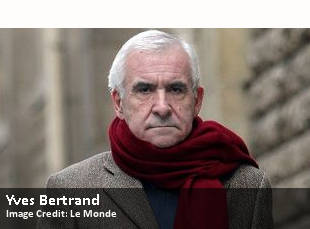
Yves BertrandBy JOSEPH FITSANAKIS | intelNews.org |
The retired director of a now-defunct French intelligence agency, who was involved in several politically charged court cases in recent years, has been found dead in his Paris apartment. From 1992 to 2004, Yves Bertrand, headed the Direction Centrale des Renseignements Généraux (known widely as RG), the domestic intelligence service of the French police. Bertrand, who once described himself as “a minesweeper for the republic”, was a reclusive figure that zealously guarded his privacy and avoided any contact with the French media. In 2007, however, he was thrust into the public spotlight after he was involved in the so-called Clearstream Affair. The controversy centered on a list of names of European government officials who had allegedly received bribes in return for authorizing weapons deals with Taiwan. French investigators searched Bertrand’s Paris apartment and confiscated nearly two dozen volumes of his personal notebooks, in hopes of uncovering inside information linking the Clearstream affair with leading French politicians, including conservative frontrunner Nicolas Sarkozy. In 2008, numerous excerpts from Bertrand’s confiscated diaries found their way into the French press. They included embarrassing revelations about the lives of many French public figures, including politicians. Read more of this post

Chile launches search for suspect in alleged Neruda poisoning

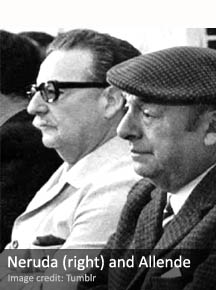
Pablo Neruda (right) and Salvador AllendeBy JOSEPH FITSANAKIS | intelNews.org |
The government of Chile has launched an official search for a United States suspect in connection with the alleged poisoning of celebrated poet Pablo Neruda. The Chilean literary icon, who was awarded the Nobel Prize in Literature in 1971, died on September 23, 1973. His death occurred less than two weeks after a coup d’état, led by General Augusto Pinochet, toppled the democratically elected Marxist government of Salvador Allende, a close friend of Neruda. The death of the internationally acclaimed poet, who was 69 at the time, was officially attributed to prostate cancer and the effects of acute mental stress over the military coup. Earlier this year, however, an official investigation was launched into Neruda’s death following allegations that he had been murdered. The investigation was sparked by a comment made by Neruda’s personal driver, Manuel Araya, who said that the poet had been deliberately injected with poison while receiving treatment for cancer at the Clinica Santa Maria in Chilean capital Santiago. Investigators are still awaiting the completion of a complex autopsy performed on Neruda’s remains, which were exhumed in April. But the Chilean government has already issued a search order for a medical doctor —or someone pretending to be a doctor— who was allegedly on Neruda’s bedside on the night of his death. The search was issued based on comments made recently by another medical doctor, Sergio Draper, who supervised Neruda’s hospital treatment in September of 1973. Dr. Draper told government investigators that he turned over his shift that night to a “Dr. Price”, a young doctor in his late 20s, who was with Neruda in the hours leading to the poet’s death. According to Rodolfo Reyes, a lawyer representing the Neruda estate, Dr.Price’s identity remains a mystery. Read more of this post