CIA shot own planes, used napalm in Bay of Pigs, documents show
August 16, 2011 Leave a comment
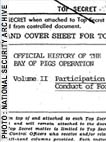
CIA documents
By JOSEPH FITSANAKIS | intelNews.org |
Newly declassified documents show that the CIA mistakenly fired at its own assault planes and resorted to using napalm to stave off successive Cuban counterattacks during the Bay of Pigs invasion. The revelations are included in a multi-volume Official History of the covert operation, which the CIA was forced to declassify after a lawsuit by George Washington University’s National Security Archive. On April 17, 1961, a brigade of 1,300 CIA-funded and -trained anticommunist Cubans mounted a surprise assault on the Caribbean island. But prior intelligence collected by spies working for Havana, and stiff resistance by pro-Castro troops, resulted in the CIA’s biggest known covert action failure. Approximately 1,200 surviving members of the CIA’s army were captured by pro-Castro forces, many of whom were severely interrogated or executed in subsequent years. According to the declassified documents, CIA forces eventually resorted to bombing Cuban government troops with napalm. Initially, operation planners were hesitant about using napalm, because of fears that doing so “would cause concern and public outcry”. But all hesitation had dissolved by the early hours of April 18, as American military commanders faced the possibility of seeing invading troops completely annihilated by successive waves of counterattacks. The documents also reveal that at least one CIA paramilitary officer opened fire on the Agency’s B-26 planes, which had been disguised to resemble those used by the Cuban Revolutionary Air Defense Force. Read more of this post



















IntelNews book review: Codename Aphrodite, by Charles S. Faddis
August 17, 2011 Leave a comment
Codename Aphrodite
By JOSEPH FITSANAKIS | intelNews.org |
Most intelNews regulars know Charles S. Faddis as the former head of the US National Terrorism Center‘s WMD Unit. His 20-year career as a CIA operations officer, with posts in South Asia, Near East and Europe, arguably culminated in 2002, when he led a CIA team into Iraq to help prepare the ground for the US invasion. He documented this in his 2010 book (co-authored with Mike Tucker) Operation Hotel California: The Clandestine War Inside Iraq. Following his 2008 retirement, Faddis, who was CIA Chief of Station in his last overseas tour, frequently comments on intelligence matters. He took a stance against the CIA’s “enhanced interrogation” program (but objected to a government investigation), and has penned hard-hitting critiques of American intelligence culture and practices, most notably in his 2009 exposé Beyond Repair: The Decline and Fall of the CIA. His latest creation, Codename Aphrodite (Orion, 2011), is a gritty novel set in the backstreets of Athens, Greece, where a former CIA clandestine operations officer goes after November 17, one of the world’s most active Marxist terrorist groups. Bill Boyle and his wife, Sarah, are both clandestine officers in the CIA’s European Division. Sarah, who is pregnant with their child, is brutally killed by November 17, after a CIA operation in pursuit of the group goes horribly wrong. Haunted by his wife’s murder, which he witnessed, Boyle quits the Agency and soon ends up as a permanent fixture in a depressing Mexican beach bar. Things take an unexpected turn, however, when political winds change in Greece. Petros Salamis, an ascending Athenian politician and aspiring Prime Minister, contacts Boyle with an irresistible offer: a hefty monetary reward and the satisfaction of revenge for his wife’s death in exchange for returning to Greece and eradicating November 17. Read more of this book review
Filed under Expert news and commentary on intelligence, espionage, spies and spying Tagged with book news and reviews, Charles "Sam" Faddis, Charles Faddis, Charles S. Faddis, CIA, Codename Aphrodite, Joseph Fitsanakis