Western ex-spooks flock to Emirates to set up new agency modeled after CIA

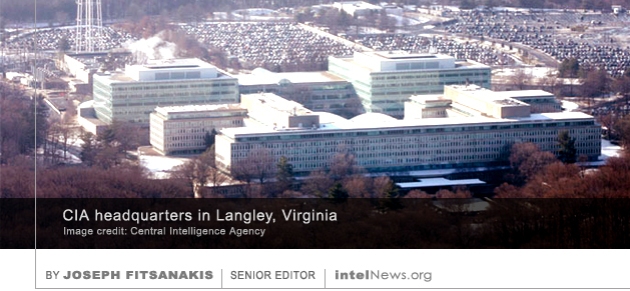
Abu Dhabi, United Arab EmiratesDozens of Western former spies, most of them Americans, are being hired by the United Arab Emirates, whose ruling family is trying to create a new spy service modeled after the United States Central Intelligence Agency. According to Foreign Policy magazine’s intelligence reporter, Jenna McLaughlin, Western contractors are paid $1000 a day for their services. They also reside for free in five-star hotels in Abu Dhabi, while helping the UAE “create its own spy empire”. The lucrative compensation makes it difficult for former spooks to turn down invitations to join a handful of Western consulting companies, who are leading the effort to create the UAE’s “professional intelligence cadre modeled after the West’s”, says McLaughlin.
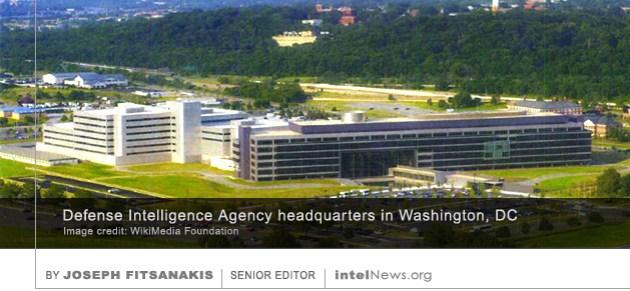
Western instructors provide courses daily at two different locations in Abu Dhabi. In-class instruction takes place at a luxurious villa located in Mina Zayed, a port in the northern outskirts of Abu Dhabi. Field training is conducted at a secret facility located about 45 miles from the UAE capital. The facility is referred to as “The Academy” and is highly reminiscent of Camp Peary, a 10,000-acre US Department of Defense training base that is used to train CIA and the Defense Intelligence Agency operations officers. Just like Camp Peary (known informally as “the Farm”), the UAE’s “Academy” features driving course instruction areas, military-style barracks, and gun ranges, among other training elements.

Foreign Policy says it spoke to “six sources with knowledge of the matter” who said that the effort to create a CIA-like agency in the UAE is spearheaded by CAGN Global Ltd., a consultancy company based in Baltimore, MD. The company’s president is Larry Sanchez, a former CIA operations officer, who struck a personal relationship with the UAE’s ruling royal family while working on counterterrorism for the US government in the early 2000s. He has reportedly been living in the UAE for the past six years, helping to build the UAE intelligence services “from the ground up”, says Foreign Policy. At times he has been joined by other high-profile American former ex-spooks, such as Blackwater founder Erik Prince and Richard A. Clarke, who served as National Coordinator for Security, Infrastructure Protection and Counter-terrorism under Presidents George Bush, Sr, and Bill Clinton.

According to McLaughlin, the work of CAGN Global Ltd. came under scrutiny last year, as several US government agencies, including the State Department and the CIA, became concerned that the training of Emirati intelligence recruits was too closely modeled after the training provided at the Farm. But a review of the company’s instructional provision in the UAE concluded in its favor and the issue seems to have been resolved said McLaughlin. In researching its story, Foreign Policy reached out to Sanchez, the CIA, the Department of State, and the UAE embassy in Washington, DC, but received no responses.

Author: Joseph Fitsanakis | Date: 25 December 2017 | Permalink

Ukraine arrests prime minister’s interpreter, accuses him of spying for Russia

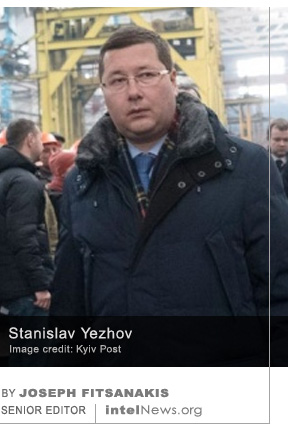
Stanislav YezhovUkraine’s counterintelligence agency has arrested the principal translator of the country’s prime minister, accusing him of spying for Russia. The translator has been identified as Stanislav Yezhov, who has served as a translator for two consecutive Ukrainian prime ministers. As part of his job, Yezhov has been present at nearly all high-level meetings between Ukraine’s Prime Minister, Volodymyr Groysman, and foreign leaders since 2016, when Groysman assumed his executive post. In the last year alone, Yezhov accompanied the Ukrainian prime minister during official trips to Washington, London and Berlin. Before translating for Groysman, Yezhov is thought to have served as an interpreter for Viktor Yanukovych, Ukraine’s former President. Yanukovych, a pro-Russian politician, occupied that office from 2010 until his ousting from power in 2014, as a result of the 2014 Ukrainian revolution.
On Wednesday, the Security Service of Ukraine (SBU), the country’s main counterintelligence agency, released a statement announcing that “an official” in the Ukrainian state had been arrested in the capital Kiev on Saturday, December 16. The SBU statement said that the official had “access to sensitive government information” and that he had operated in the service “of an adversary state for a long period”. The statement then identified the “adversary state” as Russia. Yezhov’s name and profession were not included in the SBU statement. But Ukrainian government officials later revealed it. According to subsequent local media reports, Yezhov was recruited by Russian intelligence in 2014, when he was posted at the Ukrainian embassy in Washington, DC. Prior to that post, Yezhov is believed to have served at the Ukrainian embassy in Slovenia.

The Russians allegedly trained him and provided him with specially designed collection technology, which he then used to gather intelligence and communicate it to his Russian handlers. Speaking on Ukrainian television, Anton Gerashchenko, advisor to Arsen Avakov, the country’s Minister of Internal Affairs, said that Yezhov had worked for Russian intelligence “for at least two years, possibly longer”. Yezhov is now reportedly facing charges of treason. The government of Russia has not issued any statements about Yezhov’s arrest.

Author: Joseph Fitsanakis | Date: 22 December 2017 | Permalink

US military intelligence staff allege ‘toxic’ work environment, lack of oversight

Defense Intelligence Agency DIACurrent and former employees of the United States’ primary military intelligence agency have publicly accused the agency’s senior watchdog of not doing her job and sabotaging the careers of her subordinates. According to Foreign Policy, which interviewed the disgruntled employees, “no one is policing” the US Defense Intelligence Agency (DIA) at the moment. The DIA is one of the largest institutions in the US Intelligence Community. It collects, analyzes and disseminates foreign military-related intelligence, and has active personnel stationed in over 140 countries. As is the case with every agency in the US Intelligence Community, the DIA’s activities are monitored by an internal office of the Inspector General. The office is tasked with investigating allegations of illegality, mismanagement, fraud, waste and abuse inside the DIA.
However, two former employees allege that the DIA Inspector General’s office has effectively been disbanded, with most of its personnel having been fired, reassigned or pressured to leave in recent years. They also claim that the current dysfunctional state of the office is due to the “toxic” leadership style of the Inspector General herself, Kristi Waschull. Foreign Policy named the two former employees as David Steele, who has nearly 40 years’ experience in military intelligence, and Ron Foster, who until recently was head of investigations at the DIA’s office of the Inspector General. The two men claim that they were “fired or involuntarily reassigned” overnight “with no warning”, because they challenged Waschull’s leadership style and decisions. They told Foreign Policy that they could not discuss the details of specific cases, because they are classified. But they claimed that Waschull repeatedly sought to soften the language of inspection reports about problems in the DIA, and that she “retaliated against them and their colleagues” when they resisted her efforts.

In 2016, a Congressional investigation was carried out into allegations by as many as 50 DIA analysts that their reports about the Islamic State were being deliberately tweaked by officials at the US Central Command, the Pentagon body that directs and coordinates American military operations in Egypt, the Middle East and Central Asia. The Foreign Policy article did not mention whether the analysts’ allegations are included in the complaints launched against Waschull by Steele and Foster. The publication said that the two men filed complaints against the Inspector General in 2015, and that they are still awaiting resolution. The DIA refused to comment on the allegations, but denied that any wrongdoing had taken place in the office of the Inspector General.

Author: Joseph Fitsanakis | Date: 21 December 2017 | Permalink

Russia announces detention of Norwegian citizen on espionage charges

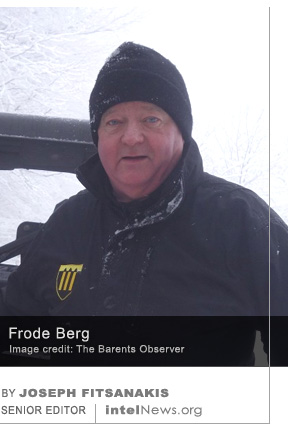
Frode BergAuthorities in Russia have announced the arrest of a Norwegian citizen, whom they accuse of receiving classified information relating to Russia’s Armed Forces. The detainee has been named as Frode Berg, 62, from Kirkenes, a small town in Norway’s far north, located 100 miles from the Russian city of Murmansk. According to articles in the Russian press, Berg is a 24-year veteran of the Office of the Norwegian Border Commissioner, an obscure government agency that operates under Norway’s Ministry of Justice and Public Security. Among other tasks, the Office of the Norwegian Border Commissioner is responsible for enforcing and monitoring bilateral compliance with the Soviet (now Russian)-Norwegian Border Agreement of 1949. Berg, who worked closely with Norway’s National Police Directorate as part of his job, retired from the Office in 2014.


According to reports in the Russian media, Berg was arrested two weeks ago by officers of the Russian Federal Security Service (FSB), the agency responsible for domestic security and counterintelligence. He is now in detention and is accused of receiving classified information relating to the Russian Navy. It is believed that Berg received the classified documents from an unnamed Russian national, who was arrested by the FSB in early December and now faces charges of high treason. No further information has been made public about Berg’s arrest. Relations between Norway and Russia have been tense in recent years, partly due to attempts by the two nations to assert control over undersea territories in the arctic region, which are becoming accessible due to global warming. In 2015, Norway’s state broadcaster accused the FSB of pressuring a Norwegian newspaper, The Barents Observer, to fire one of its journalists who covered fossil fuel exploration in the Arctic Ocean. But the Russian government denied that it has played any role in the journalist’s firing.

Norway’s Ministry of Foreign Affairs said on Tuesday that it had established contact with a Norwegian national who was behind bars in Russia, but did not give the person’s name or further details. Berg’s family in Norway said the last time they had news from him was two weeks ago, when he was holidaying in Moscow. The Russian state prosecutor’s office said that Berg’s lawyers had filed an appeal against his detention, but that the Norwegian would remain in jail until his appeal is heard in court.

Author: Joseph Fitsanakis | Date: 20 December 2017 | Permalink

Finnish reporter destroys computer with hammer to protect spy source

Helsingin SanomatAn investigative journalist in Finland, who recently co-authored an exposé of a Finnish intelligence program targeting Russia, destroyed her computer with a hammer, prompting police to enter her house on Sunday. The journalist, Laura Halminen, co-wrote the exposé with her colleague, Tuomo Pietiläinen. Titled “The Secret Behind the Cliff”, the article appeared in the Saturday edition of the Helsingin Sanomat, Finland’s highest-circulation newspaper. It reveals the existence of a sophisticated electronic interception station in the northern suburbs of Jyväskylä, a city of about 140,000 people that is located in central Finland. Based on classified documents dating as far back as 1999, the article claims that the Finnish intelligence services have operated the top-secret program in Jyväskylä for years. It focuses on monitoring the maneuvers of Russian military units stationed around the St. Petersburg area, allegedly by tracking electromagnetic radiation emissions.

Over the weekend, the Finnish government reacted angrily to the Helsingin Sanomat report, accusing the newspaper of “revealing the content of highly classified documents” that are “critical to the [country’s] security and may cause grave damage to it”. The government, however, argues that the newspaper revealed without proper authorization the contents of classified military documents that were marked TOP SECRET, which is a crime under Finnish law. But the newspaper’s editors argue that the public has a right to know about the surveillance project. The dispute between the newspaper and the government reached new heights on Sunday evening, when a team of police officers arrived at the home of Helsingin Sanomat journalist Laura Halminen. The newspaper claims that the police raided Halminen’s house in connection with the Jyväskylä revelations. According to the Helsingin Sanomat the reporter said she destroyed her computer in order to safeguard information relating to future articles. However, there are some who believe that she destroyed the computer in order to safeguard the identity of the source of the information that led to Saturday’s exposé. However, argues that they intervened only after Halminen destroyed her home computer with a hammer, creating a fire and prompting an emergency response by the fire brigade. Police officers who arrived with the fire brigade called for reinforcements after they began to suspect that Halminen may have been trying to destroy evidence connected with a criminal investigation.

Helsingin Sanomat editors claim that police left Halminen’s house after confiscating the remains of her damaged computer, several mobile phones, an iPad, and over a dozen USB flash drives. The newspaper’s editors said that the raid on the reporter’s home was “uniquely exceptional” in the history of journalism in Finland, and claimed that the police did not present Halminen with a search warrant prior to raiding the premises. But Police authorities argue that Finnish law allows them to conduct warrantless searches for national-security-related cases, and that their actions were observed by an appointed lawyer. The lawyer took possession of all evidence removed from Halminen’s house, to ensure compliance with Finnish law. The government has since said that it will launch a criminal probe to find out the source of the leak to the newspaper.

Author: Joseph Fitsanakis | Date: 19 December 2017 | Permalink
IntelNews thanks AiT, N.H. and A.S. for their help in ensuring the factual accuracy of this report

Poland arrests military intelligence chiefs for ties to Russian spies

PytelAuthorities in Poland have charged three high-level military intelligence officials with acting in the interests of Russia. The three include two former directors of Polish military intelligence and are facing sentences of up to 10 years in prison. The news broke on December 6, when Polish authorities announced the arrest of Piotr Pytel, who was director of Poland’s Military Counterintelligence Service (SKW) from 2014 to 2015. It soon emerged that two more arrests had taken place, that of Pytel’s predecessor, Janusz Nosek, and Krzysztof Dusza, Pytel’s chief of staff during his tenure as SKW director.

According to the newsmagazine Gazeta Polska, which provides extensive coverage of the arrests in its latest issue, the SKW officials are accused of having had unauthorized contacts with Russian intelligence personnel and of “operating on behalf of a foreign intelligence service”. The court indictment reportedly states that the Polish officials “cooperated, without seeking the necessary authorization, with members of the Russian Federal Security Service (FSB)”. The indictment also notes that “the mission of the FSB conflicts with that of the North Atlantic Treaty Organization”, of which Poland is a full member.

According to reports in the Polish media, the three men are accused of having held several undisclosed meetings with FSB officers in Poland. One such meeting allegedly took place in the village of Ułowo, in north-central Poland. The village is located just a few miles from Poland’s border with the Russian exclave of Kaliningrad, which lies between Poland and Lithuania on the Baltic Sea. During the meeting, which included dinner and “heavy consumption of alcohol”, the SKW officials allegedly met with the FSB’s senior representative in Poland, identified in court documents only as “W.J.”, as well as with several other Russian intelligence officers. Following that meeting, Pytel and Dusza allegedly helped falsify the application data of an unnamed representative of the FSB in Poland, who was stationed at Russia’s embassy in Warsaw. This allegedly allowed the Russian intelligence officer to evade diplomatic restrictions on travel and to gain access to information about Poland’s military that he otherwise would not have.

Speaking on Polish state-owned television, Poland’s Defense Minister Antoni Macierewicz said last week that he was aware of the seriousness of the accusation against the three SKW officials. He told the Telewizja Polska station that the three officials face “very serious allegations” that point to “fully conscious and illegal cooperation with Russian spies”. That, said Macierewicz, was the “worst kind of betrayal that can be committed by a Pole”. The three defendants claim that they were not working in the interests of the FSB and that it was their job to meet regularly with Russian intelligence representatives in Poland.

Author: Joseph Fitsanakis | Date: 18 December 2017 | Permalink

Luxembourg to further-probe Jean-Claude Juncker’s role in spy scandal

Jean-Claude JunckerA judge in Luxembourg has launched a criminal investigation into whether officials working for the country’s former Prime Minister and current European Commission President, Jean-Claude Juncker, tried to conceal his role in a spy scandal. Until he stepped down from his post in 2013, Juncker, a member of Luxembourg’s Christian Social People’s Party, was Europe’s longest-serving elected leader, having served as Prime Minister since 1995. His resignation from his post came after a parliamentary inquiry found that the country’s State Intelligence Service (SREL) had engaged in serious criminal activity.

The investigation was launched in 2012, after a local newspaper alleged that SREL’s Director, Marco Mille, employed a surreptitious recording device disguised as a watch to record a private conversation with Juncker. This led to revelations that the SREL had carried out countless illegal wiretaps around the country and that it maintained extensive secret files on over 13,000 citizens and residents of Luxembourg. The report also alleged that SREL set up a front company in order to facilitate the transfer of $10 million from a corrupt Russian businessman to a Spanish intelligence operative, as a personal favor to the Russian. The probe also examined, but did not confirm, allegations that the Grand Duke of Luxembourg had been a trusted informant of MI6, Britain’s Secret Intelligence Service. The release of the report prompted calls for Juncker to resign, because, according to Luxembourg law, the Prime Minister is directly responsible for the conduct of the country’s intelligence services, including SREL.

Now Judge Eric Schammo has launched a new criminal investigation into whether government officials working for Mr. Juncker deliberately falsified crucial evidence during the 2012 parliamentary investigation and the subsequent judicial investigation. Government prosecutors believe that a small group of officials falsified evidence in order to protect Mr. Juncker and shield him from any political fallout caused by the scandal. According to reports, former SREL Director Mille, who is currently on trial over his role in the spy affair, has in its possession a recording of a private conversation with Juncker. It is said that the recorded conversation shows that Juncker was aware of and approved the wiretap operation. This evidence was allegedly shared with members of the parliamentary inquiry in 2012. However, according to reports, pro-Juncker officials deleted it from the committee’s files. Juncker denies having had any knowledge of, or having authorized, SREL’s illegal activities.

Author: Joseph Fitsanakis | Date: 13 December 2017 | Permalink

Russian court sentences Estonian aircraft executive to 12 years for espionage

Raivo SusiA Russian court has sentenced an Estonian aircraft business executive to 12 years at a maximum security prison, allegedly for having spied on Russia a decade ago. Little is known about the case of Raivo Susi, who co-owns two companies that are involved in the sale and maintenance of non-commercial aircraft. The Estonian businessman’s activities include the partial ownership of Aerohooldus OU, which provides training jet aircraft for use by the Air Force of Estonia –a member state of the North Atlantic Treaty Organization (NATO).

Russian media have stated that the Russian Federal Security Service (FSB) began investigating Susi in January of 2016. By that time, the Estonian businessman was not actively engaging in espionage against Russia, but he was still in touch with his spy handlers, according to the Russians. A group of FSB officers arrested Susi at Moscow’s Sheremetyevo airport in February of 2016, as the Estonian businessman was preparing to board a flight from Moscow to the Tajik capital Dushanbe. Since that time, Susi has been held in prison awaiting trial. According to his Russian lawyer, Aleksei Toplygin, Susi faced charges of engaging in espionage against the Russian state from 2004 until 2007. No further information was released about Susi’s activities. His trial, which concluded on Monday in Moscow, was held behind closed doors. It is believed that Susi consistently denied having spied on Russia throughout his trial.

Susi’s espionage case is the latest in a string of spy affairs that have rocked Russian-Estonian relations during the past decade. In 2008, Estonian authorities arrested Herman Simm, a high-level official at the Estonian defense ministry, on charges of spying on behalf of Russian intelligence for nearly 30 years. In 2014, Eston Kohver, a counterintelligence officer in the Estonian Internal Security Service, was allegedly abducted by Russian troops near the Estonian-Russian border. Later that year, the Estonians arrested two Russian citizens, said to be former employees of the Soviet-era KGB, who allegedly crossed into Estonian territory without a permit. In 2015, the Russians exchanged Kohver for Aleksei Dressen, a former Estonian intelligence officer who was jailed in 2012 along with his wife, Viktoria Dressen, for allegedly spying for Russia.

Author: Joseph Fitsanakis | Date: 12 December 2017 | Permalink

Polish counterintelligence chief questioned over alleged deal with Russia

General Piotr PytelThe former director of Poland’s military counterintelligence agency has been questioned by the country’s military police, over allegedly illegal cooperation with Russian intelligence. From 2006 to 2012, General Piotr Pytel was head of Poland’s Military Counterintelligence Service (MCS), which is responsible for domestic security and for ensuring the war-readiness of Poland’s armed forces. According to government prosecutors, General Pytel struck an illegal agreement with the Russian Federal Security Service, the FSB, in 2010. The alleged agreement concerned the return to Poland of troops who had been sent to serve in Afghanistan with the International Security Assistance Force (ISAF). Several hundred Polish troops participated in ISAF, a NATO-led security mission in Afghanistan, established by the United Nations Security Council in 2001.

General Pytel’s critics claim that he reached out to the FSB without authorization, and struck an agreement allowing for the passage of Polish troops through Russian soil on their way back to Poland from Central Asia. Some in the Polish government claim that the passage of Polish troops through Russia allowed the Russian spy services to collect intelligence on the Polish armed forces and thus weakened the Polish military vis-à-vis Russia. Polish authorities also accuse Genera Pytel’s predecessor at the helm of the MCS, General Janusz Nosek, of striking similar agreements with Moscow. These agreements were not authorized by NATO or the Polish high command and thus exceeded the prerogative of the MCS directors, according to prosecutors. The same prosecutors also questioned Donald Tusk, the current President of the European Council, who was Prime Minister of Poland in 2010. Mr. Tusk is also suspected of colluding with the Russian FSB, according to some reports.

But Mr. Tusk, and Generals Pytel and Nosek, deny that they engaged in illegal dealings with Russia and accuse the Polish prosecutor’s office of engaging in a political witch-hunt. All three of the accused belong to the Civil Platform, a liberal political party that is now in opposition but was the ruling party in the country from 2007 to 2015. Members of the Civil Platform have accused the Minister of Defense, Antoni Macierewicz, a member of the ruling conservative Law and Justice party (PiS), of politically persecuting his opponents. In statements made on social media on Wednesday, Mr. Tusk said he was proud to have worked with the two MCS former directors, whom he described “shining example[s] of responsibility, patriotism and honor”. He also called for Minister of Defense Macierewicz to resign.

Author: Joseph Fitsanakis | Date: 6 December 2017 | Permalink

Turkey issues warrant for ex-CIA officer over alleged role in 2016 coup

Recep Tayyip ErdoğanThe Turkish government has issued a warrant for the arrest of a former officer in the United States Central Intelligence Agency, which Ankara claims was instrumental in the failed July 2016 attempt to topple the government of Turkish President Recep Tayyip Erdoğan. The move comes amidst heightened tensions in relations between Ankara and Washington. The two NATO allies have partially revoked entry visas for each other’s citizens, while it is alleged that Michael Flynn, US President Donald Trump’s former national security advisor, had an illegal agreement with Turkey to help abduct a Turkish dissident cleric living in Pennsylvania and help transport him to Turkey.

The warrant was issued on December 1 by the Office of the Chief Public Prosecutor in Istanbul. It seeks the arrest of Graham Fuller, an 80-year-old former analyst in the CIA, who lives in Canada. The warrant identifies Fuller as a “former CIA official” and claims that he attempted to “overthrow the government of the Republic of Turkey” and obstruct “the missions” of the Turkish government. The reference here is to the July 2016 coup, which the Turkish government claims was carried out by the so-called Gülen movement. The Gülen movement consists of supporters of Muslim cleric Fethullah Gülen, who runs a global network of schools, charities and businesses from his home in the United States. The government of Turkey has designated Gülen’s group a terrorist organization and claims that its members have stealthily infiltrated Turkish state institutions since the 1980s. Ever since the failed coup, Ankara has engaged in a controversial campaign to remove so-called Gülenists from prominent posts in government and the private sector. More than 50,000 people have been arrested on terrorism charges and are awaiting trial. Another 150,000 public and private sector employees have been summarily fired from their job.

Many in Turkey accuse the CIA of having colluded with Gülenists to topple Erdoğan’s pro-Islamist government. Fuller is accused of having strong links with Gülen and of having been instrumental in helping the exiled cleric receive permanent residency in the US. Some Turkish media claim that Fuller acted as a “CIA handler” of Gülen, who is accused of being a CIA agent. Fuller’s CIA career involved a tour in Turkey in the 1960s. He concluded his career as a member of the US National Intelligence Council, a body that helps coordinate the US Intelligence Community’s broad and long-term strategic planning. In 1988, Fuller joined the RAND Corporation, a research think-tank with close links to the US Department of Defense. After 2006, he taught history at Simon Fraser University in Vancouver, Canada, where he lives today.

Fuller emailed a statement to major news agencies on Friday, rejecting the Turkish government’s allegations and saying that Ankara was using him as “a choice target”. The former CIA officer said he had not been to Turkey in over five years, and that he had only met Gülen once in 2002 in Istanbul. At that time, said Fuller in his statement, he had been out of the CIA for 15 years. Further on in his statement, Fuller said that he understood why some Turks accused the CIA of having planned the 2016 coup, given the agency’s history of meddling in domestic Turkish politics. However, he said he had nothing to do with the coup attempt, which he described as “pathetic, ill-conceived and amateurish”. The CIA has not commented on Ankara’s allegations.

Author: Joseph Fitsanakis | Date: 04 December 2017 | Permalink

Trump administration allegedly considering plan to privatize CIA operations

Trump CIAThe United States Central Intelligence Agency and the White House are considering several proposals to hire private companies to carry out covert operations abroad, according to a report. BuzzFeed News said on Thursday that the proposals were communicated to the White House in the summer. The news site, which described the proposed plans as “highly unusual”, quoted “three sources who have been briefed on or have direct knowledge of the proposals”. The sources told BuzzFeed that, if approved, the plans would include the establishment of large intelligence networks in so-called “denied areas” —namely foreign environments deemed hostile. The networks would recruit and handle local agents, carry out psychological operations, capture terrorism suspects and rendition them to the US or third countries. “Islamic extremism” is mentioned as the primary target of the proposals.

According to BuzzFeed, one of the proposals involves Amyntor Group, a private company headquartered in the remote town of Whitefish, in northwestern Montana. The company is staffed by former members of the US Intelligence Community who have security clearances. It specializes in intelligence training and risk assessment. But it also collects and analyzes intelligence and provides counterintelligence services for government agencies in America and what it calls “friendly foreign governments” abroad. The company has reportedly been holding discussions with senior officials in the administration of President Donald Trump in recent weeks, according to two of BuzzFeed’s sources. The same sources say that the move toward privatization of some intelligence operations is being led by a feeling in the Trump administration that the CIA has a negative view of the White House. They claim that the CIA is not prepared to go along with the Trump administration’s efforts to make the agency’s operations more aggressive and, in the words of its new director, Mike Pompeo, “much more vicious”. They therefore see privatization as a way to bypass the resistance and skepticism of the CIA’s upper management.

BuzzFeed said it contacted the CIA about the Amyntor Group proposal, but the agency preferred not to comment. A press officer for the National Security Council, which is chaired by President Trump, said that its members were not aware of the privatization proposals. Amyntor Group commented through one of its lawyers, who told BuzzFeed that any contract signed between the company and the US government would be directed and controlled “by the proper government authority”.

Author: Joseph Fitsanakis | Date: 01 December 2017 | Permalink

MI5 releases new information about Soviet ‘Portland Spy Ring’

DocumentFiles released on Monday by the British government reveal new evidence about one of the most prolific Soviet spy rings that operated in the West after World War II, which became known as the Portland Spy Ring. Some of the members of the Portland Spy Ring were Soviet operatives who, at the time of their arrest, posed as citizens of third countries. All were non-official-cover intelligence officers, or NOCs, as they are known in Western intelligence parlance. Their Soviet —and nowadays Russian— equivalents are known as illegals. NOCs are high-level principal agents or officers of an intelligence agency, who operate without official connection to the authorities of the country that employs them. During much of the Cold War, NOCs posed as business executives, students, academics, journalists, or non-profit agency workers. Unlike official-cover officers, who are protected by diplomatic immunity, NOCs have no such protection. If arrested by authorities of their host country, they can be tried and convicted for engaging in espionage.

The existence of the Portland Spy Ring has been known since 1961, when British authorities arrested five people throughout England. Two of them were British citizens, Harry Houghton, a clerk at the Royal Navy’s Underwater Detection Establishment facility in Dorset, England, and his mistress, Ethel Gee. Their Soviet handler was Konon Molody, a Soviet intelligence officer who was posing as a Canadian, under the name Gordon Lonsdale. Also arrested was a married couple from New Zealand, Peter and Helen Kroger. But in reality they were Americans, whose real names were Morris and Lona Cohen, and had worked for Soviet intelligence since the late 1930s. Collectively, the five were referred in media reports as members of the Portland Spy Ring.

The newly declassified files about the spy ring were released by the Security Service, known commonly as MI5, Britain’s primary counterterrorism and counterintelligence agency. They reveal how British authorities managed to bust the Portland Spy Ring. According to the files, the initial tip-off came from the Central Intelligence Agency (CIA). The American agency had managed to recruit Michael Goleniewski, codename SNIPER, a Polish military counterintelligence officer, who led the technical office of Poland’s military intelligence. In the spring of 1960, Goleniewski told the CIA that Polish intelligence were running a British agent who was recruited while serving in the office of the naval attaché at the British embassy in Warsaw. The CIA shared the information with British intelligence, who soon identified the agent as Harry Houghton in Dorset. MI5 agents followed Houghton and his girlfriend, Ethel Gee, as they met with a successful Canadian businessman in London, Gordon Lonsdale (real name Konon Molody). Molody had grown up with a family member in California in the 1930s, and spoke fluent English. He had joined Soviet intelligence during World War II and sent to Britain posing as a Canadian. When he arrived there, in 1954, he established the KGB’s first known illegal residency in the British Isles.

In turn, Molody led MI5 to Peter and Helen Kroger from New Zealand (real names Morris and Lona Cohen), who were posing as antique book dealers. The couple acted as couriers, radio operators and technical support officers for Molody. They were born in the United States and had been recruited by Soviet intelligence in the 1930s. It is now known that they had contacts with several other Soviet illegals in America, including Rudolf Abel (real name William Fisher) who was captured by the Federal Bureau of Investigation in 1957. The couple had left the United States on orders of the KGB in 1952 and reappeared in the United Kingdom using New Zealand passports and new names.

The newly declassified documents show that MI5 decided to move against the five members of the Portland Spy Ring after Goleniewski became an open defector and was exfiltrated to the United States by officers in the CIA’s Berlin station. British authorities feared that Goleniewski’s open defection would prompt the Soviets to pull out Houghton, whose identity was known to Goleniewski. Houghton and Gee were sentenced to 15 years in prison. They were released in 1970, married the following year, and died in the 1980s. Molody was sentenced to 25 years in prison but was released in 1964 and exchanged for Greville Wynne, a British spy captured in the USSR. The Cohens received 20 year sentences, but were released in 1969 and exchanged with Gerald Brooke, a British teacher who was arrested in the USSR for smuggling anti-communist literature and trying to organize dissidents inside the country.

Author: Joseph Fitsanakis | Date: 28 November 2017 | Permalink

Israeli armed raid in Syria reportedly led to US banning laptops on some flights

Ibrahim al-AsiriA temporary ban issued by United States authorities on laptop computers onboard some commercial flights earlier this year came from a tip by Israeli intelligence, according to a new report. The report was published last week in the American magazine Vanity Fair. It claimed that Israeli commandos carried out a dangerous night-time operation deep inside Syria, in order to acquire physical proof that the Islamic State had  built bombs that were not detectable by X-ray screening systems at airports. But some Israeli intelligence officials became infuriated with Donald Trump after the US President allegedly gave Russia background information about the commando operation, according to the article.

The order to temporarily ban electronic devices larger than cellphones was issued by the US government on March 20, 2017. It applied to direct flights to the US departing from a dozen international airports in the Middle East. In June, the New York Times alleged that the ban was aimed at stopping Islamic State operatives from bringing onboard airplanes bombs disguised as laptop batteries. The paper also said that the information about these bombs had been acquired by Israeli government hackers who had penetrated Islamic State computer systems. But now a new report by Vanity Fair claims that Tel Aviv tipped off the Americans following a commando raid deep inside Syrian territory, which acquired physical evidence of the bombs. The magazine alleges that the raid was carried out by the Sayeret Matkal, an elite unit of the Israel Defense Forces, under the supervision of the Mossad, Israel’s external spy agency. Its target was a highly secretive cell of explosives experts, who were led Ibrahim al-Asiri, a Saudi militant who built bombs for the Yemen-based Al-Qaeda in the Arabian Peninsula. The Mossad shared some of the intelligence from that raid with the Central Intelligence Agency, which in turn told President Trump. That led to the decision to ban laptops from selected flights, until X-ray machines at airports were modified to detect the new type of bomb.

The Vanity Fair article repeats earlier claims that President Trump shared intelligence given to him by the Israelis with Russian Foreign Minister Sergei Lavrov and Russian Ambassador to the United States Sergei Kislyak, when he met them in May of this year. According to Israeli sources, Mr. Trump did not tell the Russian officials that Israel was behind the operation. But he allegedly identified the city in Syria where the raid took place, and in doing so placed the life of an Israeli human asset at risk, according to some. The Israeli government will not comment on these allegations. Additionally, Vanity Fair said that one “former Mossad officer with knowledge of the operation and its aftermath” would not say whether the asset in question had been safely exfiltrated from Syria or even whether he or she was still alive.

Author: Joseph Fitsanakis | Date: 27 November 2017 | Permalink

Ukraine, Belarus expel diplomats following espionage claims

Ukrainian embassy in BelarusUkraine fired its deputy-head of foreign intelligence and expelled a Belarussian diplomat a day after the government of Belarus claimed that it busted a Ukrainian spy ring that recruited local agents. The chain of events began on October 25, when the Belarussian Committee for State Security (KGB) arrested a Ukrainian journalist. The journalist, Pavlo Sharoyko, is based in the Belarussian capital Minsk and works as the Belarus correspondent for the National Radio Company of Ukraine —the country’s public broadcaster. Even though Sharoyko was arrested in October, his imprisonment was not publicly announced by Belarus until last Saturday. On Tuesday, November 21, at a press conference held at the KGB headquarters in Minsk, KGB spokesman Dmitry Pobyarzhin told reporters that Sharoyko was arrested for engaging in espionage on behalf of the Ukrainian government.

According to Pobyarzhin, Sharoyko is an undercover intelligence officer masquerading as a journalist. His real employer, said Pobyarzhin, is the Chief Directorate of Intelligence of the Ministry of Defense of Ukraine. While based in Minsk, the Ukrainian radio correspondent allegedly built an extensive network of spies, consisting of Belarussian citizens who carried out espionage tasks in exchange for financial compensation, said Pobyarzhin. The KGB spokesman also claimed that Sharoyko was not officially associated with the Ukrainian embassy in Minsk, but he had a spy handler there. The alleged handler, a Ukrainian diplomat by the name of Ihor Skvortsov, had been confronted by the KGB and expelled from the country for engaging in espionage, said Pobyarzhin.

Late on Tuesday, The Ukrainian Ministry of Defense said that Sharoyko had worked there as a spokesman before 2009, but rejected the charges against him. However, on Monday, a day after Sharoyko’s arrest was announced, Ukraine’s President, Petro Poroshenko, dismissed the deputy director of the country’s Foreign Intelligence Service, V. Sinkevich, from his post. It is not known whether the surprise dismissal is connected to the announcement by the Belarussian KGB. On Tuesday, Kiev announced that it had expelled a Belarussian diplomat from the embassy of Belarus in the Ukrainian capital, in response to the expulsion of Skvortsov the day before. The Ukrainian government did not name the expelled Belarussian diplomat.

Author: Joseph Fitsanakis | Date: 24 November 2017 | Permalink

CIA believed Yugoslavia was on the brink of going nuclear in 1975

Josip Broz TitoThe United States Central Intelligence Agency believed that Yugoslavia was on the brink of becoming a nuclear-armed state in 1975, due partly to assistance from Washington, according to newly declassified documents. The documents, which date from 1957 to 1986, were unearthed by Dr Filip Kovacevic, a Montenegrin expert on American foreign policy who teaches at the University of San Francisco in California. He accessed the documents in October of this year, after filing a Freedom of Information Act request with the CIA in 2016. In response, the spy agency sent Dr Kovacevic eight different files consisting of 84 pages of formerly classified scientific studies, analytical estimates and other reports.

The documents show that the CIA placed the beginning of the Yugoslav nuclear program at the end of World War II. At that time, the multi-ethnic Balkan country became the focus of an intense campaign for influence by the two emerging superpowers, the United States and the Soviet Union. But Yugoslavia’s communist leader, Josip Broz Tito, opted for a policy of nonalignment, refusing to side with Washington or Moscow. It was at that time that Tito began to explore the creation of a nuclear arsenal, which he hoped would enable Yugoslavia to remain independent amidst the pressures of the Cold War. Interestingly, his plans were quietly supported by the US, which invited Yugoslav physicists and engineers to study and conduct research at American universities. Washington also sent teams of geologists to conduct surveys across Yugoslavia in 1952. These and subsequent surveys detected substantial uranium deposits in northern and southern Yugoslavia, which were deemed sufficient to fuel several nuclear bombs. Two decades later, an American manufacturing company, Westinghouse Nuclear, was contracted by Belgrade to build Yugoslavia’s first nuclear power plant in Slovenia.

The papers unearthed by Dr Kovacevic suggest that in 1975 the CIA was convinced that Yugoslavia was technically and financially capable of building an atomic weapon within four years. In a study entitled “Prospects for Further Proliferation of Nuclear Weapons”, the spy agency said that Belgrade had made remarkable technical strides in the area of nuclear research and production in 15 years, partly with America’s support. The only question was whether the Yugoslav leadership would decide to go nuclear, something that the CIA’s analysts warned that it would be difficult to ascertain, as President Tito was unpredictable in his decision-making. Eventually, the Yugoslav leader opted to beef up his country’s conventional forces instead of going nuclear. As Tito’s health worsened in the latter half of the 1970s, ethnic rivalries between competing officials took center stage, and the nuclear weapons question lost its immediacy. Tito died in 1980, and almost immediately the country began to sink under the weight of deepening ethnic tensions.

According to Dr Kovacevic, the CIA documents show that the agency kept close tabs on Yugoslavia’s nuclear ambitions throughout the Cold War. Moreover, CIA analysts appeared to have detailed, accurate and up-to-date information about the Yugoslav nuclear program, on which they based their —broadly accurate— estimates. Crucial pieces of information came from the CIA’s “well-organized network of informants” who were placed “across the country’s institutions” and provided the US with highly dependable intelligence on Tito’s nuclear plans, said Dr Kovacevic.

Author: Joseph Fitsanakis | Date: 23 November 2017 | Permalink