Taliban pose open threat to 70% of Afghanistan, BBC study finds

TalibanThe Taliban have an open and constant presence in 70 percent of Afghanistan, according to an extensive study undertaken by the BBC, which was conducted over several months in every corner of the country. The report comes nearly 17 years after a military coalition led by the United States invaded Afghanistan in response to the attacks of September 11, 2001. Since then, Western forces, most of them members of the North Atlantic Treaty Organization, have spent countless lives and billions of dollars in an effort to defeat the Pashtun-led insurgency of the Taliban. American forces in the country, which at the end of 2009 numbered close to 100,000 troops, were reduced to a force of fewer than 8,000 by 2014, when US President Barack Obama declared the war over.

But the BBC study has found that the Taliban have grown in strength since the US military withdrawal, and are now more powerful than at any time in the past decade. The BBC said that it carried out the study between August and November of 2017, with the help of a large network of reporters who spoke to more than 1,200 local sources. Thousands of interviews were conducted either in person or by telephone with Afghans across the country, and every report of a Taliban-related violent incident was cross-referenced with as many as six other sources, said the BBC. The interviews covered every one of Afghanistan’s 399 districts, using a representative sample from both urban and rural areas.

The findings were described by one expert, Kate Clark, co-director of the Kabul-based Afghanistan Analysts Network, as “shocking”. They show that more than half of Afghanistan’s population resides in areas that are either mostly controlled by the Taliban, or where Taliban forces are openly and regularly active. The group is now in complete control of 14 Afghan districts, which represent 4 percent of the country’s territory. But they maintain an open armed presence in another 263 districts, which represent a further 66 percent of Afghan territory. No open Taliban presence was reported in 122 districts (30 percent of Afghanistan), but the BBC cautioned that many attacks by the Taliban are not reported by the locals. The statistics published in the study show that the Taliban have managed to establish strongholds far beyond their traditional strongholds of southeastern Afghanistan. They are now openly active in much of central, western, and even northern Afghanistan, where their power had been limited in the past.

The BBC reported that the Afghan government dismissed the findings of the study, arguing that its forces are in control of most areas in the country. The US government has not commented on the BBC study. US President Donald Trump said last week that his representatives would not hold talks with the Taliban, and announced that 1,000 more American troops would be sent to the country.

Author: Joseph Fitsanakis | Date: 31 January 2018 | Permalink

China hacked African Union computer servers for five years, report claims

African UnionChinese spies hacked the computer servers of the African Union headquarters in the Ethiopian capital Addis Ababa, which the Chinese government funded and built as a gift to the organization, a French newspaper has claimed. Beijing donated $200 million toward the project and hired the state-owned China State Construction Engineering Corporation to build the tower, which was completed in 2012. Since then, the impressive 330 feet, 19-storey skyscraper, with its reflective glass and brown stone exterior, has become the most recognizable feature of Addis Ababa’s skyline. The majority of the building material used to construct the tower was brought to Ethiopia from China. Beijing even paid for the cost of the furniture used in the impressive-looking building.

However, according to the Paris-based Le Monde Afrique newspaper, African Union technical staff found that the computer servers housed in the organization’s headquarters were secretly communicating with a server facility in Shanghai, China. The secret communications reportedly took place at the same time every night, namely between midnight and 2 in the morning. According to Le Monde Afrique, the African Union servers forwarded data to the servers in Shanghai from 2012, when the building opened its doors, until early 2017.

Interestingly, even though the organization was allegedly notified about the breach by its technical staff in January of 2017, there has been no public reaction on record. However, according to Le Monde Afrique, African Union officials took immediate steps to terminate the breach. These included replacing the Chinese-made servers with new servers purchased with African Union funds, without Beijing’s mediation. Additionally, new encryption was installed on the servers, and a service contract with Ethio Telecom, Ethiopia’s state-owned telecommu- nications service provider, which uses Chinese hardware, has been terminated.

On Monday, China’s Ministry of Foreign Affairs dismissed the French newspaper’s allegations as “baseless” and “complete nonsense”. A statement issued by the ministry said that Beijing would “in no way interfere with the internal policies of African countries or do anything that would hurt their interests”.

Author: Joseph Fitsanakis | Date: 30 January 2018 | Permalink

Dutch spies identified Russian hackers who meddled in 2016 US election

Cozy BearDutch spies identified a notorious Russian hacker group that compromised computer servers belonging to the Democratic Party of the United States and notified American authorities of the attack, according to reports. In 2016, US intelligence agencies determined that a Russian hacker group known as Cozy Bear, or APT29, led a concerted effort to interfere in the US presidential election. The effort, which according to US intelligence agencies was sponsored by the Russian government, involved cyber-attacks against computer systems in the White House and the Department of State, among other targets. It also involved the theft of thousands of emails from computer servers belonging to the Democratic National Committee, which is the governing body of the Democratic Party. The stolen emails were eventually leaked to WikiLeaks, DCLeaks, and other online outlets. Prior descriptions of the Russian hacking in the media have hinted that US intelligence agencies were notified of the Russian cyber-attacks by foreign spy agencies. But there was no mention of where the initial clues came from.


Last Thursday, the Dutch current affairs program Nieuwsuur, which airs daily on Holland’s NPO 2 television, said that the initial tipoff originated from the AIVD, Holland’s General Intelligence and Security Service. On the same day, the Dutch newspaper De Volkskrant published a detailed account of what it described as AIVD’s successful penetration of Cozy Bear. According to these reports, AIVD was able to penetrate Cozy Bear in mid-2014, before the hacker group intensified its campaign against political targets in the US. Citing “six American and Dutch sources who are familiar with the material, but wish to remain anonymous”, De Volkskrant said that the AIVD was able to detect the physical base of the Cozy Bear hackers. The latter appeared to be working out of an academic facility that was adjacent to Moscow’s Red Square. The AIVD team was then able to remotely take control of security camera networks located around the facility. Eventually, the Dutch team hacked into another security camera network located inside the buildings in which the hackers worked. They soon began to collect pictures and footage of Cozy Bear members, which they then compared with photos of “known Russian spies”, according to De Volkskrant.

The paper said that the AIVD team continued to monitor Cozy Bear’s activities until at least 2017, while sharing intelligence with the Central Intelligence Agency and the National Security Agency in the US. The intelligence was allegedly instrumental in alerting US spy agencies about Russian government-sponsored efforts to meddle in the 2016 presidential election. Several newspapers, including The Washington Post in the US and The Independent in Britain, contacted the AIVD and the MIVD —Holland’s military intelligence agency— over the weekend. But the two agencies said they would not comment on reports concerning Cozy Bear.

Author: Joseph Fitsanakis | Date: 29 January 2018 | Research credit: E.J. & E.K. | Permalink

Britain to set up intelligence unit to combat ‘fake news’ by foreign states

Theresa MayThe British government has announced that it will form a new intelligence unit tasked with preventing the spread of so-called “fake news” by foreign states, including Russia. The decision was revealed earlier this week in London by a government spokesman, who said that the new unit will be named “National Security Communications Unit”. The spokesman added that the unit will be responsible for “combating disinformation by state actors and others”. When asked by reporters whether the effort was meant as a response to the phenomenon often described as “fake news”, the spokesman said that it was.

According to The Times newspaper, the proposal for a National Security Communications Unit was presented during a scheduled meeting of the country’s National Security Council earlier this week. It was put forward by its strongest proponent, Sir Mark Sedwill, Britain’s former ambassador to Afghanistan and current national security adviser to the government. The unit will be directly accountable to the Cabinet Office, the government department that is responsible for providing support to the Prime Minister and her Cabinet. It will be staffed with professionals from Britain’s intelligence and security agencies, but will also rely on contributions from external experts in cybersecurity, communications and public relations. The unit will also include a “rapid response unit” that will be tasked with countering “fake news” in real time, according to The Times.

The move follows a similar development in the United States. In December of 2016, the then President Barack Obama signed a new law that designated $160 million to set up a government center for “countering foreign propaganda and disinformation”. The law, entitled “Countering Foreign Propaganda and Disinformation Act”, authorized the departments of State and Defense to work with other federal agencies in establishing the new body. According to a statement by the White House, the goal of the Center would be to collect and analyze “foreign government information warfare efforts” and to “expose and counter foreign information operations” directed against “US national security interests”.

On Wednesday it was announced in London that the British Secretary of Defense, Gavin Williamson, will be providing further details about the National Security Communications Unit in a speech to the House of Commons “within the next few days”.

Author: Joseph Fitsanakis | Date: 25 January 2018 | Permalink

Lebanese media accuses Mossad of assassination attempt in Sidon

Mohammad HamdanMedia reports from Lebanon claim that Israel was behind a bomb explosion that injured an official of the Palestinian group Hamas in the southern Lebanese city of Sidon eight days ago. The official, Mohammad Abu Hamza Hamdan, who is originally from the Gaza Strip, suffered light wounds when his parked car blew up on January 14. Television footage posted online by Lebanon24 from the site of the alleged attack shows smoke coming out of a white BMW car, parked on the courtyard of Hamdan’s home. Reporters at the site said the car belonged to Hamdan and that it had been booby-trapped by unknown assailants. Hamdan was reportedly transported to a nearby hospital, where he received treatment for light wounds.

Reports quoted Lebanese officials who pointed to the fact that the booby-trapped car was parked inside the enclosed courtyard of Hamdan’s home as evidence that the attack was specifically targeted at Hamdan. Others said that the attackers may have originally planned to kill Hamdan’s brother, Osama Hamdan, also from the Gaza Strip, who has served as Hamas’ Lebanon representative for 30 years. Now a new article published by Lebanon’s Al Akhbar newspaper has accused Israel’s Mossad intelligence agency of having orchestrated the assassination attempt. The paper also said that Lebanese security officials had managed to identify the Mossad operatives that carried out the attack. It said they were headed by Ahmed Battiya, a Dutch-born Lebanese man who was recruited by the Mossad in Holland and has participated in prior assassination operations perpetrated by the Israeli spy agency. Al Akhbar said that Battiya had traveled extensively inside Lebanon on behalf of the Mossad, in order to identify Hamas officials and track their movements. The article was published hours after Hassan Nasrallah, leader of the Shiite paramilitary group Hezbollah, also accused Israel of attempting to kill Hamdan.

In Israel, however, government officials appeared to reject claims that the Mossad was behind the attack on Hamdan. The country’s Minister of Defense, Avigdor Liberman, told reporters that the Lebanese media blames Israel for everything that happens in Lebanon, and warned Hamas not to open a “new front against Israel from Lebanon”. Yisrael Katz, Israel’s Minister for Intelligence, said that, if Israel had been involved in the attack against Hamdan, “this wouldn’t have ended with him lightly wounded”.

Author: Joseph Fitsanakis | Date: 22 January 2018 | Permalink

Lebanese spy agency used Android app to spy on thousands, say researchers

GDGS EFF LookoutThe spy agency of Lebanon used a virus designed for the Android mobile operating system to compromise the cell phones of thousands of people in at least 20 countries, according to a new mobile security report. The 50-page report was published on Thursday by a team of researchers from Lookout, a mobile security company, and the Electronic Frontier Foundation in Washington, DC. In an accompanying press release, the researchers said that the virus, which they named Dark Caracal, has been in existence for at least six years. They added that it was traced to a building in Beirut belonging to the General Directorate of General Security (GDGS), Lebanon’s primary external intelligence agency.

According to the Lookout/EFF research team, the trojanized phone application was camouflaged as a secure messaging service, resembling popular applications like Signal or WhatsApp. However, once an Android user downloaded it, it gave remote users access to the compromised phone’s cameras and microphone, thus turning it into a bugging device. The virus also stole email and text messages, pins and passwords, lists of contacts, call logs, photographs, as well as video and audio recordings stored on the compromised device. The report states that compromised devices were found in over 20 countries, including Lebanon, France, Canada, the United States and Germany. The majority of those targeted by the virus were civilian and military officials of foreign governments, defense contractors, and employees of manufacturing companies, financial institutions and utility providers.

On Thursday, Reuters contacted Major General Abbas Ibrahim, who serves as director general of GDGS. He insisted that the GDGS is known for collecting intelligence using human sources, not cyber technologies. “General Security does not have these type[s] of capabilities. We wish we had these capabilities”, General Ibrahim told the news agency.

Author: Joseph Fitsanakis | Date: 19 January 2018 | Permalink

Ex-CIA case officer was arrested after being lured back to US at least once

FBIA former case officer in the Central Intelligence Agency, who was arrested this week for violating the United States Espionage Act, was lured back to America from Hong Kong at least once by counterintelligence investigators, according to reports. Jerry Chun Shing Lee, 53, served in the CIA from 1994 to 2007. He was arrested by Federal Bureau of Investigation officers on Monday, as soon as he arrived in the US from Hong Kong. He is accused of carrying with him top-secret information about CIA agents and operations, which he was not authorized to possess. It now appears that the FBI had been investigating Lee since 2010, and that he was lured to the US in 2012 so that he could be investigated. It is also possible that he was lured back to the US from his home in Hong Kong on Monday, so that he could be arrested by the FBI.

The New York Times said on Wednesday that a consortium of FBI agents and CIA officers identified Lee as a suspect in a counterintelligence case involving the loss of over a dozen CIA assets in China between 2010 and 2012. By that time, Lee had left his job as a case officer —essentially a spy handler— in the CIA and was living in Hong Kong. According to NBC, the FBI decided to lure Lee back to American soil by creating a job for him in the nation’s capital. That was the reason why Lee traveled with his family back to the US in August of 2012. The family stopped in Hawaii, where, according to court documents, the FBI surreptitiously searched Lee’s possessions in a Honolulu hotel. FBI officers also searched Lee’s belongings in a hotel in Virginia a few days later. Lee was found to have with him two notebooks containing “operational notes from asset meetings”, “operational phone numbers” and even “the addresses of CIA covert facilities” —safe houses where CIA case officers meet their assets in privacy.

According to The Times, the FBI confronted Lee five times in subsequent months, but did not inform him that his belongings had been surreptitiously searched or that he had been found to possess classified information without authorization. But the FBI did not press charges against Lee, nor did it prevent him from returning to Hong Kong with his family in the summer of 2013. Instead, it focused on establishing a connection between Lee and the catastrophic loss of CIA assets in China. It was only this week, when Lee returned to the US, that authorities decided to arrest him. The reason why Lee decided to return to the US remains unknown. The possibility that he may have been lured back to the US by the FBI, just as he was in 2012, should not be excluded.

It appears that investigators have not at this point connected Lee with the more serious charge of conveying the classified information to foreign agents. Instead, the former CIA officer is charged simply with possessing top-secret information, but not with communicating it. The charge is believed to be “the same single charge that could have been brought years ago”, namely when Lee was found to be carrying classified information with him in Hawaii.

Author: Joseph Fitsanakis | Date: 18 January 2018 | Permalink

Ex-CIA case officer arrested in New York for violating Espionage Act

CIAA former operations officer in the United States Central Intelligence Agency has been arrested on charges of illegally possessing top secret information, including lists of real names of foreign assets and addresses of CIA safe houses. The news emerged on Tuesday, as the US Department of Justice announced that the Federal Bureau of Investigation had filed a criminal complaint over the weekend. The complaint identifies the former case officer as Jerry Chun Shing Lee, also known as Zhen Cheng Li. Lee, a 53-year-old naturalized American, served in the CIA from 1994 to 2007 “in various overseas positions and locations”, according to court documents. Lee has reportedly been living in Hong Kong since his retirement from the CIA. He was arrested by FBI officers on Monday, as he arrived on a flight that landed at the John F. Kennedy International Airport in New York.

The FBI criminal complaint alleges that Lee kept on his person a number of notebooks that contained classified details of his CIA work. These included the real names of covert CIA personnel and the real names of foreign assets —providers of intelligence information that are recruited by CIA case officers. The notebooks also contained “operational notes from asset meetings” (presumably meetings between Lee and the assets he handled during his CIA career), “operational phone numbers” and even “the addresses of CIA covert facilities” —safe houses where CIA case officers meet their assets in privacy. From the court documents it appears that the FBI has been investigating Lee since at least 2012. In August of that year, the FBI surreptitiously searched Lee’s possessions in a hotel in Hawaii, where he was staying while on holiday with his family. A few days later, FBI officers also searched Lee’s possessions in a hotel in Fairfax, Virginia, and photographed them.

According to The New York Times, Lee’s arrest is connected with reports last May that the Chinese intelligence services had arrested or killed over a dozen CIA assets in China between 2010 and 2012. There is intense speculation that the Chinese acted on information they received from a mole inside a US intelligence agency, possibly the CIA. But the court documents in Lee’s case do not mention any connection to foreign intelligence and do not accuse Lee of sharing classified information with unauthorized users. As of yesterday evening, the CIA was referring all media inquiries to the Department of Justice.

Author: Joseph Fitsanakis | Date: 17 January 2018 | Research Credit: C.B. | Permalink

Syrian rebels visit Washington to request resumption of CIA assistance

Free Syrian Army delegationA delegation of Syrian rebels is currently in Washington to ask that that United States President Donald Trump authorizes the Central Intelligence Agency to resume giving them military assistance. In 2013, the then-US President Barack Obama instructed the CIA to provide covert support to fighters in Syria. The CIA promptly began to assist fighters affiliated with the Free Syrian Army (FSA), whose goal was to topple the regime of Syrian President Bashar al-Assad. Under the project, which was codenamed TIMBER SYCAMORE, CIA personnel trained FSA fighters and gave them light weaponry. But in July of last year, President Trump abruptly terminated the CIA program, which he called “dangerous and wasteful”.

Now the FSA has sent a delegation to Washington to argue that, if the CIA does not help them, Iranian-backed militias will dominate much of Syria. On Monday, the Reuters news agency quoted Mustafa Sejari, a senior representative of the FSA, who said that the Syrian delegation had met with US Congress members and White House officials. This week they were hoping to speak with representatives from the Departments of State and Defense, said Sejari. Members of the delegation, Sejari told Reuters, “asked for the resumption of aid and explained the dangers of leaving moderate FSA forces without support”. He added that, if the US “is serious about challenging growing Iranian influence in Syria” by Hezbollah and other Shiite militias, it should resume its support of the FSA. Sejari also described Mr. Trump’s decision to end TIMBER SYCAMORE as “damaging”. The FSA, he said “endorse[s] President Trump’s statements about the need to confront Iranian hegemony in the region. It is time to turn words into action”. We went on to claim that “until now on the ground it’s the Iranian militias that are expanding without serious resistance”.

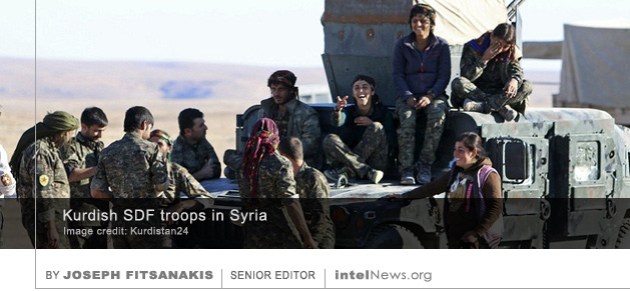
Shortly after President Trump announced his decision to terminate CIA support for the FSA, some experts warned that the move could backfire by causing the suddenly unemployed fighters to join jihadist organizations, if only to secure sources of income. In late August, it was reported that US troops deployed in Syria had exchanged fire with former FSA rebels that were now led by Turkish-trained commanders. In a related development, the government of Turkey dismissed on Monday plans by the US military to train members of the Kurdish Syrian Democratic Forces (SDF) as “terror army” tactics. The US-led coalition in Syria said that it planned to train a 30,000-strong SDF force as a professional army that could maintain control of the territories captured last year from the Islamic State.

Author: Joseph Fitsanakis | Date: 16 January 2018 | Permalink

Russian-trained Serb separatists are forming paramilitary group in Bosnia

Serbian Honor militiaA group of hardline Bosnian Serbs, some of whom have been trained in military tactics by Russian instructors, are secretly creating a paramilitary group to undermine the territorial integrity of Bosnia, according to reports. Information about the alleged paramilitary group was published on the Friday edition of Žurnal, a nonpartisan investigative newsmagazine. The allegations exposed by Žurnal were later repeated by Dragan Mektić, Bosnia and Herzegovina’s Minister for Security, who is himself a Bosnian Serb. Žurnal’s revelations came just days after hardline Serb separatists, dressed in dark-colored combat gear, staged a military-style rally in Banja Luka. The city of 200,000 is the administrative center of the Republika Srpska, the semi-autonomous Serb entity in Bosnia and Herzegovina. The entity was established under the terms of the 1995 Dayton peace agreement, which ended the Bosnian War that began in 1992.

The rally was held despite an earlier decision by the Constitutional Court of Bosnia and Herzegovina, which ruled that military-style marches by separatist organizations were unconstitutional. According to Žurnal, the rally was organized by Srbska čast (Serbian Honor), a militia made up of hardline Serb separatists. The group strongly supports Milorad Dodik, a Serb nationalist who has served as president of Republika Srpska since 2010. The investigative news site said that several members of Srbska čast’s were trained by Russian paramilitary instructors in the Russian-Serbian Humanitarian Center, a Russian-funded disaster relief center based in southern Serbia, which Western officials claim is really an intelligence base. Žurnal also said that one of Srbska čast’s leading figures, Bojan Stojković, a former commando, was trained in military schools in Russia and has been decorated by the Russian military.

Friday’s report by the investigative news outlet quoted extensively from a leaked report by Bosnia and Herzegovnia’s intelligence agency. The report allegedly states that Srbska čast leaders, including Stojković, met secretly with Dodik and discussed the formation of a new, heavily armed paramilitary unit, which will operate as an extrajudicial force in support of Dodik’s administration in Republika Srpska. One quote from the document said that the paramilitary force would engage in “possible intervention if the opposition [i.e. those opposed to Dodik] seeks to obstruct the functioning of the authorities” in the Republika Srpska. Bosnia and Herzegovina has been seeking to join the North Atlantic Treaty Organization since 2006. The country has gone through a series of stages in negotiations with NATO and ratified a membership action plan in 2010. Bosnia’s application is heavily supported by Turkey, NATO’s only predominantly Muslim member state, but is fiercely opposed by Russia and by the Balkan country’s Serb minority.

Author: Joseph Fitsanakis | Date: 15 January 2018 | Permalink

Egyptian branch of ISIS declares war on Hamas as tensions rise in Sinai

Egypt Gaza borderThe Islamic State in Egypt’s Sinai Province has declared war on the Palestinian militant group Hamas, in a move that experts say will furhter-complicate an already volatile security situation in eastern Egypt. Many observers see the group, Wilayat Sinai, as the strongest international arm of the Islamic State of Iraq and Syria (ISIS). Known officially as ISIS – Sinai Province, Wilayat Sinai was behind the 2015 downing of Metrojet Flight 9268, which killed all 224 passengers and crew onboard, most of them Russians. The same group killed 311 people at a Sufi mosque in November of last year, in what has become known as the worst terrorist attack in Egypt’s modern history.

Israeli sources claim that, in the past, Wilayat Sinai has had limited cooperation with Hamas, the militant group that controls the Gaza Strip, a coastal section of the Palestinian territories that borders with Egypt’s Sinai Province. The two organizations are believed to have engaged in limited cross-border arms-smuggling, while some injured Wilayat Sinai fighters have been treated in Gaza Strip hospitals. But the two groups have major ideological differences that contribute to their increasingly tense relationship. The Islamic State objects to participation in democratic elections, which it sees as efforts to place human will above divine law. It has thus condemned Hamas’ decision to participate in the 2006 elections in the Palestinian territories. Additionally, even though it promotes Sunni Islam, Hamas is far less strict in its religious approach than the Islamic State, and does not impose Sharia (Islamic law based on the Quran) in the territory it controls. Furthermore, Hamas suppresses Saudi-inspired Wahhabism and its security forces often arrest ISIS and al-Qaeda sympathizers in the Gaza Strip. In the past month, ISIS accused Hamas of having failed to prevent America’s formal recognition of Jerusalem as the capital of Israel. Additionally, ISIS is opposed to the support that Hamas receives from Iran, a Shiite nation that ISIS regards as heretical.

There are reports that Hamas has been quietly collaborating with Egypt and even Israel in recent months, in order to combat the rise of ISIS in the region. For several months now, the Palestinian group has exercised stricter control over its seven-mile-long border with Egypt. It has rebuilt border barriers that had previously been destroyed and has installed security fences and a digital surveillance system. It has also launched a public-relations effort to shame the families of young men from Gaza who have joined ISIS forces in Sinai. In response to these moves, Wilayat Sinai has publicly urged its supporters to kill members of Hamas and attack the group’s security installations and public buildings. The ISIS-affiliated group has also urged its members to eliminate members of the small Shiite Muslim community in the Gaza strip. According to experts, the decision by Wilayat Sinai to declare war on Hamas means that the group has now virtually surrounded itself with adversaries. The move may also increase informal collaboration between Hamas and the Israeli government, say observers.

Author: Joseph Fitsanakis | Date: 12 January 2018 | Permalink

Tony Blair denies he warned Donald Trump British spies were after him

Tony BlairA spokesman for Tony Blair has dismissed as “categorically absurd” allegations that the former British Prime Minister warned the White House that President Donald Trump was targeted by British spy agencies. The claims are made in the book Fire and Fury: Inside the Trump White House, which is due to be published next week. Its author, Michael Wolf, says he based the information in the book on more than 200 interviews that he held with President Trump and members of his inner circle during the past year.

Wolf alleges that Blair, who was Britain’s prime minister from 1997 to 2007, visited the White House in secret in February of 2017. He allegedly did so as a private citizen, as he has held no public position since 2015, when he stepped down from his post as a Middle East envoy for the United Nations. While at the White House, Blair reportedly met with Jared Kushner, Trump’s son-in-law and senior aide. During that meeting, says Wolf, Blair told Kushner that Trump could have been under surveillance by British intelligence during his presidential election campaign. The former British prime minister allegedly said that any surveillance on Trump would have been carried out by the Government Communications Headquarters (GCHQ), Britain’s signals intelligence agency. Wolf further alleges that the administration of US President Barack Obama never asked London to spy on Trump. Instead, the White House “hinted” that intelligence collection about Trump would be “helpful”, says Wolf. The reason why Blair volunteered this information to Kushner, claims Wolf, was that he was hoping to gain the US president’s trust and be appointed as Washington’s envoy to the Middle East.

Blair’s revelation, which Wolf describes in his book as a “juicy nugget or information”, allegedly “churned and festered” in Trump’s mind. It was the basis for claims made on March 14, 2017, by a Fox News commentator that the GCHQ had spied on Trump on behalf of the White House. The claim was repeated on March 17 at the White House by Sean Spicer, Trump’s then-press secretary, who said that Obama had used the GCHQ to spy on Trump so as to evade American privacy laws. Spicer’s claim prompted an angry response from the British government in London and from the British spy agency itself. In a rare public comment, GCHQ called the allegations “utterly ridiculous”.

Late on Wednesday, a spokeswoman for the office of Tony Blair said in an email that Wolf’s claims in Fire and Fury were “a complete fabrication […], have no basis in reality and are simply untrue”. Last year, another spokesman for Blair dismissed claims that the former British prime minister had lobbied to be appointed Trump’s Middle East envoy. This claim was so “completely overblown” and “so far beyond speculation there isn’t a word for it”, said the spokesman. President Trump has not commented on Wolf’s claim about Blair’s alleged visit and subsequent meeting with Kushner.

Author: Joseph Fitsanakis | Date: 04 January 2018 | Permalink

British spy agency speeds up hiring process to compete with private firms

GCHQThe Government Communications Headquarters (GCHQ), one of Britain’s most powerful intelligence agencies, says it plans to accelerate its vetting process because it is losing top recruits to the private sector. Founded in 1919 and headquartered in Cheltenham, England, the GCHQ is tasked with communications interception. It also provides information assurance to both civilian and military components of the British state. It primarily hires people with technical expertise in communications hardware and software. But in the past fiscal year, the agency fell notably short of its recruitment target, according to a new government report published this week.

The information is included in the annual report of the Intelligence and Security Committee of the British Parliament. According to the document, GCHQ’s recruitment shortfall during the past fiscal year exceeded 22 percent, as the agency hired 500 new staff, 140 short of its initial goal of 640. Because of its mission, the agency must have the “ability to recruit and retain cyber specialists”, says the report. However, GCHQ officials told the parliamentary committee that they “struggle to attract and retain a suitable and sufficient cadre of in-house technical specialists”. The latter are lured away by large hi-tech companies, for two reasons: first, because the salaries are higher; and second, because the hiring process is faster. Due to its security requirements, GCHQ has a lengthy vetting process for all potential employees, which sometimes takes more than a year. In recent times, the process has suffered backlogs, a phenomenon that has negatively impacted on the agency’s ability to recruit top talent.

In response to its recruitment shortfall, GCHQ told the parliamentary committee that it plans to speed up its vetting process by addressing its “lack of security vetting capacity”. In July of 2016, the agency had 51 vetting officers in its ranks. It hopes to raise this number to 110 by the summer of 2018, according to the parliamentary report. This will allow it to clear hiring backlogs by December of next year and thus be able to bettercompete with hi-tech firms in the private sector. Other British intelligence agencies have faced recruitment challenges in recent years. In 2010, the then Director-General of MI5, Jonathan Evans, told the British Parliament’s Intelligence and Security Committee that “some [MI5] staff perhaps aren’t quite the ones that we will want for the future”. He added that the lack of even basic computer skills among MI5’s aging officer ranks have sparked the introduction of a program of “both voluntary and compulsory redundancies”. And in 2016, MI6 said that it would increase its staff size by 40 percent by 2020, reflecting a renewed emphasis in foreign intelligence collection using human sources, which is the primary task of the agency.

Author: Joseph Fitsanakis | Date: 28 December 2017 | Permalink

Analysis: Egyptian Islamist group is emerging as ISIS’ most powerful branch

Wilayat SinaiThrough a series of meticulously planned terrorist strikes and assassinations, Wilayat Sinai has emerged as the strongest international arm of the Islamic State of Iraq and Syria (ISIS), according to some experts. Known officially as ISIS – Sinai Province, Wilayat Sinai claimed responsibility for the October 2015 downing of Metrojet Flight 9268. All 224 passengers and crew, most of them Russians, died when the plane blew up in midair over Egypt’s Sinai Peninsula. The incident marked the worst aviation disaster in Russian history. The same group, Wilayat Sinai, was behind last month’s attack on the Al Rawda Sufi mosque in bir al-Abed, Egypt. The massacre resulted in the deaths of 311 people, making it the worst terrorist attack in the history of modern Egypt.

According to leading Israeli defense and security expert Amos Harel, Wilayat Sinai’s most recent strike demonstrates that, aside from operational expertise, the group also possesses formidable intelligence collection capabilities. In an article published on Tuesday in the Israeli daily Ha’aretz, Harel focuses on the group’s assassination attempt against Egyptian Defense Minister Sedki Sobhy and Interior Minister Magdy Abdel-Ghaffar. The attack took place on December 19 at the Al-Arish military airport in north Sinai. Wilayat Sinai guerrillas fired an antitank missile at a parked Egyptian Air Force helicopter, which had just transported the two ministers to the area. Footage of the attack, released last week by ISIS, shows the helicopter exploding after being hit by the missile. Three people died in the attack, a security guard, a helicopter pilot, and a senior aide to Defense Minister Sobhy. Although neither minister was harmed in the attack, that is not the point, says Harel, and points to the fact that the officials’ trip to northern Sinai was part of a surprise visit, which had not been announced in advance. It seems, therefore, says Harel, “that Wilayat Sinai obtained intelligence information that exposed the minister[s] to attack”.

Interestingly, the group’s membership is not large. American and other Western intelligence sources estimate that its armed nucleus consists of no more than a thousand fighters. However, Wilayat Sinai members have access to advanced weaponry, which is routinely smuggled into Egypt from Libya and the Sudan. It is thus the weaponry, coupled with advanced organization and intelligence capabilities, that makes Wilayat Sinai so dangerous, says Harel. In the past three years, the militant group has killed in excess of 1,500 people in Egypt. But as its attacks become increasingly surgical and sophisticated, Egypt may be forced to respond with increasing firepower, which could further-destabilize the volatile Sinai region. Meanwhile, Israeli security forces are preparing for the possibility of cross-border raids by Wilayat Sinai, warns Harel. The Egyptian-Israeli border region could become the next front in the war against ISIS.

Author: Joseph Fitsanakis | Date: 27 December 2017 | Permalink

Western ex-spooks flock to Emirates to set up new agency modeled after CIA

Abu Dhabi, United Arab EmiratesDozens of Western former spies, most of them Americans, are being hired by the United Arab Emirates, whose ruling family is trying to create a new spy service modeled after the United States Central Intelligence Agency. According to Foreign Policy magazine’s intelligence reporter, Jenna McLaughlin, Western contractors are paid $1000 a day for their services. They also reside for free in five-star hotels in Abu Dhabi, while helping the UAE “create its own spy empire”. The lucrative compensation makes it difficult for former spooks to turn down invitations to join a handful of Western consulting companies, who are leading the effort to create the UAE’s “professional intelligence cadre modeled after the West’s”, says McLaughlin.

Western instructors provide courses daily at two different locations in Abu Dhabi. In-class instruction takes place at a luxurious villa located in Mina Zayed, a port in the northern outskirts of Abu Dhabi. Field training is conducted at a secret facility located about 45 miles from the UAE capital. The facility is referred to as “The Academy” and is highly reminiscent of Camp Peary, a 10,000-acre US Department of Defense training base that is used to train CIA and the Defense Intelligence Agency operations officers. Just like Camp Peary (known informally as “the Farm”), the UAE’s “Academy” features driving course instruction areas, military-style barracks, and gun ranges, among other training elements.

Foreign Policy says it spoke to “six sources with knowledge of the matter” who said that the effort to create a CIA-like agency in the UAE is spearheaded by CAGN Global Ltd., a consultancy company based in Baltimore, MD. The company’s president is Larry Sanchez, a former CIA operations officer, who struck a personal relationship with the UAE’s ruling royal family while working on counterterrorism for the US government in the early 2000s. He has reportedly been living in the UAE for the past six years, helping to build the UAE intelligence services “from the ground up”, says Foreign Policy. At times he has been joined by other high-profile American former ex-spooks, such as Blackwater founder Erik Prince and Richard A. Clarke, who served as National Coordinator for Security, Infrastructure Protection and Counter-terrorism under Presidents George Bush, Sr, and Bill Clinton.

According to McLaughlin, the work of CAGN Global Ltd. came under scrutiny last year, as several US government agencies, including the State Department and the CIA, became concerned that the training of Emirati intelligence recruits was too closely modeled after the training provided at the Farm. But a review of the company’s instructional provision in the UAE concluded in its favor and the issue seems to have been resolved said McLaughlin. In researching its story, Foreign Policy reached out to Sanchez, the CIA, the Department of State, and the UAE embassy in Washington, DC, but received no responses.

Author: Joseph Fitsanakis | Date: 25 December 2017 | Permalink