North Korea is now robbing banks, says US intelligence official

North KoreaComments made by a senior American intelligence official on Tuesday appeared to suggest that the North Korean government was behind an attempt to steal nearly $1 billion from a Bangladeshi bank last year. The heist took place in February of 2016, when a computer malware was used to issue several requests to transfer funds from Bangladesh Bank —the state-owned central bank of Bangladesh— using the SWIFT network. The hackers were able to transfer five separate sums of $101 million each to a linked Bangladesh Bank account at New York’s Federal Reserve Bank. However, when further requests were issued, Federal Reserve Bank employees contacted Bangladesh Bank and blocked further transactions. Eventually, most of the transferred funds, which neared $1 billion, were recovered; but the hackers managed to get away with approximately $81 million worth of funds.

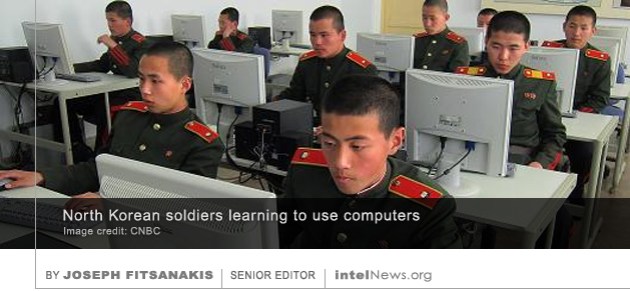
Forensic investigators described the heist as technically advanced. The antivirus company Symantec said it identified a piece of code in the malware that is known to have been used by North Korean government hackers in the past. Not everyone agreed with the claim that Pyongyang was behind the bank heist. But those who did, said that it was unprecedented in scope and aggressiveness. Some even said that the heist showed that North Korea’s cyber capabilities were among the most sophisticated and powerful in the world.

Meanwhile the United States government did not comment on the matter. However, this past Tuesday the deputy director of the National Security Agency appeared to confirm reports that North Korea was behind the Bangladesh Bank heist. Rick Ledgett, a 30-year veteran of the NSA, who is due to retire in 2018, was speaking at a public event hosted by the Aspen Institute in Washington, DC. He reminded the audience that private researchers had connected the malware code used in the Bangladesh Bank heist with that used in previous hacking attempts launched by North Korea. “If that linkage […] is accurate”, said Ledgett, it “means that a nation state is robbing banks”. When asked by the moderator whether he believes that to be the case, Ledgett responded “I do. And that’s a big deal”. Foreign Policy magazine reached out to Ledgett following his talk and asked him for clarification about his comments regarding the Bangladesh Bank heist. But the NSA official simply said that “the public case [about the heist] was well-made”. Foreign Policy also contacted the NSA, but the agency said it preferred not to comment on the matter.

Author: Joseph Fitsanakis | Date: 23 March 2017 | Permalink

Israel’s chief of staff says Hezbollah killed its own commander in Syria

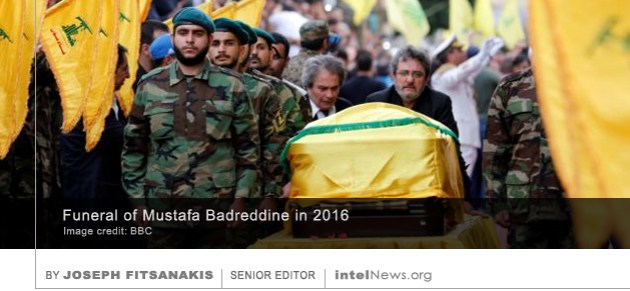
Mustafa Amine BadreddineAn Israeli military official has repeated claims in the Arab media that the Lebanese Shiite group Hezbollah killed its own military commander in Syria, following a dispute with Iran. Mustafa Amine Badreddine, 55, an expert in explosives and former bomb-maker, was a senior military commander in the military wing of Hezbollah. He rose through the ranks of the organization to become a trusted adviser to Hezbollah’s Secretary General, Hassan Nasrallah. In 2011, the Special Tribunal for Lebanon, set up by the United Nations, charged Badreddine with organizing the assassination of Lebanese Prime Minister Rafik Hariri. Hariri was killed with over 20 other people in a massive bomb blast in Beirut, in February of 2005.

Soon after the outbreak of the Syrian Civil War, the leadership of Hezbollah dispatched Badreddine to the Syrian capital Damascus. His stated mission was to command thousands of Hezbollah troops, who fought under Iranian guidance in support of the Syrian President Bashar al-Assad. But on May 13, 2016, Badreddine was reportedly killed in Damascus, causing observers to describe his death as the biggest setback for the Shiite militant group since the 2008 assassination of its leading commander, Imad Mughniyeh. Initial reports in Hezbollah-controlled Lebanese media suggested that Badreddine might have been killed in an Israeli air attack. But a press statement issued later by Hezbollah said the commander had been killed as a result of an armed attack by Sunni rebels. However, on March 8 of this year, the Saudi-owned pan-Arab television network al-Arabiya said it had conducted its own investigation into Badreddine’s death, and had concluded that he was killed by Hezbollah itself. The network claimed that Hezbollah’s Secretary General Nasrallah had ordered Badreddine’s killing, after the Iranians demanded it. Apparently the Iranians wanted him killed because he disputed the authority of Major General Qasem Soleimani, commander of Iran’s Revolutionary Guard Corps, who is often credited with having saved the Syrian government from demise during the Civil War.

The claim that Badreddine was killed by Hezbollah was echoed on Tuesday by Lieutenant General Gadi Eisenkot, Chief of the General Staff of the Israel Defense Forces. Speaking to the Associated Press, Lt Gen Eisenkot said that reports from Arab media that Badreddine was killed by his own forces agreed “with intelligence we have”, referring to the Israeli military. It is worth noting that Israeli officials rarely comment on intelligence operations, including assassination operations, choosing instead to adhere to a “refuse to confirm or deny” policy.

Author: Joseph Fitsanakis | Date: 22 March 2017 | Permalink

US politics in uncharted waters as FBI announces probe into Russian activities

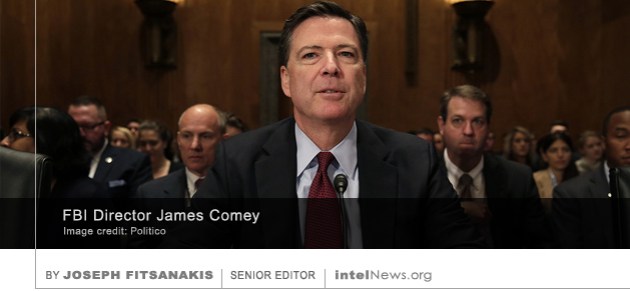
James ComeyMonday’s official announcement that an investigation is underway into alleged Russian involvement in the 2016 United States presidential election was an important moment in American political history. It exposed the chaotic state of American politics and added yet another layer of complexity in an already intricate affair, from which the country’s institutions will find it difficult to recover for years to come. This is regardless of the outcome of the investigation, which is being conducted by the Federal Bureau of Investigation. Even if it fails to produce a ‘smoking gun’, the very fact that the country’s chief counterintelligence agency is examining the possibility that a US president was elected with help from Russia, is an astonishing development without parallel in modern American history.

It is important to recognize that the FBI would never have initiated such a controversial and politically charged investigation without having concrete proof of Russia’s interference in last year’s presidential election. No agency of the US federal government would choose to dedicate enormous resources and personnel, and risk the political fallout that such a probe inevitably entails, without first having amassed indisputable evidence that necessitates it. Moreover, the FBI is not acting alone; its investigation almost certainly encompasses and incorporates similar probes carried out by other American security agencies, and possibly by agencies in allied countries, including the United Kingdom. It follows that the FBI investigation will undoubtedly confirm the existence of a systematic Russian intelligence operation that was aimed at influencing the outcome of last year’s American election.

As the present author has previously stated, it would be “extremely unusual and highly uncharacteristic of Russian spy agencies if they did not launch at least a rudimentary covert campaign to target the 2016 US presidential election […]. Indeed, the opposite would have been strange”. The central question, of course, is: what types of activities were part of the Kremlin’s covert campaign? Did it mostly involve the methodical production and dissemination of so-called ‘fake news’? Did it involve substantial funding of individual candidates or political parties? Or were there perhaps instances of extortion and blackmail of targeted individuals? These questions must be answered in full, and their inherent complexity explains fully why the FBI Director James Comey would not discuss details of the investigation on Monday.

Crucially, the FBI probe will have to answer conclusively the question of whether members of the administration of US President Donald Trump, or indeed the president himself, were implicated in the Kremlin’s actions. Did the president and his senior campaign team know that the Kremlin was —allegedly—assisting their efforts? If so, how did they know? And if not, did they deliberately ignore concrete warnings pointing to the contrary?

Every American, regardless of political persuasion, who genuinely cares about his or her nation’s political stability, hopes that the FBI probe finds no collusion between the Kremlin and the Trump campaign. However, there is an important sense in which, no matter the outcome of the investigation, serious damage has already been done. The reputation of American political institutions as a whole has been severely shaken, and mistrust between American civil society and its political institutions continues to rise exponentially. Meanwhile, it is safe to say that it will take months for the FBI’s probe to conclude. By then, the current chaotic state of American politics could be the a new permanently reality in Washington, a city that has witnessed much tumult in its history, though perhaps never as perplexing as the current crisis.

Author: Joseph Fitsanakis | Date: 21 March 2017 | Permalink

China has 5,000 spies in Taiwan, says official amidst espionage arrests

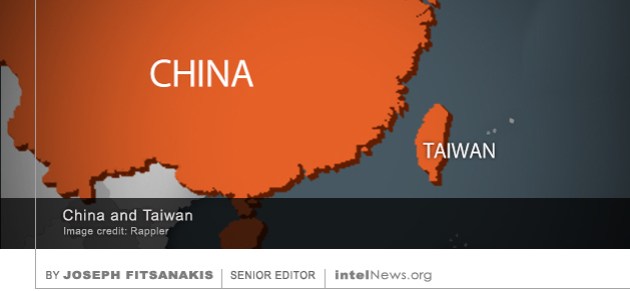
China and TaiwanA Taiwanese government official has alleged that China maintains an army of more than 5,000 spies in Taiwan, many of whom have infiltrated the highest levels of government and industry. The allegation came after two sensational arrests were made in Taiwan last week, of people accused of spying for Beijing. Taiwanese counterintelligence officers reportedly arrested a bodyguard of Annette Lu, Taiwan’s former vice president. The bodyguard, who has been identified in Taiwanese media as Wang Hong-ju, has been charged with receiving payments from his Chinese intelligence handler in return for providing information about Mrs. Lu. This incident followed another arrest, made earlier in the week, this time of a Chinese man who is believed to have initially come to Taiwan as a student. Zhou Hong-xu is accused of trying to recruit officials in the Taiwanese government by offering them money.

Following reports of the arrests, Taiwanese media quoted an official, who spoke on condition of anonymity, as saying that Beijing maintains “about 5,000 individuals” who spy in Taiwan. These agents are allegedly tasked with “collecting state secrets” in the island country, over which China claims ownership. The anonymous Taiwanese official said that authorities in Taipei had uncovered no fewer than 60 espionage plots linked to China since 2002. Less than a third of those were uncovered before 2009, said the official. The year is important, because it marks the time when communications and transportation systems between the two nations were reestablished after decades of mutual isolation. The ease with which people from the two countries can travel in each other’s territory has increased exponentially since 2009. But so have instances of espionage by China, said the Taiwanese official.

Asked about the alleged targets of Chinese espionage in Taiwan, the official said that nearly 80 percent of identified cases of espionage by Beijing’s agents were aimed at military targets, with only 20 percent focusing on the civilian sector. However, the apparent disparity in numbers does not mean that China shows more interest in Taiwanese military secrets. Rather, the Taiwanese military has better counterintelligence defenses and thus a higher detection rate than the country’s civilian sector, said the anonymous source.

Author: Joseph Fitsanakis | Date: 20 March 2017 | Permalink

Russian special forces troops seen in Egypt and Libya, say reports

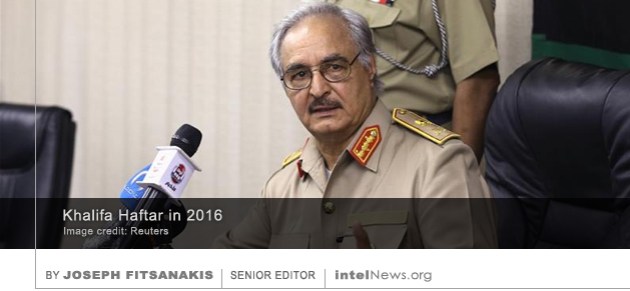
Khalifa HaftarRussia may have become the latest country to deploy special forces soldiers in Libya, according to news reports citing anonymous United States officials. Late on Tuesday, the Reuters news agency reported that Russian special forces troops had been seen on the border between Libya and Egypt. The news agency said that the information came from “two US officials, who spoke on condition of anonymity”. The same article cited unnamed “Egyptian security forces”, who said that a 22-member Russian paramilitary team had set up an operations base in the Egyptian town of Sidi Barrani, which is located 60 miles from Libyan territory.

Libya has descended into a state of complete anarchy since the demise of the country’s dictator, Colonel Muammar Gaddafi. The Libyan strongman was killed in 2011, as a result of a popular uprising backed by Western powers and the North Atlantic Treaty Organization. Arguably the strongest faction in the ongoing Libyan Civil War is the so-called Tobruk-led Government, which is affiliated with the Libyan National Army. The commander of the Libyan National Army is Field Marshal Khalifa Haftar, an old adversary of Colonel Gaddafi, who lived in the US under Washington’s protection for many decades before returning to Libya in 2011 to participate in the war. The Tobruk-led Government is ostensibly supported by the US. However, its military wing, led by Haftar, operates semi-autonomously, and some believe that Haftar has aspirations to lead his own armed faction in Libya. Last November, Haftar visited Moscow, where he met with senior government officials, including Russian Foreign Minister Sergei Lavrov. There are reports that the Russian special forces troops alleged seen in Egypt are operating in support of Haftar.

Earlier this week, a spokesman for the Tobruk-led government told Russian media that Moscow had promised to provide it with funding and military aid. Earlier this year, it was confirmed that a number of Russian private security contractors were in Libya and were providing services to Haftar’s militias. But there are no confirmed reports of the presence of Russian government troops on the ground in Libya. On Tuesday, Moscow denied the Reuters report and accused “certain Western mass media” of “spreading false information from anonymous sources” in order to “smear Russia”.

Author: Joseph Fitsanakis | Date: 16 March 2017 | Permalink

FBI launches criminal investigation into WikiLeaks’ CIA disclosures

WikiLeaksThe United States federal government has launched a criminal investigation into the public disclosure of thousands of documents that purportedly belong to the Central Intelligence Agency. The documents were released on Tuesday by the anti-secrecy website WikiLeaks. They reveal what appear to be technical collection methods used by the CIA to extract information from digital applications and electronic devices, ranging from flash drives to smart screen televisions. WikiLeaks named the collection “Vault 7”, and said that it consists of nearly 8,000 web pages and 1,000 attachments. It also said that its editors redacted hundreds of pages of computer code, in order to prevent the public release of advanced cyberweapons allegedly used by the CIA to sabotage electronic devices and systems.

On Wednesday, former director of the CIA Michael Hayden told the BBC that the disclosure appeared “incredibly damaging”, because it revealed some of the methods that the CIA uses to acquire information. But some cybersecurity experts said that the techniques contained in the leaked documents did not appear to be uniquely advanced, and most focused on exploiting technical vulnerabilities that were generally known. Still, The New York Times reported on Wednesday that the CIA had begun to assess the damage caused by the release. The agency was also trying to contain the extent of the damage, and had even “halt[ed] work on some projects”, said The Times. Officials from the CIA are reportedly in communication with the Federal Bureau of Investigation, which on Wednesday launched a criminal investigation into the “Vault 7” release.

The main purpose of the FBI investigation is to find out how WikiLeaks acquired the files. The website said that the documents were leaked by a CIA contractor, which would imply that they were accessed from a server outside the CIA’s computer network. However, federal investigators are not excluding the possibility that the leaker of the information may be a full-time CIA employee. Reports suggest that the FBI is preparing to conduct hundreds, and possibly thousands, of interviews with individuals who are believed to have had access to the documents that were released by WikiLeaks. Meanwhile, neither the FBI nor the CIA have commented on the authenticity of the information contained in “Vault 7”. WikiLeaks said that Tuesday’s release, which it codenamed “Year Zero”, was the first part of several installments of documents that will be released under its Vault 7 program.

Author: Joseph Fitsanakis | Date: 09 March 2017 | Permalink

Files released by WikiLeaks show advanced CIA technical collection methods

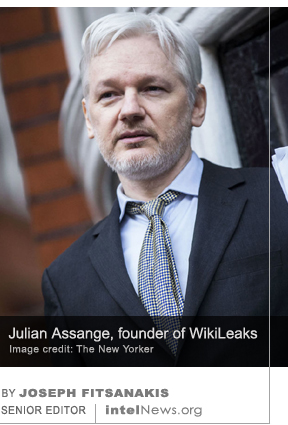
Julian AssangeThousands of documents belonging to the United States Central Intelligence Agency, which were released on Tuesday by the international anti-secrecy website WikiLeaks, are almost certainly genuine. They reveal an entire universe of technical intelligence collection methods used by the CIA to extract information from digital applications and electronic devices, ranging from flash drives to smart screen televisions. WikiLeaks named the collection Vault 7, and said that it consists of nearly 8,000 web pages and 1,000 attachments. It also said that its editors redacted hundreds of pages of computer code, in order to prevent the public release of advanced cyberweapons that are allegedly used by the CIA to sabotage electronic devices and systems.

The information contained in the leaked documents is almost certainly genuine, and most likely belongs to the CIA —though many of the programs listed may be jointly run by the CIA and the National Security Agency (NSA). These programs, with names such as McNUGGET, CRUNCHYLIMESKIES, ELDERPIGGY, ANGERQUAKE and WRECKINGCREW, appear to be designed to compromise computer systems using a series of sophisticated methods that force entry or exploit built-in vulnerabilities or systems. Targets include popular communications systems like Skype and WhatsApp, smartphones produced by Google and Apple, commercial software like PDF and Microsoft Windows, and even so-called smart televisions that connect to the Internet.

The WikiLeaks revelations are most likely related to operations conducted under the auspices of the Special Collection Service (SCS), a joint CIA/NSA program that dates to the earliest days of the Cold War. The program was started by the United States Armed Forces but was eventually transferred to civilian hands and monitored by the CIA. It used advanced communications-interception facilities around the world to collect information. Over the years, the CIA collaborated with the NSA and developed many SCS projects targeting several foreign countries using technical and human means. In recent years the SCS has been primarily operated by the NSA, which oversees the program’s technical platforms.

WikiLeaks did not reveal the source of the documents. But it said that they had been “circulated [by the CIA] among former US government hackers and contractors” and that it was one of the latter that leaked them to the anti-secrecy website. A statement by WikiLeaks said that Tuesday’s release, which it codenamed “Year Zero”, was part one of several installments of documents that will be released under its Vault 7 program. The site also claimed that the information in “Year Zero” has “eclipsed the total number of pages published over the first three years of the Edward Snowden NSA leaks”. The CIA, the NSA and the White House have not commented on this development.

Author: Joseph Fitsanakis | Date: 08 March 2017 | Permalink

Malaysia assassination highlights North Korea’s network of front companies

North KoreaThe sensational assassination of Kim Jong-nam, half-brother of North Korea’s Supreme Leader Kim Jong-un, on February 13, revealed much about the current operational mindset of Pyongyang. But it also brought to light the shady network of front companies set up by the North Korean regime to facilitate the country’s illicit financial activities around the world. This extensive network permits Pyongyang to evade international sanctions against it, and to coordinate the activities of hundreds of clandestine operatives around the world. Through these activities, the reclusive country has been able to develop its weapons of mass destruction program unabated, despite concerted efforts by the United Nations to prevent it from doing so.

Writing for Forbes, Scott Snyder, senior fellow for Korea Studies and director of the program on US-Korea Policy at the Council on Foreign Relations, notes that the UN has for many years employed sanctions to “block international financial and material support for North Korean nuclear and missile development efforts”. But now the UN’s own experts have concluded that Pyongyang has been able to evade these sanctions so skillfully that it has “largely eviscerated the intent and impact of UN sanctions resolutions”. How has it done so? Mostly through a network of countries that routinely turn a blind eye to North Korea’s illicit activities. These include several countries in the Middle East, as well as Singapore, China, Indonesia, and Malaysia. Pyongyang maintains an extensive network of front companies in these countries, says Snyder, with the main purpose of enabling it to evade international sanctions against it.

Malaysia has been a primary hub of North Korean illicit activity. In that, Pyongyang has been crucially assisted by the fact that —until last week— North Korean citizens could travel to Malaysia without entry visas. Malaysia thus provides a useful base for dozens of North Korean front companies, such as Glocom, which ostensibly markets radio communications equipment, or Pan Systems Pyongyang, which just happens to trade in exactly the kind of commercial items that could be described as “dual-use goods” in UN sanctions resolutions. Pan Systems is connected to several Malaysian-based subsidiaries, including International Global Systems and International Golden Services, which, according to investigators, are operated by North Korean intelligence.

Many of these companies also serve as exporting and importing hubs for Pyongyang. In the last five years, several ships have been intercepted while carrying illicit cargo dispatched from North Korea or destined for the reclusive state. In one such instance in 2013, the Jie Shun, a Cambodian-registered ship with a North Korean crew, was found to be carrying over 30,000 rocket propelled grenades hidden under thousands of tons of iron ore. The shipment was intended for an “undisclosed Middle Eastern destination”, says Snyder and was traced to a firm called “Dalian Haoda Petroleum Chemical Company Ltd.”. Many of these mysterious firms are headquartered in China, registered in Hong Kong, but actually work on behalf of North Korea, often using banking facilities in Europe and the United States to conduct financial transactions.

Author: Joseph Fitsanakis | Date: 07 March 2017 | Permalink

Opinion: Trump’s astonishing wiretapping claims deepen volatility of US politics

Trump and ObamaThe absurdity of American politics reached new heights over the weekend, as President Donald Trump dramatically alleged on Twitter that his predecessor, Barack Obama, wiretapped his telephones last year. Even for a highly impulsive public figure known for his sensational and often-unsubstantiated allegations, Mr. Trump’s latest claims prompted a new sense of abnormality and astonishment in Washington. If the president is unable to prove his dramatic claims, his reliability will be further-eroded, and what little is left of his relationship with the American intelligence and national-security communities will disintegrate. If his allegations are proven, they will cause a scandal of unprecedented proportions from which American political institutions —including the presidency— will find it difficult to recover.

Mr. Trump appears to claim that Mr. Obama personally instructed the machinery of government to intercept the telecommunications of his campaign in the run-up to the 2016 US presidential election. But experts —including the present author, whose PhD focuses on government-sponsored wiretapping— correctly note that, barring a complete and systematic breakdown of law and q-quoteorder at the highest levels of the American government, Mr. Trump’s claims cannot possibly be true. American presidents have not been legally allowed to order wiretaps since 1978, when the Foreign Intelligence Surveillance Act (FISA) was established. Prompted by the abuse of executive power revealed through the Watergate scandal, FISA forces government agencies to seek the approval of specially mandated judges before installing wiretaps. If an agency like the Federal Bureau of Investigation (FBI) wants to wiretap an individual or group suspected of acting as agents of a foreign power, it must convince one of 11 federal district judges who rotate on the FISA court that the case warrants a wiretap order. Thus, before authorizing the wiretap, a FISA judge must be convinced by examining the available evidence presented before him or her.

Usually FISA counterintelligence cases involve foreign subjects who are suspected of operating in the US as unregistered agents of a foreign power —that is, spies or handlers of spies. However, if the case proposed by the FBI involves the targeting of American citizens’ communications, then the application for a wiretap must be personally reviewed by the US attorney general. Only if the attorney general approves the application does it get sent to a FISA judge. That is precisely why President Trump’s allegation is so explosive: if Mr. Obama personally directed a law enforcement or intelligence agency to wiretap the Trump campaign’s telecommunications, it would mean that a US president deliberately violated FISA regulations and kept the Department of Justice in the dark while wiretapping the telecommunications of American citizens. Read more of this post

MI6 to revert to old-fashioned ways of recruitment, says director

Alex YoungerBritain’s primary external-intelligence agency will revert to old-fashioned ways of recruiting employees, including the co-called “tap on the shoulder” method, according to its director. Known informally as MI6, the Secret Intelligence Service (SIS) was founded in 1908 to protect Britain’s national security by collecting intelligence from foreign sources. However, the agency has had difficulty recruiting a diverse group of people, and many still view it as a professional destination for a small wealthy elite, drawn primarily from Britain’s most prestigious universities such as Oxford and Cambridge.

MI6 is now trying to diversify the makeup of its employees, according to its director, Alex Younger. Younger, who is known at MI6 as ‘C’, gave an interview to British newspaper The Guardian on Thursday. He did so as the agency he leads prepares to increase its personnel numbers by 40 percent in the next four years. Last year, the British government announced that MI6’s personnel strength would grow from its current size of 2,500 employees to approximately 3,500 by 2020. The reason for the increase, said Younger, is that Britain is facing “more threats than ever before […] from terrorist groups and hostile states”. As a result, “the demands on our services [and] capabilities are on the up”, Younger told The Guardian in his first-ever interview with a national newspaper.

But MI6 would function more efficiently and achieve better results it if had a “more diverse workforce”, said Younger. Therefore, he said, the agency must go out of its way to “draw in a new cadre of black and Asian officers”. In doing so, the spy service would need to reach out to minority communities who are “selecting themselves out” of working for the British intelligence community. Useful in this process are what Younger called “old recruitment techniques”, such as the so-called “tap on the shoulder”. The term refers to the deliberate recruitment of individuals who will be approached by MI6 without having applied for employment with the agency. “We have to go to people that would not have thought of being recruited to MI6”, said Younger, adding that the “tap on the shoulder” method can be redeployed in order to increase diversity among MI6’s workforce and “reflect the society we live in”.

The spy agency is preparing to launch an aggressive recruitment campaign next week, aiming at bringing its overall size to 3,500 —a historic high, according to intelligence observers.

Author: Joseph Fitsanakis | Date: 03 March 2017 | Permalink

Islamic State faces imminent financial collapse, claims new study

ISIS meetingThe Islamic State is facing imminent financial collapse, according to a new study conducted by a London-based research group in association with one of the world’s leading international accounting firms. The recently launched report is entitled Caliphate in Decline: An Estimate of Islamic State’s Financial Fortunes. The analysis that forms the basis of the report was conducted by scholars at the International Center for the Study of Radicalization, a research center that operates out of the Department of War Studies at King’s College in London. The report’s authors were joined by financial analysts at Ernst & Young, a British-based company that is often referred to as one of the world’s ‘big four’ accounting firms.

The report challenges the widely accepted claim that the Islamic State is the wealthiest terrorist organization in history. Its authors argue that the organization’s wealth is connected to its function as “a quasi-state”, with a geographical territory under its control and a subject population that lives in it. Territorial control, say the report’s authors, allows the Islamic State to amass significant revenue from sources like direct and indirect taxation, extraction of natural resources, and confiscation of property from citizens, among others. Even though much of the Islamic State’s financial activity is hidden, the study uses open sources to make the claim that the group’s income in 2014 was close to $2 billion. Last year, however, the overall income amassed from all sources dropped to less than $900 million, an estimated reduction of 45 percent, say the researchers.

The reason for the drop is that the financial revenue model of the Islamic State is directly linked to its territorial control. In comparison to the peak of its power in the spring of 2014, the Islamic State has today lost control of over 60 percent of its territory in Iraq and nearly a third of its territory in neighboring Syria. As coalition forces are beginning to retake Mosul, the Islamic State is facing the potential loss of the caliphate’s commercial capital. These developments will continue to seriously erode the group’s tax base and severely limit its revenue streams. There are no signs, say the researchers, that the Islamic State has been able to devise new forms of revenue streams that are not connected to direct territorial control. However, the authors of the study warn that a potential financial collapse of the Islamic State will not prevent the organization from carrying out terrorist activities in the Middle East and beyond.

Author: Joseph Fitsanakis | Date: 01 March 2017 | Permalink

CCTV footage shows assassination of North Korean leader’s half-brother

Kim Jong-nam murderA Japanese television channel has aired footage showing the alleged assassination of the half-brother of North Korean leader Kim Jong-un, who died in Malaysia on Monday. Investigators believe that Kim Jong-nam, half-brother of North Korea’s supreme leader, and grandson of North Korea’s founder Kim Il-Sung, died after being deliberately poisoned by two women at the Kuala Lumpur International Airport. Shortly prior to his death, he reported that two women approached him at the Kuala Lumpur International Airport and splashed his face with liquid poison —though some reports suggest that he was injected with a poisoned needle. According to Malaysian media, Kim was about to board a flight to Macau, where he had been living in exile since 2007. American and South Korean officials believe that he was killed on orders of the North Korean government in Pyongyang.

The footage —seen here in its entirety— is low quality and appears to have been taken from closed-circuit television (CCTV) cameras at the airport. It was aired by Fuji TV, a Japanese television station based in Tokyo, Japan. The filmed sequence shows a man dressed in blue jeans, dark blue shirt and gray jacket, who closely resembles Kim, heading toward the low-budget departures hall of the Kuala Lumpur International Airport. In subsequent footage he is shown being grabbed from behind by a woman wearing a white long-sleeved shirt, while another woman rapidly approaches him and assaults him from the front. The woman standing behind him appears to quickly put her hands over his face and pull rapidly backwards. The entire attack sequence lasts no more than two seconds, after which both women rapidly walk away. A stunned Kim then hurriedly stumbles away from the scene of the attack, and is seen approaching airport personnel. They direct him to a group of police officers. Another camera shows him trying to describe to the officers the attack that just took place, pointing to his face with his hands. The officers are then seen escorting him to a secure area of the airport.

Fuji TV did not reveal how it acquired the footage, and the connection between it and the death of Kim has not been independently verified or commented on by Malaysian authorities. However, regional observers have confirmed that the airport shown in the footage is indeed the low-budget departures hall of the Kuala Lumpur International Airport. Malaysian authorities have arrested four people, two men and two women, in connection with the attack. One of the men carries a North Korean passport; the other man carries a Malaysian passport, while the two women are in possession of Vietnamese and Indonesian travel documents. Authorities in Kuala Lumpur say they are still looking for four North Korean men who appear to have left the country shortly after the attack on Kim.

Author: Joseph Fitsanakis | Date: 22 February 2017 | Permalink

Indonesia to investigate North Korean restaurant reportedly used as spy base

Pyongyang Restaurant in Jakarta, IndonesiaIndonesian authorities said on Sunday that they will investigate a North Korean restaurant in the country, after a Singaporean news agency claimed it was being used as a center for espionage. The announcement comes amidst heightened tensions between North Korean and its neighbors, following the murder last week in Malaysia of Kim Jong-nam, half-brother of North Korea’s Supreme Leader Kim Jong-il. Kim, the grandson of North Korea’s founder Kim Il-Sung, died after two women approached him at the Kuala Lumpur International Airport and splashed his face with liquid poison. Sources in South Korea and the United States have pointed at Pyongyang as the culprit of the assassination.

On Friday of last week, the Singapore-based news agency Asia One published a lengthy report into alleged North Korean espionage operations in Southeast Asia. The report claimed that North Korean intelligence agencies have operated extensive networks of operatives in Indonesia, Malaysia and Singapore, and that these networks have operated unimpeded for over two decades. The news agency cited an unnamed “intelligence source” as saying that the spy networks are operated by North Korea’s Reconnaissance General Bureau (RGB). The RGB is in charge of special activities abroad, which include covert operations and intelligence collection involving espionage. It operates under the Ministry of State Security and answers directly to North Korea’s supreme leader.

According to Asia One, the RGB maintains some of its largest spy networks abroad in Indonesia, Singapore and Malaysia, where Kim Jong-nam met a gruesome death last week. RGB personnel operating in these countries are North Korean citizens who are employed in the construction sector, as well as the tourism industry. Some operate North Korean restaurants, which are popular tourist attractions across Southeast Asia. The unnamed intelligence source told Asia One that North Korean restaurants serve “as a main front to conduct intelligence gathering and surveillance [against] Japanese and South Korean politicians, diplomats, top corporate figures and businessmen”. The RGB’s network in Indonesia is based in textile factories located in several Indonesian cities, said Asia One. There is also “an apartment located above a North Korean restaurant in [the Indonesian capital] Jakarta that is part of the RGB Indonesia office”, according to the report.

Following the news agency’s allegations, Argo Yuwono, senior commander for the Indonesian National Police, said that an investigation would take place into Asia One’s allegations. He said that his detectives would coordinate their activities with the Indonesian Foreign Ministry before moving ahead with the probe.

Author: Joseph Fitsanakis | Date: 21 February 2017 | Permalink

Turkish diplomats stepping up espionage in Europe, claims German report

Turkish embassy in GermanyTurkish state agencies have asked the country’s diplomats stationed all over Europe to spy on Turkish expatriate communities there, in an effort to identify those opposed to the government, according to a German report. The government of Turkish President Recep Tayyip Erdoğan accuses members of the so-called Gülen movement of orchestrating a military coup in July of last year, which resulted in an armed attack on the country’s parliament and the murder of over 200 people across Turkey. The Gülen movement consists of supporters of Muslim cleric Fethullah Gülen, who runs a global network of schools, charities and businesses from his home in the United States. The government of Turkey has designated Gülen’s group a terrorist organization and claims that its members have stealthily infiltrated state institutions since the 1980s.
According to German newsmagazine Der Spiegel, the Erdoğan government has now tasked its diplomats stationed abroad to engage in intelligence collection targeting alleged Gülen sympathizers. The report cited “a confidential analysis by the Federal Office for the Protection of the Constitution” (BfV), Germany’s counterintelligence agency. The analysis allegedly states that Turkish diplomats are now conducting systematic espionage activities in Germany, Austria, Switzerland, Holland, Belgium, and other Western European countries. The BfV report allegedly claims that much of the espionage conducted by Turkish diplomats is directed by the country’s Religious Affairs Directorate, known as Diyanet. The agency is seen as the institutional guardian of Turkey’s Sunni Muslim orthodoxy. It provides schools with religious education that is carefully tailored to be compatible with the country’s secular constitution, and trains the country’s imams, who are employed by the state. Der Spiegel claimed on Monday that Diyanet has asked its religious representatives stationed in Europe to look for Gülen sympathizers. According to the German newsmagazine, information is now pouring in from Turkey’s embassies and consulates. It includes names of individuals, as well as student groups, cultural organizations, schools and day-care centers that are seen as not sufficiently critical of the Gülen movement. Der Spiegel said it had seen a report sent to Diyanet by the Turkish embassy in Berne, Switzerland, which warned that many Gülenists had left Turkey and were now operating in Switzerland.

Late last summer, Der Spiegel claimed that Turkey’s National Intelligence Organization (known by its Turkish initials, MİT) secretly contacted its German counterpart, the Federal Intelligence Service (BND) and asked for assistance to investigate and arrest supporters of the Gülen movement living in Germany, some of whom are German citizens. The BND reportedly refused to cooperate with the request. Another German news outlet, Die Welt, cited an unnamed German security official who said that the MİT employed more operatives in Germany than the East German spy agency did at the height of the Cold War.

Author: Joseph Fitsanakis | Date: 20 February 2017 | Permalink

Wall Street Journal alleges US spies hide sensitive intelligence from Trump

Donald Trump CIAIn a leading article published on Wednesday, The Wall Street Journal alleged that American intelligence officials are choosing to withhold sensitive intelligence from President Donald Trump, fearing that it might be compromised. The WSJ, America’s leading newspaper by circulation, which is highly influential in conservative circles, cited “current and former officials familiar with the matter”. The paper said it was unclear how much information had been withheld from President Trump. It added that at no point did intelligence officials keep the president in the dark about critical security threats by foreign states or potential terrorist attacks by non-state groups. However, intelligence officials are consciously and systematically withholding information from the White House that concerns “sources and methods”, said the article. The term refers to the precise methods used by the United States Intelligence Community to collect information, as well as the identification of sources —human or otherwise— of the information.

In recent weeks, several media outlets have alleged that American intelligence officials are skeptical about providing the White House with sensitive information. Late last month, Steve Hall, a former member of the Central Intelligence Agency’s Senior Intelligence Service, told National Public Radio that the matter of President Trump’s trustworthiness was “a live question” at the CIA. But this week’s article in The WSJ marks the first time that a conservative media outlet alleges that senior American intelligence officials mistrust the president. According to the New York-based newspaper, the Intelligence Community is uncomfortable with Mr. Trump’s “repeated expressions of admiration” for his Russian counterpart Vladimir Putin. Many intelligence officials are also disturbed by the US president’s public support for the alleged hacking of Democratic Party computer servers by the Kremlin.

Relations between the White House and the Intelligence Community are said to be extremely tense at the moment. On Wednesday, President Trump repeated his previously stated allegation that the US Intelligence Community is systematically leaking information to the media in order to subvert his administration’s work. The WSJ said it spoke to a representative from the Office of the Director of National Intelligence, which heads and oversees the US Intelligence Community. The representative questioned the accuracy of the newspaper’s allegations, saying that “any suggestion that the US intelligence community is withholding information and not providing the best possible intelligence to the president and his national security team is not true”. The report was also denied by an official at the White House, who said that Mr. Trump and his aides had no evidence “that leads us to believe that [The WSJ article] is an accurate account of what is actually happening”.

Author: Joseph Fitsanakis | Date: 17 February 2017 | Permalink