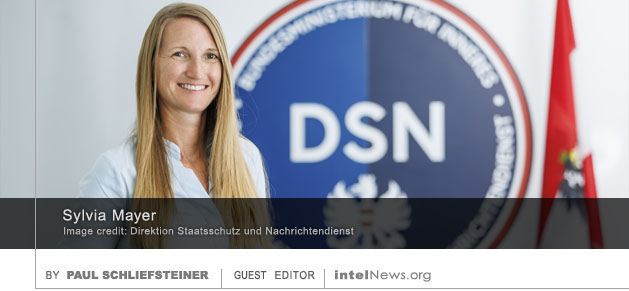
Analysis: Change in sight as Austria appoints its first-ever female spy chief

Sylvia MayerIN LATE NOVEMBER 2025 news broke that the selection for the new director of Austria’s domestic intelligence service, the Direktion Staatsschutz und Nachrichtendienst (Directorate State Protection and Intelligence Service – DSN) had been finalized: the new head of DSN would be Sylvia Mayer, a long time member of the Austrian intelligence community and the DSN’s deputy director for intelligence since October 2023. Mayer, therefore, will become the first female spy chief in Austrian history. She will officially commence her new position on the 1st of January 2026, by which time she will have fulfilled her current role as DSN interim director for several weeks.

During the selection process, Mayer did not simply prevail against her competitors, but virtually dominated the field: not only was she the sole candidate rated “highly suitable”—the highest mark in the application process— but all the remaining eleven applicants—among them two other women—were classified as “not suitable”, the lowest possible category.

Mayer being considered highly qualified by the section committee is not surprising, given her impressive career: after graduating from a higher technical education institute (an Austrian school form that educates teenagers from 15 to around 19 years of age) that focused on information technology—which earned her the title of an engineer—Mayer joined the Austrian uniformed police in Linz, the country’s third largest city.

In 2012, Mayer joined the predecessor of the DSN, the Bundesamt für Verfassungsschutz und Terrorismusbekämpfung (Federal Office for the Protection of the Constitution and Counterterrorism – BVT). Initially tasked with combating extremism, she was soon asked to establish a new unit (Referat in German) for the protection of critical infrastructure, which she consequently began heading in 2013. From 2020 to 2021 Mayer was the interim head of the protection and security department of the BVT. From December 2021 onwards, following the restructuring of the BVT into the DSN, Mayer took over the department of strategy, policy, resources and staff matters (Stabsangelegenheiten in German) within the new agency, before becoming its vice-director for intelligence, as mentioned earlier.

While working full-time, Mayer completed a law degree and doctorate in the same field, which was awarded to her in 2021 by the University of Vienna. According to her official biographical note, Mayer also holds a master’s degree in strategic security management from the University of Applied Sciences Wiener Neustadt.

Mayer is also an accomplished athlete: playing soccer since her teen years, she took part in the Austrian national league and joined the Austrian under-19 female national team. As a young girl she is said to have trained at length with the boys—an experience some have pointed out might have proven helpful for a career in Austria’s male dominated Ministry of Interior and the intelligence world. Over the years, Mayer has emphasized on several occasions that she hopes to inspire other women to also assume leadership roles and demonstrate that they are as capable as their male counterparts. Read more of this post

Former deep-cover spy leads Kremlin’s efforts to woo Indian high-tech sector

Andrei Bezrukov A FORMER DEEP COVER Russian intelligence officer, whose cover was blown in 2010 when he was arrested in the United States, is spearheading efforts by the Kremlin to secure investments by India’s technology sector. The spy, Andrei Bezrukov, was recruited by the Soviet Committee for State Security (KGB) in the late 1970s or early 1980s—most likely alongside his wife, Elena Vavilova. For several years, the married couple lived in several countries, including Canada and France, before arriving in the United States in 1999 using fraudulently obtained Canadian passports.


Posing as Donald Heathfield and Tracey Foley, Bezrukov and Vavilova were among 10 Russian non-official-cover intelligence officers arrested by the Federal Bureau of Investigation (FBI) in June 2010. They were eventually swapped with Moscow for several Western spies held in Russian prisons. After returning to Russia, Bezrukov and Vavilova received the Order “For Merit to the Fatherland” 4th Class, which is Russia’s second-highest state decoration. They also entered state-sponsored employment, with Bezrukov advising the Rosneft Oil Company—Russia’s second-largest corporation—and teaching at the Moscow State Institute of International Relations.

In June 2025, Bezrukov apparently represented the Russian state at the 28th Saint Petersburg International Economic Forum (SPIEF)—often referred to as “Putin’s Davos”. According to the Washington Post, Bezrukov’s apparent role at SPIEF was to network with Forum representatives from India’s advanced technology sector, allegedly on direct orders by the administration of Russian President Vladimir Putin.

The event, which went under the tagline “Shared Values as a Foundation for Growth in a Multipolar World”, gathered nearly 20,000 delegates from 140 countries. The Kremlin touted it as evidence of the West’s failure to isolate Russia following its invasion of Ukraine. It also served as part of a set of broader efforts by the Kremlin to prevent the Russian economy from sliding into a recession by seeking to develop alternative energy markets and strengthening economic and political ties to the Global South.

India is by far the largest of a group of countries seen as “friendly” by Russia, which could potentially help revitalize the Russian economy, largely through the International North–South Transport Corridor (INSTC). The 14-year-old agreement aims to interconnect a transnational transportation network connecting Russia and India with import-export routes in Central Asia the Middle East, and Europe. Experts claim that the INSTC is the logistical backbone of Russia’s efforts to salvage its economy from the growing pressures of the war in Ukraine.

The Post reported that Bezrukov denied that he is still an employee of Russian intelligence agencies when approached and asked about his past by Western journalists.

Author: Joseph Fitsanakis | Date: 08 December 2025 | Permalink

Colombian spy chief claims intelligence-sharing with CIA continues despite dispute

Gustavo PetroIN A RARE MEDIA interview, the chief of Colombia’s National Intelligence Directorate (DNI) has said that his agency’s collaboration with the Central Intelligence Agency (CIA) and other American spy organizations continues unabated. This statement appears to contradict a prior statement by the president of Colombia, who said his country had stopped all intelligence-sharing with the United States in protest against the lethal targeting of civilian vessels in the Caribbean.

The political dispute between the two countries made headlines on November 11, when Colombian President Gustavo Petro (pictured) ordered his government’s intelligence agencies to “suspend intelligence sharing with US intelligence agencies”. The leftist leader made the announcement in response to the targeting of Colombian boats that Washington accuses of involvement in narcotics smuggling in the Caribbean. Two weeks earlier, the White House had personally accused Petro of participating in illicit drug trade activities and imposed sanctions on him and his immediate family.

Two days after the dramatic breakdown in intelligence cooperation between Colombia and the United States, Colombian officials claimed that Bogota would continue to share intelligence with international spy agencies, including those of the United States. Petro’s Minister of the Interior, Armando Benedetti, said that reports about the alleged breakdown in intelligence cooperation between the two countries were due to “a misunderstanding”. He added that Colombia would “continue working […] against drug trafficking and crime with the United States”.

Now the director of the DNI, Jorge Lemus, has told Agence France Presse that his agency’s relationship with the CIA had not been disrupted, despite the high-level political dispute between Colombia and the United States. The CIA “are collaborating a lot, and so are we”, said Lemus. The spy chief added that Colombian counternarcotics forces had destroyed “over 10,000” illicit cocaine labs in 2025 and were continuing operations against drug cartels “together with them [the CIA], hand-in-hand with them. We continue exactly as before […] not only with the CIA, but with all agencies”.

Lemus’ comments are reportedly the first high-level confirmation of Benedetti’s November 13 statement that intelligence cooperation between Colombia and the United States continued unabated despite the political falling-out between the two countries’ leaders.

Author: Joseph Fitsanakis | Date: 01 December 2025 | Permalink

France arrests members of humanitarian charity accused of being a Russian front

SOS DonbassFRENCH AUTHORITIES HAVE ARRESTED three individuals and placed a fourth person under supervision after scrutinizing the operations of a humanitarian organization suspected of being a front for Russian intelligence. The arrests were announced on Tuesday by the General Directorate for Internal Security (DGSI), France’s domestic security agency.

The organization in question was registered at the Pyrénées-Atlantiques prefecture of southwestern France in 2022 under the name “Sud Ouest Solidarité Donbass” (“Solidarity for South-West Donbass). This was abbreviated in the organization’s marketing material as “SOS Donbass”. Its expressed mission is to raise funds in support of civilians in Ukraine’s war-torn region of Donbass, most of which is currently under Russian military control.

The DGSI said it began monitoring the activities of SOS Donbass in early 2025. It claims that members of the organization used the cover of humanitarian work in order to spread Russian propaganda in France on the orders of Moscow. It also claims that they attempted to collect “economic information” from executives of French firms. At least one member of the group participated in a concerted campaign of putting up posters in downtown Paris, bearing the slogan “Russia is not my enemy” (pictured), according to the DGSI.

The director of SOS Donbass, identified in French media reports as “Anna N.”, 40, who was born in Russia but lives in France, was arrested by DGSI on November 17. Another Russian-born member of SOS Donbass, “Vyacheslav B.”, also 40, was arrested on the same day. A third individual, “Vensan B.”, 63, who is French-born and lives in Paris’ northern Seine-Saint-Denis suburb, was arrested the following day. A fourth individual, identified as “Bernard F.”, 58, has been placed under strict supervision and is required to report to the police weekly.

According to France’s Le Parisien newspaper, Anna N. and Vyacheslav B. have been formally charged with “colluding with a foreign power”, “conducting activities to gather information on the interests of the nation for a foreign power” and “actions likely to harm the fundamental interests of the nation”, which carry sentences of up to 10 years.

Author: Ian Allen | Date: 26 November 2025 | Permalink

British spy and his Chinese handler used private jet to escape to China, report claims

Belgrade Nikola Tesla Airport SerbiaA BRITISH MAN WANTED by American authorities for spying for China, who disappeared along with his Chinese handler while under house arrest, may have managed to escape to China using a private jet, a report claims. John Miller, 63, from Tunbridge Wells in the United Kingdom, was arrested alongside his alleged Chinese handler, Cui Guanghai, in April of this year.

At the time of their arrest, the two men were staying at the Hyatt Regency Hotel in Serbian capital Belgrade. Serbian authorities reportedly arrested the men just hours before they were about to board a flight to China. American authorities accuse Mille, who lives permanently in the United States, of attempting to smuggle “sensitive […] military technology” to China, such as drones, air defense systems, and ground-to-air missiles.

The two suspects were jailed while awaiting extradition to the United States, where each faced up to 40 years in prison for violating the United States Arms Export Control Act. A month later, the two suspects were moved out of jail and placed into house arrest in two separate apartments in Belgrade. Both were required to wear electronic ankle bracelets at all time.

However, on August 4, the two men damaged and forcibly removed their surveillance devices. Records show that the devices stopped transmitting their location coordinates between 12:43 and 12:54 a.m. local time. Alarms were automatically triggered, alerting officials at Serbia’s Criminal Sanctions Enforcement Directorate, whose surveillance systems were monitoring the two men.

In less than an hour, however, the two men had arrived at Belgrade’s Nikola Tesla Airport. According to a new report, published last week by the Serbia-based Balkan Investigative Reporting Network (BIRN), the suspects boarded a private Gulfstream G550 jet that was waiting for them at the airport. The report claims that the jet is owned by a Beijing-headquartered firm called Deer Jet. Shortly afterwards, the jet took off for a nine-hour direct flight to the Chinese capital.

Miller and Cui have not been seen since. BIRN said officials from the Serbian government did not respond to calls for comment. British newspaper The Mail on Sunday said it contacted Deer Jet but received no responses. The Department of Justice and the Federal Bureau of Investigation in the United States refused to comment as well.

Author: Joseph Fitsanakis | Date: 10 November 2025 | Permalink

Dutch spy services have restricted intelligence-sharing with the United States: report

Mark Rutte NATO TrumpINTELLIGENCE SERVICES IN THE Netherlands have restricted intelligence-sharing with their United States counterparts due to political developments in Washington, according to two leading Dutch intelligence officials. This development—which may typify Europe’s current approach to transatlantic intelligence-sharing—was confirmed last week by the heads of the Netherlands’ two largest intelligence agencies in a joint interview with De Volkskrant newspaper.

The joint interview was given to De Volkskrant by Erik Akerboom, director of the General Intelligence and Security Service (AIVD), and Peter Reesink , director of the General Intelligence and Security Service (MIVD)—AIVD’s civilian military counterpart.

Both men stressed that inter-agency relations between Dutch and American intelligence organizations remain “excellent”. However, they added that the Netherlands has grown more selective about what it chooses to share with American intelligence agencies—particularly the Central Intelligence Agency and the National Security Agency. “That we sometimes don’t share things anymore, that’s true,” Reesink said, referring to sharing information with American intelligence agencies. Akerboom added: “sometimes you have to think case by case.” He went on to say: “We can’t say what we will or won’t share. But we can say that we are more critical.”

According to the two senior officials, Dutch spies have been intensifying intelligence cooperation and sharing with their European counterparts. This is particularly applicable to a collection of central and northern European intelligence services from countries like Scandinavia, France, Germany, the United Kingdom, and Poland, according to De Volkskrant.

Author: Ian Allen | Date: 20 October 2025 | Permalink

Ashraf Marwan: Israel’s ‘Angel’ or Egypt’s Double Agent?

Ashraf MarwanASHRAF MARWAN, POPULARLY KNOWN “the Angel,” is regarded as one of the greatest spies in Israeli intelligence history—the man on whom the entire Israeli government relied, and the informant who warned of the Yom Kippur War. Long-standing suspicions that he was actually a double agent have been strongly dismissed.

However, a comprehensive investigation by two Israeli journalists, Ronen Bergman and Yuval Robovitz, published in the popular Israeli newspaper Yedioth Ahronoth under the title “The Angel of Lies”, presents a different picture. Based on thousands of secret documents not yet revealed and rare conversations with people involved in the operation, their report claims that ‘the Angel’ was actually the spearhead of Egypt’s deception plan before and during the war—and that he succeeded beyond all expectations.

A Spy or Double Agent?

Bergman and Robovitz examined whether Ashraf Marwan—advisor to Egyptian President Anwar Sadat and a Mossad agent who died in 2007—was truly the best agent Israel had before the Yom Kippur War. Their findings indicate that a series of serious operational failures, combined with arrogance within the Israeli intelligence community, made Marwan one of the most dangerous spies ever to act against Israel.

They also investigated whether he was genuinely an Israeli agent who contributed meaningfully to Israel’s national security, as claimed by Mossad and by scholar Professor Uri Bar-Joseph, who wrote extensively about the Yom Kippur War intelligence failure and authored the well-known book The Angel: The Egyptian Spy Who Saved Israel. Netflix later produced a film, The Angel, based on Bar-Joseph’s book.

Or, was Marwan, as the journalists argue, a double agent working for Egypt from the beginning—since volunteering for Israeli intelligence in 1970—and who managed to deceive Israel for years, particularly by delaying his warning about Egypt’s impending attack until roughly 12 hours before it began? According to Bergman and Robovitz, Marwan knew about Egypt’s plans weeks earlier but withheld that information, allowing Egypt to launch a surprise attack.

A Public Debate

Following the article’s publication, a public debate erupted between Bergman and Robovitz on one side and Professor Uri Bar-Joseph on the other, over Marwan’s true motives. Whether he was a double agent or a loyal Israeli operative, all agree he played a key role in the intelligence drama preceding the Yom Kippur War. Read more of this post

Mossad had ‘some 100 agents’ on the ground in Iran on June 13, Israeli officials claim

Mossad inside IranTHE MOSSAD, ISRAEL’S PRIMARY covert action agency, had “some 100 agents” on the ground in Iran at the start of the Twelve-Day War, according to senior Israeli government officials who participated in a television documentary. The documentary was aired last week on Israel’s Channel 13 television channel. It features interviews with senior Israeli government officials, including Prime Minister Benjamin Netanyahu, Minister of Defense Israel Katz, Minister of Foreign Affairs Gideon Sa’ar, and National Security Adviser Tzachi Hanegbi.

According to the documentary, several new intelligence units focusing on Iran were established across the Israeli military establishment in the summer of 2023, in anticipation of a war with the Islamic Republic. These units acted in coordination with the Mossad in the lead-up to June 13, when Israel launched the opening salvos of the Twelve-Day War. The documentary claims that around 100 Mossad agents were active on the ground in the early hours of June 13. It appears that the term “agents”, as used in the documentary, refers primarily to Iranian Mossad assets, rather than Mossad officers.

Israeli officials describe the Mossad operation as “unprecedented” in scale, as never before had so many operatives been simultaneously activated for a single mission. It was also unprecedented in complexity, because it involved the deployment missile systems, the documentary claims. These systems had been previously smuggled into Iran and were used to destroy Iran’s anti-aircraft installations and ballistic missile launchers. Iranian war planners had not considered the possibility of missile attacks against their military installations originating from within Iran’s borders.

In addition to the Mossad-led component of the operation, members of the Israel Defense Forces were also active outside Israel’s borders that day. According to Brigadier General Gilad Keinan, commander of Israeli Air Forces’ Air Operations Group, Israeli troops were “on the ground somewhere in the Middle East” on the evening of June 13. He did not provide further details.

Author: Joseph Fitsanakis | Date: 22 September 2025 | Permalink

Austrian prosecutors charge ex-intelligence officer accused of spying for Russia

Landesgericht für Strafsachen Wien Vienna Regional Court for Criminal MattersPROSECUTORS IN VIENNA HAVE charged a former intelligence officer with spying for Russia in a high-profile case that has had broad political ramifications in Austria and abroad. The criminal case centers on Egisto Ott, a former employee of Austria’s Federal Office for the Protection of the Constitution and Counterterrorism (BVT). The BVT operated as Austria’s primary domestic intelligence agency from 2002 until its dissolution in 2021.

Ott was first arrested in March 2021, but was soon released after Vienna’s state court ruled that the accused no longer had access to classified information, and was thus not a persistent threat to the state. Ott was arrested again in March 2024 on suspicion of having maintained contact with Russian intelligence officers even following his 2021 arrest and release, and of trying to sell classified information after his release. As intelNews reported a year ago, Ott was released again from pre-trial detention in June 2024, in a decision that raised eyebrows.

Now Ott is facing charges of colluding with an unidentified police officer to “support an intelligence agency” of a foreign country “to the detriment of Austria”, according to the public prosecutor. Ott is also accused of having engaged in bribery, misuse of his office, and of having broken Austria’s Official Secrets Act. Among several instances of engaging in espionage, Ott is accused of having given Russian intelligence an encrypted SINA-workstation laptop of the type used by government employees to access classified information remotely.

Ott and his lawyers have denied he was involved in espionage and have vowed to confront all charges against him in court.

Author: Joseph Fitsanakis | Date: 02 September 2025 | Permalink

Ex-head of Israeli Military Intelligence discusses October 7 attack in leaked recordings

Aharon HalivaIN A SERIES OF leaked recordings, the former head of Israel’s Military Intelligence Directorate, Major General Aharon Haliva, has expressed strong views about Israel’s war in Gaza. General Haliva headed Israel’s Military Intelligence Directorate (known as Aman) on October 7, 2023, when Palestinian militants took Israel by surprise in a combined arms attack, killing over 1,200 and kidnapping 250. Since resigning a year ago, Haliva has not made any public statements.

It is unclear who Haliva was speaking to when he was recorded, or by whom he was recorded. Nor is it clear when or where the recordings occurred. They were leaked last week by Israeli television station Channel 12. There follows a summary of Haliva’s comments in the leaked recordings.

Personal Responsibility. Haliva admits that the disaster occurred during his watch; therefore, he bears ultimate responsibility. At the same time, he emphasizes that responsibility is systemic and broad—not only his, but also that of the entire Israel Defense Forces (IDF), the Israel Security Agency (ISA), and the country’s senior political leadership. He states: “Anyone who voluntarily assumes a leadership position knows that his decisions will bring both great successes and great failures”.

Systemic and Cultural Failures. Haliva argues that the failure originates from a long-standing organizational culture within the Aman, rooted in arrogance, overconfidence, and the belief that “the enemy is deterred”, as well as the idea that Israel’s intelligence is all-powerful. This mindset led to operational stand-downs during Sabbaths, holidays, and in the month of August, reflecting overconfidence. He warns: “This was not a one-time accident, but something that requires dismantling and rebuilding the system”.

Responsibility of Other Bodies. Haliva points to the ISA as the agency that should have provided human intelligence alerts on the evening of October 6 and the early hours of October 7, 2023, but did not. He criticizes the government and the cabinet for not holding serious, in-depth discussions on Gaza, while for years allowing Hamas to grow stronger with the help of Qatari money and by dividing Gaza from the West Bank.

The Political Leadership and Benjamin Netanyahu. Haliva describes Netanyahu as “a very attentive man, who reads, but is very cowardly—and in the test of results, he failed”. He emphasizes that Israel’s political leadership made decisions that strengthened Hamas and hindered proper preparedness. His conclusion: “In such a biblical-scale disaster, responsibility lies with everyone—they should all step down”. Read more of this post

Soldier with far-right links becomes first convicted spy in New Zealand history

New Zealand ChristchurchA DISAFFECTED SOLDIER, WHO tried to commit espionage against New Zealand for a foreign government, has become the first convicted spy in the Pacific Island nation’s history. The only other time New Zealand prosecuted an individual for espionage was in 1974, when the government accused Bill Sutch, a prominent, English-born civil servant, of spying for the Soviet Union. Sutch was acquitted in 1975 and died soon afterwards.

According to reports, a member of the New Zealand Defence Force, who has not been named, drew the attention of the authorities in the aftermath of the 2019 Christchurch shooting. The attack was carried out by Australian white supremacist Brenton Tarrant, who stormed a mosque with an automatic weapon, killing 51 and injuring nearly 100 people. The terrorist attack sparked a widespread investigation into far-right militancy in the Australian and New Zealand armed forces, which continues to this day.

The soldier was found to have contacts with a number of local far-right groups, including the Dominion Movement and Action Zealandia. Government prosecutors said that, while observing the soldier’s activities, government agents found out that he had “made contact with a third party, indicating that he was a soldier” and signaling his desire to defect to a foreign country. They eventually approached the soldier using an undercover officer who pretended to be a representative of the country whose officials the soldier had previously contacted. The soldier told the undercover officer that he was prepared to “get a covert device into army headquarters” and offered to provide “mapping and photographs” of classified government facilities.

During his trial, the soldier pled guilty, admitting that he had tied to spy for a foreign government, and adding that his ultimate goal was to “leave New Zealand and get to what I thought was safety”. Following the soldier’s conviction, the three-judge military panel said it would announce the sentence later this week. The country for which the convicted soldier offered to spy has not been named.

Author: Joseph Fitsanakis | Date: 18 August 2025 | Permalink

Israeli intelligence using Microsoft servers to store intercepted phone call data

Microsoft ISRAELI INTELLIGENCE IS USING Microsoft’s cloud service to store recordings and metadata from millions of intercepted telephone conversations placed by residents of Gaza and the West Bank, according to a new investigation. The investigation was jointly conducted by British newspaper The Guardian and Israeli weekly magazine Sikha Mekomit (Local Call), which published it last week.

Citing conversation with 11 sources from Microsoft and within Israel, the investigation reveals that Israel Defense Forces (IDF) Unit 8200 is the primary force behind the interception and data storage project. Operating under Aman, Israel’s military intelligence directorate, Unit 8200 is responsible for collecting signals intelligence (SIGINT), cyber warfare, and code decryption, among other tasks.

Israeli security sources cited in the report explain that the commander of Unit 8200, Brigadier General Yossi Sriel, approached Microsoft because the Israeli intelligence unit lacked enough storage space and processing power to store “billions of files”. General Sriel has led a large-budget project that has significantly expanded the scope of information-gathering on Palestinians and has integrated various databases.

In November 2021, an meeting, described in the report as “extraordinary”, took place at Microsoft’s headquarters in Seattle, Washington. On one side were Microsoft Chief Operating Officer, Satya Nadella, and other company executives, while on the other side were General Sriel and other senior officials of Unit 8200. The agenda centered on a plan, promoted by Sriel, to transfer intelligence information held by the Unit to the computing giant’s servers. According to an internal Microsoft document, which was leaked by The Guardian, Sriel requested the transfer to Microsoft’s cloud of 70% of the unit’s data, including “secret and top secret” data.

The meeting allegedly led to the development of one of the world’s most invasive surveillance systems, which has been employed by Israel to monitor Palestinians in Gaza and the West Bank. According to documents cited by The Guardian, as of July this year, 11,500 terabytes of Israeli military data—equivalent to 862 billion documents or 195 million hours of audio—were stored on Microsoft Azure public cloud servers in the Netherlands. A smaller portion of the data was stored in Ireland and Israel. Read more of this post

Russian hacker group using Internet service providers to spy on foreign embassies

Hacking cyber - JFA HACKER GROUP LINKED to Russia’s Federal Security Service (FSB) has compromised Russia’s domestic internet infrastructure and is using it to target foreign diplomats stationed in Russia. According to a report, published last week by Microsoft Threat Intelligence, the hacker group behind this operation is Turla, also known as Snake, Venomous Bear, Group 88, Waterbug, and Secret Blizzard. Analysts have linked the group with “some of the most innovative hacking feats in the history of cyberespionage”.

Turla began its attempt to compromise a host of Russian internet service providers in February, according to Microsoft’s report. The group’s apparent goal has been to gain access to the software that enables Russian security agencies to legally intercept internet traffic, following the issuance of warrants by judges. This software is governed by Russia’s System for Operative Investigative Activities (SORM), which became law in 1995, under the presidency of Boris Yeltsin. All local, state, and federal government agencies in Russia use the SORM system to facilitate court-authorized telecommunications surveillance.

According to Microsoft, targeted Internet users receive an error message prompting them to update their browser’s cryptographic certificate. Consent by the user results in the targeted computer downloading and installing a malware. Termed ApolloShadow by Microsoft, the malware is disguised as a security update from Kaspersky, Russia’s most widely known antivirus software provider. Once installed the malware gives the hackers access to the content of the targeted user’s secure communications.

The Microsoft report states that, although Turla has been involved in prior attacks against diplomatic targets in Russia and abroad, this is the first time that the hacker group has been confirmed to have the capability to attack its targets at the Internet Service Provider (ISP) level. In doing so, Turla has been able to incorporate Russia’s domestic telecommunications infrastructure into its attack tool-kit, the report states. The report does not name the diplomatic facilities or the countries whose diplomats have been targeted by Turla hackers. But it warns that all “diplomatic personnel using local [internet service providers] or telecommunications services in Russia are highly likely targets” of the group.

Author: Joseph Fitsanakis | Date: 02 August 2025 | Permalink

Hackers breach website used by US intelligence community to solicit vendor contracts

NRO - IAHACKERS HAVE COMPROMISED A website used by the United States Intelligence Community (IC) to solicit sensitive contracts from the private sector, according to a new report. The target of the attack, and the methods used by the hackers, appear to point with a high degree of certainty to a state actor.

The website in question belongs to the Acquisition Research Center (ARC), an initiative of the US government’s Acquisition Center of Excellence. Even though the ARC solicits contracts on behalf of the entire US IC, its public-facing website is maintained by the National Reconnaissance Office (NRO), which last week notified several companies affected by the breach.

The ARC online interface is designed for companies in the private sector who want to register as government vendors in the national security space. Once they register through the ARC system, these companies can pitch a variety of intelligence agencies with a particular technology or idea. Recent projects solicited through the ARC system have involved communications interception systems, artificial intelligence-powered data collection or analysis tools, predictive technologies, signature-reduction systems, or various tools used in physical surveillance.

It is believed that the hackers targeted the unclassified portion of the ARC website, seeking personal information about vendors, as well as proprietary intellectual property. An NRO spokesperson told The Washington Times that the breach was being looked at by federal law enforcement but declined to provide further information about what he described as an “ongoing investigation”.

Author: Ian Allen | Date: 28 July 2025 | Permalink

Senior Mossad veteran discusses recruitment of Iranian assets in rare interview

Mossad - ABTHE MOSSAD, ISRAEL’S PRIMARY foreign-intelligence agency, played a crucial role in Israel’s most recent attack on Iran. It is clear that, without unique intelligence on key Iranian figures and nuclear sites, much of it gathered by the Mossad, the Israeli Air Force could not have been so precise and deadly against Iranian targets.

It is a rare occasion to hear directly from a senior veteran of the Mossad. Oded Eilam (or Ailam), now 71, served in the Mossad for 24 years. In an interview with the German newspaper Bild, Eilam described the strategy that allowed the Israeli intelligence agency to successfully recruit and maintain an “extensive network” of spies inside Iran.

According to Eilam, the key to the Mossad’s success lies in Iran’s complex social structure. “Only 40% of [Iran’s] population of 90 million are Persians,” Eilam said, explaining that the ethnic divide makes it difficult for the Iranian government to control the population. “The [Iranian government’s] surveillance system has huge gaps; you can’t compare it to what the Stasi did in East Germany,” he added.

The former Mossad official explained that various ethnic groups inside Iran, such as Kurds, Turkmen, Baluchis, and Azeris, make up a potential pool for recruiting agents. According to Eilam, the motivation for cooperating with the Mossad is not necessarily support for Israel or financial reward, but often stems from dissatisfaction with the Iranian regime.

“Many people in Iran are unhappy. Large parts of society live in poverty,” explained Eilam. “While Iran has significant gas reserves, instead of investing this money in their country, the clerics have funneled billions into terrorist organizations like Hezbollah,” he added. Another factor that helps Mossad’s activities, according to Eilam, is Iran’s long territorial borders and the difficulty of monitoring them thoroughly. “This makes it possible to smuggle everything into the country,” he noted.

Eilam also emphasized the Mossad’s commitment to safeguarding its assets. “When someone works for us, we take care not only of them but also of their family,” he said, clarifying that the Mossad is dedicated to bringing its spies and their families to safety if needed. Although there are many opportunities to recruit agents in Iran, the Mossad is not in a rush. Eilam highlighted that the organization spends a significant amount of time on the process of selecting and screening candidates. “When we are looking for agents, we don’t just choose someone; we take a lot of time to ensure that the person is suitable.”

“When someone works for us,” the former officer noted, “the importance the Mossad attaches to verifying information. For a target, we do not use information from just one agent, but always multiple sources to be sure that the right person is hit,” said Eilam, also hinting at the extensive vetting processes the organization conducts before operational actions.

Eilam’s interview is a unique source of insight into the espionage operations of the Mossad. It is unclear why it was published—possibly to warn the Iranians to think twice before taking any offensive actions against Israel.

Author: Dr. Avner Barnea* | Date: 22 July 2025 | Permalink

Dr. Avner Barnea is a research fellow at the National Security Studies Center of the University of Haifa in Israel. He served as a senior officer in the Israel Security Agency (ISA). He is the author of We Never Expected That: A Comparative Study of Failures in National and Business Intelligence (Lexington Books, 2021).