Sophisticated spy malware found on Russian government computers

FSB - IAAccording to the predominant media narrative, the United States is constantly defending itself against cyber-attacks from countries like China and Russia. But, as intelNews has argued for years, this narrative is misleading. Recent intelligence disclosures clearly show that the US cyber-security posture is as offensive as that of its major adversaries. Additionally, China and Russia have to defend their computer networks as much as America does. Last weekend’s report from Moscow helps restore some of the balance that is missing from media reporting on cyber-security. According to the Russian Federal Security Service (FSB), a meticulously coded and sophisticated virus has been found on the computer networks of at least 20 major Russian agencies and organizations. The targets appear to have been carefully selected by the malware’s authors. They include government bodies, weapons laboratories and defense contractors located throughout Russia.

The FSB said that once installed, the virus gave its handler control of the infected computer system. It permitted an outside hacker to turn on a computer’s microphone or camera, and capture screenshots. It also stealthily installed keylogging software, thus allowing an outside party to monitor keyboard strokes on an infected system. Based on its functions, the malicious software seems to be designed to conduct deep surveillance on infected computers and their physical surroundings. The FSB would not attribute the malware to a specific hacking group or nation. But it said it believed that the malware attack was “coordinated”, “planned and planned professionally”. It also said that the coding of the virus “required considerable expertise”. In a brief statement released Saturday, the FSB said that aspects of the coding of the virus, as well as other identifying information, resembled those detected in preceding hacking attacks on computer servers in Russia and other countries. The statement did not elaborate, however.

The news about hacked Russian computers comes less than two weeks after it was claimed that Russian government-backed hackers stole electronic data belonging to the Democratic National Convention (DNC) in the United States. The Democratic Party’s presidential candidate, Hillary Clinton, publicly accused the Russian government of orchestrating the hacking of the DNC computer systems in an attempt to damage her campaign.

Author: Ian Allen | Date: 01 August 2016 | Permalink

Countries using Eastern Europe to flood Syria with weapons, study finds

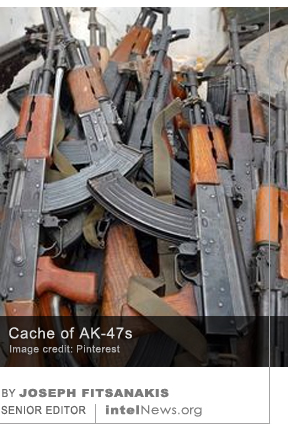
AK-47Unprecedented quantities of weapons and ammunition worth in nearly $1.5 billion have been procured from Eastern Europe and sent to Syria to arm nearly every side in the ongoing civil war, a study has found. The weapons are transported through the Balkans and sold legally to countries bordering Syria, including Jordan, Saudi Arabia and Turkey. Once there, they are secretly transported to Syria for use in the bloody five-year civil war, which has so far killed or displaced millions. The revelation resulted from a year-long investigative project by the Serbia-based Balkan Investigative Reporting Network (BIRN) in the Organised Crime and Corruption Reporting Project (OCCRP) in Bosnia.

The probe found that the weapons transferred to the Middle East include heavy machine guns, rocket and mortar launchers and shells, anti-tank weapons, as well as thousands of assault rifles and rounds of ammunition. Many originate from Ukraine, Belarus and the former Yugoslavia and are procured by companies in eight Eastern European countries including Bulgaria, Slovakia, Romania, the Czech Republic, Montenegro, and Bosnia. The governments of these countries give the companies permission to sell weapons to Middle Eastern countries, even though it is informally understood that they will eventually end up in Syria, in contravention of international agreements.

Investigators say the smuggled weapons have been traced to various factions fighting in Syria, primarily the Free Syrian Army, which is fighting against the government of Syrian President Bashar al-Assad. But many have ended up in the hands of Islamist militias, including the Islamic State, Ansar al-Islam, and the group formerly known as Jabhat al-Nusra. Some of the weapons have also surfaced in Yemen, in the hands of Sunni fighters there. According to the probe’s findings, Middle Eastern countries like Turkey, Jordan or Saudi Arabia, whose militaries use Western-made weaponry, were never large purchasers of Eastern European weapons. But that quickly changed in 2012, as the Syrian Civil War picked up pace.

According to British newspaper The Guardian, which published some of the findings of the BIRN-OCCRP report, the United States has used this weapons-smuggling channel as a way to arm Syrian opposition forces. The study found that, since December of last year, the US military’s Joint Special Operations Command has commissioned at least three cargo ships that left ports in the Black Sea for the Middle East carrying weapons for Syria. Regular intelNews readers will remember a report from November 2013, according to which the Greek authorities seized a ship that had left Ukraine heading for Syria or Libya, carrying 20,000 AK-47s, as well as explosives and ammunition. Two years later, in November 2015, we reported on allegations that Ukraine may be secretly arming the Islamic State in an effort to impair its regional foe, Russia.

Author: Joseph Fitsanakis | Date: 29 July 2016 | Permalink
Turkish media accuse US general, CIA, of plotting coup

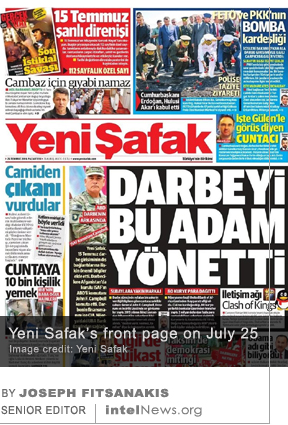
Yeni Şafak’sAmerican officials have strongly denied accusations in the Turkish press that Washington was behind the failed July 15 coup in Turkey. On July 25, Yeni Şafak, a popular Turkish daily, alleged that the failed coup had been funded and organized by the United States government. The newspaper, which is headquartered in Istanbul, is known for its conservative political stance and close links to the AKP, the party of Turkish President Recep Tayyip Erdoğan. Its editorials typically reflect the AKP’s position on the political affairs of the day.

In its leading article on Monday, Yeni Şafak cited “senior government officials” in claiming that the CIA had organized the plotters behind the July 25 military putsch. It also fingered retired US Army General John F. Campbell as the principal intermediary between the CIA and the coup plotters in the Turkish military. Born in 1957, General Campbell served as the US Army’s Vice Chief of Staff until 2014, when he assumed the command of all US armed forces in Afghanistan. Upon his retirement, in 2016, he stepped down from that post as the last commander of the International Security Assistance Force in the Central Asian country. Yeni Şafak’s July 25 front-page headline read: “This man led the coup”, next to a photograph of General Campbell. In the corresponding article, the retired American General was accused of having “organized and managed the soldiers” behind the coup, and having handled “at least $2 billion” in CIA funds, which he allegedly distributed to the coup plotters via the Nigeria-based United Bank for Africa (UBA).

But in a statement issued on Tuesday, UBA called Yeni Şafak’s allegations spurious and insisted it had “no involvement with, or connection to” the July 15 coup attempt in Turkey. Speaking to The Wall Street Journal, General Campbell also dismissed the allegations against him as “absolutely ridiculous”, adding that they “don’t even warrant a response”. On the same day, the Chairman of the US Joint Chiefs of Staff, General Joseph Dunford, described the Turkish newspaper’s article as “absurd”. Speaking at a press conference held jointly with US Defense Secretary Ashton Carter in Washington, General Dunford said: “I really don’t know where that report could have come from”. Last week, US President Barack Obama telephoned his Turkish counterpart to assure him that the US had no prior knowledge of, or involvement in, the coup.

Pro-AKP media in Turkey have repeatedly accused Washington of being behind the July 15 coup attempt. But the Yeni Şafak article marked the first time that a foreign individual was named as a leading coup plotter. Ankara claims that the main culprit of the coup is Fethullah Gülen, a charismatic religious figure who leads a large anti-AKP religious movement from his place of exile in the US state of Pennsylvania. Turkey has said that it will issue a formal request for Gülen’s extradition. But the White House says it will consider extraditing Gülen only in light of sufficient evidence from Ankara. Gülen himself denies all charges of involvement in the plot.

Author: Joseph Fitsanakis | Date: 28 July 2016 | Permalink

Two men held in Ireland over 2006 murder of Provisional IRA spy

Denis DonaldsonPolice in Ireland say they have arrested two individuals in connection with the 2006 killing of a senior member of the Irish Republican Army, who had previously been outed as a spy for the British state. Denis Donaldson joined the Provisional IRA as a volunteer in mid-1960s, before the outbreak of the Troubles, which rocked Northern Ireland from the late 1960s until 1998. He was trained in paramilitary operations in Lebanon and participated in many IRA actions. He served time at the Long Kesh Detention Centre along with IRA volunteer and Member of Parliament Bobby Sands, who died in the famed 1981 Irish hunger strike. After Sands’ death, Donaldson stood as a general election candidate in Belfast East for Sinn Féin, the IRA’s political wing. In the process, he became a close associate of Sinn Féin President Gerry Adams. In 2000, shortly after the end of the IRA’s 30-year military campaign, Sinn Féin appointed Donaldson as the administrator of its parliamentary group in Stormont, the devolved Northern Irish parliament.
But on December 16, 2005, Adams stunned reporters during a press conference in Dublin, Ireland, by announcing that Donaldson had been a spy for the British government inside Sinn Féin and the Provisional IRA. There were rumors at the time that Donaldson was deliberately outed to Adams by the British government. Soon after Adams’ revelation, Donaldson read a prepared statement on Ireland’s state-owned RTÉ television station, admitting that he had been recruited as a spy by the British Security Service (MI5) and the Special Branch of the Royal Ulster Constabulary (known today as the Police Service of Northern Ireland). Following his public admission, Donaldson was nowhere to be found. However, on March 19, 2006, a reporter for a British tabloid newspaper found Donaldson living in a remote farmhouse outside the village of Glenties, in Northern Ireland’s County Donegal. Weeks later, Donaldson was shot dead in his cottage by persons unknown. Most saw the Provisional IRA behind Donaldson’s murder. In 2009, however, the Real IRA, a Provisional IRA splinter group that disagreed with the Good Friday Agreement and subsequent cessation of hostilities, took responsibility for Donaldson’s killing.

On Tuesday, the Garda Síochána, the police force of the Republic of Ireland, said it had arrested two men in connection with Donaldson’s murder. The two men, who are reportedly in their 40s and 70s, have not been named. They are being held under Ireland’s Offences Against the State Act, the Gardaí said. The precise connection —if any— between Tuesday’s arrests and the official inquest into Donaldson’s death, which continues after having been postponed or delayed 20 times, is unknown at this time.

Author: Joseph Fitsanakis | Date: 27 July 2016 | Permalink

Italian mafia may be supplying weapons to ISIS, say investigators

AK-47Organized criminal groups in southern Italy may be supplying assault weapons to groups and individuals that are associated with the Islamic State, according to European investigators. British newspaper The Guardian said last week that security officials in Italy, Britain, and elsewhere in Europe have traced weapons used by Islamists to at least one arms cache that entered the European black market through a Sicilian crime family with links to the mafia.

According to The Guardian, the initial link to the supply of weapons seems to originate with an organized criminal family in Catania, on Sicily’s eastern coast. The family, known locally as the “Ceusi”, is part of the “Santopaula” clan, which is the dominant criminal network in that part of Italy. Investigators have confirmed that two years ago the Ceusi family purchased a cache of 160 deactivated AK-47s from AFG Security Corporation, a Slovakia-based European weapons dealer. The purchase of the weapons, for $40,000, was legal. But the Sicilian mafia then illegally reactivated the weapons by removing the deactivating metal pins that had been inserted into the weapons’ barrels. The reactivated weapons were then supplied to the ’Ndrangheta, the Italian organized crime network that operates in the region of Calabria, in the Italian mainland. In turn, the ’Ndrangheta, which specializes in the trafficking of contraband to and from Europe, sold many of these reactivated weapons to a smuggling ring headquartered in the Egyptian port of Alexandria.

It was the Egyptian network, say investigators, that sold the AK-47s to Islamist militants in Egypt’s Sinai Peninsula, who have close connections with the Islamic State in Syria and other Islamist groups. A few of the weapons even ended up in the hands of European Islamists in France and elsewhere. Much of the intelligence regarding the AK-47s comes from telephone intercepts, said The Guaridan. But the newspaper cautioned that concrete links between the Mafia and the Islamic State have not yet been established. Nevertheless, the paper said that, according to European investigators, “organized criminals are increasingly open to trading with extremists”, and there are mounting “signs of an even closer relationship between organized criminals and Islamists” operating in North Africa and the Middle East.

Author: Joseph Fitsanakis | Date: 26 July 2016 | Permalink

India expels high-profile Chinese journalists, allegedly for spying

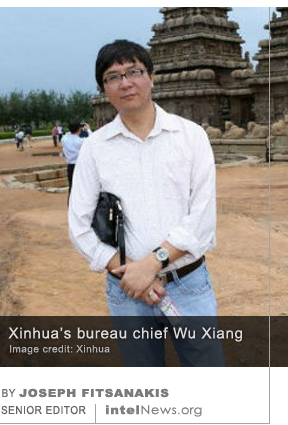
Wu XiangFor the first time in history, India has refused to extend temporary residency visas for three senior Chinese media correspondents, effectively expelling them from the country, allegedly for espionage activities. All three reporters are employees of China’s state-run Xinhua news agency. They include Xinhua’s bureau chief in the Indian capital, New Delhi, Wu Xiang, and the agency’s Mumbai bureau chief, Lu Tang. A third journalist, She Yonggang, also based in Mumbai, has been asked to leave India by no later than July 31.

According to several Indian news media, the decision to refuse visa renewals for the Chinese journalists was taken after Indian intelligence agencies confirmed that the three were engaging in activities that “were incompatible with their journalistic capacity”. The phrase typically refers to espionage and related activities. According to India’s Ministry of External Affairs, the Chinese reporters have been officially asked to leave the country by the end of this month. All three are reportedly reputable experts in Indian affairs. Xinhua’s Mumbai bureau chief, Lu Tang, is typical: a fluent Hindi speaker and Jawaharlal Nehru University graduate, she specializes in Indo-Chinese relations and has written for some of Asia’s most best known publications.

Indian sources have not confirmed that the decision to expel the journalists relates to espionage activities. Government officials insist that the three had let their visas expire four months ago and were staying in India based on temporary fortnightly extensions. The Indian government simply made the decision not to renew the journalists’ already expired visas, they said. When asked about his impending expulsion, Xinhua’s New Delhi bureau chief, Wu Xiang, said he and his two colleagues had not been given a reason for the Indian government’s refusal to extend their visas. Indian officials told reporters that Xinhua would be allowed to replace the three reporters’ posts. The Chinese government has not yet responded to the news of the expulsions. There are reportedly five Indian journalists working in China for Indian news agencies.

Author: Joseph Fitsanakis | Date: 25 July 2016 | Permalink

Did Russian intelligence warn Turkish government of impending coup?

Turkey coupRussian and Turkish authorities will not confirm or deny reports that the Kremlin warned Turkey’s intelligence services about an impending coup on July 15, several hours before tanks appeared on the streets of major Turkish cities. On Wednesday, several Arab and Iranian news outlets claimed that Russian intelligence officials told the government in Ankara that the Turkish military was preparing a coup. The reports cited anonymous Turkish diplomats who said that Turkish intelligence was urgently alerted by the Russians “hours before [the military coup] was initiated on Friday”.
According to the unconfirmed reports, the secret preparations for the coup first came to the attention of Russian military intelligence. Its radio interceptors captured —and were subsequently able to read— a series of encoded radio messages exchanged between Turkish commanders in the early hours of July 15. There is no information about the precise circumstances of the alleged interception, though media reports note the significant presence of Russian military intelligence in the northern Syrian province of Latakia, a few miles south of the Turkish border. The reports state that the intercepted messages contained “highly sensitive army exchanges” involving a plan to send army helicopters to the Turkish resort port of Marmaris, where the Turkish President Tayyip Erdoğan was holidaying, in order to kill or capture him. Russian intelligence officials reportedly shared the information with senior members of Turkey’s National Intelligence Organization (MİT). The alleged exchange allegedly took place “several hours before the start of the coup” in Turkey.

However, government officials in Ankara will not comment on the possibility that Russian intelligence services may have warned the MİT about the coup. On Thursday, Russian government spokesman Dmitri Peskov was asked directly by journalists whether the Kremlin warned Turkish officials of an impending coup by the military. He responded saying “I have no information of that kind and I do not know which sources [the media reports] are citing in making these claims”. Russia’s TASS news agency interpreted Peskov’s comment as a denial. However, the wording in his response shows that he simply denies having personal knowledge of the incident. He does not deny it happened.

Author: Ian Allen | Date: 22 July 2016 | Permalink

French government acknowledges it has special forces, spies, in Libya

French special forcesThe death of three French Special Forces soldiers in Libya has prompted the first public acknowledgement by France that its troops are involved in “dangerous intelligence operations” in the North African country. The acknowledgement was made on Wednesday in an official statement issued by Jean-Yves Le Drian, France’s Minister of Defense. In the statement, Le Drian said he “regretted the loss of three French officers who expired while on mission in Libya”. The acknowledgement came less than 24 hours after the Associated Press news agency claimed that a helicopter carrying French troops had been shot down in Libya. The report quoted unnamed Libyan officials as saying that the helicopter had been shot down by an Islamist militia in the outskirts of the city of Benghazi, in eastern Libya.

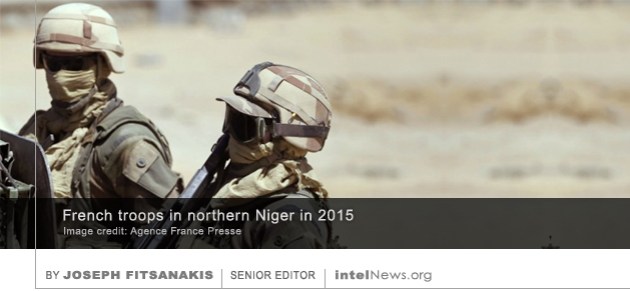
Paris has previously acknowledged the presence of French warplanes in Libya, which it says are only involved in reconnaissance operations. It is also known that France has set up a forward operating base in Niger, close to the southern Libyan border. But the French government has never before acknowledged the presence of French troops or intelligence operatives on Libyan soil. During the uprising that deposed longtime Libyan dictator Muammar Gaddafi, there were persistent rumors of daring operations by French commandos and intelligence operatives, which were never confirmed. In February of this year, French newspaper Le Monde claimed that French troops and spies were active in Libya. In a leading article titled “France’s Secret War in Libya”, the French daily said that President François Hollande had secretly authorized operations by elite special forces and officers of the DGSE, France’s General Directorate for External Security. But France’s Defense Ministry refused to comment on Le Monde’s allegations, while Laurent Fabius, who was then France’s Minister of Foreign Affairs, denied the newspaper’s claims, saying that France did not have the means to intervene militarily in Libya.

Speaking shortly after Wednesday’s disclosure by the Defense Ministry, President Hollande said the three special forces soldiers had died while “carrying out perilous intelligence operations” in Libya. In a subsequent interview on the Paris-based France Info Radio, French government spokesman Stephane Le Foll admitted that French operatives are indeed active in Libya. Asked whether the Defense Ministry’s statement offered such an acknowledgement, Le Foll responded: “French special forces are [in Libya], naturally, to offer assistance and to ensure that France has a presence wherever the struggle against international terrorism is taking place”.

Author: Joseph Fitsanakis | Date: 21 July 2016 | Permalink

North Korea resumes Cold-War-era radio broadcasts for its spies abroad

Voice of KoreaIn a development that is reminiscent of the Cold War, a radio station in North Korea appears to have resumed broadcasts of encrypted messages that are typically used to give instructions to spies stationed abroad. The station in question is the Voice of Korea, known in past years as Radio Pyongyang. It is operated by the North Korean government and airs daily programming consisting of music, current affairs and instructional propaganda in various languages, including Arabic, Chinese, Spanish, French, English, and Russian. Last week however, the station interrupted its normal programming to air a series of numbers that were clearly intended to be decoded by a few select listeners abroad.
According to the South Korean public news agency, Yonhap, the coded segment was broadcast on shortwave at 12:45 a.m. on Friday, July 15. It featured a female announcer slowly reading a series of seemingly random numbers from an instruction sheet. The announcer began the segment by stating that she would “now provide a review on the topic of mathematics, as stipulated by the distance-learning university curriculum for the benefit of agents of the 27th Bureau”. She went on to read a series of numbers: “turn to page 459, number 35; page 913, number 55; page 135, number 86; page 257 number 2”, etc. This went on for approximately 12 minutes, said Yonhap.

The technique described above is informally known as ‘numbers stations’, and was extensively used by both Western and communist countries during the Cold War to send operational instructions to their intelligence personnel stationed abroad. Armed with a shortwave radio, an intelligence officer would turn to the right frequency on a pre-determined date and time, write down the numbers read out and proceed to decrypt them using a ‘number pad’, a tiny book that contained the key to deciphering the secret message aired on the radio. But the era of the Internet, mobile phones and microwave communications has caused the demise of ‘numbers stations’. The latter are rarely heard nowadays, though a number of nations, including Cuba, South Korea and Israel, are believed to still use them.

The last time North Korea is thought to have employed ‘numbers stations’ to contact its spies stationed abroad was in the spring of 2000, prior to the historic first Inter-Korean Summit that featured a face-to-face meeting of the then South Korean President Kim Dae-jung and the then North Korean Supreme Leader Kim Jong-il. Since that time, the North Koreans are believed to have stopped deploying broadcasts to communicate with their intelligence operatives in foreign countries. Yonhap quoted an unnamed South Korean government source as saying that last Friday’s broadcast was the first number sequence aired by Pyongyang in over 16 years. According to the news agency, the broadcast has Seoul worried about “possible provocations” that may be planned by North Korean spies living secretly in the south.

Author: Joseph Fitsanakis | Date: 20 July 2016 | Permalink

Analysis: It seems everyone predicted the coup in Turkey except its spy agency

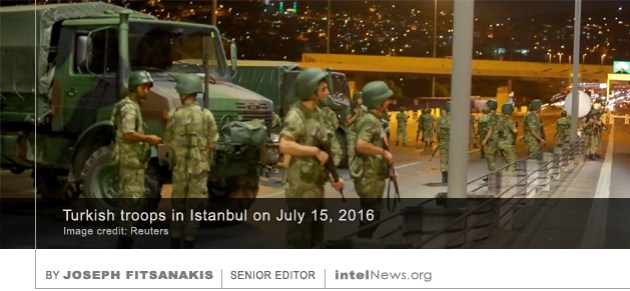
Turkey coupAfter the failure of the recent military coup d’état in Turkey, much attention has been given to the country’s armed forces, the police, even the judiciary. In contrast, little to no information has surfaced about Turkey’s intelligence establishment, which is led by MİT, the National Intelligence Organization. Did it anticipate the plot, and how did it fare as the crisis unfolded in the early hours of July 16?
Two days after the failed coup, American Congressman Peter King (R-NY), a senior member of the United States House of Representatives’ Committee on Homeland Security, claimed that “no one […] saw this coup coming”. Speaking on WNYM, a conservative talk-radio station in his home state of New York, Rep. King said that, as far as he was aware, “there was no diplomatic talk; there was no intelligence talk of this coup”. Speaking a day earlier, US Secretary of State John Kerry had stated that the White House had “no idea” that a coup was imminent in Turkey, and that developments in the country had “surprised everybody”.

As is often the case, King and Kerry were both wrong. Even as early as October of 2015, Norman Bailey, of the University of Haifa in Israel and the Institute of World Politics in Washington, was stating with certainty that Turkey’s “army will step in and take over” if it senses that the country is descending into chaos. On March 12 of this year, Russian observers warned that Turkey’s military was “gradually building up its political influence, thus laying grounds for a military coup”. Later in the same month, Michael Rubin, of the American Enterprise Institute, asked: “could there be a coup in Turkey?”, and answered that “no one should be surprised […] if the Turkish military moves to oust Erdogan and place his inner circle behind bars”. And on March 30, the esteemed journal Foreign Affairs hosted an article by Gönül Tol, founding director of The Middle East Institute’s Center for Turkish Studies, in which she explained that Turkey was about to face its “next military coup”. During an interview on July 2 of this year, the present author spoke about the “very volatile situation within [Turkey]” and added: “I can’t think of any countries in the region that are more unsettled and unpredictable right now than Turkey”.

If analysts relying on open sources were able to issue concrete warnings about Turkey’s political instability at least a year in advance of the coup, it should be taken for granted that intelligence observers were equally alarmed over the same period. We know, for instance, that American intelligence analysts were “concerned for months” prior to the coup “about simmering tensions between President […] Tayyip Erdoğan and Turkish military brass”. Read more of this post

Italian spy chief paid secret visit to Syria: news reports

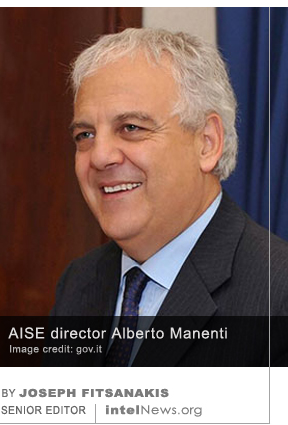
Alberto ManentiThe head of Italian intelligence paid a secret visit to Syria earlier this month, a week after his Syrian counterpart visited Rome, according to reports from the Middle East. The Dubai-based newspaper Gulf News, which first reported the alleged behind-the-scenes exchange, said the visits focused on counter-terrorism cooperation between Syria and the European Union. The paper said that the initial contact was made in late June by Major General Deeb Zeitoun, head of Syria’s General Intelligence Directorate, who paid a secret visit to Rome. General Zeitoun’s visit was allegedly in response to an official invitation issued by the Italian government. The general is believed to have stayed in a secluded private villa, which was provided by the Italian External Intelligence and Security Agency, known as AISE. He subsequently met with several Italian intelligence officials, including AISE Director, General Alberto Manenti.
A week later, Manenti secretly traveled to Syrian capital Damascus, where he stayed for several days. According to Gulf News, General Manenti met with his Syrian counterpart and other senior intelligence officials, as well as with Syrian President Bashar al-Assad. The main purpose of the secret meetings was to explore the potential for enhanced collaboration between Syria and the European Union on counter-terrorism issues. It appears that the Syrian government is willing to share intelligence on citizens of the EU who have traveled to Syria and have joined the ranks of the Islamic State, as well as other al-Qaeda-inspired groups in the country. Damascus is even willing to give EU intelligence personnel access to captured Islamist fighters that are being held in Syrian government facilities.

In return, however, the Syrians are asking that the EU enters negotiations on possibly normalizing diplomatic relations with Damascus. Contacts between the EU and Syria were severely disrupted at the outbreak of the Syrian Civil War and remain officially non-existent to this day. According to Gulf News, the Syrians told General Manenti that full intelligence cooperation in the area of counter-terrorism will ensue as soon as the EU normalizes diplomatic relations with the government in Damascus. The Italian intelligence official is believed to have told the Syrians that Rome will press the EU to move toward re-establishing relations with Damascus, in return for concrete steps taken in Syria toward “political transition” in the war-torn country.

Author: Joseph Fitsanakis | Date: 18 July 2016 | Permalink

Russian foreign intelligence headquarters has doubled in size since 2007

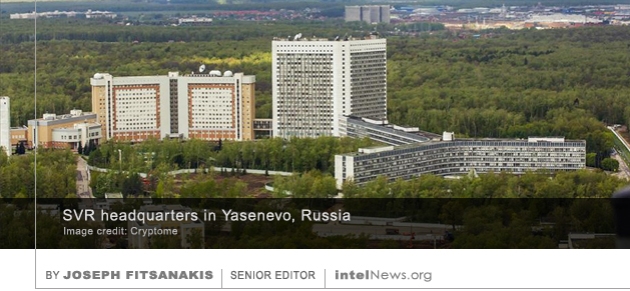
SVR hqRecent satellite images reveal that the headquarters of the Russian Federation’s external intelligence agency has doubled, and possibly tripled, in size in the past nine years. The Russian Foreign Intelligence Service, known as SVR, is one of the successor agencies of the Soviet-era KGB. During the Soviet times, the present-day SVR was known as the First Chief Directorate or First Main Directorate of the KGB. Despite its name change, however, its mission remains the same, namely to collect secrets from targets outside the Russian Federation —often through the use of espionage— and to disseminate intelligence to the president. In the Soviet days, along with most of the KGB, the First Chief Directorate was headquartered in the imposing Lubyanka building, which is located in Moscow’s Meshchansky District. But in the early 1970s, the entire First Chief Directorate began a decade-long process of moving to a new, state-of-the-art complex in the southern suburbs of the Russian capital. The complex, which is located in Yasenevo, today houses the entire apparatus of the SVR, including its espionage wing, and is informally known as les (the forest) or kontora (the office).
Until 2007, the SVR’s Yasenevo headquarters consisted of a large Y-shaped office building that adjoins an imposing 21-story skyscraper, which is visible for several miles around. But an open-source collection of recent satellite images shows that the top-secret complex has doubled —and possibly tripled— in size in the past decade. Steven Aftergood, who edits the Federation ofMikhail Fradkov American Scientists’ Secrecy News blog, has published a collection of images that was compiled by Allen Thomson, an analyst who worked for the United States Central Intelligence Agency from 1972 to 1985. The images clearly show that at least three more large buildings have been erected alongside the landmark skyscraper and the adjoining Y-shaped office block. These additions, says Aftergood, appear to have increased the SVR headquarters’ floor space “by a factor of two or more”. Moreover, the nearby parking capacity at the complex “appears to have quadrupled”, he adds.
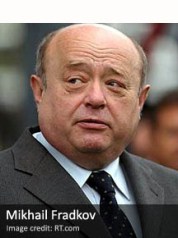
There is no information available about what may have prompted the sudden building expansion at the SVR complex, nor whether it reflects drastic changes in the organizational structure, budget or mission of the agency. Secrecy News quotes Russian intelligence observer Andrei Soldatov, who suggests that there may be a direct connection between the expansion of the SVR facility and the appointment of Mikhail Fradkov as the agency’s director, in 2007. Fradkov is a Soviet-era diplomat, who some suspect was secretly an officer of the KGB. He served as Russia’s prime minister from 2004 to 2007, when he was appointed director of the SVR —a position that he retains to this day. There have been suggestions in the Russian media that Fradkov could succeed Vladimir Putin when the latter retires from his post as president of the Russian Federation.

Author: Joseph Fitsanakis | Date: 14 July 2016 | Permalink

Australia, Indonesia exchange intelligence personnel to combat ISIS

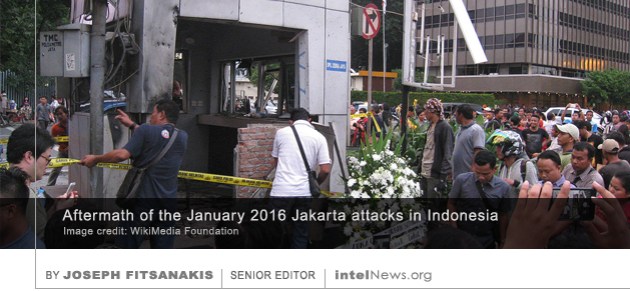
2016 Jakarta attacksAn ambitious new personnel exchange program between intelligence agencies in Australia and Indonesia aims to combat the unprecedented rise of militant Islamism in Southeast Asia, which is fueled by the Islamic State. The program, which is already underway, aims to strengthen intelligence cooperation between two traditionally adversarial regional powers. According to The Australian newspaper, the scheme owes its existence to the growing recognition that the security environment in the region is rapidly deteriorating due to the popularity of the Islamic State. The militant group appears to have replaced al-Qaeda in the minds of many radical Islamists in Indonesia, Malaysia, the Philippines and elsewhere, and is fueling the resurgence of smaller Islamist sects that have laid largely dormant for years.
Relations between militant Islamist sects in Indonesia —the world’s most populous Muslim nation— have traditionally been factional in nature. But some experts fear that the unprecedented growth of the Islamic State is galvanizing and uniting Islamist factions throughout Southeast Asia. Chief among them is the Jemaah Islamiyah, an al-Qaeda-linked terrorist group operating across the region, which was behind the 2002 Bali bombings that killed over 200 people, 88 of them Australians. In January of this year, Jemaah Islamiyah praised a series of attacks in the Indonesian capital Jakarta, which were perpetrated by militants connected to the Islamic State. The attacks killed four people, far fewer than their perpetrators had hoped to harm. But they lasted for several hours and shocked many due to the ease with which the heavily armed terrorists were able to evade security measures. Similar attacks were recently prevented in their planning stages by security agencies in Malaysia and the Philippines.

These developments prompted the rapprochement that is currently taking place between two traditionally rival intelligence agencies, the Australian Security Intelligence Organisation (ASIO) and Indonesia’s State Intelligence Agency, commonly referred to as BIN. The two agencies have reportedly begun posting officers to each other’s headquarters on multi-month assignments. The purpose of these exchanges is to gain a detailed understanding of each other’s counterterrorist planning and operations, and devise areas of actionable cooperation. The plan can be characterized as ambitious, given that relations between ASIO and BIN were severely disrupted in late 2013 and are still damaged, according to some observers. The break in relations was prompted by revelations, made by the American defector Edward Snowden, that Australian intelligence spied on senior Indonesian politicians and their family members, including the wife of the country’s president. Indonesia responded by withdrawing its ambassador from Canberra and terminating all military and intelligence cooperation with Australia. Nine months later, the two countries signed a joint agreement promising to curb their intelligence activities against each other. Some observers suggest that it will take years for Indonesian and Australian intelligence to fully reestablish intelligence cooperation. However, the rapidly deteriorating security situation in Southeast Asia could be significantly accelerating this process.

Author: Joseph Fitsanakis | Date: 13 July 2016 | Permalink

German intelligence spied on EU and NATO allies, report finds

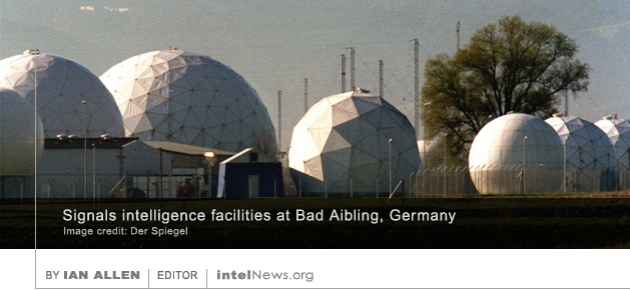
Bad Aibling - IAA major parliamentary inquiry into the operations of Germany’s main intelligence agency has concluded that it spied on nearly 3,500 foreign targets in recent years, most of which belonged to allied countries. The inquiry was initiated by the German government in response to a number of recent public controversies involving the Bundesnachrichtendienst, Germany’s Federal Intelligence Service, known as BND.
In 2015, the BND was found to have secretly collaborated with the US National Security Agency (NSA) in spying on several European governments and private companies. According to German investigative magazine Der Spiegel, the BND used its facilities at Germany’s Bad Aibling listening station to help the NSA spy on, among other targets, the palace of the French president in Paris, the headquarters of the European Commission in Brussels, and the France-based European conglomerate Airbus. In response to the revelations, Airbus filed a criminal complaint against the German government, while Belgium and Switzerland launched official investigations into the joint BND-NSA activities. The extent of the BND-NSA collaboration prompted widespread public criticism in Germany. In response to the criticism, German Chancellor Angela Merkel promptly fired the director of the BND in April of this year. Additionally, the German chancellor authorized a parliamentary inquiry into the operations of the BND, which was completed last spring.

The resulting 300-page report has not been made public. But summaries leaked to the German media reveal that the BND spied on 3,300 targets until the end of 2013. Nearly 70 percent of these targets belonged to countries that are members of the European Union or the North Atlantic Treaty Organization, and are thus some of Germany’s closest international allies. The targets allegedly included “hundreds of diplomatic missions” in Europe and elsewhere, as well as heads of state, government ministers, aides to foreign cabinet officials, and heads of foreign militaries. The report summary also states that the BND targeted non-governmental organizations and private corporations that are operate in the areas of aviation, weapons design, transportation, advertising and the media.

Last month, the German cabinet approved draft legislation that aims to reform the BND. The legislation explicitly bans the agency from spying on foreign governments or corporations for the benefit of German companies. It also prevents it from spying on targets within the European Union, unless the operation pertains to “information to recognize and confront threats to internal or external security”. The legislation also calls for the establishment of a new independent oversight body consisting of senior judges and representatives of the Office of the Federal Prosecutor, whose job will be to evaluate and approve the BND’s proposed espionage activities against foreign targets.

Author: Ian Allen | Date: 12 July 2016 | Permalink

Senior Russian intelligence defector to the US is allegedly dead

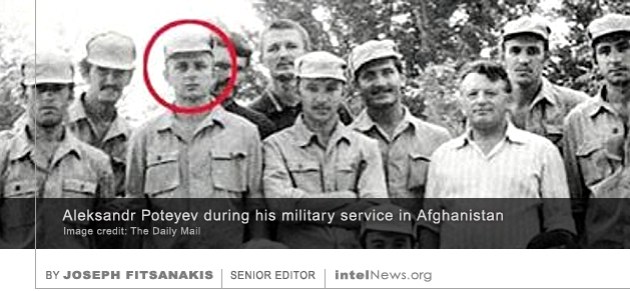
Aleksandr PoteyevA Russian former senior intelligence officer, who reportedly defected to the United States after helping the Federal Bureau of Investigation arrest 10 Russian spies in 2010, is believed to have died. The arrests, which revealed the so-called “Russian illegals program” in the US, were part of a counterintelligence operation codenamed GHOST STORIES by the FBI. The operation culminated in June 2010 with the dramatic arrests of 10 Russian ‘illegals’ in several US states. The Russian illegals, deep-cover intelligence operatives with no official connection to the country that employs them, had been operating in the US for over a decade prior to their arrest, using passports from third countries, including Britain, Canada and Uruguay. They were eventually exchanged with spies for the West that had been imprisoned in Russia.

Moscow blamed the arrests of the illegals on Colonel Aleksandr Poteyev, a veteran of the Soviet war in Afghanistan, who rose through the ranks of the KGB and its successor agency, the SVR, to become second-in-command in the so-called Department S. The senior leaders of Department S are believed to be appointed directly by the president of Russia, and are tasked with directing the activities of all Russian illegals operating abroad. According to the Russian government, which tried Poteyev in absentia in 2011, he began working for the US Central Intelligence Agency in 1999, shortly before entering the senior echelons of Department S.

A panel of judges was told during Poteyev’s Moscow trial that he left Russia without permission on June 24, 2010, just days before the FBI arrested the 10 Russian illegals in the US. He initially went to Belarus, from where he notified his unsuspecting wife via a text sent from a mobile phone that he was leaving Russia for good. He then traveled to Ukraine and from there to Germany, where he was allegedly picked up by his American CIA handler. It is believed that was provided with a new identity and passport, which he used to enter the US. By the time the Russians sentenced him to 25 years in prison for treason, Poteyev was adjusting to his new life in America.

But on July 7, the Moscow-based Interfax news agency reported that Poteyev, had died in the US, aged 64. The brief report did not specify the cause of Poteyev’s alleged death, nor did it state how Interfax acquired the information. Since the report was issued, no confirmation of Poteyev’s purported death has appeared from any other news source, or from government agencies. Russia’s Sputnik News contacted the SVR last week, but the agency declined to comment. It is believed that Poteyev’s two children were working in the US at the time of his defection, and that they are still living in the country.

Author: Joseph Fitsanakis | Date: 11 July 2016 | Permalink