Al-Qaeda plotter claims Saudi royals helped fund 9/11 attacks
February 5, 2015 2 Comments
 By JOSEPH FITSANAKIS | intelNews.org
An al-Qaeda member, who helped plot the 9/11 attacks on the United States in 2001, has said during court testimony that members of the Saudi royal family provided financial support for the terrorist operation. Zacarias Moussaoui is serving a life sentence in a maximum-security prison in the US state of Colorado, after admitting in federal court that he conspired to kill US citizens as part of the 9/11 attacks. Moussaoui, a citizen of France, was being paid by al-Qaeda to take flying lessons in Minnesota when he was arrested on immigration charges less than a month before 9/11. He said during his trial that he was supposed to be the fifth member of an al-Qaeda hijacker team that aimed to fly a Boeing 747 into the White House.
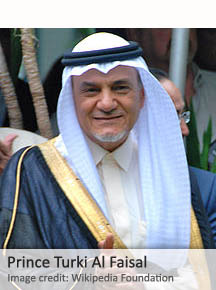
On Wednesday it emerged that Moussaoui gave testimony last October in a US court, as part of a lawsuit brought by family members of 9/11 victims and several insurance companies against the government of Saudi Arabia. They claim that members of the Saudi government helped fund al-Qaeda in the run-up to the 9/11 attacks through a variety of means. Speaking under oath, Moussaoui said a number of “extremely famous” Saudi government officials were systematically funding al-Qaeda’s operations in the years immediately preceding the 9/11 attacks. Among them, said Moussaoui, was Prince Turki bin Faisal Al Saud, the youngest son of the late King Faisal bin Abdulaziz Al Saud. Prince Turki directed the Kingdom’s intelligence agency, the Al Mukhabarat Al-A’amah, from 1979 until 2001, when he briefly became ambassador to Britain and then the United States, before retiring. Moussaoui told the court that he also met another senior Saudi official who worked in the US embassy in Afghanistan in the 1990s. The purpose of the meeting, said Moussaoui, was to arrange a trip to Washington, DC, where the two men would search for a suitable location from where a laser-guided Stinger missile could be launched against Air Force One, the personal aircraft of the President of the US.
Moussaoui’s testimony emerged on Wednesday as a result of a legal push by the government of Saudi Arabia to have the lawsuit thrown out of court. Spokesmen for the Saudi government have blasted the lawsuit, claiming it is based on testimony by “deranged criminals” like Moussaoui, who have “zero credibility”.












 intelNews.org
Swedish double spy who escaped to Moscow in 1987 dies at 77
February 9, 2015 by Ian Allen 3 Comments
Sweden’s most notorious Cold-War spy, who went on the run for nearly a decade after managing to escape from prison in 1987, has died in Stockholm. Born in the Swedish capital in 1937, Stig Eugén Bergling became a police officer in the late 1950s prior to joining SÄPO, the Swedish Security Service, in 1967. He initially worked in the Service’s surveillance unit, and later joined several counterintelligence operations, mostly against Soviet and East European intelligence services. In 1979, while posted by SÄPO in Tel Aviv, he was arrested by the Israelis for selling classified documents to the GRU, the military intelligence agency of the USSR.
He was promptly extradited to Sweden, where he stood trial for espionage and treason. His trial captivated the headlines, as details about the spy tradecraft he employed while spying for the Soviets, including radio transmitters, invisible ink and microdots, were revealed in court. He said in his testimony that he sold over 15,000 classified Swedish government documents to the Soviets, not due to any ideological allegiance with the Kremlin, but simply in order to make money. Bergling was sentenced to life in prison, while lawyers for the prosecution argued in court that the reorganization of Sweden’s defense and intelligence apparatus, which had been caused by Bergling’s espionage, would cost the taxpayer in excess of $45 million. For the next six years, the convicted spy disappeared from the headlines, after legally changing his name to Eugen Sandberg while serving his sentence.
But in 1987, during a conjugal visit to his wife, he escaped with her using several rented cars, eventually making it to Finland. When they arrived in Helsinki, Bergling contacted the Soviet embassy, which smuggled him and his wife across to the USSR. The couple’s escape caused a major stir in Sweden, and an international manhunt was initiated for their capture. In 1994, the two fugitives suddenly returned to Sweden from Lebanon, where they had been living, claiming they were homesick and missed their families. They said they had lived in Moscow and Budapest under the aliases of Ivar and Elisabeth Straus. Bergling was sent back to prison, while his wife was not sentenced due to ill health. She died of cancer in 1997. Bergling changed his name again, this time to Sydholt, and lived his final years in a nursing home in Stockholm until his recent death. He was 77.
Filed under Expert news and commentary on intelligence, espionage, spies and spying Tagged with Cold War, defectors, double agents, Eugen Sandberg, Eugen Sydholt, GRU, history, obituaries, SAPO (Sweden), Stig Bergling, Sweden