More information on French spies’ mysterious plot to kill woman in Paris

DGSE FranceFrench media have released new information on a puzzling murder conspiracy by three operations officers in France’s external intelligence agency, who planned to kill a middle-aged woman in Paris. As intelNews reported earlier this month, the three men work for the Directorate-General for External Security, known as DGSE. The service is France’s equivalent of the United States Central Intelligence Agency (CIA). Like the CIA, the DGSE is not permitted to carry out operations inside France.

Two of the men were arrested by police early in the morning of July 24 in Val-de-Marne, a boulevard in Créteil, a southeastern suburb of the French capital. On July 31, French authorities arrested a third man, also in Paris, who is also believed to be a DGSE operations officer. New media reports from France have identified the two men arrested on July 24 as “Pierre B.” and “Karl E.”. They are believed to be members of the DGSE’s Action Division, a group that is trained by DGSE to carry out covert operations on foreign soil.

In the past week, authorities arrested two more men, who are also believed to be among the plotters in this strange case. They have not been named. One is believed to own a private security firm and the other is a former DGSE employee who now works as a private detective specializing in electronic crime. The two men have been charged with conspiracy and attempted murder.

Bizarrely, when Pierre B. and Karl E. were arrested on July 24, they claimed they were on an official DGSE mission. This, if true, would violate French law, since the agency is not permitted to operate on French soil. Additionally, the two men appear to have broken the law by identifying themselves as DGSE employees to the police officers who arrested them. According to French media reports, the two suspects continue to claim that they were on a mission ordered by their superiors at DGSE, and believe that the agency will eventually help them clear all charges against them.

Meanwhile, their intended victim has not been named. She is reportedly a psychotherapist who specializes in hypnotherapy. She has allegedly told police investigating the case that her murder might have been planned by rival hypnotherapists. However, police are finding it difficult to believe that professional rivalries could have resulted in the hiring of highly trained DGSE operations officers to commit a murder.

Four suspects, including the two operations officers arrested on July 24, remain in custody. The fifth man, the DGSE officer arrested on July 31, has reportedly been released on bail.

Author: Joseph Fitsanakis | Date: 14 August 2020 | Permalink

Slovakia expels three Russian diplomats in connection with 2019 murder in Berlin

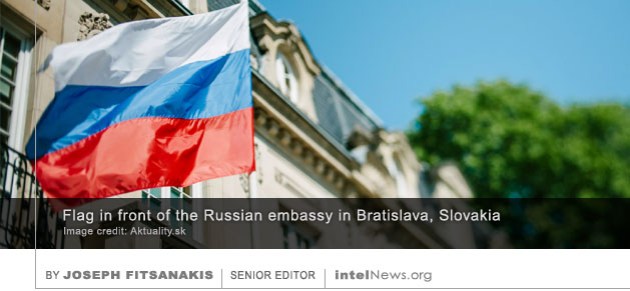
Russian embassy in SlovakiaThree Russian diplomats have been ordered to leave Slovakia, reportedly in connection with the killing in Germany of a Chechen former separatist, which many believed was ordered by Moscow. On Monday, the Foreign Ministry of Slovakia confirmed media reports that three Russian diplomats had been declared ‘unwanted persons’ and ordered to leave the country.

The three diplomats are stationed at Russia’s embassy in Bratislava. They are believed to be intelligence officers operating under diplomatic cover. A spokesman from the Slovak Foreign Ministry issued a statement on Monday, citing “information from the Slovak intelligence services”, according to which the three Russians engaged in “activities [that] were in contradiction with the Vienna convention on diplomatic relations”. Additionally, said the statement, Slovak authorities had uncovered “an abuse of visas issued at the Slovak general consulate in St. Petersburgh, and in this connection a serious crime was committed on the territory of another European Union and North Atlantic Treaty Organization member state”.

The statement did not elaborate on the specifics of the “serious crime”, but Slovak media report that it refers to the killing last August of Zelimkhan Khangoshvili, a leading figure in the Second Chechen War, which pitted the Russian military against groups of Muslim fighters in the North Caucasus between 1999 and 2009. Khangoshvili, a Muslim born in Georgia, was a bodyguard of Aslan Maskhadov, the self-described leader of the Muslim separatists in the Northern Caucasus. In 2015, Khangoshvili sought political asylum in Germany after two men tried to kill him in Tbilisi. The German authorities initially placed him on a terrorism watch list, but removed him after he began to collaborate with German counterterrorist agencies and participate in programs designed to de-radicalize Muslim youth. He was shot in broad daylight in Berlin by a man wearing a wig and carrying a pistol fitted with a silencer. Officials from the Berlin prosecutor’s office said at the time there were “indications the deed was pre-planned and may have political motives behind it”. It is now believed that at least one of the men suspected of involvement in planning Khangoshvili’s killing had traveled from Russia to the European Union on a visa issued by the Slovakian consulate in St. Petersburgh.

The three Russian diplomats have reportedly been told that they have until this coming Sunday to leave Slovakia. The Russian embassy in Bratislava said it would not comment on the expulsions. Kremlin officials have strongly denied that the Russian government had any ties to the killing of Khangoshvili. Moscow has vowed to expel an equal number of Slovak diplomats from the Russian capital in the coming days.

Author: Joseph Fitsanakis | Date: 11 August 2020 | Permalink
Large-scale cyberattacks, Internet disruptions, reported on Belarus election day

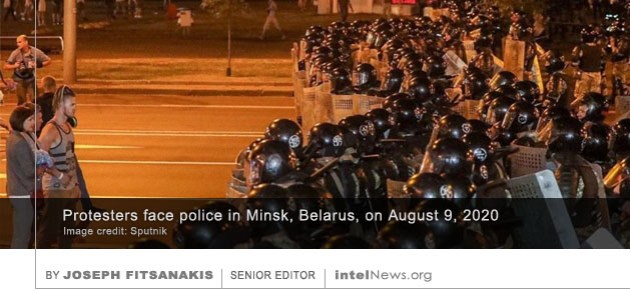
BelarusBelarus experienced large-scale cyberattacks that crippled many government websites, while parts of the Internet were inoperative during a national election on Sunday, as large-scale demonstrations erupted all over the country. The demonstrations, which went on late into Sunday night, were sparked by reports that the country’s authoritarian leader, Alexander Lukashenko, had secured a record sixth term in office, despite facing a serious challenge from opposition leader Sviatlana Tsikhanouskaya. Tsikhanouskaya is married to Syarhey Tsikhanouski, a jailed blogger with substantial social-media following among young voters.
On Sunday afternoon, the National Computer Incident Response Center of Belarus (CERT) reported that the servers of the State Security Committee (KGB), the country’s spy agency, had come under sustained attack. The Internal Affairs Ministry’s website and servers had also been affected by what CERT called “a large wave” of cyberattacks. These were first noticed on Saturday, but continued well into the evening of Sunday, according to reports. Other government websites and services were subjected to distributed denial of service (DDoS) attacks, during which online servers crashed after being flooded with requests for information.

Meanwhile, Internet and cell phone users reported having difficulty accessing popular websites like Google, and social media services, including Telegram and Signal. Internet-based cell phone service was almost completely down throughout the country by Sunday afternoon. Beltelecom, the state-owned telephone service provider, said its systems were “experiencing interruptions in access” and “congestion of channels due to foreign traffic in large quantities”. It added that its technicians had not yet determined “whether people or machines” were behind the disruptions in service.

Late last month, the Belarusian secret services arrested 33 Russian citizens, who were allegedly members of the Wagner Group, a Kremlin-backed private military firm. The government of Belarus accused the group of trying to subvert the presidential elections on behalf of Moscow. The 33 Russians were charged with terrorism against the state. Russia has denied claims by the Belarussian government that it is behind an effort to destabilize the former Soviet Republic.

Author: Joseph Fitsanakis | Date: 10 August 2020 | Permalink

Canada thwarted plot to assassinate exiled Saudi former top spy, lawsuit alleges

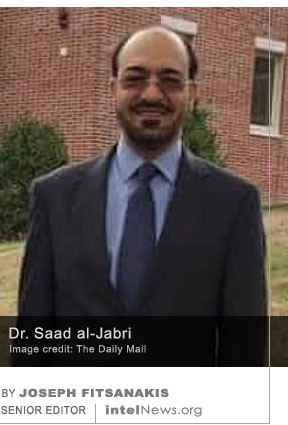
Saad al-JabriCanadian border guards thwarted a sophisticated plot to kill a Saudi former senior intelligence official, who has been targeted by the oil kingdom’s crown prince because he served a rival member of the royal family, according to a lawsuit filed in an American court.

The target of the alleged assassination attempt is Dr. Saad al-Jabri, who rose through the ranks of the Saudi aristocracy in the 1990s, under the tutelage of his patron, Crown Prince Muhammad bin Nayef. Prince bin Nayef is the grandson of Saudi Arabia’s founding monarch, King Abdulaziz, and until 2015 was destined to succeed King Abdullah and occupy the kingdom’s throne. Eventually, bin Nayef appointed Dr. al-Jabri as Minister of State and made him his most senior and trusted adviser on matters of security and intelligence.

But Dr. al-Jabri’s standing changed suddenly in 2015, when King Abdullah died and was succeeded by King Salman. Salman then quickly began to rely on his son, Mohammed Bin Salman, who he eventually named as his successor. That meant that Dr. al-Jabri’s mentor and protector, Prince bin Nayef, was effectively usurped. Bin Salman abruptly fired Dr. al-Jabri in September of 2015. Less than two years later, bin Nayef was dismissed from his post as Minister of Interior and went under house arrest in Saudi Arabia’s coastal resort city of Jeddah. That was effectively a bloodless palace coup, which purged bin Nayef and everyone who was closely associated with him. Fearing for his life, Dr. al-Jabri took his eldest son, Khalid, and escaped to Canada in the middle of the night. They remain there to this day.

Now a new 106-page lawsuit (.pdf), filed yesterday with the United States District Court in Washington, DC, claims that bin Salman sent spies to conduct physical surveillance on at least one of Dr. al-Jabri’s properties in the US, in an effort to locate him. The lawsuit also claims that bin Salman dispatched members of his “personal mercenary group”, known as the Tiger Squad, to Canada, in order to assassinate Dr. al-Jabri. The members of the squad allegedly arrived at Toronto’s Pearson International Airport sometime in mid-October 2018. The documents claim that the Tiger Squad members traveled to Canada just days after they were dispatched to Istanbul, Turkey, where they killed Saudi journalist Jamal al-Khashoggi.

The lawsuit claims that the members of the assassination team attempted to enter Canada in small groups, using tourist visas, and did not declare their affiliation to the Saudi intelligence services. However, Canadian border guards became suspicious of the men, after realizing that they were part of a larger group. Prior to expelling them from Canada, Canadian border officials searched the men’s belongings and found “two bags of forensic tools”, according to the lawsuit. The suit further claims that the Tiger Squad included “forensic personnel experienced with the clean-up of crime scenes, including an instructor” who had links with “the forensic specialists who dismembered Khashoggi with a bone saw”.

The Saudi palace has made no comment about Dr. al-Jabri’s lawsuit. Earlier this year, Riyadh denied allegations of harassment by Dr. al-Jabri and his family, and claimed he is wanted in Saudi Arabia for financial discrepancies and corruption.

Author: Joseph Fitsanakis | Date: 07 August 2020 | Permalink

Paris prosecutor charges three French spies with mysterious plot to kill woman

dgse franceThe Paris prosecutor has charged three officers of France’s external spy agency with a mysterious plot to kill a woman, after two of them were caught driving a stolen vehicle and in possession of weapons. The three men are reportedly operations officers in the Directorate-General for External Security, known as DGSE. The service operates as France’s equivalent of the United States Central Intelligence Agency (CIA). Like the CIA, the DGSE is not permitted to carry out operations inside France.
Two of the men were arrested by police on the night of July 23 to 24 in Val-de-Marne, a boulevard in Créteil, a southeastern suburb of the French capital. They have been identified in the French media as ‘Pierre’ and ‘Karl’, and are reportedly 25 and 28 years old respectively. According to the Paris prosecutor, the men were found driving a stolen car with forged license plates. Inside the vehicle, police officers found a bag containing a handgun along with 12 rounds of ammunition. Both men were carrying military-issue knives. On July 31, French authorities arrested a third man, also in Paris, who is allegedly connected to the case. The third man, who has not been named in the media, is also believed to be a DGSE operations officer.

An official statement issued this week by the Paris prosecutor’s office said the three men plotted to kill a 54-old woman. It added that the murder plot was not part of their DGSE duties, and that the three operations officers were acting in a “rogue” fashion. There has been no information released about the motive behind the plot to kill the woman. On Wednesday, the Paris prosecutor said it filed preliminary charges for attempted murder against the two men who were caught in Val-de-Marne in the early hours of July 24. The third man was handed preliminary charges of complicity in the murder attempt and of being part of a criminal conspiracy. His co-conspirators were also charged with car theft and being in possession of a weapon. If convicted, each man could face up to 10 years behind bars.

Author: Joseph Fitsanakis | Date: 06 August 2020 | Permalink

North Korea targeted UN Security Council officials with spear-phishing campaign

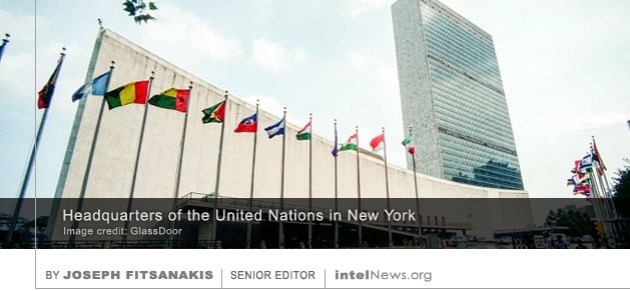
United Nations headquartersComputer hackers working for North Korea launched cyberattacks against carefully selected officials of national delegations belonging to the United Nations Security Council, according to a soon-to-be released report. The report is expected to be submitted early next month to the UN Security Council Sanctions Committee on North Korea.
Known previously as the UN Security Council Committee Established Pursuant to Resolution 1718, the committee was created in 2006 as part of the UN Security Council’s resolution 1718. The resolution was implemented in response to the first nuclear test conducted by North Korea on October 9 of that year, which confirmed beyond doubt the existence of Pyongyang’s nuclear weapons program. The committee’s mission is to gather information about North Korea’s nuclear activities, examine and evaluate the impact of international sanctions, and issue periodic recommendations to the UN National Security Council.

A draft version of the report was leaked to the media earlier this week. It states that a North Korean cyberattack targeted at least 11 officials belonging to six different national delegations that are members of the UN National Security Council. According to the draft report, the 11 officials were targeted earlier this year via a so-called “spear-phishing” campaign. The term refers to cyber-espionage operations in which hackers carefully select specific staff members of larger organizations for penetration. The targeted officials were reportedly approached using Gmail and WhatsApp, by a group of hackers who used fake identities.

The report also details efforts by the North Korean regime to acquire foreign hard currency through illicit hacking operations, as well as by illicitly acquiring virtual assets, such as cryptocurrencies. There is increasing speculation among North Korea observers about Pyongyang’s involvement in the cryptocurrency industry —though how exactly the government manages to cash out its alleged cryptocurrency assets remains a mystery.

Author: Joseph Fitsanakis | Date: 05 August 2020 | Permalink

Rare internal budgetary report shows Mossad ‘explosive growth’ since 2016

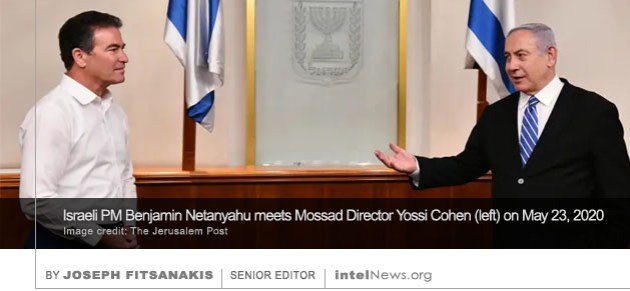
Yossi Cohen MossadA rare declassified budgetary report shows that Israel’s primary external intelligence agency, the Mossad, has received large increases in funding since 2016. The report was released on Monday by the Office of the State Comptroller. It covers a two-year period starting from August 2016. It is extremely rare for any document on Mossad’s internal affairs, including its budget, to be made available for public viewing.
The document shows that the Mossad exceeded its budget by over 50 percent during the two-year period covered in the report. It also includes statements made by Mossad director, Yossi Cohen, which show that the agency’s leadership is aware that requests for more funds are typically approved by Israel’s Ministry of Finance without much resistance. One of the Mossad’s deputy commanders is quoted as saying that “the Finance Ministry is a partner [of the Mossad] whether it wants to be or not”.

Observers have attributed the recent growth of the Mossad to the close personal relationship between Cohen and his political mentor, Israeli Prime Minister Benjamin Netanyahu. Increased support by the government in recent years has helped the agency augment its technical resources and add to the ranks of its operations officers, which are believed to have reached record numbers this year. But the State Comptroller’s report criticizes the Mossad, saying that it has argued in favor of growth without having explained in detail how it intends to utilize its newly acquired resources. The report also criticizes the Office of the Prime Minister and the subcommittee of ministers for having failed to restrain the Mossad’s spending and inquire in detail about how the agency uses its funds.

In response to the release of the State Comptroller’s report, the Mossad issued the following press statement: “Due to the increasing security threats against Israel and due to its unique and decisive contributions, the Mossad’s role and missions as part of the [nation’s] national security campaign have broadened in recent years. As a result of this, the Mossad has received additional resources and budgets in order to carry out its goals and to perform at the highest levels preserving the state’s security”. The statement adds that budgetary decisions at the Mossad involve “careful planning, transparency and full oversight from the Ministry of Finance, taking into account the approved budget for the Mossad, and taking care not to create budgetary obligations which were not approved by the Ministry”.

Author: Joseph Fitsanakis | Date: 04 August 2020 | Permalink

Grandfather of new MI6 boss was IRA fighter who won medals in war with Britain

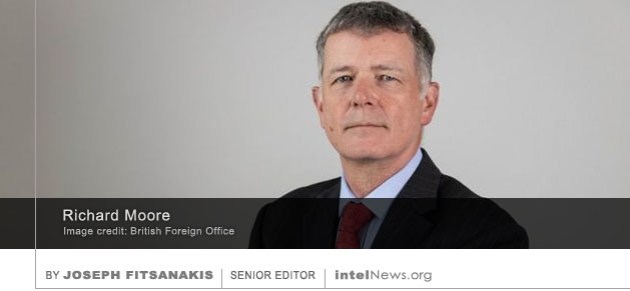
Richard MooreThe grandfather of the incoming director of Britain’s main external intelligence agency was a member of the Irish Republican Army and was awarded a medal by Irish separatists for fighting against British rule in Ireland. British Foreign Secretary Dominic Raab announced last week that Richard Moore would take over as director of the Secret Intelligence Service (MI6), Britain’s equivalent of the United States Central Intelligence Agency.
Moore, 57, will be replacing Sir Alex Younger, who has served as MI6 chief since 2014. British media reported that Moore served as an undercover MI6 officer for years before being appointed ambassador in 2014. Moore was born in Libya to British parents and studied at the Universities of Oxford and Harvard. He then joined MI6 and served under official cover in Vietnam, Pakistan, Malaysia and Turkey, where his cover was as the British embassy’s press attaché, from 1990 to 1992. He then held a number of posts in Britain’s Foreign and Commonwealth Office, including his current position, Director General for Political Affairs. Before that he served as British Ambassador to Turkey, where he lived from 2014 to 2017.

Following the announcement of Moore’s appointment as MI6 director, it emerged in the British press that his grandfather, Jack Buckley, was a volunteer in the Irish Republican Army (IRA) in Cork, Ireland. Buckley reportedly joined the separatist IRA in 1916 and served in its ranks until 1922. He was eventually honored by Sinn Fein —the IRA’s political wing— with a medal for his service in the war against the British, which resulted in the independence of most of Ireland and the creation of the Free Irish State. It is today commemorated across Ireland as the Irish War of Independence.

Moore discussed his grandfather’s membership in the IRA during his stint as ambassador to Turkey. He told a Turkish newspaper that he was of Irish origin and that his grandfather had “fought against the British government in the separatist Irish Republican Army”. He was making the point that, over time, national differences between peoples can be smoothed out given the right conditions, and made a comparison between his family’s experience and the conflict between Turkey and the Kurds.

Moore is scheduled to assume his new post in the fall. He is expected to remain as director of MI6 until 2025.

Author: Joseph Fitsanakis | Date: 03 August 2020 | Permalink

Belarus arrests 33 Russians, accuses Kremlin of trying to subvert upcoming elections

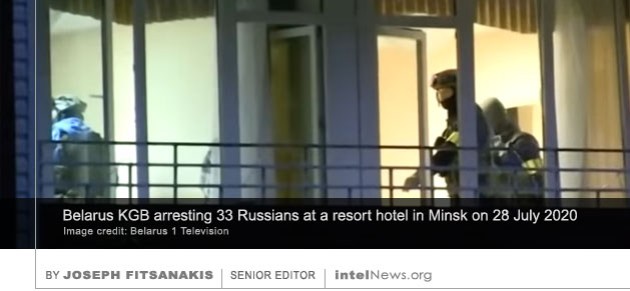
Belarus KGBBelarussian secret services announced on Wednesday the arrest of 33 Russian citizens, who are allegedly members of a Kremlin-backed private military firm. The government of Belarus accuses the Russians of trying to subvert next month’s presidential elections on behalf of Moscow. The 33 Russians were charged with terrorism against the state on Thursday. They are allegedly employees of Wagner Group, a private Russian military company that some believe is in reality a private paramilitary wing of the Russian Armed Forces. However, the Kremlin has denied these accusations and says it has no connections with Wagner.

On Wednesday the state-owned Belarus 1 television channel aired footage of the 33 Russians being placed under arrest by the Belarussian State Security Committee (KGB). The arrests were later confirmed by Andrey Rawkow, secretary of the Security Council of Belarus, an interdepartmental body that supervises national security operations in the country. Rankow said the Investigative Committee, Belarus’ primary investigating authority, had determined that the 33 had entered the country as part of a 200-strong group of Russians working for Wagner, in order to “destabilize the situation during the election campaign”.

Rankow was referring to the upcoming presidential elections of August 9, in which the country’s authoritarian leader, Alexander Lukashenko, will be seeking a sixth term in office. Since the collapse of the Soviet Union and the independence of Ukraine in 1991, Lukashenko has ruled the country with an iron fist. This time, however, partly because of the growing coronavirus crisis, his leadership is in dispute more than ever before and opposition protests have gripped the country in recent months.

Meanwhile, the close relationship between Minsk and Moscow has suffered numerous setbacks since 2018, as Russia’s economic struggles have forced the Kremlin to curtail its financial outreach to Belarus. There have been differences between the two countries over the price of energy that Belarus imports from Russia each year. Sensing his faltering support among the population, which is broadly mistrustful of Moscow, Lukashenko has campaigned on a largely anti-Russian ticket this time around, hoping to attract independent voters.

According to Belarussian state television, the 33 Russians were found in possession of Sudanese currency and a Sudanese smartphone card. Sudan is one of the Wagner Group’s most active areas of operation, according to some observers, and in the past the company has used Belarus as a transit center from which it coordinates its operations in the African continent. There were also reports in the state-owned Belarussian media that the 33 Russians were connected with the jailed husband of Sviatlana Tsikhanouskaya, a leading opposition presidential candidate. Tsikhanouskaya’s husband, Syarhey Tsikhanouski, is a blogger with substantial social-media following among younger voters. Some now suspect that the government will use this opportunity to bar Tsikhanouskaya from running for office.

Late on Wednesday, Belarus’ state-owned Belta news agency published the names and birth dates of all 33 Russian suspects. Soon afterwards, the government of Ukraine said its intelligence agency, the Security Service of Ukraine (SBU), had asked it to file extradition requests for the 33 Russians, who are believed to have worked with separatists in eastern Ukraine in recent years.

Author: Joseph Fitsanakis | Date: 31 July 2020 | Permalink

After dropping charges, US prosecutors broaden indictment against Saudi spies

TwitterTwo days after dropping charges against three Saudi men for spying on American soil, United States prosecutors submitted a new indictment that restates the two original charges and adds five more. The original complaint was filed by the Federal Bureau of Investigation in November of last year in San Francisco, California. It accused three men of “acting as unregistered agents” of Saudi Arabia since 2015. The phrase is used in legal settings to refer to espionage.

According to the FBI, the Saudi government allegedly contacted Ali Alzabarah, a 35-year-old San Francisco-based network engineer working for Twitter. Ahmed Almutairi (also known as Ahmed Aljbreen), a “social media advisor” for Saudi Arabia’s royal family, arranged for Alzabarah to be flown to Washington to meet an unidentified member of the Saudi dynasty. He and another Twitter employee, 41-year-old Ahmad Abouammo, were allegedly given money and gifts by the Saudi government. These were given in return for the email addresses, IP addresses and dates of birth of up to 6,000 Twitter users who had posted negative comments about the Saudi royal family on social media.

Earlier this week, however, US government prosecutors filed a motion to drop the charges against the three men. The two-page filing did not offer a reason behind this sudden decision by the US government. Interestingly, however, it included a request to have the charges against the three men dismissed “without prejudice”, meaning that the US government could decide to file new charges against them in the future.

This has now happened, as the US government has filed fresh charges against the three men. In addition to the two original charges, the men have now been charged with acting as agents for a foreign government without notifying the US attorney general. They have also been charged with conspiracy to commit wire fraud, committing wire fraud and money laundering, aiding and abetting, and destroying, altering or falsifying records in a federal investigation. The indictment also specifies the financial rewards Abouammo allegedly received from the Saudi government in return for his services. These included a wire transfer for $200,000 to a shell company and associated bank account in Lebanon, as well as a luxury watch valued at $20,000.

Author: Joseph Fitsanakis | Date: 30 July 2020 | Permalink

Without explanation, US dismisses charges against Saudis caught spying on US soil

Twitter IAIn a surprising move, the United States government is seeking to dismiss espionage charges it filed last year against three men, including a member of staff of Saudi Arabia’s royal family, who were caught spying on American soil. Last November, the Federal Bureau of Investigation filed a complaint in San Francisco, accusing the three men of “acting as unregistered agents” of Saudi Arabia. The phrase is used in legal settings to refer to espionage.

According to the FBI, the charges stemmed from an investigation that lasted several years and centered on efforts by the oil kingdom to identify and silence its critics on social media. In 2015, the Saudi government allegedly reached out to Ali Alzabarah, a 35-year-old network engineer working for Twitter, who lived in San Francisco. The complaint alleges that Ahmed Almutairi (also known as Ahmed Aljbreen), who worked as a “social media advisor” for Saudi Arabia’s royal family, arranged for Alzabarah to be flown from San Francisco to Washington to meet with an unidentified member of the Saudi dynasty.

Alzabarah, along with another Twitter employee, 41-year-old Ahmad Abouammo, were allegedly given money and gifts by the Saudi government in return for supplying it with private information about specific Twitter users, according to the FBI complaint. The information provided by the two Twitter employees to the Saudi authorities allegedly included the email addresses, IP addresses and dates of birth of up to 6,000 Twitter users, who had posted negative comments about the Saudi royal family on social media. Special Agents from the FBI’s Settle field office arrested Abouammo at his Seattle home. However, Alzabarah managed to flee the United States along with his family before the FBI was able to arrest him, and is believed to be in Saudi Arabia. The FBI issued a warrant for his arrest.

In a surprising move, however, US government prosecutors have now filed a motion to drop the charges against the three men. The motion, filed on Tuesday in San Francisco, is asking for permission from the judge in the case to have all charges against the three men dismissed “without prejudice”, meaning that the US government could decide to file new charges against them in the future. The two-page filing does not offer a reason behind this sudden decision by the US government. The Bloomberg news service, which reported the news on Tuesday, said it inquired about this case by calling and emailing the Saudi Embassy in Washington, the San Francisco US Attorney’s office, and Twitter. It received no responses.

Author: Ian Allen | Date: 29 July 2020 | Permalink

Turkish spy agency hid Islamist views of candidates for CIA-funded Syrian rebel group

Free Syrian ArmyTurkey’s spy agency systematically downplayed the Islamist views of men seeking to join a Syrian rebel group, which was supported by the United States Central Intelligence Agency on account of its moderate leanings. The United States began to fund and train the Free Syrian Army (FSA) soon after it was established in 2011. The group said its mission was to depose the Syrian President Bashar al-Assad and institute a Western-style multiparty democracy in Syria.
By 2015, much of the recruitment and vetting for the FSA was taking place in Turkish regions bordering northern Syria, where thousands of opponents of al-Assad’s regime had fled with their families. The CIA relied on its Turkish counterpart, the National Intelligence Organization, known as MİT, to recruit and conduct initial vetting of FSA volunteers from Syrian refugee camps. The MİT was desperately short of personnel for such a large-scale operation, and reached out to the Turkish Special Forces Command for assistance. Eventually, Special Forces Command officers were put in charge of reaching out to potential FSA volunteers and vetting them. Successful candidates would then be forwarded to the CIA.

One such officer was Lt. Murat Aletirik, who vetted dozens of FSA volunteers in 2015 and 2016. However, he was arrested following the failed coup of July 15, 2016, and was tried for alleged participation in armed insurrection against the Turkish government. During his testimony in 2018, which was leaked this week, Lt. Aletirik told the court that he and his fellow officers were issued guidelines by the MİT on how to select fighters for the CIA-funded program.

According to Lt. Aletirik, the MİT guidelines centered on whether FSA candidates were “sympathetic towards the [Kurdistan Workers’ Party, known as] PKK, the [Democratic Union Party, or] PYD, or offshoots of the PKK”. These groups support autonomy for the Kurds, a non-Turkish and non-Arab ethnic group in the Middle East. Turkey, along with the European Union and the United States, classify the Turkish-based PKK as a terrorist organization. Turkey claims that the PYD, which operates in Syria, is also a terrorist group. However, Washington supports and funds the PYD, and even worked with its militias in the war against the Islamic State.

According to Lt. Aletirik, the MİT guidelines had little to say about how to filter out potential FSA volunteers who were found to harbor sympathies for Salafi-Jihadist groups, such as the Islamic State, al-Qaeda, or al-Nusra. In fact, said Lt. Aletirik, he and his fellow officers had instructions to downplay such findings and forward candidates to the CIA, so long as they did not have pro-Kurdish sympathies. It is believed that, eventually, the CIA caught on to this, and began turning down hundreds of FSA candidates that had been vetted by the Turkish military. This slowed down the vetting process tremendously, with only a fraction —possibly fewer than 10 percent— of all candidates joining the CIA-run program.

In 2017, the United States shut down the program, reportedly after a direct order was issued by President Donald Trump. Today the FSA is almost completely supported and funded by the Turkish state. Locals often refer to it tongue-in-cheek as the “Free Syrian Turkish Army”.

Author: Joseph Fitsanakis | Date: 28 July 2020 | Permalink

World can’t stop Iran from going nuclear, says former Mossad chief

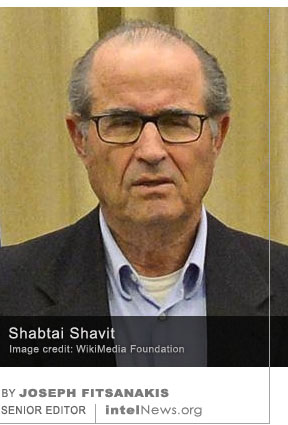
Shabtai ShavitShabtai Shavit, one of the longest-serving directors of the Israeli spy agency Mossad, has said that Israel and the world cannot stop Iran from developing a nuclear arsenal, and should focus instead on establishing a deterrence mechanism. Shavit, who is now 80, rose through the ranks of the secretive intelligence agency and became its director in 1989, under Labor Party leader Yitzhak Rabin. He stepped down in 1996 and was succeeded by Danny Yatom.
Shavit has rarely spoken since his retirement from the intelligence world. But earlier this month he gave an interview to David Horovitz, founding editor of The Times of Israel Newspaper. The former spy chief’s book, Head of the Mossad, which was published in Hebrew in 2018, is expected to become available in English in September. Horovitz said he spoke to Shavit on June 2 of this year. The English-language translation of the interview was published by The Times of Israel on July 8.

In the interview, Shavit is sharply critical of Israel’s Prime Minster, Benjamin Netanyahu, whom he accuses of “not making decisions as a statesman”. Instead of being statesmanlike, says Shavit, Netanyahu makes decisions on matters such as Israel’s national security, or the coronavirus, with reference to his trial for alleged corruption. Under Netanyahu’s leadership, says Shavit, Israel’s standing “is among the worst in decades” internationally, with the exception of the United States. But that alliance is also in doubt, as President Donald Trump’s re-election in November —a prospect Shavit calls “a catastrophe for the United States and the world”— is doubtful.

On the issue of Iran, Shavit says he is obligated to speak, not as politician or other public figure, but as an intelligence officer, and thus consider the worst possible outcome for Israel. He argues that the worst-case scenario is that Tehran will refuse to abandon its ambition to develop a nuclear arsenal. If Iran decides to pursue that goal with full speed, it would be very difficult —even impossible— for Israel to avert such an eventuality. However, the Jewish state could potentially deter Iran from using a nuclear weapon, he argues.

For this to happen, Israel must recognize that Iran’s prime rationale “is not necessarily: ‘I want to have a bomb in order to drop it on Tel Aviv’”, says Shavit. On the contrary, its prime rationale is to elevate its “influence and status” in the region, primarily vis-à-vis Saudi Arabia, Turkey and Israel. Additionally, the regime in Tehran is seeking to develop nuclear weapons in order to attain what Shavit calls “immunity” from a potential military attack by the United States.

Once Israel recognizes that Iran is not necessarily intent on destroying the Jewish state, it can stop trying to prevent Tehran from building nuclear weapons, and seek instead to deter it from using them. It can do so, says Shavit, by convincing the Iranians that “Iran will cease to exist” if it decides to make use of its nuclear arsenal. This policy of deterrence can be exercised no matter whether the clerics remain in charge in Tehran, or whether they are removed from power by the Islamic Revolutionary Guard Corps —something that Shavit believes is possible.

Author: Joseph Fitsanakis | Date: 27 July 2020 | Permalink

Britain to ‘modernize’ counterespionage laws following criticism from parliament

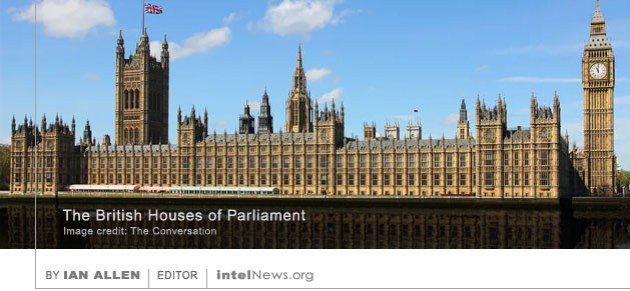
James BrokenshireSenior United Kingdom officials have said the country will seek to “modernize” its laws on counterespionage, after a long-awaited parliamentary report criticized the government for failing to stop Russian spy operations. Earlier this week saw the release of the report by the British Parliament’s Intelligence and Security Committee. The report [.pdf] focuses on Russia. It concludes that British intelligence agencies remain incapable of combating espionage and psychological operations by Russian spy agencies, of which many aim to influence British politics on a mass scale.
On Wednesday Britain’s Minister of State for Security, James Brokenshire, pushed back against the report’s findings that the government had failed to manage the thread posed by Russian intelligence activities on British soil. Speaking during an extraordinary meeting of parliament to discuss the report, Brokenshire rejected claims that a succession of British conservative administrations went out of their way to avoid investigating Russian spy activities. He claimed that the activities of the Kremlin remained one of Britain’s “top national security priorities”. During the same meeting, British Prime Minister Boris Johnson told members of parliament that “no country in the Western world is more vigilant in countering Russia” than the United Kingdom.

Some government officials said the government now plans to implement a new Espionage Bill, which is currently in the drafting stage, and is expected to provide the authorities with more powers to combat foreign espionage. Additionally, Whitehall is considering initiating a large-scale review of the Official Secrets Act and redrafting it so as to include a foreign agent registration clause. The proposed clause would resemble the Foreign Agent Registration Act in the United States, which requires those working or lobbying on behalf of a foreign government —except accredited diplomats— to register with the authorities.

This would allow British authorities to arrest, deport or imprison those found working on behalf of foreign powers, even if they are never caught committing espionage or transmitting classified information to a foreign entity.

Author: Ian Allen | Date: 23 July 2020 | Permalink

Analysis: British report into Russian meddling leads to uncomfortable conclusions

British parliamentBritain is abuzz today with news of the long-awaited release of the Parliament’s report [.pdf] into Russian meddling in British politics. The report is the work of the Parliament’s Intelligence and Security Committee. Since 2013, the Committee has been appointed to oversee the work of Britain’s intelligence agencies. Almost all of its meetings are conducted behind closed doors, and its reports are vetted by the spy agencies prior to release. By law, the Committee cannot make its reports public without previously submitting them for approval to the Office of the Prime Minister.

In the past it has taken no more than 10 days for the Committee’s reports to be approved by the prime minister. This particular report, however, which concerns —among other things— Russian meddling into British politics, took considerably longer. It was given to the prime minister on October 17. But by November 6, when parliament was dissolved in preparation for the election that brought Boris Johnson to power, it had not been approved. It finally came out yesterday, after numerous and inexplicable delays. Many speculated that the government did not want to deal with the uncomfortable conclusions in the report.


Like all reports of its kind, this one will be politicized and used by Britain’s major parties against their rivals. But behind the politicking, the report makes for uncomfortable reading indeed. It shows that, not just British, but Western intelligence agencies as a whole, remain incapable of combating online psychological operations from foreign state actors —primarily Russia— aiming to influence Western politics on a mass scale.

This is ironic, because Western spy agencies used to be really good on Russia. In fact, during the Cold War that is all they did. Many years have passed since then, and many leading Western experts on Russia have either retired or died. Additionally, the attacks of September 11, 2001, turned the attention of Western spy agencies to terrorism by groups like al-Qaeda, and away from Russia. Meanwhile, back in Moscow, President Vladimir Putin, a former KGB officer, rebuilt the state and sought to reclaim Russia’s lost international prestige. This plan includes a page from the old KGB playbook: destabilizing Western nations through psychological operations that accentuate existing extremist tendencies from the left or right. Read more of this post