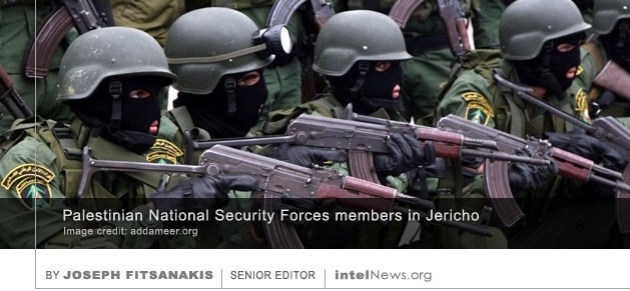
 The Palestinian Authority has announced an immediate cessation to all intelligence and security ties with Israel and the United States. The announcement, made on Thursday by Palestinian Authority President Mahmoud Abbas, marks the strongest response so far by the Fatah-dominated administration to the Israeli government’s plan to annex large parts of the occupied West Bank.
The Palestinian Authority, which controls the West Bank, runs two intelligence agencies, the Palestinian Preventive Security (also known as the Preventive Security Service) and the General Intelligence Service. Both agencies are largely trained and funded by the United States and Israel. The US Central Intelligence Agency (CIA) has long assisted the two agencies, and has often benefited by intelligence-sharing aimed at a common adversary, Hamas, which controls the Gaza Strip. In the past decade, American and Israeli intelligence agencies have worked closely with their Palestinian Authority counterparts to neutralize Hamas’ support in the West Bank.
But the Palestinian Authority has been threatening to terminate that longstanding security and intelligence cooperation, in response to an American-backed plan by Israel’s Prime Minister, Benjamin Netanyahu, to annex large parts of the occupied territories in the West Bank. The annexed land contains illegal Israeli settlements, which the United States has condemned in the past. But the administration of President Donald Trump has reversed course and in May of 2018 even transferred its embassy from Tel Aviv to Jerusalem, effectively recognizing the divided city as the capital of Israel. That move prompted the Palestinian Authority to cut all relations with Washington.
However, despite the political rift between the two sides, President Abbas had instructed the Palestinian Authority’s intelligence and security services to continue their cooperation with their Israeli and American counterparts. That ended on Thursday, as President Abbas announced that his administration would cease all intelligence and security cooperation with Israeli and American government agencies, effective immediately. Following Abbas’ announcement, the veteran Palestinian diplomat Saeb Erekat told reporters that direct cooperation with Israeli and American intelligence agencies had “stopped at the end of the president’s speech”. Erekat, who serves as secretary general of the Palestine Liberation Organization and is the Palestinian Authority’s chief negotiator with Israel, did not explain the extent of the cessation in cooperation. When asked, he responded that “the whole system is about to shut down […] in its entirety”.
In February it was reported that CIA director Gina Haspel had secretly visited Majed Faraj, director of the Preventive Security Organization, with the aim of convincing him not to terminate ties with her agency and other American intelligence bodies. The meeting reportedly took place in Ramallah, which is considered the seat of the Palestinian government in the West Bank. It appears, however, that Haspel’s efforts did not bear fruit, as all intelligence contacts between the two former partners have now been severed.
► Author: Joseph Fitsanakis | Date: 22 May 2020 | Permalink
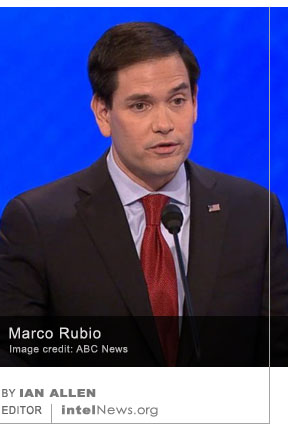 • China may set up Hong Kong spy agency under new law. China’s new national security legislation may be used to establish a domestic intelligence agency in Hong Kong similar to the British colonial-era’s Special Branch, according the territory’s former leader Leung Chun Ying. Leung’s comments could give weight to concern among some Hong Kongers and Western governments that national security legislation will herald a new era of political surveillance and law enforcement controlled from the mainland.
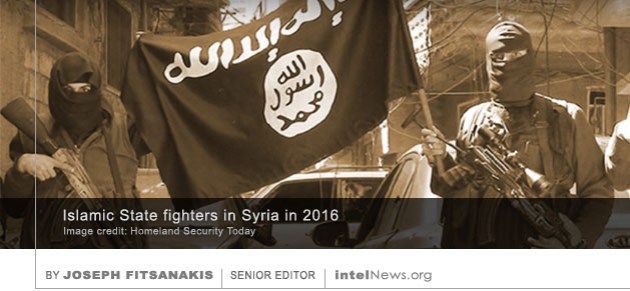 As the Islamic State continues to transfer its activities online due to the coronavirus pandemic, the group has published the first issue of a new cybersecurity magazine, aimed at helping its members evade surveillance. The Islamic State, known previously as the Islamic State of Iraq and Syria, has always been active online. But the COVID-19 pandemic has prompted it to
  The United States has alleged that the Russian military flew over a dozen unmarked aircraft to Libya, in an attempt to provide air support for Russian mercenaries who are fighting in Tripoli. If true, this development marks a major escalation of Russia’s military intervention in the Libyan civil war.
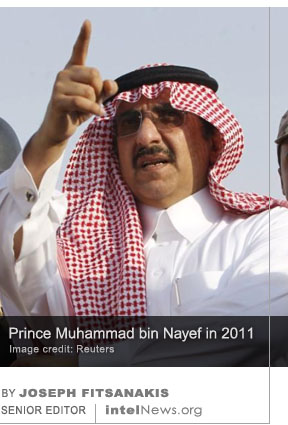 A Saudi government official, who served as a senior advisor to the oil kingdom’s former Crown Prince, has accused the Saudi monarchy of abducting his children in order to force him to end his self-exile in Canada. With a doctorate in artificial intelligence from the University of Edinburgh, Dr. Saad al-Jabri was until 2015 a rare example of a highly educated government administrator among Saudi Arabia’s ruling elite. Dr. al-Jabri rose in the ranks of the Saudi aristocracy in the 1990s under the tutelage of his patron, Crown Prince Muhammad bin Nayef (pictured). Prince bin Nayef is the grandson of Saudi Arabia’s founding monarch, King Abdulaziz, and until 2015 was destined to succeed King Abdullah and occupy the kingdom’s throne. Eventually, bin Nayef appointed Dr. al-Jabri as Minister of State and made him his most senior and trusted adviser on matters of security and intelligence.
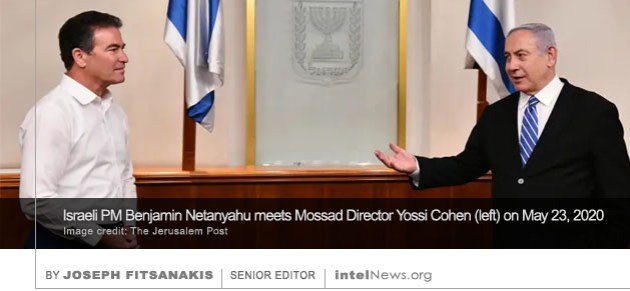 The embattled Prime Minister of Israel, Benjamin Netanyahu, met publicly with the Director of the Mossad, Yossi Cohen, and thanked him for leading the country’s procurement efforts during the COVID-19 crisis. The meeting was a rare public acknowledgement of the central role that the secretive spy agency played during the pandemic.
 The United States has warned that it might be forced to stop sharing intelligence with Australia if the country’s second most populous state enters into a much-heralded investment agreement with China. The Australian state of Victoria has said it intends to join Beijing’s Belt and Road Initiative, a worldwide investment venture that was announced with much fanfare by Chinese President Xi Jinping in 2013.
 •
•  •
•  Researchers have been able to uncover the identities and track the movements of military and intelligence personnel by using visual and geo-locational information found on a popular smartphone application for beer aficionados. The information uncovered included the home addresses of United States government personnel, some of whom were found to be working at a secret Central Intelligence Agency (CIA) facility.
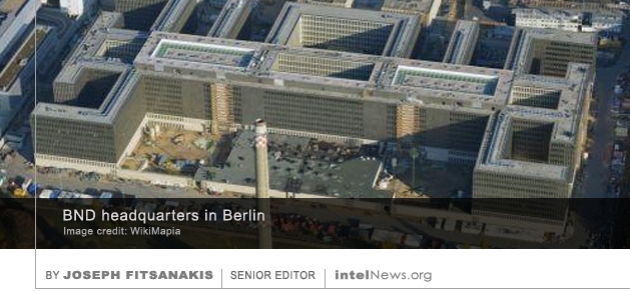 Germany’s Federal Court of Justice has ruled that the country’s intelligence agencies are not entitled to spy en masse on the telecommunications exchanges of foreign citizens. The ruling comes in response to a lawsuit filed by several journalist groups, including the German chapter of Reporters Without Borders. The groups partnered with the German-based Society for Civil Rights and argued in their lawsuit that existing law did not prevent German spy agencies from spying at will on the communications of journalists. This could potentially allow the intelligence agencies to identify trusted sources that journalists use in their work, and even share that information with intelligence agencies of other countries, they argued.
 The United Arab Emirates is behind a “covert air bridge” to supply weapons to Libyan warlord Khalifa Haftar, according to a leaked report by a United Nations investigative panel. A war has been raging in Libya since 2011, when a popular uprising backed by the West and its allies led to the demise of the country’s dictator, Muammar Gaddafi. Much of the east of the country is controlled by the United States-backed Tobruk-led Government, which is affiliated with the Libyan National Army (LNA) and its commander, Field Marshal Khalifa Haftar (pictured). The LNA is fighting against the UN-recognized Libyan Government of National Accord.
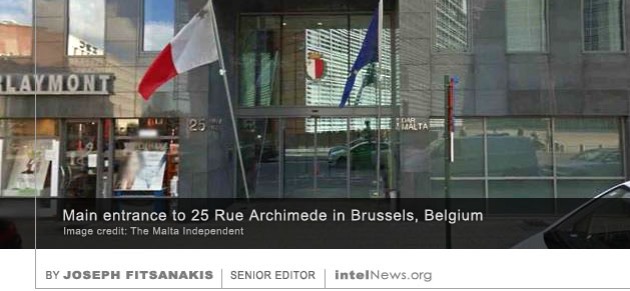 The Maltese government has strongly denied allegations, made by a leading French newspaper, that the island nation’s embassy in Brussels is being used by China to spy on European Union institutions. The allegations concern a nine-story building located at 25 Rue Archimede, in one of downtown Brussels’ most desirable areas. The building houses the Embassy of Malta in Belgium, as well as Malta’s Permanent Representation to the European Union. It is conveniently located across the street from Le Berlaymont —the headquarters of the European Commission, which is the European Union’s executive branch. It is also around the corner from the headquarters of the European Council, which operates as the collective presidency of the European Union.
 •
• 






 intelNews.org
News you may have missed #901
May 31, 2020 by Ian Allen Leave a comment
• The sex worker who spied for Israel’s pre-state militia. Once a disregarded sex worker, today Michal Garbovitz is hailed for aiding the Haganah, a Jewish paramilitary organization in British-Mandate Palestine between 1920 and 1948. Described in contemporary accounts as a “good-looking and handsome” woman, Garbovitz was estranged by her Jewish family for fraternizing with Arabs. However, during the Arab Revolt of 1936-39 against the Mandatory forces, she “exploited her contacts with Arabs and British police officers to extract vital information and transfer it to the Haganah”.
• Should COVID-19 status be a protected classification? People who have recovered from COVID-19 already face significant disadvantages, even if they have fully recuperated from the virus. For instance, the military announced several weeks ago that recovering from COVID-19 would be a permanently disqualifying condition for entrance into the armed services. Although the military later clarified that such a disqualification would only apply to individuals hospitalized because of COVID-19, many people who have recovered from the virus will face obstacles to joining the military due to these restrictions.
Filed under Expert news and commentary on intelligence, espionage, spies and spying Tagged with 0 Should COVID-19 Status Be A Protected Classification, 0 The sex worker who spied for Israel's pre-state militia, 0 US Army Already Looking to Future Pandemics, biosecurity, Coronavirus, COVID-19, Haganah, honey traps, Israel, Michal Garbovitz, news you may have missed, Palestine, privacy