ISIS in Afghanistan is now more dangerous than the Taliban, say experts
June 11, 2019 Leave a comment
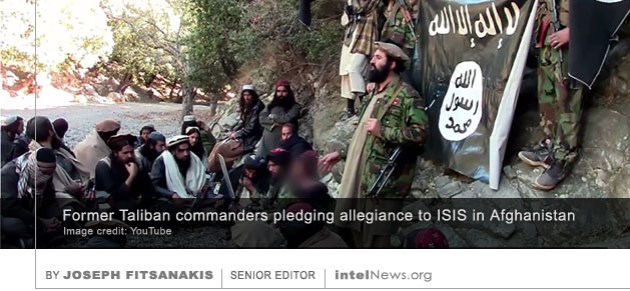 The Islamic State group in Afghanistan is now more threatening than the Taliban to both Afghan and Western interests, according to some experts, who warn that many of its fighters are moving there from the Middle East. It was in late 2014 when the Islamic State, known formerly as the Islamic State of Iraq and Syria (ISIS), made its initial appearance in Afghanistan. Soon an official Islamic State affiliate emerged in Afghanistan, calling itself Islamic State – Khorasan Province. Security observers estimated the group’s strength to below 150 armed fighters, most of them Pakistani Taliban who had sought refuge in Afghanistan, or small cadres of Afghan Taliban who pursued a more globalized Salafist agenda. Aided by the growing worldwide notoriety of its parent organization in Iraq and Syria, the Islamic State – Khorasan Province grew in size in 2015 and 2016. Its armed cadres were joined by Salafist-jihadists from Central Asia and the Indian subcontinent, as well as by radical Muslims from China’s northwestern Xinjiang Province. In 2016, as the Islamic State began retreating in the Middle East, fighters from there gradually began to make their way to Afghanistan, adding to the numerical strength of the organization’s Khorasan Province branch.
Today, the strength of the Islamic State in Afghanistan is concentrated in four northeastern Afghan provinces, Nuristan, Nangarhar, Kunar and Laghman. Nearly all of these provinces border Pakistan and none are far from the Afghan capital Kabul. According to the Associated Press’ Kathy Gannon, who wrote an extensive article about the current state of the Islamic State in Afghanistan, the primary military goal of the group’s Khorasan Province branch is to expand its territory. Some believe that the Islamic State aspires to one day conquer Jalalabad, a city of nearly 400,000 residents that serves as the administrative center of Nangarhar Province. This aspiration is not delusional; Gannon cites an unnamed US intelligence official who insists that the Islamic State is now a more deadly threat than the Taliban to Afghan and Western security. Islamic State fighters are acquiring increasingly sophisticated military hardware, which enables them to broaden their tactical capabilities. Additionally, unlike the Taliban, who largely follow a policy of limiting their attacks on government and military targets, the Islamic State appears to be deliberately targeting civilians. What is more, security experts see these attacks as “practice runs for even bigger attacks in Europe and the US”. In other words, the Islamic State – Khorasan Province is actively using its Afghan base to plan “external attacks in the US and Europe [and] it’s just a matter of time” before these occur, says a US intelligence official.
According to Gannon, the growth of the Islamic State in Afghanistan is so alarming that some security experts are beginning to see the Taliban as a potential partner of the West in containing the danger. One expert says that the Taliban remain bigger and stronger than the Islamic State, and their fighters “know the terrain [and] territory” of northeastern Afghanistan. Furthermore, the Islamic State has declared war on the Taliban and the two groups are active adversaries in the region. Gannon claims that Russia would not be opposed to the idea of utilizing the Taliban to fight off the Islamic State. As intelNews reported last month, Russia’s Federal Security Service warned that thousands of Islamic State fighters were operating in Afghanistan’s northern border regions and were attempting to destabilize former Soviet Republics with substantial Muslim populations.
► Author: Joseph Fitsanakis | Date: 11 June 2019 | Permalink
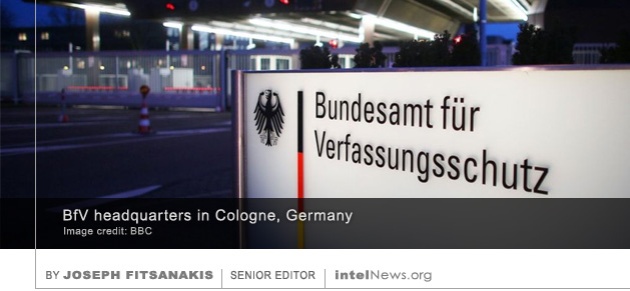 Turkey’s spy agency has developed a smart phone application to enable pro-government Turks living in Germany inform on their compatriots who speak out against the ruling Justice and Development Party (AKP). The existence of the phone application was revealed in the annual report of the Federal Office for the Protection of the Constitution (BfV), Germany’s primary counterintelligence agency. The report covers terrorist and foreign intelligence activity that took place in 2018 in Baden-Württemberg, a state in southwest Germany that borders Switzerland and France. Deutsche Welle, Germany’s state broadcaster, which
  Despite allegations in the French press that China has been spying for years on the internal communications of the African Union, the organization appears to be deepening its ties with a leading Chinese telecommunications firm. The allegations
  Iran has announced that it will release a Lebanese national and United States permanent resident, who has served nearly half of his 10-year prison sentence for allegedly spying for Washington. Nizar Zakka, 52, was born in Lebanon but was schooled in the US, where he lived permanently until 2015. In September of that year, Zakka traveled to the Iranian capital Tehran at the invitation of the government of Iran, where he spoke at a conference on Internet-based entrepreneurship. He attended the event as an information technology expert who worked for companies like Cisco and Microsoft before setting up his own company called IJMA3. Based in Washington, DC, IJMA3 lobbies investors to help build online networks in the Middle East in order to develop the region economically, socially and politically.
 Documents that were allegedly leaked by a Cuban intelligence insider show that Cuban spies targeted the Miami International Airport (MIA) and may have acquired MIA internal files, passwords and other sensitive information. The documents were
  North Korea has executed at least five of its senior nuclear negotiators and imprisoned several others, according to a report in a leading South Korean newspaper. Rumors of executions of North Korean nuclear negotiators have circulated in international diplomatic circles since February, but specific allegations have not surfaced in the news media. That changed on Friday, when Chosun Ilbo, South Korea’s highest-circulation newspaper, said that at least five executions of nuclear negotiators took place in Pyongyang in March.
 A military court in Pakistan has sentenced two men to death and one to 14 years in prison for espionage. The alleged spies, who have been named, include a lieutenant general and civilian employee of a security agency. In February, several Pakistani news outlets
 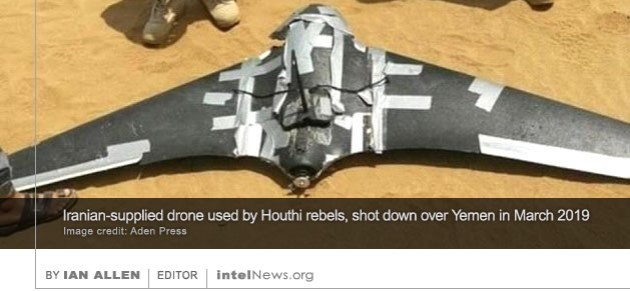 The current wars in the Middle East, especially the ongoing conflict in Yemen, are proof that the use of small drones in insurgencies is now a permanent phenomenon of irregular warfare, according to experts. Drones have been
 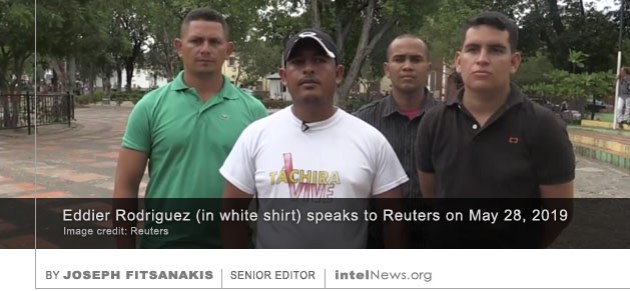 Groups of Venezuelan expatriates are reportedly forming armed militias in Colombia and say they are preparing to launch cross-border attacks to topple the government of President Nicolás Maduro in Caracas. It is
 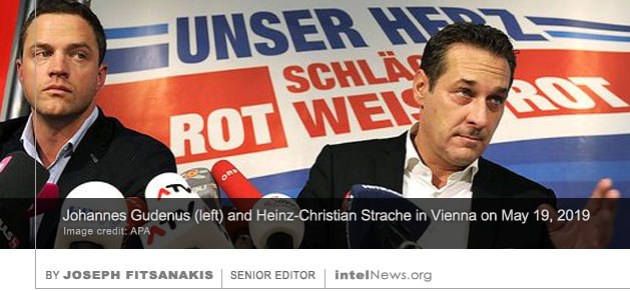 Israeli intelligence was likely behind the leaked video that brought down the far-right governing coalition in Austria on Monday, according to the former deputy director of Germany’s spy agency. The surreptitiously recorded video was
  Jonathan Pollard, an American who spied on his country for Israel in the 1980s, and is now free after spending 30 years in prison, has spoken of his frustration with the Israeli government, which it claims has forgotten about him. Pollard, a former intelligence analyst for the United States Navy, was released from an American prison in 2015, after serving a lengthy sentence for selling US government secrets to Israel. Throughout Pollard’s time in prison, the government of Israel
 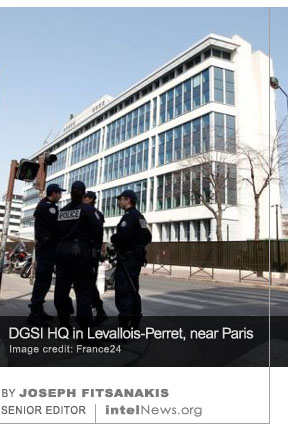 France’s domestic intelligence agency has summoned eight journalists for questioning in relation to two separate investigative reports, prompting concerns about press freedom, according to reports from Paris. Last month, France’s domestic security and counter- intelligence agency, the General Directorate for Internal Security (DGSI), summoned three journalists for questioning. The summonses related to a
 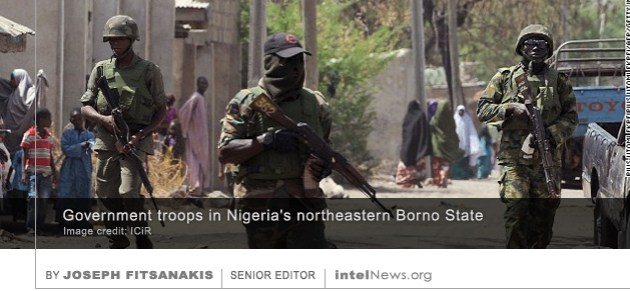 The West Africa province of the Islamic State has claimed responsibility for the killing 20 Nigerian soldiers and the execution of nine more soldiers that were captured in various operations, according to Reuters. The group behind the attacks emerged in 2002 under the name Boko Haram (“Western education is forbidden”), as part of a growing wave of anti-government sentiment in Nigeria’s Muslim-majority northern regions. In 2014, the group pledged allegiance to Abu Bakr al-Baghdadi, leader of the Islamic State of Iraq and Syria —otherwise known as Islamic State. Since that time, Boko Haram has rebranded itself as Islamic State – West Africa Province, while a smaller faction of the group has refused to align itself with the ISIS and continues to operate under the name Boko Haram.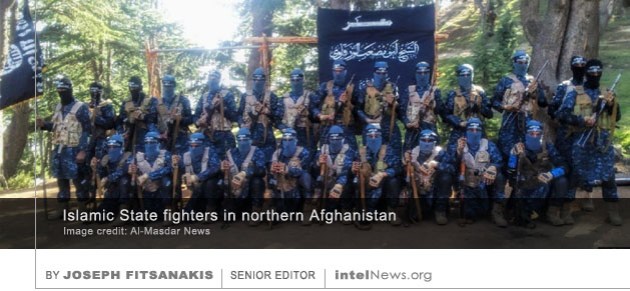







 intelNews.org
North Korean leader’s half-brother worked with CIA before his death, paper claims
June 12, 2019 by Joseph Fitsanakis 1 Comment
But a new book published on Tuesday by a Washington Post reporter, and an article that came out in The Wall Street Journal on the same day, allege that Kim Jong-nam was working with the United States Central Intelligence Agency and was in fact in Malaysia to meet with his American spy hander when he was killed. The Wall Street Journal article said that many details of Kim Jong-nam’s precise relationship with the CIA remain “unclear”. It is doubtful that the late half-brother of the North Korean leader had much of a powerbase in the land of his birth, where few people even knew who he was. So his usefulness in providing the CIA with crucial details about the inner workings of the North Korean regime would have been limited. However, the paper quoted “a person knowledgeable about the matter” as saying that “there was a nexus” between the CIA and Kim. The article also alleges that Kim met with CIA case officers “on multiple occasions”, including during his fateful trip to Malaysia in February of 2017.
In her just-published book The Great Successor, Anna Fifield, a correspondent with The Washington Post, claims that Kim spent a number of days on the island of Langkawi, a well-known resort destination in Malaysia. Security footage at his hotel showed him meeting with “an Asian-looking man [Korean-American, according to The Wall Street Journal] who was reported to be an American intelligence [officer]”. It was one of regular trips Kim took to places like Singapore and Malaysia to meet his spy handlers, according to Fifield, who cites “someone with knowledge of the intelligence”. She adds that, although meeting with this CIA handler may not have necessarily been the sole purpose of Kim’s fateful trip to Malaysia, it was certainly a major reason. Fifield alleges that the backpack Kim was carrying when he was killed at the Kuala Lumpur International Airport was found to contain $120,000 in cash. The Wall Street Journal claims that, in addition to meeting with the CIA, Kim held regular meetings with spy agencies of other countries, including China.
Meanwhile, two South Korean government agencies, the National Intelligence Service and the Ministry of Reunification, said on Tuesday that they were unable to confirm that Kim was indeed an asset of the CIA or any other intelligence agency. They also said that they could not confirm whether Kim had traveled to Malaysia to meet with a CIA case officer at the time of his assassination.
► Author: Joseph Fitsanakis | Date: 12 June 2019 | Permalink
Filed under Expert news and commentary on intelligence, espionage, spies and spying Tagged with assassinations, book news and reviews, CIA, espionage, Kim Jong-nam, Malaysia, News, North Korea, United States