US diplomats secretly met with Taliban without Afghan government

TalibanIn a dramatic change to longstanding policy, senior United States diplomats have reportedly held secret meetings with Taliban leaders without the presence –and presumably knowledge– of the Afghan government. For over a decade, the Taliban have refused to negotiate with the Afghan government, which they view as a puppet regime controlled by Washington. They have instead sought to speak directly with the United States, without Kabul’s mediation. In 2015, the United States sought to initiate peace talks with the Taliban in the Qatari capital Doha, but the effort collapsed after the Afghan government denounced it and demanded a seat at the table. The negotiation process has remained dormant since then.

Last week, however, The Wall Street Journal reported that a series of unannounced meetings have been taking place between a delegation of senior Taliban officials and an American team led by Alice Wells, principal deputy assistant secretary of the US Department of State’s Bureau of South and Central Asian Affairs. On Saturday, The New York Times confirmed the story, saying that meetings between the two sides were being held in Qatar, where the Taliban maintain an informal diplomatic mission. Citing “two senior Taliban officials”, The Times said that the American diplomats have been meeting with members of the Taliban’s political commissariat. But the paper said it had no information about the substance or progress of the talks. If The Times’ claims are accurate, they would mark a dramatic reversal of longstanding US policy on the Taliban. Since 2001, Washington has consistently argued that any negotiation process involving the Taliban would be “Afghan-owned and Afghan-led”. Therefore, direct talks between Washington and the Taliban without Kabul’s mediation would mark a major shift in America’s security strategy in Afghanistan and beyond.

The New York Times said it contacted the US Department of State in Washington, seeking clarification about the alleged talks. But a spokesman refused to discuss the claims and insisted that “any negotiations over the political future of Afghanistan will be between the Taliban and Afghan government”. However, The Times noted that the spokesman did not expressly deny the existence of the talks with the Taliban.

Author: Joseph Fitsanakis | Date: 31 July 2018 | Permalink

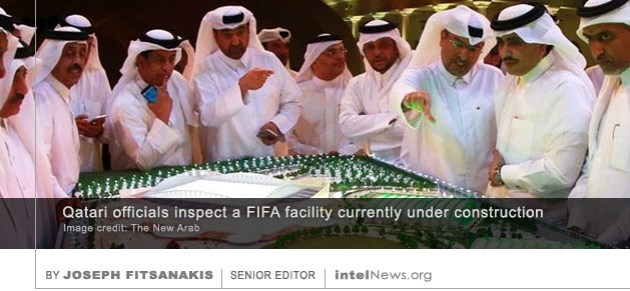
FIFA World Cup host Qatar ‘used ex-CIA agents to sabotage rival bids’

Qatar FIFA 2022The government of Qatar, which won the right to host the 2022 FIFA World Cup, hired a high-profile public relations group and a team of former officers of the United States Central Intelligence Agency (CIA) in order to undermine rival bids to host the tournament, according to a British newspaper. In December 2010, Qatar was named as the host of the lucrative tournament, which is held every four years under the auspices of the International Federation of Association Football. In winning the right to host the tournament, the Middle Eastern oil kingdom beat formidable rival bids from Japan, South Korea, Australia and the United States. FIFA’s decision to award the 2022 World Cup to Qatar has been heavily criticized –not least because it will take place in the winter, so as to avoid Qatar’s scorching summer temperatures. Many countries in Europe, Latin America and elsewhere will therefore have to resort to the highly unusual step of disrupting their domestic football seasons in order to send their national teams to compete in Qatar.

Now controversy over Qatar’s winning bid is likely to intensify following a claim by a leading British newspaper that the oil kingdom hired former CIA officers and public-relations specialists to discredit rival bids. According to the London-based Sunday Times newspaper, Qatar employed the public-relations firm Brown Lloyd Jones (now known as BLJ Worlwide) and a team of ex-CIA operatives. The Times said it had seen internal documents leaked by an unnamed whistleblower, which reveal the sinister nature of Qatar’s public-relations offensive. Much of it, said The Times, centered on propagating the view that World Cup bids by the United States and Australia would not be supported by the two countries’ domestic audiences. Organizations, academics, journalists and pressure groups from Australia and the United States, who were critical of their countries’ efforts to host the tournament, were clandestinely funded in order to promote their views. Additionally, BLJ and the former CIA operatives compiled intelligence folders on the leading figures of the rival countries’ bids.

If The Sunday Times’ allegations are correct, it would mean that Qatari authorities violated FIFA’s regulations for bidding to host tournaments. But last night the Supreme Committee for Delivery and Legacy, Qatar’s state-run group that organized the country’s World Cup bid, disimssed the newspaper’s accusations. Its spokesman rejected “each and every allegation put forward by The Sunday Times” and assured reporters that Qatar had “strictly adhered to all FIFA’s rules and regulations”.


Author: Joseph Fitsanakis | Date: 29 July 2018 | Permalink
Researchers uncover ‘ambitious’ Iranian hacker group that targets the Middle East

Computer hackingAn American cyber security firm has reported the discovery of a previously undetected, “highly active” Iranian cyber espionage group, whose extensive target list consists mainly of large organizations and companies in the Middle East. The cyber security firm Symantec, makers of Norton antivirus software, which uncovered the cyber espionage group’s existence, has dubbed it “Leafminer”. It said the group has been active since the beginning of 2017, but has “significantly ramped up its activities” in 2018 and is currently involved in dozens of ongoing attacks.
In a report published on Wednesday, Symantec said that its security experts managed to obtain what appears to be Leafminer’s master list of targets. The list is written in the Farsi language and contains just over 800 organizations, which according to Symantec researchers is “an ambitious goal” for any cyber espionage group. The organizations listed on the target sheet come from a variety of sectors, including government, transportation, the financial sector, energy and telecommunications. But the majority of the group’s targets appear to be in the petrochemical and government sectors. Additionally, virtually all of Leafminer’s targets are located in the Middle East and North Africa, in countries such as Israel, Egypt, Bahrain, Qatar, Kuwait and the United Arab Emirates. Some of the group’s targets are located in Afghanistan and Azerbaijan.

Symantec said its researchers observed the Leafminer hackers execute attacks in real time on at least 40 targets in the Middle East, including on the website of an intelligence agency in Lebanon. According to the cyber security company, Leafminer uses a variety of hacking tools, including custom-designed malware and some publicly available software. The group’s operational sophistication is also varied, and ranges from complex, multilayered attacks to brute-force login attempts. Symantec said it concluded that the cyber espionage group originates from Iran because its master target list is written in Farsi and because Iran is virtually the only country in the Middle East that is missing from the target list. However, it said that it did not have sufficient evidence to link Leafminer to the Iranian government. In a separate development, Germany’s domestic intelligence agency, the Federal Office for the Protection of the Constitution (BfV), said this week in its annual report that the government of Iran has significantly expanded its cyber warfare capabilities and “poses a danger to German companies and research institutions”.

Author: Joseph Fitsanakis | Date: 26 July 2018 | Permalink

German far-right group is arming itself, poses serious threat, report warns

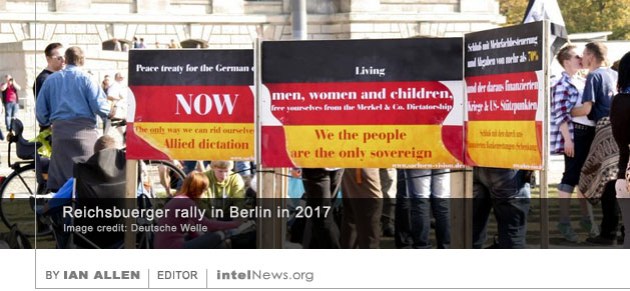
ReichsbuergerAdherents of a bizarre far-right movement in Germany, who claim to be citizens of Prussia, are arming themselves and pose a growing security threat, says a new report by the country’s domestic spy service. The members of the movement call themselves Reichsbuerger (“citizens of the Reich”) and reject the legitimacy of the Federal Republic of Germany. Instead of the modern-day German state, which emerged in 1990 from the union of East and West Germany, Reichsbuergers swear allegiance to the Deutsches Reich (German Reich), the Nazi German state that existed between 1933 and 1945. They also claim that the Deutsches Reich, which they occasionally refer to as Prussia, continues to exist in its pre-1945 state and is still governed by a provisional government in exile.

In some cases, Reichsbuerger adherents have contacted foreign embassies in Berlin and asked to be recognized as citizens of the Third Reich, but without success. In addition, some Reichsbuerger associations issue Deutsches Reich identification cards and Deutsches Reich car license plates. But these are dismissed as “fantastical” by German authorities, who have historically refused to take Reichsbuerger adherents seriously. But now the Federal Office for the Protection of the Constitution (BfV), Germany’s main domestic security agency, has said that the Reichsbuerger movement is growing and needs to be viewed as a potential security threat. According to the BfV’s annual report, which was published on Tuesday, the Reichsbuerger movement has grown by more than 65 percent since 2016 and currently consists of approximately 20,000 committed members.

In its report, the BfV notes that the numerical growth of Reichsbuerger adherents may be partly attributed to the heightened attention that German authorities have been paying to far-right organizations in recent years. The agency also states that only about five percent of Reichsbuergers may be described as violent or potentially violent extremists. However, violent Reichsbuergers have risen from 500 in 2016 to 900 in 2017, an 80% increase in a year, according to the report. Moreover, says the BfV, many core members of the Reichsbuerger movement maintain close contacts with German far-right criminal networks, whose members include current and former supporters of the National Socialist Underground (NSU). Earlier this month, several NSU members were found guilty of having participated in 10 politically motivated killings of immigrants between 2000 and 2007. The BfV report states that Reichsbuergers increasingly view the NSU’s violent acts as examples to follow, and that they are systematically attempting –and usually succeeding– to obtain gun licenses. In a report published earlier this year, the BfV had warned that the Reichsbuerger movement was trying to build an army.

Author: Ian Allen | Date: 25 July 2018 | Permalink

Revealed: British prime minister was not told about fourth Cambridge spy ring member

Anthony BluntThe Prime Minister of Britain, Sir Alec Douglas-Home, was kept in the dark by his own home secretary about the discovery of a fourth member of the infamous Cambridge Spy Ring in 1964, according to newly released files. The Cambridge Spies were a group of British diplomats and intelligence officials who worked secretly for the Soviet Union from their student days in the 1930s until the 1960s. They included Guy Burgess, Donald Maclean and H.A.R. “Kim” Philby, all of whom eventually defected to the Soviet Union. In 1964, Sir Anthony Blunt, an art history professor who in 1945 became Surveyor of the King’s Pictures and was knighted in 1954, admitted under interrogation by the British Security Service (MI5) that he had operated as the fourth member of the spy ring.

Despite his allegedly full confession, Blunt was never seriously disciplined for his espionage activities against Britain. In return for revealing his spy activities and naming others who had assisted him, he was granted immunity from prosecution. He was also allowed to remain in his academic post and retained his title of Surveyor of the Queen’s Pictures –effectively the curator of Queen Elizabeth II’s art collection. It wasn’t until 1979 when British Prime Minister Margaret Thatcher revealed in a statement to the British House of Commons that Blunt had been the fourth member of the Cambridge Spy Ring. Minutes after the prime minister’s statement entered the public record, Buckingham Palace (which had been made aware of Blunt’s espionage role back in 1964, but had been asked by Britain’s Interior Ministry to not draw attention to the scandal) stripped him of his 1954 knighthood.

It has now been revealed known that, in the days following her House of Commons statement about Blunt, Prime Minister Thatcher received several letters by Henry Brooke, who was serving as home secretary in 1964, when Blunt’s treachery was discovered. In his letters, Brooke (by then Lord Brooke of Cumnoor) expressed his support for the prime minister’s revelation. But the letters, which were previously classified but were published on Tuesday by Britain’s National Archives, also reveal that Brooke kept Blunt’s 1964 confession hidden from the then Prime Minister Sir Alec Douglas-Home. In his 1979 letter to Thatcher, Brooke states that he did not inform the prime minister in 1964 in his “well-meant effort not to add to [Douglas-Home’s] burdens”. But he adds that “I may, with hindsight, have expressed my discretion wrongly”. By that time, Blunt had voluntarily withdrawn from public life and was rarely heard of. Upon his death in 1984, his unfinished memoir was given to the British Library by the executor of his will, under the stipulation that it be kept sealed for 25 years. It was released to the public in 2009.

Author: Joseph Fitsanakis | Date: 24 July 2018 | Permalink

Iran warns of repercussions as US intensifies campaign against Tehran

IRGC IranIranian military officials have warned of extracting “revenge from foreign intelligence services”, as Reuters reported that an aggressive campaign against Tehran has been launched by Washington. On Sunday, the Reuters news agency said that senior officials in the administration of US President Donald Trump had launched a concerted offensive “meant to foment unrest” in the Islamic Republic. Citing information from “more than half a dozen current and former officials”, Reuters said that the US offensive is directly supported by President Trump’s Secretary of State Mike Pompeo and his National Security Adviser John Bolton. Both officials are known for their aggressive stance against the Iranian government.
The campaign, said Reuters, is meant to “work in concert” with President Trump’s push to “economically throttle Iran”. The US leader announced a series of economic sanctions on the Islamic Republic and has intensified his critical statements against Tehran after May of this year, when Washington pulled out of the Iran nuclear agreement. Known as the Joint Comprehensive Plan of Action (JCPOA), the international agreement was reached in 2015 between Iran and a group of nations known as the P5+1, namely the five permanent members of the United Nations Security Council plus Germany. As part of the deal, Iran agreed to halt its nuclear weapons program in exchange for an end to economic sanctions by the West. But President Trump abandoned the agreement, saying it was a form of appeasing Tehran.

According to Reuters, Washington’s campaign involves the spreading of information that “paints Iranian leaders in a harsh light” and in some cases makes claims about Tehran that are “exaggerated”. For example, said Reuters, some social media posts by the US Department of State’s Farsi-language news service claim that Iran is close to al-Qaeda, despite the fact that Shiite Islam, which is Iran’s state religion, is viewed as a heresy by Sunni members of al-Qaeda. Other –perhaps more believable– accusations include claims that the leaders of Iran are wasting funds released by the JCPOA instead of using it for their people’s welfare, and that Tehran funds the Taliban in Afghanistan.

Meanwhile, a spokesman for the Islamic Revolutionary Guard Corps (IRGC), arguably the most powerful branch of the Iranian Armed Forces, issued a warning on Sunday against “foreign intelligence services”. The spokesman, Brigadier General Ramezan Sharif, said Iran would take revenge on foreign spy services “who try to disrupt the security of Iran’s borders”. He was referring to an armed attack that took place on Saturday in Iran’s northwestern Marivan region, near the Iran-Iraq border. The attack concentrated on an Iranian military compound in the village of Dari and culminated with the bombing of an IRGC arms depot. According to Iranian media reports, the explosion killed 11 Iranian border guards. Reuters said it contacted the White House and the Department of State about the alleged campaign against Iran, but that both declined to comment.

Author: Joseph Fitsanakis | Date: 23 July 2018 | Permalink

Israel says it foiled Iranian-sponsored bomb attack in France

MossadIsrael helped foil an alleged Iranian-sponsored bomb attack in Paris, which involved arrests of several Iranian agents and at least one diplomat in France, Belgium and Germany, according to media reports. As intelNews reported earlier this month, the arrests began on June 30, when members of Belgium’s Special Forces Group arrested a married Belgian couple of Iranian descent in Brussels. The couple were found to be carrying explosives and a detonator. On the following day, July 1, German police arrested an Iranian diplomat stationed in Iran’s embassy in Vienna, Austria. On the same day, a fourth person, who has not been named, was arrested by authorities in France, reportedly in connection with the three other arrests.
All four individuals appear to have been charged with a foiled plot to bomb the annual conference of the National Council of Resistance of Iran (NCRI) that took place on June 30 in Paris. The NCRI is led by Mujahedin-e Khalq (MEK), a militant group with roots in radical Islam and Marxism. The MEK was designated as a terrorist group by the European Union and the United States until 2009 and 2012 respectively. But it has since been reinstated in both Brussels and Washington, reportedly because it provides the West with a vehicle to subvert the Iranian government.

On Thursday, authorities in Israel announced the lifting of a blanket censorship decree that prevented local media from discussing the country’s role in helping the Europeans foil the alleged bomb attack in Paris. According to Israel’s Channel 2, a private television station based in Jerusalem, the Iranian attack was prevented after the Israeli agency Mossad detected the whereabouts of several suspects involved in it. The Mossad then supplied Germany, Belgium and France with intelligence that led to the arrests of some of those suspects. However, Channel 2 said that the Israeli government did not give a reason for the initial censorship imposed on the country’s media, nor did it explain why it had decided to lift it. On July 4, Israeli Prime Minister Benjamin Netanyahu appeared to hint that Israel had a role in the foiling of the alleged bomb attack in Paris. Speaking during a commemoration ceremony in Acre, Israel, Netanyahu said it was “no coincidence” that the attack in Paris had been stopped. But the Israeli leader did not expressly indicate that the Mossad had a role in the operation.

Following news of the arrests in Europe, the Iranian government said that it had no connection to the alleged plot in Paris and called the incident a “false flag” operation staged by Tehran’s enemies at home and abroad.

Author: Joseph Fitsanakis | Date: 20 July 2018 | Permalink

US intelligence officials called to resign despite Trump’s Russia retraction

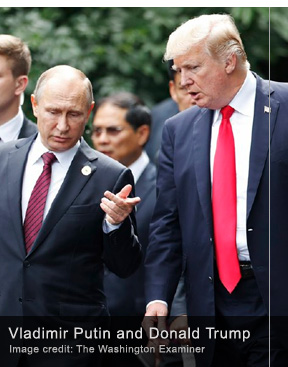
Putin and TrumpSeveral American former intelligence officials have called on their active colleagues to resign despite President Donald Trump’s retraction of his remarks about Russia’s alleged meddling in the 2016 presidential elections. On Tuesday, the US president issued an unusual retraction and correction of his public statement on Monday in Helsinki, Finland, in which he appeared to side with the Kremlin over his own Intelligence Community’s views. The Office of the Director of National Intelligence (ODNI), which is the coordinating body of the US Intelligence Community, has said that Russia tried to systematically interfere in the 2016 US presidential elections. According to the ODNI, the Kremlin’s goal was to augment the already heightened discord in American political life and deepen the mistrust between the electorate and state institutions, including Congress and the White House.
But President Trump dismissed those conclusions on Monday, while speaking alongside Russian President Vladimir Putin following the US-Russia summit in the Finish capital. During the joint press conference of the two leaders, the US president was asked to publicly adopt the US Intelligence Community’s conclusion that Russia interfered in the 2016 elections. But instead of doing so, Trump said his Russian counterpart had strongly denied the American accusations. “My people came to me”, said Trump, referring by name to his Director of National Intelligence (DNI) Dan Coats, and “said they think it’s Russia”. However, Trump continued, “President Putin […] just said it’s not Russia. I will say this, I don’t see any reason why it would be”. Following strong criticism of that comment, much of it from his own supporters, the US president retracted it on Tuesday in Washington, saying he misspoke in Helsinki. According to Trump, he said “would” when he meant to say “wouldn’t”.

The US president’s odd retraction came just hours after DNI Coats –a Trump appointee– issued a rare public statement rejecting Trump’s comments in Helsinki. “We have been clear in our assessments of Russian meddling in the 2016 election and their ongoing, pervasive efforts to undermine our democracy”, said Coats, adding that his office’s conclusion had been based on “unvarnished and objective intelligence”. Coats’ predecessor, former ODNI James Clapper, said during an interview with CNN on Tuesday that, if he still led the ODNI and had been “publicly thrown under the bus” by the president in that manner, he “would have stepped down in a heartbeat”. Read more of this post

Group of 13 North Korean defectors say they were ‘forcibly kidnapped’ by South

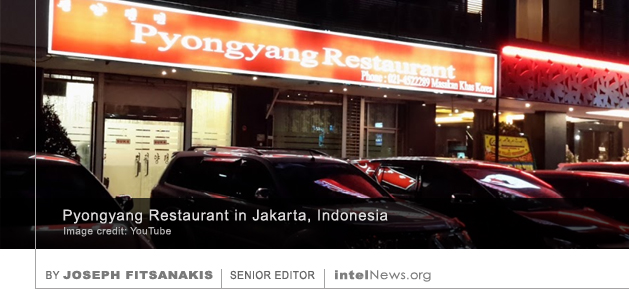
Pyongyang Restaurant in Jakarta, IndonesiaA group of 12 female North Korean restaurant workers and their male manager claim that their widely advertised defections in 2016 were fake, and that they were in fact abducted by South Korea’s spy services. The North Korean government maintains a chain of North Korea-themed restaurants throughout Asia, which operate as popular tourist attractions across Southeast Asia. The state-owned restaurants help provide the cash-strapped regime in Pyongyang with desperately needed foreign funds. The North Korean staff —almost all of them female— who work at these restaurants are carefully vetted and chosen to represent the reclusive regime abroad. Some observers claim that these restaurants serve “as a main front to conduct intelligence gathering and surveillance [against foreign] politicians, diplomats, top corporate figures and businessmen”.

In April of 2016, the entire staff of a North Korean restaurant in the Chinese city of Ningbo defected. They disappeared all of a sudden, and reappeared a few days later in South Korean capital Seoul, where South Korean authorities held a press conference. The South Koreans told reporters that the 13 North Koreans had decided to defect after watching South Korean television dramas, which allegedly caused them to lose faith in the North Korean system of rule. But Pyongyang dismissed the defections as propaganda and claimed that its citizens had been abducted by South Korean intelligence.

Now in a shocking interview published by South Korea’s Yonhap news agency, Ho Kang-il, the male manager of the North Korean restaurant in Ningbo said that he and his staff had been forcibly taken to South Korea. Ho told Yonhap that he had been approached by officers of South Korea’s National Intelligence Service (NIS) who tried to entice him to defect to South Korea. They told him that he could open a restaurant if he chose to lead a new life in the south. Initially Ho said he was interested in the offer. But when he appeared to change his mind, the NIS officers threatened to inform the North Korean embassy in China that he had been speaking with them. Ho also said that the NIS officers blackmailed his staff at the restaurant using similar methods. Consequently, all 13 of them decided to cooperate with the NIS, as they “had no choice but to do what they told [us] to do”, said Ho.

On Sunday, the United Nations’ Special Rapporteur on Human Rights in North Korea, Ojea Quintana, said during a press conference that the UN was concerned about the allegations made by Ho. He also said that some of the North Korean defectors had told UN personnel that they left China without knowledge of where they were being taken by South Korean intelligence. Quintana concluded his remarks by calling for a “thorough investigation” into the alleged abductions of the North Koreans.

Author: Joseph Fitsanakis | Date: 18 July 2018 | Permalink

Indian intelligence infiltrated Islamic State in ‘unprecedented operation’

New Dehli IndiaA joint Indian-American counterintelligence operation, described as “unprecedented in its scale and scope”, reportedly foiled a major suicide attack by the Islamic State in New Delhi and helped achieve “a string of victories” against the group in Afghanistan and Pakistan. Citing “top diplomatic and intelligence sources”, the New Delhi-based daily The Indian Express said that the “audacious” operation took place a year ago, but details about it were only made available to its reporters in recent days.
The paper said that the operation lasted 18 months and involved the systematic surveillance of numerous suspects in Dubai, New Delhi and several cities in Afghanistan. It also involved substantial intelligence-sharing between Indian and American security agencies, as well as constant intelligence-gathering by as many as 80 Indian physical-surveillance experts. Intelligence gathered from physical surveillance was reportedly combined with information collected through telephone intercepts. Eventually it became clear that the Islamic State had recruited and trained 12 suicide bombers across several secret camps in Pakistan. The recruits were tasked with carrying out suicide bomb attacks throughout Pakistan, Afghanistan and India.

One such recruit, the 25-year-old “son of a wealthy [Afghan] businessman”, had been sent by the Islamic State to New Delhi to carry out his deadly mission. In order to escape the attention of the authorities, he had enrolled in a private engineering college in New Delhi. But he was arrested by Indian intelligence and quickly transported to Afghanistan, where he was interrogated by American officers. According to The Indian Express, intelligence gathered from these interrogations helped the United States-led coalition in Afghanistan achieve “a string of successes” against former Taliban forces aligned with the Islamic State. The Afghan would-be suicide bomber remains in Afghanistan under US custody, according to the paper.

Author: Joseph Fitsanakis | Date: 17 July 2018 | Permalink

Emirati royal seeks asylum in rival Qatar in unprecedented move

Sheikh Rashid bin Hamad al-SharqiA member of one of the United Arab Emirates’ seven royal families has defected to Qatar and asked for political asylum, in what appears to be the first time that an Emirati royal has publicly turned against the oil-rich kingdom. In May of last year, the UAE joined an Arab coalition led by Saudi Arabia, which broke off all diplomatic relations with Qatar. The coalition accuses the tiny oil kingdom of clandestinely supporting Iran and funding Iranian-backed militant groups in the region. The UAE also participates in an ongoing large-scale commercial embargo against Qatar, which observers say is part of the regional cold war between Saudi Arabia and Iran.
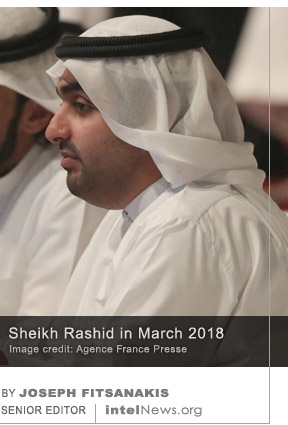
But on the morning of May 16, 2018, security officers in the Qatari capital Doha were stunned when an Emirati royal appeared before them and asked for political asylum and protection from the UAE. The royal was Sheikh Rashid bin Hamad al-Sharqi, the second son of the emir of Fujairah, one of the seven kingdoms that form the UAE. As a son of Fujairah’s emir, Sheikh Hamad bin Mohammed al-Sharqi, Sheikh Rashid, 31, had been placed in charge of the kingdom’s state-owned media arm. But in a stunning development, which appears to be a first in the 47-year history of the UAE, the prince has now defected to the UAE’s rival Qatar, and is publicly airing criticism of the UAE’s secretive rulers. In an interview with The New York Times last weekend, the prince provided what the paper described as “a rare glimpse into tensions among the rulers of the UAE” —especially between the Emirate of Abu Dhabi, which dominates the UAE, and the other six kingdoms.

Sheikh Rashid told The Times that Emirati officials were displeased with the country’s military intervention in Yemen, where a Saudi-led coalition is battling against Iranian-backed rebels. The increasingly bloody war is now in its third year without a clear end in sight. According to the prince, the rulers of Abu Dhabi have repeatedly failed to consult the country’s six remaining kingdoms before making major decisions about the war in Yemen. The sheikh also accused the leadership of the UAE of money laundering, and claimed that it was routine for UAE royals like himself to be asked by the country’s rulers to make secret payments “to people he did not know in other countries”, in direct violation of international money-laundering laws. Prince Rashid also alleged that the UAE government had tried to blackmail him by threatening to reveal audiovisual material that would discredit his reputation.

The Times said it reached out to the government of the Emirate of Fujairah, but its messages were not returned. The paper also contacted the UAE’s embassy in Washington, DC, but officials there declined to comment. For the time being, Sheikh Rashid remains at an unspecified location in Qatar, but the Qatari government will not comment as to his whereabouts.

Author: Joseph Fitsanakis | Date: 16 July 2018 | Permalink

Greece expels Russian diplomats who ‘tried to bribe Greek officials’

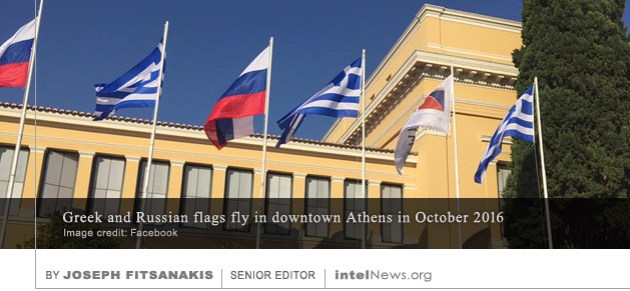
Greece RussiaIn a rare moment of downturn in relations between Athens and Moscow, Greece has expelled two Russian diplomats and refused to accredit two more, reportedly for “undermining Greek national security”. Greece was not among nearly 30 countries that expelled or refused to accredit over 150 Russian diplomats in March, in an act of solidarity with the United Kingdom. The expulsions came in response to the attempted assassination of Sergei Skripal, a Russian former intelligence officer who had been living in England since 2010. Britain accused the Kremlin of having sponsored the attack on Skripal. But the Greek government, which has enjoyed warm relations with Moscow for decades, warned against unduly aggressive measures against the Kremlin.
Things changed swiftly on Wednesday, however, when Athens announced the surprise expulsion of two Russian diplomats from the Greek capital. One of the two diplomats has been named as Victor Yakovlev, third secretary of the Russian embassy in Athens, who some say is in fact an intelligence officer. Two more Russian diplomats, who have not been publicly named, were barred from entering Greece —a move that effectively amounts to a refusal by the Greek government to accredit them. According to an official statement from the Greek Ministry of Foreign Affairs, the expulsions were meant to prevent the “undermining of [Greek] national security”. However, a report in the Greek daily Kathimerini said that the move was taken in response to attempts by Russian spies to bribe Greek state officials. Other reports claim that the Russians were caught trying to blackmail Greek lawmakers over the possible expansion of the North Atlantic Treaty Organization (NATO), of which Greece is a member.

Some of the allegations in the Greek press refer to the country’s three-decade long dispute with the Former Yugoslav Republic of Macedonia, which Athens accuses of harboring territorial ambitions against its neighbors. Greece —the wealthiest and most powerful state in the Balkans— has barred the entry of its northern neighbor into the European Union and NATO until it complies with a list of Greek demands. Chief among those is the drawing of a clear distinction between Greek Macedonia —once an ancient Greek kingdom ruled by Alexander the Great— and the Former Yugoslav Republic of Macedonia, which encompasses a small portion of Alexander’s former empire. Last month, the decades-long dispute between the two neighboring countries appeared to draw to a close with the proposed adoption of “Northern Macedonia” as the official name of the former Yugoslav republic. The agreement would open the way for the tiny landlocked country to enter into negotiations for eventual entry into NATO. However, nationalists in both countries have staged public rallies to protest against the proposed agreement.

It appears that Russian diplomats may have tried to convince Greek lawmakers —through extortion, bribing or both— to vote against the proposed agreement. There are also reports that Russian diplomats assisted in the organization of nationwide rallies against the proposed agreement in Greece, possibly by funding them or by spreading information about them on social media. The Russian government said on Wednesday that it would protest the expulsion of its diplomats from Athens. It also said that it reserved the right to respond to Greece’s move in kind, possibly by expelling an equal number of Greek diplomats from Moscow.

Author: Joseph Fitsanakis | Date: 12 July 2018 | Research credit: SF | Permalink

Spy chiefs from Russia, China, Iran and Pakistan hold high-level meeting

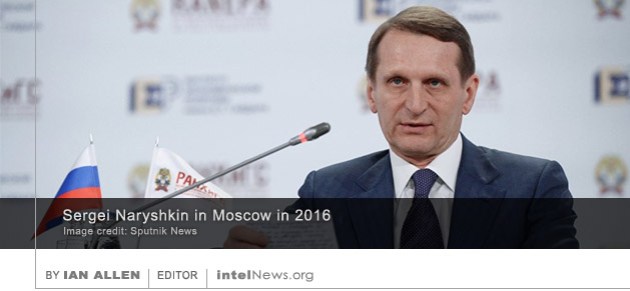
Sergei NaryshkinIntelligence directors from Russia, China, Iran and Pakistan met on Tuesday to discuss regional cooperation with particular reference to combating the Islamic State in Afghanistan. Information about the high-level meeting was revealed yesterday by Sergei Ivanov, media spokesman for the Russian Foreign Intelligence Service (SVR). Ivanov told Russia’s state-owned TASS news agency that the meeting was held in Pakistan and included the participation of SVR director Sergei Naryshkin. TASS reported that the meeting was held under the auspices of Pakistan’s powerful Inter-Services Intelligence (ISI) Directorate and was attended by “senior intelligence officials” from Pakistan, Russia, Iran and China.
Ivanov said that discussions during the meeting “focused on the dangers arising from a buildup of the Islamic State on the Afghan territory”. The Islamic State announced the formation of its Afghan province (wilayah in Arabic) in January 2015, using the term “Khorasan Province”. By July 2016, two of its most prominent leaders had been killed in coordinated drone strikes by the United States, but the group continues to launch operations to this day. Its core is thought to be made up of nearly 100 fighters from the Islamic State’s former strongholds in Syria and Iraq. According to Russian reports, security officials in China, Russia, Pakistan and Iran are concerned that the Islamic State’s Afghan command is becoming stronger as fighters from the group are leaving the Middle East and moving to Afghanistan.

Tuesday’s high-level meeting in Islamabad follows an announcement last month by the Beijing-led Shanghai Cooperation Organization (SCO) that it would adopt a more active stance on security issues in Afghanistan. Early in June, Afghan President Mohammad Ashraf Ghani described the SCO as “an important platform for anti-terrorist cooperation and enhancing regional connectivity” in Central and South Asia. President Ghani made these comments shortly before traveling to China to attend the annual summit of the SCO, of which Afghanistan is an observer country.

Author: Ian Allen | Date: 11 July 2018 | Permalink

North Korea asked Israel for $1 billion to stop giving missile technology to Iran

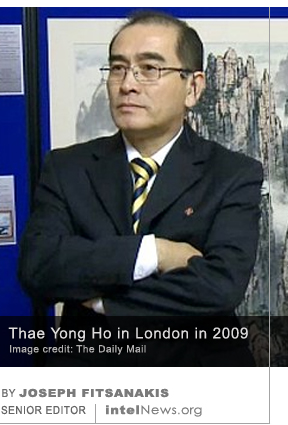
Thae Yong-HoNorth Korea offered to stop selling missile technology to Iran and other enemies of Israel in exchange for $1 billion in cash from the Jewish state, according to former senior North Korean diplomat who has now defected. The account of the offer can be read in Password from the Third Floor, a book published earlier this year by Thae Yong Ho. Thae, a member of a prominent North Korean family, defected with his wife and children in 2016, while he was serving as a senior member of the diplomatic staff of the North Korean embassy in London. News of Thae’s defection emerged on August 16, 2016, when a South Korean newspaper reported that he had disappeared from London after having escaped with his family “to a third country”. Thae later emerged in Seoul, from where he publicly denounced the North Korean regime.
Now Thae has written a book about his experiences as a North Korean diplomat from a family that is close to the country’s ruling Kim dynasty. In his memoir, Thae claims that he acted as a translator during a series of meetings between Son Mu Sin and Gideon Ben Ami, respectively North Korea’s and Israel’s ambassadors to Sweden. The alleged meetings took place in secret in the winter of 1999 in Stockholm, says Thae. During the first meeting, Son allegedly told Ben Ami that Pyongyang had a series of agreements to sell ballistic missile technology and know-how to Israel’s adversaries, such as Syria, Pakistan and Iran. However, the North Korean government would be willing to scrap the agreements in exchange for $1 billion in cash from Israel, said Son. Ben Ami reportedly told his North Korean counterpart that he would pass along his offer to the Israeli government. Three days later, says Thae, the two men held another secret meeting, during which the North Korean ambassador was told that Israel was not willing to pay Pyongyang $1 billion in cash. However, it could offer humanitarian aid of equal value. But according to Thae the North Koreans refused and “the talks ended without an agreement”.

It is believed that North Korea then went ahead and supplied both Syria and Iran with missile and nuclear technology. On Sunday, The Wall Street Journal reported that it contacted the government of Israel with several questions stemming from Thae’s account of the alleged diplomatic exchange of 1999. However, it received no response. The paper also tried to elicit responses from Ben Ami and Son, but had no success. According to The Journal, Ben Ami said during a television interview last week that he held three meetings with a group of North Korean officials in 1999. But he did not name the diplomats, nor did he discuss the subject of his conversations with them.

Author: Joseph Fitsanakis | Date: 10 July 2018 | Permalink

Holland expels two Iranian diplomats, but stays silent on reasons

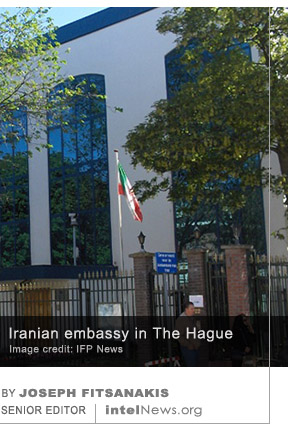
Iran embassy HagueHolland has expelled two Iranian diplomats without saying why, leading to speculation that the expulsions may be related to the arrests of members of an alleged Iranian sleeper cell in Belgium, Germany and France last week. On Friday, a spokesperson from Holland’s General Intelligence and Security Service (AIVD) told reporters that “two persons accredited to the Iranian embassy” in the Hague “were expelled from the Netherlands on June 7”. The spokesperson continued saying that, although the AIVD was able to confirm that the two unnamed persons had been expelled from the country, they would “not provide any further information”. When journalists contacted Holland’s Ministry of Foreign Affairs, they were told that there would be no comment on the matter from the Dutch government.

Late on Friday, the Reuters news agency cited an unnamed “European government official and a Western intelligence source” who said that the two Iranian embassy personnel were expelled from Holland “up to two months ago”. But Holland’s state-owned Dutch Broadcast Foundation (NOS) reported that the expulsions took place on June 7. No further information appears to be publicly available. However, assuming that the expulsions took place last week, and not two months ago, they appear to have coincided with the arrests of members of an alleged Iranian sleeper cell on June 30 and July 1. As intelNews reported last week, the arrests began on June 30, when members of Belgium’s Special Forces Group arrested a married Belgian couple of Iranian descent in Brussels. The couple were found to be carrying explosives and a detonator. On the following day, July 1, German police arrested an Iranian diplomat stationed in Iran’s embassy in Vienna, Austria. On the same day, a fourth person, who has not been named, was arrested by authorities in France, reportedly in connection with the three other arrests.

All four individuals appear to have been charged with a foiled plot to bomb the annual conference of the National Council of Resistance of Iran (NCRI) that took place on June 30 in Paris. The NCRI is led by Mujahedin-e Khalq (MEK), a Marxist militant group that has roots in radical Islam and Marxism. Until a few years ago, the MEK was designated as a terrorist group by the European Union and the United States, but has since been reinstated in both Brussels and Washington. There is also speculation that last week’s expulsions in Holland may be related to the assassinations of dissident Iranian expatriates in Holland in 2015 and 2017, which have been blamed on the government in Tehran.

On Saturday, the Iranian Ministry of Foreign Affairs summoned the Dutch ambassador to protest against the expulsions of its diplomats, while a ministry spokesperson warned that “the Islamic Republic reserves the right to retaliate”. Reuters quoted an unnamed “senior Iranian official” who said that “all these arrests and expulsions are part of our enemies’ attempts to harm efforts to salvage the nuclear deal”, a reference to the Joint Comprehensive Plan of Action.

Author: Joseph Fitsanakis | Date: 09 July 2018 | Research credit: M.K. | Permalink