Analysis: French are upset, but not surprised, by news of US spying

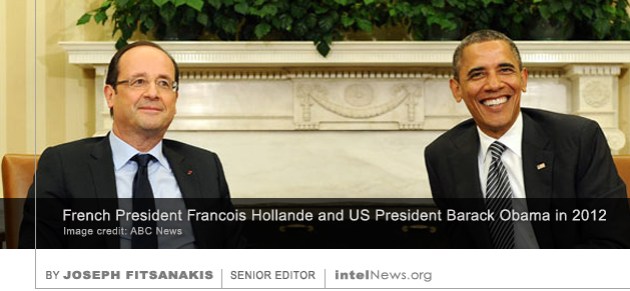
Before Edward Snowden, the revelation that the United States National Security Agency spied on three successive French presidents would have shocked many. But in the post-Snowden era, the news came and went without much tumult. The French President, Francois Hollande, called two emergency meetings of senior government officials at the Élysée Palace; the American ambassador to France was summoned for an official protest; but nothing more came of it. It was reported that US President Barack Obama spoke directly with his French counterpart on Wednesday, and assured him in no uncertain terms “that the US is no longer spying on France”.

The French leader, who is one of three French presidents mentioned in the WikiLeaks documents as a target of the NSA, is genuinely upset. And there will be some in his government who will push for a harder response than simply summoning the American envoy in Paris to file an official protest. But nobody in Paris or Washington thinks that Mr. Hollande, or indeed any other senior French official, was shocked or even surprised by the revelations of American espionage against France. Nor will the revelation cause any drastic disruption in the intelligence cooperation between France and the US. The two countries depend on each other to address a number of international issues that affect both, such the worrying situatioQ Quoten in Syria and Iraq, the continuing crises in Ukraine and in Libya, as well as the financial meltdown in Greece. So there is a recognition that their intelligence agencies must continue to work together on several pressing issues.

However, the French response may become a lot more direct if WikiLeaks publish further revelations about US espionage against French officials. The whistleblower website noted on Tuesday that “French readers can expect more timely and important revelations in the near future”. Unlike Edward Snowden, who is known to release progressively more damning documents in stages, WikiLeaks does not have a history of aiming for a crescendo through progressive releases of classified information. But there is speculation that Edward Snowden may in fact be the source of this latest WikiLeaks disclosure. If that is the case, we should not exclude further releases of relevant documents, and thus a more robust French response.

And what about America’s retort? Washington has suffered considerable diplomatic blowback from revelations in 2013 and 2014 that it spied on the leaders of Germany, Brazil and Argentina. Is the NSA still spying on America’s allied leaders? I am of the opinion that the NSA is not currently targeting the personal communications of allied government leaders as a matter of Q Quoteroutine practice. However, I do believe that this regimen can easily be changed to address particular needs, through what is called a “presidential finding”, basically a direct order issued by the president of the United States to target an individual foreign leader.
In the past two years, we have witnessed the diplomatic fallout that can result from publicly revealing these practices. However, for an intelligence agency like the NSA, having access to the personal communications of a foreign head of state is a temptation that is simply too difficult to resist. Moreover, it should not be assumed that political leaders are always completely in the know about the practices of their country’s intelligence agencies. American intelligence history amply demonstrates this truism. Finally, I would point to the well known maxim that intelligence agencies do not typically distinguish between adversaries and allies. All targets are considered fair game. This will admittedly do little to appease the French, but it will at least give them an accurate impression of what to expect in the brave new world of wholesale communications interception.

* This editorial is based on an interview given by the author to the Spanish newspaper La Razón.

Author: Ian Allen | Date: 25 June 2015 | Permalink: https://intelnews.org/2015/06/25/01-1722/

French president calls crisis meeting to discuss US spy revelations

France Hollande ObamaThe president of France has convened an emergency meeting of the country’s highest national security forum in response to revelations that the United States spied on three French presidents. The Conseil de la Défense is to convene in Paris on Wednesday to discuss the emergence of documents that appear to implicate the US National Security Agency (NSA) in spying on Jacques Chirac and Nicolas Sarkozy, who ruled France from 1995 to 2012. The documents further indicate that the NSA may have also targeted the personal communications of Francois Hollande, France’s current head of state.


The files were published on Tuesday by the international whistleblower website WikiLeaks. They consist of what WikiLeaks described as “top secret intelligence reports and technical documents”, which detail NSA spying operations against the French presidency, as well as espionage directed at several French government ministers and at France’s ambassador to the US. WikiLeaks would not indicate whether it acquired the documents from American defector Edward Snowden, who is currently living in Russia. But it said that “French readers can expect more timely and important revelations in the near future”.

The material –termed “Espionnage Élysée” by WikiLeaks– features a list of “selectors”, which includes French government telephone numbers targeted for interception. One of the numbers is identified as belonging to the president of France. The document collection also includes a handful of intelligence briefs, which are presumably based on intercepted communications from the telephone lines listed among the “selectors”. They detail the thoughts and diplomatic maneuvers by French presidents and other senior officials on subjects such as the Greek economic crisis, the Israeli-Palestinian dispute, and the United Nations.

French newspaper Liberation, which partnered with WikiLeaks to release the NSA material, said on Tuesday that the revelation should not surprise anyone in the post-Snowden era, but that it was still likely to cause a significant rift in French-American relations. In 2014, Germany expelled the station chief of the Central Intelligence Agency in Berlin –essentially the highest-ranking American intelligence officer in the country– over revelations that the US spied on the personal communications of Chancellor Angela Merkel.

Liberation contacted the NSA but was told by its spokesman, Ned Price, that the Agency was “not going to comment on specific intelligence allegations”. A spokesman from the Élysée Palace told the paper that an official statement would be issued following the Conseil de la Défense meeting on Wednesday.

Author: Joseph Fitsanakis | Date: 24 June 2015 | Permalink: https://intelnews.org/2015/06/24/01-1721/

New book by ex-Mossad officer examines Israel’s intelligence doctrine

Yossi AlpherYossi Alpher, a former Israeli intelligence officer, who was directly involved in numerous top-secret operations during his spy career, has published a new book that analyzes the overarching strategy behind Israel’s spy operations. Alpher served in Israeli Military Intelligence before joining the Mossad, where he served until 1980. Upon retiring from the Mossad, he joined Tel Aviv University’s Jaffee Center for Strategic Studies, which he eventually directed. Throughout his career in intelligence, Alpher worked or liaised with every Israeli spy agency, including the Shin Bet –the country’s internal security service.

In Periphery: Israel’s Search for Middle East Allies, published this week by Rowman & Littlefield, Alpher examines Israel’s so-called ‘periphery doctrine’. This strategy was devised by Israel’s founder and first Prime Minister, David Ben-Gurion, and formed the basic operational doctrine of the Mossad since the organization’s inception, in 1949. The strategy was based on forging deep operational ties between Israeli and non-Arab intelligence services in the Middle East and Africa, and then presenting these alliances as assets to the United States, so as to win Washington’s support. In pursuit of the periphery doctrine, Israel focused on strengthening ties with religious or ethnic minorities in the Middle East, including the Kurds in Iraq and Syria, and signed intelligence cooperation agreements with countries such as Iran, Turkey, Ethiopia, Kenya and Uganda.

According to Alpher, the most ambitious part of the periphery doctrine was the secret intelligence pact signed between Israel, Turkey and Iran. Known as C’lil in Israel, and as Trident in the United States, the agreement was struck in Ankara in 1958. Almost immediately after signing the treaty, senior Israeli officials contacted Washington and presented the secret pact between three American allies as a barrier against Soviet influence in the Middle East. Alpher says the Americans’ response was so enthusiastic, that the Central Intelligence Agency even agreed to fund the construction of a two-story building in a remote region of Israel, which served as C’lil/Trident’s headquarters. The building still exists today, says Alpher.

In another aspect of the periphery doctrine, the Mossad trained the bodyguards of senior Moroccan government officials and funded the science and technology division of the Moroccan intelligence services, almost in its entirety. In the book, Alpher reveals that Yitzhak Rabin visited Morocco incognito when he was prime minister, wearing a blond wig, in order to avoid being noticed by the press, diplomats or foreign spies. Alpher also discusses in unprecedented detail Operation ROTEV, a secret program implemented by the Mossad in the 1960s to arm the Yemeni royalists involved in the North Yemen Civil War. He told Israeli newspaper Yedioth Ahronoth that he was personally tasked with inspecting Israeli weapons and ammunition destined for the Yemeni royalists, in order to ensure that they could not be traced back to Israel.

A number of Israeli authors, notably Shimon Shamir, professor emeritus of Middle East history at Tel Aviv University, have authored highly critical appraisals of the Mossad’s periphery doctrine, arguing that it prevented Israel from seeking peace with its Arab neighbors. Additionally, the periphery strategy prompted the Mossad to collaborate with several governments that Yedioth Ahronoth calls “dark regimes and terrible dictatorships, by actively supporting them and sometimes tipping the scales in their favor”. Alpher recognizes the ethical problems of the periphery doctrine; however, he remains supportive. The periphery doctrine allowed Israel to survive by giving it funds to develop weapons programs, which in turn allowed it to win two wars against Arab armies, he says.

Author: Ian Allen | Date: 23 June 2015 | Permalink: https://intelnews.org/2015/06/23/01-1720/

Panel to present findings on mysterious death of UN secretary general

Dag HammarskjöldA panel of experts commissioned by the United Nations is about to unveil fresh evidence on the mysterious death in 1961 of UN secretary general Dag Hammarskjöld, who some claim was murdered for supporting African decolonization. The evidence could spark a new official probe into the incident, which has been called “one of the enduring mysteries of the 20th century”.

On September 17, 1961, a Douglas DC-6 transport aircraft carrying United Nations Secretary General Dag Hammarskjöld crashed in the British-administered territory of Northern Rhodesia (now Zambia). The crash killed everyone onboard. Three successive investigations into the crash, conducted by the Rhodesian Board of Investigation, the Rhodesian Commission of Inquiry, and the United Nations Commission of Investigation, viewed “pilot error” as the most likely cause of the tragedy. However, the latter probe, which was closed in 1962, opined that deliberate sabotage could not be ruled out as a likely cause of the tragedy.

Since that time, numerous scholars and independent investigators, such as Swedish development expert Göran Björkdahl and British academic Susan Williams, have raised the possibility that the plane carrying Secretary General Hammarskjöld may have been “shot down by an unidentified second plane”. Several commentators have also pointed to what seemed like eagerness by British colonial administrators in Northern Rhodesia to obscure the details of the incident. One argument is that Hammarskjöld, described as the most independent-minded secretary general in the history of the UN, had angered many world powers due to this fierce support for anti-colonial movements that were sweeping the African continent. Indeed, at the time of his death, Hammarskjöld was flying to the Congo’s mineral-rich Katanga region to meet European-supported chieftains who in 1960 had seceded from the nationalist government of Congolese Prime Minister Patrice Lumumba. Ironically, Lumumba had been assassinated in a Western-backed coup exactly eight months before Hammarskjöld’s own death.

In 2012, the independently funded Hammarskjöld Inquiry Trust appointed an international team of jurists to study all available evidence on the plane crash. The team, called the Hammarskjöld Commission, was composed of a diplomat and three judges from the Netherlands, the United Kingdom, South Africa, and Sweden. The Commission reported in 2013 that “significant new evidence” had emerged, which suggested that American intelligence agencies, notably the National Security Agency and the Central Intelligence Agency, held “crucial evidence” that could help clarify the causes of the crash.

The report by the Hammarskjöld Commission prompted the UN’s current Secretary General, Ban Ki-moon, to appoint a UN-sponsored panel of experts to examine the new evidence and present it before the UN General Assembly. The three-member panel traveled to several countries, including Zambia, the US, Britain and Belgium, to access government, as well as private archives. Its report is expected to be delivered to the UN General Assembly this week. It is said to include written testimony by a Belgian pilot who says he shot down the plane carrying Hammarskjöld by error, while trying to divert it on orders by a government entity. Another witness, a former intelligence officer with the US National Security Agency, is believed to have told the UN experts that he listened to a recording of a pilot who said he shot down the UN Secretary General’s plane.

Once this new evidence is presented, the UN General Assembly will have to vote on whether the UN should hold an official probe into the plane crash. It would mark the first such inquiry since 1962.

Author: Joseph Fitsanakis | Date: 22 June 2015 | Permalink: https://intelnews.org/2015/06/21/01-1719/

German parliament may sue government to access British spy files

Angela Merkel and David CameronA German parliamentary committee investigating spying operations may take the German government to court in order to force it to give up secret documents on Berlin’s intelligence cooperation with Britain. The Committee of Inquiry into Intelligence Operations was set up in 2014, after files leaked by American defector Edward Snowden revealed 1 that the United States had been spying on the telephone communications of German Chancellor Angela Merkel. But the scope of the committee expanded earlier this year, when it emerged that, while being spied upon by the US and Britain, Germany also collaborated 2 with American and British intelligence agencies in order to spy on France and other European countries.

Last week, the German Office of the Federal Prosecutor concluded 3 its criminal investigation into alleged espionage operations by the US National Security Agency against Chancellor Merkel. German officials said they had to drop the probe because of the unwillingness of US government officials to share information on the subject. But the parliamentary committee continues the inquiry on the related subject of Germany’s intelligence cooperation with the Britain and the US. The committee’s chairman, Dr. Patrick Sensburg, said on Thursday that his team of investigators would consider “going to court” in order to force the German government to release all relevant documents. Speaking 4 to the British newspaper The Daily Telegraph, Dr. Sensburg said that the parliamentary inquiry had a right to investigate intelligence cooperation between Berlin and London.

However, as intelNews reported 5 in February, the British government is said to have warned Germany that all intelligence cooperation between the two countries will be terminated should classified information about British intelligence operations be shared with an inquiry. Dr. Sensburg was asked by The Telegraph whether reports of the British warnings were true, but he responded that he was unable to comment on the matter.

Author: Joseph Fitsanakis | Date: 19 June 2015 | Permalink: https://intelnews.org/2015/06/18/01-1718/


  1. J. FITSANAKIS “US surveillance or Merkel’s phone prompts angry German reaction” intelNews [24oct2013] 
  2. J. FITSANAKIS “Airbus to sue Germany for helping US spy on its operations” intelNews [01may2015] 
  3. T. SCHLEIFER “Germany drops probe into U.S. spying on Merkel” cnn [13jun2015] 
  4. J. HUGGLER “German spy inquiry could demand access to British secrets” The Daily Telegraph [18jun2015] 
  5. J. FITSANAKIS “Britain threatens to stop intelligence cooperation with Germany” intelNews [13feb2015] 

Informant ‘got $47m reward’ for clues on MH17 downing over Ukraine

MH17 crashA German investigator, who is probing the downing of a civilian airliner over Ukraine nearly a year ago, says that an informant has claimed a multimillion reward for information pointing to those responsible for the attack. The investigator, Josef Resch, of Lübeck, Germany, says that a binding non-disclosure agreement does not allow him to reveal his client, who offered the $47 million reward. But he told German business magazine Capital that he is hopeful his client will soon reveal the details, since “people who pay that kind of money in exchange for information do not keep it for themselves”. However, he also hinted that his client may be an intelligence agency, who may decide to “deal with the matter without fanfare”.

Resch was speaking in reference to the murder of 295 people in July 2014, who died when the Malaysia Airlines Boeing 777-200 they were on was shot down 1 near the Ukrainian city of Donetsk. The city has a large Russian population and constitutes a major front in the current War in Donbass, which is being fought between the Ukrainian government and pro-Russian Ukrainians. For that reason, the downing of MH17 has become politically contentious: the United States claims 2 that it was shot down by Russian-supported rebels, while Russia accuses 3 the Ukrainian Air Force of deliberately firing on the airliner in order to blame the rebels.

If Resch’s claim is accurate, it would mean that someone with inside knowledge about the identity of the shooters has has come forward with crucial information about the killing of nearly 300 civilians over Donetsk. The size of the award also implies that those offering it are prepared to take some form of action in response to the information. Capital notes 4 that the multimillion award is higher than the amount offered in the past by the government of the United States for information leading to the capture of Osama bin Laden.

Resch told Capital that he is not certain whether the anonymous informant was able to claim the entire reward amount, or just part of it. He also said that he never came in direct contact with the informant, as the latter was represented “by a Swiss middleman” throughout the negotiations.

Author: Ian Allen | Date: 18 June 2015 | Permalink: https://intelnews.org/2015/06/18/01-1717/


  1. J. FITSANAKIS “Ukraine rebels ‘admit downing Malaysia plane’ in phone intercepts” intelNews [18jul2014] 
  2. I. ALLEN “US spies say incriminating flight MA17 recordings are genuine” intelNews [24jul2014] 
  3. I. ALLEN “Russia says it traced Ukraine fighter jet near downed Malaysia plane” intelNews [22jul2014 
  4. J. BRAMBUSCH “Informant zu MH 17 packt aus” Capital [15jun2015] 

Australian spies use paid informants abroad to stop human smuggling

ASISAustralian law enforcement and intelligence agencies routinely use paid informants in Indonesia and Pakistan as part of a decade-old covert war against human traffickers in the Indian Ocean. This information has been revealed by The Australian newspaper in response to reports 1 last week that Australian authorities paid traffickers to turn around a boat transporting asylum-seekers to the country. After the reports came out, many members of the opposition Australian Labor Party blasted the government for bribing human traffickers, and calling the practice “disgraceful” and “unsustainable”. But new information published on Monday shows that, when the Labor Party was in government, it instructed the country’s law enforcement and intelligence agencies to recruit and pay informants from within the human-trafficking networks abroad.

According 2 to The Australian, the use of paid informants is part of a wider secret war between the Australian intelligence and security agencies and the trafficking networks, which began in 2001. This “covert war”, said the paper, is meant to identify the structure and operations of human-trafficking syndicates and stop the constant flow of tens of thousands of asylum-seekers to Australia. According to the paper, the Australian Secret Intelligence Service (ASIS) was the first Australian government agency to begin the practice. It was followed in 2005 by the Australian Federal Police, which also began stationing officers abroad and tasking them with running networks of informants. In 2009, ASIS received $21 million (US$16.5 million) from the Australian government to develop networks of agents in several countries where large human-smuggling cartels are known to operate. The agency used the funds to station officers in several Indonesian cities, as well as in Pakistani capital Islamabad, where it operates in coordination with the Federal Investigations Agency of Pakistan’s Ministry of the Interior.

The Australian quoted an unnamed Australian intelligence official who had access to the intelligence reports from the ASIS anti-smuggling operations. He told the paper that the use of informants who are members of smuggling gangs was the only effective way of eventually “collapsing these networks”. Meanwhile, the government of Australia has refused comment on the allegations of bribing human smugglers.

Author: Joseph Fitsanakis | Date: 17 June 2015 | Permalink: https://intelnews.org/2015/06/17/01-1716/


  1. B. LAGAN “Australia accused of bribing smugglers to take refugees away” The Times [13jun2015] 
  2. C. STEWART “Spies, police have paid Indonesian informers for years” The Australian [16jun2015] 

Murder suspect to give evidence on death of ex-KGB spy in London

Alexander LitvinenkoA Russian former intelligence officer, who is accused by the British government of having killed a former KGB spy in London, has agreed to testify at a public inquiry to be held in the British capital next month. British government prosecutors believe Russian businessman Dmitri Kovtun, who worked for the KGB during the Cold War, poisoned his former colleague in the KGB, Alexander Litvinenko, in 2006. Litvinenko was an officer in the Soviet KGB and one of its successor organizations, the FSB, until 2000, when he defected with his family to the United Kingdom. He soon became known as a vocal critic of the administration of Russian President Vladimir Putin. In 2006, Litvinenko came down with radioactive poisoning soon after meeting Kovtun and another former KGB officer, Andrey Lugovoy, at a London restaurant. He was dead less than two weeks later.

In July of 2007, after establishing the cause of Litvinenko’s death, which is attributed to the highly radioactive substance Polonium-210, the British government officially charged 1 Kovtun and Lugovoy with murder and issued international arrest warrants for their arrest. Soon afterwards, Whitehall announced the expulsion of four Russian diplomats from London. The episode, which was the first public expulsion of Russian envoys from Britain since end of the Cold War, is often cited as marking the beginning of the worsening of relations between the West and post-Soviet Russia.

Since 2007, when they were officially charged with murder, Kovtun and Lugovoy deny the British government’s accusations, and claim that Litvinenko poisoned himself by accident while trading in illegal nuclear substances. The administration of Russian President Vladimir Putin refuses to extradite the two former KGB officers to London, and has denounced the British public inquiry into Litvinenko’s death as “a sham”. However, last March Kovtun unexpectedly wrote to the presiding judge at the inquiry, Sir Robert Owen, offering to testify via a live video link from Moscow. On Monday, Sir Robert issued a statement 2 saying an agreement had been struck between Kovtun and the inquiry, and that the Russian businessman would testify from Moscow, “most likely towards the end of next month”. Kovtun is expected to confirm that he met Litvinenko in London on the day the former KGB spy fell ill, but to insist that he had no role in poisoning him.

Author: Joseph Fitsanakis | Date: 16 June 2015 | Permalink: https://intelnews.org/2015/06/16/01-1715/

In surprise move, US Congress may slash funding for CIA ops in Syria

CIAAmerican Congressional lawmakers have voted to cut funding for the Central Intelligence Agency’s secret operations in Syria, in a surprise move that indicates growing concern on Capitol Hill with Washington’s strategy on the Syrian Civil War. The CIA’s involvement in the Syrian Civil War began in 2012, when US President Barack Obama issued 1 a classified presidential finding that authorized Langley to arm and train opposition militias. The clandestine program was initially based in training camps in Jordan, before eventually expanding to at least one location in Qatar. Currently, the CIA’s secret involvement in the Syrian conflict is said 2 to be among the Agency’s most extensive covert operations in the world, and comes at an annual cost that is nearing $1 billion.

But this amount may be cut by as much as 20 percent if the Permanent Select Committee on Intelligence of the US House of Representatives has its way. According to The Washington Post 3, the Committee recently voted to reduce the Agency’s classified funds for the Syria operation as a way of expressing its “concern with [US] strategy in Syria”. It is perhaps indicative of the displeasure on Capitol Hill with Washington’s current policy on Syria that the Committee voted unanimously to slash the CIA’s funding. The Post even quoted the ranking Democrat on the Committee, Adam B. Schiff (CA), who said there was “growing pessimism” among Committee members, who felt that the US would not be in a position to “help shape the aftermath” of the conflict in Syria.

The surprise move by the Congressional intelligence panel will need to be ratified by the House, which will vote on a preliminary intelligence-spending bill this week. The Post said that the measure “provoked concern” in the White House, while CIA officials warned that slashing the CIA’s funding for its Syria operations could seriously hurt rebel groups that are being backed by the US. One unnamed US intelligence official told the paper that Russia and China would continue to fund the regime of Syrian President Bashar al-Assad, even as Congress decided to defund the CIA’s operations in the war-torn Middle Eastern country. The White House declined to respond to questions about the vote.

Author: Joseph Fitsanakis | Date: 15 June 2015 | Permalink: https://intelnews.org/2015/06/15/01-1714/


  1. J. Fitsanakis “Obama authorizes CIA to conduct ‘non-lethal covert action’ in SyriaintelNews [03aug2012] 
  2. G. Miller and K. DeYoung “Secret CIA effort in Syria faces large funding cutThe Washington Post [12Jun2015] 
  3. G. Miller and K. DeYoung “Secret CIA effort in Syria faces large funding cutThe Washington Post [12Jun2015] 

Israel denies using computer virus to spy on Iran nuclear deal

Duqu 2.0The Israeli government rejected reports yesterday that its spy agencies were behind a virus found on the computers of three European hotels, which hosted American and other diplomats during secret negotiations on Iran’s nuclear program. Cybersecurity firm Kaspersky Lab said on Wednesday that it first discovered the malware, which it dubbed “Duqu 2.0”, in its own systems. The Moscow-based firm said the sophisticated and highly aggressive virus had been designed to spy on its internal research-related processes. Once they detected the malicious software in their own systems, Kaspersky technicians set out to map Duqu’s other targets. They found that the virus had infected computers in several Western countries, in the Middle East, as well as in Asia. According to Kaspersky, the malware was also used in a cyberattack in 2011 that resembled Stuxnet, the elaborate virus that was found to have sabotaged parts of Iran’s nuclear program in 2010.

However, Kaspersky said that among the more recent targets of the virus were “three luxury European hotels”, which appear to have been carefully selected among the thousands of prestigious hotels in Europe. The three appear to have only one thing in common: all had been patronized by diplomats engaged in the ongoing secret negotiations with Iran over the Islamic Republic’s nuclear program. Kaspersky was referring to the so-called P5+1 nations, namely the five permanent members of the United Nations Security Council plus Germany, who lead ‘the Geneva pact’. Israel has condemned the negotiations and has repeatedly expressed anger at reports that the Geneva pact is about to strike an agreement with Tehran over its nuclear program.

However, Israel’s deputy foreign minister flatly rejected Kaspersky’s allegations on Wednesday, calling them “pure nonsense”. Speaking on Israel Radio, Eli Ben-Dahan said Israel had “many far more effective ways” of gathering foreign intelligence and that it did not need to resort to computer hacking in order to meet its intelligence quotas. Israeli government spokespeople refused to comment on the allegations when asked late Wednesday.

Author: Joseph Fitsanakis | Date: 11 June 2015 | Permalink: https://intelnews.org/2015/06/11/01-1713/

CIA chief paid secret visit to Israel ahead of Iran nuclear deal

John BrennanThe director of the United States Central Intelligence Agency visited Israel in secret last week to discuss the Jewish state’s refusal to endorse an emerging deal with Iran over its nuclear program. Citing “two senior Israeli officials”, the Tel Aviv-based Israeli newspaper Haaretz said on Tuesday that CIA Director John Brennan arrived in Israel last Thursday. Although he was officially hosted by Tamir Pardo, director of Israeli intelligence agency Mossad, Brennan used the opportunity to hold secret meetings with several senior Israeli officials, said Haaretz. Among them were Prime Minister Benjamin Netanyahu, National Security Adviser Yossi Cohen, as well as Major General Hartzl Halevi, who heads Israel’s Military Intelligence Directorate.

According to Haaretz, Brennan’s visit to Israel had been planned “long ahead of time”, and should not be interpreted as a sudden diplomatic move from Washington. However, it came just weeks ahead of a deadline for a far-reaching settlement next month between Iran and six world powers over the Islamic Republic’s nuclear program. If successful, the much-heralded deal will mark the conclusion of ongoing negotiations between the Islamic Republic and a group of nations that have come to be known as P5+1, representing the five permanent members of the United Nations Security Council plus Germany. Israel, however, has strongly criticized the negotiations, referred to as ‘the Geneva pact’. Last year, the Israeli Prime Minister called the pact a “historic mistake” that would enable “the most dangerous regime in the world” to get closer to “attaining the most dangerous weapon in the world”.

It is not known whether Brennan brought with him a message from US President Barack Obama addressed to the Israeli Prime Minister, said Haaretz. On Monday, just 72 hours after Brennan’s departure, another senior American official landed in Tel Aviv —openly this time. It was General Martin Dempsey, Chairman of the US Joint Chiefs of Staff, who was hosted by his Israeli counterpart, General Gadi Eisenkot. Like Brennan before him, General Dempsey met with Prime Minister Netanyahu and Minister of Defense Moshe Yaalon. Haaretz contacted the CIA about Brennan’s secret visit to Israel, but an Agency spokesperson refused to comment.

Author: Joseph Fitsanakis | Date: 10 June 2015 | Permalink: https://intelnews.org/2015/06/10/01-1712/

Swiss reject contract bid by UK-owned internet firm over spy fears

UPC CablecomThe Swiss federal government has rejected a multi-million dollar contract bid by one of the world’s largest broadband Internet service providers, saying it is foreign-owned and could serve as “a gateway for foreign spies”. The company, UPC Cablecom, is headquartered in Zurich, is subject to Swiss law, and is currently the largest broadband cable operator in Switzerland. However, in 2005 it became a subsidiary of the UPC Broadband division of Liberty Global Europe, an international telecommunications and television company based in London, England. It is therefore technically considered a foreign company according to Swiss law. In 2013, UPC Cablecom submitted a bid for a competitive contract to provide broadband Internet services to Swiss government agencies. But in January 2014, the company was informed by Swiss officials that such a contract could not be awarded to a foreign-owned telecommunications service provider such as UPC Cablecom.

Until last week, it had been generally assumed that the decision to exclude UPC Cablecom’s bid on the basis of the company’s foreign ownership had been taken by the officials in charge of evaluating the contract. However, on Friday of last week, the Swiss daily Berner Zeitung reported that the decision to drop UPC Cablecom’s bid had been taken by no other than the Swiss Federal Council. Consisting of seven members representing various cantons and political parties, the Federal Council serves as Switzerland’s collective head of government and effectively operates as the country’s head of state. It was the Federal Council, said Berner Zeitung, that intervened in the contract evaluation proceedings and instructed the Swiss Federal Department of Finance to exclude bids by foreign-owned companies. The argument was that such companies could serve as “potential gateways for foreign intelligence constituencies”, said the paper. It added that the decision had been taken in light of information revealed by American former intelligence operative Edward Snowden, who is currently living in Russia.

The ruling by the Federal Council meant that Swisscom became the sole bidder for the government contract, which is worth 230 million Swiss francs (US $378 million). Meanwhile, UPC Cablecom has filed a complaint with Switzerland’s Federal Administrative Court, claiming that the Federal Council abused its power by intervening in the service contract. The Court’s decision is not expected for several months.

Author: Joseph Fitsanakis | Date: 9 June 2015 | Permalink: https://intelnews.org/2015/06/09/01-1711/

Belgium launches official probe into alleged German-US espionage

BelgacomThe Belgian government has announced the start of an official investigation into allegations that the country’s tele- communications networks were spied on by a consortium of German and American intelligence agencies. A press release issued Friday by the Belgian Ministry of Justice said the minister, Koen Geens, had authorized an examination of claims of espionage by the United States National Security Agency and Germany’s Bundesnach-richtendienst (BND). The statement was referring to EIKONAL, an alleged collaboration between the NSA and the BND, which was revealed last month by Austrian politician Peter Pilz. Pilz told a press conference in Bern, Switzerland, that EIKONAL had targeted European telecommunications carriers for at least four years, from 2005 to 2008. The governments of Switzerland and the Netherlands have already launched their own investigations into EIKONAL.

After speaking with Pilz, Belgian politician Stefaan Van Hecke told Belgian media last month that the BND-NSA consortium had penetrated the network of Proximus, the mobile subsidiary of Belgacom, Belgium’s national telecommunications carrier. Speaking anonymously about the investigation, a Belgian official told the country’s largest French-language newspaper, Sud Presse, that if the alleged espionage is confirmed, it would have “not only legal implications, but will also affect relations between Belgium, Germany and the US”. A Justice Ministry spokeswoman said on Friday that if the allegations of espionage were confirmed “the government would take appropriate action”, but she refused to elaborate.

IntelNews regulars will remember the last time Belgacom surfaced in the news: in 2013, we reported that the company’s technicians had detected an “unidentified virus” that had infected several dozen mainframe computers. The virus specifically targeted telecommunications traffic carried by Belgacom’s international subsidiaries in Africa and the Middle East. Belgium’s Federal Prosecutor’s Office said at the time that the malware’s complexity, coupled with its grand scale, “pointed towards international state-sponsored cyber espionage”.

Author: Ian Allen | Date: 8 June 2015 | Permalink: https://intelnews.org/2015/06/08/01-1710/

Israel, Saudi Arabia, acknowledge holding secret talks on Iran

Dore Gold and Anwar Majed EshkiRepresentatives from Israel and Saudi Arabia have publicly admitted for the first time that they met secretly to discuss their common foe Iran, even though Saudi Arabia does not officially acknowledge Israel’s existence. The admission was made at a symposium held on Thursday at the Council on Foreign Relations, a foreign-policy think tank based in Washington, DC.

According to Bloomberg’s Eli Lake, who covered the event, it featured speeches by Saudi General (ret.) Anwar Majed Eshki, and Israeli career diplomat Dore Gold. Eskhi is a former adviser to Saudi Arabia’s ambassador to the United States, Prince Bandar bin Sultan. Gold is Israel’s former ambassador to the United Nations, and is currently seen as a strong candidate to lead Israel’s Ministry of Foreign Affairs. Lake notes that Eshki gave his speech in Arabic, Gold gave his in English, and that no questions were taken from the audience.

At least five meetings appear to have taken place between senior Israeli and Saudi officials since early 2014, in secret venues located in Italy, India and the Czech Republic. The main purpose of the clandestine meetings was to discuss what Tel Aviv and Riyadh see as Iran’s increasingly powerful role in Middle Eastern affairs, and to explore ways of stopping Tehran from building nuclear weapons.

The admission of the secret meetings between Israeli and Saudi diplomats will not come as a surprise to seasoned Middle East observers. Many have suspected that the two countries, who have historically been bitter enemies, have sought to collaborate behind the scenes against Iran. However, as Lake correctly points out, this week’s acknowledgement is the first time that this collaboration has been openly admitted by the two sides. He quotes one participant at Thursday’s symposium, Israeli General (ret.) Shimon Shapira, who says that Tel Aviv and Riyadh have also discussed “political and economic” means of thwarting Iran’s nuclear ambitions.

This admission, however, does not mean that the Saudis are about to recognize Israel, or that the Israelis are any closer to accepting the Saudis’ 2002 Arab-Israeli peace plan, which Tel Aviv has flatly rejected, says Lake. Admittedly, the rising power of Iran can only do so much to bring Israelis and Arabs closer.

Author: Joseph Fitsanakis | Date: 05 June 2015 | Permalink: https://intelnews.org/2015/06/05/01-1709/

Colombia’s ex-spy chief on trial for 1989 killing of election candidate

Luis Carlos GalánThe former director of Colombia’s intelligence service returned to court this week to face charges of complicity in the assassination of a leading presidential hopeful, who was gunned down in 1989 by a powerful drug cartel. Luis Carlos Galán, a senator and former minister, was tipped to win the 1990 presidential election in which he stood on the Liberal Party ticket. His popularity with the electorate is largely attributed to his uncompromising stance against Colombia’s powerful drug cartels. He had vowed to arrest leading drug lords and send them to the United States to face criminal charges. He would do so, he said, after signing a mutual extradition treaty with Washington. However, Galán was assassinated on August 18, 1989, during a campaign rally in Soacha, a working-class suburb of Colombia’s capital, Bogotá. The assassination took place before thousands of spectators who were present at the rally, and is considered one of the highest-profile political killings in the history of Colombia.

A notorious hitman for the Colombian mafia, John Jairo Velázquez, was convicted of Galán’s killing. Velázquez admitted in court that had been ordered to kill the Liberal Party senator by Pablo Escobar and Jose Gonzalo Rodriguez, the two most senior leaders of the powerful Medellín Cartel. In 2007, a former justice minister and presidential hopeful, Alberto Santofimio, was convicted of helping organize Galán’s murder. He is currently serving a 25-year prison sentence for the killing.

On Monday, another senior government figure, General Miguel Maza Márquez, was taken to court to face charges of complicity in Galán’s assassination. Maza headed Colombia’s highly disreputable Administrative Department for Security (DAS) in the late 1980s, and he has been in jail since 2013, awaiting trial for the murder. The prosecution alleges that Maza appointed a DAS officer who had known links to the Medellín Cartel as the head of security for Galán, and that he did so to “help the hitmen carry out the assassination”. This is the second time Maza is standing trial for Galán’s murder. He faced the same charges in 2012, after surrendering himself to justice in 2009, following two years in hiding. He denies all charges against him.

Author: Ian Allen | Date: 03 June 2015 | Permalink: https://intelnews.org/2015/06/03/01-1708/