Ukraine expels Russian diplomat for ‘spying activities’

Embassy of Russia in KievBy JOSEPH FITSANAKIS | intelNews.org
The Ukrainian government has issued an expulsion order for an unidentified Russian diplomat, who was detained on Wednesday for allegedly engaging in “spying activities”. On Thursday, Ukrainian government officials announced that a Russian naval attaché stationed in Ukrainian capital Kiev had been declared persona non grata (an unwelcome individual) for “engaging in acts incompatible with his diplomatic status”. The phrase is used in the international legal vernacular to describe an accredited diplomat engaging in intelligence operations abroad without the consent of his or her host nation. The Ukrainian Ministry of Foreign Affairs told reporters that the attaché had been found to “engage in spying activities”. Initially, ministry officials did not specify the nature of the Russian diplomat’s alleged spying activities. Later, however, in response to a question by a journalist, Ukrainian government representatives said that the diplomat was collecting intelligence on military and political cooperation between Ukraine and the North Atlantic Treaty Organization. At a separate public briefing, Maryna Ostapenko, spokeswoman for the SBU, Ukraine’s counterintelligence agency, said the Russian diplomat was in fact an accredited intelligence officer, who was detained “while committing spying activities” on April 30. She told reporters that the diplomat was “caught red-handed receiving classified material from his source”. Ostapenko later described the source as an unidentified colonel in the armed forces of Ukraine. A press release by the Ukrainian Ministry of Foreign Affairs said that the diplomat had been ordered to “leave the territory of the country [of Ukraine] as soon as possible”. There has been no immediate response from the Kremlin. Read more of this post

Are America’s most senior military intel officers being forced out?

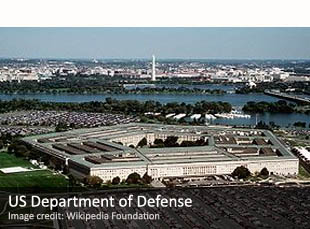
The US Department of DefenseBy IAN ALLEN | intelNews.org
There are rumors that the two most senior military intelligence officers in the United States, who have announced their intention to step down in the coming months, are being forced out by the White House. Lieutenant General Michael T. Flynn, who directs the Defense Intelligence Agency, and his Deputy Director, David R. Shedd, both said on Wednesday that they intend to quit their jobs before the end of the summer. The Department of Defense said later on Wednesday that the two officials had been scheduled to step down “for some time” and that the leadership of the DoD “appreciates the service of these two dedicated and professional leaders”. But the announcement does not change the fact that America’s two leading military intelligence administrators have suddenly decided to quit their jobs. Shedd entered his current post in 2010, while Flynn rose to the DIA’s top position in 2012. If he does indeed step down in the coming months, he will be doing so at least a year before he was officially scheduled to depart from the DIA. The Washington Post claimed on Wednesday that Flynn “faced pressure” to step down, from senior US government officials, including James R. Clapper, Director of National Intelligence. According to the paper, Clapper, whose main job is to coordinate the activities of America’s intelligence agencies, approached Flynn several weeks ago and told him that the administration of US President Barack Obama had decided that “a leadership change was necessary” at the DIA. As the so-called “global war on terrorism” has been winding down, the DIA has been faced with calls for significant changes in both operations and scope. The latter have included plans to expand the agency’s human intelligence operations abroad, as was seen in the Pentagon’s recent effort to launch a new intelligence agency, called Defense Clandestine Service. But in late 2012 the US Senate blocked the plan, citing gross mismanagement of the Pentagon’s existing intelligence operations. The failed plan had been strongly supported by both Flynn and Shedd, who had vowed to increase the DIA’s intelligence-collection operations abroad, and had campaigned in favor of turning the agency’s attention to locations other than Iraq and Afghanistan. Read more of this post
Former director of Venezuelan spy agency shot dead in Caracas

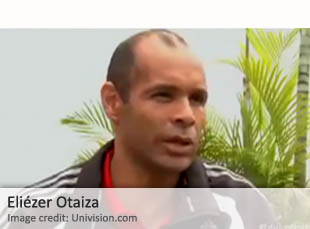
Eliézer OtaizaBy JOSEPH FITSANAKIS | intelNews.org
The former director of Venezuela’s primary intelligence agency has been found shot dead. Venezuelan officials said Eliézer Otaiza was shot dead sometime in the early hours of Saturday morning in Baruta, a suburb in the outskirts of capital Caracas. His bullet-ridden vehicle was later found abandoned in another part of the same barrio. Venezuela’s Minister of the Interior, Miguel Rodriguez Torres, told reporters on Tuesday that Otaiza’s body was discovered on Saturday, but that it took nearly two days for him to be identified due to the absence of identification documents on the body. At the time of his assassination, Otaiza headed the Libertador Bolivarian Municipality in Caracas which numbers over two million residents. Earlier in his career, however, Otaiza led an elite unit of the personal guard corps of Venezuelan President Hugo Chavez. The latter also appointed him director of the National Directorate of Intelligence and Prevention Services (DISIP), later renamed Bolivarian Intelligence Service, which is today Venezuela’s foremost intelligence organization. Otaiza was known as a stalwart supporter of Venezuela’s populist president, even in the early 1990s, when Chavez was still in opposition. In February of 1992, when Chavez led a failed military coup aimed at ousting President Carlos Andres Perez, Otaiza had been unable to participate on account of his absence from Venezuela. But he played a leading role in another pro-Chavez military mutiny in November of that year, when he led a small military force attempting to storm the Miraflores presidential palace in Caracas. He was shot several times in the chest but survived thanks to a bulletproof vest he was wearing. Venezuelan government media said Otaiza played “an important part in the events leading to the Bolivarian revolution”, and remained a strong supporter of Chavez throughout the president’s life. Read more of this post

US ‘quietly expanding’ intelligence presence in war-torn Iraq

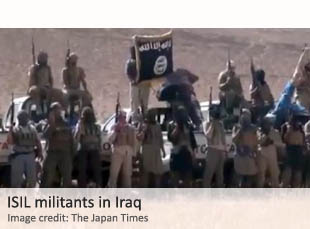
ISIL militants in IraqBy JOSEPH FITSANAKIS | intelNews.org
The United States is “quietly expanding” its intelligence operations in Iraq in response to the worsening security situation in the country, according to American government sources. The Reuters news agency reports that US officials have been holding a series of “urgent meetings” in Washington and Iraqi capital Baghdad. The meetings center on finding ways to contain the growing destabilization in the Middle Easter country, which the US occupied from 2003 to 2011. The news agency cited one former and two current US government officials in claiming that a “high-level Pentagon team” is already in Iraq holding successive consultations with Iraqi military and intelligence figures. Many of the conversations in these meetings are believed to center on the activities of the Islamic State of Iraq and the Levant (ISIL), a Sunni militant group that has been ideologically aligned with al-Qaeda for most of its existence. Founded in response to the US invasion of Iraq, ISIL became informally known as “al-Qaeda in Iraq” until 2014, when al-Qaeda officially severed all ties to the group, following a bitter power struggle. According to Reuters’ sources, the pressure for the US to respond to the worsening situation in Iraq comes mostly from the Pentagon. But it is unclear whether the White House will continue to intensify American involvement in the country, said the source, adding that Washington’s intelligence presence in Iraq is now “more than before, but not really a lot”. The news agency cited another US government source, who said that a second group of “senior US policy officials”, known as the “Deputies Committee”, has been meeting in Washington to discuss possible responses to the deteriorating security situation in Iraq. Read more of this post

Article sheds light on life of legendary Israeli spy Jacob Cohen

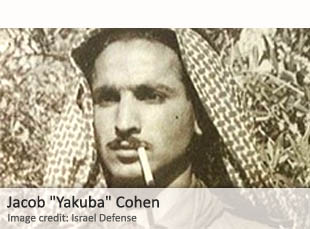
Jacob “Yakuba” CohenBy IAN ALLEN | intelNews.org
Within the ranks of the Israeli intelligence community, Jacob “Yakuba” Cohen is considered a legend. An intelligence officer for the Israel Defense Forces, the Mossad, and finally for Shin Bet, Cohen remains a deeply mysterious figure in the history of Israeli intelligence. Now a new article, published in Israel Defense magazine, which includes parts of a testimony Cohen allegedly gave to a close friend in the years before his death, sheds light on the life and times of one of the 20th century’s most enigmatic intelligence operatives. Cohen was born in 1924 in a predominantly Jewish neighborhood of central Jerusalem. His family, however, had Persian origins, and he spent most of his childhood fraternizing with the Arab populations of nearby neighborhoods and villages. In the late 1930s, Cohen joined the Haganah, a violent paramilitary force set up by nationalist Jews to resist the formation of the British Mandate for Palestine. Cohen eventually entered the ranks of the Palmach, a special-forces outfit of the Haganah, which also conducted intelligence operations. Cohen’s asset, which eventually made him a good fit for Israeli intelligence, was his ability to assimilate into Arab society. He spoke fluent Arabic and was able to observe Arab Muslim cultural conventions and religious practices, regularly attending Mosque services. Soon after the establishment of the state of Israel, Cohen assumed the cover of Jamil Mohammad Rushdi, a Syrian Arab, and moved to Lebanon, where he worked as a taxi driver, regularly transporting customers from Lebanese capital Beirut to Tripoli, Syria, and back. Israeli intelligence historians credit Cohen’s stint in Lebanon as having been instrumental in laying the infrastructure that enabled the eventual creation in Arab countries of Israeli intelligence networks consisting of long-term sleeper agents and other non-official-cover operatives. After Israel’s Sinai campaign of 1956, Cohen was tasked with interrogating thousands of Egyptian prisoners of war. Read more of this post

MI5 releases documents on Dutch double spy Mata Hari

Mata HariBy JOSEPH FITSANAKIS | intelNews.org
The British government has released a set of documents relating to the capture and eventual execution of Mata Hari, modern history’s most legendary female spy. Mata Hari was born Margaretha Geertruida Zelle in northern Holland in 1876. In 1895 she married Rudolf MacLeod, a Dutch Army Captain of Scottish descent serving the Dutch colonial administration of what is now Indonesia. She eventually divorced the alcoholic and abusive MacLeod, who was 20 years her senior, and joined the circus in Paris. Eventually she became wildly popular as an exotic dancer, a position that placed her in close contact with several influential men in France, including the millionaire industrialist Émile Étienne Guimet, who became her longtime lover. Several of her male devotees came from military backgrounds from various European countries. Most historians agree that by 1916 Zelle was working for French intelligence, gathering information from a host of German lovers. However, in February of the following year she was arrested by French counterintelligence officers in Paris and accused of spying on behalf of the German Empire. French prosecutors accused Zelle of having provided Berlin with tactical intelligence that cost the Triple Entente the lives of over 50,000 soldiers. A set of documents released this month by Britain’s Security Service, commonly known as MI5, reveal that allied intelligence operatives trailed the exotic dancer across several European countries before she was apprehended in Paris. They also allege that, while under French custody, the Dutch spy admitted that she had conducted espionage on behalf of the German Secret Service and that her codename was H21. She is also alleged to have admitted that she received payments of approximately 20,000 French francs for her servicse. The papers also suggest that Zelle admitted that several vials of invisible ink fond in her hotel suite had been given to her by her German handlers. However, the MI5 reports claim that the accused spy “never made a full confession” and “never gave away anyone” as her accomplice, leading the British author of the report to conclude that she must have been “working alone”. Read more of this post

Russian espionage in Germany rising sharply, says Berlin

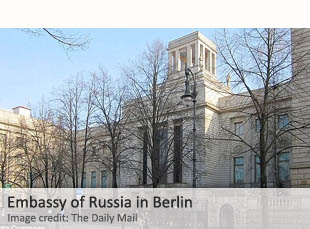
Embassy of Russia in BerlinBy JOSEPH FITSANAKIS | intelNews.org
Russian espionage activity in Germany has reached levels not seen since the days of the Cold War, according to senior counterintelligence officials in Berlin. An article published in weekly newspaper Die Welt am Sonntag on Sunday said Russian intelligence-gathering activities in the German capital center on infiltrating German political institutions and corporations. The Berlin-based publication said Russian spies typically seek to gain “intimate knowledge” of German energy policy as well as corporate practices. Another area of interest for Russian intelligence concerns Germany’s activities in the European Union and the North Atlantic Treaty Organization. Citing Hans-Georg Maassen, Director of the Office for the Protection of the Constitution (BfV —Germany’s primary counterintelligence agency), Die Welt said that no foreign intelligence service is more active on German soil than Russia’s SVR —one of the KGB’s successor agencies. Most Russian intelligence officers “pose as embassy workers”, said the paper, adding that the BfV believes up to a third of all Russian diplomats stationed at the German capital have a “background in intelligence gathering”. According to Burkhard Even, who directs the BfV’s counterintelligence operations, the primary task of Russian intelligence operatives in Germany is to “closely analyze individuals who could be of interest” to Moscow. Those targeted —usually key staffers at the Bundestag (Germany’s federal parliament) or major German companies— are then systematically accosted by Russian ‘diplomats’. The latter often ask to take them out to lunch or dinner, said Maaßen, and will often pick up the bill. Read more of this post

British spy chiefs ‘warn against’ Western military action in Ukraine

Map of UkraineBy IAN ALLEN | intelNews.org
The heads of British intelligence agencies are said to have advised London that interfering militarily in Ukraine would likely prompt a violent Russian response. The Sunday People said last weekend that Whitehall has been advised a Western military interference in Ukraine would “risk spiraling into an all-out war with Russia”. The Labour-supporting paper, which is published by the Trinity Mirror group, claimed that the head of MI6, Sir John Sawers, is understood to have told British Prime Minister David Cameron that the Russian government “will not stand idly by” if Western troops enter Western Ukraine, ostensibly to prevent westward military advances by Russian forces. One “senior source” told The People that the message delivered to Whitehall was that “it’s not worth starting World War Three over Ukraine”. The briefing appears to rest on intelligence acquired from sources in Russia, as well as by MI6 operatives on the ground in eastern Ukraine, which, according to the paper, “have been moving around [eastern Ukraine] covertly, monitoring border crossing points and towns where Russian support is strongest”. Meanwhile on Monday the United States Department of State distributed an 11-page document with photographs alleging that Russian Spetsnaz (special purpose forces) troops are among the occupiers of government buildings in eastern Ukraine. The same document was distributed last week by Ukrainian officials at a meeting of the Organization for Security and Co-operation in Europe. Early on Tuesday, US Vice President Joe Biden, who is visiting Ukrainian capital Kiev, pledged $50 million to help the country’s government carry out unspecified “political and economic reforms”. About a fifth of that amount has been earmarked to help fund Ukraine’s presidential election in late May of this year. Read more of this post

CIA operative who defected to Cuba resurfaces in British film

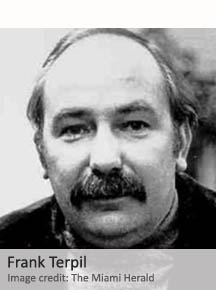
Frank TerpilBy IAN ALLEN | intelNews.org
An operative of the United States Central Intelligence Agency, who defected to Cuba in 1981 to avoid charges of criminal conspiracy, has reemerged in a British documentary film about the late Libyan dictator Muammar al-Gaddafi. Frank Terpil, 74, resigned from the CIA in 1970, allegedly after he was caught running a pyramid scheme in India, where he had been posted by the CIA. Soon after his forced resignation from the Agency, US federal prosecutors leveled criminal charges on Terpil and his business partner. The former CIA operative was also charged with conspiracy to commit murder, after it was found that he had helped facilitate the illegal transfer of over 20 tons of plastic explosives to the government of Libya. Terpil managed to leave the US and reappeared in Lebanon in 1980, shortly before a court in New York sentenced him in absentia to five decades in prison for conspiring to smuggle 10,000 submachine guns to African warlords, including Uganda’s dictator Idi Amin. As agents of various countries started to zero in on Terpil’s Lebanon hideout, he disappeared again and resurfaced in 1981 in Havana, Cuba. Shortly afterwards, Cuba’s General Intelligence Directorate hired him as an operative under the operational alias CURIEL. Since that time, Terpil has been repeatedly mentioned as having played a part in Cuban intelligence operations around the world, but has rarely given interviews. He resurfaced again this month, however, in a documentary entitled “Mad Dog: Inside the Secret World of Muammar Gaddafi”. The film was made by British company Fresh One Productions on behalf of Showtime, an American premium cable and satellite television network. The film’s co-producer, Michael Chrisman, told news agencies that Terpil was interviewed “at his home” in Cuban capital Havana, where he apparently still lives, along with his “much younger” Cuban girlfriend. Read more of this post

Pilot program gives Syrian rebels advanced Western weaponry

Syrian rebelsBy JOSEPH FITSANAKIS | intelNews.org
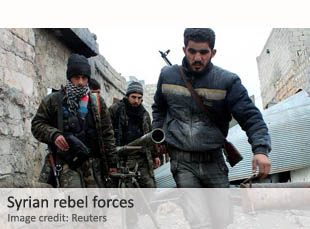
A pilot program operated by American and Saudi intelligence services has allegedly supplied Syrian rebel groups with sophisticated Western weaponry for the first time. Last weekend, The Wall Street Journal cited “people briefed on the effort” as stating that “a small number” of advanced American antitank missiles have been offered to Syrian rebel groups. The move is reportedly part of a new clandestine program, which, if successful, could open the door to “larger flows” of sophisticated Western-made weaponry in the hands of Syrian rebels. The paper said that Washington made the decision to give the weapons to the rebels following the collapse of the Western-backed peace talks early this year, coupled by the apparent military victories of Syrian government forces on the ground in the embattled Middle Eastern country. The effort is apparently part of a “small, tailored program”, which The Journal says is coordinated by American and Saudi intelligence services, aimed at “testing the waters” in Syria. Specifically, Washington and Riyadh are trying to discern whether these advanced weapons will fall into the hands of some of Islamist-inspired rebel groups on the ground, some of which have strong links with al-Qaeda. According to the paper, American and Saudi intelligence operatives have funneled “about a dozen” BCM-71 TOW armor piercing antitank systems to at least one rebel group on the ground. The group, Harakat Hazm, emerged earlier this year through the union of several small secular rebel groups in northern Syria. One weapons expert told The Journal that the antitank systems are equipped with a “complex, fingerprint-keyed security device” that should hopefully help limit the number of individuals that can fire the weapons. The article adds that US and Saudi intelligence services have entered a period of closer collaboration aimed at increasing material support for the Syrian rebels. Read more of this post

Saudi Arabia replaces spy chief who failed to deliver on Syria

Prince Bandar bin SultanBy JOSEPH FITSANAKIS | intelNews.org
Saudi Arabia has replaced its intelligence chief, who is widely seen as the architect of the kingdom’s interventionist policy on the Syrian civil war. The government-owned Saudi Press Agency announced on Tuesday that prince Bandar bin Sultan had been “relieved of his post at his own request”. Bandar was born in 1946 to a concubine of crown prince Sultan bin Abdulaziz, 12th son of Saudi monarch King Abdulaziz. In 1983, Bandar was appointed ambassador to the United States, a post he held until 2005. He developed numerous connections in Washington and rose to become a leading operator in Middle East affairs, enjoying to this day very close personal ties with Presidents George H.W. Bush and George W. Bush. In 2012 he was appointed director of the Saudi Intelligence Agency, the country’s primary intelligence organization. Since that time, he has been the primary planner of Riyadh’s hawkish policy on the Syrian civil war, which has been to openly support the rebel groups fighting to oust the government of Syrian President Bashar al-Assad. Saudi Arabia began supplying weapons, cash and intelligence to the Syrian rebels as soon as Bandar took control of the country’s intelligence apparatus. But his once close relations with Washington went sour last year, when he described US President Barack Obama’s refusal to launch military strikes on Syria as a “major shift” in American Middle East policy. He also angered the US by criticizing it’s rapprochement with the Islamic Republic of Iran, which is Riyadh’s major regional adversary. Perhaps most important of all, Bandar appears to have underestimated the strength of the al-Assad administration and over-confidently advising King Abdullah in 2012 that the Syrian government’s days were numbered. The stalemate in the Syrian civil war seems to have frustrated the Saudi government, which began to gradually distancing itself from Bandar’s musings since January. Read more of this post

News you may have missed #876 (analysis edition)

Russian troops in UkraineBy IAN ALLEN | intelNews.org
►►Why did Obama not bomb Syria? In 2011 Barack Obama led an allied military intervention in Libya. Last August, after the sarin attack in Syrian capital Damascus, he was ready to launch an allied air strike to punish the Syrian government for allegedly crossing the ‘red line’ he had set in 2012 on the use of chemical weapons.​ But with less than two days to go before the planned strike, he announced that he would seek congressional approval for the intervention. The strike was later postponed. Why did Obama relent on Syria when he was not shy about rushing into Libya? Award-winning investigative reporter Seymour Hersh argues that the answer lies in “a clash between those in the Obama administration who were committed to enforcing the red line, and military leaders who thought that going to war was both unjustified and potentially disastrous”.
►►What is the role of the FSB in the Ukrainian crisis? On April 4, the Ukrainian Foreign Ministry sent a note to Moscow demanding to know why FSB Colonel General Sergei Beseda visited Kiev in February. The very next day Russian news agency InterFax cited a source in Russian intelligence confirming that visit. Beseda heads the FSB Fifth Service’s Operational Information Department, which is responsible for conducting intelligence activities focusing on the former Soviet republics. Agentura.ru intelligence analyst Andrei Soldatov says that the answer as to why Beseda was in Kiev could be key to understanding the role of Russia’s intelligence agencies in the current crisis and to the Kremlin’s entire strategy in Ukraine.
►►What would a US-Russia war look like? The chances that the US and Russia will clash militarily over Moscow’s invasion of Ukraine are very, very slim. But, says The Week’s Peter Weber, if we learned anything from World War I, it’s that huge, bloody conflicts can start with tiny skirmishes, especially in Eastern Europe. So what would a US-Russia war look like? The US is much wealthier than Russia and spends a lot more on its military. That doesn’t mean a war would be easy for the US to win, though, or even guarantee a victory. As Napoleon and Hitler learned the hard way, Russia will sacrifice a lot to win its wars, especially on its home turf.

White House confirms CIA Director visited Ukraine

John BrennanBy JOSEPH FITSANAKIS | intelNews.org
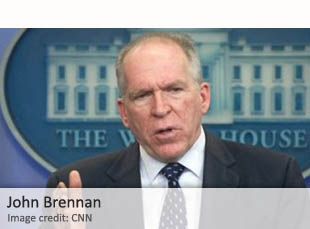
White House officials has confirmed that the director of the Central Intelligence Agency visited Ukraine over the weekend, following reports in the Russian media. On Sunday, Moscow urged Washington to respond to allegations in the Russian press that CIA Director John Brennan had made an incognito visit to Ukrainian capital Kiev. The reports alleged that Brennan, who assumed the directorship of the CIA a year ago, traveled to Ukraine on official business under a false identity in order to avoid attention. Russian media further alleged that the CIA head met with a host of Ukrainian intelligence and security officials and advised them on how to respond to the ongoing crisis in eastern Ukraine. Initially, Washington denied comment on the allegations. But early on Monday White House Press Secretary Jay Carney told reporters that Brennan had indeed traveled to Ukraine over the weekend. He said that the White House normally declines comment on the whereabouts of the CIA Director. However, “given the extraordinary circumstances” in the case of Ukraine, he said he was willing to confirm that Brennan was in Kiev over the weekend “as part of a trip to Europe”. He went on to state that he hoped the official confirmation of Brennan’s trip by the White House would suffice to discredit the “false claims being leveled by the Russians at the CIA”. Carney added that there was nothing inherently suspicious about a CIA Director’s trip to a foreign country. He argued that “senior-level visits of intelligence officials [abroad] are a standard means of fostering mutually beneficial security cooperation” and that such visits —some of which have been to Russia— go back “to the beginnings of the post-Cold War era”. Read more of this post

More documents emerge on CIA effort to salvage Soviet submarine

Project AZORIANBy IAN ALLEN | intelNews.org
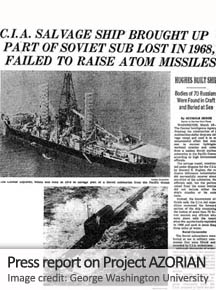
New documents have emerged about a massive effort by the United States Central Intelligence Agency to recover a sunken Soviet nuclear submarine in the 1970s. This blog has written before about Project AZORIAN, a 1974 attempt to recover a Soviet submarine in 5,200 meters of water. The initiative cost the CIA over $800 million, which translates to something like $3 billion in today’s prices. It centered on an effort to salvage K-129, a Soviet Golf II class submarine that had suffered an internal explosion while on a routine patrol mission in the Pacific Ocean, in 1968. The explosion caused the vessel to sink along with the three nuclear ballistic missiles it was carrying and nearly 100 crew members, all of whom died in the incident. The Soviets initiated an immediate frantic effort to recover the vessel but gave up after two months, unable to bring it to the surface. After the Soviets abandoned the site, a number of CIA scientists proposed to undertake an American effort to recover the sunken submarine. This, they suggested, would allow Washington to study the design features of Soviet nuclear warheads, as well as obtain cryptographic hardware that could prove useful in deciphering Soviet naval codes. This prompted the launch of Project AZORIAN, which commenced in 1974, once the Agency secured the necessary funds. As we have indicated before, the recovery team nearly caused a nuclear explosion when the submarine split while being raised, and its body hit the ocean floor. The CIA prepared to enter a new phase of the project in 1975, aimed at launching a second attempt to raise the sunken vessel. But the attempt was cancelled when vague snippets of information about the project were leaked to the press. Nothing more emerged until 2010, when the CIA aired a heavily redacted article about the project, which had originally appeared in the 1980s in Studies in Intelligence, the Agency’s in-house publication. Now, however, intelligence historians are able to rely on 200 pages of mostly fresh information on Project AZORIAN, released under the US Department of State’s Foreign Relations of the United States (FRUS) program. Read more of this post

United States allegedly not sharing Russia intelligence with Ukraine

Russian troops in UkraineBy JOSEPH FITSANAKIS | intelNews.org
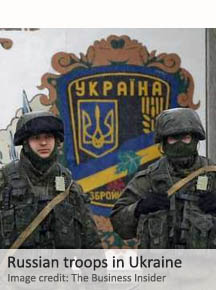
The United States is not sharing with the Ukrainian government detailed intelligence or Russia’s military buildup, according to American lawmakers. Moscow is reportedly deploying large numbers of troops along Russia’s border with Ukraine, while US intelligence agencies have allegedly detected the presence of Russian military supply lines that would be required for a land invasion of Ukraine. The US administration of President Barack Obama has publicly expressed solidarity with the Ukrainian government and has warned the Kremlin that any military incursions into eastern Ukraine would constitute a grave “historical error” that would bear serious consequences for the Russian leadership. But according to American news reporting website The Daily Beast, Washington has instructed the American military and intelligence community to refrain from sharing detailed intelligence on Russia’s military buildup with Ukrainian authorities. Details being kept from Ukrainian eyes include “imagery, intercepts and analysis” that pinpoint the exact location of Russian troops along the Ukrainian border. They also include intelligence predictions of how Russian units would deploy during a possible invasion of Ukraine. The Daily Beast, which is owned by Newsweek, cited “US officials and members of Congress” who were briefed by intelligence personnel earlier this week on the situation in Ukraine. They told the news website that senior American military officials have been instructed “to refrain from briefing their Ukrainian counterparts in detail” about information on Russian troop movements held by American intelligence agencies. The Daily Beast quotes Republican Representative Michael Turner, chair of a subcommittee of the House Armed Services Committee that oversees America’s tactical air and land force strength. Turner told the website that he is “not confident” that Washington is “sharing any of that kind of [detailed military] information” with Kiev. Read more of this post