Denmark university professor faces charges of spying for Russia

Timo KivimäkiBy JOSEPH FITSANAKIS | intelNews.org |
Authorities in Denmark have charged a university professor with assisting “foreign intelligence operatives”, believed to be Russian. Professor Timo Kivimäki, a conflict resolution expert, who teaches international politics at the University of Copenhagen, is accused of “providing or attempting to provide” information to four Russian government officials on several documented instances between 2005 and 2010. The indictment claims Kivimäki, who was born in Finland, intended to give the Russians “information relating to individuals and subjects connected with intelligence activities”. The charges were filed after a lengthy investigation, launched in 2009 by the Danish Security and Intelligence Service (PET) in cooperation with Finland’s Security Intelligence Service (SUPO). The university professor spoke to leading Finnish newspaper Helsingin Sanomat and admitted that he carried out contractual “consulting work” for the Ministry of Foreign Affairs of the Russian Federation, for six years. He said he was paid approximately €16,000 (US$20,000) for his services, but denied that he knowingly contacted Russian intelligence operatives in the course of his consulting duties. According to Kivimäki, the Russian officials he interacted with appeared to be “diplomats, not spies”. He also pointed to the fact that none of the Russian officials he worked with as a consultant were apprehended or expelled by Danish counterintelligence, as is customary in such cases. Despite its relatively small size, Denmark had its share of international intelligence activity during the Cold War. During that period, PET amassed detailed files on approximately 300,000 Danish citizens considered to be “leftist sympathizers”. More recently, in November of 2010, media reports from Denmark suggested that the US embassy in Copenhagen maintained a network of local former police and intelligence officers, who were conducting “illegal systematic surveillance of Danish citizens”. Read more of this post

Ex-CIA officer sheds light on 1977 spy arrests in Moscow

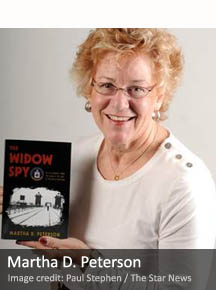
Martha D. PetersonBy JOSEPH FITSANAKIS | intelNews.org |
A recently retired CIA officer has spoken publicly for the first time about the 1977 arrest and eventual suicide of a Soviet double agent considered one of the Central Intelligence Agency’s most important assets during the Cold War. Aleksandr Dmitryevich Ogorodnik was an official in the Soviet diplomatic service who, while stationed at the Soviet embassy in Bogotá, Colombia, was compromised and later blackmailed by Colombian intelligence into spying on Moscow. Ogorodnik was initially handled by the Colombians, with little success. Later, however, when he was moved to a sensitive post in the Soviet Ministry of Foreign Affairs in Moscow, the Colombians turned him over to the CIA. He was handled by CIA officer Aldrich Ames —himself a double spy for the Soviet KGB— who gave Ogorodnik the codename TRIGON. After establishing contact with him in Moscow, the CIA provided Ogorodnik with a miniature camera and other essentials, which he used regularly to take photographs of classified Soviet documents. As a go-between, the Agency selected Martha D. Peterson, the first female CIA case officer ever to be posted in Moscow. Peterson was a fresh CIA recruit, who had completed her Career Training program in 1974, less than a year before being sent to the Soviet capital. Having retired in 2003, after 31 years with the CIA, Peterson has now published a memoire entitled The Widow Spy. In it, she reveals that she coordinated regular dead-drops with Ogorodnik for nearly two years, picking up his used film while supplying him with fresh film and other espionage accessories. On July 15, 1977, however, her mission was abruptly terminated after she was arrested by a large team of KGB officers underneath a railway bridge in Moscow, a few minutes after conducting a dead-drop for Ogorodnik. She was taken to the KGB’s Lubyanka prison, where she says she was interrogated for three days before being released by way of her diplomatic immunity, and ordered to leave the USSR. Ogorodnik was not so fortunate. A few months prior to his arrest, he had requested that the CIA provide him with a poison pill, which he could take in case he was arrested by the KGB. Read more of this post
Analysis: Biometric passports, iris scanners, worry undercover spooks

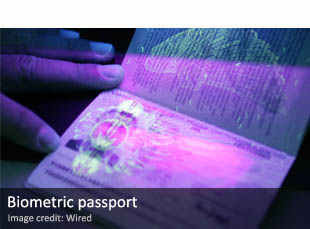
Biometric passportBy JOSEPH FITSANAKIS | intelNews.org |
False passports are to intelligence operatives what petrol is to automobiles. In the absence of forged travel documentation, intelligence officers working undercover are unable to operate internationally without revealing their identity. This is why, traditionally, intelligence operatives are known to “use and discard false passports like hand wipes”, in the words of one knowledgeable source. But according to a fascinating article by veteran intelligence correspondent Jeff Stein, authored for Wired magazine’s Danger Room blog, “the day of the trench-coated spy easily slipping in and out of countries on false papers multiple times [may be] coming to an end”. The reason is “the electronic curtain [that] is descending all over the world”, most notably the increasing deployment of iris recognition devices and biometric passports at airports and hotels around the world, says Stein. Over the coming decade, iris scanners, which employ mathematical pattern-recognition techniques to identify individuals by their irides, will become increasingly common at international airports. The same applies to biometric passports, namely travel documents with embedded microchips that store a massive amount of personal information. These technologies are ostensibly being introduced in international transport hubs in order to combat transnational terrorism and organized crime. But they are also expected to heavily interfere with the work of undercover intelligence operatives, says Stein, especially as they are being introduced in popular spy routes, in countries such as India, Jordan, United Arab Emirates, as well as in several European Union entry points. He quotes an unnamed “career spook” currently working for the Central Intelligence Agency as a consultant, who explains that an undercover officer’s biometric identity will be forever linked to the passport that he or she first uses to enter these countries. If the officer were to try to enter these countries again, using a different alias, alarm bells will ring: “you can’t show up again under a different name with the same data”, says the CIA consultant. Read more of this post

News you may have missed #713 (analysis edition)

RAW headquarters, New Delhi, IndiaBy IAN ALLEN | intelNews.org |
►►Israel wary of changes in the Arab world. For decades, Israel had been hoping for change in the Arab world. Yet now that the region is in upheaval, its not just Israeli citizens who are concerned. The government has shown a preference for walling itself in rather than exploring new opportunities. The Jewish state has tried to integrate itself into the Middle East for decades. Now it is trying to cut the cord between itself and the surrounding region, blocking out the changes in its neighborhood.
►►Melting Arctic may redraw global geopolitical map. If, as many scientists predict, currently inaccessible sea lanes across the top of the world become navigable in the coming decades, they could redraw global trading routes —and perhaps geopolitics— forever. This summer will see more human activity in the Arctic than ever before, with oil giant Shell engaged in major exploration and an expected further rise in fishing, tourism and regional shipping. But that, experts warn, brings with it a rising risk of environmental disaster not to mention criminal activity from illegal fishing to smuggling and terrorism.
►►Why Indian intelligence doesn’t work too well in Pakistan. Sources in the RAW, India’s external agency, say India lacks both political will and the capability to carry out a hit inside Pakistan. “We do not have the mandate to do what Mossad does. Our charter does not include the job of getting [or assassinating] people from other countries. If such political will is there, the agency would be able to do it”, says a senior RAW official. Another former officer, who has spent a considerable time studying these outfits, attributes it to the fundamental difference between India and Pakistan in dealing with espionage. “It takes a great deal of money and time to cultivate sources in foreign soil. We don’t have either in plenty, unlike countries in the West. Pakistan’s ISI is better off in this as the state sponsors terrorism”, he says.

Iran allegedly busts ‘Israel-backed’ sabotage ring

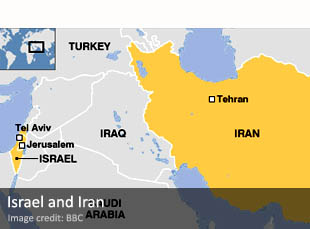
Israel and IranBy IAN ALLEN | intelNews.org |
The government of Iran has announced the arrests of a “terrorist network” that was allegedly planning sabotage and assassination operations inside the Islamic Republic. The announcement was released by the Iranian Intelligence Ministry and aired by a host of state-controlled media on Tuesday. The reports were vague, but claimed that the sabotage ring was supported by Israel, and that its members were “plotting fresh attacks” against Iranian government targets. The Intelligence Ministry said that Iranian counterterrorist teams decided to move against the “large and sophisticated” network after preparing the ground during “months of operations”. An unidentified Iranian government official was quoted as saying that the arrests of the group members involved the “recovery of large bombs, automatic weapons, handguns, [as well as] telecommunications equipment” from houses and apartments belonging to alleged sabotage group members. One report stated that some of the arrests were concluded following “firefights” between the suspects and Iranian government forces. Reports also claimed that the network led officials to the discovery of a separate “regional command center in a third country”, which was not named, but which is widely suspected to be Azerbaijan. Earlier this week, The Washington Post reported that American intelligence agencies had ramped up intelligence and sabotage missions directed against Iran’s nuclear program. Read more of this post

News you may have missed #712

Abdel Hakim BelhajBy IAN ALLEN | intelNews.org |
►►New US spy satellite could include ‘domestic surveillance. Last week, a new US spy satellite was launched into orbit as part of a secretive military program enabling the surveillance of Earth from space. An official at the Vandenberg base told The Los Angeles Times that the NROL-25 was part of a “national security payload”, which could mean it is to be used for any number of purposes, possibly including domestic surveillance.
►►US steps up intelligence and sabotage missions in Iran. American intelligence agencies are ramping up intelligence and sabotage missions focused on Iran’s nuclear program, according to The Washington Post. Officials from the National Security Agency have increased efforts to intercept email and electronic communications coming from Tehran, according to reports in The Post‘s Sunday edition. The CIA and other agencies have also ramped up sabotage missions in the country, geared toward disrupting Iran’s ongoing nuclear work, the paper reports.
►►MI6 ‘considers paying off’ Libyan official. Britain’s MI6 chiefs allegedly plan to offer more than £1 million ($1.6 million) hush money to a Libyan who claims British spies sent him to be tortured by the Gaddafi regime. The Secret Intelligence Service is scrambling to prevent Abdel Hakim Belhaj releasing details of his case following the revelation that a Labour Party minister sanctioned his extraordinary rendition —contravening UK policy on torture.

News you may have missed #711 (ex-spy edition)

Glenn L. CarleBy IAN ALLEN | intelNews.org |
►►Egypt ex-spy chief to run for President. Omar Suleiman, 74, announced his candidacy on Friday and collected around 72,000 signatures of eligible voters in one day, more than twice the 30,000 required. Hosni Mubarak’s former intelligence chief insisted that his bid for the presidency does not have the support of Egypt’s military rulers and accused Islamists of sending him death threats. Mr Suleiman, made vice-president by Mubarak in the last days of his three-decade rule, symbolizes that era’s tough security regime and poses a threat to Islamists, who were routinely harassed and arrested during Mubarak’s era, and to liberals, who spearheaded Mubarak’s ouster. But his candidacy might appeal to some Egyptians hoping for an end to political instability.
►►Ex-CIA officer says evidence in alleged case was flawed. Information from the US Central Intelligence Agency used by Canada to link accused Ottawa terrorist Mohamed Harkat to al-Qaeda was untrue, according to Glenn Carle, a retired CIA case officer who interrogated Harkat at secret CIA black site prisons in 2002. Speaking to promote his blistering memoir about the case, The Interrogator: An Education, Carle said that Harkat, who was thought to be Osama bin Laden’s main financial administrator, “wasn’t the senior member of al-Qaeda that we had assessed. He wasn’t even a member of al-Qaeda”. Yet as recently as 2010, Canadian Security Intelligence Service evidence and testimony before the Federal Court of Canada continued to point to Harkat’s relationship with Haji Pacha Wazir as evidence of Harkat’s ties to the bin Laden terror network.
►►Ex-KGB agent wins South Ossetia vote. Former senior KGB agent Leonid Tibilov has won a tense run-off to lead Georgia’s rebel pro-Russian region of South Ossetia, after two earlier polls ended in turmoil. Tibilov won 54.12 percent of the vote with all ballots counted against human rights commissioner David Sanakoyev’s 42.65 percent. The peaceful end to the election contrasts sharply with the angry protests that followed a November 27 ballot in which Alla Dzhioyeva, a female candidate who opposed the local administration was disqualified after coming out ahead in the poll. Dzhioyeva was then hospitalized in February after being interrogated and allegedly beaten by police following allegations that she planned to seize power.

US rejects calls to free Navy analyst who spied for Israel

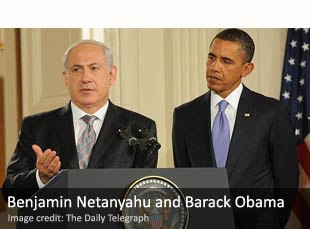
Benjamin Netanyahu and Barack ObamaBy JOSEPH FITSANAKIS | intelNews.org |
The White House has rejected persistent calls by Israeli politicians and lobbyists to free a United States Navy intelligence analyst serving a life sentence for giving classified US government documents to Israel. Jonathan Jay Pollard was convicted in 1987 for selling classified information to the Israeli government. Ronald Olive, a former counterintelligence officer for the US Naval Criminal Investigative Service, who led the US Navy’s prosecution of Jonathan Pollard, has described Pollard’s spying activity as “one of the most devastating cases of espionage in US history”, involving the theft of over “one million classified documents”. Recently it emerged that, before spying for Israel, Pollard had attempted to spy on the US for the government of Australia. However, in Israel, Pollard, who is now an Israeli subject after renouncing his American citizenship, is widely considered a national hero. Last week, senior Israeli political figures renewed persistent calls to the administration of US President Barack Obama to free Pollard. According to the Israelis’ reasoning, the life sentence imposed on Pollard is too harsh considering that he spied for a US ally. Last week’s calls were led by Israeli Prime Minister Benjamin Netanyahu, who urged the White House to free the convicted spy “in the spirit of the Jewish Passover. Netanyahu said that “the Festival of Freedom of all the Jews should be turned into Pollard’s private one”. Prime Minister Netanyahu’s plea was echoed in a personal letter addressed to President Obama by Israeli President Shimon Peres, along with a petition signed by over 80 members of the Israeli Knesset. Read more of this post

News you may have missed #710

Jonathan PollardBy IAN ALLEN | intelNews.org |
►►MI6 officer murder inquest to be held in secret. Britain’s Foreign Secretary William Hague has ordered that key evidence in the inquest into the death of MI6 officer Gareth Williams is to be heard in secret. Williams, who was found dead in a padlocked sports bag in the bath of his London apartment 20 months ago, was on secondment to MI6 from GCHQ, the British government’s signals intelligence agency, and had worked closely with the American security services.
►►GCHQ warns it is losing terrorists on the internet. Speaking of the GCHQ, the organization says that modern internet technology has left them unable to intercept calls which use new technology instead of traditional phone systems. Britain’s Daily Telegraph quotes “senior intelligence sources with detail knowledge of the problem”, who say that GCHQ technical experts have seen their access to telephone intercept information “eroded” by the use of the technologies such as Voice Over Internet Protocol, or VoIP, which route telephone calls over the world wide web.
►►Israel pressures Obama to release Jewish spy. Israel’s Prime Minister Benjamin Netanyahu has again called on the United States to release convicted spy Jonathan Pollard after the former US Navy intelligence analyst was hospitalized this week. Pollard, an American of Jewish descent, was sentenced to life in prison 25 years ago for leaking classified documents to Israel. Many Israelis believe the sentence was too harsh and officials often demand his release. But Democratic and Republican administrations in the US have repeatedly refused Israeli appeals to release the convicted spy.

Number of Russian spies in Britain ‘back at Cold War levels’

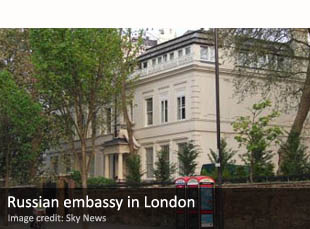
Russian embassy in LondonBy JOSEPH FITSANAKIS | intelNews.org |
The Russian Federation has as many intelligence officers operating in the United Kingdom today as it did during the last decade of the Cold War, according to a British newspaper. The London-based Daily Telegraph cites “senior sources” in alleging that Moscow maintains “around 40 [spies] at any one time” in the UK. Many of them are reportedly based in London, where approximately half the staff at the Russian embassy are believed to be routinely involved in intelligence gathering, says the paper. The Telegraph shared the information with Dr Jonathan Eyal, Director of International Security Studies at the London-based Royal United Services Institute, who told the paper that the numbers of Russian spies in the UK are “similar to if not higher than those just before the end of the Cold War”. Undoubtedly, writes The Telegraph, some of the Russian intelligence officers stationed in Britain are involved in traditional intelligence collection directed at UK government institutions and personnel. But increasing numbers of them are focusing on the growing Russian expatriate community in the UK, including the many oligarchs whose relations with the Kremlin are strained at best. A smaller but significant number of Russian intelligence operatives are believed to conduct commercial and industrial spying aimed at benefiting Russian firms competing against their British counterparts for international contracts, claims the paper. Dr Eyal adds that Russian intelligence agencies have traditionally viewed Britain —a staunch American ally— as a “back door to US intelligence”, thus Washington constitutes yet another target of Russian intelligence activity in the UK. Read more of this post

News you may have missed #709

Famagusta portBy IAN ALLEN | intelNews.org |
►►North Korea defector sentenced for assassination plot. The man, only identified by the Seoul Central District Court by his surname, Ahn, was sentenced on Thursday after being found guilty of plotting to kill Park Sang-hak, a leading anti-North Korea activist, last September. When apprehended, Ahn —a former member of the North’s special forces— was carrying a black torch that was actually a gun capable of firing a projectile around 30 feet and a bullet coated with a poisonous chemical. Another weapon that he was carrying was disguised as a fountain pen that could fire a bladed projectile, while a second ballpoint pen concealed a poison-tipped needle.
►►Russian arrested in Cyprus for alleged espionage. Media in the Turkish-controlled part of Cyprus are reporting an alleged “espionage incident” at the port of Famagusta. The incident concerns a crewmember of the Russian cargo ship Natali 1, which is docked there. Police authorities say they arrested the Russian national, identified as Nanec Hikov, after he was caught taking photos of Turkish warships. Photographing or filming in the port area is strictly forbidden by Turkish occupation authorities. The Russian Embassy has been informed and the sailor remains in custody.
►►Mystery deepens over death of UK intel expert in China. Last week, the British Foreign Office confirmed that it had asked China to open a fresh ivestigation into the November 14 death of British businessman and intelligence specialist Neil Heywood . The Foreign Office said other businessmen in Beijing had suggested there may have been foul play. Diplomatic sources suggested that the Foreign Office had acted on information given by Wang Lijun, the former police chief of Chongqing, where Heywood died, to the United States consulate in Chengdu, in February.

Interview with ex-Mossad director Meir Dagan

Meir DaganBy JOSEPH FITSANAKIS | intelNews.org |
The former director of Israel’s most revered intelligence agency has given an extensive interview on why he believes a military strike against the Iranian nuclear program “should be the last option” for Israel. In November 2010, Meir Dagan stepped down from his post as the head of the Mossad after having led the agency for over eight years —the longest tenure of any Mossad director. During his leadership, the Israeli intelligence agency augmented its notoriety by assassinating Imad Mughniyah, security chief of the Lebanese militant group Hezbollah, and allegedly killing Islamic Hamas weapons procurer Mahmoud al-Mabhouh. The Mossad is also said to have played a role in Operation ORCHARD, the 2007 Israeli air attack on what is thought to have been a secret nuclear reactor in Al-Kibar, Syria. However, when it comes to the Iranian nuclear program, the 67-year-old retired spy is adamant that the military option would be a strategic error of gigantic proportions. Last year, Dagan admonished calls by hawkish Israeli politicians to bomb Iran as “the stupidest idea” he had ever heard. In an interview with Reuters news agency published on Thursday, April 5, Dagan said the word “stupid” was “a harsh expression” and “not something [he is] very proud of”. But he insisted that the military option should be last on the table, and said that it would be a mistake for Israel to lead international action against the Iranian nuclear program. Instead, the “Iranian problem” should be “left in the hands of the international community”, said Dagan. The Mossad veteran went on to identify three main problems with the military option. To begin with, he said, military action, no matter how damaging in the physical sense, “cannot disarm the core factor of the Iranian program: knowledge” about how to build a nuclear device. Second, Dagan argued that, even if a military strike managed to eliminate a considerable portion of the Iranian nuclear program’s infrastructure —which is not at all assured— it would likely cause a significant backlash. That backlash would culminate in “a regional war” that would involve simultaneous actions by non-state forces allied with Iran, including Hamas, Islamic Jihad, and Hezbollah. Read more of this post

News you may have missed #708

Bertil StrobergBy IAN ALLEN | intelNews.org |
►►Swedish Cold War spy dies at 79. Bertil Stroberg, a former Swedish air force officer, who was convicted of spying for Poland during the Cold War, but always maintained his innocence, has died, following a yearlong battle against cancer. He was sentenced to six years in prison for spying in 1983, but released on parole after serving three years. The key evidence in his case was a letter the prosecution said he had written to the Polish embassy offering to sell military secrets. The letter was signed Sven-Roland Larsson and asked that money be sent in that name to the Central Post Office. Stroberg was arrested when he went to the post office to collect Larsson’s mail.
►►US keeping Britain in the dark on intel issues. American intelligence agencies are increasingly keeping their British counterparts in the dark on key information, for fear those secrets could end up on full display in UK courts. “The Americans have got nervous that we are going to start revealing some of the information and they have started cutting back, I’m sure, on what they disclose”, Ken Clarke, the United Kingdom’s justice secretary, said in a Wednesday interview with the BBC. The American intelligence community has become wary about sharing sensitive intelligence with the UK ever since a 2008 court case forced the British government to disclose specific details on terror detainee operations.
►►Bush official says CIA ‘committed war crimes’. Philip Zelikow, who was a top adviser to former Secretary of State Condoleezza Rice, warned the Bush administration that its use of “cruel, inhuman or degrading” interrogation techniques like waterboarding were “a felony war crime”. What is more, newly obtained documents reveal that State Department counselor Zelikow told the Bush team in 2006 that using the controversial interrogation techniques were “prohibited” under US law —“even if there is a compelling state interest asserted to justify them”. Zelikow’s memo was an internal bureaucratic push against an attempt by the Justice Department to flout long-standing legal restrictions against torture.

Why are al-Qaeda websites going off-line?

Shamukh al-IslamBy JOSEPH FITSANAKIS | intelNews.org |
It began late last month, and nobody seems to really know why:  one after another, the most popular pro-al-Qaeda websites around the world have been going off the air, in what appears to be coordinated fashion. For most of the past decade, a host of al-Qaeda-linked websites have acted as online platforms of outreach, propaganda, and communication between the group’s sympathizers around the world. Most fulfill the role of conduits for al-Qaeda’s media production arm, as-Sahab, as well as for al-Fajr Media, al-Qaeda’s online distribution network. These two outfits routinely rely on a collection of websites to deliver online content ranging from glossy periodicals to audio speeches and digital videos. But on March 23, two of the largest pro-al-Qaeda websites, Shamukh al-Islam and the Ansar al-Mujahidin Arabic Forum, simultaneously disappeared from the World Wide Web. Two days later, another popular site, al-Fida, also vanished. By March 30, two remaining pro-al-Qaeda forums had also gone off line. Two sites, the Shamukh al-Islam and the Ansar al-Mujahidin Arabic Forum, reappeared, but offered no concrete explanation of the reasons why they went off the air in the first place. Interestingly, nobody has claimed responsibility for the disappearance of the pro-al-Qaeda websites, and the US government has refused to state whether its operatives had been engaged in undermining them. But CNN’s Security Clearance blog contacted Brandeis University researcher Aaron Y. Zelin, who offered one possible explanation. Read more of this post

News you may have missed #707

Gareth WilliamsBy IAN ALLEN | intelNews.org |
►►Russian colonel charged with spying for the US. Russia charged a reserve colonel with espionage on Tuesday, for selling what officials said were classified topographical maps to the United States Department of Defense. The officer, Vladimir Lazar, purchased a disk with over 7,000 topographical images of Russian territory from a collector he met on the Internet in 2008, smuggled it into neighboring Belarus and gave it to a Russian citizen working for the United States, the prosecutor general’s office said in a statement. An investigation found that the materials could be used for planning military operations, including missile strikes. Officials did not disclose when Lazar was arrested or give his current whereabouts.
►►FBI denies Russian spy tried to sexually entice US cabinet official. On April 1, British newspaper The Independent quoted C. Frank Figliuzzi, the assistant FBI director for counterintelligence, saying that the recently discovered Russian illegals spy ring, which included Anna Chapman, was “getting close enough to a sitting US cabinet member that we thought we could no longer allow this to continue”. Now the FBI says that Figliuzzi “was misquoted”, and that “there is no allegation or suggestion in the complaint that Anna Chapman or anyone else associated with this investigation attempted to seduce a US Cabinet official”.
►►London police admits ‘errors’ in MI6 officer’s death investigation. A coroner was given a wrong name for a witness in the case of an MI6 officer Gareth Williams, whose body was found in a bag in a London flat in August of 2010. The Metropolitan Police said “administrative errors” led to the coroner being given three different names for Elizabeth Guthrie. She is expected to be questioned about her contact with the MI6 officer in the months before his death. At a pre-inquest hearing last week coroner Dr Fiona Wilcox said “there has been some confusion” over the identity of the witness.