News you may have missed #579 (CIA edition)

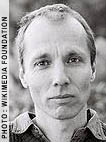
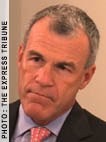
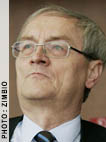
Robert Grenier

Robert Grenier

►►Interview with ex-CIA Islamabad station chief. Robert Grenier, who was the CIA’s Islamabad station chief from 1999 to 2001, tells Pakistan’s Express Tribune newspaper that the US unmanned drone program, which began as “a very surgically employed tool against international terrorists”, has now “become much more of a conventional weapon against militants”. He also rejects allegations that Pakistani government officials were aware of osama bin Laden’s whereabouts, saying that “no one has apparently found any compelling evidence”.
►►Who will guide Petraeus in his new CIA job? Siobhan Gorman, of The Wall Street Journal, opines that, when US General David Petraeus takes the helm at the Central Intelligence Agency next month, it will fall to the Agency’s deputy director Michael J. Morell, a little-known 31-year CIA veteran, to guide the new director.
►►CIA drone kills al-Qaeda deputy. An anonymous US official has told The New York Times that a CIA drone killed al-Qaeda’s second-ranking operative in Pakistan’s northwest province of Waziristan. Atiyah Abd al-Rahman, a Libyan who in the past year had taken over as al-Qaeda’s top operational planner, was killed on August 22, according to the official. Al-Qaeda is still officially led by Ayman al-Zawahiri, who is also believed to be in Pakistan.

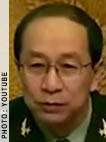
Video of Chinese general’s espionage lecture leaked onto YouTube

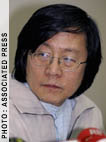
Jin Yinan

Jin Yinan

By JOSEPH FITSANAKIS | intelNews.org |
Video footage of a lecture on recent espionage incidents against China, delivered before a vetted audience by a senior Chinese military official, has been leaked to online video sites, including YouTube. The lecturer has been identified as Major General Jin Yinan, and the location appears to be one of the main lecture halls at China’s National Defense University (NDU) in Beijing. Administered by the Central Committee of the Chinese People’s Liberation Army (PLA), NDU is China’s equivalent of the United States’ West Point Military Academy. The precise date of the venue cannot be verified, though it appears to have been intended as a cautionary lesson for NDU students, on the fate that awaits Chinese officials spying against their country. In the video, General Jin laments the fact that too many Chinese Communist Party members have “become decadent” and have succumbed to selling classified national secrets to foreign adversaries. He also discusses several recent cases of espionage against China, including that of Xu Junping, a senior colonel in the PLA, who defected to the United States in December of 2000. The speaker also mentions the case of Tong Daning, a Social Security Department economist who was executed in 2006 for sharing classified Chinese economic data with Taiwanese intelligence operatives. But the primary revelations of the speech concern the cases of Li Bin and Kang Rixin, which General Jin addresses in detail. Li Bin was arrested during his tenure as China’s Ambassador to South Korea, and was eventually sentenced to a seven-year prison term for corruption. But General Jin discloses in his speech that the Ambassador was arrested for selling classified information to South Korean intelligence, and that the Chinese prosecutors decided to bring him up on corruption charges, to “avoid embarrassing [our] country”. Read more of this post

US misused our intel to justify Iraq War, says German ex-spy chief

August Hanning

August Hanning

By JOSEPH FITSANAKIS | intelNews.org |
The former Director of Germany’s foreign intelligence service has accused the Bush administration of consciously falsifying intelligence supplied by Germany in order to justify going to war in Iraq. August Hanning, who served as Director of Germany’s Bundesnachrichtendienst (known as BND) from 1998 to 2005, said that the BND had no part in the deception, and that “the responsibility for the war lies solely with the Americans”. In an interview to the Sunday edition of German national newspaper Die Welt, Hanning explained that the administration of US President George W. Bush was especially interested in intelligence collected by the BND from an Iraqi defector codenamed ‘Curveball’. The defector, whose real name is Rafid Ahmed Alwan al-Janabi, arrived in Germany in 1999 and applied for political asylum, saying he had been employed as a senior scientist in Iraq’s biological weapons program. Among other things, he told his BND debriefing team that Saddam Hussein had built a fleet of biological weapons labs on wheels, in order to avoid detection from America and other countries. After consulting with biological weapons experts, the BND expressed serious doubts about Curveball’s reliability, but kept him in Germany nonetheless. Several years later, al-Janabi confirmed the BND’s suspicions, by admitting that he had invented his allegations in order to help bring down the regime of Saddam Hussein. He also admitted that he was in reality a taxi driver from Baghdad, who had used his undergraduate knowledge of engineering to get asylum in Germany. At the time, said Hanning, the BND strongly and repeatedly communicated to the CIA its doubts about Curveball’s claims, something which is known. What is not known, however, is that Hanning personally wrote to then CIA Director George Tenet and urged him to adopt a skeptical approach to the defector’s allegations. The former BND chief told Die Welt that he was “assured by the Americans that our intelligence would not be used in Powell’s speech”. Read more of this post

News you may have missed #578

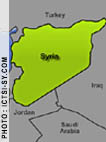
Syria

Syria

►►CIA agent who helped kill Che wants payout from Cuba. This is from the “news that isn’t” department: Gustavo Villoldo, a Cuban-born CIA operative, who helped track down and kill Che Guevara in Bolivia, has won $2.8 billion in damages from the Cuban government, for confiscating his family property after the 1959 revolution. But he is unlikely to ever collect the money because Cuba does not recognize US court rulings.
►►Cheney wanted Bush to destroy suspected Syrian nuke site. Former US Vice President Dick Cheney says in a new memoir that he urged President George W. Bush to bomb a suspected Syrian nuclear reactor site in June 2007. But, he wrote, Bush opted for a diplomatic approach expressed misgivings. Eventually Israeli jets bombed the site. Cheney’s account of the discussion appears in his autobiography, In My Time: A Personal and Political Memoir, which is to be published by Simon & Schuster next week.
►►South Korea indicts five for spying for North. Five South Koreans, including a former parliamentary aide, have been indicted for allegedly spying for North Korea, in connection with the Wangjaesan spy ring.

News you may have missed #577

Waihopai base

Waihopai base

►►Interview with Michael Hayden. The former director of the CIA and the NSA gave a lengthy interview in preparation for his keynote speech at the Raleigh Spy Conference. Among other things, he says that he does “not immediately conclude that senior levels of the Pakistani government knew about” Osama bin Laden’s whereabouts.
►►CIA denies helping police spy on NY Muslims. The Central Intelligence Agency is denying a news report that it helped the New York Police Department conduct covert surveillance on Muslims. The agency said suggestions that it engaged in domestic spying were “simply wrong” and that the report “mischaracterized the nature and scope” of the CIA’s support for the New York police.
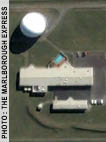
►►Spy base reservoir not a pool after all... A journalist at New Zealand’s Marlborough Express newspaper noticed what looked suspiciously like a swimming pool on a satellite photo (pictured) of the super-secret Waihopai listening base near Blenheim. Do spies go swimming on the base, he asked? It turns out they don’t. According to Government Communications Security Bureau Waihopai station chief Chris Farrow, the landmark is in fact a water reservoir, to be used in case of fire.

Documents reveal MI5 role in Guyana coup

Cheddi and Janet Jagan

The Jagans

By JOSEPH FITSANAKIS | intelNews.org |
Secret intelligence documents declassified last week reveal that Britain’s Security Service, known as MI5, played a significant role in the lead-up to the 1953 coup that toppled the democratically elected government of British Guiana. The Latin American territory, which borders Suriname, Venezuela and Brazil, was once one of the British Empire’s most lucrative sugar-producing colonies. In 1963, after gaining its independence from Britain, it was officially renamed the Co-Operative Republic of Guyana. Instrumental in the fight for independence was Cheddi Jagan —an ethnic Indian former dentist who is today considered the father of the nation— and his American-born wife Janet (née Rosenberg). In 1950, the couple founded the People’s Progressive Party (PPP), which became the primary pro-independence political vehicle in the British colony. But dozens of folders of classified documents that were released last Friday by Britain’s National Archives show that MI5 was suspicious of the Jagans, and believed that Janet had been a member of the Communist Party of the United States in the 1940s. Several MI5 reports from the 1950s express concern that the PPP intended to establish close proximity between a newly independent Guyana and the Soviet Union. The declassified MI5 archives contain countless transcribed telephone conversations between the Jagans and their political allies, as well as copies of intercepted correspondence and reports of physical surveillance by MI5 informants. They reveal that British intelligence closely monitored the Jagans for at least a decade. Even though MI5 concluded that the PPP had no close contacts with Soviet agents or agencies, and that the party was “not receiving any financial support from any Communist organization outside the country”, it continued to describe Janet Jagan as “a committed communist” and remained apprehensive of the couple’s “disruptive antics”. The British government of Winston Churchill decided to take aggressive action in 1953, after a landslide election victory for the PPP in British Guiana elections. Read more of this post

News you may have missed #576 (Libya edition)

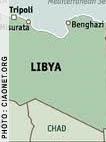
Libya

Libya

►►Rebels seize Libyan intelligence service HQ. Rebel forces of the National Transitional Council have occupied the Tripoli headquarters of Libya’s intelligence service. Al Jazeera, which was given access to the building by the rebels, says that it is “full of confidential documents that could provide a valuable insight into what was one of the world’s most secretive regimes. But”, adds the report, “it will take weeks to sift through”.
►►Gadhafi’s loose weapons could number a ‘thousand times’ Saddam’s. This is the alarming assessment of Peter Bouckaert, emergencies director at Human Rights Watch, who spent time on the ground in Libya during the uprising. He told Wired magazine’s Danger Room blog that “weapon proliferation out of Libya is potentially one of the largest we have ever documented —2003 Iraq pales in comparison— and so the risks are equally much more significant”.
►►The bewildering dance between Gaddafi and MI6. A well-researched article in The Independent newspaper, written by one of Britain’s most esteemed diplomatic correspondents, Gordon Corera. He argues that Britain and the Gaddafi regime “were not always the enemies they are now”.

Why Are Armed Groups Storming Foreign Embassies in Tripoli?

The new Libyan flag

New Libyan flag

By JOSEPH FITSANAKIS | intelNews.org |
It is perhaps understandable that fighters of the National Transitional Council, Libya’s rebel umbrella group, have stormed locations in Tripoli that are associated with the regime of deposed Libyan leader Muammar al-Gaddafi. Strategic sites such as  Bab al-Aziziya, Gaddafi’s compound, government ministries, or even houses belonging to Gaddafi’s large and powerful family, may be deemed legitimate targets. But why are the rebels also selectively attacking foreign embassies in the Libyan capital? According to Yonhap, South Korea’s state-run news agency, the South Korean embassy in Tripoli was “attacked […] by an armed gang” of about 30 people late on Tuesday. The report, which could not be immediately confirmed by the Republic’s Ministry of Foreign Affairs, cited anonymous sources, who said that embassy staff were “threatened at gunpoint”. At roughly the same period, another group of “armed persons” stormed the building of the Bulgarian embassy, according to the Bulgarian Ministry of Foreign Affairs, which said that it had yet to clarify “the circumstances around the incident”. On Wednesday, Venezuelan President Hugo Chavez said that armed groups had “assaulted and totally looted” the Venezuelan embassy. A few hours later, the Venezuelan Ambassador to Libya, Afif Tajeldine, clarified that the attack took place at his official residence, which is located about 9 miles from the Venezuelan embassy. He told El Universal that armed groups broke into the ambassadorial residence and “searched the house asking for me”. They then “ransacked the house completely” and “left nothing in the house”. Read more of this post

News you may have missed #576 (Europe edition)

GCHQ

GCHQ

►►Inside Britain’s signals intelligence agency. This account of the work of Britain’s General Communications Headquarters is a bit basic, but it’s not every day that the GCHQ grants access to a journalist to its Cheltenham base.
►►Czech telecoms to share data with intel services. The Czech Interior Ministry has placed a clause in the planned amendment to the electronic communications law, under which operators of communication networks will have to provide data on cell phones and the Internet to the civilian and military counterintelligence.
►►Dutch F-16 pilot suspected of espionage. A Dutch former F-16 pilot suspected of espionage, identified only as Chris V., had more state secrets in his possession than he previously admitted to, according to public prosecutors in The Hague. The pilot was arrested last April and stands accused of leaking state secrets to a colonel from Belarus.

Western companies help Bahrain spy on democracy activists

NSN Logo

By JOSEPH FITSANAKIS | intelNews.org |
While Western governments preach to the world about the benefits of democracy, Western companies supply some of the most detestable dictatorial regimes with surveillance technologies for use against pro-democracy activists. One example in point is the repressive government of Bahrain, which, according to Amnesty International, is responsible for some of the most extensive human rights violations anywhere in the Middle East. Bahrain is the kind of place where even medical professionals who treat people wounded by police or soldiers in demonstrations are charged with “incitement”. Despite the fervor of the pro-democracy movement that has risen as part of the Arab Spring, the oil-rich royal clique that rules the nation has managed a series of debilitating hits against the reformists. The success of the crackdown is largely due the use of sophisticated telecommunications surveillance systems that allow Bahraini authorities to spy on cell phones and social networking platforms used by members of the pro-democracy opposition. Who supplied the Bahraini dictators with this equipment? Step forward German engineering conglomerate Siemens AG, and Finnish multinational Nokia. An article published this week in Bloomberg’s Markets magazine, fingers the German company as the primary supplier of telecommunications surveillance systems to the Bahraini royals. The latter rely on contracts with Nokia’s Trovicor GmbH subsidiary to maintain the sophisticated software and hardware. Bloomberg says it was notified of the Nokia Siemens Networks (NSN) partnership by two unnamed insiders, “whose positions at the companies gave them direct knowledge of the installations and the sale and maintenance contracts”. Read more of this post

News you may have missed #575

IARPA logo

IARPA logo

►►Inquest into death of MI6 spy to go ahead. The inquest into the bizarre death of MI6 and GCHQ officer Gareth Williams will go ahead before Christmas without a jury, according to London-based newspaper The Express. The paper says that “12 spy chiefs will attend [the inquest] to explain the background to the case”.
►►Colombia’s ex-president denies role in spy scandal. Alvaro Uribe has denied, during a 3½-hour appearance before a Colombian congressional committee, that he ordered the country’s domestic intelligence agency to spy on judges, journalists and political foes. More than 20 agents of the DAS intelligence agency have been imprisoned for alleged roles in the spying. Two more have pleaded guilty in exchange for reduced sentences.
►►US spy research firm eyes stock market. IARPA, the US intelligence community’s research arm, plans to introduce a new program to develop tools to help analysts “quickly and accurately assess petabytes of complex anonymized financial data”. According to a conference presentation, the program would help spies “analyze massive amounts of data to spot indicators of market behavior, find relationships between seemingly unrelated transactions across hundreds of global markets, and provide insight into specific events and general financial trends”.

Western spies, security contractors, won Libyan war for rebels

Libya

Libya

By JOSEPH FITSANAKIS | intelNews.org |
As I write these lines, celebratory gunfire is being heard all across Tripoli and the rebel National Transitional Council is appointing civilians to replace the crumbling administration of longtime Libyan leader Muammar al-Gaddafi. But a handful of news outlets discreetly remind us that the rebels’ claim to victory rests on vital covert assistance provided by several Western intelligence services. British daily The Independent notes that the victorious rebels were assisted on all levels by “an army of [British] diplomats, spooks, military advisers and former members of the special forces”, all of whom allowed “London to influence events in Libya beyond the activities of warplanes and naval vessels”. Early indications of Britain’s substantial covert involvement in the Libyan civil war emerged in March, when a secret operation involving a team of 20 Special Air Service (SAS) personnel was disrupted by a group of Libyan rebels, who thought the foreigners were employed by the Libyan government. Eight captured SAS members were soon released by the red-faced rebels, but not before the botched operation had made headlines all over the world. That experience prompted British intelligence planners to rethink their methodology. Eventually, notes The Independent, the British government decided to prompt the rebel National Transitional Council to use British funds to hire teams of former special forces operatives working for private security firms. This, according to the paper, accounts for the “small groups of […] Caucasian males, many with British accents [and] equipped with sunglasses, 4×4 vehicles and locally acquired weaponry, who [were] seen regularly by reporters in the vanguard of the rebels’ haphazard journey […] towards Tripoli”. Read more of this post

News you may have missed #574

CIA documents

CIA documents

►►CIA told Kennedy Cuba invasion was ‘unachievable’. [Never mind. It turns out that the original article on Foreign Policy has been corrected to state that the meeting was not with Kennedy after all — see reader’s comment below]. More revelations from the newly declassified CIA Official History of the Bay of Pigs Invasion. According to the multi-volume history (pictured), a CIA team told President-Elect John F. Kennedy during a meeting in 1960 that toppling the Cuban government of Fidel Castro would not be feasible, considering the small invasion force that Kennedy insisted upon for the Bay of Pigs operation, in order to maintain plausible deniability.
►►NATO bombs home of Libyan intel chief. A compound in Tripoli destroyed overnight by NATO air strikes was the home of Abdullah Al-Senussi, former head of Libyan intelligence. This information allegedly comes from al-Senussi’s neighbor, oil engineer Omar Masood, who said he has lived across the street for 35 years. Meanwhile, several news outlets report that Abdel Salam Ahmed Jalloud, prime minister of Libya between 1972 and 1977, has defected to Italy.
►►Palestinian attacks took Israeli intel by surprise. The triple attacks, attributed by Israel to a Palestinian splinter group from the Gaza Strip, took Israel’s intelligence and security services by surprise, judging by the ensuing confusion and inaccuracy of initial reports. Between 15 and 20 Arab gunmen, some wearing Egyptian army fatigues, are believed to have taken part in the operation.

Was plane carrying UN Secretary General shot down in 1961?

Dag Hammarskjöld

Hammarskjöld

By JOSEPH FITSANAKIS | intelNews.org |
On September 17, 1961, a Douglas DC-6 transport aircraft carrying United Nations Secretary General Dag Hammarskjöld crashed in the British-administered territory of Northern Rhodesia (now Zambia). The crash killed everyone onboard, except one passenger, who died hours later. Three successive investigations into the crash, conducted by the Rhodesian Board of Investigation, the Rhodesian Commission of Inquiry, and the United Nations Commission of Investigation, viewed “pilot error” as the most likely cause of the tragedy. Göran Björkdahl, a Swedish aid worker with Sweden’s International Development Cooperation Agency, who is stationed in Burkina Faso, has spent three years researching Hammarskjöld’s death. He has produced a report with his findings, in which he cites interviews with several witnesses of the crash, who are still living. He says that, according to the evidence he has amassed, he has “no doubt” Dag Hammarskjöld’s plane was “shot down by an unidentified second plane”. In an article published in British quality broadsheet The Guardian, Björkdahl also claims that the only survivor of the downed DC-6, American sergeant Harold Julian, who was a member of the UN Secretary General’s security detail, was abandoned to die of his injuries at a makeshift hospital in Ndola, Northern Rhodesia. Björkdahl’s claim is based on his interview with colonial medical practitioner Mark Lowenthal, who tried to treat Julian in the hours following the airplane’s crash. Moreover, Björkdahl alleges that British colonial authorities in Northern Rhodesia were eager to cover up the details of the incident, and went out of their way to intimidate local villagers who witnessed the crash, and to downplay witness testimony suggesting that the Douglas DC-6 may have been shot down. Read more of this post

News you may have missed #573 (analysis edition)

Clair E. George

Clair E. George

►►New report details gaps in US spy collaboration. Nearly 10 years after the 9/11 attacks, US intelligence agencies are still struggling to strengthen the information sharing networks that broke down in 2001, according to the latest report by the US Congressional Research Service. Among other things, the 33-page report (pdf) points out that “agencies that obtain highly sensitive information are reluctant to share it throughout the intelligence community out of a determination to protect their sources”.
►►CIA Iran-Contra figure Clair George dies. Clair E. George, a consummate spymaster who was convicted of lying to Congress about the Iran-Contra affair, has died. George was known for operating in what spies call the “night soil circuit” –the less desirable posts of the world. He worked in Africa, Asia, Europe and the Middle East. He was the CIA’s station chief in Beirut when civil war erupted there in 1975. He then volunteered to replace the CIA’s Athens station chief, who had just been assassinated by November 17 Revolutionary Organization.
►►Here’s why CIA ‘mind control’ lawsuit was thrown out. A very good and succinct analysis of why a federal lawsuit against the CIA by the Vietnam Veterans of America, for allegedly subjecting US military personnel to chemical, biological and mind control experiments, was thrown out of court earlier this month. It includes the CIA’s court filing in a pdf link, here.